(1) Universidade Federal de Santa Maria – UFSM, Santa Maria, RS, Brasil. Source: FAPERGS/PRONEX
Conlict of interest: non-existent
Favorable stimulus words for the treatment of phonological
disorders involving the production of simple onset sounds
Palavras-estímulo favorecedoras para o tratamento
do desvio fonológico em onset simples
Ana Rita Brancalioni(1)
Márcia Keske-Soares(1)
Received on: April, 29, 2016 Accepted on: July, 28, 2016
Mailing address:
Márcia Keske-Soares
Rodovia RST 287 (Fx Nova de Camobi), 900, Cerrito, Santa Maria - RS CEP: 97060-500
E-mail: [email protected]
ABSTRACT
Purpose: to develop and analyze a list of target words providing a favorable environment for the
acqui-sition of target sounds in simple onset poacqui-sition, using a programming algorithm to assign a favorability score for each of these words.
Methods: an algorithm was programmed to calculate a favorability score for target words by adding up
the weights assigned to the following variables, with regards to the target sound: position within the word, stress pattern, number of syllables, preceding and following context. The algorithm was programmed using Java. The lists of target words for each target sound contained a total of 748 words. A score was calculated for each item, and used to classify the word as favorable, neutral, or unfavorable.
Results: target words with the highest scores on the aforementioned variables were considered favorable,
as they provided a facilitating context for the production of the target sound. However, target words did not need to meet all aforementioned linguistic criteria to be considered favorable.
Conclusion: the algorithm was eficient in calculating favorability scores for the target words. However,
although words classiied as favorable, or those with high scores on linguistic measures, should be pre-ferred during the selection of target stimuli, these may not necessarily apply to all types of phonological disorder.
Keywords: Speech; Speech Disorders; Child; Rehabilitation of Speech and Language Disorders; Speech
Therapy
RESUMO
Objetivos: propor e analisar listas com palavras-estímulo em contextos linguísticos favorecedores para
segmentos-alvo na posição de onset simples, utilizando um padrão de programação para pontuar o nível
de favorecimento dessas palavras.
Métodos: foi desenvolvido um padrão de programação, em linguagem Java, para determinar a
pontua-ção das palavras-estímulo, que considerou o somatório dos pesos atribuídos às variáveis linguísticas: posição na palavra, tonicidade, número de sílabas, contexto precedente e contexto seguinte, para cada segmento-alvo. Foram utilizadas 748 palavras para elaboração de listas de palavras-estímulo para cada segmento-alvo. Todas as palavras-estímulo tiveram sua pontuação de favorecimento calculada a partir do padrão de programação e classiicadas quanto ao nível de favorecimento.
Resultados: veriicou-se que as palavras-estímulo classiicadas como favorecedoras (PEF) foram as que
alcançaram maior pontuação, uma vez que contemplaram os contextos mais favorecedores para pro-dução do segmento-alvo. Contudo não foi necessário que todos os contextos favorecedores fossem privilegiados para as palavras serem classiicadas como PEF.
Conclusão: o padrão de programação desenvolvido foi eiciente para pontuar o nível de favorecimento
das palavras-estímulo. Além disso, deve haver uma preferência por palavras-estímulo favorecedoras, ou que alcançam maior pontuação, porém nem sempre essas palavras são as mais adequadas para o trata-mento de qualquer sistema fonológico desviante.
Descritores: Fala; Distúrbios da Fala; Criança; Reabilitação dos Transtornos da Fala e da Linguagem;
INTRODUCTION
Phonological disorders are characterized by the substitution, omission or distortion of speech sounds
in the absence of organic conditions1. These
impair-ments may inluence the intelligibility of speech to
varying degrees, and are highly incident in childhood2.
Several phonological treatments have been developed for these disorders based on the production of target
words. The cycles approach3, for instance, involves
the careful selection of target words to be used in production practice, whose aim is to help the child form new auditory and kinesthetic images, while facilitating accurate production and self-correction.
As a result, one of the most important aspects of treatment planning is the selection of target words,
since the irst stages of treatment will inevitably focus on
word-level interventions4-11. Therefore, regardless of the
treatment used, target words must be carefully selected based on several criteria, including the provision of a facilitating environment for the accurate production of the target sound4-12.
Each phoneme is associated with a unique acqui-sition process, which may be facilitated by several features of its linguistic and extralinguistic environ-ments. The presentation of target sounds in a favorable environment may be an important aspect of effective
speech therapy3-8. The extent to which a linguistic
environment can be considered favorable for the correct production of a target sound is determined by the following linguistic variables: word and syllable position; syllable stress; and the preceding and following context of the target sound6-8,12-17.
Additional variables which may also inluence the
production of the target sound include familiarity with the target word6,9,18,19, its role in the child’s
commu-nication system and presence in their phonetic inventory6,9, its frequency8,9 and the “number of problem
sounds”9,10,16,18,19 in the word.
According to a previous study7, the extent to which
a given word facilitates the production of a target sound can be calculated based on its linguistic features. The “degree of favorability” associated with each
coda position. Its results revealed that some contexts may facilitate the acquisition of the target sounds, while others may hinder it.
The use of target words which provide a favorable environment for the production of target sounds can make a positive contribution to treatment. This hypothesis is supported by studies of phonological change following treatment involving target words which provide a favorable environment for target sounds3,4,7,11,12,14,21,22.
In light of these observations, the aim of this study was to develop and analyze a list of target words providing a favorable environment for the acquisition of target sounds in simple onset position, using a programming algorithm to assign a favorability score for each of these words.
METHODS
This was an exploratory quantitative study, approved by a university research ethics committee. All ethical and methodological procedures followed the guide-lines established in Resolution 466/2012 of the National Health Council. The present study is registered under protocol number CAEE 28053914.1.0000.5346.
As a irst step, word lists were created for each
target sound in simple onset position. The lists were developed using 748 target words with corresponding pictures, available in the Speech Intervention Software
(Software de IntervençãoparaFala; SIFALA)20. Words
were selected from several semantic categories, including toys, animals, fruits and vegetables, clothing and accessories, furniture and home appliances,
school and ofice supplies, shapes and colors and,
numbers, letters, colors, musical instruments, tools, etc. All words except for “hamburger” derive from Brazilian Portuguese.
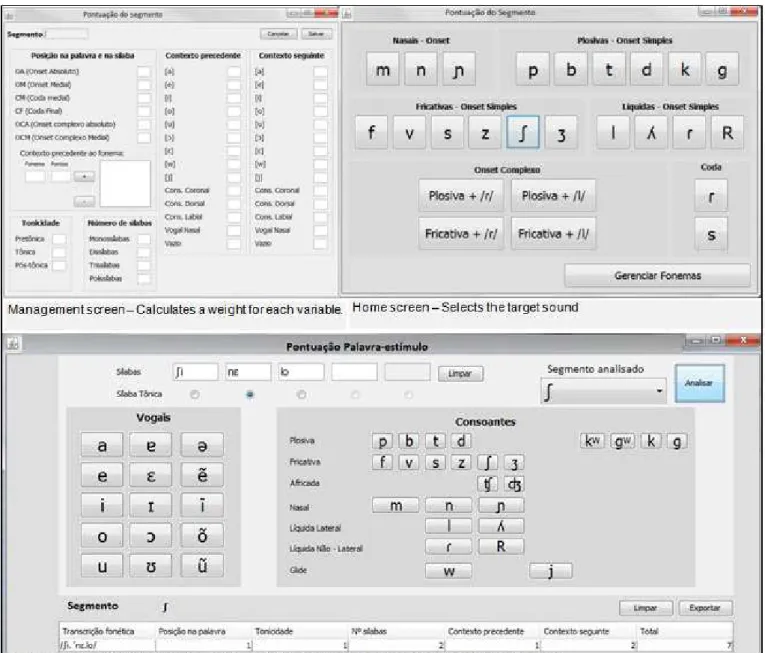
developed. The algorithm used syntactic analysis to analyze each sequence of characters and construct a structure tree. In this way, the phonetic representation of
each word was divided into blocks, composed of struc-tural units. The screens in the software programmed for this study are shown in Figure 1.
Lastly, a weight of “3” was given to features associated with correct production in 100% of cases. As a result, linguistic variables were analyzed as ordinal qualitative variables.
The target words in each list were then given a “favorability score” by the algorithm, based on the target sound of interest. Each word list was then ranked from lowest to highest in terms of the favorability score of each word relative to the target sound of interest. These values were then analyzed using the Biostat
software, which calculated the irst (Q1) and third (Q3)
quartile values. These results were then used to classify target words into the following categories: Favorable
(FTW) - scores in Q1; Neutral (NTW) - scores in the interquartile range, including the values of Q1 and Q3; Unfavorable (UFTW) - scores in Q3. The
highest-scoring target words, corresponding to the top 25% of
each list, were therefore classiied as Favorable Target
Words (FTW) for each target sound.
The stages involved in the planning of the algorithm were carried out by an IT company, with the researchers providing assistance and theoretical insight. This interface was linked to the Speech Intervention
Software (Software de IntervençãoparaFala– SIFALA)20.
Research costs were covered by a 2012 FAPERGS/ PRONEX grant, number 11/2060-5.
RESULTS
Figure 2 shows the FTWs for the production of nasal and plosive sounds in simple onset position. The /m/, /p/, /t/ and /k/ sounds were associated with the highest number of FTWs.
Figure 3 shows the FTWs for the production of fricatives and laterals in simple onset position. At least
eight FTWs were identiied for all target sounds save for /r/. A signiicant number of target words containing
/r/ received a modal score of 11, which was the cutoff
for Q1. As a result, the irst quartile contained less than
25% of words in the list, yielding fewer FTWs. The algorithm analyzed each individual structure
in order to determine the score of the target word in terms of its favorability for the production of the target sound. The weights assigned to each linguistic variable
were obtained from a previous study20 which identiied
favorable environments for the correct production of all nasal, plosive, fricative and liquid sounds.
Scores on the “word position” variable were calcu-lated based on the word position of the target sound (i.e. initial or medial onset). The variable “syllable stress” was measured by determining whether the target sound was in a pre-stressed, stressed, or post-stressed syllable. The number of syllables was examined by classifying words as monosyllabic, disyl-labic, trisyllabic and polysyllabic. Lastly, the presence of the following features was investigated in the preceding and following context of the target sounds: oral vowels, semivowels, nasal vowels, coronal consonants, dorsal consonants, labial consonants, or empty context20.
The sample20 consisted of a corpus of speech
samples obtained from the irst phonological
assessment of 58 individuals with phonological disorders. A total of 21,619 words were analyzed using
the VARBRUL 2S statistical package. Relative weights
were then assigned to the features of the context provided by each target word based on the probability of correct production of the target sound.
Values equal to or lower than 0.5 were considered unfavorable, and assigned a weight of “1.” Values
ranging from 0.50 to 0.59 were classiied as neutral,
Target Sound Target words (score)
N
as
al
s
/m/
remo[paddle](14); algema[handcuffs](13); gêmeos[twins](13); gema[yolk](13); “M”(13); perfume[perfume] (13); pijama[pajamas](13); diploma[diploma]; dálmata[dalmatian](13); grama[grass](13; pluma[feather](13); creme[cream](1); rímel[mascara](13); cama[bed](13); arame[wire](13); salame[salami](13); liperama[arcade] (13); lesma[snail](13); fantasma[ghost](13); remédio[medicine] and termômetro[thermometer](13)
/n/
violino[violin](14); bailarina[ballerina](14); espinafre[spinach](13); binóculos[binoculars](13); alinete[pin] (13); dezenove[nineteen](13); sino[bell](12); sinaleira[trafic light](12); cisne[swan](12); azeitona[olive](12); carne[meat](12); telefone[telephone](12); cortina[curtain](12); lanterna[lantern](12); dinossauro[dinosaur](12); caderno[notebook](12); pepino[cucumber](12); pernas[legs](12); microfone[microphone](12); nó[knot](12) / / passarinho[bird](13); ursinho[teddy bear](12); pintinho[chick](12); carrinho[toy car](12); joaninha[ladybug](12); trenzinho[toy train](12); golinho[dolphin](12)
P
lo
si
ve
s
/p/
zíper[zipper](13); xarope[syrup](13); chope[draft beer](13); jipe[jeep](13); pipoca[popcorn](12); roupas[clothes] (12); pipa[kite](12); lâmpada[lightbulb](12); copo[glass](12); envelope[envelope](12); sopa[soup](12); grampo[staple](12); espelho[mirror](12); champanhe[champagne](12); esponja[sponge](12); repolho[cabbage] (11); liperama[arcade](11); hipopótamo[hippopotamus](11); grampeador[stapler](11); guarda-roupa[wardrobe] (11); espada[sword](11); despertador[alarm clock](11); clips[paperclip](11); espingarda[shotgun](11); P(11); pão[bread](11)
/b/
ônibus[bus](12); globo[globe](11); lobo[wolf](11); alinete[pin](11); proibido[forbidden](11); nabo[turnip] (10); hamburguer[hamburger](10); pomba[dove](10); beterraba[beet](10); rabo[tail](10); robô[robot](10); cachimbo[pipe](9); carambola[starfruit](9); quebra-cabeça[puzzle](9); frigobar[minifridge](9); gambá[skunk](9); tambor[drum](9); goiaba[guava](9); cabide[clotheshanger](9); bule[teapot](9); burro[donkey](9); bench[bank](9)
/t/
fantoche[puppet](11); pimentão[bell pepper](11); batom[lipstick](11); quatorze[fourteen](11); biblioteca[library] (11); chuteira[cleats](11); patins*[skates](11); chocolate[chocolate](10); charuto[cigar](10); cotonete[cotton swab](10); cartola[top hat](10); prateleira[shelf](10); lanterna[laslight](10); ratoeira[mousetrap](10); cafeteira[coffee maker](10); sapato[shoe](10); oitenta[eighty](10); abacate[avocado](10); sapatilha*[ballet shoes] (10); bateria[battery](10); extintor*[ire extinguisher](10); trator[tractor](10); alicate[pliers](10); antena[antenna] (10); tomate[tomato](10); tatu[armadillo](10); esmalte[nailpolish](10); batata[potato](10); peteca[shuttlecock] (10); gafanhoto[grasshopper](10); batedeira[mixer](10)
/d/
dólar[dollar](11); dedo[inger](10); doze[twelve](10); pudim*[pudding](10); dor[pain](9); dinossauro*[dinosaur] (9); diamante*[diamond](9); dezessete[seventeen](9); dois[two](9); dez[ten](9); dezenove[nineteen](9); despertador[alarmclock](9); dentadura[dentures](9); dedal[thimble](9); dado[die](9); detergente[detergent](9); D(9); frigideira[fryingpan](9); crocodilo*[crocodile](9)
/k/
suco[juice](11); círculo[circle](11); tucano[toucan](11); banco[bank](11); peruca[wig](11); tronco[trunk](11); escuro[dark](11); buquë[bouquet](11); cinco[ive](11); branco[white](11); brinco[earring](11); cinquenta[ifty] (10); cocô[poop](10); coqueiro[palm tree](10); parque[park](10); óculos[glasses](10); mosquito[moskito](10); faca[knife](10); esquilo[squirrel](10); máscara[mask](10); fraco[weak](10); isqueiro[lighter](10); jaca[jackfruit] (10); jaqueta[jacket](10); macaco[monkey](10); escova[brush](10); placa[sign](10); chocalho[rattle](10); taco[bat](10); vaca[cow](10); arco[arch](10); barco[boat](10); barraca[tent](10); macaco[monkey](10); boca[mouth](10); saco[bag](10); caqui[persimmon](10); macacão[overalls](10); caracol[snail](10); porco[pig] (10); casaco[coat](10); casca[peel](10); cerca[fence](10)
/g/
Agulha[needle](11); hambúrguer[hamburger](11); bigode[moustache](11); água[water](10); frango[chicken] (10); mangueira[hose](10); lamingo[lamingo](10); igo[ig](10); morango[strawberry](10); morcego[bat](10); trigo[wheat](10); dragão[dragon](10); carga[charge](10); prego[nail](10); água[water](10); gangorra[see-saw] (10)
Note: * Affricate production, allophones.
DISCUSSION
After all linguistic variables were assigned a weight of “0”, “1”, “2” or “3,” each target word could obtain
a maximum score of 157,20.However, in addition to
these weights, the combination of favorable factors associated with each variable must also be considered
when estimating the favorability of each target word7.
As a result, in some cases, only pseudowords could possibly contain all features considered favorable.
Additionally, according to a previous study,20some
target sounds may not have a target word that achieves
the maximum score (3) on all ive variables analyzed.
The target sounds occur in medial onset position in the majority of FTWs. However, the production of
produce syllables in metrical feet (to the left of two syllables) due to word stress patterns in Brazilian
Portuguese (paroxytone)7,16,24. These results also
corroborate those of another study25 suggesting that
target sounds are more likely to be produced correctly in stressed syllables, as a result of the stress contrast.
Stressed syllables also beneit from increased attention
by the speaker to ensure their correct production, which may favor target sounds located in such a syllable26.
The majority of FTWs was also found to be di- or trisyl-labic. However, according to the literature, words with fewer syllables provide an easier context for production and stimulation9,10,26-28. As a result, mono- and disyllabic
words are likely to be more easily produced. The fact
Target sound Target words (score)
Fri
ca
tiv
es
/f/ feijão[bean](11); ferro[iron](11); faca[knife](10); fada[fairy](10); foto[photo](10); forte[strong](10; farol[lighthouse](10); favo[honeycomb](10); fechadura[lock](10); foca[seal](10); troféu[trophy](10); café[coffee](10)
/v/
“V”(11); vô[grandpa](10); vó[grandma](10); vinte[twenty](10); véu[veil](10); vaso[vase](10); verde[green](10); vagem[string bean](10); vaca[cow](10); vela[candle](9); vinho[wine](9); varal[clothesline](9); noiva[bride](9); pavão[peacock](9)
/s/
“S”(11); peças[pieces](11); alface[lettuce](10); fumaça[smoke](10); abraço[hug](9); S(9); taça[goblet](9); quebra-cabeça[puzzle](9); pulseira[bracelet](9); polícia[police](9); passarinho[bird](9); palhaço[clown](9); dinossauro[dinosaur](9); crianças[children](9); classe[class](9); massa[pasta](9); aliança[ring](9); calça[pants] (9); balança[scale](9); bolsa[bag](9); capacete[helmet](9)
/z/ trenzinho[train](11); trezentos[three hundred](10); duzentos[two hundred](10); quatorze[fourteen](10); presunto[ham](10); presente[present](10); lasanha[lasagna](10); televisão[television](10); blusão[sweater](10); explosão[explosion](10)
/ / roxo[purple](11); sanduíche[sandwich](10); boliche[bowling](10); mochila[backpack](10); lagartixa[gecko](10); lecha[arrow](10); ichas[tokens](10); salsicha[sausage](10); coxinha[drumstick](10)
/ /
Frigideira[frying pan](11); zoológico[zoo](10); bandeja[tray](10) cerveja[beer](10); cereja[cherry](10); beija-lor[hummingbird](9); relógio[clock](9); caranguejo[crab](9); carruagem[carriage](9); coruja[owl](9); esponja[sponge](9); laranja[orange](9); injeção[injection](9); tijolo[brick](9); pijama[pajamas](9)
Liq
uid
s
/l/ lua[moon](11); luva[glove](11); lupa[magnifying glass](11); lustre[chandelier](11); luta[ight](11);lápis[pencil](10); lobo[wolf](10); lata[can](10); livro[book](10); linha[line](10); cola[glue](10); dólar[dollar](10); mola[spring] (10); bola[ball](10)
/ / ervilha[pea](11); ilhote[cub](11); lentilha[lentil](11); chocalho[rattle](11); medalha[medal](11); baralho[deck](11); toalha[towel](11); agulha[needle](11)
/R/ régua[ruler](11); rímel[mascara](11); rosa[rose](10); rolo[roll](10); rolha[cork](10); rodo[mop](10); roupas[clothes](10); rato[rat](10); roxo[purple](10); rabo[tail](10); ralo[drain](10); rádio[radio](10); ferro[iron] (10); burro[donkey](10); terra[earth](10)
/r/ pirulito[lollipop](12); aquário[ishtank](12); girassol[sunlower](12)
adjacent to one with the same place of articulation in all FTWs. However, in most cases, a phoneme with similar features to the target sound was present either in the preceding or following context provided by the target
word. This inding supports the hypothesis that correct
speech production is favored when there is less articu-latory adjustment between sounds6,9.
A literature search revealed no studies of the target words used in the treatment of nasals in onset position, probably because their production is rarely affected by
phonological disorders, except in very severe cases29.
Nevertheless, the use of FSWs may still contribute to the treatment of nasals.
FSWs for the target sound /k/ are all disyllabic or trisyllabic, and in all cases except for “tucano” (toucan), “escuro” (dark) and “buquê” (bouquet), present the target sound in a post-stress syllable, as suggested by a previous study8. The target words “frango” (chicken), “mangueira” (hose), “lamingo” (lamingo), “morango”
(strawberry) and “gangorra” (see-saw), containing the target sound /g/, followed previous recommendations regarding the presence of a nasal vowel in its preceding
context8 and its presentation in a medial onset
position8,15,17. The presence of coronal consonants, /a/
and /w/ in the preceding context of the /g/ sound were
also found to favor its production. This inding corrobo -rates those of previous studies regarding the facilitating role of coronal and dorsal vowels in the production of /k/ and /g/15.
The use of target words which provide a favorable environment for the production of target sounds may contribute to treatment gains in speech therapy. However, it may not always predict a better treatment
outcome3,4,12,21,22, nor should it be used as the only
criterion in the selection of target words9,10,19.
Studies12,21,22 of the effects of phonological treatment
for speech sound disorders on the acquisition of fricatives using target words providing a favorable phonological context, and words providing neutral or unfavorable contexts, selected the words “azedo” (sour), “azeite” (oil), “asa” (wing), “doze” (twelve), and “casinha” (little house) as the most favorable for the acquisition of /z/. The algorithm developed in the present study would assign a score of nine to all of the words except for “asa” (wing) and “doze” (twelve), which would receive a score of eight. As a result, all
would be classiied as neutral.
Studies analyzing the acquisition of / / 12,21,22
selected the words “bicho” (animal), “cachorro”
(dog), “peixe”(ish), “caixa”(box), “roxo”(purple)
and “abacaxi”(pineapple) - all of which present the target sound in medial onset position - as the most favorable for treatment. In the present study, the word “roxo”(purple) was considered a FTW, as shown in
igure 3. The word “bicho”(animal) would also be classiied as favorable. However, the remaining words would be classiied as neutral by the algorithm.
The acquisition of the target sound / / has been found to be favored by the words “beijo” (kiss), “queijo” (cheese), “anjo” (angel), “canja”(broth), “loja”
(store), “laranja”(orange), “pijama”(pajamas)12,21,22,
“jibóia”(python), “joaninha” (ladybug) and “longe”(far)9.
All of these present the target sound in medial onset position. In the present study, only “laranja” and
“pijama” were classiied as favorable, as shown in
Figure 3. According to the algorithm, the remaining
words would be classiied as neutral.
The inluence of favorable environments on the
production of fricatives has also been analyzed in a previous study7. However, the investigation in question
involved pre-existing data, whose collection did not consider the need for a standardized number of favorable vs. unfavorable words. Its results revealed no correlation between the use of FTWs and a successful treatment outcome, as measured by the number of words produced, the number of sounds acquired, and the different types of generalization. However, subjects whose treatment involved only one or no FTWs showed the least generalization. The remainder of the sample, whose treatment involved a higher number of FTWs, was able to acquire a larger number of phonemes, in addition to correctly producing the target words.
Another study13used normal phonological acquisition
data to examine facilitation effects on the production of non-lateral liquids. The authors found that some words
may be more linguistically eficient in phonological
rehabilitation. The study13 identiied the following FTWs
for the acquisition of /R/ ([X]) in initial onset position: “Roger”, “Roque”, “roda”(wheel), “rosa”(rose), “rodo”(mop), “roxo”(purple), “rolha”(cork), “Rose”, “Rute”, “Rubens” and “roupas”(clothes). These words have several features in common, including the number of syllables (two), the location of the target sounds in a stressed syllable, and the presence of particular phonemes following the target (/o/, / / or /u/). FTWs for the target sound /R/ in medial onset were “ferro” (iron), “burro”(donkey), “morro”(hill), “gorro” (cap), “serrote”(saw), “verruga” (wart) and “cachorro”(dog).
study were classiied as FTWs, with the exception
of“rato”(rat) and “rádio”(radio).
The words identiied as FTWs10 for the
acqui-sition of /r/ in simple onset were: “peruca”(wig), “peru”(turkey), “girafa”(giraffe), “pirata”(pirate), “seringa”(syringe), “pirulito”(lollipop), “labirinto”(maze),
“girassol”(sunlower) and “Irineu”.Two of the three
words included in the present study (”girassol” and
“pirulito”) were classiied as favorable by the algorithm.
In the aforementioned study13, the adult pronunciation
of the word “peruca” was used; that is, [pi´ruka]. In this case, the word can also be considered favorable for the acquisition of the target sound.
In the present study, the pronunciation of target words followed the phonological standard as closely as possible. As such, words like “cavalo”(horse),
“peixe”(ish), and “peru” (turkey) were transcribed
as follows: [ka´valo] /ka´valo/, [´pej e] /´pei e/, and [pe´ru] /´pe´ru/. These phonetic transcriptions were then used to calculate the degree of favorability associated with each target word. The use of this form of pronunciation in phonological treatment may be preferable to others due to its potential contribution to writing. However, variations in the production of these words can also occur, as in the case of [ka´valu], [´pe
e], [´pe i], [´pej i], [pi´ru], as a result of individual differences in dialect or sociocultural background. This must always be considered by speech therapists, who may need to recalculate the values associated with these target words.
A case study4 of the inluence of favorable environ
-ments on the treatment of an individual with a phono-logical disorder found that the words used for the acquisition of /r/ in simple onset did not provide
a favorable environment13 in terms of their stress
patterns, number of syllables, and preceding and following context. The words used in treatment were “barata”(cockroach), “coração”(heart),”cenoura”( carrot), “coruja”(owl),”morango”(strawberry), and “tesoura”(scissors). The results revealed that the target sound was more likely to be produced correctly
Another case study5 of the acquisition of /r/ in simple
onset in two subjects with phonological disorders
using a word hierarchy13and generalization during
treatment revealed that the subject treated with target words providing a favorable environment had a better
treatment outcome. This was conirmed by his accuracy
in the production of target sounds and higher frequency
of generalization. This inding supports the idea that
words which provide a favorable environment for the target sound may reduce the duration of treatment, as suggested by previous studies7,11. It also corroborates
the hypothesis of increased generalization with the use of FTWs7,10,22.
However, a comparative study14 of favorable and
neutral environments, classiied based on data drawn
from typically-developing children, found that target words providing a neutral context (/r/ in a stressed syllable, preceded by /o/ and followed by / /) produced larger changes in the phonological system of six children treated for phonological disorders than favorable target words (target sound preceded by the vowel /i/ and followed by /u/; target sound preceded
by /a/ and followed by /e/). These indings suggest
that favorable contexts determined based on data from typically-developing children may not apply to children with phonological disorders. Therefore, in the present study, the weights assigned to variables in the calcu-lation of favorability were obtained from data collected in children with phonological disorders20.
According to the literature, other variables must also be considered in the selection of target words in addition to the scores obtained by their linguistic
variables and/or their favorability classiication. These
variables include the “number of problem sounds” and familiarity to the child. With regards to the former, the literature suggests that target words should be selected so that the target sound is the only one the
child has dificulty producing9,10,17. That is, the presence
Lastly, target words should always be part of the child’s vocabulary, since, according to the literature, the higher the familiarity of the word, the more easily will it be included in the child’s vocabulary9,10,18,19. As a
result, words such as “rímel”(mascara) - though they may be considered favorable - should be avoided when the child is unable to name or recognize its corre-sponding image after being given the name, meaning and function of the target word.
A recent case study30of phonological treatment
using FTWs selected using the algorithm described in the present study and the variables recommended by the literature9,10,16-19 identiied signiicant advances
in terms of the establishment of new sounds in the patient’s phonetic inventory and their acquisition in the phonological system. Although additional studies
involving larger samples are still required to conirm the present indings, the use of the target words included in these lists and classiied as favorable may contribute to
the acquisition of target sounds. However, the advan-tages offered by these stimuli over other target words in the context of treatment can only be measured and
conirmed by clinical application.
CONCLUSION
The algorithm developed in the present study was
eficient in providing favorability scores for the target
words provided, facilitating and simplifying the proce-dures involved. The degree of favorability associated with word position, stress pattern, number of syllables, preceding context, and following context may change depending on the target sound.
Target words with the highest scores on the afore-mentioned variables were considered favorable, as they provided a facilitating context for the production of the target sound. However, target words did not need to meet all aforementioned linguistic criteria to be considered favorable.
The selection of target words for treatment should not focus exclusively on these scores or the favorability
classiication, but should also consider the “number
of problem sounds” and word familiarity, both of
which can inluence the production of target sounds. Therefore, although words classiied as favorable, or
those with high scores on linguistic measures, should be preferred during the selection of target stimuli, these may not necessarily apply to all types of phonological disorder. The therapist must have the knowledge required to select the best target words, but, most
importantly, should attend closely to the results of
treatment and monitor its eficacy.
REFERENCES
1. Pawłowska M, Leonard LB, Camarata SM, Brown
B, Camarata MN. Factors accounting for the ability of children with SLI to learn agreement morphemes in intervention. J Child Lang. 2008;35(1):25-53. 2. Sices L, Taylor HG, Freebairn L, Hansen A, Lewis
B. Relationship between speech-sound disorders and early literacy skills in preschool-age children: impact of comorbid language impairment. J Dev Behav Pediatr. 2007;28(6):438-47.
3. Hodson BW, Paden EP. Targeting intelligible speech: a phonological approach to remediation. San Diego, Colege-Hill Press, 1983.
4. Keske-Soares M, Mota HB, Pagliarin KC, Ceron MI. Estudo sobre os ambientes favoráveis à produção da liquida não lateral /r/ no tratamento do desvio fonológico. Rev. Soc. Bras. Fonoaudiol. 2007;12(1):48-54.
5. Keske-Soares M, Pagliarin KC, Ceron MI. Terapia fonológica considerando as variáveis linguisticas. Rev. Soc. Bras. Fonoaudiol. 2009;14(2):261-6. 6. Mezzomo CL, Baesso JS, Athayde ML, Dias RF,
Giacchini V. O papel do contexto fonológico no desenvolvimento da fala: implicações para a terapia dos desvios fonológicos evolutivos. Letras de Hoje. 2008;43(3):15-21.
7. Blanco-Dutra AP. A aquisição das fricativas /f/, /v/, / / e / / por crianças com desvio fonológico. [Doutorado]. Porto Alegre (RS): Letras, Linguística
Aplicada da Pontifícia Universidade Católica do Rio
Grande do Sul; 2009.
8. Brancalioni, AR, Bonini J, Gubiani MB, Keske-Soares M. Ambientes favorecedores para a produção dos fonemas plosivos /k/ e /g/ por. Rev. Distúrb. Comun. 2012;24:101-7.
9. Lowe RJ, Weitz JM. Intervenção. In: Lowe RJ. Fonologia - avaliação e intervenção: aplicações na patologia da fala. Porto Alegre: Artes Médicas, 1996. p.159-88.
10. Mota HB. Terapia fonoaudiológica para os desvios fonológicos. Rio de Janeiro: Revinter. 2001.
11. Bonini JB, Bertagnolli AP, Freitas GP,
Blanco-Dutra AP, Keske-Soares M. Eicácia de
23. Berticelli A. Ambientes favoráveis à produção das plosivas no desvio fonológico. [Mestrado]. Santa Maria (RS): Distúrbios da Comunicação Humana
da Universidade Federal de Santa Maria, Santa
Maria; 2012.
24. Rechia IC, Souza APR, Mezzomo CL. Processos de apagamento na fala de sujeitos com dispraxia verbal. Rev. CEFAC. 2010;12(3):421-6.
25. Kent RD. Desenvolvimento fonológico como
biologia e comportamento. In: Chapman RS.
Processos e distúrbios na aquisição da linguagem. Porto Alegre: Artes Médicas, 1996. p.73-89.
26. Oliveira CC. Aquisição das consoantes róticas no português brasileiro e no espanhol: um estudo comparativo. [Doutorado] Porto Alegre (RS):
Faculdade de Letras da Pontifícia Universidade
Católica do Rio Grande do Sul; 2006.
27. Linassi L, Keske-Soares, M. Habilidades de
memória de trabalho e o grau de severidade do desvio fonológico. Pró-Fono R Atual. Cient. 2005;17(3):383-92.
28. Athayde M, Baesso JS, Dias RF, Giacchini V, Mezzomo CL. O papel das variáveis extralinguísticas idade e sexo no desenvolvimento da coda silábica. Rev. Soc. Bras. de Fonoaudiol. 2009;14(3):293-9. 29. Brancalioni AR, Magnago KF, Keske-Soares M.
Análise de variáveis utilizadas para a classiicação
da gravidade do desvio fonológico. Rev. CEFAC. 2013;15(4):815-26.
30. Brancalioni AR, Keske-Soares M. Efeito do
tratamento do desvio fonológico pelo modelo de estratos por estimulabilidade e complexidade dos segmentos com software de intervenção para fala (SIFALA). Rev. CEFAC. 2016;18(1):298-308.
12. Wiethan FM, Mota HB. Ambientes linguísticos para a produção das fricativas /z/, / / e / /: variabilidade na aquisição fonológica de seis sujeitos. Rev. CEFAC. 2013;15(1):179-87.
13. Gonçalves CS. Variáveis linguísticas facilitadoras na reabilitação fonológica das líquidas não-laterais [Doutorado]. Porto Alegre: Faculdade de Letras da
Pontifícia Universidade Católica do Rio Grande do
Sul; 2002.
14. Goncalves GF, Keske-Soares M, Checalin MA. Estudo do papel do contexto linguístico no
tratamento do desvio fonológico. Rev. soc. bras.
fonoaudiol. 2010; 15(1):96-102.
15. Dias RF, Lopes SG, Marchetti PT, Oppitz SJ, Cardoso J, Mezzomo CL. Comparação da aquisição de /k/ e /g/ e das sequências fonéticas [kw] e [gw] no PB – variáveis intervenientes e status fonológico. Rev. CEFAC. 2014;16(5):1471-80.
16. Ribas LP, Sant´Ana BS, Silva KZ. Variáveis facilitadoras na produção de palavras: dados de fala de crianças com Transtorno Fonológico. Domínios Lig. 2015;9(5):288-308.
17. Lopes SG, Mezzomo CL, Dias RF, Vargas DZ, Freitas CR. Caracterização e comparação da aquisição de /k/ e /g/ e de [kw] e [gw] nos casos de desvio fonológico. Rev. Distúrb. Comun.2015;27(4):798-806.
18. Ulloa MS. Adquisición prosódica en español
peninsular septentrional: La sílaba y la palabra
prosódica. Universidad Autónoma de Barcelona,
2005.
19. Bagetti T, Mota HB, Keske-Soares M. Modelo de
oposições máximas modiicado: uma proposta
de tratamento para o desvio fonológico. Rev. soc. bras. Fonoaudiol. 2005;10(1):36-42.
20. Brancalioni AR. Modelo de estratos por
estimulabilidade e complexidade dos segmentos: desenvolvimento e aplicação em software [Doutorado]. Santa Maria (RS): Distúrbios da
Comunicação Humana da Universidade Federal de