2012 Jan.-Feb.;20(1):183-91 www.eerp.usp.br/rlae
Corresponding Author: Cristina Maria Galvão
Universidade de São Paulo. Escola de Enfermagem de Ribeirão Preto Departamento de Enfermagem Geral e Especializada
Av. dos Bandeirantes, 3900 Bairro: Monte Alegre
CEP: 14040-902, Ribeirão Preto, SP, Brasil E-mail: [email protected]
Active cutaneous warming systems to prevent intraoperative
hypothermia: a systematic review
Vanessa de Brito Poveda
1Edson Zangiacomi Martinez
2Cristina Maria Galvão
3This study analyzed the evidence available in the literature concerning the effectiveness of
different active cutaneous warming systems to prevent intraoperative hypothermia. This
is a systematic review with primary studies found in the following databases: CINAHL,
EMBASE, Cochrane Register of Controlled Trials and Medline. The sample comprised 23
randomized controlled trials. There is evidence in the literature indicating that the circulating
water garment system is the most effective in maintaining patient body temperature. These
results can support nurses in the decision-making process concerning the implementation
of effective measures to maintain normothermia, though the decision of health services
concerning which system to choose should also take into account its cost-benefit status
given the cost related to the acquisition of such systems.
Descriptors: Hypothermia; Technology; Perioperative Nursing.
1 RN, Ph.D. in Nursing, Full Professor, Faculdades Integradas Teresa D´Ávila, Lorena, SP, Brazil. E-mail: [email protected]. 2 Statistics, Free Lecturer, Associate Professor, Faculdade de Medicina de Ribeirão Preto, Universidade de São Paulo, SP, Brazil. E-mail:
3 RN, Ph.D. in Nursing, Full Professor, Escola de Enfermagem de Ribeirão Preto, Universidade de São Paulo, WHO Collaborating Centre
Métodos ativos de aquecimento cutâneo para a prevenção de hipotermia no período intraoperatório: revisão sistemática
O estudo teve como objetivo analisar as evidências disponíveis na literatura sobre a efetividade dos diferentes métodos ativos de aquecimento cutâneo, para a prevenção de hipotermia no período intraoperatório. Para tal, a revisão sistemática foi empregada como método de revisão. A busca por estudos primários foi realizada nas bases de dados CINAHL, EMBASE, Cochrane Register of Controlled Trials e MEDLINE. A amostra da revisão foi composta por 23 ensaios clínicos randomizados controlados. Na literatura, há evidências que indicam que o sistema de circulação de água aquecida é o método mais efetivo à manutenção da temperatura corporal. Os resultados evidenciados podem subsidiar a tomada de decisão do enfermeiro na implementação de medidas efetivas para a manutenção da temperatura corporal. Recomenda-se, entretanto, que a escolha do sistema em cada serviço de saúde seja também baseada na análise custo/benefício, devido aos custos relativos à aquisição dos sistemas investigados.
Descritores: Hipotermia; Tecnologia; Enfermagem Perioperatória.
Métodos activos de calentamiento cutáneo para la prevención de hipotermia en el período intraoperatorio: revisión sistemática
La inalidad del estudio fue analizar las evidencias disponibles en la literatura acerca
de la efectividad de los diferentes métodos activos de calentamiento cutáneo para la prevención de hipotermia en el período intraoperatorio. Para esto, la revisión sistemática fue usada como método de revisión. La búsqueda de los estudios primarios fue efectuada en las bases de datos CINAHL, EMBASE, Cochrane Register of Controlled Trials y Medline. La muestra de la revisión abarcó 23 ensayos clínicos aleatorios controlados. La literatura ofrece evidencias que indican que el sistema de circulación de agua calentada es el método más efectivo en la manutención de la temperatura corporal. Los resultados evidenciados pueden subsidiar la toma de decisión del enfermero en la implementación de medidas efectivas para la manutención de la temperatura corporal. Sin embargo, considerando los costos de adquisición de los sistemas investigados, la elección del
sistema en cada servicio de salud debería ser basada en el análisis de costo-beneicio.
Descriptores: Hipotermia; Tecnología; Enfermería Perioperatoria.
Introduction
The Association of PeriOperative Registered Nurses(1) recommends monitoring the body temperature
of patients in the perioperative period because hypothermia is a common event among patients undergoing surgical anesthetic procedures. Hypothermia mainly occurs due to the action of anesthetics on the patient’s thermoregulation and reduced metabolism, in addition to other factors that cause the individual to lose heat to the environment, such as the temperature of the surgical room and the opening of thoracic and abdominal cavities(2).
Hypothermia can lead to complications, among which are cardiac arrhythmia, increased mortality, surgical site infection, coagulation abnormalities and abnormal platelet function, which increases patient blood loss, as well as thermo discomfort and also a more lengthy stay in the post anesthetic recovery room(3-4).
During the surgical anesthetic procedure, approximately 90% of patient heat loss occurs from skin to environment. Cutaneous warming systems can be used to prevent such loss; these are divided into passive and active systems, while the use of (heated or unheated) cotton sheets and (tissue or adhesive)
surgical ields are passive methods. There is current
evidence that active cutaneous warming systems (heated air or water) are more effective in maintaining the patient’s body temperature in the intraoperative. Up to the end of the 1990s,the forced-air warming system and circulating water mattress were the most used means in hospital practice(4-5). New active cutaneous
warming systems began to be used in the intraoperative period from 2000 on, which reinforces the need to acquire knowledge concerning the effectiveness and costs of new technologies intended to maintain patient normothermia.
The responsibility to adopt measures to prevent hypothermia in clinical practice rests with all the professionals involved in the patient’s surgical care. Nurses, however, in addition to being responsible for planning and implementing interventions intended to improve quality of care, are involved in the decision-making process concerning the purchase of material and equipment in the context of health services.
Objective
This study analyzes evidence available in the literature concerning the effectiveness of the different active cutaneous warming systems used to prevent hypothermia during the intraoperative period.
Method
The steps followed in this systematic review included: the development of a protocol (research
project), deinition of a clinical question, search for
primary studies, selection of studies, data collection, evaluation of the quality of studies and synthesis of evidence found(6-7).
Guiding question and inclusion and exclusion criteria used to select primary studies
The clinical question was: “What is the evidence available in the literature concerning the effectiveness of different active cutaneous warming systems to prevent hypothermia in the intraoperative period?”
Inclusion criteria were: randomized controlled trials testing active cutaneous warming systems in
the intraoperative period (control group = forced-air warming; experimental group = other active warming systems); published in English, Portuguese or Spanish from January 2000 to August 2010; sample composed of patients 18 years old or older; and who have underwent elective surgery. Exclusion criteria included: studies testing passive warming systems, using medication to prevent hypothermia, or testing pre-warming before administering anesthetics, or those studies in which hypothermia was induced in patients in the intraoperative.
Search for primary studies
Two authors (VBP and CMG) searched for the primary studies in the following databases: Cumulative Index to Nursing and Allied Health Literature (CINAHL), Medical Literature Analysis and Retrieval System on-line (Medline); Cochrane Central Register of Controlled Trials (CENTRAL, Clinical Trials) and EMBASE. A combination of controlled and non-controlled descriptors (key words) was used, based on each analyzed database (Figure 1).
Data bases Controlled descriptors Non-controlled descriptors
MEDLINE and COCHRANE
Hypothermia Warming devices
Body temperature changes
Warming system
Active warming
CINAHL
Hypothermia Warming devices
Warming techniques Warming system
Body temperature Active warming
EMBASE
Hypothermia Warming devices
Warming Warming system
Body temperature Active warming
Figure 1 – Databases selected for the search for primary studies, and controlled and non-controlled descriptors utilized
A total of 347 primary studies were identiied in the
Rev. Latino-Am. Enfermagem 2012 Jan.-Feb.;20(1):183-91.
systems, passive warming systems (control group), induced hypothermia (n=227), or appeared in more than one database (n=30).
Extracting data from primary studies
Two authors (VBP and CMG) independently extracted data from the primary studies included in the review using a validated data collection instrument(8).
Data concerning the sample characteristics (i.e. number of subjects, type of anesthesia, type of surgery) and the intervention(s) being tested (i.e. circulating water mattress versus forced-air warming system) were recorded for each study selected along with their respective results and conclusions.
Synthesis of available evidence
The Jadad score(9) was used to evaluate the
methodological quality of the randomized controlled clinical trials. Each clinical trial was evaluated in relation to its quality of randomization, whether it was double blind, and loss and withdrawals of the participants. The maximum score a clinical trial could obtain is 5. The synthesis of evidence is descriptive to facilitate understanding each primary study included in the review.
Results
The 23 clinical trials included in this systematic review compared different active cutaneous warming systems with the forced-air warming system. The clinical trials were divided into eight categories according to the intervention being tested (Figure 2).
Comparison between the radiant warming system and the forced-air warming system
Four clinical trials comparing the radiant system with the forced-air warming system were included in this review(10-13). We veriied that the forced-air warming
system was more effective in keeping body temperature compared with the radiant system in two studies(11-12);
no statistically signiicant differences were observed
between the groups investigated in the other two studies(10,13). The four clinical trials obtained a score of
3 on the Jadad scale, that is, they presented moderate quality.
Comparison between the circulating water garment system and forced-air warming system
The circulating water garment system was tested in six studies(14-19). This system was more effective in
keeping body temperature in long procedures when compared to the forced-air warming system (statistically
signiicant differences were observed among the studied
groups). Two clinical trials obtained a Jadad score of 2 (low quality)(14,16) and four obtained a 3 (moderate
quality)(15,17-19).
Comparison between circulating-water mattress and the forced-air warming system
Circulating-water mattress was compared with the forced-air warming system in four clinical trials(20-23).
In one of the studies, a group using circulating-water mattress was compared with a group of patients using this system together with the forced-air warming system(23).
The differences in temperature were statistically
signiicant from the third hour of measurement, showing
that the use of circulating-water mattress together with the forced-air warming system was more effective. The other three studies(20-22) reported that the forced-air
warming system was better at preventing hypothermia (abdominal surgeries and general anesthetics). Three of the four clinical trials presented a Jadad score of 3 (moderate)(20-22) and one scored a 2 (low quality)(23).
Comparison between the electric heating pad and the forced-air warming system
The electric heating pad was tested in two clinical trials(24-25). The electric system was as eficient as the
forced-air warming system in maintaining patient body temperature in the study in which patients received epidural anesthesia(24). In the clinical trial(25) in which
patients received general anesthesia, the electric heating
pad was less eficient than the forced-air warming
system. Both clinical trials scored 2 (low quality) on the Jadad scale.
Comparison between the carbon-iber
resistive-warming system and the forced-air resistive-warming system
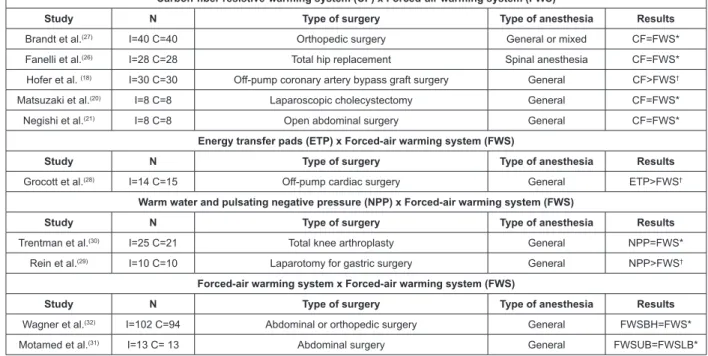
The authors of ive primary studies compared the carbon-iber resistive-warming system with the
forced-air warming system and the results indicate the systems are comparably effective in maintaining body temperature in the intraoperative period(18,20-21,26-27). No
statistically signiicant differences were found between
groups in four of the studies(20-21,26-27); one of them
reports statistically signiicant differences between
the two tested systems(18). In regard to the studies’
methodological quality, three clinical trials scored 3 (moderate)(18,20-21) on the Jadad scale and two scored 2
Comparison between energy transfer pads and the forced-air warming system
Energy transfer pads were tested in a clinical trial and they were more effective in maintaining patient normothermia when compared to the forced-air warming system. The study’s sample however was small and the score obtained on the Jadad scale was 2(28).
Comparison between the warm water and pulsating negative pressure and the forced-air warming system
Two clinical trials investigated the warm water and pulsating negative pressure. This new system has a device in the form of a clear cylinder, in which heated
water circulates around a speciic vascularized part of
the body, such as the upper limbs(29-30).
The results obtained by the clinical trials were contradictory. One of the studies(29) reports the new
device is more effective compared to the forced-air warming system in maintaining normothermia while
the other study does not report statistically signiicant
differences between the tested systems(30). The two
studies scored three in the Jadad scale. Given a lack of conclusive results coupled with the fact that the sample size of both trials is small, further studies are needed to test the new system.
Comparison among types of the forced-air warming system
Two studies compared types of forced-air warming system. One of the studies compared different disposable devices (disposable device for the upper limbs versus disposable device for the lower limbs)(31).
One trial tested the system with disposable devices for the upper limbs and trunk, while the equipment and devices were of different brands(32). The results of both
studies suggest that the forced-air warming system
reduces hypothermia, though no statistically signiicant
difference was observed. Both studies obtained a 3 on the Jadad scale.
Radiant warming system (RW) x Forced-air warming system (FWS)
Study N Type of surgery Type of anesthesia Results
Kadam et al.(13) I=14 C=15 Laparoscopic cholecystectomy General RW=FWS*
Torrie et al.(12) I=28 C=32 Transurethral resection of the prostate Spinal anesthesia RW<FWS†
Lee et al.(11) I=29 C=30 Surgeries longer than two hours General RW<FWS†
Wong et al.(10) I= 21 C=21 Laparoscopic cholecystectomy General RW=FWS*
Circulating water garment system (CWG) x Forced-air warming system (FWS)
Study N Type of surgery Type of anesthesia Results
Zangrillo et al.(19) I=15 C=16 Off-pump coronary artery bypass graft surgery General CWS>FWS†
Hofer et al.(18) I=30 C=29 Off-pump coronary artery bypass graft surgery General CWS>FWS†
Nesher et al.(17) I=45 C=45 Off-pump coronary artery bypass graft surgery General CWS>FWS†
Nesher et al.(16) I=40 C=20 Off-pump coronary artery bypass graft surgery General CWS>FWS†
Janicki et al.(15) I=12 C=12 Liver transplantation General CWS>FWS†
Janicki et al.(14) I=25 C=28 Open abdominal surgery General CWS>FWS†
Circulating-water Mattress (CM) x Forced-air warming system (FWS)
Study N Type of surgery Type of anesthesia Results
Pagnocca et al.(23) I=24 C=19 Xifo-pubic laparotomy General CM<FWS+CM†
Ihn et al.(22) I=30 CA=30 CB=30
Total abdominal hysterectomy General CM
<FWSA>FWSB†
Negishi et al.(21) I=8 C=8 Open abdominal surgery General CM<FWS†
Matsuzaki et al.(20) I=8 C=8 Laparoscopic cholecystectomy General CM<FWS†
Electric heating pads (EHP) x Forced-air warming system (FWS)
Study N Type of surgery Type of anesthesia Results
Leung et al.(25) I=30 C=30 Laparotomy General EHP<FWS†
Ng et al.(24) I=30 C=30 Total knee replacement Epidural EHP=FWS*
Rev. Latino-Am. Enfermagem 2012 Jan.-Feb.;20(1):183-91.
Carbon-fiber resistive-warming system (CF) x Forced-air warming system (FWS)
Study N Type of surgery Type of anesthesia Results
Brandt et al.(27) I=40 C=40 Orthopedic surgery General or mixed CF=FWS*
Fanelli et al.(26) I=28 C=28 Total hip replacement Spinal anesthesia CF=FWS*
Hofer et al. (18) I=30 C=30 Off-pump coronary artery bypass graft surgery General CF>FWS†
Matsuzaki et al.(20) I=8 C=8 Laparoscopic cholecystectomy General CF=FWS*
Negishi et al.(21) I=8 C=8 Open abdominal surgery General CF=FWS*
Energy transfer pads (ETP) x Forced-air warming system (FWS)
Study N Type of surgery Type of anesthesia Results
Grocott et al.(28) I=14 C=15 Off-pump cardiac surgery General ETP>FWS†
Warm water and pulsating negative pressure (NPP) x Forced-air warming system (FWS)
Study N Type of surgery Type of anesthesia Results
Trentman et al.(30) I=25 C=21 Total knee arthroplasty General NPP=FWS*
Rein et al.(29) I=10 C=10 Laparotomy for gastric surgery General NPP>FWS†
Forced-air warming system x Forced-air warming system (FWS)
Study N Type of surgery Type of anesthesia Results
Wagner et al.(32) I=102 C=94 Abdominal or orthopedic surgery General FWSBH=FWS*
Motamed et al.(31) I=13 C= 13 Abdominal surgery General FWSUB=FWSLB*
*no statistically signiicant differences were found; †statistically signiicant; I=Intervention group; C=Control group; FWSBH=Forced-air warming system
of another brand; FWSUB=Forced-air warming system with disposable component on the upper limbs; FWSLB=Forced-air warming system with disposable component on the lower limbs.
Figure 2 – Distribution of clinical trials included in the systematic review according to the tested active warming systems
Discussion
The forced-air warming system is effective in preventing hypothermia in surgical patients. It may,
however, be insuficient to keep normothermia in some
patients, such as elderly or severely ill individuals, or during certain procedures (i.e. liver transplantation or cardiac surgery)(1,5).
The need for technologies capable of warming limited skin areas with optimal effectiveness coupled
with dificulty maintaining normothermia in patients
during the perioperative period has encouraged the development of new active cutaneous warming systems, among them, the circulating water garment system. This system has disposable devices that involve the patient’s trunk and limbs and transfers a great amount of heat. Water has greater ability to transfer heat compared with air(33). The authors of a recent meta-analysis
concluded that the circulating water garment system is more effective than the forced-air warming system in maintaining patient normothermia(34).
Energy transfer pads also have a unit generating heated water that circulates through hoses to disposable devices, which is similar to that used in the circulating water garment system. The devices of the latter,
however, are adhesive, lexible hydrophilic gel, and can
cover the patient’s abdomen, back, and thighs(5,35).
A study was conducted with seven male volunteers randomly allocated into three groups. The following systems were tested: circulating water garment system, energy transfer pads, and the forced-air warming system. The results indicate that the energy transfer pads were 25% faster than the circulating water garment system in recovering the individual temperature, and twice as fast as the forced-air warming system(36).
Only one clinical trial(28) included in this review
tested the energy transfer pads. Even though we did
ind, during the search for primary studies, another
study(37) testing this system, it was not a randomized
controlled trial and had to be excluded, though its results also suggest that energy pads are more effective than the forced-air warming system. Therefore, further research testing this system is needed.
The carbon-iber resistive-warming system was tested in ive primary studies included in this review.
Its components are not disposable and can be placed in different segments of the patient’s body. The components are made with resistant and washable material and can be either sterilized or disinfected(18).
systems and its results indicate that the forced-air
warming system and the carbon-iber resistive-warming
system are comparably effective in maintaining patient normothermia during the intraoperative period(38).
The advantage in using systems that employ
carbon-iber technology is related to reduced costs and lower
environmental impact in terms of the waste generated, since its components are not disposable.
The radiant warming device is designed to increase body temperature through the irradiation of heat in a
speciic body area, usually one rich in arteriovenous
anastomoses, such as the face or palms of the hands. This system also minimizes costs since it does not require disposable devices(10-12) and its effectiveness
should be further investigated since there is evidence that the forced-air warming system is more effective in maintaining normotherapy(11-12).
Preventing hypothermia in patients during the intraoperative period can prevent complications associated with such an event, reduce hospital costs, improve the patients’ thermal comfort and, consequently, their satisfaction(39). This systematic review supports
the development of institutional policies intended to prevent this event. However, given the costs related to the acquisition of the investigated systems, each health facility should adopt systems that at least allow reducing hypothermia in patients during the perioperative period.
Conclusion
The implementation of measures to maintain patient normothermia in the intraoperative period is crucial to improving the quality of care provided to surgical patients. We conclude, based on this systematic review, that there is evidence indicating that the circulating water garment system is more effective in maintaining the temperature of patients in the intraoperative period. The forced-air warming system and the system
employing carbon-iber technology are comparably
effective. However, we note that the highest Jadad score obtained by the studies was 3, which indicates moderate methodological quality. Therefore, one needs to be cautious in interpreting the results reported by the clinical trials included in this systematic review.
Given the new technologies employed in active cutaneous systems, further studies are required to
test systems that appear to be more eficient when
compared to the forced-air warming system, such as energy transfer pads and those systems seldom investigated so far.
We also note the need to conduct studies addressing the costs involved in the implementation of active cutaneous warming systems in the perioperative to support the decision-making process concerning the acquisition of new equipment in health services.
References
1. Association of perioperative Registered Nurses. Recommended practices for the prevention of unplanned perioperative hypothermia. In: Association of perioperative Registered Nurses. Perioperative standards and recommended practices. Denver (USA): Association of periopertive Registered Nurses; 2009. p. 491-504. 2. Biazzotto CB, Brudniewski M, Schimidt AP; Júnior-Auler JOC. Hipotermia no período peri–operatório. Rev Bras Anestesiol. 2006;56(1):89-106.
3. Scott EM, Buckland R. A systematic review of intraoperative warming to prevent postoperative complications. AORN J. 2006;83(5):1090-113.
4. Kumar S, Wong PF, Melling AC, Leaper DJ. Effects of perioperative hypothermia and warming in surgical practice. Int Wound J. 2005;2(3):193-204.
5.Kurz A. Thermal care in the perioperative period. Best Pract Res Clin Anaesthesiol. 2008;22(1):39-62.
6. Galvão CM, Sawada NO, Trevizan MA. Revisão sistemática: recurso que proporciona a incorporação das evidências na prática da enfermagem. Rev. Latino-Am. Enfermagem. 2004;12(3):549-56.
7. Higgins JPT, Green S. Cochrane handbook for systematic reviews of interventions. Version 4.2.6 [atualização set 2006] [Internet] UK: The Cochrane Collaboration; 2006 Sep [acesso 13 fev 2008]. Disponível em: http://www. cochrane.org/resources/handbook/index.htm
8. Ursi ES. Prevenção de lesão de pele no perioperatório: revisão integrativa da literatura. [dissertação de mestrado]. Ribeirão Preto (SP): Escola de Enfermagem de Ribeirão Preto da Universidade de São Paulo; 2005. 128 p.
9. Jadad AR, Moore RA, Caroll D, Jenkinson C, Reynolds DJM, Gavaghan DJ, et al. Assessing the quality of reports of randomized clinical trials: is blinding necessary? Controlled Clin Trials. 1996;17(1):1-12.
10. Wong A, Walker S, Bradley M. Comparison of a radiant patient warming device with forced air warming. Anaesth Intensive Care. 2004;32(1):93-9.
Rev. Latino-Am. Enfermagem 2012 Jan.-Feb.;20(1):183-91.
12. Torrie JJ, Yip P, Robinson E. Comparison of forced air warming and radiant heating during transurethral prostatic resection under spinal anaesthesia. Anaesth Intensive Care. 2005;33(6):733-8.
13. Kadam VR, Moyes D, Moran JL. Relative efficiency of two warming devices during laparoscopic cholecystectomy. Anaesth Intensive Care. 2009;37(3):464-8.
14. Janicki PK, Higgins MS, Janssen J, Johnson RF, Beattie C. Comparison of two different temperature maintenance strategies during open abdominal surgery. Anesthesiology. 2001;95(4):868-74.
15. Janicki PK, Stoica C, Chapman WC, Wright JK, Walker G, Pai R, et al. Water warming garment versus forced air system in prevention of intraoperative hypothermia during liver transplantation: a randomized controlled trial. BMC Anaesthesiol. 2002;2(7):1-5.
16. Nesher N, Insler SR, Shenberg N, Bolotin G, Kramer A, Sharony R, et al. A new thermoregulation system for maintaining perioperative normothermia and attenuating myocardial injury in off-pump coronary artery bypass surgery. Heart Surg Forum. 2002;5(4):373-80.
17. Nesher N, Uretzky G, Insler S, Nataf P, Frolkis I, Pineaus E, et al. Thermo-wrap technology preserves normothermia better than routine thermal care in patients undergoing off-pump coronary artery bypass and is associated with lower immune response and lesser myocardial damage. J Thorac Cardiovas Surg. 2005;129(7):1371-8.
18. Hofer CK, Worn M, Tavakoli R, Sander L, Maloigne M, Klaghofer R, et al. Influence of body core temperature on blood loss and transfusion requirements during off-pump coronary artery bypass grafting: a comparison of 3 warming systems. J Thorac Cardiovas Surg. 2005;129(4):838-43.
19. Zangrillo A, Pappalardo F, Talo G, Corno C, Landoni G, Scandroglio AM, et al. Temperature management during off-pump coronary artery bypass graft surgery: a randomized clinical trial on the efficacy of a circulating water system versus a forced-air system. J Cardiothorac Vasc Anesth. 2006;20(6):788-92.
20. Matsuzaki Y, Matsukawa T, Ohki K, Yamamoto Y, Nakamura M, Oshibuchi T. Warming by resistive heating maintains perioperative normothermia as well as forced air heating. Br J Anaesth. 2003;90(5):689-91.
21. Negishi C, Hasegawa K, Mukai S, Nakagawa F, Ozaki M, Sessler DI. Resistive-heating and forced air warming are comparably effective. Anaesth Analg. 2003;96(6):1683-7.
22. Ihn CH, Joo JD, Chung HS, Choi JW, Kim DW, Jeon YS, Kim YS, Choi WY. Comparison of three warming devices for the prevention of core hypothermia and pos-anesthesia shivering. J Int Med Res. 2008;36(5):923-31. 23. Pagnocca ML, Tai EJ, Dwan JL. Controle de temperatura em intervenção cirúrgica abdominal convencional: comparação entre os métodos de aquecimento por condução e condução associada à convecção. Rev Bras Anestesiol. 2009;59(1):56-65.
24. Ng V, Lai A, Ho V. Comparison of forced air warming and electric heating pad for maintenance of body temperature during total knee replacement. Anaesthesia. 2006;61(11):1100-4.
25. Leung KK, Lai A, Wu A. A randomized controlled trial of the electric heating pad vs forced air warming for preventing hypothermia during laparotomy. Anaesthesia. 2007;62(6):605-8.
26. Fanelli A, Danelli G, Ghisis D, Ortu A, Moschini E, Fanelli G. The efficacy of resistive heating under-patient blanket versus a forced-air warming system: a randomized controlled trial. Anesth Analg. 2009;108(1):199-201. 27.Brandt S, Oguz R, Hüttner H, Waglechner G, Chiari A, Greif R, et al. Resistive-polymer versus forced-air warming: comparable efficacy in orthopedic patients. Anesth Analg. 2010;110(3):834-8.
28. Grocott HP, Mathew JP, Carver EH, Phillips-Bute B, Landolfo KP, Newman MF. A randomized controlled trial of the Artic Sun temperature management sytem versus conventional methods for preventing hypothermia during off-pump cardiac surgery. Anesth Analg. 2001;98(2):298-302.
29. Rein EB, Filtvedt M, Walloe L, Raeder JC. Hypothermia during laparotomy can be prevented by locally applied warm water and pulsating negative pressure. Br J Anaesth. 2007;98(3):331-6.
30. Trentman TL, Weinmeister KP, Hentz JG Laney MB, Simula DV. Randomized non-inferiority Trial of the vitalHEAT temperature management system vs the Bair Hugger warmer during total knee arthroplasty. Can J Anesth. 2009;56(12):914-20.
Received: Dec. 21st 2010
Accepted: Dec. 19th 2011
32. Wagner K, Swanson E, Raymond CJ, Smith CE. Comparison of two convective warming systems during major abdominal and orthopedic surgery. Can J Anesth. 2008;55(6):358-63.
33. Taguchi A, Ratnaraj J, Kabon B, Sharma N, Lenhardt R, Sessler DI, et al. A Effects of a circulating-water garment and forced-air warming on body heat content and core temperature. Anaesthesiology. 2004;100(5):1058-64. 34. Galvão CM, Liang Y, Clark AM. Effectiveness of cutaneous warming systems on temperature control: meta-analysis. J Adv Nurs. 2010;66(7):1196-206. 35. Taguchi A, Kurz A. Thermal management of the patient: where does the patient lose and/or gain temperature? Current Opinion in Anaesthesiol. 2005;18(6):632-9.
36. Wadhwa A, Komatsu R, Orhan-Sungur M, Barnes P, In J, Sessler DI, et al. New circulating-water devices warm more quickly than forced air in volunteers. Anesth Analg. 2007;105(6):1681-7.
37. Stanley TO, Grocott HP, Phillips-Bute B, Mathew JP, Landolfo KP, Newman MF. Preliminary evaluation of the arctic Sun temperature controlling system during off pump coronary artery bypass surgery. Ann Thorac Surg. 2003;75(4):1140-4.
38. Galvão CM, Marck PB, Sawada NO, Clark A M. A systematic review of the effectiveness of cutaneous warming systems to prevent hypothermia. J Clin Nurs. 2009;18(5):627-36.