How to evaluate quality of life in overweight and obese women
during climacterium?
LIVIA OLIVEIRA MUNHOZ1*, ISABEL CRISTINA ESPOSITO SORPRESO2, MARIA CRISTINA CACERES NOGUEIRA3, RICARDODOS SANTOS
SIMÕES4, JOSÉ MARIA SOARES JUNIOR5, EDMUND CHADA BARACAT6
1Resident in Obstetrics and Gynecology, Faculty of Medicine, University of São Paulo, Brazil.
2Adjunct Professor in Gynecology, Department of Obstetrics and Gynecology, Faculty of Medicine, University of São Paulo, Brazil.
3Collaborating Physician in the Division of Gynecology, Department of Obstetrics and Gynecology, Faculty of Medicine, University of São Paulo, Brazil. 4Assistant Physician Doctorate student in Obstetrics and Gynecology at the Faculty of Medicine, University of São Paulo, Brazil.
5Associate Professor in the Division of Gynecology, Department of Obstetrics and Gynecology, Faculty of Medicine, University of São Paulo, Brazil. 6Full Professor in the Division of Gynecology, Department of Obstetrics and Gynecology, Faculty of Medicine, University of São Paulo, Brazil.
S
UMMARYDivision of Gynecology, Department of
Obstetrics and Gynecology, School of Medicine at University of São Paulo
Article received: 7/15/2014
Approved for publication: 7/23/2014
*Correspondence:
Instituto Central do Hospital das
Clínicas da Faculdade de Medicina da Universidade de São Paulo,
Address: Av. Dr. Enéas de Carvalho Aguiar, 255, 10o andar
Cerqueira César, Postal Code: 05403-000
São Paulo, SP – Brazil [email protected]
http://dx.doi.org/10.1590/1806-9282.60.05.018
Conlict of interest: none
Objective: identifying the instruments used to measure quality of life during me-nopausal transition and post-menopause in women with obesity or overweight. Methods: a systematic search using the Embase, Pubmed and Cochrane data-bases, and the following key-words: menopause/climacteric, quality of life, over-weight/obesity. Nineteen papers that fulilled the including criteria were found. Results: eighteen studies using generic health questionnaires (global quality of life) were identiied, six of them were speciic for menopause and one speciic for obesity. Eleven studies used generic questionnaires, while only eight question-naires were speciic for menopause.
Conclusion: there was no consensus in the literature about the use of quality of life questionnaires in women with overweight and obesity in climacterium, which makes de comparison and reproducibility of the results dificult. This is an alert about the need for standardization to better evaluate this speciic po-pulation.
Keywords: menopause, climacteric, overweight, obesity, quality of life.
I
NTRODUCTIONObesity is a multifactorial disease, epidemic in nature, which according to the World Health Organization af-fects over 300 million adults worldwide. Overweight in-dividuals correspond to about one billion adults.1 The
body mass index (BMI) of women seems to reach its highest values between 50 and 59 years, a period that of-ten coincides with menopause.2
This period is characterized by body aging linked to progressive hypoestrogenism, which not only triggers health implications, but is also associated with changes in women’s lives. Characteristic symptoms may be obser-ved, including vasomotor, psychological, urogenital, sleep disturbances and sexual dysfunction, as well as dificul-ties in emotional and social sphere.3-6 The quality of life
in postmenopausal women is a major subject, because its results can help deine therapeutic approaches and pro-mote healthier aging for females, with improved quality of life.4,5,7
Research shows associations among obesity, meno-pausal symptoms and worse quality of life.5,8-17 To
con-duct this evaluation, various types of questionnaires are used, both generic - analyzing overall quality of life for any population - and speciic questionnaires to analyze the quality of life in the transition to menopause and postmenopause.18-21
transi-tion to menopause and post-menopause), through a sys-tematic review of the literature.
M
ETHODSA systematic search was performed using the Embase, Pubmed and Cochrane databases, and the following key--words:menopause/climacteric, quality of life, overweight/ obesity. Full articles and editorials in English, Portugue-se and Spanish were Portugue-selected. Inclusion criteria were: full articles that used at least one questionnaire to assess quality of life or questionnaire related to climacteric symptoms, being at least part of the sample comprised of patients with overweight, obesity or metabolic syn-drome who were also in transition to menopause and post-menopause. Exclusion criteria were: case reports and systematic reviews. Using these criteria were selec-ted twenty-two articles after reading the title and
abs-tract. After reading the full articles, three were excluded for the following reasons: the irst examined only psycho-logical well-being, the second used questionnaires of quality of life speciic to women with breast cancer, and the third used speciic questionnaires for urinary incon-tinence and sexual function. In the end, 19 articles were selected for this systematic review.
R
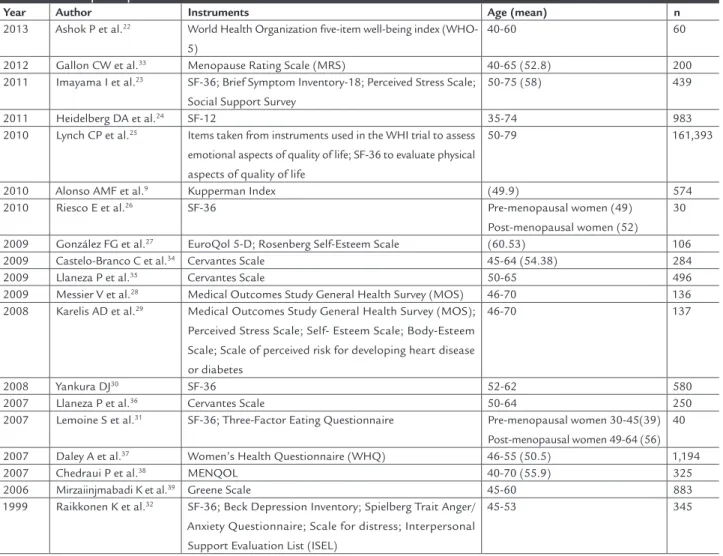
ESULTSNineteen articles were found in the systematic literature search. The characteristics of both the articles and ques-tionnaires used are summarized in Table 1. The studies were published between 1999 and 2013, and ten of these were dated 2009 or later. The different populations ran-ged from 40 to 70 years of age, n ranran-ged from 30 to 161.393 women, with the majority (13) of research having n of 200-1,194.
TAble 1 Summary of articles that used questionnaires to assess quality of life in overweight or obese women in transition to menopause and post-menopause, identifying the year of publication, the instrument used, age range and/or mean population and number of participants
Year Author Instruments Age (mean) n
2013 Ashok P et al.22 World Health Organization five-item well-being index
(WHO-5)
40-60 60
2012 Gallon CW et al.33 Menopause Rating Scale (MRS) 40-65 (52.8) 200
2011 Imayama I et al.23 SF-36; Brief Symptom Inventory-18; Perceived Stress Scale;
Social Support Survey
50-75 (58) 439
2011 Heidelberg DA et al.24 SF-12 35-74 983
2010 Lynch CP et al.25 Items taken from instruments used in the WHI trial to assess
emotional aspects of quality of life; SF-36 to evaluate physical aspects of quality of life
50-79 161,393
2010 Alonso AMF et al.9 Kupperman Index (49.9) 574
2010 Riesco E et al.26 SF-36 Pre-menopausal women (49)
Post-menopausal women (52) 30
2009 González FG et al.27 EuroQol 5-D; Rosenberg Self-Esteem Scale (60.53) 106
2009 Castelo-Branco C et al.34 Cervantes Scale 45-64 (54.38) 284
2009 Llaneza P et al.35 Cervantes Scale 50-65 496
2009 Messier V et al.28 Medical Outcomes Study General Health Survey (MOS) 46-70 136
2008 Karelis AD et al.29 Medical Outcomes Study General Health Survey (MOS);
Perceived Stress Scale; Self- Esteem Scale; Body-Esteem Scale; Scale of perceived risk for developing heart disease or diabetes
46-70 137
2008 Yankura DJ30 SF-36 52-62 580
2007 Llaneza P et al.36 Cervantes Scale 50-64 250
2007 Lemoine S et al.31 SF-36; Three-Factor Eating Questionnaire Pre-menopausal women 30-45(39)
Post-menopausal women 49-64 (56) 40
2007 Daley A et al.37 Women’s Health Questionnaire (WHQ) 46-55 (50.5) 1,194
2007 Chedraui P et al.38 MENQOL 40-70 (55.9) 325
2006 Mirzaiinjmabadi K et al.39 Greene Scale 45-60 883
1999 Raikkonen K et al.32 SF-36; Beck Depression Inventory; Spielberg Trait Anger/
Anxiety Questionnaire; Scale for distress; Interpersonal Support Evaluation List (ISEL)
Twenty-four questionnaires were identiied in nine-teen articles (Table 2). The instruments found were divi-ded into generic, assessing overall quality of life in any population; speciic, for quality of life in women during transition to menopause and post-menopause; and res-tricted, for psychosocial aspects of quality of life.
TAble 2 List of assessment tools for quality of life used in overweight and obese women in transition to
menopause and post-menopause, identifying the type of instrument, frequency of use, and year of use
Instrument Type Frequency Year
World Health Organization five-item well-being index (WHO-5)
EPS 1 2013
Menopause Rating Scale
(MRS) EM 1 2012
SF-36 G 6 2011, 2010, 2010, 2008, 2007, 1999 Brief Symptom Inventory-18 EPS 1 2011
Social Support Survey EPS 1 2011
SF-12 G 1 2011
Perceived Stress Scale EPS 2 2008, 2011 Items taken from
instruments used in the WHI trial
EPS 1 2010
Kupperman Index EM 1 2010 EuroQol 5-D G 1 2009 Rosenberg Global
Self-Esteem Scale EPS 1 2009
Cervantes Scale EM 3 2009, 2009, 2007 Medical Outcomes Study
General Health Survey (MOS)
G 2 2009, 2008
Self- Esteem Scale EPS 1 2008 Body-Esteem Scale EPS 1 2008 Scale of perceived risk for
developing heart disease or diabetes
EPS 1 2008
Three-Factor Eating
Questionnaire EPS 1 2007 Women’s Health
Questionnaire (WHQ) EM 1 2007
MENQOL EM 1 2007
Greene Scale EM 1 2006 Beck Depression Inventory EPS 1 1999 Spielberg Trait Anger/
Anxiety Questionnaire EPS 1 1999 Scale for Distress EPS 1 1999 Interpersonal Support
Evaluation List (ISEL) EPS 1 1999
G: generic quality of life instrument; EM: specific instrument for quality of life in the transition to menopause and post-menopause; EPS: specific instrument for psychosocial aspects of qua-lity of life.
Four different instruments were identiied to assess overall quality of life. For speciic analysis of quality of life related to the climacteric period, six different questionnaires were used. Most instruments found (fourteen) aimed to quanti-fy the quality of life related to psychosocial aspects.
The SF-36 was observed more frequently, being used in six articles published from 1999 to 2011. The second most frequently found was the Cervantes Scale, seen in three articles, two published by a single group of resear-chers (Lhaneza et al.35,36). The Medical Outcome Study
General Health Survey (MOS) was used in two articles, and the other questionnaires in one study only.
Six studies used more than one instrument to mea-sure quality of life. Eight studies used speciic question-naires for menopause, while 11 used generic questionnai-res, combined or not with instruments for psychosocial analysis.
D
ISCUSSIONThe nineteen studies obtained used twenty-four different scales. Eleven used generic questionnaires,22-32 while eight
employed speciic instruments to assess quality of life in wo-men before and after wo-menopause.9,33-39 A single article made
reference to a speciic questionnaire related to obesity.31
The SF-36 and Medical Outcomes Study General Health Survey (MOS) questionnaires, which are derived from the same study, were the most prevalent generic tools, being found in eight articles.23,25,26,28-32 The SF-36
was the most widely adopted, being found in six arti-cles,23,25,26,30-32 which is consistent with the literature,
sin-ce it is the most widely used generic instrument docu-mented in over four hundred publications.40,41 However,
none of these questionnaires takes into consideration im-portant aspects such as menopausal symptoms or speci-ic psychosocial conditions regarding this time of life, which hinders the assessment of quality of life in this po-pulation. The social psychological aspect was measured by fourteen different scales covering aspects of emotio-nal health and the social structure in which the indivi-dual lives, which affect the quality of life. Six articles used generic instruments combined with psychosocial ques-tionnaires, showing that the use of generic instruments may fail to take into account important aspects of qua-lity of life in the period close to menopause.23,25,27,29,31,32
Ashok et al.22 used the World Health Organization
i-ve-item well-being index (WHO-5) well-being question-naire, which assesses psychological and not physical di-mensions related to menopause.22 Lynch et al.25 used the
life circumstances, should be included; i.e., occupational, sexual, emotional and health-related factors.16 Schneider
et al.21 argues that the instrument must have certain
attri-butes or properties of measures suitable for a particular purpose. Speciic questionnaires are more sensitive to change and make sense for both the physician and pa-tient, since the items included report highly relevant do-mains to that particular population.21
The varied use of questionnaires can be justiied by the researcher’s choice for the most widely used instru-ments such as the SF-36 and also the preference of cer-tain authors to use surveys created in the language and targeted to the cultural context of the study popula-tion.48 The predilection for generic tools found in the
ar-ticles used in this review fails to analyze important cha-racteristics of the study population, given the peculiarities of both the period of transition to menopause and post--menopause and obesity. Therefore, assessment of the
qua-lity of life of these women was hindered.
C
ONCLUSIONThe most widely used instrument for assessing quality of life in obese women in transition to menopause and post--menopause was the generic SF-36 questionnaire. The Cer-vantes Scale was the speciic instrument most used. The-re was no consensus The-regarding the use of the instruments, which is an obstacle for comparison and reproducibility of results. The current study is a warning to researchers that there is a need for a standard instrument to assess this growing population.
R
ESUMOComo aferir qualidade de vida de mulheres com sobrepe-so e obesidade no climatério?
Objetivo: identiicar os instrumentos utilizados para afe-rir a qualidade de vida de mulheres com sobrepeso e obe-sidade no climatério (transição para menopausa e pós--menopausa).
Métodos: busca sistemática nas bases de dados Embase, Pubmed e Cochrane com os descritores: menopause/climac-teric, quality of life, overweight/obesity. Foram incluídos 19 artigos que preencheram os critérios de inclusão. Resultados: foram identiicados 18 questionários gené-ricos (qualidade de vida global), 6 especíicos para meno-pausa e 1 especíico para obesidade. Onze estudos utili-zaram instrumentos genéricos, enquanto 8 utiliutili-zaram especíicos para menopausa.
Women’s Health Initiative (WHI) trial.25 Therefore, the
article used its own instrument, unlike those classically found in the literature, which demonstrates the lack of standardization in the literature.
Eight of the nineteen studies used speciic question-naires for menopause.9,33-39 The Cervantes Scale was the
most prevalent, found in three of them.34-36 The instrument
was developed in Spanish, mainly for use in this popula-tion, and translated into Portuguese, despite being valida-ted in a limivalida-ted number of countries.42 In these three
stu-dies, two were conducted by the same author (Llaneza et al.9, making it dificult to generalize the results.35,36
Alon-so et al.39 used the Kupperman Index, according to the data
found in the literature about its widespread use, even with criticism for not addressing urogenital, social and other symptoms related to sexuality.9,43-45 Mirzaiinjmabadi et al.39
used the Greene Scale, a list of 21 items including psycho-logical, vasomotor and somatic symptoms, which was not exactly designed as an instrument of quality of life.21,39 The
other speciic questionnaires were: Menopause Rating Sca-le (MRS), Women’s Health Questionnaire (WHQ) and Me-nopause-Speciic Quality of Life Questionnaire (MEN-QOL), which have already been validated and are the main scales currently used in studies on women in transition to menopause and post-menopause.33,37,38,43,46,47 In Brazil, only
WHQ, MENQOL and Cervantes Scale were validated; Gree-ne Scale has been used for many years, and MRS is being used even without validation.
Lemoine et al.31 was the only author who used a
spe-ciic questionnaire for obesity, the Three-Factor Eating Questionnaire, which is related to psychological well-be-ing. Thus, it is important to assess the need to use speci-ic questionnaires for obesity since the population in ques-tion is also subject to the effects of obesity as a comorbidity on quality of life.31
There is no consensus as to the best type of instru-ment to be used to assess quality of life. Fayers et al.41
be-lieves that both generic and speciic measures have ad-vantages and disadad-vantages. He recommends the use of generic and speciic instruments wherever possible, in combination, to give strength to both approaches.41 On
the other hand, many researchers prefer to use speciic questionnaires to assess a certain condition. Chedraui et al.38 states that speciic instruments are required in each
condition, and menopause, or climacterium, is not an ex-ception.38 Utian16 believes that in order to evaluate the
Conclusão: não houve consenso na literatura quanto ao uso de instrumentos de qualidade de vida em mulheres com sobrepeso e obesidade no climatério, o que diicul-ta a comparação e a reprodutibilidade dos resuldiicul-tados. Este é um alerta quanto à necessidade de padronização para melhor avaliar essa população especíica.
Palavras-chave: menopausa; climatério; sobrepeso; obe-sidade; qualidade de vida.
R
EFERENCES1. De Lorenzi DRS, Basso E, Fagundes PO, Saciloto B. Prevalência de sobrepeso e obesidade no climatério. Rev Bras Ginecol Obstet. 2005;27(8):479-84. 2. Teede HJ, Lombard C, Deeks AA. Obesity, metabolic complications and the
menopause: an opportunity for prevention. Climacteric. 2010 Jun;13(3):203-9. 3. Davis SR, Castelo-Branco C, Chedraui P, Lumsden MA, Nappi RE, Shah D, et al. Understanding weight gain at menopause. Climacteric. 2012 Oct;15(5):419-29.
4. Conde DM, Pinto-Neto AM, Santos-Sá D, Costa-Paiva L, Martinez EZ. Factors associated with quality of life in a cohort of postmenopausal women. Gynecological endocrinology. 2006 Aug;22(8):441-6.
5. Lorenzi DRS, Baracat EC, Saciloto B, Padilha IJ. Fatores associados à qualidade de vida após menopausa. Rev Assoc Med Bras. 2006;52(5):312-7. 6. Lorenzi DRS, Catan LB, Cusin T, Felini R, Bassani F, Arpini AC. Caracterização da qualidade de vida segundo o estado menopausal entre mulheres da Região Sul do Brasil. Rev Bras Saúde Matern Infant. 2009;9(4):459-66.
7. Filho EAS, Costa AM. Avaliação da qualidade de vida de mulheres no climatério atendidas em hospital-escola na cidade do Recife , Brasil. Rev Bras Ginecol Obstet. 2008;30(3):113-20.
8. Coakley EH, Kawachi I, Manson JE, Speizer FE, Willet WC, Colditz GA. Lower levels of physical functioning are associated with higher body weight among middle-aged and older women. International journal of obesity and related metabolic disorders. 1998 Oct;22(10):958-65.
9. Fernández-Alonso AM, Cuadros JL, Chedraui P, Mendoza M, Cuadros AM, Pérez-López FR. Obesity is related to increased menopausal symptoms among Spanish women. Menopause international. 2010 Sep;16(3):105-10. 10. López-García E, Banegas JRB, Gutiérrez-Fisac JL, Pérez-Regadera AG, Gañán LD, Rodríguez-Artalejo F. Relation between body weight and health-related quality of life among the elderly in Spain. International journal of obesity and related metabolic disorders. 2003 Jun;27(6):701-9.
11. Myint PK, Welch AA, Luben RN, Wainwright NWJ, Surtees PG, Bingham SA, et al. Obesity indices and self-reported functional health in men and women in the EPIC-Norfolk. Obesity. 2006 May;14(5):884-93.
12. Yan LL, Daviglus ML, Liu K, Pirzada A, Garside DB, Schiffer L, et al. BMI and health-related quality of life in adults 65 years and older. Obesity research. 2004 Jan;12(1):69-76.
13. Rivenes AC, Harvey SB, Mykletun A. The relationship between abdominal fat, obesity, and common mental disorders: results from the HUNT study. Journal of psychosomatic research. Elsevier Inc. 2009 Apr;66(4):269-75. 14. Sorpreso ICE, Vieira LHL, Haidar MA, Nunes MG, Baracat EC, Júnior JMS.
Multidisciplinary approach during menopausal transition and post-menopause in Brazilian women. Clin Exp Obstet Gynecol. 2010;37(4):283-6.
15. Sorpreso ICE, Vieira LHL, Calió CC, Abi Haidar M, Baracat EC, Soares JM. Health education intervention in early and late postmenopausal Brazilian women. Climacteric. 2012;15(6):573-80.
16. Utian WH. Psychosocial and socioeconomic burden of vasomotor symptoms in menopause: A comprehensive review. Health and quality of life outcomes. 2005;3(47):1-10.
17. Calio CL, Sorpreso ICE, Haidar MA, Maciel GA, Baracat EC, Soares JMJ. Physiotherapeutic approach in early and late post-menopausal Brazilian women. Gynecol Endocrinol. 2013;29(7):670-3.
18. Sorpreso ICE. Atenção Integral à Saúde da Mulher na Transição para Menopausa e Pós-menopausa. 2010.
19. Silveira MF, Almeida JC, Freire SR, Haikal DS, Martins AEBL. Propriedades psicométricas do instrumento de avaliação da qualidade de vida: 12-item health survey (SF-12). Ciência e Saúde Coletiva. 2013;18(7):1923-31. 20. Neto AMP, Conde DM. Qualidade de vida. Rev Bras Ginecol Obstet.
2008;30(11):535-6.
21. Schneider HPG, Maclennan H, Feeny D. Assessment of health-related quality of life in menopause and aging. Climacteric. 2008 Apr;11(2):93-107. 22. Ashok P, Apte G, Wagh G, Joshi A. Psychological Well-Being & obesity in
Peri and Post-menopausal women. National Journal of Physiology, Pharmacy and Pharmacology. 2013;3(1):97-101.
23. Imayama I, Alfano CM, Kong A, Foster-Schubert KE, Bain CE, Xiao L, et al. Dietary weight loss and exercise interventions effects on quality of life in overweight/obese postmenopausal women: a randomized controlled trial. International journal of behavioral nutrition and physical activity. BioMed Central Ltd. 2011 Jan;8(1):118.
24. Heidelberg DA, Holle R, Lacruz ME, Ladwig K-H, Von Lengerke T. Do diabetes and depressed mood affect associations between obesity and quality of life in post-menopause? Results of the KORA-F3 Augsburg population study. Health and quality of life outcomes. BioMed Central Ltd; 2011 Jan;9(1):97.
25. Lynch CP, McTigue KM, Bost JE, Tinker LF, Vitolins M, Adams-Campbell L, et al. Excess weight and physical health-related quality of life in postmenopausal women of diverse racial/ethnic backgrounds. Journal of women’s health. 2010 Aug;19(8):1449-58.
26. Riesco E, Tessier S, Pérusse F, Turgeon S, Tremblay A, Weisnagel J, et al. Impact of walking on eating behaviors and quality of life of premenopausal and early postmenopausal obese women. Menopause. 2010;17(3):529-38. 27. González FG, García JCF, Rubio AB, Galera RA, Macagno LE, Abella CP, et
al. An ambulatory physical exercise program improves in the short term weight and quality of life of obese post-menopausal women. Medicina clínica. 2009 Oct 17;133(14):533-8.
28. Messier V, Karelis AD, Lavoie M-E, Brochu M, Faraj M, Strychar I, et al. Metabolic proile and quality of life in class I sarcopenic overweight and obese postmenopausal women: a MONET study. Appl. Physiol. Nutr. Metab. 2009 Feb;34:18-24.
29. Karelis AD, Fontaine J, Messier V, Messier L, Blanchard C, Rabasa-Lhoret R, et al. Psychosocial correlates of cardiorespiratory itness and muscle strength in overweight and obese post-menopausal women: a MONET study. Journal of sports sciences. 2008 Jul;26(9):935-40.
30. Yankura DJ, Conroy MB, Hess R, Pettee KK, Kuller LH, Kriska AM. Weight regain and health-related quality of life in postmenopausal women. Obesity. 2008 Oct;16(10):2259-65.
31. Lemoine S, Rossell N, Drapeau V, Poulain M, Garnier S, Sanguignol F, et al. Effect of weight reduction on quality of life and eating behaviors in obese women. Menopause. 2007;14(3):432-40.
32. Räikkönen K, Matthews KA, Kuller LH. Anthropometric and psychosocial determinants of visceral obesity in healthy postmenopausal women. International Journal of Obesity. 1999 Aug;23:775-82.
33. Gallon CW, Wender MCO. Estado nutricional e qualidade de vida da mulher climatérica. Rev Bras Ginecol Obstet. 2012;34(4):175-83.
34. Castelo-Branco C, Palacios S, Ferrer-Barriendos J, Cancelo MJ, Quereda F, Alberich X. Impact of anthropometric parameters on quality of life during menopause. Fertility and sterility. 2009 Dec;92(6):1947-52.
35. Llaneza P, González C, Fernandez-Iñarrea J, Alonso A, Arnott I, Ferrer-Barriendos J. Insulin resistence and health-related quality of life in postmenopausal women. Fertility and sterility. 2009 Apr;91(4 Suppl):1370-3. 36. Llaneza P, Iñarrea J, Gonzalez C, Alonso A, Arnott I, Ferrer-Barriendos J.
Differences in health related quality of life in a sample of Spanish menopausal women with and without obesity. Maturitas. 2007 Dec;58:387-94. 37. Daley A, Macarthur C, Stokes-Lampard H, McManus R, Wilson S, Mutrie
N. Exercise participation, body mass index, and health-related quality of life in women of menopausal age. British journal of general practice. 2007 Feb;57:130-5.
38. Chedraui P, Hidalgo L, Chavez D, Morocho N, Alvarado M, Huc A. Quality of life among postmenopausal Ecuadorian women participating in a metabolic syndrome screening program. Maturitas. 2007 Jan 20;56(1):45-53. 39. Mirzaiinjmabadi K, Anderson D, Barnes M. The relationship between exercise,
40. Ware JE, Gandek B. Overview of the SF-36 Health Survey and the International Quality of Life Assessment (IQOLA) Project. Journal of clinical epidemiology. 1998 Nov;51(11):903-12.
41. Fayers P, Hays R. Assessing Quality of Life in Clinical Trials. 2nd ed. United
Kigdon: Oxford University Press; 2005. p. 3-8.
42. Lima JEM, Palacios S, Wender MCO. Quality of life in menopausal women: a Brazilian Portuguese version of the Cervantes Scale. TheScientiicWorldJournal. 2012 Jan;2012:5 pages.
43. Filho CRS, Baracat EC, Conterno LO, Haidar MA, Ferraz MB. Climacteric symptoms and quality of life: validity of women’s health questionnaire. Rev Saúde Pública. 2005;39(3):333-9.
44. Schneider HP, Heinemann LA, Rosemeier HP, Potthoff P BH. The Menopause Rating Scale (MRS): comparison with Kupperman index and quality-of-life scale SF-36. Climacteric. 2000;3(1):50-8.
45. Zöllner Y, Kay S, Abetz L. La qualité de vie sexuelle des européennes. Gyn Info. 2001;51:9-11.
46. Heinemann LAJ, Potthoff P, Schneider HPG. International versions of the Menopause Rating Scale (MRS). Health and quality of life outcomes. 2003 Jan;01:28 AM.
47. Lewis JE, Hilditch JR, Wong CJ. Further psychometric property development of the Menopause-Speciic Quality of Life questionnaire and development of a modiied version, MENQOL-Intervention questionnaire.Maturitas. 2005;50:209-21.