Cardiovascular risk assessment according to the Framingham
score and abdominal obesity in individuals seen by a clinical
school of nutrition
ALANE CABRAL MENEZESDE OLIVEIRA1*, RAPHAELA COSTA FERREIRA2, ARIANNE ALBUQUERQUE SANTOS3
1Adjunct Professor of Nutrition, Universidade Federal de Alagoas. PhD in Biotechnology Applied to Health, Maceió, AL, Brazil 2Nutrition MSc Student, Faculdade de Nutrição, Universidade Federal de Alagoas, Maceió, AL, Brazil
3Multidisciplinary Resident (Physician), Hospital Universitário Prof. Alberto Antunes, Maceió, AL, Brazil
S
UMMARYStudy conducted at Universidade Federal de Alagoas, Maceió, AL, Brazil
Article received: 5/24/2014 Accepted for publication: 10/21/2014
*Correspondence: Address: Av. Lourival de Melo Mota, s/n, Cidade Universitária
Maceió, AL – Brazil Postal code: 57072-900 [email protected]
http://dx.doi.org/10.1590/1806-9282.62.02.138
Objective: To analyze the relation of abdominal obesity on cardiovascular risk in individuals seen by a clinic school of nutrition, classifying them based on Framingham score.
Methods: Cross-sectional study, conducted at the nutrition clinic of a private college in the city of Maceió, Alagoas. We included randomly selected adults and elderly individuals with abdominal obesity, of both sexes, treated from August to December of 2009, with no history of cardiomyopathy or cardiovascular events. To determine the cardiovascular risk, the Framingham score was calculated. All analyzes were performed with SPSS software version 20.0, with p <0.05 as sig-nificative.
Results: We studied 54 subjects, 83% female, the mean age was 48 years old, rang-ing from 31 to 73 years. No correlation was observed between measurements of waist circumference and cardiovascular risk in the subjects studied (r=0.065, p=0.048), and there was no relationship between these parameters.
Conclusion: Abdominal fat distribution was weakly related to cardiovascular risk in patients seen by a clinical school of nutrition.
Keywords: Abdominal obesity, cardiovascular diseases, obesity, risk factors.
I
NTRODUCTIONCardiovascular diseases (CVD) are the leading causes of death in women and men in Brazil. They are responsible for about 20% of all deaths in individuals aged over 30 years, indicating their importance as a public health prob-lem, as well as showing the close relationship with the level of obesity of the population.1
Obesity in modern and globalized society has spread to alarming levels in all age groups. It is a chronic disease, resulting from the chronic imbalance between food in-take and energy expenditure. It is highly complex, has a multifactorial etiology, with biological, psychological, so-cial and economic variables that also involve environmen-tal and genetic aspects, and is difficult to treat, with high morbidity and mortality. Its risk increases progressively in accordance with weight gain, associated with a series of factors such as dyslipidemia, hypertension (SAH), dia-betes mellitus (DM) and insulin resistance, factors that can
also increase cardiovascular risk.2,3
In recent years, adipose tissue has become more than just energy reserve being recognized as an organ with mul-tiple functions and a central role in the genesis of insu-lin resistance. Currently, it is known that adipocytes re-ceive the influence of various signals such as insulin, cortisol and catecholamines and, in response, secrete a wide variety of substances (leptin, adiponectin, TNF-α
[tumor necrosis factor alpha] and more), which act both locally and systemically, participating in the regulation of various processes such as endothelial function, athero-genesis, insulin sensitivity and regulation of the energy balance. It is also recognized that, depending on their lo-cation, adipocytes present different metabolic features, and intra-abdominal adiposity presents the greatest im-pact on the deterioration of insulin sensitivity.4
ener-gy X-ray absorptiometry (DEXA) and magnetic resonance imaging (MRI). For epidemiological studies, however, con-sidering the simplicity and the costs of various methods, the use of anthropometric indexes has been recommend-ed: BMI, waist-hip ratio (WHR) or simply waist circum-ference (WC).5
The anthropometric methods proposed to analyze the distribution of body fat include skinfolds, waist-hip ratio and waist circumference (WC), the latter being one of the methods most commonly used in the literature to assess abdominal adiposity, with suggested cut-off points associated with increased cardiovascular risk.6,7
As for the cardiovascular risk, it can be measured us-ing the Framus-ingham risk scale, created accordus-ing to a prospective observational study carried out in a small town in the northeast of the United States of America (USA). This study evaluated blood pressure, smoking, lip-id profile and other characteristics of 5,300 indivlip-iduals from different ethnic groups and resident in Framing-ham, aged between 30 and 74 years, as well as the causes of death and disease over a period of 50 years. Lastly, the results of this study were used to calculate the absolute risk of coronary events, both fatal and non-fatal, over the next 10 years.8
As such, the present study aimed to evaluate the re-lationship between central body fat distribution and car-diovascular risk, according to the Framingham score, in individuals with abdominal obesity seen at a clinical school of nutrition, so as to direct health action strategies for re-ducing the incidence of cardiovascular events.
M
ETHODSThis research is part of a larger study entitled “Anthro-pometric marker of abdominal obesity: a screening in-strument for high cardiovascular risk?” conducted at the Clinical School of Nutrition at the Centro de Estudos Su-periores de Maceió (CESMAC), located in the city of Ma-ceió (AL), in the period from August to December 2009.
This is a cross-sectional study type study, conducted with a randomly selected sample, which included adults with abdominal obesity, older than 30 years, and elderly of both sexes, with no history of cardiomyopathies and cardiovascular events. The research excluded all children, adolescents, pregnant women and adults under the age of 30 years seen by the clinical school of nutrition.
To assess the nutritional status of the participants in the study the following data was collected: (1) weight and height measurements to calculate body mass index (BMI) obtained from formula = weight/height² (Kg/m²) using
the cut-off points established by the World Health Orga-nization (WHO, 1995);9 (2) estimated percentage of body
fat obtained by the sum of the four skin folds (biceps, tri-ceps, subscapular and suprailiac), taken using an non-elastic measuring tape and Lange® type calipers,
estimat-ed basestimat-ed on Durnin and Womersley (1974)10 and classified
following the reference values for body fat percentages according to gender, and (3) measurement of the waist circumference (WC) for confirmation of the diagnosis of abdominal obesity, using a non-elastic tape measure and measured at the midpoint between the iliac crest and the external surface of the last rib, using the cut-off points established by the International Diabetes Federation
(IDF),11 where a normal WC would be ≤ 90 cm for men
and ≤ 80 cm for women, respectively.
To determine the cardiovascular risk, the Framing-ham score was calculated,8 which takes into consideration
the following factors: age; gender; presence or absence of type 2 DM; smoking (consumption of any number of cig-arettes in the last 30 days); high-density lipoproteins cho-lesterol (HDL-c) and total chocho-lesterol values; as well as blood pressure values. Each of these factors is assigned a pestablished value, later added to the others. The re-sult is a final value that is correlated with a table of per-centage risks for developing CVD within ten years.
To do this, a standardized questionnaire containing information about age, sex, presence or absence of DM, smoking, alcoholism, physical inactivity and family his-tory of CVD was first applied.
The biochemical variables (total cholesterol, triglycer-ides, low-density lipoprotein cholesterol (LDL-c), HDL-c and fasting glucose) were measured in laboratory using standardized and routine methods, through the collection of venous blood after fasting for 12 hours. For dyslipid-emia, the following cut-off points were considered: total cholesterol: ≥ 200 mg/dL; triglycerides: ≥ 150 mg/dL; HDL < 40mg/dL; LDL ≥ 130mg/dL.12 For abnormal fasting
gly-cemia levels, we used fasting glygly-cemia >100mg/dL.13
Systemic blood pressure measurements were obtained by evaluating the systolic blood pressure (SBP) and dia-stolic blood pressure (DBP). The cut-off points used were
130 mmHg for SBP and 85 mmHg for DBP.14
All analyses were carried out with the aid of the Mi-crocal software SPSS (Statistical Package for Social Sci-ence) version 20.0, adopting a confidence interval of 95% (p=0.05). For comparison of frequencies and averages we used the chi-square test, Fisher’s exact test and Student’s
t test, respectively. Pearson correlation coefficient was
The present study was approved by the Research Eth-ics Committee of the CESMAC University Center under protocol number 679-9.
R
ESULTS54 individuals were studied from a total of 83 seen dur-ing the study period, 45 (83%) of whom were female and 9 (17%) male. When classified by age group: 41 adults (79.9%), and 13 elderly individuals (20.1%), with an aver-age aver-age of 48 years, ranging from 31 to 73 years.
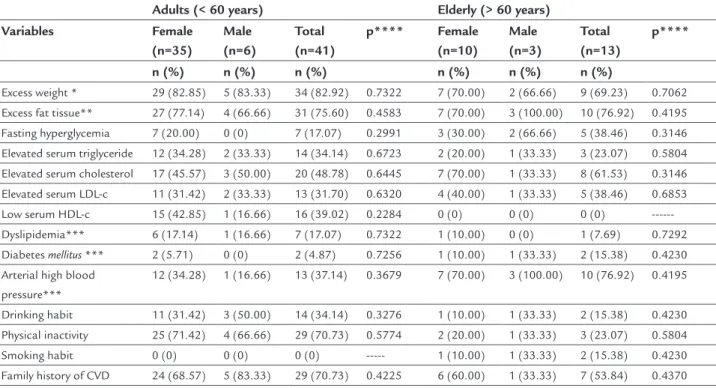
The anthropometric and biochemical variables and lifestyle of the individuals under study are displayed in Table 1. Thus, there was no significant difference (p>0.05) for these variables when compared between age group (adults and the elderly) and sex, which shows the homo-geneity of the sample. The highest frequencies found for the adult population were those pertaining to: excess weight (BMI); excess adipose tissue (according to the sum of the skin folds); physical inactivity and family history of CVD. For the elderly, in addition to the anthropomet-ric indicators of obesity, hypertension was also relevant, as it was present in 10 of the 13 elderly individuals.
Table 2 presents the average standard deviation of the anthropometric and biochemical variables of the individ-uals studied according to age group and sex. When
evalu-ated by sex and age group, women showed a higher fre-quency of obesity according to the sum of the skin folds (p<0.05). For the other parameters studied, there was no significant difference. The averages of the biochemical vari-ables of the individuals under study were: total cholester-ol 206.65 ± 44.78 mg/dL; HDL-c 58.43 ± 12.77 mg/dL; LDL-c 123.794 ± 40.67 mg/dL, triglyceride 128.11 ± 37.46 mg/dL and fasting glucose 93.15 ± 15.78 mg/dL.
According to Table 3, it is possible to observe that 91% of the individuals assessed were classified as low risk (78% male and 93% female); 7.4% as medium risk (22% male ver-sus 5.0% female) and 2% as high risk, present only in the female sex, of developing cardiovascular disease within 10 years. The only significant differences between men and women (p≤0.05) was in the relative frequency of the low cardiovascular risk, where the women in the study showed a lower risk of developing cardiovascular disease within 10 years when compared with men. Furthermore, in general, increasing age is not related with an increase in the over-all cardiovascular risk in this population, and cardiovas-cular events are happening earlier and earlier.
Lastly, there was an almost zero correlation between waist circumference measurements and cardiovascular risk of the individuals studied (r=0.065; p=0.048), there-fore there is no relationship between these parameters.
TABLE 1 Distribution of individuals with abdominal obesity according to anthropometric, biochemical, clinical and lifestyle variables, Maceió (AL), 2009.
Adults (< 60 years) Elderly (> 60 years)
Variables Female (n=35)
Male (n=6)
Total (n=41)
p**** Female (n=10)
Male (n=3)
Total (n=13)
p****
n (%) n (%) n (%) n (%) n (%) n (%)
Excess weight * 29 (82.85) 5 (83.33) 34 (82.92) 0.7322 7 (70.00) 2 (66.66) 9 (69.23) 0.7062
Excess fat tissue** 27 (77.14) 4 (66.66) 31 (75.60) 0.4583 7 (70.00) 3 (100.00) 10 (76.92) 0.4195
Fasting hyperglycemia 7 (20.00) 0 (0) 7 (17.07) 0.2991 3 (30.00) 2 (66.66) 5 (38.46) 0.3146
Elevated serum triglyceride 12 (34.28) 2 (33.33) 14 (34.14) 0.6723 2 (20.00) 1 (33.33) 3 (23.07) 0.5804
Elevated serum cholesterol 17 (45.57) 3 (50.00) 20 (48.78) 0.6445 7 (70.00) 1 (33.33) 8 (61.53) 0.3146
Elevated serum LDL-c 11 (31.42) 2 (33.33) 13 (31.70) 0.6320 4 (40.00) 1 (33.33) 5 (38.46) 0.6853
Low serum HDL-c 15 (42.85) 1 (16.66) 16 (39.02) 0.2284 0 (0) 0 (0) 0 (0)
---Dyslipidemia*** 6 (17.14) 1 (16.66) 7 (17.07) 0.7322 1 (10.00) 0 (0) 1 (7.69) 0.7292
Diabetes mellitus *** 2 (5.71) 0 (0) 2 (4.87) 0.7256 1 (10.00) 1 (33.33) 2 (15.38) 0.4230
Arterial high blood pressure***
12 (34.28) 1 (16.66) 13 (37.14) 0.3679 7 (70.00) 3 (100.00) 10 (76.92) 0.4195
Drinking habit 11 (31.42) 3 (50.00) 14 (34.14) 0.3276 1 (10.00) 1 (33.33) 2 (15.38) 0.4230
Physical inactivity 25 (71.42) 4 (66.66) 29 (70.73) 0.5774 2 (20.00) 1 (33.33) 3 (23.07) 0.5804
Smoking habit 0 (0) 0 (0) 0 (0) --- 1 (10.00) 1 (33.33) 2 (15.38) 0.4230
Family history of CVD 24 (68.57) 5 (83.33) 29 (70.73) 0.4225 6 (60.00) 1 (33.33) 7 (53.84) 0.4370
D
ISCUSSIONObesity, especially located at the abdominal or visceral level, is considered one of the greatest risk factors for cor-onary artery disease, as well as being associated with in-creased prevalence of hypertension, dyslipidemia and di-abetes, which in turn also contribute to the worsening of ischemic heart disease.15 In the present population, all of
the individuals studied were people with abdominal obe-sity, with WC values above that recommended by the IDF.11 In addition, despite the studied population not
presenting a history of cardiovascular illness or events, the presence of diseases resulting from obesity was ob-served, such as dyslipidemia, hypertension and DM.
The estimated risk of atherosclerotic disease results from the sum of the risk associated with each of the risk factors plus the escalation caused by synergism between some of these factors. Given the complexity of these in-teractions, the intuitive attribution of the risk often re-sults in underestimation or overestimation of cases with greater or lesser risk, respectively. To circumvent this dif-ficulty, several algorithms have been created based on re-gression analyses of population studies, by means of which the identification of the overall risk is improved
substan-tially. Among the existing algorithms, the Framingham Risk Score estimates the likelihood of myocardial infarc-tion or death from coronary heart disease within 10 years in individuals with no previous diagnosis of clinical ath-erosclerosis.8
The ability to estimate the absolute risk within ten years allows preventive actions, mainly directed at the population strategy, as well as the search for individuals at high cardiovascular risk.16 It should be pointed out
that the Framingham score is intended for calculation of risk for individuals without clinical manifestations of car-diovascular disease.17
The present study corroborates the study by Cavagio-ni et al.18 whose goal was to determine the prevalence of
metabolic syndrome and to identify variables related to professional drivers in transit on the Highway BR-116, where the majority of the individuals had a low cardio-vascular risk score. The authors explain this as a higher percentage of individuals in the study population in the age group of 30 to 40 years.
In addition, in study by Sampaio et al.19 with patients
seen at a family health unit (USF) in Maceió, Alagoas, aimed at estimating the absolute risk of cardiovascular
TABLE 2 Average standard deviations of anthropometric and biochemical variables in individuals with abdominal obesity according to age group and sex, Maceió (AL), 2009.
Adults (< 60 years) Elderly (> 60 years)
Variables Female (n=35)
Male (n=6)
p* Female (n=10)
Male (n=3)
p*
Body mass index (Kg/m2) 29.75±5.41 27.12±4.50 0.203 28.22±4.67 28.77±5.29 0.606
Body fat (%) 38.17±5.63 28.90±5.06 0.001 36.98±8.17 30.40±4.23 0.044
Waist circumference (cm) 98.46±10.64 102.16±13.68 0.858 95.90±16.46 103.27±7.29 0.155
Fasting blood glucose (mg/dL) 92.63±16.84 85.60±10.85 0.267 94.76±12.24 98.33±23.45 0.588
Serum triglyceride (mg/dL) 119.15±54.69 116.00±44.08 0.881 124.23±70.19 127.66±114.09 0.928
Serum cholesterol (mg/dL) 213.42±49.85 193.16±27.03 0.799 184.50±27.83 228.33±32.65 0.589
Serum HDL-c (mg/dL) 61.06±12.83 51.83±12.59 0.833 53.60±13.18 58.66±6.02 0.766
Serum LDL-c (mg/dL) 119.74±34.88 124.76±28.74 0.708 136.56±54.93 117.04±46.13 0.515
*Student’s t test.
TABLE 3 Classification of cardiovascular risk, according to the Framingham score, by age group and sex of individuals with abdominal obesity seen by a clinical school of nutrition, Maceió (AL), 2009.
Adults (< 60 years) Elderly (> 60 years) Cardiovascular risk Female
(n=35)
Male (n=6)
Total (n=41)
p* Female (n=10)
Male (n=3)
Total (n=13)
p*
n (%) n (%) n (%) n (%) n (%) n (%)
Low 33 (94.28) 5 (83.33) 38 (92.68) 0.3860 9 (90.00) 2 (66.66) 11 (84.61) 0.4230
Medium 1 (2.85) 1 (16.66) 2 (4.87) 0.2743 1 (10.00) 1 (33.33) 2 (15.38) 0.4230
High 1 (2.85) 0 (0) 1 (2.43) 0.8536 0 (0) 0 (0) 0 (0)
disease according to the Framingham score as well as re-lating to other risk factors, the results showed that 59.05% of the subjects had a low cardiovascular risk and preva-lence of risk factors such as a sedentary lifestyle, dyslip-idemia, changes in fasting glucose and high blood pres-sure. It is important to point out that the majority of in-dividuals were aged between 30-49 years, and that this is a group attended by a continuous preventive service.
In the present study, this justification cannot be tak-en into account, since more than half (71%) of the sub-jects studied are in the age group of 40 to 67 years, in ad-dition to the cardiovascular risk not being related with the increase in age. Furthermore, according to the same authors, the use of this score may not identify low-risk individuals in the short term with lifestyles that would predispose them to develop cardiovascular disease in the long term, which would justify further efforts aimed at interventions on the modifiable risk factors for cardio-vascular disease.
The results of the present research are related with the study by Rodrigues & Phillipi,20 conducted in
southeast-ern Brazil, where the women involved presented low car-diovascular risk, according to Framingham score, com-pared to men. When age is taken into account, Sanches et al.15 claim that death caused by heart disease is greater in
men (39%) than in women between the ages of 45 and 64 years of age. However, after age 65, the mortality rate for heart disease in women exceeds that of men by 22%.
In the study conducted by Texeira et al.21 aiming to
describe food consumption and cardiovascular risk fac-tors present in outpatient patients, it was noted that more than half of the population under study was obese, with 92% of individuals presenting a high WC, and about 80% of these individuals classified as high and medium risk of developing cardiovascular disease within 10 years ac-cording to the Framingham score. This does not corrob-orate our research. This fact is explained by the authors as caused by the high consumption of saturated fatty ac-ids, cholesterol, and sodium-rich food, as well as insuffi-cient intake of fruits, vegetables, legumes and fiber; and also the high prevalence of sedentary, diabetic and hyper-tensive individuals.
According to Barbosa, Scala & Ferreira22 the
increas-ing morbidity and mortality from chronic-degenerative diseases is associated with excess weight, mainly abdomi-nal fat deposits, favoring the occurrence of cardiovascular events, particularly coronary events. In the present research only 4% of the individuals studied presented a medical di-agnosis of DM compared with 23% for high blood pres-sure and 28% for HDL-c below the normal limits.
The waist circumference in this study had a weak correlation with cardiovascular risk, and was not corre-lated in a study by Casanueva,23 which aimed to assess
the relevance of abdominal obesity and obesity in the prevalence of CVD, diabetes mellitus, dyslipidemia and
hy-pertension in primary care patients and to verify wheth-er WC should be included in routine clinical practice, in addition to the body mass index. The frequency of CVD increased in parallel with increased adiposity as mea-sured by BMI or WC. Both WC and age were associated with CVD, with each additional centimeter of WC in-creasing the likelihood of CDV. Abdominal obesity was significantly associated with CVD. Some individuals with abdominal obesity but a slim BMI showed an increased prevalence of cardiovascular disease and diabetes. In ad-dition, abdominal obesity has been strongly associated with dyslipidemia and hypertension.23
Unlike that proposed by the WHO, a study by Haun,24
that aimed to compare the waist/stature ratio (WHTR) with other anthropometric indicators of obesity in order to point out the high coronary risk (HCR) concluded that WC was not the best predictor of HCR, although it pre-sented better accuracy than BMI for both sexes.
In opposition to this research, in a study by Castro et al.25 with obese and overweight individuals aiming to
assess the impact of body fat distribution on cardiovas-cular risk, it was observed that the prevalence of hyper-tension increased from 35.7% in those with WHR between 0.73 and 0.88 to 66.6% in those with WHR >0.97 (p<0.05), regardless of the BMI, and the SBP values were weakly correlated with the WC measurements (r=0,35; p<0.0001). Alves, Coutinho & Sanches,26 conducted a study to
ver-ify the association between anthropometric indicators and risk of cardiovascular disease in adults treated at the Mu-nicipal Hospital of Esteio, state of Rio Grande do Sul (RS), where there was a greater chance of high cardiovascular risk (HCR) among men with high WHR (OR: 2.98; 95CI 1.22-7.27) and increased conicity index (OR: 6.52; 95CI 1.45-29.33); while among women, there was an association between the HCR an high WHR measurements (OR: 7,05; 95CI 2.38-20.85). Unlike the present research, the inade-quacy of the WHR and conicity index were associated with high cardiovascular risk, noting that the anthropometric measurements are easy to execute and can be used to dis-criminate HCR and enable early nutritional intervention strategies.
It is important to reinforce that the traditional Fram-ingham score was an instrument developed in the 1950s and validated in the 60s and 70s,8 a period in which the
States was one-third of the current level, and acute myo-cardial infarction was more frequent in male gender.27
Since the 1980s, heart attacks are more common in wom-en and obesity has become a global epidemic.28 Therefore,
it is possible that this score has underestimated the car-diovascular risk in the current population, and is, there-fore, a limitation to the study.
C
ONCLUSIONAbdominal fat distribution was weakly related to cardiovas-cular risk in patients seen by a clinical school of nutrition.
Despite the low number of individuals at medium or high risk, the risk of developing cardiovascular disease within 10 years increases according to certain factors, such as diabetes, smoking, age, among others. In the present study, this was regardless of age group.
It has become essential to promote interventions, in-cluding educational activities about healthy eating and physical activity, since weight reduction in overweight or obese individuals leads to a significant improvement in insulin resistance and consequently a reduction in car-diovascular risk factors.
A
CKNOWLEDGMENTSNutritionists Andréa Santana dos Santos, Ana Luiza Tenório Guimarães, Fabiana Grace Araújo da Silva and Vanessa Fernanda Baia Cardoso for their contributions in data collection.
R
ESUMOAvaliação do risco cardiovascular segundo escore de Framingham e obesidade abdominal em indivíduos atendidos por uma clínica escola de nutrição
Objetivo: avaliar a relação entre a distribuição central de gordura e o risco cardiovascular em indivíduos atendidos por uma clínica escola de nutrição, classificando-os pelo escore de Framingham.
Método: estudo do tipo transversal, realizado em uma clínica escola de nutrição de uma faculdade particular da cidade de Maceió, Alagoas. Foram selecionados aleatoria-mente indivíduos adultos e idosos portadores de obesi-dade abdominal, de ambos os sexos, atendidos no perío-do de agosto a dezembro de 2009, sem histórico de miocardiopatias e eventos cardiovasculares. Para deter-minação do risco cardiovascular, foi calculado o escore de Framingham. Todas as análises foram realizadas com o auxílio do programa SPSS versão 20.0, considerando p<0,05 como significativo.
Resultados: foram estudados 54 indivíduos, sendo 83% do sexo feminino, com idade média de 48 anos, variando de 31 a 73 anos. Foi observada correlação praticamente nula entre as medidas de circunferência da cintura e o ris-co cardiovascular dos indivíduos estudados (r=0,065; p=0,048), não havendo relação entre esses parâmetros. Conclusão: a distribuição central de gordura se relacio-nou fracamente com o risco cardiovascular em indivíduos atendidos por uma clínica escola de nutrição.
Palavras-chave: obesidade abdominal, doenças cardio-vasculares, obesidade, fatores de risco.
R
EFERENCES1. Mansur AP, Favarato D. Mortalidade por doenças cardiovasculares no Brasil e na Região Metropolitana de São Paulo: Atualização 2011. Arq Bras Cardiol. 2012; 99(2):755-61.
2. Graves BW. The obesity epidemic: scope of the problem and management strategies. J Midwifery Womens Health. 2010; 55(6):568-78.
3. Catenacci VA, Hill JO, Wyatt HR. The obesity epidemic. Clin Chest Med. 2009; 30(3):415-44.
4. Harwood HJ Jr. The adipocyte as an endocrine organ in the regulation of metabolic homeostasis. Neurophamacology. 2012; 63(1):57-75. 5. Oliveira CN, Costa RG, Ribeiro RL. Obesidade abdominal associada a fatores
de risco a saúde em adultos. Saúde & Ambiente em Revista. 2008; 3(1):34-43. 6. Ponte LMB. Composição corporal e insulino-resistência. [Dissertation]. Porto: Faculdade de Ciências Sociais, Universidade Fernando Pessoa, 2011. Available from: http://bdigital.ufp.pt/bitstream/10284/2481/1/T_15226.pdf. 7. Lavie CJ, Milani RV, Artham SM, Patel DA, Ventura HO. The obesity parodox,
weight loss, and coronary disease. Am J Med. 2009; 122(12):1106-14. 8. Kannel WB, McGee D, Gordon T. A general cardiovascular risk profile: the
Framingham Study. Am J Cardiol. 1976; 38(1):46-51.
9. World Health Organization (WHO). Physical status: the use and interpretation of anthropometry. Geneva: WHO, 1995. N.452.
10. International Diabetes Federation: IDF, 2006 [cited 2012 May]. Available from: http://www.idf.org/metabolic-syndrome/faqs.
11. Wilson PWF, Ralph BDA, Levy D, Belanger AM, Silbershatz H, Kannel WB. Prediction of coronary heath disease using risk factor categories. Circulation. 1998; 97(18):1837-47.
12. V Diretriz Brasileira de Dislipidemias e Prevenção da Aterosclerose. Sociedade Brasileira de Cardiologia. Arq Bras Cardiol. 2013; 101(4 Supl 1). Available from: http://publicacoes.cardiol.br/consenso/2013/V_Diretriz_Brasileira_ de_Dislipidemias.pdf.
13. Diretriz da Sociedade Brasileira de Diabetes. Sociedade Brasileira de Diabetes. 2012-2013.
14. VI Diretriz Brasileira de Hipertensão Arterial. Arq Bras Cardiol. 2010; 95(1):1-51. 15. Koopman RJ, Swofford SJ, Beard MN, Meadows SE. Obesity and metabolic
disease. Primary care. Clin Office Pract. 2009; 36(2):257-70.
16. Lotufo PA. O escore de risco de Framingham para doenças cardiovasculares. Rev Med. 2008; 87(4):232-7.
17. Gowdak LHW, Paula FJ, Giorgi DMA, Vieira MLC, Krieger EM, De Lima JJG. Doença cardiovascular e fatores de risco cardiovascular em candidatos a transplante renal. Arq Bras Cardiol. 2005; 84(2):156-60.
18. Cavagioni LC, Beseñor IM, Halpern A, Pierin AMG. Síndrome metabólica em motoristas profissionais de transporte de cargas da rodovia BR-116 no trecho Paulista-Régis Bittencourt. Arq Bras Endocrinol Metab. 2008; 52(6):1015-23.
19. Sampaio MR, Melo MBO, Wanderley MAS. Estratificação do risco cardiovascular global em pacientes atendidos numa unidade de saúde da família (USF) de Maceió, Alagoas. Rev Bras Cardiol. 2010; 23(1):47-56. 20. Rodrigues TFF, Phillipi ST. Avaliação nutricional e risco cardiovascular em
executivos submetidos a check-up. Rev Assoc Med Bras. 2008; 54(4):322-7. 21. Teixeira AMNC, Sachs A, Santos GMS, Asakura L, Coelho LC, Silva CVD.
22. Barbosa LS, Scala LCN, Ferreira MG. Associação entre marcadores antropométricos de adiposidade corporal e hipertensão arterial na população adulta de Cuiabá, Mato Grosso. Rev Bras Epidemiol. 2009; 12(2):237-47.
23. Casanueva FF, Moreno B, Azeredo RR, Massien C, Conthe P. Relationship of abdominal obesity with cardiovascular disease, diabetes and hyperlipidaemia in Spain. Clin Endocrinol (Oxf). 2010; 73(1):35-40. 24. Haun DR, Pitanga FJG, Lessa I. Razão cintura/estatura comparado a outros
indicadores antropométricos de obesidade como preditor de risco coronariano elevado. Rev Assoc Med Bras. 2009; 55(6):705-11.
25. Carneiro G, Faria NA, Ribeiro Filho FF, Guimarães A, Lerário D, Ferreira SRG, et al. Influência da distribuição da gordura corporal sobre a prevalência de hipertensão arterial e outros fatores de risco cardiovascular em indivíduos obesos. Rev Assoc Med Bras. 2003; 49(3):306-11.
26. Alves LR, Coutinho V, Santos LC. Indicadores antropométricos associados ao risco de doença cardiovascular. Arq Sanny Pesq Saúde. 2008; 1(1):1-7. 27. Mitchell S, Shaw D. The worldwide epidemic of obesity. Best Pract Res Clin
Obstet Gynaecol. 2015; 29(3):289-99.