www.spsp.org.br
REVISTA PAULISTA
DE PEDIATRIA
1984-0462/$ - see front matter © 2014 Sociedade de Pediatria de São Paulo. Published by Elsevier Editora Ltda. All rights reserved. KEYWORDS
Adolescent;
Motor activity/criteria; Public health
Abstract
Objective: To analyze the agreement between two cutoff points for physical activity (300 and 420 minutes/week) and associated factors in youth.
Methods: The study enrolled 738 adolescents of Londrina city, Paraná, Southern Brazil. The following variables were collected by a self report questionnaire: presence of moderate to vigorous physical activity, gender, age, father and mother education level, with whom the adolescent lives, number of siblings, physical activity perception, participation in Physical Education classes, facilities available to physical activity practice and sedentary behavior. Prevalence of physical activity between criterions were compared using McNemar test and the agreement was analysed by Kappa index. Multivariate analysis was performed using Poisson regression with robust variance adjustment was applied.
Results: The prevalence for physical activity was significantly different: 22,3% for 300
minutes/week and 12,8% for 420 minutes/week (p<0,05), but the agreement was strong
(k=0,82, p<0,001). The variables gender, father education, physical activity perception and sedentary behavior were associated to physical activity in both analyzed criteria. Participation in Physical Education class and facilities available to physical activity practice were associated to physical activity only with 300 minutes/week cutoff point.
Conclusion: Caution is suggested regarding cutoffs use for physical activity in epidemiological studies, considering they can result in differences in prevalence of physical activity and its associated factors.
© 2014 Sociedade de Pediatria de São Paulo. Published by Elsevier Editora Ltda. All rights reserved.
oRIgINAL ARTICLE
Agreement between two cutoff points for physical activity and
associated factors in young individuals
☆Diogo Henrique Constantino Coledam*, Philippe Fanelli Ferraiol, Raymundo Pires Júnior,
Edinéia Aparecida Gomes Ribeiro, Marco Antonio Cabral Ferreira, Arli Ramos de Oliveira
Universidade Estadual de Londrina (UEL), Londrina, PR, Brazil
Received 1 November 2013; accepted 27 January 2014
DoI refers to: 10.1590/0103-0582201432311
☆Study conducted at Universidade Estadual de Londrina, Londrina, PR, Brazil.
*Corresponding author.
PALAVRAS-CHAVE Adolescente; Atividade motora/ critério;
Saúde pública
Concordância entre dois pontos de corte para atividade física e fatores associados em jovens
Resumo
Objetivo: Analisar a concordância entre dois pontos de corte para atividade física (300 e 420 minutos/semana) e os fatores associados em jovens.
Métodos: Participaram do estudo 738 adolescentes da cidade de Londrina-PR, Brasil. A prática de atividade física em intensidade moderada a vigorosa e as variáveis sexo, idade, escolaridade paterna e materna, com quem mora, número de irmãos, percepção de atividade física, participação nas aulas de educação física, local para prática de ati-vidade física e comportamento sedentário foram coletadas por meio de um questionário. A prevalência de atividade física entre os critérios foi comparada por meio do teste de McNemar, a concordância avaliada, por meio do índice Kappa, e a análise multivariada, por meio da regressão de Poisson com ajuste robusto da variância.
Resultados: A prevalência de atividade física foi significativamente diferente: 22,3% para
300 minutos/semana e 12,8% para 420 minutos/semana (p<0,05), e a concordância foi
forte (k=0,82, p<0,001). As variáveis sexo, escolaridade paterna, percepção de atividade física e comportamento sedentário se associaram com a atividade física em ambos os critérios analisados. A participação nas aulas de educação física e a disponibilidade de locais para prática se associaram apenas com o ponto de corte 300 minutos/semana.
Conclusões: Sugere-se cautela ao utilizar pontos de corte para atividade física em estu-dos epidemiológicos, considerando que pode resultar em diferença na prevalência de atividade física e dos fatores a ela associados.
© 2014 Sociedade de Pediatria de São Paulo. Publicado por Elsevier Editora Ltda. Todos os direitos reservados.
Introduction
Physical activity has been investigated in different age
groups due to its positive association with health.1 The
recommendation for physical activity for children and ado-lescents is 60 minutes at a moderate-to-vigorous intensity, at least five days a week, and performing more than this
daily can produce additional health benefits.2 Therefore,
active adolescents have a better cardiometabolic profile and a higher degree of physical fitness related to health, mental health, and nutritional status.3-5
In Brazil, several epidemiological studies have been performed to identify the prevalence and factors associ-ated with physical activity among adolescents. The
preva-lence of physical activity ≥300 minutes/week in Brazilian
adolescents from different regions of the country ranges
from 14.5% to 50%.6-12 Due to the low prevalence of young
individuals who meet the recommendations of weekly physical activity, several studies have sought to identify factors associated with physical activity in this age group. In general, the factors positively associated with physical activity of young Brazilians are male gender,7,9,10,13
socio-economic status,9 maternal and paternal education,8 and
participation in physical education classes,7-9 while
seden-tary behavior,9,11,13 work,7 age,9 and night study12 are
fac-tors negatively associated with physical activity.
Concerning the level of weekly activity by adolescents, although there is a recommendation of performing moder-ate to vigorous physical activity for 60 minutes daily, and because performing 60 minutes daily produces additional
benefits,2 studies have used 300 minutes/week as the
cut-off,6-9,11,12,14 as well as 420 minutes/ week.5,13,15-19
Nevertheless, it is not known whether using different cut-offs for physical activity among young individuals results in similar prevalence and factors associated to physical activity.
The absence of information that show the association between the cutoff and the factors associated with physi-cal activity have resulted in the use of different cutoffs in epidemiological studies, a fact that hinders the interpreta-tion of results.20 Thus, the objectives of this study were: a)
to analyze the agreement between two cutoffs (300 and 420 minutes) regarding the prevalence of active young individu-als, and b) to identify factors associated with physical activ-ity in each cutoff.
Methods
This was a cross-sectional study of children and adolescents from the public schools of the city of Londrina, state of Paraná, Brazil, carried out in the second quarter of 2012. According to a survey by the Regional Education Center, 55,475 children and adolescents were enrolled from the sixth grade of elementary school to the third year of high school in the public schools of the city in 2012.
To calculate the sample size, the following parameters were used: population of 55,475 school children,
preva-lence of outcome 35%,7 confidence interval of 95%, and
sampling error of 5%. Thus, the minimum required sample size was 347 students. In order to increase the precision of the estimates, given that the present study used com-plex sampling, a design effect (Deff) of two was applied to sample size, producing a total of at least 694 students.
The present study evaluated 965 students, with a final sample of 738 participants, as data was only analyzed from subjects who completed the questionnaire correctly. There was a loss of 23.5%, and individuals who did not complete the questionnaire were 50% females. Regarding age, 48.6% were 10-13, 37.2% were 14-16, and 14.2% were 17 years of age; 24.3% met the criterion for physical activity of 300 minutes/week, and 13.5%, the criterion for 420 minutes/ week.
The study was approved by the Ethics Committee of Research on Human Subjects of Universidade Estadual de Londrina, protocol No. 312/2011, according to Resolution 196/96 of the National Health Council. All parents/guard-ians of the students who agreed to participate signed the informed consent, which described all the procedures that would be performed and provided contact information to clarify possible questions. At the end of the study, the results were presented to each school through individual reports.
All procedures were performed in the classrooms of the schools on a single day, by five trained researchers supervised by the study coordinator. The dependent vari-able, moderate-to-vigorous weekly physical activity, was assessed by section 2 of the physical activity questionnaire
proposed by Baecke et al in 1982,21 which estimates the
amount of physical activity through sports or physical exer-cise programs according to the activity intensity.
The criteria used concerned the recommendation of physical activity in young individuals: 60 minutes of moder-ate-to-vigorous physical activity at least five days a week
(300 minutes), and 60 minutes daily (420 minutes).2
Participants reported gender and date of birth in the questionnaire, which were verified through the students’ list of the Regional Education Center. The independent variable, paternal and maternal education, was estab-lished by the question about the educational level of the household head contained in the Associação Brasileira de
Empresas de Pesquisa (ABEP) 2012 questionnaire.22 The
per-ception of physical activity was estimated using the ques-tion “Compared to other people of the same age, do you believe that the activities performed during your free time are physically very high, high, equal, low, or very low?”.21
The number of siblings was estimated through the open question “How many siblings do you have?” To analyze the persons with whom the participant lived, the question used was “Who do you live with?”, and the response options were “With my father and mother”, “only with my mother” “only my father”, and “Neither”. The availability of places to practice physical activity nearby home was assessed by the question “In your neighborhood, is there an adequate place (square, park, court, field, or club) for you to play or practice any sports?” with response options “No”, “Yes, just one”, and “Yes, more than one.”
given that the curriculum of the state schools in Paraná includes two physical education classes a week, informa-tion on class participainforma-tion was obtained through the ques-tion “Do you participate in physical educaques-tion classes?”, with possible responses “Yes, both”, “Yes, just one”, and “No”. The results were dichotomized into “yes” to those who claimed to attend two classes per week, and “no” to those who participated in only one or did not participate in the classes.
Sedentary behavior was estimated by the question “How many hours on average do you watch TV, play video games, or use the computer?” With response options “<1 hour each day”, “1 hour each day”, “2 hours each day”, “3 hours each day”, “4 hours each day”, and “5 or more hours each day” during weekdays. Responses were dichotomized as
≤2 hours/day or >2 hours/day.23
The reliability of the questionnaire used in this study was tested on 70 schoolchildren, within a seven-day interval. For categorical variables, all questions showed acceptable reliability, with question agreement tested using the Kappa index ranging from 65% to 100% between the two moments. For the number of siblings, a discrete numerical variable, the reliability was high, with intraclass association coef-ficient =0.964 (0.926-0.983).
Absolute and relative frequencies were used for the descriptive statistics. To assess the bivariate association between the independent variables and the two criteria for moderate-to-vigorous physical activity, the chi-squared
test (χ2) was used. The variables that showed an
associa-tion of up to 20% were included in the multivariate analy-sis, performed by Poisson regression with robust variance adjustment to estimate the prevalence ratios and respec-tive 95% confidence intervals.
The variables were included in the model in three hier-archical levels, adjusted for the variables of the same level and the level above. At level 1 the variables gender, age, and maternal and paternal education were inserted; at level 2, the variable place available for physical activ-ity was inserted; level 3 included the variables perceived physical activity, participation in physical education class-es, place for physical activity, and sedentary behavior. The complex sample model was considered according to the sample cluster.
The McNemar test was used to compare the preva-lence rates between the criteria. To analyze the agree-ment between the criteria of 300 and 420 minutes/ week, as well as the questionnaire reliability, the Kappa index was applied, adjusted by prevalence and inter-preted in accordance with the classification: <0=poor; 0-0.20=weak; 0.21-0.40=reasonable; 0.41-0.60=moderate; 0.61-0.80=strong; 0.81-1.00=almost perfect. In all cases, the significance was set at 5%.
Results
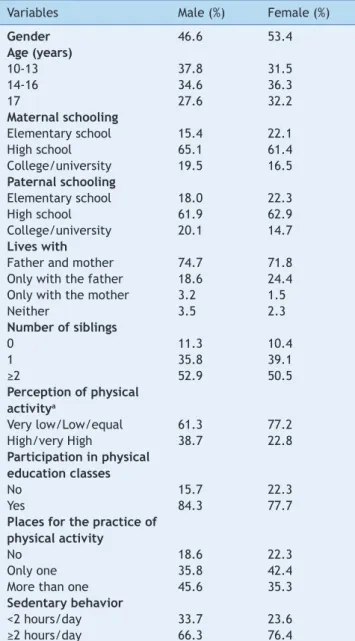
individu-Table 1 Sample characteristics (n=738)
Variables Male (%) Female (%)
Gender 46.6 53.4
Age (years)
10-13 37.8 31.5
14-16 34.6 36.3
17 27.6 32.2
Maternal schooling
Elementary school 15.4 22.1
High school 65.1 61.4
College/university 19.5 16.5
Paternal schooling
Elementary school 18.0 22.3
High school 61.9 62.9
College/university 20.1 14.7
Lives with
Father and mother 74.7 71.8
only with the father 18.6 24.4
only with the mother 3.2 1.5
Neither 3.5 2.3
Number of siblings
0 11.3 10.4
1 35.8 39.1
≥2 52.9 50.5
Perception of physical activitya
Very low/Low/equal 61.3 77.2
High/very High 38.7 22.8
Participation in physical education classes
No 15.7 22.3
Yes 84.3 77.7
Places for the practice of physical activity
No 18.6 22.3
only one 35.8 42.4
More than one 45.6 35.3
Sedentary behavior
<2 hours/day 33.7 23.6
≥2 hours/day 66.3 76.4
aCompared to individuals of the same age
als had parents with high school education, lived with both
parents (father and mother), and had ≥2 siblings. Regarding
the perception of physical activity in relation to individu-als of the same age, both boys and girls perceived them-selves as below or equal, participated in physical education
classes, and had sedentary behavior >2 hours/day. Among
males, a higher proportion of individuals reported having more than one place for physical activity practice, while females reported having only one.
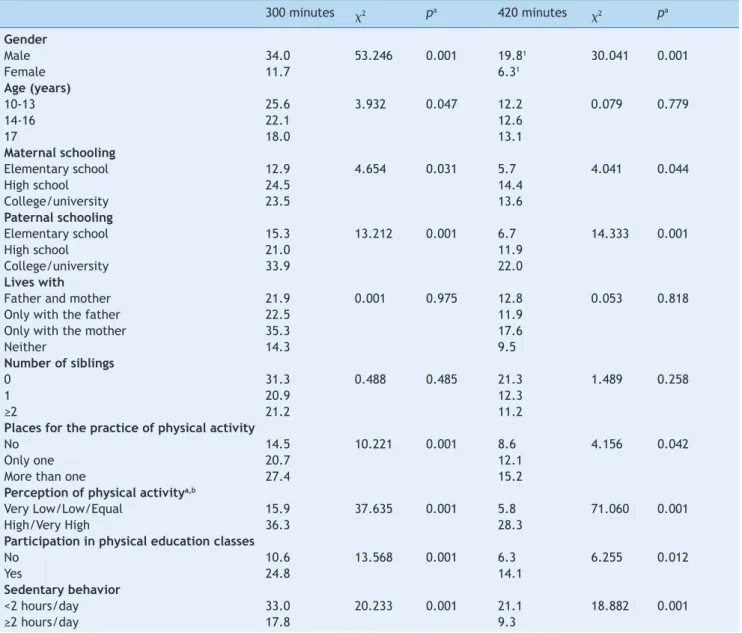
The results concerning the bivariate analysis of the association between meeting the criteria of physi-cal activity and the independent variables, as well as the comparison of prevalence between the criteria are described in Table 2. A significant difference was found in prevalence rates between the two criteria (22.1% for
300 min vs. 12.6% for 420 min, p<0.05). The variables
gender (male), maternal and paternal education, physi-cal activity perception, participation in physiphysi-cal
educa-tion classes, and number of places to practice physical activity were positively associated, while sedentary behavior was negatively associated with physical activity
in both criteria (p<0.05). Age was associated only with
the criterion of 300 min. The agreement of the preva-lence of meeting the physical activity recommendation
was considered strong, with k=0.816, p<0.001, agreeing
in 90.5% of cases.
Table 3 presents the results of the multivariate analysis adjusted according to the hierarchical level. The variables gender (male), paternal education (university degree), perception of physical activity (high or very high), and sedentary behavior (<2 hours/day) were positively associ-ated with physical activity in both cutoff points studied. Conversely, participation in physical education classes and
availability of places for physical activity (>1) were posi -tively associated with physical activity only when the cut-off used was 300 minutes/week.
Discussion
The main findings of this study were that the cutoffs for moderate-to-vigorous physical activity of 300 and 420 minutes/week showed strong agreement (90.5% of cases). However, a significant difference (9.5%) was observed in the prevalence of meeting the recommendation. In addi-tion, gender, parental educaaddi-tion, perception of physical activity, and sedentary behavior were associated with physical activity in both cutoffs. Conversely, participation in physical education classes and availability of places for physical activity practice were associated with physical activity only when using the cutoff of 300 minutes/week.
The prevalence of individuals who meet the recommen-dation of moderate-to-vigorous physical activity weekly was found to be 22.1% for 300 minutes and 12.6% for 420 minutes. The results are within the range observed in other studies that used 300 minutes as the cutoff point (14.5% to
50%),6-12 but lower than those found when the cutoff point
used was 420 minutes, which ranged from 15 to 49.5%.13,15,18
A noteworthy result is that when comparing the prev-alence rates of compliance with the recommendation of physical activity using the cutoffs of 300 and 420 minutes, a significant difference was observed. These data demon-strate that, along with other factors such as sample
char-acteristics and type of assessment tool used,20 the cutoff
alone significantly influences the prevalence value of phys-ical activity in young individuals.
Table 2 Prevalence of meeting the recommendation of moderate-to-vigorous physical activity of 300 and 420 minutes/week according to the independent variables analyzed
300 minutes χ2 pa 420 minutes χ2 pa
Gender
Male 34.0 53.246 0.001 19.81 30.041 0.001
Female 11.7 6.31
Age (years)
10-13 25.6 3.932 0.047 12.2 0.079 0.779
14-16 22.1 12.6
17 18.0 13.1
Maternal schooling
Elementary school 12.9 4.654 0.031 5.7 4.041 0.044
High school 24.5 14.4
College/university 23.5 13.6
Paternal schooling
Elementary school 15.3 13.212 0.001 6.7 14.333 0.001
High school 21.0 11.9
College/university 33.9 22.0
Lives with
Father and mother 21.9 0.001 0.975 12.8 0.053 0.818
only with the father 22.5 11.9
only with the mother 35.3 17.6
Neither 14.3 9.5
Number of siblings
0 31.3 0.488 0.485 21.3 1.489 0.258
1 20.9 12.3
≥2 21.2 11.2
Places for the practice of physical activity
No 14.5 10.221 0.001 8.6 4.156 0.042
only one 20.7 12.1
More than one 27.4 15.2
Perception of physical activitya,b
Very Low/Low/Equal 15.9 37.635 0.001 5.8 71.060 0.001
High/Very High 36.3 28.3
Participation in physical education classes
No 10.6 13.568 0.001 6.3 6.255 0.012
Yes 24.8 14.1
Sedentary behavior
<2 hours/day 33.0 20.233 0.001 21.1 18.882 0.001
≥2 hours/day 17.8 9.3
ap-value referring to Chi-squared test. bCompared to individuals of the same age.
physical activity,25 availability of places for physical activity
practice,6,26 participation in physical education classes,7-9
and sedentary behavior.9,11,13
However, other studies have observed the opposite, i.e., that physical activity is not associated with paternal edu-cation,10,11 participation in physical education classes,12 nor
sedentary behavior;12 that 40% of adolescents overestimate
their physical activity;27 and that it is not associated with
the number of leisure facilities for females.6
In spite of the discrepancies found in literature, there is a greater amount of evidence indicating that physical activity is associated with male gender, paternal educa-tion, perceived physical activity, participation in physical education classes, and sedentary behavior, and that the difference in results can be partly explained by the char-acteristics of the studied samples. Thus, it is suggested that the results of each study should only be generalized to similar samples.
Regardless of the factors found to be associated with physical activity, the present study’s main objective was to assess whether such factors among adolescents are the same when the two cutoffs used in the literature (300 and 420 min/week) are applied. The results indicated that, of the ten factors analyzed, there was agreement between the criteria in eight, with associations found between physical activity and gender, paternal educational level, perception of physical activity, and sedentary behavior. This suggests that, when analyzing different volumes of activity within the recommended range for young individuals, these fac-tors are appropriate to predict physical activity in this age group. Thus, when analyzing these variables, both cutoffs can be used in epidemiological studies.
within the recommended range, higher volumes of physi-cal activity are independent from these factors. Therefore, they should be used cautiously in epidemiological studies, as the association between physical activity and participa-tion in physical educaparticipa-tion classes and availability of places for physical activity practice depend on the cutoff used. Possibly, for higher volumes of physical activity, in addition to the variables analyzed in this study, other factors may be determinant, such as health status, self-efficacy, motiva-tion, and urban planning.28
Regarding the amount of physical activity required to produce health benefits, it has been described that a
vol-ume of moderate-to-vigorous physical activity ≥55 min -utes/day (385 minutes/week) discriminates normal weight
adolescents from overweight, whereas ≥49 minutes/day
(343 minutes/week) discriminates those with normal
per-centage of body fat from those with excess body fat,29
values similar to those found by Wittmeyer30 (45 minutes/
day, resulting in 315 minutes/week). Similarly, values of at least 52 minutes/day (364 minutes/week) for boys and
51 minutes/day (357 minutes/week) for girls prevent low
cardiorespiratory fitness in adolescents.30 Higher values
were found in a recent study, which demonstrated that the minimum amount of moderate to vigorous physical activity to prevent overweight in children was 67 minutes/day (469 minutes/week) when the analyzed outcome was BMI and percentage of body fat, and 47 minutes/day (329 minutes/
week) when the outcome was waist circumference.31
For girls, the required amount was 57 minutes/day (399
minutes/week).31 However, Morrow et al5 demonstrated
that adolescents who meet the recommendation of 420 minutes/week of moderate to vigorous physical activity were three times more likely to meet the grouped criteria for cardiorespiratory fitness, muscle strength, and BMI.
The results of the present study demonstrate that some factors associated with physical activity are modified according to the cutoff used, which suggests standardizing the criteria used in epidemiological studies. However, the choice of a cutoff in such studies should be based on the capacity of these cutoffs to diagnose health-related out-Table 3 Adjusted and crude prevalence ratio (PR) of meeting the recommendation of moderate-to-vigorous physical activity of 300 and 420 minutes/week according to the independent variables analyzed.
300 Minutes 420 Minutes
Crude PR Adjusted PR Crude PR Adjusted PR Level 1
Gender
Male 1.00 1.00 1.00 1.00
Female 0.34 (025-0.47) 0.36 (0.27-0.50) 0.32 (0.21-0.50) 0.34 (0.22-0.53) Age (years)
10-13 1.00 1.00 1.00 1.00
14-16 0.86 (0.63-1.18) 0.93 (0.68-1.30) 1.03 (0.65-1.63) 1.12 (0.71-1.78)
17 0.70 (0.50-0.99) 0.74 (0.53-1.04) 1.07 (0.67-1.72) 1.11 (0.70-1.76)
Maternal schooling
Elementary school 1.00 1.00 1.00 1.00
High school 1.90 (1.20-3.01) 1.56 (0.95-2.56) 2.51 (1.23-5.11) 1.79 (0.77-4.14) College/university 1.82 (1.07-3.10) 1.20 (0.66-2.18) 2.38 (1.07-5.30) 1.31 (0.50-3.51) Paternal schooling
Elementary school 1.00 1.00 1.00 1.00
High school 1.37 (0.90-2.08) 1.15 (0.74-1.78) 1.79 (0.93-3.42) 1.35 (0.65-2.84) College/university 2.20 (1.41-3.46) 1.79 (1.08-2.96) 3.30 (1.67-7.54) 2.50 (1.09-5.73) Level 2
Places for the practice of physical activity
No 1.00 1.00 1.00 1.00
only one 1.42 (0.91-2.23) 1.42 (0.93-2.18) 1.41 (0.77-2.59) 1.43 (0.79-2.58) More than one 1.89 (1.23-2.90) 1.62 (1.07-2.46) 1.77 (0.99-3.19) 1.55 (0.87-2.76) Level 3
Perception of physical activitya
Very low/Low/equal 1.00 1.00 1.00 1.00
High/very high 2.28 (1.75-2.97) 1.75 (1.35-2.29) 4.85 (3.23-7.27) 3.84 (2.50-5.92) Participation in physical education
classes
Yes 1.00 1.00 1.00 1.00
No 0.42 (0.26-0.70) 0.58 (0.35-0.96) 0.45 (0.23-0.87) 0.77 (0.40-1.49)
Sedentary behavior
<2 hours/day 1.86 (1.42-2.42) 1.33 (1.02-1.73) 2.27 (1.56-3.30) 1.59 (1.09-2.33)
≥2 hours/day 1.00 1.00 1.00 1.00
comes. Regarding physical activity, this becomes difficult, considering that the available evidence shows health ben-efits with amounts within the range of 300 to 469 minutes/ week, the fact that benefits can be linear, and that the necessary amount of physical activity is different for dif-ferent aspects of health.5,29-31
The present study had some limitations that should be considered. First, although there is a more accurate meth-od to estimate physical activity, for instance, using accel-erometry in epidemiological studies, the questionnaire is a more practical method and has been widely used. In addi-tion, other predictors of physical activity, such as moti-vational factors and urban planning, were not analyzed, and it is not possible to identify whether the factors that have a causal association with physical activity are associ-ated differently according to the cutoff used. Finally, the study sample did not provide sufficient power to detect the association between physical activity and places available for physical activity practice when using the cutoff of 420 minutes, as well as to conduct the analysis stratified by gender and age. It is suggested that future studies assess the association of the criteria for physical activity in young individuals according to gender and age.
In conclusion, although the agreement between the cut-offs of 300 and 420 minutes/week in young individuals is considered strong, the prevalence of physical activity found in the two cutoffs was significantly different. Regarding associated factors, gender, paternal education, perceived physical activity, and sedentary behavior were associated with physical activity in both cutoffs. However, participa-tion in physical educaparticipa-tion classes and the places available for physical activity practice were only associated with the cutoff for physical activity of 300 minutes/week. The results suggest caution when using cutoffs for physical activity of 300 and 420 minutes/week in young individuals, as, although both are within the recommended range for this age group, they result in different prevalence values. Similarly, the association between the factors participation in physical education classes and available places to practice physi-cal activity depends on the cutoff used. Thus, care must be taken when analyzing the factors associated with physical activity in young individuals and when applying predictive models resulting from studies that used different cutoffs.
Conlicts of interest
The authors declare no conflicts of interest.
References
1. Lloyd-Jones DM, Hong Y, Labarthe D, Mozaffarian D, Appel LJ, Van Horn L et al. Deining and setting national goals for cardiovascular health promotion and disease reduction: the American heart association’s strategic impact goal through 2020 and beyond. Circulation 2010;121:586-613.
2. World Health organization. global recommendations on physical activity for health. geneva: WHo; 2010.
3. Ekelund U, Luan J, Sherar LB, Esliger DW, griew P, Cooper A et al. Moderate to vigorous physical activity and sedentary
time and cardiometabolic risk factors in children and adolescents. JAMA 2012;307:704-12.
4. Kremer P, Elshaug C, Leslie E, Toumbourou JW, Patton gC, Williams J. Physical activity, leisure-time screen use and depression among children and young adolescents. J Sci Med Sport; Epub 2013 Mar 12.
5. Morrow JR Jr, Tucker JS, Jackson AW, Martin SB, greenleaf CA, Petrie TA. Meeting physical activity guidelines and health-related itness in youth. Am J Prev Med 2013;44:439-44. 6. Lima AV, Fermino RC, oliveira MP, Añez CR, Reis RS. Perceived
distance to recreational and the association with physical activity and exercise among adolescents in Curitiba, Paraná state, Brazil. Cad Saude Publica 2013;29:1507-21.
7. Tenório MC, Barros MV, Tassitano RM, Bezerra J, Tenório JM, Hallal PC. Physical activity and sedentary behavior among adolescent high school students. Rev Bras Epidemiol 2010;13:105-17.
8. Farias Júnior JC, Lopes Ada S, Mota J, Hallal PC. Physical activity practice and associated factors in adolescents in Northeastern Brazil. Rev Saude Publica 2012;46:505-15. 9. Ceschini FL, Andrade DR, oliveira LC, Araújo Junior JF,
Matsudo VK. Prevalence of physical inactivity and associated factors among high school students from state’s public schools. J Pediatr (Rio J) 2009;85:301-6.
10. Fermino RC, Rech CR, Hino AA, Rodriguez Añez CR, Reis RS. Physical activity and associated factors in high-school adolescents in Southern Brazil. Rev Saude Publica 2010;44:986-95.
11. Dumith SC, Domingues MR, gigante DP, Hallal PC, Menezes AM, Kohl HW. Prevalence and correlates of physical activity among adolescents from Southern Brazil. Rev Saude Publica 2010;44:457-67.
12. Silva KS, Nahas MV, Peres Kg, Lopes AS. Factors associated with physical activity, sedentary behavior, and participation in physical education among high school students in Santa Catarina state, Brazil. Cad Saude Publica 2009;25:2187-200. 13. Barbosa Filho VC, Campos W, Bozza R, Lopes AS. The
prevalence and correlates of behavioral risk factors for cardiovascular health among Southern Brazil adolescents: a cross-sectional study. BMC Pediatr 2012;25:12-130.
14. Farias Júnior JC, Siqueira FV, Nahas MV, Barros MV. Prevalence and associated factors to insuficient level physical activity and in youth from two city of Brazil: last seven days or typical week. Rev Bras Educ Fis Esporte 2011;25:619-29.
15. Dumith SC, Muniz LC, Tassitano RM, Hallal PC, Menezes AM. Clustering of risk factors for chronic diseases among adolescents from Southern Brazil. Prev Med 2012;54:393-6. 16. Dumith SC, gigante DP, Domingues MR, Hallal PC, Menezes
AM, Kohl HW 3rd. Predictors of physical activity change during adolescence: a 3.5-year follow-up. Public Health Nutr 2012;15:2237-45.
17. Mitchell JA, Pate RR, España-Romero V, o’Neill JR, Dowda M, Nader PR. Moderate-To vigorous physical activity is associated with decreases in body mass index from ages 9 to 15 years. obesity (Silver Spring) 2013;21:E280-93.
18. Song M, Carroll DD, Fulton JE. Meeting the 2008 physical activity guidelines for Americans among U.S. youth. Am J Prev Med 2013;44:216-22.
19. Jose KA, Blizzard L, Dwyer T, McKercher C, Venn AJ. Childhood and adolescent predictors of leisure time physical activity during the transition from adolescence to adulthood: a population based cohort study. Int J Behav Nutr Phys Act 2011;8:54.
21. Baecke JA, Burema J, Frijters JE. A short questionnaire for the measurement of habitual physical activity in epidemiological studies. Am J Clin Nutr 1982;36:936-42.
22. Associação Brasileira de Empresas de Pesquisa [homepage on the Internet]. Critério de Classiicação Econômica do Brasil, 2012 [cited 2012 Apr 12]. Available from: http://www.abep.org 23. Tremblay MS, Leblanc Ag, Janssen I, Kho ME, Hicks A, Murumets K
et al. Canadian sedentary behaviour guidelines for children and youth. Appl Physiol Nutr Metab 2011;36:59-64.
24. Jiménez-Pavón D, Fernández-Alvira JM, te Velde SJ, Brug J, Bere E, Jan N et al. Associations of parental education and parental physical activity (PA) with children’s PA: the ENERgY cross-sectional study. Prev Med 2012;55:310-4.
25. Crocker PR, Eklund RC, Kowalski KC. Children’s physical activity and physical self-perceptions. J Sports Sci 2000;18:383-94. 26. Floyd MF, Bocarro JN, Smith WR, Baran PK, Moore RC, Cosco Ng
et al. Park-based physical activity among children and adolescents. Am J Prev Med 2011;41:258-65
27. Corder K, Van Sluijs EM, McMinn AM, Ekelund U, Cassidy A, Grifin SJ. Perception versus reality awareness of physical activity levels of British children. Am J Prev Med 2010; 38:1-8.
28. Bauman AE, Reis RS, Sallis JF, Wells JC, Loos RJ, Martin BW et al. Correlates of physical activity: why are some people physically active and others not? Lancet 2012;380:258-71. 29. Martinez-gomez D, Ruiz JR, ortega FB, Casajús JA, Veiga oL,
Widhalm K et al. Recommended levels and intensities of physical activity to avoid low-cardiorespiratory itness in European adolescents: the Helena study. Am J Hum Biol 2010;22:750-6.
30. Wittmeier KD, Mollard RC, Kriellaars DJ. Physical activity intensity and risk of overweight and adiposity in children. obesity (Silver Spring) 2008;16:415-20.