International Journal of Environmental Research and Public Health ISSN 1660-4601 www.mdpi.com/journal/ijerph Article
Body Image and Nutritional Status Are Associated with Physical
Activity in Men and Women: The ELSA-Brasil Study
Carolina G. Coelho 1,*, Luana Giatti 1,2, Maria D. C. B. Molina 3, Maria A. A. Nunes 4 and
Sandhi M. Barreto 1
1 Public Health Postgraduate Program, Research Group on Epidemiology of Chronic and
Occupational Diseases (GERMINAL), Universidade Federal de Minas Gerais, Belo Horizonte, 31270-901, Brazil; E-Mails: [email protected] (L.G.); [email protected] (S.M.B.)
2 Nutrition School, Universidade Federal de Ouro Preto, Ouro Preto, 35400-000, Brazil
3 Postgraduate Program in Public Health, Universidade Federal do Espírito Santo, Vitória,
29043-900, Brazil; E-Mail: [email protected]
4 Postgraduate Program in Epidemiology, Universidade Federal do Rio Grande do Sul, Porto Alegre,
90035-003, Brazil; E-Mail: [email protected]
* Author to whom correspondence should be addressed; E-Mail: [email protected]; Tel.: +55-31-3409-9140.
Academic Editor: Paul B. Tchounwou
Received: 7 April 2015 / Accepted: 15 May 2015 / Published: 29 May 2015
Keywords: ELSA-Brasil; physical activity; body image; nutritional status; adults; sex differences
1. Introduction
Even though the importance of physical activity is widely recognized, millions of adults remain sedentary, resulting in alarming sedentary lifestyle rates [1]. Considering the world population, approximately 31% of the adults are physically inactive [2], but more than 60% of them are not sufficiently active in order to obtain health benefits, according to the World Health Organization [1,3]. In Brazil, estimates for all capitals and the Federal District, also show that only one third of adults practice the recommended amount of physical activity during their leisure time, being this percentage higher among men (41.2%) than among women (27.4%) [4].
Obesity and abdominal obesity are associated independently with morbidity and mortality [5] and physical activity is a key point to manage this worldwide epidemic [6]. The association between obesity and sedentary lifestyle is dynamic, for obesity can be either the consequence or the cause of sedentary behavior [7]. Physical inactivity contributes to weight gain, because it leads to an adverse energetic balance [8]. On the other hand, obese people tend to be less active, in part due to mobility problems caused by obesity and/or to embarrassment related to a negative body image [9,10]. A longitudinal study with a middle-aged cohort suggested that higher body weight, body mass index and fat mass may predict future sedentary behavior, independent of baseline confounding factors. Therefore, the increase in the prevalence of obesity also contributes to the rising of physical inactivity levels [7].
Body image can be defined as a multifaceted psychological construct that includes subjective attitudinal and perceptual experiences about one’s body, particularly its appearance [11]. The construction and perception of body image are strongly influenced by social standards and the media, which advertise almost unattainable perfect bodies in most Western countries [12]. Usually, women present more body weight/shape concerns than men [13] and tend to consider thinness as the preferred body image style [14]. Despite the concerns about body image are often associated with adolescence in the literature [11,14,15], these concerns also affect adults, especially women. One explanation for the women’s permanent concern with their body image would be the so-called “double standard of aging”. This concept suggests that modern urbanized societies allow two standards of male beauty (the boy and the man), but only one for females (the girl). Consequently, growing older for women in Western society means that they will have to cope with the stigma of unattractiveness simply because of the aging process [16].
of 19,003 participants of the Aerobics Center Longitudinal Study (ACLS), in which the weight satisfaction was independently associated with being moderate to vigorously active [20].
In theory, individuals who feel dissatisfaction about their body image are more likely to engage in behaviors to fight the discomfort [18]. However, the literature has shown that a negative body image may decrease the motivation to practice physical activity [21]. Kruger et al. [22] observed in 10,021 participants of the National Physical Activity and Weight Loss Survey (NPAWLS) that white men and women who were somewhat or not satisfied with their body size were less likely to be regularly active.
Research on gender differences indicates that males and females exhibit different aspects that encourage the practice of physical activity. In general, men seek to gain muscular mass and do the activity for challenge or competition [23,24] and strength [23], which may explain the fact that they are more active and practice more vigorous activities [1]. Appearance, physical condition [24] and weight management [23] are the most common motives for women to do physical activity and they are more prone to choose and practice mild physical exercises, such as walking and dance to maintain or lose weight and gain firmness [25].
Few studies have investigated, simultaneously, whether body image dissatisfaction and obesity are associated with the practice of physical activity during leisure time and if these associations differ significantly among men and women. The majority of the published studies were carried out in high-income countries, where patterns of physical activity are different from those observed in developing countries, such as Brazil [3,22]. Most studies that also address body image refer to children and adolescents [11,14,15,26,27]. Moreover, body image might have even greater role in promoting physical activity in a tropical country, due to greater exposure and concern about body shape, as compared to temperate countries [25].
The present study investigates whether dissatisfaction with body image, obesity and central obesity are independently associated with physical activity and if such association is different among men and women participants in the Longitudinal Study of Adult Health (ELSA-Brasil). The main hypothesis is that moderate or intense physical activity is less frequent among individuals who are dissatisfied with their body image, and those who are obese and/or have greater central adiposity indicator. We believe that the dissatisfaction with own body image is more strongly related to the practice of physical activity among women than men, independent of nutritional indicators. Conversely, we think that anthropometric indicators are more frequently related to the practice of physical activity among men, independent of body image dissatisfaction.
2. Methods
2.1. Design
participated in the study. The study was conducted in accordance with the Declaration of Helsinki, and the protocol was approved by National Research Ethics Committee (CONEP N. 13065).
2.2. Participants
The present analysis included all individuals aged between 35 and 64 years who answered the questionnaire about physical activity and about the other variables of interest. The respondent mean age was 50 years (SD = 0.6). The individuals with 65 years or more were excluded from this study (n = 1591) because the International Physical Activity Questionnaire (IPAQ) used to ascertain physical activity is not recommended for individuals aged 65 years and more [30]. We also excluded from the present analysis all individuals with a body mass index inferior to 17 kg/m2 (n = 21) due to the greater
probability of health problems that can influence the physical activity practice among this group [31], as the presence of eating disorders [32,33], body image distortions [33] and weight loss attempts related to psychological symptoms [34].
2.3. Outcome of Interest
Trained personnel applied the Brazilian version of the short form IPAQ in face-to-face interviews in order to assess physical activity. The short form IPAQ was validated in several countries, including Brazil [35]. The procedures described in the Guidelines for Data Processing and Analysis of the International Physical Activity Questionnaire were employed in order to calculate the scores of physical activity, where each type of activity has a specific MET score: 3.3 METs for walking, 4.0 METs for moderate intensity activities and 8.0 METs for high intensity activities. Considering the quantity of days per week and minutes spent on each type of activity, we obtain the total of MET-min per week.
The physical activity was categorized into: (a) low (those who do not exercise and who did not meet the criteria to be included into the other categories); (b) moderate (three or more days of high intensity activity during at least 20 min each day; or five or more days of moderate intensity activity and/or walking during 30 min per day; or five or more days of any combination between walking, moderate or intensity activity, reaching a minimum of 600 MET-min/week); and (c) high (high intensity activity during three days a week, reaching a minimum of 1500 MET-min/week; or seven days of any combination between walking and moderate or high intensity activity, reaching a minimum of total physical activity of 3000 MET-min/week).
2.4. Explanatory Variables of Interest
scale had 9 figures for each sex, the ELSA-Brasil version was expanded to 15 figures as the validation study indicated that subjects identified themselves with figures outside the limits of the original scale.
Body image dissatisfaction was obtained by subtracting the number corresponding to the ideal body image from the number corresponding to the current body image. When the difference was equal to zero, the individual was classified as satisfied and, if smaller than zero, dissatisfied due to slimness.
When the result was higher than zero, the participants were classified as dissatisfied due to overweight [9]. The nutritional status of the participants is represented by the body mass index (BMI), calculated as kg/m2, and the central obesity. The weight was measured by a platform scale (Toledo®, São Bernardo do Campo, São Paulo, Brazil) with 50 g precision. The height was measured by a stadiometer (Seca®,
Hamburg, Germany) with 0.1 cm precision. The BMI was categorized into: normal weight (<25 kg/m2); overweight (25.0 to 29.9 kg/m2); and obesity (>30 kg/m2).
The central obesity was evaluated by the waist to height ratio, which was calculated using waist circumference (cm) and the height (m). The circumference of the waist was measured by a non-extensible anthropometric tape (Mabis®, Waukegan, IL, USA) with 0.1 cm precision. The waist/height ratio (WHR) was categorized into: less than 0.5 (absence of central obesity); higher or equal to 0.5 (presence of central obesity) [41].
2.5. Adjustment Variables
The following variables were considered as potential confounding factors in the sex-specific analysis: age (categorized into 35 to 44 years, 45 to 54 years and 55 to 64 years in the univariate analysis and continuous, in the multivariate analysis), per capita family income, divided into quintiles (1st quintile: under U.S. $259.53; 5th quintile: over U.S. $980.77), schooling in years of school (<11 years; 11 to 14 years; >15 years), smoking (never smoked; former smoker; smoker) and mental disorder (no; yes).
The presence of mental disorder was verified by means of the Clinical Interview Schedule Revised (CIS-R), which evaluates the presence of 14 different symptoms during the week prior to the interview. The complete version of the CIS-R includes 14 sections which cover non-specific symptoms. The presence of 12 or more symptoms characterized the presence of common mental health disorder [42].
The presence of common mental health disorders was used for adjustment due to its association with physical activity [43] and body image perception [44]. Smoking was considered due to its association with body weight [45] and behaviors related to health, such as physical activity [46].
2.6. Statistical Analysis
level was used as criterion to reject the null hypothesis. The analyses were carried out in the program Stata 12.0 (Stata Corporation, College Station, TX, USA).
3. Results
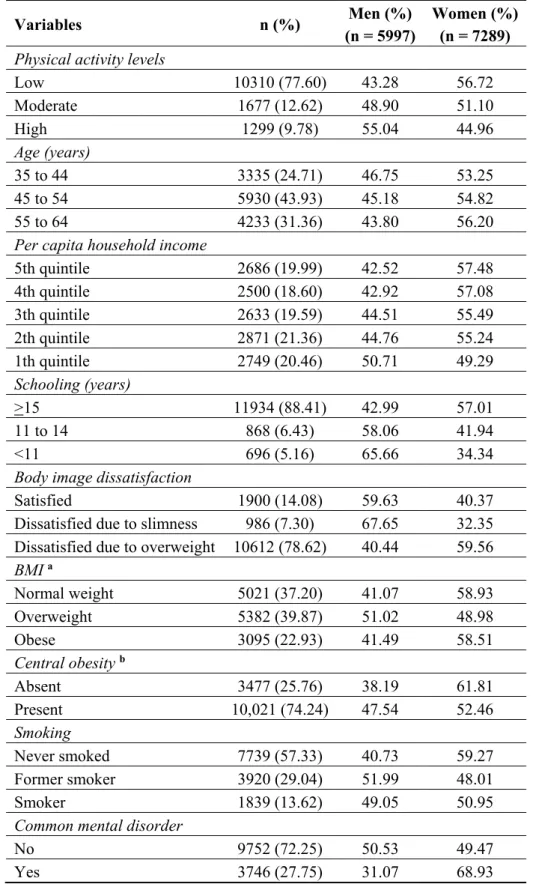
Among the 13,286 participants studied, most were women (54.4%), aged between 45 and 54 (44%) and had more than 15 years of schooling (52.2%). With regard to physical activity level, 77.6% of the individuals practiced low intensity physical activity. The prevalence of individuals who practiced high intensity physical activity was greater among men than among women (Table 1).
The great majority of the participants (85.9%) was dissatisfied with their body image, 74.2% presented central obesity, 39.9% were overweight and 22.9% were obese. The prevalence of dissatisfaction due to slimness was higher among men and the proportion of dissatisfaction due to overweight was higher among women (Table 1), as well as the prevalence of normal weight, obesity and the presence of central obesity.
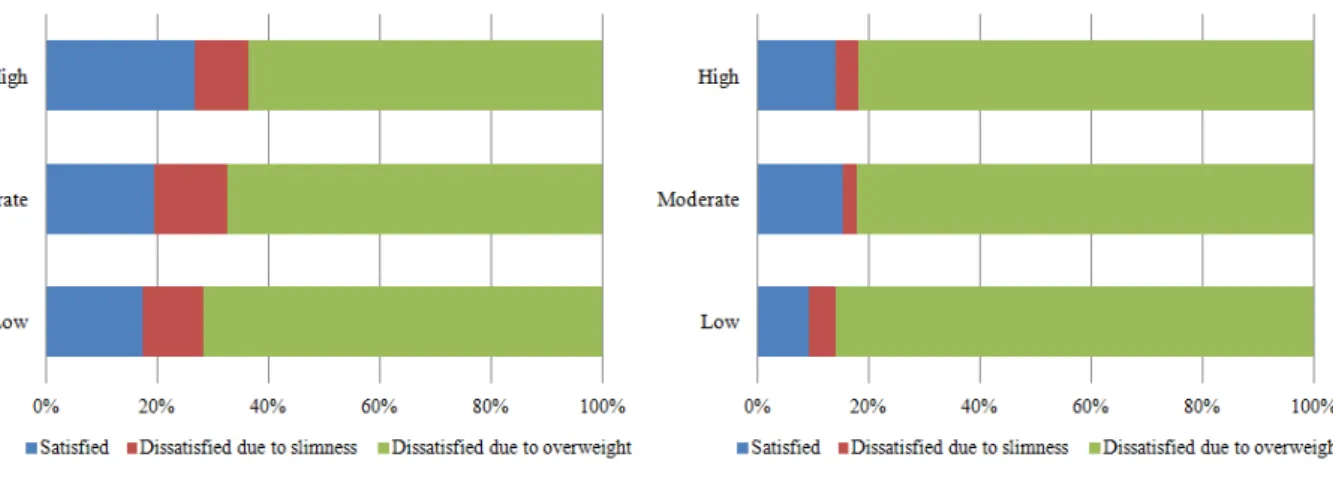
The frequency of men satisfied with their body image was greater as the intensity of physical activity increased. The women who practiced low level of physical activity had the greatest frequency of obesity (Figure 2) and dissatisfaction due to overweight (Figure 1).
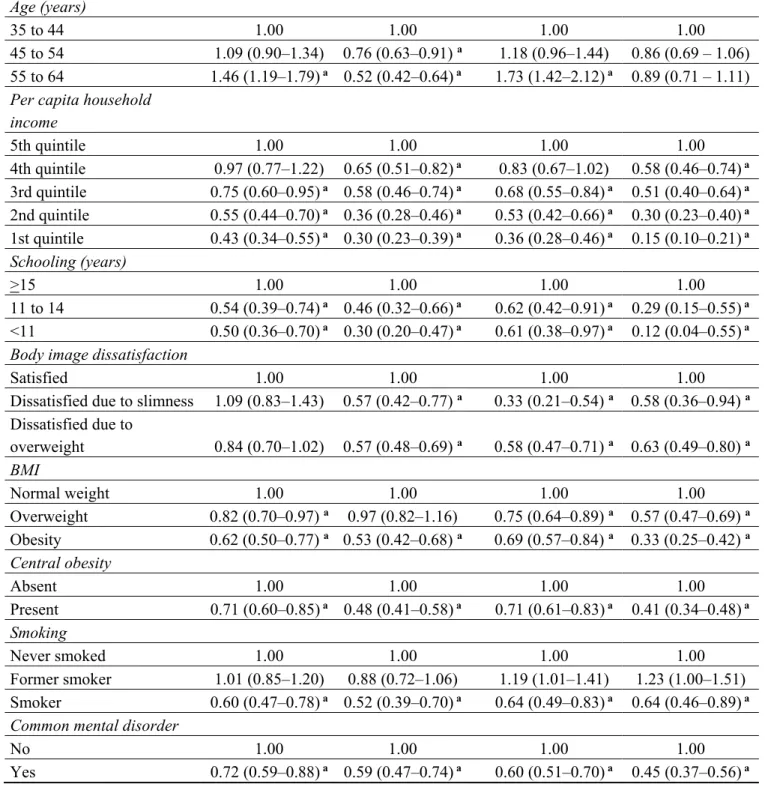
In the univariate analysis, for both men and women, the odds of practicing moderate physical activity was higher among those who were aged between 55 and 64 years (when compared to younger age ranges); decreased with the reduction of the per capita household income and schooling level and was lower among those who presented overweight and obesity, central obesity, common mental disorders and smokers. With regard to body image dissatisfaction, among men, the chances of practicing high intensity physical activity were lower for those who presented body image dissatisfaction; among women, these chances were lower for those dissatisfied, regardless the physical activity level (Table 2).
The pattern of the associations for those who practiced high intensity physical activity was similar to the one described for moderate intensity activity, except for age and body image dissatisfaction. Among men, the chances of practicing high intensity activity decreased with age. In both sexes, the odds of engaging in high intensity activity was smaller among those dissatisfied compared to the satisfied ones (Table 2).
Table 1. Distribution of the general characteristics of the participants (35–64 years-old), according to sex. ELSA-Brasil (2008–2010).
Variables n (%) Men (%)
(n = 5997)
Women (%) (n = 7289)
Physical activity levels
Low 10310 (77.60) 43.28 56.72
Moderate 1677 (12.62) 48.90 51.10
High 1299 (9.78) 55.04 44.96
Age (years)
35 to 44 3335 (24.71) 46.75 53.25 45 to 54 5930 (43.93) 45.18 54.82 55 to 64 4233 (31.36) 43.80 56.20 Per capita household income
5th quintile 2686 (19.99) 42.52 57.48 4th quintile 2500 (18.60) 42.92 57.08 3th quintile 2633 (19.59) 44.51 55.49 2th quintile 2871 (21.36) 44.76 55.24 1th quintile 2749 (20.46) 50.71 49.29 Schooling (years)
>15 11934 (88.41) 42.99 57.01 11 to 14 868 (6.43) 58.06 41.94
<11 696 (5.16) 65.66 34.34
Body image dissatisfaction
Satisfied 1900 (14.08) 59.63 40.37
Dissatisfied due to slimness 986 (7.30) 67.65 32.35 Dissatisfied due to overweight 10612 (78.62) 40.44 59.56 BMI a
Normal weight 5021 (37.20) 41.07 58.93
Overweight 5382 (39.87) 51.02 48.98
Obese 3095 (22.93) 41.49 58.51
Central obesity b
Absent 3477 (25.76) 38.19 61.81
Present 10,021 (74.24) 47.54 52.46
Smoking
Never smoked 7739 (57.33) 40.73 59.27 Former smoker 3920 (29.04) 51.99 48.01
Smoker 1839 (13.62) 49.05 50.95
Common mental disorder
No 9752 (72.25) 50.53 49.47
Yes 3746 (27.75) 31.07 68.93
(a) Men (b) Women
Figure 1. Prevalence of body dissatisfaction among men and women, according to the physical activity (35–64 years-old). ELSA-Brasil (2008–2010).
(a) Men (b) Women
Figure 2. Prevalence of BMI among men and women, according to the physical activity (35–64 years-old). ELSA-Brasil (2008–2010).
Table 2. Crude Odds Ratios for physical activity, according to sociodemographic, body and behavioral characteristics, in adults (35–64 years-old), categorized by sex. ELSA-Brasil (2008–2010).
Variables
Men Women
Physical Activity Levels Physical Activity Levels Moderate
OR (95% CI)
High OR (95% CI)
Moderate OR (95% CI)
High OR (95% CI)
Age (years)
35 to 44 1.00 1.00 1.00 1.00
45 to 54 1.09 (0.90–1.34) 0.76 (0.63–0.91) a 1.18 (0.96–1.44) 0.86 (0.69 – 1.06)
55 to 64 1.46 (1.19–1.79)a 0.52 (0.42–0.64)a 1.73 (1.42–2.12)a 0.89 (0.71 – 1.11)
Per capita household income
5th quintile 1.00 1.00 1.00 1.00
4th quintile 0.97 (0.77–1.22) 0.65 (0.51–0.82)a 0.83 (0.67–1.02) 0.58 (0.46–0.74)a
3rd quintile 0.75 (0.60–0.95)a 0.58 (0.46–0.74)a 0.68 (0.55–0.84)a 0.51 (0.40–0.64)a
2nd quintile 0.55 (0.44–0.70)a 0.36 (0.28–0.46)a 0.53 (0.42–0.66)a 0.30 (0.23–0.40)a
1st quintile 0.43 (0.34–0.55)a 0.30 (0.23–0.39)a 0.36 (0.28–0.46)a 0.15 (0.10–0.21)a
Schooling (years)
>15 1.00 1.00 1.00 1.00
11 to 14 0.54 (0.39–0.74)a 0.46 (0.32–0.66)a 0.62 (0.42–0.91)a 0.29 (0.15–0.55)a
<11 0.50 (0.36–0.70)a 0.30 (0.20–0.47)a 0.61 (0.38–0.97)a 0.12 (0.04–0.55)a
Body image dissatisfaction
Satisfied 1.00 1.00 1.00 1.00
Dissatisfied due to slimness 1.09 (0.83–1.43) 0.57 (0.42–0.77) a 0.33 (0.21–0.54) a 0.58 (0.36–0.94) a
Dissatisfied due to
overweight 0.84 (0.70–1.02) 0.57 (0.48–0.69) a 0.58 (0.47–0.71) a 0.63 (0.49–0.80) a
BMI
Normal weight 1.00 1.00 1.00 1.00
Overweight 0.82 (0.70–0.97) a 0.97 (0.82–1.16) 0.75 (0.64–0.89) a 0.57 (0.47–0.69) a
Obesity 0.62 (0.50–0.77) a 0.53 (0.42–0.68) a 0.69 (0.57–0.84) a 0.33 (0.25–0.42) a
Central obesity
Absent 1.00 1.00 1.00 1.00
Present 0.71 (0.60–0.85)a 0.48 (0.41–0.58)a 0.71 (0.61–0.83)a 0.41 (0.34–0.48)a
Smoking
Never smoked 1.00 1.00 1.00 1.00
Former smoker 1.01 (0.85–1.20) 0.88 (0.72–1.06) 1.19 (1.01–1.41) 1.23 (1.00–1.51) Smoker 0.60 (0.47–0.78)a 0.52 (0.39–0.70)a 0.64 (0.49–0.83)a 0.64 (0.46–0.89)a
Common mental disorder
No 1.00 1.00 1.00 1.00
Yes 0.72 (0.59–0.88)a 0.59 (0.47–0.74)a 0.60 (0.51–0.70)a 0.45 (0.37–0.56)a
Table 3. Adjusted b Odds Ratios for physical activity, according to body characteristics
among adults (35–64 years-old), categorized by sex. ELSA-Brasil (2008–2010).
Variables
Men Women Physical Activity Levels Physical Activity Levels
Moderate OR (95% CI)
High OR (95%CI)
Moderate OR (95% CI)
High OR (95% CI)
Body image dissatisfaction
Satisfied 1.00 1.00 1.00 1.00
Dissatisfied due to slimness 1.13 (0.85–1.50) 0.57 (0.42–0.79) a 0.37 (0.22–0.59) a 0.68 (0.42–1.12)
Dissatisfied due to overweight 0.95 (0.75–1.19) 0.63 (0.50–0.79) a 0.69 (0.54–0.87) a 1.01 (0.77–1.34)
BMI
Normal weight 1.00 1.00 1.00 1.00
Overweight 0.96 (0.77–1.21) 1.78 (1.38–2.30) a 0.89 (0.72–1.10) 0.84 (0.65–1.07)
Obese 0.75 (0.57–0.98) a 1.11 (0.80–1.54) 0.90 (0.71–1.15) 0.57 (0.41–0.79) a
Central obesity
Absent 1.00 1.00 1.00 1.00
Present 0.75 (0.59–0.96) a 0.44 (0.34–0.58) a 0.79 (0.63–0.98) a 0.60 (0.46–0.76) a
Notes: aSignificant associations (p < 0.05); bAdjusted by age (continuous), per capita household income, schooling, smoking and common mental disorder; BMI: body mass index.
4. Discussion
The results presented reveal that the prevalence of high and moderate intensity physical activity are very low, especially the high intensity activity among women. Also, the results showed that the presence of obesity in women and central obesity in both gender was associated with lower chances of practicing exercise, corroborating with our original hypothesis. But, unlike expected, the presence of overweight in men was associated with greater chances of practicing high intensity physical activity. Moreover, our findings confirm the other original hypothesis: that body image dissatisfaction is associated with smaller chances of practicing physical activity both in women and in men. However, in contrast with our hypothesis, this association was stronger among men. Other authors [9,22] also described that greater discrepancies between current and ideal body image were related to lower levels of physical activity during leisure time among men and women.
Our results show that the direction of the association between BMI and the practice of physical activity is not the same for men and women. While being overweight increased the chances practicing high intensity physical activity among men, obesity was associated with smaller chances of practicing it among women. Obesity was also associated with less chance of practicing moderate physical activity in men. Central obesity was the only measure associated with both physical activity level: was negatively correlated to moderate and high intensity activity among men and women.
which result in a more athletic and muscular silhouette, seems to have recently increased in Brazil [25] and in other countries [50].
The prevalence of obesity and overweight observed in this study reflects the general tendencies in the country. In 2013, a countrywide telephone interview survey (VIGITEL) [4]also revealed that the prevalence of overweight was higher among men (54.7% vs. 47.4%); whereas the prevalence of obesity was exactly the same among both sexes (17.5%). Our findings corroborate other studies that show that women tend to express more dissatisfaction with their body than men, especially due to overweight [51,52]. Women are generally concerned with reaching the ideal of slimness imposed by media and society, stressing the dissatisfaction with overweight. This was the observed among a cohort of North American health professionals, where the women reported to see themselves more overweight than the men, even the ones with normal weight [51]. Men, on the other hand, seek better physical conditioning and a more muscular appearance [22,53], which may explain the higher prevalence of dissatisfaction due to slimness among men found in this study.
The association between physical activity and BMI may vary. Overweight and obesity can either be the result of physical inactivity as may promote it, especially in advanced cases of obesity in which there are physical limitations and constraints related to the appearance. [9,10]. In the present study, obese women presented smaller chances of practicing high intensity physical activity, and this finding is corroborated by The Transition and Health During Urbanisation of South Africans (THUSA) study, which revealed a strong association between physical inactivity and obesity among women [54]. In the present study, it is equally likely that the small frequency of physical activity led to obesity among women, due to insufficient energy expenditure for the loss or maintenance of body weight, or that prior overweight demotivated the practice of physical activity. In a longitudinal study with 3042 adults, overweight predicted the increase of physical inactivity after a 5-year follow-up [3].
Differently from women, overweight was associated to greater chances of high intensity physical activity among men. In this group, specifically, overweight may indicate a higher proportion of lean body mass and not excess of body fat. The BMI presents a good correlation with body fat percentage [55], considering the population characteristics. However, this index does not distinguish adequately between lean and fat body mass and may be a less precise indicator of adiposity among men [56]. Thus, it is possible that part of the association between overweight and greater frequency of high intensity activity observed in our study among men is related to higher percentages of lean body mass. This conjecture is substantiated by the smaller frequency of high or moderate physical activity among men with central obesity. In conclusion, overweight among men who practice high intense activity may express greater muscularity in this group.
dose-response gradient connecting the practice of physical activity and the level of discrepancy between current and ideal body image.
Roy and Payette [16] conducted a systematic review in which they report that older people’ body image importance related to body competence increases whereas the one attributed to physical appearance decreases. Thus, it is possible that older participants of the present study are experiencing a transition in their body image judgment and this may lead to changes in what motivate them to do physical activity as the years go by.
In contrast with our hypothesis, not only objective body indicators, but also body image dissatisfaction, were associated with high intensity physical activity among men. Some authors suggest that men tend to better accept their bodies, since they are less prone to social pressure and stigmas related to body weight [13,57]. Tiggemann et al. [58] defend that body weight and body perception are also aspects that determine men’s body image, and may influence masculine behavior concerning physical activity. Recently, men have revealed dissatisfaction with their body and sought a mesomorph body ideal: wide shoulders, well developed upper body, flat abdomen and narrow hips [58,59]. Nonetheless, what we observe does not suggest that body dissatisfaction promotes physical activity; on the contrary, our results indicate that the dissatisfaction is related to smaller chances of practicing physical activity. This means that body dissatisfaction, even due to slimness, does not seem to motivate the quest for the socially idealized masculine body. The mesomorph body model is often pursued by young adults [53], which suggests that the more advanced age range of the present cohort may have influenced the direction of the association found between body dissatisfaction and physical activity among men. Furthermore, the scale of silhouettes used in the present study does not indicate the muscularity of the body, since it was built based only on body mass index [36].
The univariate analysis confirmed the associations, already described by many authors, between decrease in physical activity and ageing [30], lower income and schooling level [2,60], as well as smoking [46] and common mental health disorder [43]. The adjustment for these variables showed that both objective indicators of body weight and subjective indicator of dissatisfaction with body image are not confounded by them, reinforcing our results.
This study had limitations. The short version of the IPAQ evaluates only physical activity during leisure time, and does not measure physical activity in different domains, such as labor and transport. Although it is the most commonly used instrument in large scale surveys, another limitation of the short form of IPAQ is its use to estimate physical activity levels, since it overestimates physical activity when compared to other questionnaires [61] and to the long version of IPAQ [62].
In summary, our results reveal that body perception as well as objective indicators are related to the practice of physical activity in both sexes, but that such associations are different among men and women, according to the intensity of the physical activity practiced by the participants of the cohort. It is important to further understand the factors that are associated with body dissatisfaction and verify whether they are motivators or inhibitors of the longitudinal increase of physical activity. The low prevalence of physical activity among men and women participating in the study, similar to the one found among the population in general, is worrying, since the participants of ELSA-Brasil present a schooling level far higher to that of the average Brazilian population. This reinforces the need to extend the knowledge about factors that promote and inhibit physical activity, which is so vital to physical and mental health.
5. Conclusions
In summary, our results reveal that body perception as well as objective indicators are related to the practice of physical activity in both sexes, but that such associations are different among men and women, according to the intensity of the physical activity practiced by the participants of the cohort.
A challenge in health promotion is to improve the participant’s perception of body image while promoting physical activity. It is important to further understand the factors that are associated with body dissatisfaction and verify whether they are motivators or inhibitors of the longitudinal increase of physical activity.
Also, with the advent of searching a muscular body by men, and also women, in tropical countries, it would be important to develop a figure rating scale of silhouettes that consider not only the BMI of individuals but also the distribution of muscles and fat in the body.
The low prevalence of physical activity among men and women participating in the study, similar to the one found among the population in general, is worrying, since the participants of ELSA-Brasil present a schooling level far higher to that of the general Brazilian population. Prevention programs should encourage these adults to be more physically active, highlighting and promoting a healthy lifestyle. As physical activity so vital to physical and mental health, this scenario reinforces the need to extend the knowledge about other possible factors that promote and inhibit physical activity in middle-age adults and whether these factors can be different across life span.
Acknowledgments
The authors thank the staff and participants of the Elsa Study for their important contributions. The study was supported by the Brazilian Ministries of Health (DECIT) and of Science and Technology (FINEP/CNPq). The ELSA-Brasil baseline study was supported by the Brazilian Ministry of Health (Science and Technology Department) and the Brazilian Ministry of Science and Technology (Financiadora de Estudos e Projetos and CNPq National Research Council), grants 01 06 0010.00 RS, 01 06 0212.00BA, 01 06 0300.00 ES, 01 06 0278.00 MG, 01 06 0115.00SP, 01 06 0071.00 RJ.
Author Contributions
Carolina G. Coelho participated in the design, analysis, writing and preparation of the manuscript. Sandhi M. Barreto and Luana Giatti participated in the design, analysis and writing the manuscript. Maria D. C. B. Molina and Maria A. A. Nunes participated in the writing of the manuscript. Carolina G. Coelho performed the statistical analyses. All of the authors contributed to the design of the research and read, edited and approved of the final draft of the manuscript.
Conflicts of Interest
The authors declare no conflict of interest.
References
1. Azevedo, M.R.; Araujo, C.L.; Reichert, F.F.; Siqueira, F.V.; da Silva, M.C.; Hallal, P.C. Gender differences in leisure-time physical activity. Int. J. Public Health 2007, 52, 8–15.
2. Hallal, P.C.; Andersen, L.B.; Bull, F.C.; Guthold, R.; Haskell, W.; Ekelund, U. Global physical activity levels: Surveillance progress, pitfalls, and prospects. Lancet 2012, 380, 247–257.
3. Panagiotakos, D.B.; Pitsavos, C.; Lentzas, Y.; Skoumas, Y.; Papadimitriou, L.; Zeimbekis, A.; Stefanadis, C. Determinants of physical inactivity among men and women from Greece: A 5-year follow-up of the Attica study. Ann. Epidemiol. 2008, 18, 387–394.
4. Ministério da Saúde. Secretaria de Vigilância em Saúde Brasil. Vigitel Brazil 2013: Protective and Risk Factors for Chronic Diseases by Telephone Survey; Ministério da Saúde. Secretaria de Vigilância em Saúde: Brasília, Brazil, 2014.
5. Ladabaum, U.; Mannalithara, A.; Myer, P.A.; Singh, G. Obesity, abdominal obesity, physical activity, and caloric intake in U.S. adults: 1988 to 2010. Amer. J. Med. 2014, 127, 717–727. 6. Committee on Accelerating Progress in Obesity, Food and Nutrition Board, Institute of
Medicine. Accelerating Progress in Obesity Prevention: Solving the Weight of the Nation, Glickman, D., Parker, L., Sim, L.J., Del Valle Cook, H., Miller, E.A., Eds.; National Academies Press: Washington, DC, USA, 2012.
7. Ekelund, U.; Brage, S.; Besson, H.; Sharp, S.; Wareham, N.J. Time spent being sedentary and weight gain in healthy adults: Reverse or bidirectional causality? Amer. J. Clin. Nutr. 2008, 88, 612–617.
8. Liao, Y.; Harada, K.; Shibata, A.; Ishii, K.; Oka, K.; Nakamura, Y.; Sugiyama, T.; Inoue, S.; Shimomitsu, T. Joint associations of physical activity and screen time with overweight among Japanese adults. Int. J. Behav. Nutr. Phys. Activ. 2011, doi:10.1186/1479-5868-8-131.
9. Anton, S.D.; Perri, M.G.; Riley, J.R., 3rd. Discrepancy between actual and ideal body images: Impact on eating and exercise behaviors. Eating Behav. 2000, 1, 153–160.
10. Jakicic, J.M.; Davis, K.K. Obesity and physical activity. Psychiat. Clin. N. Amer. 2011, 34, 829–840. 11. Malete, L.; Motlhoiwa, K.; Shaibu, S.; Wrotniak, B.H.; Maruapula, S.D.; Jackson, J.; Compher, C.W.
12. Rodgers, R.F.; Salès, P.; Chabrol, H. Psychological functioning, media pressure and body dissatisfaction among college women. Eur. Rev. Appl. Psychol. 2010, 60, 89–95.
13. Barreto, P.S.; Ferrandez, A.M.; Guihard-Costa, A.M. Predictors of body satisfaction: Differences between older men and women’s perceptions of their body functioning and appearance. J. Aging Health 2011, 23, 505–528.
14. Alipour, B.; Abbasalizad Farhangi, M.; Dehghan, P.; Alipour, M. Body image perception and its association with body mass index and nutrient intakes among female college students aged 18–35 years from Tabriz, Iran. Eating Weight Disorder 2015, doi:10.1007/s40519-015-0184-1. 15. Kopcakova, J.; Veselska, Z.D.; Geckova, A.M.; van Dijk, J.P.; Reijneveld, S.A. Is being a boy
and feeling fat a barrier for physical activity? The association between body image, gender and physical activity among adolescents. Int. J. Environ. Res. Public Health 2014, 11, 11167–11176. 16. Roy, M.; Payette, H. The body image construct among Western seniors: A systematic review of
the literature. Arch. Gerontol. Geriatr. 2012, 55, 505–521.
17. Harper, L.; Seaborn, C.; Peterson, K.; Klem, J. The impact of macronutrient intake and exercise on body image among female college undergraduate students. J. Amer. Diet. Assn. 2010, doi:10.1016/j.jada.2010.06.199.
18. Zaccagni, L.; Masotti, S.; Donati, R.; Mazzoni, G.; Gualdi-Russo, E. Body image and weight perceptions in relation to actual measurements by means of a new index and level of physical activity in Italian university students. J. Transl. Med. 2014, 12, 42–42.
19. Moraes, C.; Anjos, L.A.d.; Marinho, S.M.S.d.A. Construção, adaptação e validação de escalas de silhuetas para autoavaliação do estado nutricional: Uma revisão sistemática da literatura. Cad. Saude. Publica. 2012, 28, 7–20.
20. Blake, C.E.; Hebert, J.R.; Lee, D.C.; Adams, S.A.; Steck, S.E.; Sui, X.; Kuk, J.L.; Baruth, M.; Blair, S.N. Adults with greater weight satisfaction report more positive health behaviors and have better health status regardless of BMI. J. Obes. 2013, 2013, doi:10.1155/2013/291371.
21. Fermino, R.C.; Pezzini, M.R.; Reis, R.S. Motivos para prática de atividade física e imagem corporal em frequentadores de academia. Bras. J. Sports Med. 2010, 16, 18–23.
22. Kruger, J.; Lee, C.D.; Ainsworth, B.E.; Macera, C.A. Body size satisfaction and physical activity levels among men and women. Obesity 2008, 16, 1976–1979.
23. Egli, T.; Bland, H.W.; Melton, B.F.; Czech, D.R. Influence of age, sex, and race on college students’ exercise motivation of physical activity. J. Amer. Coll. Health 2011, 59, 399–406.
24. Molanorouzi, K.; Khoo, S.; Morris, T. Motives for adult participation in physical activity: Type of activity, age, and gender. BMC Public Health 2015, doi:10.1186/s12889-015-1429-7. 25. Salles-Costa, R.; Heilborn, M.L.; Werneck, G.L.; Faerstein, E.; Lopes, C.S. Gênero e prática de
atividade física de lazer. Cad. Saude. Publica. 2003, 19, 325–333.
26. Slater, A.; Tiggemann, M. Gender differences in adolescent sport participation, teasing, self-objectification and body image concerns. J. Adolesc. 2011, 34, 455–463.
27. Veselska, Z.; Madarasova Geckova, A.; Reijneveld, S.A.; van Dijk, J.P. Aspects of self differ among physically active and inactive youths. Int. J. Public Health 2011, 56, 311–318.
29. Schmidt, M.I.; Duncan, B.B.; Mill, J.G.; Lotufo, P.A.; Chor, D.; Barreto, S.M.; Aquino, E.M.; Passos, V.M.; Matos, S.M.; Molina Mdel, C.; et al. Cohort profile: Longitudinal study of adult health (Elsa-Brasil). Int. J. Epidemiol. 2015, 44, 68–75.
30. Matsudo, S.M.; Matsudo, V.K.R.; Barros Neto, T.L. Atividade física e envelhecimento: Aspectos epidemiológicos. Bras. J. Sports Med. 2001, 7, 2–13.
31. Khongsdier, R. Body mass index and morbidity in adult males of the War Khasi in Northeast India. Eur. J. Clin. Nutr. 2002, 56, 484–489.
32. Keyes, A.; Woerwag-Mehta, S.; Bartholdy, S.; Koskina, A.; Middleton, B.; Connan, F.; Webster, P.; Schmidt, U.; Campbell, I.C. Physical activity and the drive to exercise in anorexia nervosa. Int. J. Eating Disorder 2015, 48, 46–54.
33. Stapleton, P.; McIntyre, T.; Bannatyne, A. Body image avoidance, body dissatisfaction, and eating pathology: Is there a difference between male gym users and non-gym users? Amer.J. Men Health 2014, doi:10.1177/1557988314556673.
34. Kim, J.; Shin, J.; Kim, Y.A.; Lee, J. Suicidal ideation in underweight adults who attempt to lose weight: Korea national health and nutrition examination survey, 2007–2012. Korean J. Fam. Med. 2015, 36, 82–91.
35. Craig, C.L.; Marshall, A.L.; Sjostrom, M.; Bauman, A.E.; Booth, M.L.; Ainsworth, B.E.; Pratt, M.; Ekelund, U.; Yngve, A.; Sallis, J.F.; et al. International physical activity questionnaire: 12-country reliability and validity. Med. Sci. Sport Exercise 2003, 35, 1381–1395.
36. Kakeshita, I.S. Adaptação e validação de escalas de silhuetas para crianças e adultos brasileiros, Doctor Thesis, Universidade de São Paulo, Brazil, 2008.
37. Gardner, R.M.; Friedman, B.N.; Jackson, N.A. Methodological concerns when using silhouettes to measure body image. Percept. Mot. Skills 1998, 86, 387–395.
38. Gardner, R.M.; Stark, K.; Jackson, N.A.; Friedman, B.N. Development and validation of two new scales for assessment of body-image. Percept. Mot. Skills 1999, 89, 981–993.
39. Griep, R.H.; Aquino, E.M.; Chor, D.; Kakeshita, I.S.; Gomes, A.L.; Nunes, M.A. Test-retest reliability of the scale silhouettes figures of body image in Brazilian longitudinal study of adult health. Cadernos Saude Publ. 2012, 28, 1790–1794.
40. Kakeshita, I.S.; Silva, A.I.P.; Zanatta, D.P.; Almeida, S.S. Construção e fidedignidade teste-reteste de escalas de silhuetas Brasileiras para adultos e crianças. Psicologia: Teoria e Pesquisa 2009, 25, 263–270.
41. Browning, L.M.; Hsieh, S.D.; Ashwell, M. A systematic review of waist-to-height ratio as a screening tool for the prediction of cardiovascular disease and diabetes: 0.5 Could be a suitable global boundary value. Nutr. Res. Rev. 2010, 23, 247–269.
42. Lewis, G.; Pelosi, A.J.; Araya, R.; Dunn, G. Measuring psychiatric disorder in the community: A standardized assessment for use by lay interviewers. Psychol. Med. 1992, 22, 465–486.
43. Meng, X.; D’Arcy, C. The projected effect of increasing physical activity on reducing the prevalence of common mental disorders among canadian men and women: A national population-based community study. Prev. Med. 2013, 56, 59–63.
45. Mackay, D.F.; Gray, L.; Pell, J.P. Impact of smoking and smoking cessation on overweight and obesity: Scotland-wide, cross-sectional study on 40,036 participants. BMC Public Health 2013, doi:10.1186/1471-2458-13-348.
46. Papathanasiou, G.; Papandreou, M.; Galanos, A.; Kortianou, E.; Tsepis, E.; Kalfakakou, V.; Evangelou, A. Smoking and physical activity interrelations in health science students. Is smoking associated with physical inactivity in young adults? Hellenic J. Cardiol. 2012, 53, 17–25.
47. Rothman, K.J.; Greenland, S.; Lash, T.L. Modern Epidemiology; Wolters Kluwer Health/Lippincott Williams: Philadelphia, PA, USA, 2008.
48. Denton, M.; Prus, S.; Walters, V. Gender differences in health: A Canadian study of the psychosocial, structural and behavioural determinants of health. Soc. Sci. Med. 2004, 58, 2585–2600. 49. Caspersen, C.J.; Pereira, M.A.; Curran, K.M. Changes in physical activity patterns in the
United States, by sex and cross-sectional age. Med. Sci. Sport Exercise 2000, 32, 1601–1609. 50. Benton, C.; Karazsia, B.T. The effect of thin and muscular images on women’s body satisfaction.
Body Image 2015, 13, 22–27.
51. Lemon, S.C.; Rosal, M.C.; Zapka, J.; Borg, A.; Andersen, V. Contributions of weight perceptions to weight loss attempts: Differences by body mass index and gender. Body Image 2009, 6, 90–96. 52. Wang, Y.; Liang, H.; Chen, X. Measured body mass index, body weight perception,
dissatisfaction and control practices in urban, low-income African American adolescents. BMC Public Health 2009, doi:10.1186/1471-2458-9-183.
53. Damasceno, V.O.; Lima, J.R.P.; Vianna, J.M.; Vianna, V.R.Á.; Novaes, J.S. Tipo físico ideal e satisfação com a imagem corporal de praticantes de caminhada. Bras. J. Sports Med. 2005, 11, 181–186.
54. Kruger, H.S.; Venter, C.S.; Vorster, H.H.; Margetts, B.M. Physical inactivity is the major determinant of obesity in Black women in the North West Province, South Africa: The Thusa study. Transition and health during urbanisation of South Africa. Nutrition 2002, 18, 422–427. 55. Ranasinghe, C.; Gamage, P.; Katulanda, P.; Andraweera, N.; Thilakarathne, S.; Tharanga, P.
Relationship between body mass index (BMI) and body fat percentage, estimated by bioelectrical impedance, in a group of Sri Lankan adults: A cross sectional study. BMC Public Health 2013, doi:10.1186/1471-2458-13-797.
56. Kyle, U.G.; Schutz, Y.; Dupertuis, Y.M.; Pichard, C. Body composition interpretation. Contributions of the fat-free mass index and the body fat mass index. Nutrition 2003, 19, 597–604.
57. Ciampo, L.A.D.; Rodrigues, D.M.S.; Ciampo, I.R.L.D.; Cardoso, V.C.; Bettiol, H.; Barbieri, M.A. Percepção corporal e atividade física em uma coorte de adultos jovens Brasileiros. J. Human Growth Develop. 2010, 20, 671–679.
58. Tiggemann, M.; Martins, Y.; Churchett, L. Beyond muscles: Unexplored parts of men’s body image. J. Health Psychol. 2008, 13, 1163–1172.
59. Tiggemann, M.; Martins, Y.; Kirkbride, A. Oh to be lean and muscular: Body image ideals in gay and heterosexual men. Psychol. Men Masculinity 2007, 8, 15–24.
61. Brown, W.; Bauman, A.; Chey, T.; Trost, S.; Mummery, K. Comparison of surveys used to measure physical activity. Aust. N. Z. Publ. Health 2004, 28, 128–134.
62. Hallal, P.C.; Victora, C.G.; Wells, J.C.K.; Lima, R.C.; Valle, N.J. Comparison of short and full-length international physical activity questionnaires. J. Phys. Act. Health 2004, 1, 227–234. 63. Mazo, G.Z.; Benedetti, T.R.B. Adaptação do questionário internacional de atividade física para
idosos. Rev. Bras. Cineantropom. Desempenho Hum. 2010, 12, 480–484.