Effe ct o f practice and span
le ngth o n the dual-task
co o rdinatio n e xe cutive te st
Laboratório de Psicologia Experimental Humana,
Departamento de Psicologia e Educação, Faculdade de Filosofia, Ciências e Letras de Ribeirão Preto, Universidade de São Paulo, Ribeirão Preto, SP, Brasil
R.P. Sylwan, F.M. Rosin and C. Galera
Abstract
The measure mu, proposed as an index of the ability to coordinate concurrent box-crossing (BC) and digit-span (DS) tasks in the dual task (DT), should reflect the capacity of the executive component of the working memory system. We investigated the effect of practice in BC and of a change in the digit span on mu by adding previous practice trials in BC and diminishing, maintaining or increasing the digit sequence length. The mu behavior was evaluated throughout three trials of the test. Reported strategies in digit tasks were also analyzed. Subjects with diminished span showed the best performance in DT due to a stable performance in DS and BC in the single- and dual-task conditions. These subjects also showed a more stable performance throughout trials. Subjects with diminished span tended to employ effortless strategies, whereas subjects with increased span employed effort-requiring strategies and showed the lowest means of mu. Sub-jects with initial practice trials showed the best performance in BC and the most differentiated performance between the single- and dual-task conditions in BC. The correlation coefficient between the mu values obtained in the first and second trials was 0.814 for subjects with diminished span and practice trials in BC. It seems that the within-session practice in BC and the performance variability in DS affect the reliability of the index mu. To control these factors we propose the introduction of previous practice trials in BC and a modification of the current method to determine the digit sequence length. This proposal should contribute to the development of a more reliable method to evaluate the executive capacity of coordination in the dual-task para-digm.
Co rre spo nde nce F.M. Rosin
Laboratório de Psicologia Experimental Humana Departamento de Psicologia e Educação, FFCLRP, USP 14040-901 Ribeirão Preto, SP Brasil
Fax: + 55-16-633-6361 E-mail: fabrosin@ usp.br
Part of these data were presented at the Symposium Short- and Long-Term Memory, Porto Alegre, RS, Brasil, November 18-20, 1998, and at the Annual Meeting SAN-SABRO , Puerto Iguazú, Misiones, Argentina, November 30-December 3, 1998.
R.P. Sylwan and F.M. Rosin are recipients of CAPES/SPU fellowships. Publication supported by FAPESP. The first two authors played equal roles in conducting this study.
Received December 2, 1998 Accepted July 28, 1999
Ke y wo rds
·Dual task ·Working memory ·Central executive ·Digit span ·Practice
Intro ductio n
Executive functions seem to be required to perform two simultaneous tasks involving visuospatial and verbal information. This capacity might indicate the ability to distrib-ute the memory capacity resources and was studied using a dual-task paradigm in the
syndrome showed an impaired performance in the simultaneous execution of the tasks, whereas they were able to perform the tasks in the single condition at the same level as the normal subjects (3-9).
The dual-task test consists of the execu-tion of the single DS and BC tasks before the combined execution of DS and BC in the dual-task condition. The performance in dual task is estimated by mu, an index of the ability to coordinate concurrent DS and BC tasks. In a normative study carried out to investigate the statistical behavior of mu, Baddeley et al. (6) showed that no signifi-cant correlation exists between the index mu
and factors like age, gender, educational level and digit span. They also found that the test-retest reliability of the obtained mu was lower than what would be required for the clinical use of the test.
In a previous study (10) we extended the investigation of the dual task in healthy sub-jects. In that study we tested the between-session training effect on the index mu by the repeated execution of the test and the within-session practice effect by inverting the order of the tasks. Training affected the single-and the dual-task conditions. The mu values showed stability only when subjects per-formed the tasks in the direct order of the tasks, but performance was worse in BC under the dual-task condition in the first session when the dual task had been per-formed before the single task. Thus, within-session practice could explain some of the better performance in the dual task under the direct order of the tasks. We also found between- and within-subject span length vari-ability affecting mu, and a negative correla-tion between the mu values and the digit span length. We obtained a test-retest reli-ability coefficient very similar to that re-ported by Baddeley et al. (6), and concluded that the practice in BC and a supposed unequal requirement of the subjects capacities in DS might affect the reliability of the measure mu. In the present study we tested the
influ-ence of span length and practice in BC on performance in the dual-task test, by the addition of practice trials in BC before the dual-task test and by increasing, maintaining or diminishing the digit sequence length. In a previous study (10) we found that the sub-jects reported effort-requiring strategies for the greater span lengths in DS. Conversely, subjects with lower span lengths tended to report effortless strategies. So, we consid-ered that the diminished-span condition would require less effort-requiring strategies than the increased-span condition. In this study subjects were asked to perform three consecutive trials of the dual-task test to evaluate the within-subject behavior of mu.
Mate rial and Me tho ds
The DS task consists of the repetition of digit sequences presented in a verbal-oral way, which the subject must repeat in the proper order within a 2-min period. Digit sequence length varies according to the sub-jects digit span. The BC task consists of traversing with an X a chain of squares linked with arrows to form a path laid out on an A4-size sheet of paper. Subjects are re-quired to fill the squares as rapidly as pos-sible for a period of 2 min. The dual task consists of the simultaneous execution of both tasks within a 2-min period.
percentage, considering the contributions of both tasks to be of equal weight: mu = [1-(pm + pt)/2] x 100. The performance in the practice trials in BC was not considered for
mu calculation.
Practice in BC was manipulated by the addition of two practice trials in BC before the dual-task test. The subjects capacity requirement in the verbal task was manipu-lated by increasing, maintaining or dimin-ishing the digit sequence length as a function of the difference between two-span meas-ures. One measure (WS) was considered to be the maximum length repeated once with success based on the WAIS digit test method (11). The other measure, a conservative span (CS), was considered to be the maximum length at which the subject performed all three lists successfully based on the method proposed by Della Sala and colleagues (3). For the diminished-span condition the se-quence length obtained with CS was dimin-ished by two digits when WS minus CS was zero, the sequence length obtained with CS was diminished by one digit when the differ-ence between WS and CS was one or two digits, and the sequence length was that ob-tained with CS when the difference between WS and CS was greater than two. In the maintained-span condition we used the con-servative span CS. For the increased-span condition we added two digits to the se-quence length obtained with CS when the difference between WS and CS was greater than two, and we added one digit to the CS sequence length when the difference was one or two digits. The same sequence length as CS was used when there was no differ-ence between the CS and WS span length.
Fifty-three healthy volunteers, 37 women and 16 men, participated in this study. Their mean age was 26.0 years ± SD 6.93 and their mean formal education 16.24 ± SD 3.81 years. The subjects were divided into six groups, three groups with practice trials in BC and three groups without previous prac-tice trials. As mentioned above, the span for
each practice trial condition was increased, maintained or diminished. Eight subjects with increased span, 10 subjects with maintained span and eight subjects with diminished span performed practice trials in BC. Eight sub-jects with increased span, 11 subsub-jects with maintained span and eight subjects with di-minished span did not perform practice trials in BC. The groups were composed accord-ing to the subjects WS and CS lengths. So, the distribution of the span variability was equated across the groups.
Subjects were asked to perform three consecutive trials of the dual-task test to evaluate the within-subject behavior of mu. The interval between trials was 5 min. Sub-jects responded to a questionnaire, which asked them about the strategies employed in the digit sequence recall, the easiest and the hardest task, and the task that received more attention in the dual-task condition.
Re sults
The proportion of correct repeated digit sequences, number of traversed squares and
mu were analyzed separately. Each of these measures was submitted to ANOVA with four factors: span (increased, maintained and diminished), practice trials (with or without practice), task condition (single and dual) and trials (first, second and third trial).
The performance in BC was lower in the dual-task condition than in the single-task condition [F(1,47) = 31.57, P<0.0001], but it increased in the single- and dual-task condi-tions across the three trials [F(2,94) = 78.16, P<0.0001]. Although not statistically sig-nificant [F(1,47) = 3.94, P = 0.053], subjects with practice trials in BC showed an
in-creased performance throughout the three trials in the single- and dual-task conditions of BC. Analysis of the data demonstrated the interactions practice trials x task condition x trials [F(2,94) = 3.66, P = 0.029], and span x task condition [F(2,47) = 5.13, P = 0.01]; these interactions explain the effects of span and practice trials on the loss in BC under the
pt
pm
mu
S
co
re
(
m
u
/
p
m
/
p
t
)
100
95
90
85
80
D span (N = 16) M span (N = 21) I span (N = 16)
1 2 3 1 2 3 1 2 3
Assay
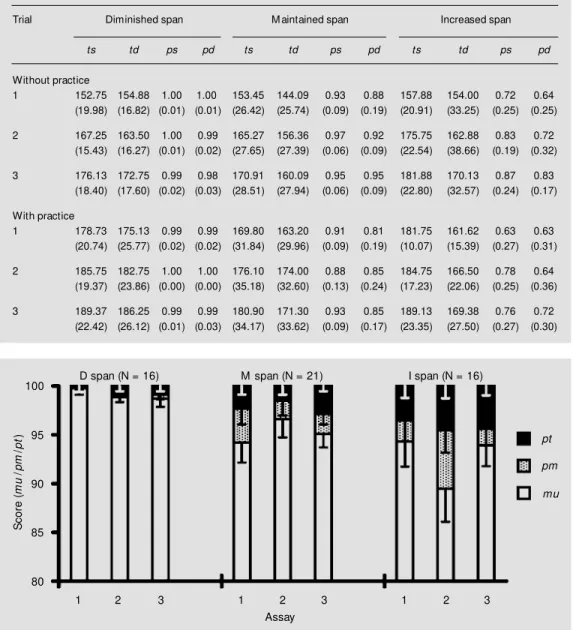
Table 1 - M eans of filled squares in single- (ts) and dual- (td) box-crossing tasks and proportion of correctly repeated
sequences in single (ps) and dual (pd) digit-span tasks.
Standard deviations are given in parentheses.
Trial Diminished span M aintained span Increased span
ts td ps pd ts td ps pd ts td ps pd
Without practice
1 152.75 154.88 1.00 1.00 153.45 144.09 0.93 0.88 157.88 154.00 0.72 0.64
(19.98) (16.82) (0.01) (0.01) (26.42) (25.74) (0.09) (0.19) (20.91) (33.25) (0.25) (0.25)
2 167.25 163.50 1.00 0.99 165.27 156.36 0.97 0.92 175.75 162.88 0.83 0.72
(15.43) (16.27) (0.01) (0.02) (27.65) (27.39) (0.06) (0.09) (22.54) (38.66) (0.19) (0.32)
3 176.13 172.75 0.99 0.98 170.91 160.09 0.95 0.95 181.88 170.13 0.87 0.83
(18.40) (17.60) (0.02) (0.03) (28.51) (27.94) (0.06) (0.09) (22.80) (32.57) (0.24) (0.17)
With practice
1 178.73 175.13 0.99 0.99 169.80 163.20 0.91 0.81 181.75 161.62 0.63 0.63
(20.74) (25.77) (0.02) (0.02) (31.84) (29.96) (0.09) (0.19) (10.07) (15.39) (0.27) (0.31)
2 185.75 182.75 1.00 1.00 176.10 174.00 0.88 0.85 184.75 166.50 0.78 0.64
(19.37) (23.86) (0.00) (0.00) (35.18) (32.60) (0.13) (0.24) (17.23) (22.06) (0.25) (0.36)
3 189.37 186.25 0.99 0.99 180.90 171.30 0.93 0.85 189.13 169.38 0.76 0.72
(22.42) (26.12) (0.01) (0.03) (34.17) (33.62) (0.09) (0.17) (23.35) (27.50) (0.27) (0.30)
dual-task condition in relation to the single-task condition. Figure 1 shows that the in-creased-span group performed BC with the greatest loss under the dual-task condition [F(2,47) = 4.72, P = 0.014]. The loss in BC for the first trial was lower for the subjects without practice trials in BC and increased across the trials [F(2,94) = 3.35, P = 0.039]. So, this result suggests a between-trial prac-tice effect for the group without pracprac-tice trials in BC that may have led to an unstable relation between the single- and dual-perfor-mance in BC.
The mu values varied according to the span group [F(2,47) = 3.60, P = 0.035]. Figure 1 shows that the mu values of the groups with diminished span were the high-est for the first session [F(4,94) = 2.97, P = 0.050]. The group with diminished span showed the most stable mu values across trials. The Pearson correlation coefficient between the mu values obtained in the first and the second trials for the group with the practice trials in BC and diminished span was 0.814, P = 0.014. In the present study we did not find a significant correlation be-tween the span length and the mu values for the group with maintained span and without practice trials in BC. This could be due to the reduced size of the sample and to the fact that two subjects with the highest span lengths performed better the DS in the dual-task condition than in the single one, increasing their respective mu values.
Responses to the questionnaire. Subjects reported the strategies employed in DS un-der the dual-task condition, which were grouped as a function of the required effort. Thus, just listen and repeat, to repeat by the sound and not using strategies at all were differentiated from to imagine the numbers, to group the numbers, to hold only the first numbers letting the last ones come by themselves or to make associa-tions. Eleven of 14 subjects with dimin-ished span reported effortless strategies, whereas 13 of 15 subjects with increased
span reported effort-requiring strategies [c2
(2, N= 50) = 12.30, P = 0.002]. The subjects were also asked to report the easiest and hardest tasks (BC, DS or dual task), and which task had received more attention in the dual-task condition (BC and/or DS). The responses were analyzed as a function of span and practice-trial groups and tasks. Box-crossing was considered the easiest task [c2
(2, N = 48) = 21.96, P<0.0001]. Although without statistical significance, the dual-task condition was considered the hardest task [c2 (2, N = 42) = 5.04, P = 0.08]. Digit span
was the task that received more attention during the dual-task condition [c2 (2, N = 51)
= 24.27, P<0.0001].
D iscussio n
The objective of the present study was to investigate the effect of the practice in BC and of a change in the digit-span on mu, by adding previous practice trials in BC and diminishing, maintaining or increasing the digit sequence length. The mu behavior was evaluated throughout three trials of the test. We also analyzed the reported strategies in digit tasks. Subjects with increased span showed the lowest performance throughout the three trials and their performance was worst in the first trial, with the greatest loss in BC under the dual-task condition. The group with diminished span showed the most stable performance across trials and reported mainly effortless strategies, whereas sub-jects with increased span reported effort-requiring strategies. Thus, the increase in the span requirements seems to lead to the use of effort-requiring strategies in DS, affecting
mu stability through a loss in performance in BC.
the single and dual performance in BC. The results suggest the possible influ-ence of between-trial practice in BC and the employed strategies in DS on the reliability of the index mu. Although the mechanisms of the interaction between the span length, the practice in BC and the ability of the dual-task coordination are still unclear, we pro-pose that two things are necessary in order to obtain a higher reliability for the dual-task test: 1) a method for the span length determi-nation that reduces the diversity of strategies employed in the digit sequences recall; this
can be achieved by diminishing the digit sequence length as a function of the differ-ence between the rather conservative meas-ure of span proposed by Della Sala et al. (3) and the traditional span measure (11); 2) diminishing the within-trial practice by ad-ministering previous practice trials in BC.
Ackno wle dgm e nts
We are grateful to Prof. A.D. Baddeley and to an anonymous referee for comments on an earlier draft of the paper.
Re fe re nce s
1. Baddeley AD & Hitch GJ (1974). Working memory. In: Bow er GH (Editor), The Psy-chology of Learning and M otivation. Aca-demic Press, New York, 47-90.
2. Baddeley AD (1986). Working M emory. Oxford University Press, Oxford. 3. Della Sala S, Baddeley A, Papagno C &
Spinnler H (1995). Dual-task paradigm: a means to examine the central executive.
Annals of the New York Academy of Sci-ences, 769: 161-171.
4. Baddeley AD (1996). Exploring the central executive. Quarterly Journal of Experi-mental Psychology, 49A: 5-28.
5. Baddeley AD, Bressi S, Della Sala S, Logie R & Spinnler H (1991). The decline of
w orking memory in Alzheimer’s disease. A longitudinal study. Brain, 114: 2521-2542.
6. Baddeley AD, Della Sala S, Gray C, Papagno C & Spinnler H (1997). Testing central executive functioning w ith a pen-cil-and-paper test. In: Rabbitt P (Editor),
M ethodology of Frontal and Executive Functions. Chapter 3. Psychology Press,
Hove, UK.
7. Baddeley AD, Della Sala S, Papagno C & Spinnler H (1997). Dual-task performance in dysexecutive and nondysexecutive pa-tients w ith a frontal lesion. Neuropsychol-ogy, 11: 187-194.
8. Baddeley AD, Logie R, Bressi S, Della
Sala S & Spinnler H (1986). Dementia and w orking memory. Quarterly Journal of Ex-perimental Psychology, 38A: 603-618. 9. Greene JDW, Hodges JR & Baddeley AD
(1995). Autobiographical memory and ex-ecutive function in early dementia of Alz-heimer type. Neuropsychologia, 33:
1647-1670.
10. Rosin FM , Sylw an RP & Galera C (1999). Effect of training on the ability of dual-task coordination. Brazilian Journal of M edical and Biological Research, 32: 1249-1261. 11. Wechsler D (1995). Teste de Inteligência