Gender-related pathways for behavior
problems in the offspring of alcoholic
fathers
1Departamento de Neurologia, Psiquiatria e Psicologia Médica,
Faculdade de Medicina de Ribeirão Preto, Universidade de São Paulo, Ribeirão Preto, SP, Brasil
2Department of Child and Adolescent Psychiatry and Psychotherapy,
Central Institute of Mental Health, University of Heidelberg, Mannheim, Germany E.F. Furtado1,
M. Laucht2
and M.H. Schmidt2
Abstract
The objective of the present study was to examine gender differences in the influence of paternal alcoholism on children’s social-emotional development and to determine whether paternal alcoholism is associ-ated with a greater number of externalizing symptoms in the male offspring. From the Mannheim Study of Risk Children, an ongoing longitudinal study of a high-risk population, the developmental data of 219 children [193 (95 boys and 98 girls) of non-alcoholic fathers, non-COAs, and 26 (14 boys, 12 girls) of alcoholic fathers, COAs] were analyzed from birth to the age of 11 years. Paternal alcoholism was defined according to the ICD-10 categories of alcohol depend-ence and harmful use. Socio-demographic data, cognitive develop-ment, number and severity of behavior problems, and gender-related differences in the rates of externalizing and internalizing symptoms were assessed using standardized instruments (IQ tests, Child Behav-ior Checklist questionnaire and diagnostic interviews). The general linear model analysis revealed a significant overall effect of paternal alcoholism on the number of child psychiatric problems (F = 21.872, d.f. = 1.217, P < 0.001). Beginning at age 2, significantly higher numbers of externalizing symptoms were observed among COAs. In female COAs, a pattern similar to that of the male COAs emerged, with the predominance of delinquent and aggressive behavior. Unlike male COAs, females showed an increase of internalizing symptoms up to age 11 years. Of these, somatic complaints revealed the strongest discriminating effect in 11-year-old females. Children of alcoholic fathers are at high risk for psychopathology. Gender-related differ-ences seem to exist and may contribute to different phenotypes during development from early childhood to adolescence.
Correspondence
E.F. Furtado
Departamento de Neurologia, Psiquiatria e Psicologia Médica FMRP, USP
Av. dos Bandeirantes, 3900 14049-900 Ribeirão Preto, SP Brasil
Fax.: +55-16-3602-2836 E-mail:[email protected]
This study was carried out as part of the Brazilian-German cooperation and exchange program CAPES/DAAD/PROBRAL, Project 177/04 “Drug Behavior: Risk Factors and Vulnerability Models”.
The Mannheim Study of Risk Children was supported by grants from the German Research Foundation (Deutsche Forschungsgemeinschaft).
Publication supported by FAPESP and FAEPA.
Received March 28, 2005 Accepted January 2, 2006
Key words
•Longitudinal study •Paternal alcohol disorder •Child development •Psychiatric disorder •Gender differences •Externalizing disorders
Introduction
Numerous clinical observations and em-pirical studies have identified children of alcoholics (COAs) as a group at high risk for
prob-lems among the offspring in a cross-sec-tional study with children hospitalized in a German child psychiatry clinic (3). COAs were also found to be over-represented in special schools for children with learning difficulties. In a study by Schmid et al. (4), about half the children in special schools had at least one parent with alcohol-related prob-lems. Finally, COAs have been reported to have a four-fold higher risk of alcoholism and addiction in adulthood than the general population (5).
As a risk group, COAs provide an excel-lent opportunity to investigate the interac-tion of biological and psychosocial factors. However, researchers in this area have pointed out that methodological problems leading to contradictory results can be the consequence of unsatisfactory research de-signs (6-8). Recently, Hill et al. (9) reported an accentuated behavioral inhibition in pre-school age COAs. According to the authors, early inhibition could explain how anxiety and depression accentuate the risk for later alcohol dependence in COAs. However, when trying to repeat this study, Biederman et al. (10) found no differences between COAs and non-COAs and concluded that their results were “not consistent with the hypothesis linking behavioral inhibition to addictions”. These contradictory findings could be partially due to methodological constraints. One frequent confounding vari-able is gender. There are important gender-related pathways for the development of psychopathology. For instance, as opposed to girls, pre-school boys exhibit more exter-nalizing symptoms (11,12) as do older boys (13). Although conduct problems in child-hood predict the same increased rates of overall psychiatric disorder in both men and women, the patterns are different: for exter-nalizing disorders, the prediction is stronger in men, while for internalizing disorders, it is stronger in women (14). Other problems arise from different subtypes of parental al-coholism. Which parent is alcoholic makes
an important difference. Alcoholic fathers seem to be more associated with an elevated risk of alcoholism in adulthood for their male offspring, an association that seems to be stronger when the father is diagnosed as antisocial (6,15).
A further methodological problem de-rives from the age composition of the study sample. From childhood to adulthood, many age-dependent changes in developmental processes occur that have consequences for psychopathological phenotypes, e.g., inter-nalizing symptoms in male toddlers may evolve into aggressive problems at school age. Thus, the age composition of a sample must be managed carefully. Epidemiologi-cal research on risk factors and vulnerability in COAs should take advantage of longitudi-nal prospective designs using community-based and age-matched samples. Employing such an approach, the present investigation was designed to pursue the following objec-tives: 1) to examine the influence of paternal alcoholism on children’s social-emotional development and 2) to explore gender dif-ferences and, more particularly, to deter-mine whether paternal alcoholism is associ-ated with a greater number of externalizing symptoms in the male offspring.
Material and Methods
Study design
Rhine-Neckar region of Germany. Children were included consecutively in the study sample according to the following criteria: firstborn children of German-speaking par-ents, singletons with no severe physical handicaps, obvious genetic defects, or meta-bolic diseases. Participation rate at the time of recruitment was 64.5%, with a slightly lower rate among parents from psychoso-cially disadvantaged backgrounds. All chil-dren were white, and the majority were of low socioeconomic status. Data were col-lected chronologically at the following ages for each child: 3 months and 2, 4 and half, 8, and 11 years of age.
The results presented here originated from a sample of 219 children (109 boys and 110 girls). The COA group was composed of 26 children (14 boys and 12 girls) selected ac-cording to a paternal diagnosis of alcohol disorder including the two ICD-10 main cat-egories of alcohol dependence (F10.2) and harmful use (F10.1). The control group con-sisted of 193 children (95 boys and 98 girls), meeting the major criterion of no paternal psychiatric morbidity.
To control more rigorously for confound-ing factors in the family environment, only biological fathers were included. In addi-tion, children with serious cognitive, motor and/or sensory handicaps were excluded from the sample. As shown in Table 1, the COAs’ families were characterized by lower educa-tional achievement on the part of the fathers
and a lower level of family income. Fathers also had more legal problems at the time of their child’s birth. No statistical differences between groups were found regarding indi-cators of pre- and perinatal health, such as birth weight and gestational age. More de-tailed information about the MARC is avail-able in recent publications dealing with meth-odological aspects and results regarding the interaction between organic and psycho-social risk factors in this sample (1,2,16-18).
Instruments and variables
Paternal psychiatric problems. To as-sess psychiatric disorders in fathers, a two-stage procedure was used. A complaint in-ventory, the “Beschwerdenliste B-L” by von Zerssen (19), served as a screening instru-ment to gather information about current paternal psychopathology. Additionally, sub-stance abuse and delinquent behavior were examined. In a second-stage assessment, a standardized clinical interview, SCID by Spitzer, Williams and Gibbons - German version by Wittchen et al. (20), was adminis-tered by trained clinical psychologists to obtain systematic diagnoses during a preva-lence period covering the past 6 months. The German SCID is based on III-R, DSM-IV and ICD-10 research criteria (20,21). Interviews were conducted with the mothers (and in 40% of the cases with the fathers as well) during a home visit. In case of absent
Table 1. Neonatal and demographic characteristics of children of alcoholic fathers (COAs; N = 26) and of the control group (non-COAs; N = 193).
Variable COAs Non-COAs F, Z, χ² P
Birth weight (g) 2915 ± 883 (830-4000) 2778 ± 809 (750-4200) 0.371 NS
Gestational age (weeks) 37.40 ± 3.57 (27-42) 37.80 ± 3.41 (27-42) 0.001 NS
Mother’s age (years) 28.46 ± 5.33 (19-40) 27.91 ± 4.41 (19-41) -0.362 NS
Father’s age (years) 32.54 ± 5.23 (24-46) 30.66 ± 5.66 (20-50) -2.057 0.039
No school graduation - father (%) 23.10% 5.20% 7.718 0.006
Child’s gender (% female) 46.15% 50.23% 0.196 NS
fathers, evaluation of paternal psychopathol-ogy relied on maternal information only. Diagnoses were made only if the informa-tion was complete and judged reliable by the interviewer. Comparisons between evalua-tions with and without the participation of the father showed that this procedure led to a slight underestimate of the rates of psychiat-ric diagnoses in fathers. As could be derived from research analyzing the concordance between direct and indirect assessment of child and adolescent psychopathology (e.g., agreement between parent and child reports), symptoms of affective and anxiety disorders were more likely to be under-reported by indirect interviews, while more externaliz-ing disorders, such as alcohol abuse and antisocial personality disorder, were better reported by informants (22).
Child cognitive development. Cognitive development was measured by the Mental Developmental Index of the Bayley Scales of Infant Development (23) at the ages of 3 months and 2 years. The Columbia Mental Maturity Scale (24) was administered at pre-school age, supplemented by the Illinois Test of Psycholinguistic Abilities (ITPA) -sentence completion sub-scale (25,26). The CFT1 (27) with the ITPA - sentence comple-tion sub-scale was used at the age of 8 years. The CFT20 supplemented with the WS scale for assessment of verbal ability was admin-istered at the age of 11 years (28).
Child psychiatric assessment. Psychiat-ric problems were identified through stan-dardized interviews and questionnaires. Be-havioral and emotional problems were as-sessed using the Mannheim Parent Inter-view MEI (29). The following areas of in-fant behavior at the age of 3 months were covered: feeding difficulties, sleeping and digestive problems. In addition, a number of temperamental characteristics such as irrita-bility, distractibility or dysphoric mood were assessed. Measurement of temperament ac-cording to Thomas et al. (30) was obtained by behavioral ratings from the parent
inter-views and from direct observations. From the age of 8 years on, a direct clinical inter-view with the child also became part of the child’s diagnostic assessment. All diagnos-tic assessments were carried out in compli-ance with the ICD-10 research criteria.
Severity was evaluated on a seven-point scale (for dichotomous analyses, levels one to four formed the category “problems ab-sent or clinically irrelevant”, while levels five to seven identified positive cases). To determine specific psychiatric syndromes (possible from the age of 2 years on) the indicating symptoms of the diagnostic groups were organized into the categories: “exter-nalizing behavior” and “inter“exter-nalizing be-havior”. “Externalizing behavior” at pre-school age included the following symp-toms: impulsiveness, hyperactivity, distract-ibility, oppositional behavior, temper tan-trums, aggressive behavior, destructive be-havior, and social disinhibition. At school age, the following symptoms were added: lying, stealing, truancy, running away from home, self-destructive behavior, suicidal behavior, psychoactive substance use, and disciplinary problems at school. The “inter-nalizing behavior” category encompassed the following symptoms: phobias, social anxiety, generalized anxiety, depression, and symptoms related to sleep and eating behav-ior. The sum of psychiatric symptoms formed a continuous variable, while diagnostic clas-sification was used as a dichotomous vari-able. Two diagnostic groups were formed: a) externalizing disorders (including hyperki-netic disorder (F90) and conduct disorders (F91, F92)), and b) internalizing disorders (including emotional disorders, disorders of social functioning (F93, F94) and other emo-tional problems (F54, F98) with specific onset in childhood).
considerable body of reliability and validity data has been published. The CBCL presents descriptions of 118 problem behaviors which are likely to occur in children 4 to 18 years of age. The German version of the CBCL (CBCL/4-18) (31,32) was used to measure children’s behavior problems as reported by their parents. The instrument’s psychomet-ric characteristics were confirmed for the German translation (32). Eight specific be-havior syndrome scales were elaborated: withdrawn, somatic complaints, anxious/de-pressed, social problems, thought problems, attention problems, delinquent behavior, and aggressive behavior. Second-order factor analyses yielded two broad-band syndromes of externalizing and internalizing behavior problems.
Statistical analysis
To examine the effect of attribution to the case group (COAs) or to the control group (non-COAs) and of gender on cogni-tive and social-emotional outcome, i.e., the sum of symptoms and the level of severity of psychiatric problems across assessments, the general linear model (GLM) procedure with repeated measures was used. Univariate parisons of continuous variables were com-puted by means of t-tests and ANOVA. To compare differences in frequencies and ra-tios between groups, chi-square tests and Fisher’s exact tests were performed.
Results
Cognitive development
When boys and girls were examined to-gether, children of alcoholic fathers pre-sented lower average scores in intelligence tests across all assessments. Throughout the study period, the mean IQ of COAs was 100.53, while the control group reached an average of 102.52 (F = 0.770, d.f. = 1.217, P = 0.306). This observed difference with lower
average among COAs did not reach statisti-cal significance. The differences were more marked among males than among females. While the difference between male COAs and non-COAs of around four-and-a-half IQ points approached significance (F = 2.571, d.f. = 1.217, P = 0.112), the difference ob-served between female COAs and non-COAs was far from being statistically significant (F = 0.124, d.f. = 1.108, P = 0.726).
Psychiatric outcome
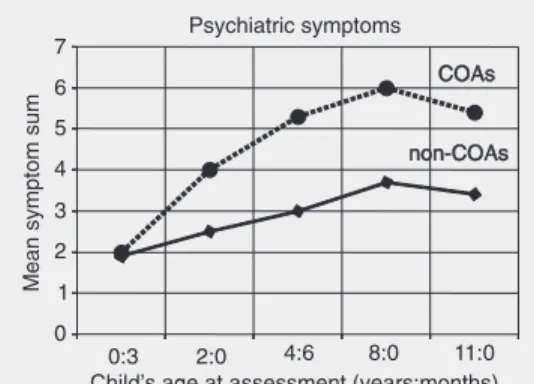
Psychiatric problems. At each phase of evaluation the total sum of identified psychi-atric problems was computed. Figure 1 shows a steady increase from 3 months to 8 years of age as the number of problems tended to grow with the age of the child. The GLM analysis revealed a significant overall effect of paternal alcoholism on the number of child psychiatric problems (F = 21.872, d.f. = 1.217, P < 0.001). While at 3 months of age, no significant difference was identified (P = 0.767), beginning at 2 years of age the mean sum of psychiatric problems in the COA group was significantly higher than in the control group and remained so up to 11 years of age (all P < 0.01).
Externalizing symptoms. Since diagnos-tic assessments are much more reliable after 2 years of age, only the period between the ages of 2 and 11 years was considered. Us-ing GLM analysis, significant main effects of COA group membership (F = 23.357, d.f.
Figure 1. Longitudinal effect of paternal alcoholism on the de-velopment of child behavior problems. COAs = children of alcoholic fathers; non-COAs = children of non-alcoholic fathers.
0 1 2 3 4 5 6 7
0:3 2:0 4:6 8:0 11:0
Psychiatric symptoms
Child’s age at assessment (years:months)
Mean symptom sum
COAs
= 1.215, P < 0.001) and of gender (F = 12.279, d.f. = 1.215, P < 0.001) on external-izing scores were obtained. As shown in Figure 2, both male and female COAs had significantly more externalizing symptoms when compared to the control group at all assessments. While the shape of the curves was similar, the mean number of externaliz-ing symptoms for male and female COAs differed, with males showing more symp-toms on average. However, the comparisons within the gender groups revealed that both male and female COAs were characterized
by scores higher than those for male and female non-COAs.
While 29.8% of the COAs were diag-nosed with an externalizing disorder, the control group had only 10.8% cases diag-nosed for the period from 2 to 11 years of age. The comparisons of 2-year-old COAs and non-COAs revealed no significant dif-ferences, although the rates of externalizing disorders were found to be almost twice as high, with an odds ratio of 1.9 (95% CI = 0.6-6.1; χ² = 1.006; NS). The odds ratios for the 4-and-a-half, 8- and 11-year-old chil-dren were 4.4 (95% CI = 1.8-10.8; χ² = 9.497; P = 0.002), 4.6 (95% CI = 1.8-11.6; χ² = 9.169; P = 0.002) and 3.6 (95% CI = 1.3-8.9;
χ² = 5.921; P = 0.013), respectively.
Internalizing symptoms. Comparison of the occurrence of internalizing disorders between groups indicated no significant dif-ferences, with frequencies remaining below 10% in both groups. However, GLM analy-sis yielded a significant group effect on the number of internalizing symptoms between the ages of 2 and 11 years (F = 7.451, d.f. = 1.215, P < 0.01). As shown in Figure 3, the shape of the curves and the mean range of the sum of internalizing symptoms were quite similar in male and female non-COAs. How-ever, a different pattern was observed in male and female COAs, showing a tendency to statistical significance (age x group x gender interaction: F = 2.826, d.f. = 1.215, P = 0.094). In male COAs, after an elevation of the scores from 2 to 4-and-a-half years of age, the number of symptoms fell continu-ously up to 11 years. The curve for the female COAs, however, showed a continu-ous rise beginning at 2 years of age that reached its maximum at the age of 11 years.
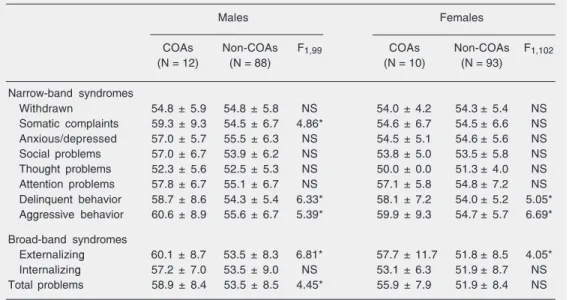
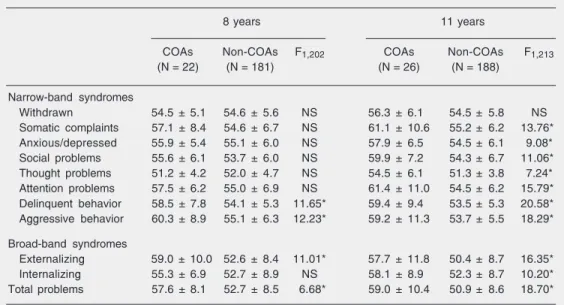
CBCL scales. The T-scores of the CBCL scales at the ages of 8 and 11 years were compared between groups in the total sample, as well as separately for males and females. Results are presented in Table 2 for 8-year-old boys and girls, in Table 3 for 11-year-olds and in Table 4 for the total sample. At
Figure 2. Longitudinal effect of paternal alcoholism on the development of externalizing symptoms in males and females. COAs = children of alcoholic fathers; non-COAs = children of non-alcoholic fathers.
Figure 3. Longitudinal effect of paternal alcoholism on the development of internalizing symptoms in males and females. COAs = children of alcoholic fathers; non-COAs = children of non-alcoholic fathers.
Mean symptom sum
5
3
2
0 1 4
5
3
2
0 1 4
Child’s age (years:months)
2:0 4:6 8:0 11:0 2:0 4:6 8:0 11:0
Boys Girls
COAs
Non-COAs
COAs
Non-COAs Externalizing symptoms
Mean symptom sum
5
3
2
0 1 4
5
3
2
0 1 4 Internalizing symptoms
Child’s age (years:months)
2:0 4:6 8:0 11:0 2:0 4:6 8:0 11:0
COAs
Non-COAs
COAs
Non-COAs
the age of 8 years, male COAs reached scores significantly higher than those for male non-COAs on three CBCL scales: somatic com-plaints, delinquent behavior and aggressive behavior. The female COAs showed a
simi-lar pattern, with significantly higher scores on the delinquent behavior and aggressive behavior scales. At the age of 11 years, however, a stronger divergence between COAs and non-COAs was observed. Male
Table 3. Gender differences: Child Behavior Checklist ratings at 11 years.
Males Females
COAs Non-COAs F1,107 COAs Non-COAs F1,105
(N = 14) (N = 94) (N = 12) (N = 94)
Narrow-band syndromes
Withdrawn 56.8 ± 5.8 54.6 ± 5.7 NS 55.7 ± 6.8 54.3 ± 6.0 NS
Somatic complaints 59.0 ± 10.3 55.0 ± 5.8 NS 63.5 ± 10.9 55.3 ± 6.6 12.77*
Anxious/depressed 59.8 ± 5.7 54.7 ± 6.1 5.17* 55.6 ± 6.9 54.4 ± 6.2 3.77*
Social problems 62.8 ± 7.4 55.1 ± 7.3 11.14* 56.4 ± 5.4 53.6 ± 6.0 NS
Thought problems 56.8 ± 6.8 51.6 ± 4.2 5.07* 51.8 ± 3.8 50.9 ± 3.3 NS
Attention problems 61.6 ± 12.0 55.2 ± 6.4 5.65* 61.1 ± 10.3 53.9 ± 6.0 10.96*
Delinquent behavior 59.4 ± 10.7 54.3 ± 5.9 5.48* 59.3 ± 8.0 52.7 ± 4.5 21.31*
Aggressive behavior 60.5 ± 12.3 54.5 ± 6.0 7.38* 57.7 ± 10.4 53.0 ± 4.8 11.81*
Broad-band syndromes
Externalizing 58.7 ± 12.7 51.3 ± 9.5 6.00* 56.5 ± 11.2 49.6 ± 7.7 11.29*
Internalizing 59.8 ± 6.8 53.1 ± 8.2 5.17* 56.0 ± 10.9 51.6 ± 9.2 4.91*
Total problems 60.3 ± 10.7 51.7 ± 8.9 7.79* 57.5 ± 10.3 50.1 ± 8.2 11.09*
Data are reported as mean ± SD T scores for sons and daughters of alcoholic fathers (COAs) and for controls (non-COAs). NS = not significant.
*P ≤ 0.05 for comparisons within groups (male and female - COAs vs non-COAs; ANOVA).
Table 2. Gender differences: Child Behavior Checklist ratings at 8 years.
Males Females
COAs Non-COAs F1,99 COAs Non-COAs F1,102
(N = 12) (N = 88) (N = 10) (N = 93)
Narrow-band syndromes
Withdrawn 54.8 ± 5.9 54.8 ± 5.8 NS 54.0 ± 4.2 54.3 ± 5.4 NS
Somatic complaints 59.3 ± 9.3 54.5 ± 6.7 4.86* 54.6 ± 6.7 54.5 ± 6.6 NS
Anxious/depressed 57.0 ± 5.7 55.5 ± 6.3 NS 54.5 ± 5.1 54.6 ± 5.6 NS
Social problems 57.0 ± 6.7 53.9 ± 6.2 NS 53.8 ± 5.0 53.5 ± 5.8 NS
Thought problems 52.3 ± 5.6 52.5 ± 5.3 NS 50.0 ± 0.0 51.3 ± 4.0 NS
Attention problems 57.8 ± 6.7 55.1 ± 6.7 NS 57.1 ± 5.8 54.8 ± 7.2 NS
Delinquent behavior 58.7 ± 8.6 54.3 ± 5.4 6.33* 58.1 ± 7.2 54.0 ± 5.2 5.05*
Aggressive behavior 60.6 ± 8.9 55.6 ± 6.7 5.39* 59.9 ± 9.3 54.7 ± 5.7 6.69*
Broad-band syndromes
Externalizing 60.1 ± 8.7 53.5 ± 8.3 6.81* 57.7 ± 11.7 51.8 ± 8.5 4.05*
Internalizing 57.2 ± 7.0 53.5 ± 9.0 NS 53.1 ± 6.3 51.9 ± 8.7 NS
Total problems 58.9 ± 8.4 53.5 ± 8.5 4.45* 55.9 ± 7.9 51.9 ± 8.4 NS
Data are reported as mean ± SD T scores for sons and daughters of alcoholic fathers (COAs) and for controls (non-COAs). NS = not significant.
COAs scored significantly higher on six of the eight CBCL scales, including anxious/ depressed, social problems, thought prob-lems, attention probprob-lems, delinquent behav-ior, and aggressive behavior. A similar pic-ture was found in the female COA group, which presented significantly higher scores on five CBCL scales including somatic com-plaints, anxious/depressed, attention prob-lems, delinquent behavior, and aggressive behavior. Differences between male sub-groups were most marked on the social prob-lems (F = 11.14, d.f. = 1.107, P = 0.001) and aggressive behavior scales (F = 7.38, d.f. = 1.107, P = 0.008). The delinquent behavior (F = 21.31, d.f. = 1.105, P < 0.001) and somatic complaint scales (F = 12.77, d.f. = 1.105, P = 0.001) were the most discriminat-ing between female COAs and non-COAs.
Discussion
Strengths and limitations
The strengths of this study lie in the recruitment procedure of a non-clinical,
high-risk community sample, and in the careful approach to the assessment and diagnosis of children and fathers, continuously from child-birth up to 11 years of age. Furthermore, with the exception of the CBCL scales (imple-mented at the ages of 8 and 11 years), all measures were comparable for all research waves, all children were assessed at the same age, and the sample was, in general, well-balanced for common confounding variables, with an overload of families at risk (which did increase the likelihood of cases). The limitations of the study are mostly related to the sample size and the small subgroup by gender. Although the GLM statistical ap-proach we have used allows for the identifi-cation of effects during a period of time and has shown robust and reliable results, we cannot be sure about the generalizability of our findings (33). However, to the best of our knowledge, there are only few prospec-tive longitudinal studies with the character-istics of our study and several of these stud-ies also suffer from problems of small sample sizes at the level of subgroup analysis. Other longitudinal studies with larger samples of
Table 4. Child Behavior Checklist ratings at 8 and 11 years (total sample).
8 years 11 years
COAs Non-COAs F1,202 COAs Non-COAs F1,213
(N = 22) (N = 181) (N = 26) (N = 188)
Narrow-band syndromes
Withdrawn 54.5 ± 5.1 54.6 ± 5.6 NS 56.3 ± 6.1 54.5 ± 5.8 NS
Somatic complaints 57.1 ± 8.4 54.6 ± 6.7 NS 61.1 ± 10.6 55.2 ± 6.2 13.76*
Anxious/depressed 55.9 ± 5.4 55.1 ± 6.0 NS 57.9 ± 6.5 54.5 ± 6.1 9.08*
Social problems 55.6 ± 6.1 53.7 ± 6.0 NS 59.9 ± 7.2 54.3 ± 6.7 11.06*
Thought problems 51.2 ± 4.2 52.0 ± 4.7 NS 54.5 ± 6.1 51.3 ± 3.8 7.24*
Attention problems 57.5 ± 6.2 55.0 ± 6.9 NS 61.4 ± 11.0 54.5 ± 6.2 15.79*
Delinquent behavior 58.5 ± 7.8 54.1 ± 5.3 11.65* 59.4 ± 9.4 53.5 ± 5.3 20.58*
Aggressive behavior 60.3 ± 8.9 55.1 ± 6.3 12.23* 59.2 ± 11.3 53.7 ± 5.5 18.29*
Broad-band syndromes
Externalizing 59.0 ± 10.0 52.6 ± 8.4 11.01* 57.7 ± 11.8 50.4 ± 8.7 16.35*
Internalizing 55.3 ± 6.9 52.7 ± 8.9 NS 58.1 ± 8.9 52.3 ± 8.7 10.20*
Total problems 57.6 ± 8.1 52.7 ± 8.5 6.68* 59.0 ± 10.4 50.9 ± 8.6 18.70*
Data are reported as mean ± SD T scores for sons and daughters of alcoholic fathers (COAs) and for controls (non-COAs). NS = not significant.
positive cases of alcoholic fathers have not anticipated prospective assessments begin-ning at childbirth (34-36). Most previous studies have sampled children or adoles-cents within a broad age range and did not allow careful observations of developmen-tal changes as has been done in the present study.
Genetic-environmental approach
Children of parents with psychiatric dis-orders are considered to be at high risk for the development of behavior problems. This clinical and empirical observation raised questions about possible models of causality that could describe the process of intergen-erational transmission of psychopathology. Recently, more attention has been paid to the role of genetic factors in this process (37,38). In addition, stress from the social and famil-ial environment has been frequently associ-ated with the development of psychiatric disorders. The interaction of genetic and environmental factors makes it extremely difficult to disentangle the etiological pro-cesses underlying this association. At the level of complex social behavior, identify-ing a sidentify-ingle factor that would explain a uni-lateral causality model has been an insolvable task. Consequently, researchers in psychia-try have been more inclined to develop multi-factorial models. The children of alcoholics are an excellent example of the complex interactions between genetic and socio-en-vironmental factors. Research on COAs has benefited from well-conceptualized multi-factorial theoretical models (38).
Empirical evidence supporting a genetic explanation of the higher psychiatric risk found in children of alcoholics has increased in the past decade. Some researchers have corroborated the hypothesis of a relation between candidate genes and certain pheno-typic behavioral characteristics that are re-lated to a profile of personality risk traits, as suggested by Cloninger and colleagues (39).
Recent findings indicating differences in the expression of the regulating gene of the D2-dopamine receptor, which seems to be asso-ciated with the occurrence of externalizing symptoms, or with behavioral disinhibition, in children of alcoholics (40), are an encour-aging contribution towards clarifying the high prevalence of externalizing symptoms and the comparatively higher risk for the development of alcohol disorder in adoles-cence and early adulthood.
The results presented here corroborate in a sample of German children the high risk of a deviant developmental course of COAs. Our results indicated a similar pattern of psychopathological problems in male and female COAs. In particular, to be a son or a daughter of an alcoholic father was associ-ated with an increased risk for the develop-ment of externalizing symptoms such as ag-gressive and delinquent behavior.
However, not only externalizing prob-lems were found to discriminate between COAs and non-COAs. Interestingly, the high-est CBCL scores for both male and female COAs were obtained on scales from the internalizing spectrum. Among female COAs a trend was observed, particularly at the age of 11 years, suggesting a different pathway of psychopathology with an increase of in-ternalizing symptoms.
The high psychiatric problem scores found in our study have to be interpreted in the context of the inclusion criteria for our sample, which had specifically pursued in-dividuals and families with a high load of biological and psychosocial risk. These find-ings show the high risk exposure of the offspring of alcoholic fathers and the fragil-ity of this group in comparison to other children raised in a common context.
to presume that deviant paternal personality characteristics at the level of social function-ing may be important in the process of inter-generational transmission of psychopathol-ogy. The results of our study are suggestive and encourage more investigation of both genetic and environmental factors which can potentially aggravate or reduce risk.
We conclude that children of alcoholic fathers are at high risk for psychopathology.
There are similar patterns for male and fe-male COAs in early childhood, when COAs present significantly more externalizing symptoms. A trend occurs in the prepubertal age when female COAs show more internal-izing symptoms than female non-COAs. Future studies can be improved by the inclu-sion of genetic analysis, searching for links and pathways for paternal alcoholism and externalizing disorders in the offspring.
References
1. Furtado EF, Laucht M & Schmidt MH (2002). Psychische Auffäl-ligkeiten von Kindern alkoholkranker Väter (Psychological symp-toms in children of alcoholic fathers). Zeitschrift für Kinder- und Jugendpsychiatrie und Psychotherapie, 30: 241-250.
2. Furtado EF, Laucht M & Schmidt MH (2002). Estudo longitudinal prospectivo sobre risco de adoecimento psiquiátrico na infância e alcoolismo paterno. (Longitudinal prospective study of psychiatric risk in childhood and paternal alcoholism). Revista de Psiquiatria Clinica, 29: 74-83.
3. Steinhausen HC, Gobel D & Nestler V (1984). Psychopathology in the offspring of alcoholic parents. Journal of the American Academy
of Child and Adolescent Psychiatry, 4:465-471.
4. Schmid W, Bachler A, Frey D et al. (1983). Genetic, medical and psychosocial factors in learning disorders in a cohort of 11-year-old
children (Winterthur study). Acta Paedopsychiatrica, 49:9-45.
5. Goodwin DW (1983). The genetics of alcoholism. Hospital and Community Psychiatry, 34: 1031-1034.
6. Chassin L, Jacob T, Johnson JL et al. (1997). Historical perspec-tives - a critical analysis of COA research. Alcohol Health and
Research World, 3:258-264.
7. Reich W (1997). Prospective studies of children of alcoholic
par-ents. Alcohol Health and Research World, 3:255-257.
8. Windle M (1997). Concepts and issues in COA research. Alcohol
Health and Research World, 3:185-191.
9. Hill SY, Lowers L, Locke J et al. (1999). Behavioral inhibition in children from families at high risk for developing alcoholism. Journal
of the American Academy of Child and Adolescent Psychiatry, 4:
410-417.
10. Biederman J, Hirshfeld-Becker DR, Rosenbaum JF et al. (2001). Lack of association between parental alcohol or drug addiction and behavioral inhibition in children. American Journal of Psychiatry, 10: 1731-1733.
11. Gadow KD, Sprafkin J & Nolan EE (2002). DSM-IV symptoms in community and clinic pre-school children. Journal of the American
Academy of Child and Adolescent Psychiatry, 12:1383-1392.
12. Lavigne JV, Gibbons RD, Christoffel KK et al. (1996). Prevalence rates and correlates of psychiatric disorders among pre-school
chil-dren. Journal of the American Academy of Child and Adolescent
Psychiatry,2:204-214.
13. Lahey BB, Schwab-Stone M, Goodman SH et al. (2000). Age and gender differences in oppositional behavior and conduct problems: a cross-sectional household study of middle childhood and
adoles-cence. Journal of Abnormal Psychology, 3:488-503.
14. Offord DR & Bennett KJ (1994). Conduct disorder: long-term out-comes and intervention effectiveness. Journal of the American
Acad-emy of Child and Adolescent Psychiatry,8:1069-1078.
15. Hussong AM, Curran PJ & Chassin L (1998). Pathways of risk for accelerated heavy alcohol use among adolescent children of
alco-holic parents. Journal of Abnormal Child Psychology, 6:453-466.
16. Laucht M, Esser G & Schmidt MH (1997). Developmental outcome of infants born with biological and psychosocial risks. Journal of
Child Psychology and Psychiatry and Allied Disciplines, 7:843-853.
17. Laucht M, Esser G & Schmidt MH (2000). Externalizing and internal-izing disorders in childhood: Studies on developmental psychopa-thology. Zeitschrift für Klinische Psychologie und Psychotherapie, 4: 284-292.
18. Laucht M, Esser G & Schmidt MH (2000). Longitudinal research on the developmental epidemiology of mental disorders: aims, con-cepts, and major results of the Mannheim Study of at Risk Children.
Zeitschrift für Klinische Psychologie und Psychotherapie, 4:
246-262.
19. Zerssen D (1976). Die Beschwerdenliste. Beltz, Weinheim, Ger-many.
20. Wittchen HU, Zaudig M & Fydrich T (1997). Strukturiertes Klinisches Interview für DSM-IV Achse I und II - SKID. Hogrefe, Göttingen, Germany.
21. Saß H, Wittchen HU, Zaudig M et al. (1998). Diagnostische Kriterien des Diagnostischen und Statistischen Manuals Psychischer Störun-gen DSM-IV. Hogrefe, GöttinStörun-gen, Germany.
22. Edelbrock C, Costello AJ, Dulcan MK et al. (1986). Parent-child agreement on child psychiatric symptoms assessed via structured
interview. Journal of Child Psychology and Psychiatry and Allied
Disciplines, 2:181-190.
23. Bayley N (1969). Bayley Scales of Infant Development. Psychologi-cal Corporation, New York.
24. Burgemeister B, Blum L & Lorg J (1972). Columbia Mental Maturity Scale. Harcourt Brace Jovanovich, New York.
25. Kirk SA, McCarthy J & Kirk WD (1968). Illinois Test of Psycholin-guistic Abilities. University of Illinois Press, Urbana, IL, USA. 26. Angermaier M (1974). Psycholinguistischer Entwicklungstest. Beltz,
Weinheim, Germany.
27. Weiß RH & Osterland J (1977). Grundintelligenztest CFT 1. Wester-mann, Braunschweig, Germany.
29. Esser G, Blanz B, Geisel B et al. (1989). Mannheimer Elterninterview - Strukturiertes Interview zur Erfassung von kinderpsychiatrischen Auffälligkeiten. Beltz, Weinheim, Germany.
30. Thomas A, Chess A & Birch HG (1968). Temperament and Behavior Disorders in Children. University Press, New York.
31. Achenbach TM (1991). Manual for the Child Behavior Checklist/4-18 and 1991 Profile. Department of Psychiatry, University of Ver-mont, Burlington, VT, USA.
32. Dopfner M, Schmeck K, Berner W et al. (1994). Reliability and factorial validity of the Child Behavior Checklist - an analysis of a clinical and field sample. Zeitschrift für Kinder und Jugendpsychia-trie, 3:189-205.
33. Diggle PJ, Liang KY & Zeger SL (1996). Analysis of Longitudinal Data. Clarendon Press, Oxford, UK.
34. Schuckit MA, Smith TL, Radziminski S et al. (2000). Behavioral symptoms and psychiatric diagnoses among 162 children in nonal-coholic or alnonal-coholic families. American Journal of Psychiatry, 157: 1881-1883.
35. Schuckit MA, Smith TL, Barnow S et al. (2003). Correlates of exter-nalizing symptoms in children from families of alcoholics and
con-trols. Alcohol and Alcoholism, 38: 559-567.
36. Barnow S, Schuckit M, Smith TL et al. (2002). The relationship between the family density of alcoholism and externalizing symp-toms among 146 children. Alcohol and Alcoholism, 37: 383-387. 37. Merikangas KR & Avenevoli S (2000). Implications of genetic
epide-miology for the prevention of substance use disorders. Addictive
Behaviors, 6:807-820.
38. Tarter RE & Vanyukov M (1994). Alcoholism: a developmental
dis-order. Journal of Consulting and Clinical Psychology, 6:1096-1107.
39. Cloninger CR, Sigvardsson S & Bohman M (1988). Childhood per-sonality predicts alcohol abuse in young adults. Alcohol Clinical and
Experimental Research, 4:494-505.
40. Ozkaragoz T & Noble EP (2000). Extraversion. Interaction between D2 dopamine receptor polymorphisms and parental alcoholism.