Probabilistic record linkage and
an automated procedure to minimize
the undecided-matched pair problem
Relacionamento probabilístico de dados
e um procedimento automático para minimizar
o problema da incerteza no pareamento
de registros
1 Departamento de Demografia, Centro de Desenvolvimento e Planejamento Regional, Faculdade de Ciências Econômicas, Universidade Federal de Minas Gerais, Belo Horizonte, Brasil. 2 Department of Population and Family Health Sciences, The Bloomberg School of Public Health, Johns Hopkins University, Baltimore, U.S.A.
Correspondence C. J. Machado
Departamento de Demografia, Centro de Desenvolvimento e Planejamento Regional, Faculdade de Ciências Econômicas, Universidade Federal de Minas Gerais. Av. Augusto de Lima 1376/908, Belo Horizonte, MG 30190-003, Brasil.
Carla Jorge Machado 1 Kenneth Hill 2
Abstract
Probabilistic record linkage allows the assem-bling of information from different data sources. We present a procedure when a one-to-one rela-tionship between records in different files is ex-pected but not found. Data were births and in-fant deaths, 1998-birth cohort, city of São Paulo, Brazil. Pairs for which a one-to-one relation-ship was obtained and a best-link was found with the highest weight were taken as unequiv-ocally matched pairs and provided information to decide on the remaining pairs. For these, an expected relationship between differences in dates of death and birth registration was found; and places of birth and death registration for neonatal deaths were likely to be the same. Such evidence was used to solve for the remaining pairs. We reduced the number of non-uniquely matched records and of uncertain matches, and increased the number of uniquely matched pairs from 2,249 to 2,827. Future research using record linkage should use strategies from first record linkage runs before a full clerical review (the standard procedure under uncertainty) to effi-ciently retrieve matches.
Probability; Records; Cohort Studies
Introduction
Record linkage is the methodology of finding a unified record from two or more records that are in different files and belong to the same en-tity. Record linkage methods can be determin-istic or probabildetermin-istic or a combination of both. Deterministic linkage is used when there is a unique identifier or if variables used for com-parison are error-free and highly discriminato-ry, whereas probabilistic linkage takes into ac-count the uncertainty that can exist in compar-ing variables used for comparison in both files. The uncertainty is related to the “rareness” of the characteristic used for comparison and on how much confidence we place in such char-acteristic. Sex, for example, induces a twofold partition of a file: males and females, and if records agree on sex, we cannot say with a high degree of confidence that they belong to the same person. On the other hand, since it is very easy to code, if records disagree on sex we can almost surely state that the linked records do not belong to the same person.
com-mon to both files used to identify matches – is needed. Clerical review is the most common option, which is considered the gold-standard, but sometimes the size of the file makes such a task prohibitively expensive or highly time-con-suming.
Data
We probabilistically linked data from the 1998-birth cohort of the city of São Paulo, Brazil, and our attempt was to match 3,842 infant deaths from this birth cohort to their corresponding live birth. The size of the live birth file was 209,628. Our data came from two sources: the Information Department of the Unified Na-tional Health System (SUS) 2and the Founda-tion for the State Data Analysis System 3; a de-scription and full review of data sources and quality can be found in Machado 4. We aimed to obtain the corresponding death record to each birth record, assuming that a logical one-to-one relationship should hold. Using probabilistic methods, in a first pass, we obtained a one-to-one match for 2,249 deaths (59% of the deaths). In this article, rather than describing the method-ology of probabilistic record linkage itself, the aim is to describe a method to get around the undecided-matched pair problem – which hap-pens here whenever a one-to-one relationship does not hold – by using information from a first matched file in order to help solve unde-cided links. Before that, however, we briefly re-view the results obtained from the probabilis-tic methodology used in order to familiarize the reader with our procedure and classifica-tion rules.
Probabilistic record linkage procedure
For any probabilistic record linkage procedure, two steps are crucial: searching out the poten-tial linked pairs for further comparison, and deciding whether a record pair is correctly matched. In the process of searching out the pairs we required that in order for records to be suitable for comparison, they had to agree ex-actly on a given variable selected to be moth-er’s district of residence in the city of São Paulo. This variable is called a blocking variable. For any given block, all pair-wise combinations be-tween births and deaths were obtained. There-fore, we first generated 13,680,789 comparison pairs, using the Reclink program5. In the process of deciding about matched pairs, the matching variables used were birth date, birth weight, maternal age, delivery mode, sex, and plurality.
Briefly, each matching weight – a value assigned to a linked pair that summarizes the compari-son results of the two variables – is a result of the logarithm to the base two of a ratio be-tween two probabilities, the mprobability and the uprobability (log2(m/u)). The m probabili-ty is the conditional probabiliprobabili-ty of an agree-ment on a given variable if the pair is a true match; the u probability is the conditional probability of an agreement on a given variable if the pair is not a match. A description and es-timation procedures of the matching weights for each matching variable can be found in Ca-margo Jr. & Coeli 5and in Machado 4. In Table 1 the estimated weights for each matching vari-able are displayed.
As an example, it is clear that if a death record was linked to a birth record and the records agreed exactly on birth weight, birth date, and mother’s age, there was a very high chance that the pair belonged to the same in-fant, i.e., was a match. On the other hand, if records disagreed on sex and on dates of birth, the chance was very small. It is also noticeable that an agreement on plurality for example was not very informative and this is quite intuitive: a pair of singular infants was very likely to be linked by chance only since the vast majority of infants were singleton. Therefore, different combinations of comparisons for different vari-ables can yield a range of combined weights, where combined weights are the linear sum of each estimated weight for each matching vari-able. Indeed, we had 1,800 possibilities of com-bined weights.
Best links
problem, which relates to the presence of miss-ing values in birth and death records or to the case where the matching variables are not highly discriminatory (such as sex or plurality, for example).
The issue of missing information, however, is more serious. In this context, we would ex-pect that a given death record would be linked and would achieve a best-link with more than one birth record. Another possibility, less like-ly, happens when one birth record is linked to more than one death record, and the two pairs formed have the same combined weight and we have no way to decide which infant repre-sented in each death record is more likely to al-so be represented by the given birth record. In both situations, “ties” are generated, that is, matches that cannot be considered as defini-tively relating to the same infant. Another pos-sible explanation would be a differential un-der-registration of births or infant deaths. Fer-reira & Flores 8pointed out that the under-recording of deaths is believed to be no greater than that of births in absolute numbers. It may be restricted to the very small percentage of live births that takes place at home, and these births are not likely to be registered either, for many of the same reasons. Indeed, in the city of São Paulo in the late 1960s, 91% of the in-fants who died had their birth registered and, to date, this percentage is considered to be even higher, close to 99% 8.
“Ties” were solved using the basic principle that, in searching for matches, other than evi-dence provided by the combined weights for or against a match, only one birth record should correspond to a given death record. Once this one-to-one relationship is established, the birth record is not allowed to link to any other death record. Pairs of records in which ties were iden-tified were classified as “temporary matches” 9. We sought other information in order to re-solve those ties and classify pairs as matches or non-matches.
From 13,680,789 pairs, we selected for each death record its respective best-link(s) and de-creased to 17,764 pairs. We then kept the links in which the birth record achieved its best-link. The assumption is that in case a given birth record is involved in more than one pair, we should keep the link with the highest combined weight. We decreased from 17,764 best links to 16,278 best links (a reduction of 8.4%). Exam-ples of pairs obtained are in Table 2, and Table 3 provides a summary of these.
We kept as potential matches four pairs, the “best-linked” ones. The ordered pair (“235”; “4,709”) is a definitive match, and (“200”;
“11,863”) and (“200”; “14,232”) were consid-ered temporary matches.
Death record “131” achieved a unique best-link with birth record “3,362”. However, birth record “3,362” was involved in another pair (with “132”) in which it achieved a higher composite weight andthis pair was considered a best link from the standpoint of the death record. We kept (“132”; “3,362”) as a definitive match and refut-ed the pair (“131”; “3,362”) as such. We then searched for another match for death record “131” among the second-best links and in later stages selected (“131”, “12,970”) as a definitive match, since birth record “12,970” did not achieve a best link with a composite weight high-er than 3.57 with any othhigh-er death record. Howev-er, selecting a death record among “second-best links” was a rare event which happened to only 39 death records (1% of the death records).
On average, there were 4.30 birth records linked to each death record and selected as best links. Therefore, for a typical death record, ties do exist. But, indeed, for the majority of ties the task is to decide among two to four birth records per death record, as we see in Table 4.
Table 1
Estimated weights for matching variables.
Comparison of results between two variables Estimated weights
Agreement on date of birth 19.52
Agreement on birth weight 15.93
Agreement on maternal age 11.69
Dates of birth off by one day 9.56 Birth weights off by 100 grams 8.23 Maternal ages off by one year 5.78
Agreement on sex 2.82
Agreement on delivery mode 2.68
Birth weights off by 200 grams 0.52
Agreement on plurality 0.10
Maternal ages off by two years -0.13 Date of birth off by two days -0.41 Plurality is missing in either record -1.67
Disagreement on plurality -1.84
Maternal age is missing in either record -5.87 Disagreement on maternal age -6.04 Birth weight is missing in either record -7.01 Disagreement on birth weight -7.19 Delivery mode is missing in either record -7.51 Disagreement on delivery mode -7.68 Disagreement on dates of birth -10.38
Disagreement on sex -10.93
Ties arose for more than one reason. Most often, a tie was formed because one death record linked to multiple birth records that were not involved in another link. This was the most common situation here, since the birth file was so much larger than the death file. In fact, the a priori probability that any birth record would link to any death record was very small, about 1.8%.
For 572 pairs, corresponding to 71 death records, ties were formed due to the linking of
a death record that achieved its best link with more than one birth record; these birth records also achieved best links with other death records. A number of them were allocated con-secutively or very closely in the death record file and linked best to the same birth record, such as death records “431” and “432” that achieved their two best links with birth records “26,355” and “26,359”. We speculate that those death records belong to non-singleton infants. Because so much identifying information was
Table 2
Examples of best-links and second best-links.
Identification number Combined weight Best link achieved by Pair selected as a temporary
Death Birth Death record? Birth record? (or definitive) match?
200 4,709 0.28 Yes No No
200 11,863 0.28 Yes Yes Yes
200 14,232 0.28 Yes Yes Yes
200 10,516 -9.68 No No No
200 15,052 -9.68 No No No
200 15,095 -9.68 No No No
200 145,459 -9.68 No No No
235 4,709 52.76 Yes Yes Yes
235 11,863 16.96 No No No
131 3,362 9.96 Yes No No
131 12,970 3.57 No No Yes (later on it will be selected)
132 3,362 10.13 Yes Yes Yes
132 3,335 0.16 No No No
132 13,134 0.16 No No No
132 20,641 0.16 No No No
Source: Departamento de Informática do Sistema Único de Saúde 2; Fundação Sistema Estadual de Análise de Dados 3.
Table 3
Results obtained after selecting first best-links.
Characteristics of pairs for which best links were found Pairs Death records Average number
n % n % of pairs per
death record
Tie due to a death record with multiple links; death records 13,443 82.6 1,466 38.6 9.1 linked to a birth record involved in one link only
Tie due to a death record with multiple links; death record 572 3.6 71 1.9 7.9 linked to a birth record also involved in at least another link
Tie due to a death record linked to more than one birth record; death record 14 0.1 14 0.4 1.0 not involved in any other link and birth record involved in multiple links
No tie (a one-to-one relationship established between a birth and a death record) 2,249 13.8 2,249 58.3 1.0
Death records with no best links 42* 0.9
Total 16,278 100.0 3,842 100.0 4.3
Source: Departamento de Informática do Sistema Único de Saúde 2; Fundação Sistema Estadual de Análise de Dados 3. * At later stages in selecting the pairs, we defined as matches the best links for 3 out of 42 death records
likely to be shared, the correct matching of records belonging to twins has been recognized as a major problem 7. For 14 death records, a tie was formed because the death record achieved its unique best link with a birth record that was also involved in another unique best link from the standpoint of the death record. Since the deaths are allocated consecutively or very close-ly for ten out of the 14 records, we invoke the same reason as before. The difference is that only one death record seems to have been is-sued. Examples are death records “344” and “345”, which achieved a best-link with birth record “27,657”.
Finally, for 2,249 death records it was possi-ble to find a unique best link, and these match-es are called unequivocally matched records; no further efforts will be implemented to ensure that these links are in fact matched pairs, and they will be considered our gold-standard, since the expected one-to-one relationship was es-tablished.
Resolution of ties
After a record linkage operation the researcher should seek other information in order to decide the matches and non-matches among ties 10. Clerical review has been extensively used and considered to be the standard method. Howev-er, given the size of the file to be reviewed, this option was not considered. We considered checking the agreement between comparison variables other than the ones used in the record linkage, such as comparing values for maternal education or gestational age category. Howev-er, this alternative is clearly not fruitful: more than 80% of the death records (or 3,093 records)
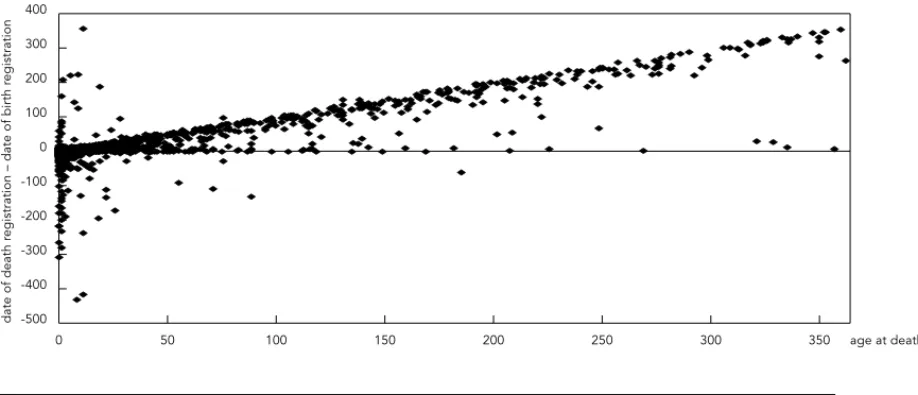
lack information on maternal education and more than 55% of the death records (or 2,128 records) lack information on gestational age. Indeed, had we believed that these variables were of value for matching, we would have in-cluded them as comparison variables in the first place. Another idea was to inspect those pairs selected as unequivocal matches. Wadja & Ross 11suggest that results from a record link-age operation obtained from an initial run through the data generally suggest opportuni-ties for improving the linkage. Winkler & Scheuren 12suggested a recursive method were firstly matched files provide information to a subsequent matching. Assuming that each of these 2,249 pairs formed truly belongs to the same infant, we inspected information on date of birth registration combined with date of death registration. We expected that births would be registered around the time of birth and that deaths would be registered around the time of death. Therefore the difference between date of death registration and date of birth reg-istration would be very close to the age at death of the infant. However, births may go unregis-tered for some time, so the time elapsed be-tween birth and death registration tended to be shorter than the actual time between the birth and death of the infant. Therefore, the idea was to use these 2,249 pairs as a “learning set of pairs” in order to calculate the ranges of birth and death registration for each of the 2,249 matched pairs. First we plotted the difference in dates of registration against the reported age at death of the child in number of days. Results are shown in Figure 1.
Most points follow or are slightly below the diagonal line, thus also indicating that the time elapsed between dates of registration may be
Table 4
Distribution of death records by number of linked birth records – records with more than one best link and birth record not involved in any other pair.
Birth records per Number of pairs Number of Percentage of Cumulative percent
death record death records death records (%) of death records (%)
2 660 330 22.5 –
3 663 221 15.1 37.6
4 588 147 10.0 47.6
5-10 4,461 642 43.8 91.4
11-21 1,589 124 8.5 99.9
100 + 5,482 2 0.1 100.0
Total 1,3443 1,466 100.0 –
slightly less than the time elapsed between the birth and the death of an infant. In fact, ac-cording to Brazilian law, the live birth should be notified and registered within 15 days. The death is likely to be registered as soon as it hap-pens, in order to obtain a death certificate for the burial. Therefore, it would be reasonable to expect that the time between registrations of the two events would lie in between the age at death of the infant minus 15 days and the age at death of the infant. This is a reasonable as-sumption, corroborated by the observations.
Figure 1 also shows that a significant num-ber of observations fall on a horizontal line, where the difference between date of death reg-istration and date of birth regreg-istration equals zero, which means that the birth and the death of the infant were registered on the same day. Lastly, 216 deaths were registered before the birth had been registered.
In Brazil, for infant deaths, if the birth has not yet been registered at the time of death reg-istration, this has to be done, by law, at the same time and at the same registrar. However, in some situations a birth might have been regis-tered after the death, due to a misunderstand-ing of the law by the registrar, for example. Or, simply, a mistake might have occurred in the recording date of registration of either event.
In light of these findings, according to the age of death of an infant we defined acceptable ranges in which we could expect the differ-ences in dates of registration to lie (Table 5).
We also hypothesized that the earlier the death, the higher the chance that the birth and the death would have taken place in the same hospital (or facility). Therefore, the chance that the birth and the death would have been regis-tered in the same registrar’s office would also be higher for earlier deaths. For the infants un-equivocally matched, the earlier the death, the higher the proportion of deaths registered in the same place as the birth. For neonatal deaths, 77% of the infants were registered in the same registrar’s office, whereas for post-neonatal deaths, only 43% were registered in the same registrar. Therefore, to solve ties we assumed that deaths during the neonatal period were more likely to be registered in the same regis-trar and used a score system, to be applied to all temporary matches, as follows:
1) For each temporary matched pair, if a death occurred at any age and the number of days elapsed between the registration of birth and registration of death fell within the proposed ranges in Table 5, we assigned the pair a score of one point (+1). Otherwise, a minus one point (-1) was assigned. If either the birth or the death did not possess information on date of regis-tration, we assigned the pair a score of zero (0). 2) For each temporary matched pair, if a death occurred during the neonatal period and the registrar’s office for the birth and death regis-tration was the same, we assigned the pair a score of one point (+1). A minus one point (-1) was assigned in case of discordant registrars. In
-500
date of death r
egistration
– date of birth r
egistration
-400 -300 -200 -100 0 100 200 300 400
300 350 age at death 250
200 150
100 50
0
Figure 1
the absence of information on registrar for ei-ther the birth or the death, a null score of zero (0) was assigned. For post-neonatal deaths, we assigned a full score of one point (+1) for all pairs, given the information on registrar was considered of no use for later deaths.
3) For each tied pair of records, we added the first to the second score. The range of possible scores is from (-2) to (+2).
4) For each death record for which tied pairs existed, we selected the pair with the highest score, if it existed.
As an example, we revisited pairs consid-ered temporary in Table 2. Death record “200” belonged to an infant who died at 18 days (Table 6). Pair (“200”; “11,863”) was selected as an un-equivocally matched pair. However, sometimes we were unable to select only one pair, as for death record “277”. The infant died at 13 days (Table 6).
We were still uncertain about which birth record truly represented the death record, and we kept the first three pairs in the absence of any other information to solve the tie.
Overall, after we used dates of birth regis-tration and death regisregis-tration combined and the information on registrar, we reduced the number of temporary matched pairs from 13,443 to 3,917, a 71% reduction.
We further reduced the number of tempo-rary pairs stating that a one-to-one relation-ship also provided evidence that the pair be-longed to the same infant. When a one-to-one relationship was found, the birth record in-volved in that relationship should not be al-lowed to be involved in any other match, in case the death record in this later match was
also involved in another match with another birth record (or records). For example, death record “196” belonged to an infant who died in the first day of life, and death record “1,447” belongs to an infant who died at three months (119 days). These death records achieved a best link with other birth records at the combined weight of 0.29 (Table 7).
Since the only birth record considered to be matched to death record “196” was birth record “11,179”, a one-to-one relationship was estab-lished. We then ruled out birth record “11,179” as an option for death record “1,447” because a
Table 5
Acceptable ranges of time intervals between birth and death registration for resolution of temporary pairs, by age at death of the infant.
Age at death Acceptable range that includes number
(in number of days) of days between birth and death registration
(inclusive time intervals)
0 0
1 (0-1)
2 (0-2)
(…) (…)
16 (0-16)
17 (2-17) or events registered at the same day (i.e., 0)
(…) (…)
363 (348-363) or same day (i.e., 0)
Source: Departamento de Informática do Sistema Único de Saúde 2; Fundação Sistema Estadual de Análise de Dados 3.
Date of birth registration, in number of days, starting with January 1st, 1998 as day “one”, is “X”; Date of death registration, in number of days, starting with January 1st, 1998 as day “one”, is “Y”; Time elapsed between registrations in the second column relates to “Y-X”.
Table 6
Example pair of resolved ties – death record “200” and death record “277”.
Identification number Registrar’s office Time between Score
Death Birth birth and death Registrar Time between Total
registration dates
200 11,863 Same 4 +1 +1 +2
200 14,232 Not same 7 -1 +1 0
277 16,558 Same 2 +1 +1 +2
277 16,567 Same 0 +1 +1 +2
277 16,575 Same 1 +1 +1 +2
277 192,334 Not same -262 -1 -1 0
277 32,173 Same -10 +1 -1 0
277 17,649 Not same 17 -1 -1 0
277 16,491 Same 14 +1 -1 0
one-to-one relationship was established be-tween death record “196” and “11,179”, but not between “1,447” and “11,179”. We notice, how-ever, that if the only birth record left for “1,447” was “11,179”, we would be unable to proceed in this way. Indeed, the reduction in the number of temporary pairs by following this procedure existed, but was very small: only six pairs.
We have ruled out a number of pairs after implementing the scoring system in which we considered the consistency in dates of registra-tion and the informaregistra-tion on registrar’s office for earlier deaths and by the later procedure de-scribed. We were left with several birth records that were now allowed to match with death records that did not achieve a best link in the first pass. We present the case of the death record “3,410”, pertaining to an infant who died at the age of twenty-five days (Table 8).
All birth records that best-linked to death record “3,410” also best-linked to death record “3,121” with a higher composite weight. Death record “3,121” belonged to an infant that died in the first day of life. We thought at that time that it would be appropriate to search for the second best-link(s) for death record “3,410”. However, not all birth records linked to death
record “3,121” were kept after we checked on information about registration dates and regis-trar’s office. We ended up selecting only pairs (“3,121”; “42,431”) and (“3,121”; “200,212”) as definitive matches and the remaining birth records were allowed to be an option for death record “3,410”. Finally, we evaluated the con-sistency between dates of registration for each pair and also the information on registrar of-fice and chosen pair (“3,410”; “42,431”) as the most likely to belong to the same infant.
A further 592 temporary matches were elim-inated. The total reduction in the number of temporary matches was 76 % (from 14,029 to 3,319 pairs). Final results are in Table 9.
According to these results, 2,827 death records were unequivocally matched (74% of the death records), since for 20 death records, one birth record was linked to more than one death record. Indeed, from the standpoint of the birth record, we eventually obtained that for 96% of the pairs, the birth record involved in a match was best-linked to only one death record; for 150 pairs, to two death records; and for 94 pairs, to at least four death records.
Table 7
Example pairs – death records “196” and “1,447” – evidence provided by one-to-one relationship in resolving temporary matched pairs.
Identification number Registrar’s office Time between Score
Death Birth registration Registrar Time between Total dates
196 11,179 Same 0 +1 +1 +2
196 16,181 Not same -2 -1 -1 -2
196 19,630 Not same -11 -1 -1 -2
196 20,610 Not same 7 -1 -1 -2
196 27,113 Not same -14 -1 -1 -2
196 27,133 Not same -15 -1 -1 -2
196 27,588 Not same -37 -1 -1 -2
196 57,358 Not same -59 -1 -1 -2
196 73,832 Not same -88 -1 -1 -2
1447 11,179 – 119 +1 +1 +2
1447 16,181 – 117 +1 +1 +2
1447 19,630 – 108 +1 +1 +2
1447 20,610 – 126 +1 -1 0
1447 27,113 – 105 +1 +1 +2
1447 27,133 – 104 +1 +1 +2
1447 27,588 – 82 +1 -1 0
1447 57,358 – 60 +1 -1 0
1447 73,832 – 31 +1 -1 0
Table 9
Final results of the record linkage.
Birth record per Number Percentage Cumulative percentage
death record Pairs Death records Pairs (%) Death records (%) Pairs (%) Death records (%)
1 2,847 2,847 46.2 74.1 46.2 74.1
2 854 427 13.9 11.1 60.0 85.2
3 687 229 11.1 6.0 71.2 91.2
4 536 134 8.7 3.5 79.9 94.7
5 475 95 7.7 2.5 87.6 97.1
6 318 53 5.2 1.4 92.7 98.5
7 203 29 3.3 0.8 96.0 99.3
8 152 19 2.5 0.5 98.5 99.8
9 45 5 0.7 0.1 99.2 99.9
11 + 49 4 0.8 0.1 100.0 100.0
Total 6,166 3,842 100.0 100.0
Source: Departamento de Informática do Sistema Único de Saúde 2; Fundação Sistema Estadual de Análise de Dados 3. Table 8
Example pairs of resolution of ties after a first pass, based on remaining birth records.
Identification number Combined weight Best link achieved by Pair selected as a temporary
Death Birth death record? birth record? (or definitive) match
3,121 42,431 17.85 Yes Yes Yes
3,121 43,442 17.85 Yes Yes Yes
3,121 200,212 17.85 Yes Yes Yes
3,121 203,961 17.85 Yes Yes Yes
3,410 42,431 11.94 Yes No No
3,410 43,442 11.94 Yes No No
3,410 200,212 11.94 Yes No No
3,410 203,961 11.94 Yes No No
Source: Departamento de Informática do Sistema Único de Saúde 2; Fundação Sistema Estadual de Análise de Dados 3.
Final considerations
In this article we have described a procedure to circumvent the “undecided-matched pair problem”, when a one-to-one relationship is expected to hold, avoiding the need to under-go a full clerical review before considering first results from the record linkage. As a result, we increased the number of uniquely matched pairs from 2,249 to 2,827, which corresponds to and increases from 59 to 74% of the 3,842 matched death records. We also reduced the number of death records best-linked to at least four records from 915 to 339 death records. Therefore, even though we could not find a one-to-one match for every single death record, we
are certain to have decreased the number of un-certain matches.
Acknowledgments
The first author’s Doctoral studies at The Bloomberg School of Public Health, Johns Hopkins University, were fully funded by The Brazilian Agency for Post-Graduate Education (process number 2166/97-6), and a preliminary version of this article was devel-oped as part of the first author’s Ph.D. dissertation, submitted in November, 2002. The authors would al-so like to thank Dr Carlos E. C. Ferreira for thoughtful comments during the development of the first ver-sion of this manuscript as part of the dissertation. Contributors
C. J. Machado conceived the study, performed the probabilistic matching, and drafted the manuscript. K. Hill contributed by advising the student through-out the dissertation development process.
Resumo
O relacionamento probabilístico permite que fontes de informações do mesmo registro e em bancos de dados distintos sejam unificadas. Apresenta-se um procedi-mento utilizado quando se espera que um registro de um banco de dados corresponda a apenas um outro num segundo banco. As fontes de dados foram os nas-cimentos e óbitos infantis da coorte de nasnas-cimentos de 1998, na cidade de São Paulo, Brasil. Os dados relacio-nados com o mais alto escore e relação unívoca foram utilizados como padrão-ouro e concorreram para a decisão sobre pares obtidos sem relação unívoca. Um comportamento esperado dos dados univocamente re-lacionados em termos da diferença nas datas de regis-tro de óbito e de nascimento, e também dos locais de registro de nascimento e de óbito para óbitos neona-tais foi observado e, aplicou-se esta relação aos demais dados. O número de pares com relação unívoca au-mentou substancialmente, de 2.249 para 2.827, e di-minuiu o número de nascimentos ligados a um óbito. Este procedimento deve ser associado à revisão manu-al (procedimento padrão na presença de incerteza) a fim de conseguir um pareamento eficiente.
Probabilidade; Registros; Estudo de Coortes
Second, even though we have reduced the number of non-uniquely matched records from 1,593 to 1,015 death records, we recognize that this number of records with uncertain matches is far from satisfactory, and that clerical review might have eliminated a number of temporary matches. Our aim, however, was to show that before undertaking a full clerical review, infor-mation from first correctly matched pairs should be considered.
References
1. Newcombe HB, Kennedy JM, Axford SJ, James AP. Automatic linkage of vital records. Science 1959; 30:954-9.
2. Departamento de Informática do Sistema Único de Saúde. Sistema de informações de nascidos vivos de 1998. http://tabnet.datasus.gov.br/cgi/ sinasc/dados/ (accessed on 20/May/2000). 3. Fundação Sistema Estadual de Análise de Dados.
Informações sobre mortalidade 1998/1999: São Paulo. São Paulo: Fundação Sistema Estadual de Análise de Dados; 2000.
4. Machado CJ. Early infant morbidity and infant mortality in Brazil: a probabilistic record linkage approach [PhD Thesis]. Baltimore: Bloomberg School of Public Health, The Johns Hopkins Uni-versity; 2002.
5. Camargo Jr. KR, Coeli CM. Reclink: an application for database linkage implementing the proba-bilistic record linkage method. Cad Saúde Públi-ca 2000; 16:439-47.
6. Macleod MC, Bray CA, Kendrick SW, Cobbe SM. Enhancing the power of record linkage involving low quality personal identifiers: use of the best link principle and cause of death prior likeli-hoods. Comput Biomed Res 1998; 31:257-70.
7. Kendrick SW, Douglas MM, Gardner D, Hucker D. Best-link matching of Scottish health data sets. Methods Inf Med 1998; 37:64-8.
8. Ferreira CEC, Flores LPO. The dimensions of in-fant mortality in São Paulo. Brazilian Journal of Population Studies 1998; 1:145-64.
9. Tepping BJ. A model for optimum linkage of records. J Am Stat Assoc 1968; 63:1321-32. 10. Waien SA. Linking large administrative
databas-es: a method for conducting emergency medical services cohort studies using existing data. Acad Emerg Med 1997; 4:1087-95.
11. Wadja A, Ross LL. Simplifying record linkage: soft-ware and strategy. Comp Biol Med 1987; 17:239-48. 12. Winkler W, Scheuren S. Recursive analysis of linked files that are computer matched. http:// www.census.gov/srd/papers/pdf/rr96-8.pdf (ac-cessed on 30/May/2002).
Submitted on 25/Mar/2003