Mothers’ memory about breastfeeding and sucking habits in the first
months of life for their children
Memória das mães sobre amamentação e hábitos de sucção nos primeiros meses da vida de seus filhos
Memoria de las madres sobre amamantación y hábitos de succión en los primeros meses de la vida de sus hijos
Rodrigo Walter Barbosa1, Adauto Emmerich Oliveira2, Eliana Zandonade3, Edson Theodoro dos Santos Neto4
Instituição: Programa de Pós-graduação em Saúde Coletiva da Universidade Federal do Espírito Santo (Ufes), Vitória, ES, Brasil
1Mestre em Saúde Coletiva pela Ufes, Vitória, ES, Brasil
2Pós-doutor em Saúde Pública pela Escola Nacional de Saúde Pública da Fundação Oswaldo Cruz (ENSP/Fiocruz); Professor Associado do Departamento de Medicina Social da Ufes, Vitória, ES, Brasil
3Doutora em Estatística pela Universidade de São Paulo (USP); Professor Associado do Departamento de Estatística da Ufes, Vitória, ES, Brasil 4Doutor em Epidemiologia em Saúde Pública pela ENSP/Fiocruz; Professor Assistente do Departamento de Medicina Social da Ufes, Vitória, ES, Brasil ABSTRACT
Objective: To validate the information of mothers’ memory about breastfeeding and sucking habits in the first months of their children’s life.
Methods: A cohort study followed 86 children for 36 months from birth. In the initial moment, zero to three months-old infants were assessed about breastfeeding, suck-ing habits and semisolid food introduction. Nearly six years after the initial study, 53 mothers of these children were re-interviewed regarding their recall about breastfeeding, sucking habits and semisolid food introduction. Kappa,
McNemar, Student’s t, and intraclass correlation tests were
used to verify the association between previous and current maternal memory.
Results: Disagreement between previous and current maternal memory was found regarding thumb-sucking
(McNemar; p=0.001) and pacifier use (McNemar; p=0.009).
In addition, mothers in the current interview report older
ages for introducing bottle feed (Student’s t; p=0.043) and
semisolid food (Student’s t; p=0.001). However, memory
about duration of breastfeeding presented high intraclass
correlation coefficient (ρ=0.923; p=0.001).
Conclusions: Maternal information about duration of breastfeeding and age of pacifier withdraw is valid for use in retrospective studies. Introduction of bottle feeding, pacifier and semisolid foods during the first six months of life may suffer a recordatory bias.
Key-words: breast feeding; sucking behavior; bias (epi-demiology).
RESUMO
Objetivo: Validar as informações da memória materna, sobre amamentação e hábitos de sucção nos primeiros meses da vida de seus filhos.
Métodos: Estudo de coorte que acompanhou, durante 36 meses, 86 crianças com idade inicial de zero a três meses, para avaliar os desfechos sobre: amamentação, hábitos de sucção e início da alimentação semissólida. Cerca de seis anos depois do estudo inicial, 53 mães dessas crianças foram reentrevistadas quanto aos hábitos alimentares e de sucção
de seus filhos. Testes de Kappa, McNemar, t de Student e
correlação intraclasse foram utilizados para testar a relação entre a memória materna pregressa e atual.
Endereço para correspondência: Edson Theodoro dos Santos Neto Rua Guilherme Bassini, 97 – São Pedro I CEP 29030-015 – Vitoria/ES
E-mail: [email protected]
Fonte financiadora: Fundação de Apoio à Pesquisa do Estado do Espírito Santo (Fapes), Fundação de Amparo a Ciência e Tecnologia do Município de Vitoria (Facitec), Universidade Federal do Espírito Santo (Ufes) Conflito de interesse: nada a declarar
Resultados: A memória materna pregressa e atual
discor-dou sobre as práticas de sucção de dedo (McNemar; p=0,001)
e de chupeta (McNemar; p=0,009) pelos seus filhos. Além
disso, a memória materna atual relatou idades mais tardias
para o início do uso de mamadeira (t de Student; p=0,043) e
da alimentação semissólida (t de Student; p=0,001).
Contu-do, apresentou um alto coeficiente de correlação intraclasse quando a informação relembrada foi o tempo de
amamen-tação (ρ=0,923; p=0,001).
Conclusões: Informações maternas, sobre o tempo de amamentação e sobre idade de cessação do hábito de sucção de chupeta são válidas para serem utilizadas em estudos retrospectivos. Com menor nível de validade, podem ser utilizadas as informações sobre a sucção de chupeta e de mamadeira nos primeiros seis meses de vida, somadas à idade da introdução do uso de mamadeira pelas mães.
Palavras-chave: aleitamento materno; comportamento de sucção; viés (epidemiologia).
RESUMEN
Objetivo: Validar las informaciones de la memoria materna sobre amamantación y hábitos de succión los primeros meses de la vida de sus hijos, en Vitória, Espírito Santo (Brasil).
Métodos: Estudio de cohorte que siguió, durante 36 me-ses, a 86 niños con edad inicial de cero a tres meses para eval-uar los desenlaces sobre: amamantación, hábitos de succión e inicio de la alimentación semi-sólida. Aproximadamente seis años después del estudio inicial, 53 madres de esos niños fueron re-entrevistados respecto a los hábitos alimentares y
de succión de sus hijos. Pruebas de Kappa, McNemar, t de
Student y correlación intraclase fueron utilizadas para probar la relación entre la memoria materna anterior y actual.
Resultados: La memoria materna anterior y actual dis-cordó sobre las prácticas de succión de dedo (McNemar;
p=0,001) y de chupete (McNemar; p=0,009) por sus hijos.
Además, la memoria materna actual relató edades más tardías
para el inicio del biberón (t de Student; p=0,043) y de la
ali-mentación semi-sólida (t de Student; p=0,001). Sin embargo,
presentó un alto coeficiente de correlación intraclase cuando la información recordada fue el tiempo de amamantación
(ρ=0,923; p=0,001).
Conclusiones: Informaciones maternas sobre el tiempo de amamantación y sobre la edad de término del hábito de succión del chupete son válidas para uso en estudios ret-rospectivos. Con menor nivel de validez, se puede utilizar
las informaciones sobre la succión de chupete y de biberón en los primeros seis meses de vida, sumadas a la edad de la introducción del uso de biberón por las madres.
Palabras clave: lactancia materna; comportamiento de succión; bies (epidemiología).
Introduction
Knowledge about the factors that determine feeding and sucking habits in the irst months of life is extremely impor-tant because the survival of newborns depends on feeding. Naturally, infants are born with an unconditioned sucking
and swallowing relex(1), which enables them the satiate their
feeding instinct by the meeting of the infant’s mouth with
the mother’s breast, deined as breastfeeding(2). However, the
actual breastfeeding encounter between mother and newborn is determined by favorable, as well as detrimental, factors
for breastfeeding(3).
Breastfeeding until the second year of life has a
recog-nized function in the prevention of infant malnutrition(4),
gastrointestinal and respiratory problems(5), allergies(6),
malocclusion(7) and even infant death(8). Most studies about
the factors that determine the duration of exclusive or nonexclusive infant breastfeeding are cross-sectional and
based on information derived from maternal recall(3). In this
context, a potential caveat of studies that use this retrospec-tive approach is the uncertainty about the reliability of data derived from recall, which are retrieved when illing out questionnaires or study forms during interviews.
Some of the limitations of data collection during in-terviews are: poor understanding of the meaning of study questions by respondents, which may lead to erroneous interpretations; the lack of interviewee’s willingness to provide the necessary information; and the fact that some
important data may be left out(9). Surveys conducted
us-ing questionnaires and forms may be imprecise when the
study subjects do not answer exactly what is asked(10). To
avoid these limitations in breastfeeding surveys, the World Health Organization recommends that the parameters about breastfeeding and infant feeding should be measured by means of semistructured questionnaires that ask about the
previous 24 hours(11).
Because of the possible inaccuracy of breastfeeding information obtained using maternal recall, prospective
data collection(3) at intervals no greater than one week has
breastfeeding and infant sucking habits was validated by comparing data derived from prior maternal recall collected along 36 months and current recall collected six years after the beginning of follow-up of a group of individuals in Vitória, southern Brazil.
Methods
This study enrolled mothers that participated in a
lon-gitudinal study conducted from 2004 to 2006(13). For three
years, this study examined the prevalence of malocclusion, caries, sucking habits, loss of lip sealing and early weaning in infants younger than three months who had been born in areas of low socioeconomic conditions in Vitória, Brazil.
The infants were selected from two regions with the low-est infant mortality rates in Vitória, São Pedro and Bonim, both fully covered by the Family Health Strategy program. All infants born in those regions from November 2003 to May 2004 were included in the study. Inclusion criteria were residence in one of the two study areas and registration in one of the family healthcare units of Ilha das Caieiras, Santo André and Thomaz Thommasi.
The initial sample size was calculated for a population of 4,521 infants born in Vitória in 2001 according to the Brazilian Live Birth Information System. For a 10% preci-sion and a level of signiicance of 5%, in addition to the breastfeeding prevalence rate of 74.8% at ages 151 to 180 days in 1999, sample size was 73 infants. About 20% was added to that number to compensate for possible losses, and the inal sample size was 86 infants.
During the study, four observers, in pairs, visited house-holds regularly, when they illed out a form and conducted clinical examinations to collect clinical data about sucking habits, oral breathing, feeding and the development of deciduous dentition. During the visits, the mothers also received instructions about baby care.
Seven house visits were made at regular intervals (every three months in the irst two years of the study and every six months in the last year) and data were used to control observations about whether the instructions given in the irst visit, when the maternal handling of the baby was recorded, were followed. A new form was illed out for each visit with data from the structured interview and the clinical examination, and the initial instructions were repeated to the mothers. After follow-up for 36 months, only 65 children remained in the study because 21 were no longer found at their addresses.
About six years after the beginning of the study, the 65 children were visited again in their homes between August 2009 and February 2010, and 53 mothers were found and interviewed again. Two dentists illed out a study form according to face-to-face interviews conducted after the participants signed an informed consent term. The form had closed and open questions about their children’s feeding and sucking habits in their irst months of life. This study was approved by the Ethics in Research Committee of the Health Sciences Center, Universidade Federal do Espírito Santo, under no. 018/09.
The following data about past events were collected: the number of months during which the infant was directly breastfed or received expressed breast milk, as well as the daily frequency of feeding; the month when the ingestion of semisolid foods was introduced; and the months when the nutritional (bottle feeding) and non-nutritional (paciier, thumb) sucking habits started and stopped. Moreover, data about the reasons for weaning, according to an open ques-tion, were recorded in the form and shortly after classiied as maternal explanations.
Data collected using the forms in this cross-sectional study were entered into the SPSS 12.0 and added to the database
of the prospective cohort(13). The inal sample of 53 mothers
was calculated based on the Student t test power for paired
samples to test mean differences between prior and current maternal recall about the variables associated with feeding and sucking habits. This calculation showed that the sample of 53 pairs detected differences at a power greater than 80% and an alpha error lower than 5%.
Kappa was used to test maternal recall about feeding and sucking habits and to measure the level of agreement
accord-ing to Landis and Koch(14): almost perfect (0.80–1.00),
sub-stantial (0.60–0.79), moderate (0.41–0.59), fair (0.21–0.40)
or poor (≤ 0.20). In addition, the McNemar tests were used to
deine the direction (tendency) of disagreement, the Student
t test, to compare means, and the intraclass correlation
coef-icient, to evaluate the direction and levels of correlation. The level of signiicance was set at 5%.
Results
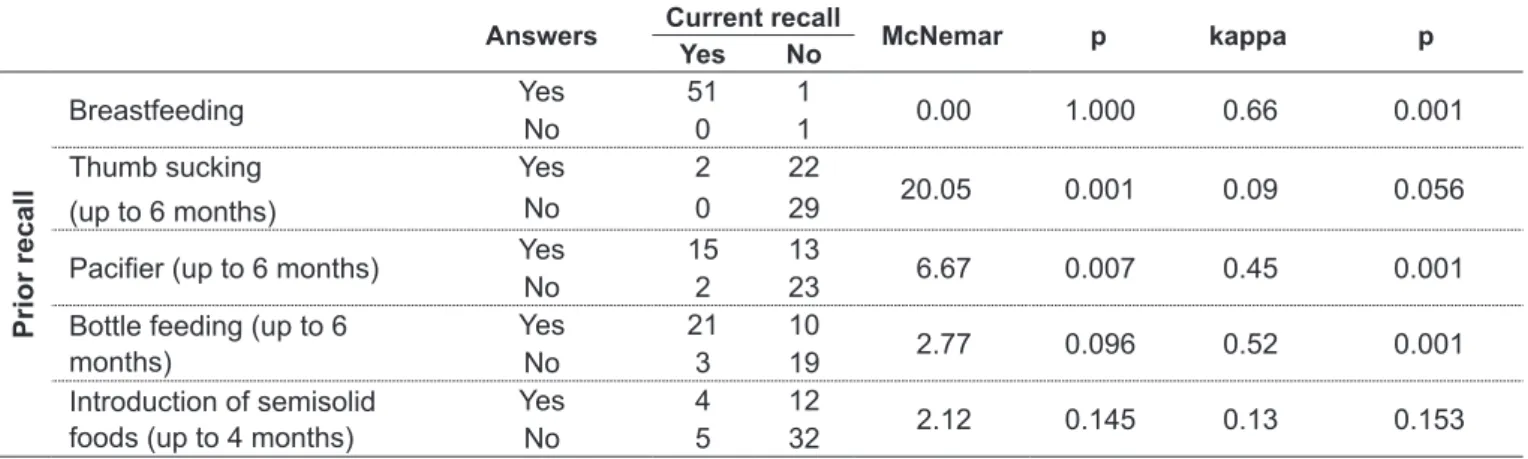
contrast, kappa coeficients suggested that there is sub-stantial agreement between prior and current memories about breastfeeding practices, and agreement was moderate for information about paciier and bottle use up to their infants’ sixth month of life.
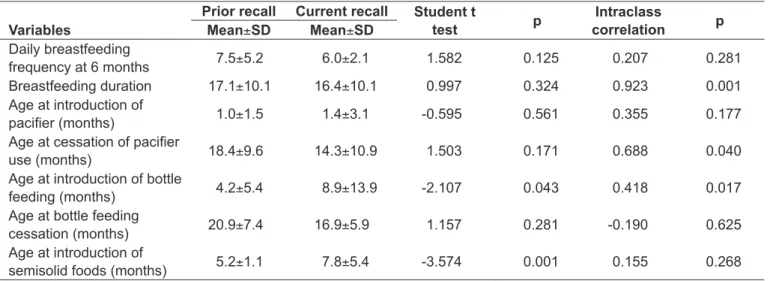
The comparisons of means using the Student t test, shown
in Table 2, revealed that there were no differences between prior and current recall about breastfeeding duration in months. However, mean differences were signiicant for re-ports about the age when bottle feeding and semisolid food consumption started. Those analyses revealed that current maternal recall overestimates ages at the beginning of those practices. Other analyses in Table 2 show that the variable for the breastfeeding duration has a high intraclass correla-tion coeficient, followed by age at cessacorrela-tion of paciier use and age at introduction of bottle feeding.
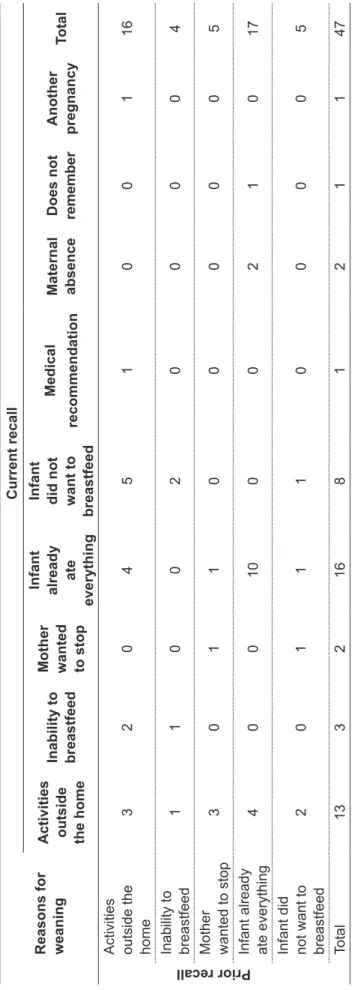
Table 3 shows the reasons for weaning given by moth-ers in prior and current reports. Five reasons remained in current maternal memories, although the levels of agree-ment were low. In addition, four new reasons appeared in maternal reports.
Discussion
Some of the most relevant factors in infancy to determine breastfeeding duration are the nutritious and non-nutritious
sucking habits. The use of bottles(15), paciiers(16) and the
early introduction of semisolid foods in the infant’s diet(17)
are factors that limit breastfeeding substantially. Therefore, information about these variables should be accurate if they are to be used in rigorous scientiic studies about breastfeed-ing, which may guide pediatric interventions.
The agreement between data from prior and current maternal recall about breastfeeding is substantial, whereas data about breastfeeding duration in months had a high in-traclass correlation, which suggests that maternal memories are valid, even after ive or six years from their child’s birth. However, no validity can be assigned to data about the daily frequency of breastfeeding at six months of life.
In a similar study, Kark et al(18) validated a questionnaire
about maternal breastfeeding history about 20 years after their child’s birth. The comparison of retrospective and prospective data revealed substantial agreement. A study
conducted in Canada(19) compared maternal reports
imme-diately after birth with maternal recall eight years after their infants were born and found an almost perfect agreement for breastfeeding duration and exclusive breastfeeding duration.
The study conducted by Huttly et al(20),who also validated
maternal recall about breastfeeding duration, compared data in the 11th month after delivery and at two other time points. They found a rate of response disagreement below 30%, and the mothers with a higher income and education were those that reported longer breastfeeding durations.
Studies suggest that mothers forget important informa-tion about the irst months of life of their infants as data are collected at more distant times from the moment when it
was experienced. However, Promislow, Gladen and Sandler(21)
found a good correlation for breastfeeding duration in a group of US women interviewed 34 to 50 years after their child’s birth. Their indings suggest that the distance be-tween time points when information was collected did not affect negatively the quality of data about maternal breast-feeding according to maternal reports, which was conirmed by our indings.
Answers Current recall McNemar p kappa p
Yes No
Pr
io
r
re
c
a
ll
Breastfeeding Yes 51 1 0.00 1.000 0.66 0.001
No 0 1
Thumb sucking (up to 6 months)
Yes 2 22
20.05 0.001 0.09 0.056
No 0 29
Paciier (up to 6 months) Yes 15 13 6.67 0.007 0.45 0.001
No 2 23
Bottle feeding (up to 6 months)
Yes 21 10
2.77 0.096 0.52 0.001
No 3 19
Introduction of semisolid foods (up to 4 months)
Yes 4 12
2.12 0.145 0.13 0.153
No 5 32
However, some authors do not fully support the use of data that depend on recalling distant memories. The
system-atic review conducted by Li, Scanlon and Serdula(22) found
that information about breastfeeding duration was more accurate when weaning took place at an interval shorter
than three years. Santos Neto et al(3) recommend that studies
about breastfeeding should be prospective to approximate weaning time from the time when data are collected. Bland
et al(12) recommended that maternal follow-up should be
weekly after birth, because breastfeeding data collected retrospectively in a rural South African community were not very accurate.
Of the nutritious sucking habits, the use of bottles is the irst choice made by mothers when replacing maternal breast
milk with animal milk or formulas. Foucault(23) reported
that, in the 18th century, there was a myth that prohibited
women to have sexual relations during the time when they were breastfeeding because, if they did, their milk would be spoiled, which motivated rich women to wean their infants early and send them to a wet nurse to be able to resume sexual relations with their husbands. In that context, in 1876, the modern bottle was created, and its use became popular
because of the book Maniere d’allaiter les enfans a la main au
defaut de nourrices, the French version of a text written by an
Italian called Baldini.
Results showed a moderate agreement between prior and current maternal recall about the use of a bottle from birth to six months of life, and there was no signiicant tendency in the disagreement test. However, the mean difference, in
months, of maternal reports about age at introduction of bottle feeding is signiicant: after ive or six years, mothers say that bottle feeding was introduced later. In contrast, the intraclass analysis had a low, but signiicant,
correla-tion (ρ<0.05). These indings are in agreement with those
reported by Launer et al(24), who found a lower percentage of
agreeing answers about age at introduction of bottle feeding than about other infant feeding events. In a similar way,
another review(22) concluded that the correlation between
reported and actual age at introduction of semisolid foods and liquids was less satisfactory.
This study did not ind any level of signiicant agree-ment about introduction of semisolid foods into the in-fant’s diet up to four months of life. In addition, mothers reported substantially older ages at the introduction of these foods. The difference in age at introduction of solid
foods was also detected by Vobecky, Vobecky and Froda(19),
who found a signiicant difference between data collected prospectively about the introduction of meat and cereals and maternal recall. In a group of Australian mothers,
Tienboon, Rutishauser and Wahlqvist(25) also found little
agreement about age at introduction of solid foods when comparing variables associated with breastfeeding. These indings are relevant for population surveys about the dura-tion of exclusive breastfeeding, which require a deinidura-tion of the time when liquid and solid complementary foods
were introduced(26). Therefore, it seems to be more reliable
to collect information about infant feeding recalled by the
mothers in the last 24 hours(11).
Prior recall Current recall Student t
test p
Intraclass
correlation p Variables Mean±SD Mean±SD
Daily breastfeeding
frequency at 6 months 7.5±5.2 6.0±2.1 1.582 0.125 0.207 0.281 Breastfeeding duration 17.1±10.1 16.4±10.1 0.997 0.324 0.923 0.001 Age at introduction of
paciier (months) 1.0±1.5 1.4±3.1 -0.595 0.561 0.355 0.177
Age at cessation of paciier
use (months) 18.4±9.6 14.3±10.9 1.503 0.171 0.688 0.040 Age at introduction of bottle
feeding (months) 4.2±5.4 8.9±13.9 -2.107 0.043 0.418 0.017 Age at bottle feeding
cessation (months) 20.9±7.4 16.9±5.9 1.157 0.281 -0.190 0.625 Age at introduction of
semisolid foods (months) 5.2±1.1 7.8±5.4 -3.574 0.001 0.155 0.268
Table 2 - Comparison of means and correlation between prior and current maternal recall about feeding and sucking habits in the irst months of life of their infants
R e a s o n s fo r w e a n in g C u rr e n t re c a ll A c ti v iti e s o u ts id e th e h o m e In a b il ity to b re a s tfe e d Mo th e r w a n te d to s to p In fa n t a lr e a d y a te e v e ry th in g In fa n t d id n o t w a n t to b re a s tfe e d Me d ic a l re c o m m e n d a ti o n Ma te rn a l a b s e n c e D o e s n o t re m e m b e r A n o th e r p re g n a n c y T o ta l Prio r r ec all Act ivi ti e s o u tsi d e t h e h o me 3 2 0 4 5 1 0 0 1 1 6 In a b ili ty to b re a st fe e d 1 1 0 0 2 0 0 0 0 4 Mo th e r w a n te d t o st o p 3 0 1 1 0 0 0 0 0 5 In fa n t a lre a d y a te e ve ryt h in g 4 0 0 1 0 0 0 2 1 0 1 7 In fa n t d id n o t w a n t to b re a st fe e d 2 0 1 1 1 0 0 0 0 5 T o ta l 1 3 3 2 1 6 8 1 2 1 1 4 7 T a b le 3 - Ag re eme nt b et w ee n pri or an d cu rre nt ma te rn al re ca ll of re aso ns fo r w ea ni ng in th e irst mo nt hs of li fe
The analysis of non-nutritious sucking habits reveals that the use of a paciier substantially reduces
breastfeed-ing duration(3). However, even when thumb sucking is not
classiied as a habit that affects breastfeeding(27), the
combi-nation of thumb and paciier sucking is associated with the
cessation of breastfeeding at several levels(28). When thumb
sucking by infants was analyzed, mothers disagreed in the direction of denying the occurrence of that habit. This information is applicable in studies that evaluate the onset of dentoskeletal deformities in the development of infant
craniofacial development(7). For paciier use, the kappa
co-eficient indicated moderate agreement between prior and current maternal recall of the habit up to the sixth month of life of their children. Age at the beginning of this type of sucking habit did not have any differences in mean number of months or any signiicant correlation. However, age at habit cessation seemed to be remarkable for mothers, as the correlation was substantial, with a coeficient close to 0.70. Since the moment when the possible association between
paciier use and breastfeeding duration was irst reported(16),
most studies have included this variable as an important predictor of breastfeeding duration, although the exact mechanism of how paciiers may affect breastfeeding remains
unclear(3). In addition to its negative effect on breastfeeding,
paciier use has important effects on the maxillary arch and is one of the main risk factors for the development of open
bite in deciduous dentition(29).
The analysis of maternal reasons for weaning conirmed the scattered pattern of the effects of maternal recall shown in category changes and the creation of new discursive cat-egories that justify weaning. For example, of the 16 mothers who irst reported having weaned their infants due to activi-ties out of the home, three maintained the same reason, two reported not being able to breastfeed, four reported weaning because their child already ate everything, ive because the infant did not want to eat anymore, one because of medical recommendations and one because of another pregnancy.
Similar reasons were reported by Ramos and Almeida(30) in a
qualitative study with 24 women in the process of weaning their infants before their fourth month of life. According to
Wayland(31), 42.0% of the mothers reported that the main
reason to stop breastfeeding was the fact that infants refused the breast. Mothers seem to reproduce socially acceptable discourses and to evade the breastfeeding function as they set the responsibility for weaning on the infant, which is translated as “the baby already eats everything” and “the
assigned false responses to the deicient interviewee recall, which results in giving socially acceptable, standard re-sponses and has low study validity. According to Marconi
and Lakatos(9), one of the problems inherent to studies based
on forms is the lack of willingness of the respondent to pro-vide true answers when the report is about something seen as negative or embarrassing.
The limitations of this study are associated with the low socioeconomic status of the sample selected, which may also be
associated with the low level of maternal education. Mothers with less education tend to remember less about infant feeding and sucking in the irst months of life. However, the conclu-sions of this study point to the fact that maternal information about breastfeeding duration and age at cessation of paciier use are valid to be used in retrospective studies. Although with a lower validity level, information about paciier use and bottle feeding in the irst six months of life can be used, together with age at introduction of bottle feeding.
References
1. Moyers RE, Carlson DS. Maturação da neuromusculatura orofacial. In: Enlow
DH, Moyers RE, Merow WW, editors. Crescimento facial. 3rd ed. Rio de Janeiro:
Artes Médicas; 1993. p. 260-71.
2. Santos Neto ET, Oliveira AE, Zandonade E. Exclusive breastfeeding on three irst months of life. Pediatria (São Paulo) 2007;29:89-98.
3. Santos Neto ET, Oliveira AE, Zandonade E, Molina MC. Paciier use as a risk factor for reduction in breastfeeding duration: a systematic review. Rev Bras Saude Mater Infant 2008;8:377-89.
4. World Health Organization. The optimal duration of exclusive breastfeeding: results of a WHO systematic review. Indian Pediatrics 2001;38:565-7. 5. Post CL, Victora CG, Valente JG, Leal MC, Niobey FM, Sabroza PC. Prognostic
factors for hospital mortality case-fatality due to diarrhea or pneumonia: a case-control study. Rev Saude Publica 1992;26:369-78.
6. Lowe AJ, Carlin JB, Bennett CM, Abramson MJ, Hosking CS, Hill DJ et al. Atopic disease and breast-feeding - cause or consequence? J Allergy Clin Immunol 2006;117:682-7.
7. Viggiano D, Fasano D, Monaco G, Strohmenger L. Breast feeding, bottle feeding, and non-nutritive sucking; effects on occlusion in deciduous dentition. Arch Dis Child 2004;89:1121-3.
8. Escuder MM, Venancio SI, Pereira JC. Impact estimates of breastfeeding over infant mortality. Rev Saude Publica 2003;37:319-25.
9. Marconi MA, Lakatos EM. Técnicas de pesquisa: planejamento e execução de pesquisas, amostragens e técnicas de pesquisa, elaboração, análise e
interpretação de dados. 7th ed. São Paulo: Atlas; 2008.
10. Greenhalgh T. Artigos que relatam pesquisa por questionário. In: Greenhalgh T, editor. Como ler artigos cientíicos: fundamentos da medicina baseado em
evidências. 3rd ed. Porto Alegre: Artmed; 2008. p. 201-12.
11. Organizacíon Mundial de la Salud. Indicadores para evaluar las prácticas de alimentación del lactante y del niño pequeño. Parte 1: Deiniciones. Conclusiones de la reunión de consenso llevada a cabo del 6 al 8 de noviembre de 2007 en Washington, DC, EE.UU. Geneva: Unicef/OMS; 2009. 12. Bland RM, Rollins NC, Solarsh G, Van den Broeck J, Coovadia HM, Child
Health Group. Maternal recall of exclusive breast feeding duration. Arch Dis Child 2003;88:778-83.
13. Santos Neto ET, Faria CP, Barbosa ML, Oliveira AE, Zandonade E. Association between food consumption in the irst months of life and socioeconomic status: a longitudinal study. Rev Nutr 2009;22:675-85.
14. Landis JR, Koch GG. The measurement of observer agreement for categorical data. Biometrics 1977;33:159-74.
15. Howard CR, Howard FM, Lanphear B, Eberly S, deBlieck EA, Oakes D et al. Randomized clinical trial of paciier use and bottle-feeding or cupfeeding and their effect on breastfeeding. Pediatrics 2003;111;511-8.
16. Victora CG, Tomasi E, Olinto MT, Barros FC. Use of pacifiers and breastfeeding duration. Lancet 1993;341:404-6.
17. Giovannini M, Riva E, Banderali G, Scaglioni S, Veehof SH, Sala M et al. Feeding practices of infants through the irst year of life in Italy. Acta Paediatr 2004;93:492-7.
18. Kark JD, Troya G, Friedlander Y, Slater PE, Stein Y. Validity of maternal reporting of breast feeding history and the association with blood lipids in 17 year olds in Jerusalem. J Epidemiol Community Health 1984;38:218-25. 19. Vobecky JS, Vobecky J, Froda S. The reliability of the maternal memory
in a retrospective assessment of nutritional status. J Clin Epidemiol 1988;41:261-5.
20. Huttly SR, Barros FC, Victora CG, Beria JU, Vaughan JP. Do mothers overestimate breast feeding duration? An example of recall bias from a study in southern Brazil. Am J Epidemiol 1990;132:572-5.
21. Promislow JH, Gladen BC, Sandler DP. Maternal recall of breastfeeding duration by elderly women. Am J Epidemiol 2005;161:289-96.
22. Li R, Scanlon KS, Serdula MK. The validity and reliability of maternal recall of breastfeeding pratice. Nutr Rev 2005;63:103-10.
23. Foucault M. Microfísica do poder. 6th ed. Rio de Janeiro: Graal; 1986.
24. Launer LJ, Forman MR, Hundt GL, Sarov B, Chang D, Berendes HW et al. Maternal recall of infant feeding event is accurate. J Epidemiol Community Health 1992;46:203-6.
25. Tienboon P, Rutishauser IHE, Wahlqvist ML. Maternal recall of infant feeding practices after an interval of 14 to 15 years. Aust J Nutr Diet 1994;51:25-7. 26. Sena MC, Silva EF, Pereira MG. Prevalence of breastfeeding in Brazilian
capital cities. Rev Assoc Med Bras 2007;53:520-4.
27. Aarts C, Hörnell A, Kylberg E, Hofvander Y, Gebre-Medhin M. Breastfeeding patterns in relation to thumb sucking and pacifier use. Pediatrics 1999;104:1-10.
28. Levy SM, Slager SL, Warren JJ, Levy BT, Nowak AJ. Associations of paciier use, digit sucking, and child care attendance with cessation of breastfeeding. J Fam Pract 2002;51:465.
29. Farsi NM, Salama FS. Sucking habits in Saudi children: prevalence, contributing factors and effects on the primary dentition. Pediatr Dent 1997;19:28-33.
30. Ramos CV, Almeida JA. Maternal allegations for weaning: qualitative study. J Pediatr (Rio J) 2003;79:385-90.
31. Wayland C. Breastfeeding patterns in Rio Branco, Acre, Brazil: a survey of reasons for weaning. Cad Saude Publica 2004;20:1757-61.