Education, leisure activities and
cognitive and functional ability of
Alzheimer’s disease patients
A follow-up study
Margarida Sobral1,2, Constança Paúl2
ABSTRACT. Education and participation in leisure activities appear to be highly relevant variables in Alzheimer’s disease (AD) and usually form the basis of the Cognitive Reserve construct. Objective: [A] To determine the association between education, cognitive and functional ability of AD patients; [B] To determine the association between participation in leisure activities and cognitive and functional ability of AD patients; [C] To evaluate the association of education and participation in leisure activities in the course of AD. Methods: Functional and neuropsychological abilities of 120 outpatients with probable AD were evaluated at baseline, at 36 and 54 months. Data collected at baseline included socio-demographics, clinical variables, education and frequency of participation in leisure activities throughout life. All participants and/or caregivers answered the questionnaire, “Participation in leisure activities throughout life” while patients completed the MMSE, the Clinical Dementia Rating scale, neuropsychological tests from the Lisbon Screening for Dementia Assessment, Barthel Index and Lawton and Brody’s Index. Results: AD patients with higher levels of education achieved better results on cognitive tests. The participants with higher participation in leisure activities exhibited better results on cognitive and functional tests than those with lower participation. The disease progression was linear and progressed similarly regardless of the level of education of participants. However, the results suggest a slower disease progression in patients with a higher level of participation in leisure activities throughout their lives. Conclusion: AD patients with high education and high participation in leisure activities may benefit from a slower cognitive and functional decline after diagnosis of AD.
Key words: aging; Alzheimer’s disease; education; leisure activities.
ESCOLARIDADE, ACTIVIDADES DE LAZER E CAPACIDADE COGNITIVA E FUNCIONAL DE DOENTES COM A DEMÊNCIA TIPO ALZHEIMER: UM ESTUDO DE FOLLOW UP
RESUMO. Escolaridade e participação em actividades de lazer parecem ser variáveis muito relevantes na doença de Alzheimer (DA) e normalmente usadas no construto Reserva Cognitiva. Objetivo: [A] Conhecer a associação entre escolaridade, capacidades cognitivas e funcionais de doentes com DA; [B] Conhecer a associação entre participação em actividades de lazer e capacidades cogntivas e funcionais de doentes com DA; [C] Avaliar a associação da escolaridade e participação em actividades de lazer no curso da DA. Métodos: Foram avaliadas competências funcionais e neurospsicológicas de 120 doentes com provável DA na baseline, após 36 e 54 meses. Dados recolhidos na baseline incluíram variáveis socio-demográficas, clínicas, escolaridade e frequência da participação em actividades de lazer. Participantes ou/e cuidadores responderam ao questionário, “Participação em actividade de lazer ao longo da vida” e completaram o MMSE, CDR, provas da Bateria de Lisboa para Avaliação das Demências, Índice de Barthel e Índice Lawton e Brody. Resultados: Doentes com DA com níveis mais elevados de escolaridade obtiveram melhores resultados nas provas cognitivas. Participantes com níveis mais elevados de participação em actividades de lazer exibiram melhores resultados nos testes cognitivos e funcionais do que aqueles com níveis mais baixos de participação. A progressão da doença foi linear e progrediu de forma semelhante relativamente ao nível de escolaridade. No entanto, resultados sugerem uma mais lenta progressão da doença relativamente aos doentes com níveis mais elevados de participação em actividades de lazer. Conclusão: Doentes com DA com elevada escolaridade e alta participação em actividade de lazer podem beneficiar de um mais lento declínio cognitivo e funcional após o diagnóstico da DA.
Palavras-chave: envelhecimento, doença de Alzheimer, escolaridade, actividades de lazer.
1MSc, Psychogeriatrics Service, Hospital Magalhães Lemos, Porto, Portugal. 2PhD, Research and Education Unit Aging, UNIFAI, Institute of Biomedical Sciences
Abel Salazar, University of Porto, Portugal.
Margarida Sobral. Hospital de Magalhães Lemos. Rua do Professor Álvaro Rodrigues 4149 – 003 Porto Portugal. E-mail: [email protected]
Disclosure: The authors report no conflicts of interest.
INTRODUCTION
I
n the last few decades there has been an increase in the Portuguese elderly population. According to the 2011 Census, 19.1% of the population is over 65 years of age.1 At present, the Aging Index is 129, which meansthat for every 100 young people (population aged be-tween 0-14 years) there are 129 elderly.1 he risk of
de-mentia rises exponentially with age.2-4 However, studies
have suggested that the prevalence of dementia increas-es exponentially up to 80 to 85 years, remaining stable or declining thereafter.5,6 Alzheimer’s disease (AD) is the
most common cause of dementia among elderly per-sons3,7-9 and is a progressive neurodegenerative disorder
that is characterized by deterioration of cognitive and functional abilities and by a number of neuropsychiat-ric and behavioral symptoms. By contrast, in Japan and China Vascular Dementia accounts for almost 50% of all dementias.10,11
Cognitive Reserve (CR) is a hypothetical construct that has been used to explain cognitive aging12 and
de-scribes the capacity of the adult brain to tolerate the ef-fects of this neurodegenerative process and to minimize the clinical manifestation of the pathology of dementia, and is probably the result of innate intelligence or life experience.12,13 he CR hypothesis suggests that
indi-vidual diferences in the ability to cope with AD pathol-ogy12-14 are consistent with the prediction that people
with more reserve can cope with advancing AD pathol-ogy longer before it is expressed clinically.13,15 Reserve
may explain why there is not a perfect relationship be-tween brain pathology observed post-mortem and the severity of clinical conditions such as AD.12 Variables
pertaining to lifetime experience (education, occupa-tional attainment and leisure activities) are the most commonly used proxies for CR and help retain cognitive function in old age.
Concerning the relationships between education, work, hobbies and dementia, there is a line of research that indicates that individuals with higher education, occupational attainment or participation in leisure ac-tivities have a lower risk of developing dementia.13,16-22
Recently, Cindy Stern and Zachary Munn21 revealed
evidence suggesting that active participation in cogni-tive leisure during mid or late life may be beneicial in preventing the risk of AD and other dementia in the el-derly. Nevertheless, these authors showed that evidence is currently not strong enough to infer a direct causal relationship. Another line of research found no associa-tion between educaassocia-tion and incident dementia23,24 and
no association between occupation and incident AD in several population-based longitudinal studies.25,26
Research also explores the hypothesis that CR may introduce diferences in the clinical course of AD.27 Some
studies have shown that AD patients with higher edu-cation have more rapid cognitive decline15,28 than those
with lower education, because at any level of clinical se-verity, the underlying progression is more advanced in patients with greater CR.13,15 Le Carret and colleagues29
conirmed that some cognitive processes, such as ab-stract thinking, decline more rapidly in AD patients with high education, whereas others seem to evolve more slowly compared to AD patients with low educa-tion. Research has indicated that high participation in leisure activities is associated with more rapid cognitive decline than those with lower participation in leisure ac-tivities.30 On the contrary Fritsch and colleagues31
con-cluded that education slows the rate of cognitive decline in individuals with AD.Treiber32 proved that increased
engagement in cognitive leisure activities throughout late life was associated with slower deterioration in gen-eral cognitive ability in mild dementia, but its efects were no longer evident in more severe AD. Other stud-ies have found no relationship between education and cognitive decline in the clinical course of AD.33,34
he results of studies regarding the association of education and participation in leisure activities and rates of cognitive decline seem to support CR, but the impact of this association on clinical outcomes remains unclear,27 namely the potential efect of CR on the
course of AD.
he aims of this work were: [1] to determine the as-sociation between education and cognitive and func-tional ability of AD patients; [2] to determine the as-sociation between participation in leisure activities throughout life and cognitive and functional ability of AD patients; [3] to evaluate the association of education and participation in leisure activities throughout life in the course of AD.
METHODS
In-stitute for Neurological and Communicating Disorders and Stroke/AD and Related Disorders Association36 for
probable AD. All participantswere free of severe medi-cal conditions other than those pertinent to the study. Normal or corrected levels of hearing and vision acuity were also ensured.
Assessment instruments. Data on participation in leisure activities was obtained from the questionnaire, “Partici-pation in leisure activities throughout life”, answered by the patient participants or/and their caregiver. he evaluation commenced by discriminating current and past activities. he present results show only activities undertaken by patients throughout life. he caregivers were asked to conirm the information about patient participation in leisure activities throughout life be-cause low current participation in leisure activities of patients may be a consequence of cognitive decline. his tool included mental activities (reading books/ newspapers, jigsaw puzzles), physical activities (walk-ing or other sport), social activities (play(walk-ing cards/board games, visiting friends or relatives), productive activi-ties (housekeeping, babysitting, gardening, crocheting) and recreational activities (listening to the radio, watch-ing television). Subjects reported the frequency of par-ticipation in leisure activities throughout life as “daily”, “several days per week”, “once a week”, “two or three days per month”, “monthly”, or “never or less than once a month”. Participants were asked if they regularly en-gaged in any other particular activities, to specify which types of activities and to report the frequency of partici-pation in leisure activities throughout life. he instru-ment had a total score and classiied respondents into three categories (low, medium and high participation in leisure activities throughout life). he questionnaire “participation in leisure activities throughout life”, has 17 questions and for each question subjects received 5 points for “daily”, 4 points for “several days per week”, 3 points for “once a week”, 2 points for “two or three days per month”, 1 point for “monthly” and 0 points for “never or less than once a month”. Total score ranges from 0 to 85 points. Subjects were classiied as having low participation in leisure activities if they scored be-low 20, medium for scores between 20 and 25 and high for scores higher than 25.
All participants were administered the Mini-Mental State Examination (MMSE)37 for cognitive screening, as
well as the Clinical Dementia Rating (CDR) scale38 which
classiies dementia under 3 stages of severity as a func-tion of overall cognitive and funcfunc-tional impairment. he Portuguese version of the MMSE from Guerreiro et al.39
was applied. he normative cut-of education-adjusted values for the Portuguese population were used.39
Sub-jects were expected to score above 27 for >11 years of education, ≤22 for 1-11 years of education or ≤15 if they were illiterate. he CDR determines the impair-ment associated to deimpair-mentia, through parameters such as memory, orientation, judgment and problem solv-ing, community afairs, home and hobbies and personal care. he overall CDR score is obtained by a standard algorithm to stage the patient’s level of impairment: 0, no impairment; 0.5, very mild impairment; 1, mild de-mentia; 2, moderate dede-mentia; and 3, severe dementia. he scale is administered to both patient and informant through a semi-structured interview.
AD patients were also assessed with the Lisbon Bat-tery for Assessment of Dementia (BLAD),40 aimed at
evaluating cognitive abilities within the realm of lan-guage (understanding of simple instructions, writing, object naming and identiication), orienting, calculat-ing, memory, attention, executive function, motor and grapho-motor initiative, and visuospatial ability.
Functional abilities were assessed with two activities of daily living scales: Barthel’s Index, addressing basic activities of daily living such as grooming, eating, bath-ing, dressbath-ing, and mobility, along with Lawton and Bro-dy’s Index, targeting instrumental activities (e.g. man-aging money, using the telephone). he Barthel Index has a total possible score ranging from 0 to 100 (fully independent) whereas Lawton and Brody’s Index has a total possible scores ranging from 8 (independent) to 30 (completely dependent). Socioeconomic status was evaluated according to the Grafar Index.41
26.66% (n=32) of the initial sample had dropped out. he drop-outs were due to refusal and to deaths in the course of 54 months.
In this study, two variables were hypothesized to represent the CR construct at baseline: education (as deined in terms of level of educational attainment) and frequency of participation in leisure activities (as deined in terms of low, medium and high leisure activi-ties). General exploratory analyses were conducted to determine sample characteristics. he t-tests were used
to compare neuropsychological and functional measures between baseline, follow-up 1 (F1) and follow-up 2 (F2). Pearson’s correlations were used to examine the associa-tion between educaassocia-tion and leisure activities, the asso-ciation between education level and social class, and the association between leisure activities and social class. An ANOVA mixed efects model was employed to study the efects of age at baseline, gender, CR mea-sured by education (with 4 levels: illiterate (cannot read or write), reading and writing (read and write, but with-out formal education or with 1-3 years of education), 4 years (4 years of education) and “>4 years” (more than 4 years of education), and participation in leisure ac-tivities (with 3 levels: low, medium and high), on neu-ropsychological performance at baseline, at 36 and 54 months. A complementary set analysis was conducted using the disease progression index to examine the in-luence of CR on cognitive and functional decline over 36 (3 years) and 54 months (4.5 years). he disease pro-gression index (DPI) was calculated for 3 years and for 4.5 years. he cognitive DPI was calculated as the difer-ence between cognitive scores at baseline and F1 after 3 years, and between baseline and F2 after 4.5 years. he functional DPI was calculated as the diference between functional scores at baseline and F1 after 3 years, and between baseline and F2 after 4.5 years.
Statistical analyses were conducted using the Statis-tical Package for Social Sciences version 18.0 (SPSS).
RESULTS
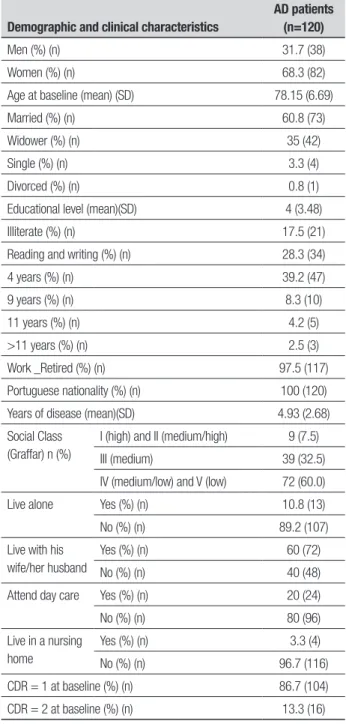
For the present analyses, data from 120 patients with dementia at baseline was used: baseline mean age of the population was 78.15 (SD 6.69 years) and educational level was 4 years. Males and females difered signii-cantly in level of education (5.92 years for males; 3.07 years for females; t=4.491 p<.001). At baseline, 86.7% were classiied as CDR=1 (mild dementia) and 13.3% as CDR=2 (moderate dementia). After 36 months 45% were classiied as CDR=1, 43.3% as CDR=2 and 11.7% as CDR=3. After 54 months 36.4% were classiied as CDR=1, 42% as CDR=2 and 21.6% as CDR=3 (severe
de-Table 1. Demographic and clinical characteristics of AD patients.
Demographic and clinical characteristics
AD patients (n=120)
Men (%) (n) 31.7 (38)
Women (%) (n) 68.3 (82)
Age at baseline (mean) (SD) 78.15 (6.69)
Married (%) (n) 60.8 (73)
Widower (%) (n) 35 (42)
Single (%) (n) 3.3 (4)
Divorced (%) (n) 0.8 (1)
Educational level (mean)(SD) 4 (3.48)
Illiterate (%) (n) 17.5 (21)
Reading and writing (%) (n) 28.3 (34)
4 years (%) (n) 39.2 (47)
9 years (%) (n) 8.3 (10)
11 years (%) (n) 4.2 (5)
>11 years (%) (n) 2.5 (3)
Work _Retired (%) (n) 97.5 (117)
Portuguese nationality (%) (n) 100 (120)
Years of disease (mean)(SD) 4.93 (2.68)
Social Class (Graffar) n (%)
I (high) and II (medium/high) 9 (7.5)
III (medium) 39 (32.5)
IV (medium/low) and V (low) 72 (60.0)
Live alone Yes (%) (n) 10.8 (13)
No (%) (n) 89.2 (107)
Live with his wife/her husband
Yes (%) (n) 60 (72)
No (%) (n) 40 (48)
Attend day care Yes (%) (n) 20 (24)
No (%) (n) 80 (96)
Live in a nursing home
Yes (%) (n) 3.3 (4)
No (%) (n) 96.7 (116)
CDR = 1 at baseline (%) (n) 86.7 (104)
CDR = 2 at baseline (%) (n) 13.3 (16)
mentia). Table 1 shows the baseline sociodemographic and clinical characteristics of AD participants.
and F2. Statistically signiicant diference between base-line and F1 were observed in functional status, Barthel’s Index (p<.001) and Lawton and Brody’s Index (p<.001) and between F1 and F2. here was a signiicant decline in cognitive and functional performance over time across all domains. Data analysis showed cognitive and func-tional decline over the 54-month period. he results of this study are in agreement with knowledge about AD, a disease characterized by progressive cognitive deterio-ration, together with declining activities of daily living.
Pearson’s correlation (r=.316) was signiicant at the .01 level (2-tailed) between education and participation in leisure activities. Positive correlations were found between educational level and socioeconomic class and between leisure activities and socioeconomic class.
According to the ANOVA mixed efects model for disease progression, as measured by the MMSE, there was no signiicant diference between men and women (p=.428) or across the age span (p=.725) on cognitive performance.
Education. Figure 1 shows the patterns of MMSE ob-tained for diferent educational levels.
he “> 4 years” group (more than 4 years of educa-tion) obtained the highest scores on the MMSE. he AD patients with higher levels of education achieved better results on the MMSE. he participants with higher edu-cational levels had higher scores on cognitive tests than elderly with lower educational levels.
he mean Barthel Index of participants with “<4 years” group (less than 4 years of education) at base-line was 96.25 and with “>4 years” group was 99.55, whereas the mean Barthel Index of AD patients with “<4 years” group at F2 was 83.29 and with “>4 years” group was 84.12. he mean Lawton and Brody Index of participants with “<4 years” group at baseline was 16.91 and with “>4 years” group was 18.14, while the Lawton and Brody’s Index mean scores of participants with “<4 years” group at baseline versus F2 was 16.91/23.78 and with “>4 years” group was 18.05/25.65.
Pearson’s correlation was signiicant at the .01 level
Table 2. Comparison between neuropsychological (MMSE, BLAD) and functional functions (Barthel Index plus Lawton and Brody’s Index) at baseline, follow-up 1 and follow-up 2.
Neuropsychological and Functional Assessment
Baseline Mean (SD)
Follow-up 1 Mean (SD)
p1 (Baseline x F1)
Follow-up 2 Mean (SD)
p2 (F1 x F 2)
Barthel Index 97.04 (8.78) 87.63(15.20) < 0.001 83.35 (17.59) < 0.001
Lawton and Brody’s Index 17.75 (5.34) 23.53 (5.65) < 0.001 24.99 (5.15) < 0.001
MMSE 21.96 (4.22) 18.73 (5.65) < 0.001 17.16 (6.56) < 0.001
Lisbon Battery for Assessment of Dementia (BLAD)
Writing 1.49 (0.86) 1.37 (0.91) 0.033 1.25 (0.96) 0.006
Reading 1.51 (0.85) 1.39 (0.91) 0.027 1.30 (0.94) 0.027
Language_Appointment 7.00 (0.000) 6.61 (1.52) 0.007 6.02 (2.39) 0.026
Language_Identification object 5.00 (0.00) 4.71 (1.15) 0.008 4.49 (1.50) 0.374
Language_Repetition of words 10.28 (1.36) 9.48 (2.40) < 0.001 8.90 (3.08) 0.004
Language_Simple instructions 3.97 (0.36) 3.72 (0.98) 0.016 3.48 (1.31) 0.042
Calculation 8.26 (4.47) 6.46 (4.76) < 0.001 5.06 (4.71) < 0.001
Orientation 8.83 (3.07) 6.01 (3.13) < 0.001 4.85 (3.29) < 0.001
Proverbs 4.66 (1.88) 3.91 (1.39) < 0.001 3.52 (1.06) < 0.001
Graphomotor initiative 1.10 (1.02) 0.75 (1.12) 0.002 0.49 (0.66) 0.013
Motor initiative 1.83 (1.12) 1.32 (1.20) < 0.001 1,01 (1,14) 0.002
Semantic Fluency 9.02 (3.46) 6.91 (3.82) < 0.001 6.22 (3.93) 0.195
Digit Span 7.63 (2.15) 6.59 (2.68) < 0.001 5.60 (3.93) 0.008
Digit Span Forward 5.28 (1.28) 4.67 (1.74) < 0.001 4.03 (2.00) 0.060
Digit Span Backward 2.37 (1.37) 1.94 (1.49) 0.012 1.63 (1.67) 0.272
Verbal memory with interference 6.54 (3.07) 4.89 (3.42) < 0.001 3.87 (3.36) 0.001
Information 8.51 (4.73) 6.76 (4.63) < 0.001 5.50 (4.49) 0.001
(2-tailed) between education and MMSE (at baseline, F1 and F2), but was not correlated with the functional scales.
According to the ANOVA mixed efects model for disease progression, as measured by the MMSE, there was no signiicant diference between educational level (with 4 levels: illiterate, reading and writing, 4 years and “>4 years”) (p=.338) on cognitive performance. he participants with greater years of education did not de-cline at signiicantly faster than individuals with fewer years of education. he “>4 years” group had a DPI, as-sessed with the MMSE, of 0.91 (36 months) and 0.99 (54 months). he “=4 years” group (4 years of educa-tion), assessed with the MMSE, had a DPI of 1.31 (36 months) and 1.32 (54 months). he “<4 years” group, assessed with the MMSE, had a DPI of 1.03 (36 months) and 0.84 (54 months). In this study, results of disease progression were found to be very similar for all levels of education.
Participation in leisure activities. In this study, 68.3% of the participants had low participation in leisure activities throughout their lives, 20.8% medium and 10.8% high participation. At baseline, for the “low leisure activities” group, 82.92% of patients were classiied as CDR=1 and 17% as CDR=2. In the “medium leisure activities” group, 92% of individuals were classiied as CDR=1 and 8% as CDR=2. In the “high leisure activities” group, 100% of individual were classiied as CDR=1. At 36 months in the “low leisure activities” group, 36.58% of individuals were classiied as CDR=1, 47.56% as CDR=2 and 15.85% as CDR=3. In the “medium leisure activities” group, 52%
Illiterate Reading and write 4 years >4 years
30
25
20
15
10
5
0
MMSE
0 6 12 18 24 30 36 42 48 54 60
Months
Figure 1. Patterns of MMSE obtained for different educational levels.
MMSE
Figure 2. MMSE, Barthel Index, Lawton and Brody Index and participation in leisure activities
30
25
20
15
10
5
0
0 6 12 18 24 30 36 42 48 54 60
Months MMSE
120
100
80
60
40
20
0
0 6 12 18 24 30 36 42 48 54 60
Months BARTHEL INDEX
30
25
20
15
10
5
0
0 6 12 18 24 30 36 42 48 54 60
Months LAWTON AND BRODY INDEX
Low leisure activities Medium leisure activities
of participants were classiied as CDR=1, 44% as CDR=2 and 4% as CDR=3. In the “high leisure activities” group, 84.61% of elderly participants were classiied as CDR=1 and 5.38% as CDR=2. At 54 months in the “low leisure activities” group, 28.84% of participants were classiied as CDR=1, 42.3% as CDR=2 and 28.84% as CDR=3. In the “medium leisure activities” group, 37.5% of individ-uals were classiied as CDR=1, 50% as CDR=2 and 12.5% as CDR=3. In the “high leisure activities” group, 66.66% of participants were classiied as CDR=1, 25% as CDR=2 and 8.33% as CDR=3.
Pearson’s correlation was signiicant at the .01 level (2-tailed) between participation in leisure activities and MMSE (at baseline, F1 and F2), but was not correlated with the functional scales.
Figure 2 shows that the participants with higher participation in leisure activities exhibited better re-sults on cognitive and functional tests than those with lower participation in leisure activities throughout life. he cognitive and functional decline appears to be more gradual for high participation in leisure activities.
According to the ANOVA mixed efects model for disease progression, as measured by the MMSE, a sig-niicant diference was found between participation in leisure activities (low, medium and high) (p=0.012) and cognitive performance. he participants with high scores for participation in leisure activities, declined (global cognitive) at a signiicantly slower rate than par-ticipants with low scores. At F1, the average diference in rate of decline, DPI, on the MMSE, for high versus low leisure activities was 0.15/1.25 and at F2 was 0.24/1.34. he functional decline was found to be more gradual for high leisure activities group. On average, the diference in rate of decline, DPI, on the Barthel Index for high versus low leisure activities at 36 months was 1.02/3.45 and at 54 months was 1.76/3.31. hese results suggest a slower disease progression for patients with a higher level of participation in leisure activities.
DISCUSSION
Our irst objective was to determine the association be-tween education and cognitive and functional ability of AD patients, and this study showed that AD patients with higher levels of education achieved better results on cognitive tests and better mean scores on Barthel’s Index, but not reaching statistically signiicance at base-line. In Portugal, most of the old people have a low level of education. In 2010, 34.81% of the resident population aged 65 years and over did not have education beyond the fourth year of school and 46.94% of the resident population aged 65 years and over had 4 years of
educa-tion.42 In this study, the participants had an average
lev-el of education of 4 years and only 18 patients had more than 4 years of education. Many of the participants may not have achieved a level of higher education, regardless of their intelligence, for socio-economic reasons. In nor-mal aging, it is generally accepted that greater education is associated with better cognitive test performance in older adults. Aevarsson and Skoog43 showed that higher
education was related to higher scores on the MMSE at age 85 while other authors44 showed that low
educa-tion was associated with poor cognitive performance. Albert and colleagues45 found that persons with higher
education attainment exhibit less cognitive decline with advancing age. Our indings are consistent with several studies showing that persons with higher education perform better on cognitive tests than less educated in-dividuals.46
Our second objective was to determine the as-sociation between participation in leisure activities throughout life and cognitive and functional ability of AD patients, and we observed that the elderly partici-pants with higher participation in leisure activities ex-hibited better results on cognitive and functional tests than those with lower participation in leisure activities throughout life. Many studies have investigated the as-sociation between level of participation in activities and performance on cognitive tests in healthy adults.13,47
High participation in leisure activities has also been associated with better outcomes on cognitive tests. Scarmeas and colleagues16 proved that subjects with
better baseline cognitive performance had higher lei-sure activity scores. Our results conirmed indings of a previous research study22 demonstrating that leisure
activities (social, mental, and physical) were beneicial to cognition and also support another study48
report-ing that cognitive stimulation with leisure activities had a positive association with cognitive and functional abilities of AD patients. Leisure activities can be broadly divided into cognitive and physical activities and some studies16,49 have included participation in cognitive and
physical leisure activities since both contribute positive-ly. his study included participation either in cognitive or physical leisure activities, where both activities were signiicantly correlated in this research.
participants shared the same status of low educational level. he intellectual challenges experienced during life, accumulate reserve and allow cognitive function to be maintained in old age.50 CR has been conceptualized as
a dynamic construct. Researchers have suggested that variables that relect lifetime experiences, education and participation in leisure activities, were proxies of CR and can help to mitigate the impact of pathology on the clinical expression of dementia. Numerous studies have indicated that CR (education and participation in leisure activities) delay the onset of dementia,16-19 but that after
onset, CR is linked to more rapid progression.15,30
Never-theless, a few other studies have shown that high educa-tion slows the rate of cognitive decline in persons with dementia31 and that high participation in leisure
activi-ties is associated with slower deterioration in general cognitive ability.32,48 Several studies have failed to ind
any relation between education and cognitive decline in dementia.33 In line with our results, Treiber32 proved
that increased engagement in cognitive leisure activities throughout late life was associated with slower dete-rioration in general cognitive ability in mild dementia whereas Katzman and colleagues33 found no
relation-ship between education and cognitive decline in the clinical course of AD.
he main limitation of this study was the small sam-ple size where the number of participants did not allow stratiication by severity of disease for analysis of the progression of each stage of dementia; the drop-outs at follow-up afected the conclusion. Nevertheless, be-cause of the potential value of the results they should be considered for future research.
In conclusion, considering our objectives of deter-mining the association between education and partici-pation in leisure activities and cognitive and functional results of AD patients, this study showed that AD pa-tients with higher levels of education achieved better results on cognitive tests. he elderly participants with higher participation in leisure activities exhibited bet-ter results on cognitive and functional tests than those with lower participation in leisure activities throughout life.
Concerning the last aim of this study, namely, to evaluate the association of education and participation in leisure activities in the course of AD, data analysis showed a cognitive and functional decline during the 54-month period. he disease progression was linear and progressed similarly regardless of the level of edu-cation of participants. However, it should be reiterated that most of the elderly participants had a low level of education. he participants had an average level of 4 years’ education. his work showed that high participa-tion in leisure activities and high educaparticipa-tion were not as-sociated with a more rapid cognitive decline compared with lower participation in leisure activities and lower education. he results suggest slower disease progres-sion for patients with a higher level of participation in leisure activities throughout their lives. AD patients with high education and high participation in leisure ac-tivities may gain beneits after diagnosis of AD, through slowing of cognitive and functional decline.
Future studies could follow a sample of elderly pa-tients with more years of education (≥ 11 years) to track disease progress.
REFERENCES
1. Instituto Nacional de Estatística. Censos 2011 - Resultados Provisórios [INE web site]. December, 2011. Available at: http://www.ine.pt.
2. Fratiglioni L, Launer LJ, Andersen K, et al. Incidence of dementia and major subtypes in Europe: A collaborative study of population-based cohorts. Neurologic Diseases in the Elderly Research Group. Neurology 2000;54 (suppl.5):S10-S15.
3. Lopes MA, Bottino CMC. Prevalência de demência em diversas regiões do Mun-do. Análise dos estudos epidemiológicos de 1994 a 2000. Arq Neuropsiquiatr 2002;60:61-69.
4. Ziegler-Graham, K, Brookmever, R, Johnson, E, Arrighi, HM. Worldwide variation in the doubling time of Alzheimer’s disease incidence rates. Alzheimers Dis 2008;4:316-323. 5. Breitner JC, Wyse BW, Anthony JC, et al. APOE-epsilon4 count predicts age when
prevalence of AD increases, then declines: The Cache County Study. Neurology 1999;53:321-331.
6. Ritchie K, Kildea D, Robine JM. The relationship between age and the prevalence of senile dementiia: a meta-analysis of recente data. Int J Epidemiol 1992;21:763-769. 7. Cummings JL. Alzheimer’s Disease. New Engl J Med 2004;351:56-67.
8. Berr C, Wancata J, Ritchie, K. Prevalence of dementia in elderly in Europe. Eur Neuro-psychopharmacol 2005;15:463-471.
9. Jalbert JJ, Daiello LA, Lapane K. Dementia of the Alzheimer Type. Epidemiol Rev 2008;30:15-34.
10. Sachdev P. Vascular Cognitive disorder. Int J Geriatric Psychiatr 1999;14:402-403. 11. Ikeda M, Hokoishi K, Maki N, et al. Increased prevalence of vascular dementia in Japan:
a community-based epidemiological study. Neurology 2001;57:839–844
12. Siedlecki K, Stern Y, Reuben A, Sacco RL, Elkind MSV, Wright C. Construct validity of cognitive reserve in multiethnic cohort: The Northen Manhattan Study. J Int Neuropsy-chol Soc 2009;15:558-569.
13. Scarmeas N, Stern Y. Cognitive Reserve and Lifestyle. J Clin Exp Neuropsychol 2003;25:625-633.
14. Stern Y. What is cognitive reserve? Theory and research application of the reserve concept. J Int Neuropsychol Soc 2002;8: 448-460.
15. Scarmeas N, Albert SM, Manly JJ, Stern Y. Education and rates of cognitive decline in incident Alzheimer’s disease. J Neurol Neurosurg Psychiatry 2006; 77:308-316. 16. Scarmeas N, Levy MD, Tang M-X, Manly J, Stern Y. Influence of leisure activity on the
incidence of Alzheimer’s Disease. Neurology 2001;57:2236-2242.
17. Verghese J, Lipton RB, Katz MJ, et al. Leisure Activities and the Risk of Dementia in the Elderly. New Eng J Med 2003;348:2508-2516.
18. Scarmeas N, Stern Y. Cognitive Reserve: Implications for Diagnosis and Prevention of Alzheimer`s Disease. Curr Neurol Neurosci Rep 2004;4:374-380.
19. Karp A, Paillard-Borg S, Wang H-X, Silverstein M, Winblad B, Fratiglioni L. Mental, Physical and Social Components in Leisure Activities Equally Contribute to Decrease Dementia Risk. Dement Geriatr Cogn Disord 2006;21:65-73.
20. Paillard-Borg S, Fratiglioni L, Winblad B, Wang H-X. Leisure Activities in Late Life in Relation to Dementia Risk: Principal Component Analysis. Dement Geriatr Cogn Disord 2009;28:136-144.
22. Fratiglioni L, Paillard-Borg S, Winblad B. An active and socially integrated lifestyle in late life might protect against dementia. Lancet Neurol 2004;3:343-353.
23. Paykel ES, Brayne C, Huppert FA, Gill C, Barkley C, Gehlhaar E. Incidence of demen-tia in a population older than 75 years in the United Kingdon. Arch Gen Psychiatry 1994;51:325-332.
24. Graves AB, Larson EB, Edland SD. Prevalence of dementia and its subtypes in the Japanese American population of King County, Washington State: The Kame Project. Am J Epidemiol 1996;144:760-71.
25. Jorm AF, Rodgers B, Henderson AS, Korten AE, Jacomb PA, Christensen H. Occu-pation type as a predictor of cognitive decline and dementia in old age. Age Ageing 1998;27:477-483.
26. Helmer C, Letenneur L, Rouch I, et al. Occupation during life and risk of dementia in French elderly community residents. Neurol Neurosurg Psychiatry 2001;71:303-309. 27. Beelen MJ. Cognitive Reserve in Alzheimer’s Disease: Implications for detection and
prevention. JLGH 2009;4:94-100.
28. Wilson RS, Li Y, Aggarwal NT, et al. Education and the course of cognitive decline in Alzheimer. Neurology 2004;63:1193-1202.
29. Le Carret N, Auriacombe S, Letenneur L, Bergua V, Dartigues JF, Fabrigoule C. Influ-ence of education on the pattern of cognitive deterioration in AD patients: the cognitive reserve hypothesis. Brain Cogn 2005;57:120-126.
30. Helzner E, Scarmeas N, Cosentino S, Portet F, Stern Y. Leisure Activity and Cognitive Decline in Incident Alzheimer Disease. Arch Neurol 2007;64:1749-1754.
31. Fritsch T, McClendon MJ, Smyth K, Ogrocki PK. Effects of educational attainment and occupational status on cognitive and functional decline in person with Alzheimer type dementia. Int Psychogeriatrics 2002;14:347-363.
32. Treiber K. Relationship of Cognitive Reserve and Decline in Alzheimer’s Disease. A Population Study. All Graduate Theses and Dissertations 2010; Paper 574. http://digi-talcommons.usu.edu/etd/574.
33. Katzman R, Brown T, Thal LJ, Fuld PA, Aronson M, Butters N. Comparison of rate of annual change of mental status score in four independent studies of patients with Alzheimer’s disease. Ann Neurol 1988; 24:384–389.
34. Filley C M, Brownell H H, Albert M L. Education provides no protection against Al-zheimer’s disease. Neurology 1985;35:1781–1784.
35. American Psychiatric Association. Diagnostic and Statistical Manual of Mental Disor-ders (DSM-IV-TR) (4thed. test revision). Washington DC: American Psychiatric
Associa-tion; 2000.
36. McKhann G, Drachman D, Folstein M, Katzman R, Price D, Stadlan EM. Clinical diag-nosis of Alzheimer’s disease: report of the NINCDS-ADRDA Work Group under the
aus-pices of Department of Health and Human Services Task Force on Alzheimer’s Disease. Neurology 1984;34:939–944.
37. Folstein MF, Folstein SE, McHugh R. Mini-Mental State: A practical method for grading the cognitive state for patients for the clinician. J Psychiatr Res 1975;12: 189-198. 38. Hughes CP, Berg L, Danzinger LW, Coben LA, Martin RL. A new clinical scale for the
staging of dementia. Br J Psychiatry 1982;140:566-572.
39. Guerreiro MS, Botelho MA, Leitão O, Castro Caldas A, Garcia C. Avaliação Breve do Estado Mental. Adaptação Portuguesa do Mini Mental State Examination (MMSE) (Fol-stein, Fol(Fol-stein, McHugh, 1975). Lisboa: Grupo de Estudos de Envelhecimento Cerebral e Demências; 1994.
40. Garcia C. Doença de Alzheimer, problemas do diagnóstico clínico [Alzheimer’disease, difficulties in clinical diagnosis]. Dissertação de Doutoramento [PhD dissertation].Uni-versidade de Lisboa. Faculdade de Medicina de Lisboa; 1984.
41. Graffar M. Une méthode de classification sociale d’échantillons de population. Courier 1956; 6:455.
42. Pordata [database online]. Francisco Manuel dos Santos Foundation, Available at: http:/ www.pordata.pt. 2011.
43. Aevarsson O, Skoog I. A Longitudinal Population Study of the Mini-Men-tal State Examination in the Very Old: Relation to Dementia and Education. Dement Geriatr Cogn Disord 2000;11:166-175.
44. Kilander L, Nyman H, Boberg M, Lithell H. Cognitive function, vascular risk factors and education. A cross-sectional study based on a cohort of 70-year- old men. J Intern Med 1997;242:313-321.
45. Albert MS, Jones K, Savage CR, et al. Predictors of cognitive change in older persons: MacArthur studies of successful aging. Psychol Aging 1995;10:578-589. 46. Ganguli M, Ratcliff G, Huff FJ, Kancel MJ. Effects of age, gender, and education on
cognitive tests in a rurural elderly community sample: norms from the Monongahela Valley Independent Elders Survey. Neuroepidemiology 1991;10:42-52.
47. James BD, Wilson RS, Barnes LL, Bennett DA. Late-life Social Activity and Cognitive Decline in old Age. J Int Neuropsychol Soc 2011;17:998-1005.
48. Teiber KA, Carlson MC, Corcoran, C, et al. Cognitive stimulation and cognitive and func-tional decline in Alzheimer’s Disease: The cache county dementia progression Study. J Gerontol B Psychol Sci Soc Sci 2011;66:416-425.
49. Friedland RP, Fritsch T, Smyth KA, et al. Patients with Alzheimer’s disease have reduced activities in midlife compared with healthy control-group members. Proc Natl Acad Sci USA 2001;98:3440-3445