DOI: 10.1590/0004-282X20150044 ARTICLE
Cognitive reserve and the severity of
Alzheimer’s disease
Reserva cognitiva e a severidade da doença de Alzheimer
Margarida Sobral1,2, Maria Helena Pestana2,3, Constança Paúl2
Alzheimer’s disease (AD) is the most common form of
dementia in the elderly1 and a clinical syndrome caused by
neurodegeneration and characterized by a progressive dete-rioration in cognitive ability and capacity for independent
living. he course of AD is not the same in every person, but
symptoms seem to develop over the same general stages. Cognitive reserve (CR) is a hypothetical construct that has been used to inform of cognitive aging and describes the
ca-pacity of the adult brain to deal with the efects of the neuro
-degenerative process and to minimize the clinical manifes-tation of pathology of dementia that is probably the result
of innate intelligence or life experience2. he CR hypothesis
suggests that individual diferences in the ability to cope
with AD pathology2,3 are consistent with the prediction that
people with more reserve can cope with advancing AD pa-thology longer before it is expressed clinically3,4,5. CR is not
ixed, but continues to evolve across the lifespan5. Variables
pertaining to lifetime experience (education, occupation at
-tainment and leisure activities)4,5 are the most commonly
used proxies for CR and help retain cognitive function in old age. Epidemiological studies suggest that lifelong
ex-periences, including educational, occupational attainment
and leisure activities (LA) in later life, can increase reserve4.
Greater understanding of the concept of CR could lead to
1Hospital de Magalhães Lemos, Serviço de Psicogeriatria, Porto, Portugal;
2Universidade do Porto, Instituto de Ciências Biomédicas Abel Salazar, Unidade de Investigação e Formação sobre Adultos e Idosos, Porto, Portugal;
3Instituto Universitário de Lisboa, Instituto Superior de Ciências do Trabalho e da Empresa, Lisboa, Portugal.
Correspondence: Margarida Sobral; Hospital de Magalhães Lemos, Serviço de Psicogeriatria; Rua do Professor Álvaro Rodrigues, 4149 - 003; Porto, Portugal; E-mail: [email protected]
Conflict of interest: There is no conflict of interest to declare.
Received 18 May 2014; Received in final form 02 January 2015; Accepted 24 January 2015. ABSTRACT
Alzheimer´s disease (AD) is a clinical syndrome caused by neurodegeneration and characterized by a progressive deterioration in cognitive ability and capacity for independent living. Cognitive reserve (CR) describes the capacity of the adult brain to cope with the effects of the neurodegenerative process and to minimize the clinical manifestation of pathology of dementia. The aim of this study was to evaluate the association of CR and the severity of AD. Method: This study was cross-sectional. Functional and neuropsychological abilities of 75 outpatients with probable AD diagnosis were evaluated. Patients completed two questionnaires, “Participation in leisure activities throughout life” and CR Questionnaire. Result: The relationship between Clinical Dementia Rating (CDR) and the level of CR was statistically significant (likelihood ratio (LR), p = 0.015). Conclusion: The level of CR influenced the severity of dementia. This study suggests that AD patients with higher CR may benefit against cognitive decline after diagnosis of AD.
Keywords: Alzheimer´s disease, cognitive reserve, education, leisure activities, lifelong occupation.
RESUMO
Doença de Alzheimer (DA) é uma síndrome neurodegenerativa caracterizada por uma deterioração progressiva das capacidades cognitivas e das competências para uma vida independente. A reserva cognitiva (RC) descreve a capacidade do cérebro adulto em lidar com os efeitos deste processo neurodegenerativo e minimizar a manifestação clínica da patologia de demência. O objetivo deste trabalho foi avaliar a associação entre RC e a severidade da DA. Método: Este estudo foi transversal. Foram avaliadas as competências funcionais e neuropsicológicas de 75 pacientes com diagnóstico provável de DA. Os pacientes completaram dois questionários, “Participação em atividades de lazer ao longo da vida” e o Questionário de RC. Resultados: A relação entre o nível de Clinical Dementia Rating (CDR) e de RC foi estatisticamente significativa (likelihood ratio (LR), p = 0,015). Conclusão: O nível de RC influenciou a severidade da demência. Este estudo sugere que os doentes com DA com um maior nível de RC podem beneficiar de proteção relativamente ao declínio cognitivo após o diagnóstico de DA.
interventions to slow cognitive aging4,6. Sobral and Paúl7
demonstrated that AD patients with higher levels of edu-cation achieved better results on cognitive tests and the participants with higher participation in leisure activities (PLA) exhibited better results on cognitive and functional tests than those with lower participation.
Tschanz et al.8 found that a signiicant proportion of
persons with AD progresses slowly and suggest ongoing need to identify factors that may slow the progression of AD. Other studies have noted faster rates of progression in
high CR patients after the diagnosis of AD3,9,10. A research
has indicated that high PLA is associated with more rapid
cognitive decline than in those with lower PLA9 and some
studies have shown that AD patients with higher
educa-tion have a more rapid cognitive decline3,10 than those with
lower education, because at any level of clinical severity, the
underlying progression is more advanced in patients with
higher education, which has been attributed to harbouring
a higher pathological burden at the time of clinical
demen-tia for subjects with higher education3. Other authors7,11
concluded that education slows the rate of cognitive
de-cline in person with AD and Treiber and colleagues12 proved
that the increased engagement in cognitive LA through late life was associated with slower deterioration in general
cog-nitive ability in mild dementia. Sobral and Paúl7 found that
AD patients with high education and high PLA may beneit
from a slower cognitive and functional decline after diag-nosis of AD. Other studies have found no relationship be-tween education and cognitive decline in the clinical course
of AD13 and between occupation and cognitive decline in
the clinical course of AD11.
We wanted to know the association between CR and dis-ease progression and the aim of this study was to evaluate the association of CR and the severity of AD.
METHODS
Participants
his study includes 75 outpatients (mean age: 80.20 years;
range 61-92 years) diagnosed with probable AD, recruit
-ed at a psychiatric hospital, psychogeriatrics service. his
Psychogeriatrics Service is designed to follow-up patients
with dementia, using an integrated multidisciplinary ap
-proach to diagnosing and managing dementia. Physical, neu
-rological, neuropsychological and psychiatric examinations, neuroimaging and additional tests, including blood tests
were used to triage the various types of dementia. Diagnosis of AD among the individuals selected was obtained accord-ing to criteria of the Diagnostic and Statistical Manual of
Mental Disorders, 5th edition14 and the National Institute on
Aging and the Alzheimer’s Association workgroup for
prob-able AD15. We excluded participants with mild cognitive
im-pairment and psychiatric disorders. All participants were
free of severe medical conditions other than those pertinent
to the study, including no history of alcohol abuse or recur
-rent substance abuse or dependence and no history of heart
disease or diabetes. he patients (or his/her legal representa
-tive) included in the study have provided written consent to participate in this study.
Instruments
In order to quantify CR, the Cognitive Reserve
Questionnaire (CRQ)16 was administered. he CRQ in
-cludes the participation in as activities (reading, intellec
-tual games), years of education, years of parents’ education,
occupation, training courses, musical training and lan
-guages carried out by participants during their adult
life-time. he CRQ has been validated for the Portuguese pop
-ulation and CRQ has high reliability and suitable content
validity17. CRQ consists of eight items and the Portuguese
version of CRQ proved to be a valuable CR instrument for
testing in research and clinical setting17. Regarding
reliabil-ity the internal consistency of CRQ was 0.795 (Cronbach’s Alpha). he factorial analysis of principal components with
varimax rotation shows good indicators of the quality of the
adjustment obtained either by Goodness of it index = 0.99 and by Root Mean Square Residual = 0.048, which were
based on the residual matrix correlation assuring the
valid-ity of the construct. he existence of eigenvalues > 1 (Kaiser
Criterion) and the steepening of the scree plot indicate the
existence of a single dimension in CR. he responses were consistent, because there was a good correlation between
the items, according to the measure of sampling adequa
-cy Kaiser-Meyer-Olkin = 0.761 and Bartlett’s Sphericity Test = 204.159; df = 28; p < 0.01.
Data on PLA was obtained from a questionnaire, “PLA
throughout life”7, answered by the participants or/and the
caregiver. We begin by discriminating current and past
ac-tivities. he caregivers were asked to conirm the information
about the PLA throughout life of patients as current low PLA
of patients may be a consequence of cognitive decline. his tool includes mental activities (reading books/newspapers, jigsaw puzzles), physical activities (walking or other sport), social activities (playing cards/board games, visiting friends or relatives), productive activities (housekeeping, babysitting, gardening, crocheting) and recreational activities (listening to the radio, watching television). Participants were asked it
they regularly engaged in other particular activities, to spec
-ify which types of activities they were engaged in and to
re-port the frequency of PLA throughout life. he instrument
presents a global score and classiies people in three catego
-ries (low, medium and high PLA throughout life). he ques
can vary from 0 points up to 85 points. he factor structure of
an instrument can also be used to assess the structural valid-ity of the observe scores. We conducted an exploratory
fac-tor analysis using varimax rotation. hrough the analysis of
major components 5 factors were extracted. he total vari
-ance explained by the questionnaire is of 55.3% and the KMO value of sample adequacy is 0.6. he variance explained by each factor was 1º factor (cognitive LA) = 19.5% (Cronbach’s Alpha = 0.7), 2º factor (productive and social LA) = 11.6%
(Cronbach’s Alpha = 0.6) and other factors (unnamed be
-cause they have a Cronbach’s Alpha < 0.5): 3º factor = 9.2%, 4º factor = 7.7% and 5º factor = 7.3%.
All participants were given the Mini-Mental State
Examination (MMSE)18 for cognitive screening, as well as the
Clinical Dementia Rating (CDR) which classiies dementia along 3 stages of severity as a function of overall cognitive
and functional impairment. We applied the Portuguese
ver-sion of the MMSE from Guerreiro et al.19. he MMSE includes
questions on orientation, registration, attention and calcu
-lation, recall, language and visual construction. he norma
-tive cut-of values adjusted to the education for Portuguese population were used. he cut-of points for the diagnosis of dementia are above 27 if they had > 11 years of education, ≤ 22 if they had 1-11 years of education or ≤ 15 if they were
illiterate. Despite some limitations, MMSE score is a good in
-dicator of severity of the disease. CDR20 classiies dementia
along 3 stages of severity as a function of overall cognitive
and functional impairment. We used the translation and
ad-aptation of Garret et al.21. he CDR determines the impair
-ment associated with de-mentia, through parameters such as
memory, orientation, judgment and problem solving, com
-munity afairs, home and hobbies and personal care. he
overall CDR score is obtained by a standard algorithm to
stage the patient’s level of impairment: 0 (no impairment), 0.5 (very mild impairment), 1 (mild dementia), 2 (moderate dementia), and 3 (severe dementia).
Addenbrooke’s Cognitive Examination Revised (ACE-R)22
is a brief cognitive test that assesses ive cognitive domains,
namely attention/orientation, memory, verbal luency, lan
-guage and visuospatial abilities. Total score is 100, higher scores indicates better cognitive functioning. he ACE-R has
been validated for the Portuguese population23.
Functional abilities were assessed with two activities of
daily living scales: the Barthel’s Index24 (BI), addressing ba
-sic activities of daily living such as grooming, eating, bath
-ing, dress-ing, mobility, and the Lawton and Brody’s Index25
(LBI), targeting instrumental activities (e.g. managing
mon-ey, using the telephone). he BI have a possible total scores range from 0 to 100 ( fully independent) and the LBI have a
possible total scores range from 8 (independent) to 30 (com
-pletely dependent). Socioeconomic status was evaluated
ac-cording to Grafar Index26. his index has ive categories from
I (the highest) to V (the lowest). he lifelong occupation was
assessed with “National Classiication of Occupations”27.
Procedure and statistical design
his study was cross-sectional and used data from the da
-tabase of a research project designed to investigate CR and
AD among patients recruited at a mental health hospital. he research protocol was approved by the Review Board (ethic
committee) of the institution where the study was conduct-ed. Data collected included socio-demographic and clinical
variables including age, gender, marital status and retirement status and variables that usually inform CR (education level,
lifelong occupation and frequency of PLA). Each participant
underwent a standard evaluation, including medical history, physical examination, laboratory tests and a neuro-imaging
(computed axial tomography). AD patients were evaluated
with MMSE and CDR for recruitment at the irst consulta
-tion of multidisciplinary assessment. Patients were submit-ted to a functional and neuropsychological evaluation. We
have examined speciic neuropsychological domains such as
memory, language, attention, visuospatial ability and execu
-tive functioning. We have rated the severity of dementia ac-cording to the CDR.
In this study variables hypothesized to represent the CR
construct were: CRQ (level of CR), education (as deined in terms of level of educational attainment), frequency of PLA
(scores of LA) and lifelong occupation. General exploratory analyses were conducted to determine sample characteris-tics. For statistical analysis we computed descriptive
statis-tics with percentages, mean, trends, standard deviations and
percentiles. In order to inferential relationship between the metric and categorical variables with two or more categories
we used the Student t-test and F test and Brown-Forsythe’s
One-Way ANOVA; to check the relationship between cate
-gorical variables we used whenever there were no interactive
efects, models of contingency tables, using the Chi-square test Pearson, Fisher and likelihood ratio (LR), depending on
the number of categories for analysis; the relationship be
-tween categorical variables was analyzed by using the
inter-active efects logistic regression models and relative risk to
quantify the efects, the degree of association between vari
-ables was evaluated using metrics R Pearson28. he analyses
were conducted using the IBM Statistical Package for Social
Sciences 21.
RESULTS
Table shows the sociodemographic and clinical charac-teristics of AD participants.
here was a signiicant majority of women compared to
men, according to the binomial test (p < 0.001). he age dif
-ference between the sexes was not statistically signiicant.
It was more likely to ind married men (80.5%) than mar
of education was replaced by a trimmed mean of 5% (5%
trimmed mean = 5.45), while the standard deviation was re
-placed by the interquartile range Tukeys Hinges where 50% of men had between 4 and 10 years instruction, whereas 50%
of women had between 3 and 4.5 years. he men had on av
-erage 2.63 more years of education than women. For each in
-crease of one category of education, it was 13% more likely to be male than female, as binary logistic regression model, with good sampling adequacy (Hosmer and Lemeshow test = 1.73, df = 4, p = 0.79) and Exp (sex) = 1.13. It was more likely to ind
women with no qualiications (70.9%) than men (20%), ac
-cording the likelihood ratio test (LR) (p < 0.001), whereas in the other categories the diferences were not signiicant. he
diference of years of disease between the sexes was not sta
-tistically signiicant. he diference of social classes between the sexes was not statistically signiicant.
he patients with “> 4 years of education” obtained a mean of 19.21 points on the MMSE, while the illiterate
obtained a mean of 9.60 points. he mean of ACE-R in elderly with “> 4 years of education” was 49.83, whereas the mean
of ACE-R in older persons without any educational level
was 15.60. he BI mean of the participants with “> 4 years of education” was 86.46, whereas the BI mean of illiterate AD patients was 70.00. he LBI mean of illiterate patients was 27.80 and with “> 4 years of education” group was 22.38. he
patients with “≥ 36 scores” on “PLA throughout life” question
-naire obtained on 19.62 of mean in the MMSE, while the pa
-tients with “≤ 25 scores” obtained 17.00. he mean in ACE-R
of elderly with “≥ 36 scores” on “PLA throughout life” ques
-tionnaire was 52.95, while in the “≤ 25 scores” group obtained 37.38. he MMSE mean of “Intermediate level professions, intellectual and scientiic activity” group was 19.83, while the MMSE mean of “Unskilled workers” group was 15.98.
he mean in ACE-R of “Professions intermediate level, intel
-lectual and scientiic activity” group was 49.00, while in the “Unskilled workers” group was 37.35.
Table. Demographic and clinical characteristics.
Demographic and clinical characteristics AD patients (n = 75) Tests (p)
Men (%) (n) < Women (%) (n) 26.7 (20) < 73.3 (55) Binomial (p < 0.001)
Age (mean) (SD) (Min/Max) 80.20 (5.64) (61/92) t-test (p = 0.3)
Married (%) (n) 45.3 (34)
Widower (%) (n) 38.7 (29) LR (p = 0.6)
Single (%) (n) 10.7 (8) LR (p = 0.6)
Divorced (%) (n) 5.3 (4) LR (p = 0.6)
Educacional level (5% trimmed mean) (IR) (Min/Max) 5.45 (3/9) (0/17)
Men > Women 7.39 (4/10) (2/17) >
4.76 (3/4.5) (0/16) t-test (p = 0.025)
Iliterate (%) (n) 6.7 (5)
Reading and writing (%) (n) 22.7 (17)
4 years (%) (n) 41.3 (31)
> 4 - 9 years (%) (n) 16.0 (12)
≥ 11 years (%) (n) 13.4 (10)
Portuguese nationality (%) (n) 100 (75)
Work Retired (%) (n) 96 (72)
Unskilled workers 57.3 (43)
Men < Women 20% < 70.9% LR (p < 0.001)
Skilled workers 10.7 (8) LR (p = 0.4)
Service workers, safety, vendors and administrative staff 24.0 (18) LR (p = 0.4)
Intermediate level professions, intellectual and scientific activity 8.0 (6) LR (p = 0.4)
Years of disease (mean) (SD) (Min/Max) 5.17 (3.31) (1/13) t-test (p = 0.223)
MMSE (mean) (SD) 17.15 (4.57) t-test (p = 0.000)
ACE- R 86.66 (18.64) t-test (p = 0.000)
Barthel Index 23.36 (5.18) t-test (p = 0.000)
Lawton Index 41.53 (15.60) t-test (p = 0.000)
Social Class (Graffar) (%) (n) LR (p = 0.241)
II (medium/high) 10.7 (8)
III (medium) 42.7 (32)
IV (medium/low) and V (low) 46.7 (35)
CDR = 1 (%) (n) 46.7(35) LR (p = 0.463)
CDR = 2 (%) (n) 36.0 (27)
CDR = 3 (%) (n) 17.3 (13)
Association of cognitive reserve and the severity of Alzheimer’s disease
Regarding the association of cognitive measures and the
severity of AD, there was a statistically signiicant decreasing linear trend between MMSE and CDR, ANOVA (p < 0.001).
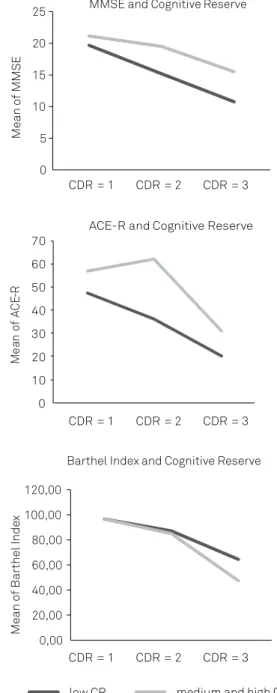
he Figure 1A shows the patterns of MMSE obtained for
diferent CR levels by CDR and the Figure 1B shows the pat
-terns of ACE-R obtained for diferent CR levels by CDR. he “medium/high level of CR” group (more or equal than 7 points
on CRQ) obtained the higher scores on MMSE and ACE-R (see
Figures 1A and 1B). he participants with higher CR levels had
higher scores on cognitive tests than elderly with lower CR
lev-els. he Figure 1C show patterns of BI obtained for diferent CR
levels by CDR. he “low level of CR” group obtained the high
-er scores on BI. AD patients with high-er levels of CR showed worse results with a BI than those with lower levels of CR.
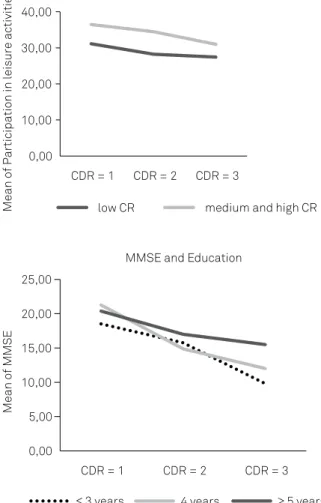
he Figure 2A shows the patterns of PLA for diferent CR levels by CDR. he participants with “medium/high level of CR” group had the higher scores on PLA. he Figure 2B shows the patterns of MMSE obtained for diferent education levels
by CDR. his study showed that AD patients with higher lev
-els of education achieved better results on MMSE.
As standardized adjusted residual = 2.1, only elderly with more than ive years of education were more likely to have mild dementia than moderate or severe dementia (45.7% vs 33.3%). Up to 4 years of education the CDR patients do
not difer from each other. As standardized adjusted re
-sidual = 2.0, only “Service workers, safety, vendors and ad
-ministrative staf ” are more likely (34.3% vs 24%) to have had
mild stage dementia than in moderate or severe dementia.
he relationship between the CR (evaluated with the CRQ) and the years of evolution of dementia along the CDR, showed no statistically signiicant diferences, according to Chi-Square Test (p = 0.946). he results showed that the level
of CR did not inluence the number of years of disease evolu
-tion. We crossed the disease stage (assessed with the CDR) and the years of the disease and we found statistically
sig-niicant diferences only in the category of the mild demen
-tia, according to Chi-Square Test (p < 0.001). he years of
the disease were associated with the severity of the disease.
he relationship between CDR and the level of CR (assessed with the CRQ) was statistically signiicant (LR, p = 0.015).
Decomposition of this test shows that mild dementia pres-ents values statistically lower than those with moderate or
severe dementia (LR, p = 0.027). he CDR moderate and se
-vere does not distinguish from each other in the CRQ. he level of CR inluenced the severity of dementia (severity of
dementia assessed with CDR).
DISCUSSION
According the current literature, AD is characterized by
inexorably progressive deterioration in cognitive ability and
capacity for independent living29 and, in this study we evalu
-ated the association of CR and the severity of AD in an outpa-tient sample. We noticed a relationship between the level of CR and the level of staging of dementia (severity of dementia
assessed with CDR). So, the level of CR inluenced the sever
-ity of dementia. Education, occupation attainment and LA
are the most commonly used proxies for CR and our study was consistent with other studies which showed that high
0 5 10 15 20 25
Mean
of MMS
E
MMSE and Cognitive Reserve
0 10 20 30 40 50 60 70
CDR = 1 CDR = 2 CDR = 3
CDR = 1 CDR = 2 CDR = 3
CDR = 1 CDR = 2 CDR = 3
Me
an
of
AC
E-R
ACE-R and Cognitive Reserve
0,00 20,00 40,00 60,00 80,00 100,00 120,00
Mean
of Barthel Inde
x
Barthel Index and Cognitive Reserve
low CR medium and high CR
CR: Cognitive Reserve; MMSE: Mini-Mental State Examination; ACE-R: Addenbrooke´s Cognitive Examination Revised; CDR: Clinical Dementia Rating; CDR = 1: mild dementia; CDR = 2: moderate dementia; CDR = 3: severe dementia. Figure 1. Patterns of MMSE, ACE-R and Barthel Index obtained for different CR levels. (A)Patterns of MMSE obtained for different CR levels (Cognitive Reserve Questionnaire); (B)
levels of CR, education, high PLA and substantively complex
work (eg, “Intermediate level professions, intellectual and sci
-entiic activity”) inluenced the rate of cognitive decline in
persons with AD7,11,12.
The results of this study confirm other studies’ results have shown that higher levels of education are associated
with better performance on cognitive tests7,30. The group
“> 4 years” got better results on functional tests than the
group of illiterates. This study showed that the patients with higher PLA levels had higher scores on cognitive tests than the participants with lower PLA levels. We found
that participants who belonged to the “Intermediate lev
-el professions, int-ellectual and scientific activity” group
achieved higher results on cognitive tests than those that
belonged to the “Unskilled workers” group, corroborat
-ing the find-ings of other studies31 that showed that
sub-stantively complex work significantly increased the level of intellectual functioning. The participants with higher CR levels had higher scores on cognitive tests than elderly with lower CR levels.
he main limitation of this study was the small sample size, the small variability of education level, the fact that
some tests are not validated for the Portuguese population and particularly the study design was a cross-sectional obser-vation. Future studies with larger sample sizes will be needed to address these limitations and we must design prospective long-term follow-up observations.
In conclusion, we must highlight that the level of CR
influenced the severity of AD. According to Tucker and
Stern5, CR explains why those with higher IQ, education,
occupational attainment, or PLA, evidence less severe
clinical or cognitive changes in the presence of age-related or AD pathology.
CR is not ixed and continues to evolve across the lifes
-pan. We agree that there are advantages in achieving high levels of CR and we think that healthy life styles should be
promoted to improve the health of older adults, helping them
to make healthy choices, such as lifelong cognitive stimula
-tion, maintaining an active life or getting regular physical
activity. Community preventive approaches for dementia
should focus on the improvement of education, changes in
lifestyles and the promotion of PLA.
his study suggests that AD patients with a higher CR may beneit against cognitive decline after diagnosis of AD. However, will be needed longitudinal studies to clarify the
course of AD along diferent stages of the disease and its re
-lationship with CR.
References
1. Berr C, Wancata J, Ritchie K. Prevalence of dementia in elderly in
Europe. European Neuropsychopharmacol. 2005;15(4):463-71. http://dx.doi.org/10.1016/j.euroneuro.2005.04.003
2. Siedlecki K, Stern Y, Reuben A, Sacco RL, Elkind MSV, Wright
CB. Construct validity of cognitive reserve in multiethnic cohort: The Northen Manhattan Study. J Int Neuropsychol Soc. 2009;15(4):558-69. http://dx.doi.org/ 10.1017/S1355617709090857
3. Scarmeas N, Albert SM, Manly JJ, Stern Y. Education and
rates of cognitive decline in incident Alzheimer´s disease. J Neurol Neurosurg Psychiatric. 2006;77(3):308-16. http://dx.doi.org/10.1136/jnnp.2005.072306
4. Stern Y. Cognitive reserve in ageing and Alzheimer’s
disease. Lancet Neurol. 2012;11(11):1006-12. http://dx.doi.org/10.1016/S1474-4422(12)70191-6.
low CR medium and high CR
0,00 10,00 20,00 30,00 40,00
CDR = 1 CDR = 2 CDR = 3
Mean
of Participation in leisure activities
Participation in leisure activities and Cognitive Reserve
0,00 5,00 10,00 15,00 20,00 25,00
CDR = 1 CDR = 2 CDR = 3
Mean
of MMSE
MMSE and Education
≤ 3 years 4 years ≥ 5 years
CR: Cognitive Reserve; MMSE: Mini-Mental State Examination; CDR: Clinical Dementia Rating; CDR = 1: mild dementia; CDR = 2: moderate dementia; CDR = 3: severe dementia; “≤ 3 years” : Three years or less than three years of education; “4 years”: 4 years of education; “ ≥ 5 years”: Five years or more than five years of education.
5. Tucker AM, Stern Y. Cognitive reserve in aging. Curr Alzheimer Res. 2011;8(4):354-60.
6. Stern Y. Cognitive reserve: implications for assessment
and interventions. Folia Phoniatr Logop. 2013;65:49-54. http://dx.doi.org/10.1159/000353443.
7. Sobral M, Paúl C. Education, leisure activities and cognitive and
functional ability of Alzheimer’s disease patients: a follow-up study. Dement Neuropsychol. 2013;7(2):181-9.
8. Tschanz JT, Corcoran CD, Schwartz S, Treiber K, Green RC, Norton
MC et al. Progression of cognitive, functional and neuropsychiatric symptom domains in a population cohort with Alzheimer’s dementia the cache county dementia progression study. Am J Geriatr Psychiatry. 2011;19(6):532-42. http://dx.doi.org/10.1097/JGP.0b013e3181faec23.
9. Helzner E, Scarmeas N, Cosentino S, Portet F, Stern Y. Leisure activity
and cognitive decline in incident Alzheimer disease. Arch Neurol. 2007;64(12):1749-54. http://dx.doi.org/10.1001/archneur.64.12.1749
10. Wilson RS, Li Y, Aggarwal NT, Barnes LL, McCann JJ,
Gilley DW et al. Education and the course of cognitive decline in Alzheimer. Neurology. 2004;63(7):1193-202. http://dx.doi.org/10.1212/01.WNL.0000140488.65299.53
11. Fritsch T, McClendon MJ, Smyth K, Ogrocki PK. Effects of educational
attainment and occupational status on cognitive and functional decline in persons with Alzheimer-type dementia. Internat Psychogeriatr. 2002;14:347-63. http://dx.doi.org/10.1017/S1041610202008554
12. Teiber KA, Carlson MC, Corcoran C et al. Cognitive stimulation and
cognitive and functional decline in Alzheimer’s disease: the cache county dementia progression study. J Gerontol B Psychol Sci Soc Sci. 2011;66 (4):416-25. http://dx.doi.org/10.1093/geronb/gbr023
13. Katzman R, Brown T, Thal LJ, Fuld PA, Aronson M, Butters N et al.
Comparison of rate of annual change of mental status score in four independent studies of patients with Alzheimer’s disease. Ann Neurol. 1988;24(3):384-9. http://dx.doi.org/10.1002/ana.410240306
14. American Psychiatric Association. Diagnostic and statistical manual
of mental disorders (DSM-5). 5th ed. Washington, DC: American Psychiatric Association; 2013.
15. McKhann GM, Knopman DS, Chertkow H, Hyman BT, Jack Jr CR,
Kawas CH et al. The diagnosis of dementia due to Alzheimer’s disease: recommendations from the National Institute on Aging-Alzheimer’s Association workgroups on diagnostic guidelines for Alzheimer’s disease. Alzheimer’s Dementia. 2011;7(3):263-9. http://dx.doi.org/10.1016/j.jalz.2011.03.005
16. Rami L, Valls-Pedret C, Bartrés-Faz D, Caprile C, Solé-Padullés
C, Olives J, Bosch B et al. Cognitive reserve questionnaire: scores obtained in a healthy elderly population and in one with Alzheimer’s disease. Rev Neurol. 2011;52(4):195-201. Spanish.
17. Sobral M, Pestana MH, Paúl C. Measures of cognitive reserve in
Alzheimer´s disease. Trends Psychiatry Psychother. 2014;36(3):160-8. http://dx.doi.org/10.1590/2237-6089-2014-0012
18. Folstein MF, Folstein SE, McHugh R. Mini-mental state: a
practical method for grading the cognitive state for patients for the clinician. J Psychiatric Res. 1975;12(3):189-98. http://dx.doi.org/10.1016/0022-3956(75)90026-6
19. Guerreiro M., Silva AP, Botelho M., Leitão O, Castro-Caldas A, Garcia
C. Adaptação à população portuguesa da tradução do Mini Mental State Examination (MMSE). Rev Port Neurologia. 1994;1:9.
20. Hughes CP, Berg L, Danzinger LW, Coben LA, Martin RL. A new clinical
scale for the staging of dementia. Brit J Psychiatry. 1982;140:566-72. http://dx.doi.org/10.1192/bjp.140.6.566
21. Garret C, Santos F, Tracana I, Barreto J, Sobral M, Fonseca
R. Avaliação clínica da demência. In: Grupo de Estudos de Envelhecimento Cerebral e Demências, editor. Escalas e testes na demência. Lisboa: Grupo de Estudos de Envelhecimento Cerebral e Demências; 2008. p. 17-32.
22. Miosh E, Dawson K, Mitchell J, Arnold R, Hodges JR. The
Addenbrooke’s Cognitive Examination Revised (ACE-R): a brief cognitive test battery for dementia screening. Int J Geriatr Psychiatry. 2006;21(11):1078-85. http://dx.doi.org/10.1002/gps.1610
23. Simões MR, Pinho MS, Prieto G et al. Addenbrooke’s Cognitive
Examination Revised (ACE-R). In: Mário R, Simões, Santana I, editores. Escalas e testes na demência. 3a ed. Lisboa: Novartis; 2014. p. 26-31.
24. Mahoney FI, Barthel DW. Functional evaluation: the Barthel index.
Md State Med J. 1965;14:61-5.
25. Lawton MP, Brody EM. Assessment of older people: self-maintaining
and instrumental activities of daily living. Gerontologist. 1969;9(3):179-86.
26. Graffar M. Une méthode de classification sociale d’échantillons de
population. Courier. 1956;6:445-9.
27. Instituto Nacional de Estatística. Classificação nacional de
profissões 2010 Lisboa: National Statistical Institute; 2011.
28. Pestana MH, Gageiro JN. Análise categórica, árvores de decisão e
análise de conteúdo em ciências sociais e da saúde com o SPSS. Lisboa: Lidel; 2009. ISBN 978-972-757-585-5.
29. Prince M, Bryce R, Albanese E, Wimo A, Ribeiro W, Ferri CP.
The global prevalence of dementia: a systematic review
and metaanalysis. Alzheimers Dement.2013;9(1):63-75.
http://dx.doi.org/10.1016/j.jalz.2012.11.007
30. Ganguli M, Snitz BE, Lee CW, Vanderbilt J, Saxton JA, Chang CC.
Age and education effects and norms on a cognitive test battery from a population-based cohort: the Monongahela-Youghiogheny Healthy Aging Team. Aging Mental Health. 2010;14(1):100-7. http://dx.doi.org/10.1080/13607860903071014
31. Schooler C, Mulatu MS, Oates G. The continuing effects of