ORIGINAL ARTICLE
Impact of socioeconomic markers in severity of lower
extremity lymphedema
Impacto dos marcadores socioeconômicos na gravidade do linfedema das
extremidades inferiores
Aquiles Tadashi Ywata de Carvalho1, Maria Clara Sampaio Barretto Pereira2, Aleksandro de Jesus Santos3, Giselle da
Fonseca Galon4, Antônio Urbano Ferreira Filho3, Vinicius Dias Cambuí5, Roberto Pastor Rubeiz3, Roberto Augusto Cafaro6
Introduction
he main function of the lymphatic system is to re-absorb macromolecules and interstitial luid, keeping stable the extracellular composition. In addition, lymph nodes are important sites of the immune system, where phagocytosis, antigen presentation to macrophages and
lymphoplasmacytic proliferation occur. Lymphopathy, which causes reduced lymphatic function and consequent deicit of interstitial drainage, leads to lymphedema, char-acterized by increased volume and weight of the afected region, reduced function and cosmetic alterations, that may result in ibrosis along the disease course1,2. Complications Abstract
In Brazil, the incidence of lymphedema is poorly known, and there is little scientiic documentation reporting the association of lymphedema with the social and economic factors in our region. he objective was to analyze the impact of socioeconomic markers on the severity of lymphedema of the lower extremities according to the classiication of Mowlem in the metropolitan region of Salvador (BA), Brazil. Of the 324 patients studied, 200 (62%) were female. he age ranged between 14 and 69 years, median 48 years. Comparatively analyzing the varying severity of lymphedema versus education level and severity versus family income, it showed that 93.8% of patients classiied as Mowlem III were included in the group of patients without education and/or with income up to three minimum wages. here was no record of advanced disease in patients with family incomes greater than seven minimum wages and/or graduate.
Keywords: lymphedema; classiication; severity of illness index; educational status. Resumo
No Brasil, a incidência do linfedema é pouco conhecida e poucas são as documentações cientíicas reportando a associação do linfedema com os fatores sociais e econômicos na nossa região. O objetivo do estudo foi analisar o impacto dos marcadores socioeconômicos na gravidade do linfedema das extremidades inferiores conforme a classiicação de Mowlem, na região metropolitana de Salvador (BA). Dos 324 pacientes estudados, 200 (62%) eram do gênero feminino. A idade variou entre 14 e 69 anos, com mediana de 48 anos. Analisando comparativamente as variáveis: gravidade do linfedema versus grau de escolaridade e gravidade versus renda familiar, observou-se que 93,8% dos pacientes classiicados como Mowlem III estavam incluídos no grupo dos pacientes sem escolaridade e/ou com renda familiar de até três salários-mínimos. Não houve registro de doença avançada em pacientes com renda familiar acima de sete salários-mínimos e/ou com terceiro grau completo.
Palavras-chave: linfedema; classiicação; índice de gravidade de doença; escolaridade.
Study carried out at the Hospital Geral Roberto Santos – Salvador (BA), Brazil.
1Master and Doctor degrees in Medicine at the Faculdade de Ciências Médicas da Santa Casa de São Paulo – São Paulo (SP), Brazil; Preceptor, Vascular Surgery Residency Program, Hospital Geral Roberto Santos – Salvador (BA), Brazil.
2Medical Student at the Faculdade de Tecnologia e Ciências – Salvador (BA), Brazil.
3Preceptor, Vascular Surgery Residency Program, Hospital Geral Roberto Santos – Salvador (BA), Brazil. 4Medical Student at the Universidade Federal do Espírito Santo – Vitória (ES), Brazil.
5Ex-Resident of Vascular Surgery, Hospital Geral Roberto Santos – Salvador (BA), Brazil.
6 Doctor Professor; Chief of Vascular Surgery Discipline at Santa Casa de São Paulo – São Paulo (SP), Brazil. Submitted on: 04.11.11. Accepted on: 09.06.11.
Impact of socioeconomic markers in severity of lower extremity lymphedema - Carvalho ATY et al. J Vasc Bras 2011, Vol. 10, Nº 4 299
such as cellulitis, erysipela, chronic ulcers, ibroedema and lymphangiosarcoma, may aggravate the initial condition3.
Regarding its etiology, it can be classiied as primary and secondary, according to the classiication of Kinmonth et al.4. Primary lymphedema results from congenital
altera-tions of lymphatic vessels, whereas secondary lymphedema results from acquired alterations that occur ater infections, trauma, operations, radiotherapy, chronic venous insui-ciency, among other causes4,5.
he exact prevalence of lymphatic disorders has not been well deined in the literature, due to the scarcity of epidemiological data, although its occurrence is largely underestimated in clinical practice. he estimated preva-lence is around 450 million people with lymphatic disor-ders, i.e., 15%, of the world population6. In Brazil, the
in-cidence and distribution of lymphedema are little known. Likewise, there is little scientiic information on the asso-ciation of lymphedema with social and economic factors in our region6,7.
he objective of this study was to analyze the impact of socioeconomic markers (education level and family income) on the severity of lower extremity lymphedema, according to Mowlem’s classiication, in the metropolitan region of Salvador (BA), Brazil.
Methods
he study analyzed consecutively 324 patients with lower extremity lymphedema that came to the Service of Vascular Surgery at Hospital Geral Roberto Santos (HGRS), between November 2005 and May 2010. he pa-tients had access to the Service through spontaneous de-mand to the outpatient clinic and therefore, this is a non-probabilistic sample.
he patients were examined using a preset clinical protocol that included personal data, such as age, sex, co-morbidities, socioeconomic level and lymphedema etiol-ogy and severity, according to Mowlem’s classiication8,9
(Chart 1), with the agreement of more than one examiner (two Vascular Surgery specialists, HGRS). In cases of bilat-eral lymphedema, only the limb with higher severity was included in the study. he patients were then stratiied by education level (no education, basic, intermediate and higher levels) and by family income (less than 1 minimum wage, 1-3, 3-5, 5-7 and above 7 minimum wages), which were the analyzed variables.
Logistic regression technique10 was used to analyze the
relation between variables and lymphedema severity, with the adoption of p value below 0.05 for statistically signii-cant factors.
Due to the observational and descriptive nature of the study, the patients’ treatment was not inluenced by the study. All participants in this study were asked to sign the informed consent form.
he study was approved by the HGRS Ethics Committee and was conducted following the ethical principles of the Declaration of Helsinki and local and international stan-dards of good clinical practices in clinical research.
Out of the 324 patients studied, 200 (62%) were female and 124 (38%) were male. he age ranged from 14 to 69 years, with median value of 48 years.
Regarding associated diseases, most patients (77%) had obesity, followed by arterial hypertension (49%) and diabe-tes mellitus (47%).
Regarding the severity, 81 (25%) patients presented with lymphedema Mowlem I, 146 (45%) had Mowlem II and 97 (30%) had Mowlem III.
Results
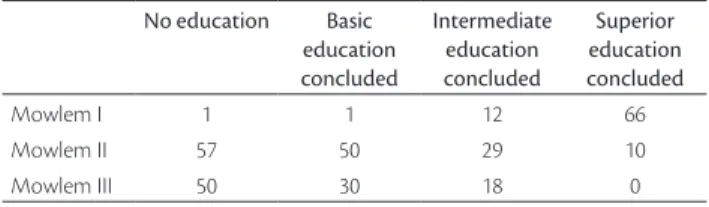
Tables 1 and 2 show the frequency distribution of patients by education level and disease severity and
<1 minimum
wage
1-3 minimum
wages
3-5 minimum
wages
5-7 minimum
wages
>7 minimum
wages
Mowlem I 2 3 10 29 36 Mowlem II 62 55 17 7 5 Mowlem III 78 16 3 1 0
Table 2. Distribution of patients according to family income and disease severity, following Mowlem’s classiication.
No education Basic education concluded
Intermediate education concluded
Superior education concluded
Mowlem I 1 1 12 66 Mowlem II 57 50 29 10 Mowlem III 50 30 18 0
Table 1. Distribution of patients according to education level and disease severity, following Mowlem’s classiication. Chart 1. Mowlem’s Classiication.
Grade I Reversible lymphedema, with elevated limb and bed rest for 24-48 hours: edema is depressible at compression
Grade II Irreversible lymphedema, even with extended rest; moderate-to-severe ibrosis and edema is non depressible at compression Grade III Irreversible lymphedema with accentuated ibrosis in
Impact of socioeconomic markers in severity of lower extremity lymphedema - Carvalho ATY et al. J Vasc Bras 2011, Vol. 10, Nº 4
300
family income and disease severity, respectively, according to Mowlem’s classiication.
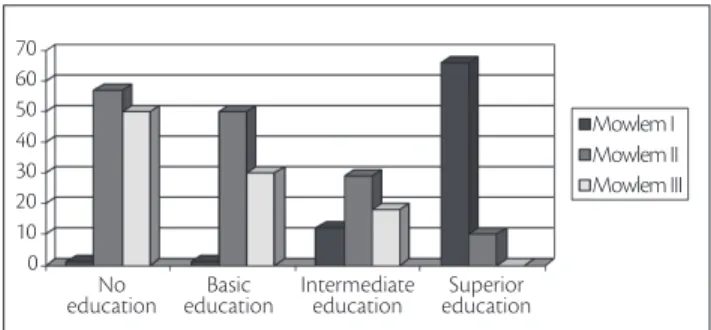
When comparatively analyzing the variables: lym-phedema severity versus education level and lymphedema
severity versus family income, 93.8% of the patients
classi-ied as Mowlem III were in the group with no formal educa-tion and/or family income up to three minimum wages. No case of the disease in its most advanced stage was reported in patients with income family above seven minimum wag-es and/or with complete higher education level. hwag-ese rela-tions were statistically signiicant, with p value below 0.05 (Figures 1 and 2).
Discussion
Lymphedema is a chronic disease characterized by the retention of high protein interstitial fluid, resulting from insufficient lymphatic drainage caused by congeni-tal and/or acquired anomalies of the lymphatic system5,11
In the beginning, the edema is mild, soft and depressible at compression, but as the disease progresses, it becomes hard and non-depressible6,12 Chronically, this increased
limb size can cause significant deformities, disability and, in extreme cases, elephantiasis. Besides that, it can undergo malignant transformation6.It can affect one or
both lower extremities6.
he diagnosis is basically clinical and imaging exams, such as computed tomography and lymphoscintigraphy, are used to conirm the suspected diagnosis, to detect sites of lymphatic malformation and neoplasias and to exclude other causes of increased limb size8,13-15.
he frequency of lymphatic disease is much lower than the frequency of arterial and venous disease8. Lymphedema,
however, it is not an uncommon disease. It is essential to know the prevalence and methods of treatment, in order to take early action. When not properly addressed, lym-phedema may result in serious sequelae, limiting the pa-tient’s quality of life.
In this study, the incidence of women with lymphede-ma was high (62%). Such prevalence was also observed by Kefeijan-Haddad et al.6 and agrees with data found in world
literature8,16.
A higher prevalence of secondary lymphedema was observed, when compared to primary lymphedema (93%
versus 7%). In the cohort, infection (post-erysipela) was
the most frequent cause of secondary lymphedema, cor-responding to 83% of the patients. Such data agree with the results obtained in other studies conducted in Brazil2,8.
In contrast, in Europe, the bacterial and fungal infections
represent less frequent etiological factors, as demonstrated by Smith, Spittell and Schirger16 andMilroy17. Post-operative
lymphedema corresponded to 10% of the secondary lym-phedema causes, as demonstrated by Guedes Neto8.
Regarding the severity of lymphedema, only 25% of patients were Mowlem I, while 45% were Mowlem II and 30% were Mowlem III. We observed that most patients with the disease in its most advanced stages (Mowlem II and III) were individuals with no education and/or low economic level. We reported that the social and economic level was inversely proportional to the lymphedema severity. his inding can be explained by the fact of having more dii-cult access to medical care, inadequate treatment and lack of instruction on lymphedema prevention ater the initial episode of limb infection. It should be emphasized that, ater the onset of lymphatic injury and lymphedema, the scarcity of specialized services in complex physical thera-py ofered by the Public Health Service (Sistema Único de Saúde) in Salvador may have contributed to such indings. On the other hand, there was no record of advanced disease in patients with family incomes greater than seven mini-mum wages and/or complete higher education, which con-irmed the study results. A stronger awareness of the need for diagnosis and early treatment of lymphedema may help improve these patients’ quality of life.
S/ escolaridade
Basic education No
education 0
10 20 30 40 50 60 70
Intermediate
education educationSuperior
Mowlem I Mowlem II Mowlem III
Figure 1. Comparative analysis between lymphedema severity and education level.
Figure 2. Comparative analysis between lymphedema severity and family income.
Mowlem I
<1 min. wage 0 10 20 30 40 50 60 70 80
1 to 3 3 to 5 5 to 7 >7 min. wages
Impact of socioeconomic markers in severity of lower extremity lymphedema - Carvalho ATY et al. J Vasc Bras 2011, Vol. 10, Nº 4 301
Conclusion
The severity of lower extremity lymphedema, ac-cording to Mowlem’s classification, was directly related to socioeconomic markers, such as low education level and low family income. Further studies on occurrence and severity of lymphedema are required for a better un-derstanding of the related factors and prevention of this disorder in our region.
References
1. Sapienza M, Shimura I, Ferraro GC, et al. Critérios semiquantitati-vos de análise da linfocintilograia em linfedema de membros infe-riores. J Vas Bras. 2006; 5(4):288-94.
2. Guedes HJ, Saliture Neto FT, Feres Junior R, et al. Estudo etiológico dos linfedemas baseado na classiicação de Kinmonth, modiicado por Cordeiro. J Vasc Bras. 2004;3(1):60-4.
3. Tiwari Am Cheng KS, Button M, et al. Diferential diagnosis, inves-tigation, and current treatment of lower limb lymphedema. Arch Surg. 2003;138(2):152-61.
4. Kinmonth JB, Taylor GW, Tracy GD, et al. Primary lymphedema; clinical and lymphangiographic studies of a series of 107 patients in which the lower limbs were afected.. Br J Surg. 1957;45(189):1-9.
5. Kafejian-Haddad AP, Garcia AP, Mitev AG, ET AL. Avaliação lin-focintilográica dos linfedemas de membros inferiores. Correlação com achados clínicos em 34 pacientes. J Vasc Bras. 2005;4(3)283-9.
6. Andrade MFC. Linfedema: epidemiologia, classiicação e isiopa-tologia. In: Mafei FHA, Lastoria S, Yoshida WB, Rollo HA, editores. Doenças Vasculares Periféricas. 3a ed. São Paulo: Medsi; 2002. p. 1641-6.
7. Kafeijian-Haddad AP, Sanjar FB, Hiratsuka J, et al. Análise dos pa-cientes portadores de linfedema em serviço público. J Vasc Bras 2005;4(1):55-8.
8. Guedes Neto HJ. Linfedemas: classiicação, etiologia, quadro clíni-co e tratamento não-cirúrgiclíni-co. In: Brito CJ. Cirurgia Vascular. Rio de Janeiro: Revinter; 2002. p. 1228-35.
9. Mowlem R. he treatment of lymphoedema. Br J Plastic Surg. 1948;1(1):48-55.
10. Hosmer DW, Lemeshow S. Apllied Logistic Regression. Wiley Series in Probability and Mathematical Statistics. Applied Probability and Statistics Section. Wiley-Interscience; 2000.
11. Gloviczki P, Wahner HW. Clinical diagnosis and evolution of lymphedema. In: Rutherford R, editor. Vascular Surgery. 5th ed. Philadelphia: W.B. Saunders Co; 2000. p. 2123-42.
12. Kafeijian-Haddad AP. Avaliação linfocintilográica do efeito da drenagem linfática manual no linfedema dos membros inferiores [tese]. São Paulo: Universidade Federal de São Paulo, 2003.
13. Andrade MF, Lastoria S, Yoshida WB, Rollo HA. Tratamento clínico do linfedema. In: Mafei FH. 3a ed. São Paulo:Medsi; 2002. p. 1647-59.
14. Guedes HJ, Andrade MF. Diagnóstico e tratamento do linfedema periférico. Cir Vasc Angiol. 1996;12:62-5.
15. Lazareth I. [Classiication of lymphedema]. Rev Med Interne. 2002; (Suppl) 3:375-8.
16. Smith RD Spittell JA, Schirger A. Secondary lymphedema of the leg: its characteristics and diagnostic implications. JAMA. 1963;185:80-2.
17. Milroy WF. Chronic hereditary edema: Milroy disease. JAMA. 1928;91:1172-4.
Correspondence
Aquiles Tadashi Ywata de Carvalho Clínica de Cirurgia Galon Ywata Av. Antônio Carlos Magalhães, 3.244 – sala 1.416 – Caminho das Árvores CEP: 41820-000 – Salvador (BA), Brazil E mail: [email protected]
Author’s contributions