Alexandre PalmaI
Ubirajara A de O MattosII Marcelo Nunes de AlmeidaIII Giselle Estrella Martins Coelho de OliveiraIII
I Programa de Pós-graduação em Educação Física. Universidade Federal do Rio de Janeiro. Rio de Janeiro, RJ, Brasil
II Programa de Pós-graduação em Engenharia Ambiental. Faculdade de Engenharia. Universidade do Estado do Rio de Janeiro. Rio de Janeiro, RJ, Brasil
III Departamento de Educação Física. Universidade Gama Filho. Rio de Janeiro, RJ, Brasil
Correspondence: Alexandre Palma
Universidade Federal do Rio de Janeiro Edifício da Educação Física
Av. Carlos Chagas Filho, 540, 21941-599 Rio de Janeiro, RJ, Brasil E-mail: [email protected] Received: 7/10/2008
Approved: 9/15/2009
Level of noise at the workplace
environment among physical
education teachers in indoor
bike classes
ABSTRACT
OBJECTIVE: To analyze identify the level of noise at the workplace environment among Physical Education teachers during indoor bike classes and its association with some aspects of health.
METHODS: Cross-sectional study carried out in 15 different gyms with 15 teachers in Rio de Janeiro (Southeastern Brazil) in 2007. A standardized questionnaire, tested in relation to its replication, was used in order to fi nd out the characteristics of the process and the way this job is organized, as well as complaints related to health reported by these teachers. The SRQ-20 (Self-Report Questionnaire) was utilized in order to verify the existence of minor psychiatric disturbances. The levels of sound pressure were measured by a portable appliance. The level of pressure was verifi ed in dB(A) at equivalent energy levels (Leq) in different places of the room at different moments during the class. ANOVA, chi-square and Pearson’s correlation analyses were performed.
RESULTS: The levels of sound pressure varied from 74.4 dB(A) to 101.6 dB(A). The results during the class were: a) warm-up (mean=88.45 dB(A)); b) main part (mean= 95.86 dB(A)); and, closure (mean= 85.12 dB(A)). The mean background noise was 66.89 dB(A)). There were signifi cant differences (p<0.001) among the background noise levels within different moments of the class. The noise was not related to minor psychiatric disturbances.
CONCLUSIONS: Physical education professionals working with indoor bike classes are under high levels of sound pressure during their classes. This physical agent has been related to several health problems and should therefore be more controlled.
DESCRIPTORS: Fitness Centers, manpower. Noise, Occupational. Occupational Exposure. Occupational Health. Cross-Sectional Studies.
INTRODUCTION
Noise may be characterized, in the simplest way, as an annoying sound. This occurs when the production of sound is undesirable or in a situation in which hearing discomfort occurrs.1
The effect of sound pressure on the individual does not only depend on its characteristics (amplitude, frequency and duration), but also of the individual’s own percep-tion. Furthermore, noises may be: “continuously sta-tionary”, when their levels of variation are negligible; “continuously fl uctuating”, when there is a continuous variation in noise levels; and, “of impact or impulsive”, that present themselves in peaks of acoustic energy that last for less than a second.1
One of the most relevant effects of exposure to noise is hearing loss, but it may also infl uence several other health disorders, such as: arterial hypertension, occupa-tional accidents, acute stress, inner ear injuries, among others.2,5,13,19,22 Thus, concern and efforts to eliminate
or control this agent are increasing.1
Government regulation 3.214, promulgated by the Ministry of Labor in Brazil on the 8th of June, 1978, established that medical examinations were required both upon admission to and dismissal from a job whenever the environment at the workplace presented levels of noise that were higher than 85 dB(A) during 8 hours of daily exposure.2 Furthermore, this regulation
establishes the limits of exposure and treats continuous and impulsive noises differently, defi ning criteria for characterizing occupational insalubrities. The above mentioned regulation constitutes an advance inasmuch as this physical agent has been a very prevalent oc-cupational risk factor. Johnson et al9 (2001) point out
that the maximum daily duration of exposure to sound pressure levels (SPL) should be 16 hours for the level of 82 dB(A); eight hours for 85 dB(A); four hours for 88 dB(A); two hours for 91 dB(A); one hour for 94 dB(A); and, at the maximum, 30 minutes for 97 dB(A).
The criteria adopted by the Ministry of Health is based on the norm established by the American Conference of Governmental Industrial Higyenists (ACGIH) and differs from Johnson et al9 (2001) with respect to the
values proposed by the latter. Thus, for each increase of 5 dB(A) in the SPL, the maximum time of daily exposure is reduced to half of what it was previously: 16 hours for the level of 80 dB(A), eight hours for 85 dB(A), four hours for 90 dB(A), two hours for 95 dB(A), one hour for 100 dB(A), 30 minutes for 105 dB(A) and up to seven minutes for 115 dB(A).
Milano et al14 (2005) defended the idea that indoor
cycling teachers have been confronted with hazardous working conditions, including problems related to noise and an excess number of working hours per week.
Deus & Duarte6 (1997) observed that the mean values
of noise in 86% of the gyms in the city of Florianopolis (SC) exceeded the legal limits (85 dB(A)). In a similar study, conducted in the city of Curitiba (PR), Lacerda et al11 (2001) found that the levels of sound pressure
varied between 73.9 and 94.2 dB(A) and that the most
common complaints among professionals were: ring-ing in their ears (24%); the feelring-ing that their ears were clogged (15%) and diffi culty concentrating (15%).
Thus, the sound pressure levels during classes may become a serious occupational health hazard, consider-ing that teachers are exposed to noise for several hours without any protection.
Taking into consideration the above mentioned issue, the objective of this study was to analyze the level of noise in the workplace environment of physical education teachers during indoor bike classes and its association to some aspects of health.
METHODS
In 2007, a cross-sectional study was conducted with 15 physical education teachers, being that ten were males and fi ve were females. All of them taught indoor bike classes in gyms in the city of Rio de Janeiro (RJ). They had all graduated from college at least one year before the interview and had been teaching this particular mode of physical education for at least one year. At least one working environment of the teachers interviewed was investigated.
The convenience sample was selected in a non-prob-abilistic manner. Due to the refusal of some gyms to participate in the study, selection of the group was based solely on the population of teachers who consented to participate in the investigation and whose workplace agreed to be evaluated.
A questionnaire with open and closed questions concerning the characteristics of the process of work and its organization was utilized. The instrument was developed and adopted in another study with physical education teachers who taught indoor bike.14 The
instru-ment was tested beforehand to verify reproducibility, with a group of 30 students who answered it twice within a period of ten days. The degree of agreement in responses from the same individual both times he or she answered the questionnaire was estimated by the kappa coeffi cient (κ). All the closed questions presented rates higher than 0.800 and were signifi cant for p<0.05.
In order to detect non-psychotic psychiatric disorders, the Self-Report Questionnaire (SRQ-20), was utilized. This instrument has been previously validated in several countries, including Brazil.17 The cut off point adopted
in this study, for both males and females, was six.
The Borg Scale was utilized to estimate the level of physical effort expended during the classes and possible situations of fatigue.3,8,14,18
equivalent energy level (Leq), which may character-ized by the mean acoustic energy within a given time interval.9 The measurements were taken at two points:
one near the auditory zone of the teacher and the other in the middle of the classroom. At each point three mea-surements were taken, according to the phases of the class: warm up, main session and closing procedures. Furthermore background noise was measured (situation in which no class was being held).
The mean length of time of the classes was 50 minutes. The proportion of this time dedicated to the main ses-sion varied from 60% to 80% and 10% to 20% was dedicated to warm up and closing procedures.
In order to establish proportionality with respect to the weight attributed to each of the three different phases, and their respective levels of sound pressure, the mea-sures taken during warm up and closing procedures were conducted for one minute, whereas the measures of SPL were undertaken in fi ve minutes during the main session.
Data collected was analyzed by means of descriptive statistics. Comparisons between the means of several different numerical variables were analyzed statistically by variance analysis (Anova) and, category variables, by chi-square. Pearson’s correlation was utilized to ana-lyze correlations between two numerical variables.
Teachers were informed of the objectives of the study, of the institution responsible for collecting the data and of the voluntary and anonymous character of their participation before the questionnaire were applied and data were collected.
RESULTS
Teachers were aged 22 to 37 years old (mean = 26.5 years; standard deviation – sd= 3.8). The mean weekly work load of the informants was 30.5 hours/week (sd= 8.3). The mean period of time dedicated to teaching indoor bike classes was 10.7 hours/week (sd= 4.9) and to activities that required the utilization of music was 23.3 hours/week (sd= 9.2).
As to levels of sound pressure, the lowest level of noise registered during the classes was 74.4 dB(A) and the highest was 101.6 dB(A). The mean values found were: a) warm up (mean= 88.45 dB(A); sd= 3.5); b) main session (mean= 95.86 dB(A); sd= 2.9); and closing procedures (mean= 85.12 dB(A); sd= 4.9). The background noise presented a mean value of 66.89 dB(A) (sd= 5.3). Statistical analysis indicated that the there were signifi cant differences (p<0.001) between the mean values of background noise and during the phases of the classes. When comparing the mean values of each phase of the classes, signifi cant differences were also found: main session and background noise:
p<0.001; main session and warm up: p<0.0001; main session and closing procedures: p<0.001; and, warm up and closing procedures: p<0.05.
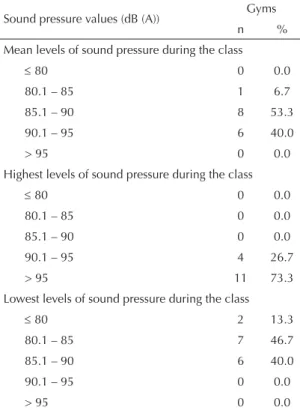
Table 1 presents the distribution of the number of gyms in this study according to the sound pressure levels. It may be observed that, whatever the specifi c situation, the distribution of the mean values are concentrated in larger number among those considered hazardous to health.
The values obtained by the SRQ-20 demonstrated that the workers presented symptoms that varied from one to six (mean= 3.3; sd= 1.8). The values of Borg’s scale presented by the teachers varied from 11 to 19 (mean= 14.3; sd= 1.9). This data indicates that the teachers, although they may have been submitted to consider-able levels of noise and felt fatigued, did not present symptoms of psychic suffering.
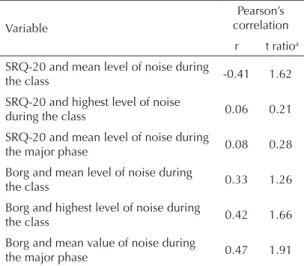
Analyses of sound pressure and psychic suffering or perceived exertion, when taken in conjunction, indicated low correlations and were not statistically signifi cant (Table 2).
Table 3 presents the distribution of cases in which there was awareness of health disorders. It should be noted that problems related to the throat and to hearing or to some issue related to the ear were amongst the most often reported.
Table 1. Distribution of the number of gyms studied according
to sound pressure values. Rio de Janeiro, Southeast Brazil, 2007.
Sound pressure values (dB (A)) Gyms
n %
Mean levels of sound pressure during the class
≤ 80 0 0.0
80.1 – 85 1 6.7
85.1 – 90 8 53.3
90.1 – 95 6 40.0
> 95 0 0.0
Highest levels of sound pressure during the class
≤ 80 0 0.0
80.1 – 85 0 0.0
85.1 – 90 0 0.0
90.1 – 95 4 26.7
> 95 11 73.3
Lowest levels of sound pressure during the class
≤ 80 2 13.3
80.1 – 85 7 46.7
85.1 – 90 6 40.0
90.1 – 95 0 0.0
On the other hand, many teachers reported, informally that they did not tolerate well a high volume of sound outside the workplace (at home or in the car). A com-mon complaint was the desire to avoid any type of loud noise, while a few teachers expressed, for example, the need to increase the volume of their TV sets so they could hear better.
When sound level pressures and the size of the gyms were confronted, few differences were observed. The mean values of noise in small, medium size and large gyms were, respectively, 89; 89.5 and 91.4 dB(A). The
highest values found were 94.2; 97 and 98.2 dB(A). These differences may be relevant from the point of view of their effects on individuals, since differences of 4 dB(A) may have intense repercussions on an individual’s health, since it represents a considerable increase in the dose of noise.
Furthermore, when considering the teachers’ process of work and its organization, it was observed that only three of them (20.0%) utilized the microphone in order to protect their vocal chords. On the other hand, teachers reported that this equipment was never supplied by the gyms and none of them utilized headphones to protect their ears. The physical space of the indoor bike class,
was 44,3m2 (sd= 10.7) in mean. The mean, maximum
and minimum widths of the classes were, respectively, 5; 4 and 6m, whereas their lengths were 8.9; 6 and 12m. The height of the classrooms varied from 3 to 4 meters (mean= 3.3 meters). Furthermore, inappropri-ate minappropri-aterials for sound absorption were utilized in the construction of the classrooms such as: mirrors, glass, and stonemasonry, among others.
DISCUSSION
Acceptable values for acoustic comfort are up to 55 dB(A). In this study, the values for each phase inves-tigated varied from 74.4 dB to 101.6 dB(A). The main session of the class presented the highest mean values (95.86 dB(A)). Furthermore, teachers worked, in their classrooms, with mean values close to 90 dB(A).
Considering the fact that teachers may be responsible for more than one class per day, and that he/she is ex-posed, for approximately 30 to 40 minutes, during the main session of each class, to a value of 95 dB(A), the maximum period of daily exposure should not exceed two hours. Thus, presumably, the physical education teacher may be working in a hazardous environment. This finding corroborates investigations involving physical education teachers in similar situations. 6,11 In
a study conducted by Lacerda et al11 (2001), the levels
of sound pressure were situated between 73.9 to 94.2 dB(A). In another investigation concerning the level of acoustic pressure, conducted in 14 gymnastics gyms, Deus & Duarte6 (1997) found that results varied from 75
to 104 dB(A). Large part of the teachers (35.7%) taught in levels higher than 85 dB(A), considering the limits of tolerance established by the current legislation. The authors also verifi ed that the mean exposure to noise was 16.4 hours per week. However, in this study it was found that, mean professional exposure was 10.7 hours per week of indoor bike and 23.3 hours per week if all the classes in which music was utilized (indoor bike, gymnastics, step and running class) were summed up.
On the other hand, Mirbod et al15 (1994) found, upon
studying three gyms, that during the warm up phase, the mean value of sound pressure was 87 dB(A). During the
Table 2. Correlations between levels of noise, SRQ-20 values
and the Borg scale in gyms. Rio de Janeiro, Southeast Brazil, 2007.
Variable
Pearson’s correlation
r t ratioa SRQ-20 and mean level of noise during
the class -0.41 1.62
SRQ-20 and highest level of noise
during the class 0.06 0.21
SRQ-20 and mean level of noise during
the major phase 0.08 0.28
Borg and mean level of noise during
the class 0.33 1.26
Borg and highest level of noise during
the class 0.42 1.66
Borg and mean value of noise during
the major phase 0.47 1.91 a Critical value of the t ratio for verifying the level of signifi cance (p<0.05) for four degrees of freedom is 2.16.
Table 3. Distribution of the cases of perceived problems
related to health in the gyms. Rio de Janeiro, Southeast Brazil, 2007.
Health problems Case
n %
Problems related to the throat 8 53.3
Flues 8 53.3
Hearing or ear problems 4 26.7
Back aches 4 26.7
Rhinitis 3 20
Allergies 2 13.3
Sinus problems 2 13.3
Mycosis 1 6.7
Chronic head aches 1 6.7
Hypertension 1 6.7
Conjunctivitis 1 6.7
Problems in the articulation of the knee 1 6.7
main session of the classes the levels of sound pressure varied from 93 to 96 dB(A). During the closing pro-cedures, noise decreased to 73 dB(A). These fi ndings, with the exception of the values for closing procedures, are similar to the results of the present study.
The consequences of noise are well documented in the literature. Deus & Duarte6 (1997) observed that
21.4% of the physical education teachers investigated presented hearing discomfort after class; 78.6% hear-ing discomfort when submitted to intense sounds and 14.2% reported headaches. The most common com-plaints found in Lacerda et al’s11 (2001) study were:
ringing in their ears; the feeling that their ears were clogged and diffi culty concentrating. In the present study, 53.3% of the teachers reported they had some type of throat problem and 26.7% reported some type of hearing discomfort.
Comparisons between gym teachers and people practic-ing high impact aerobic gymnastics revealed that the teachers, due to their greater period of exposure, pre-sented symptoms such as vertigo disorders, dizziness, imbalance, ringing in their ears and the sensation that their ears were clogged more frequently.24
Exposure to noise with a certain intensity and duration may provoke Temporary Threshold Shifts (TTS), that is, an acute effect represented by a reduction in auditory sensibility which may gradually be recuperated once exposure has ceased. These temporary shifts in auditory function are considered a type of auditory fatigue and the larger the period of exposure, the greater the mag-nitude of the problems associated to them.1 In a study
whose objective was to detect the temporary shifts in auditory function, after 60 minutes of exposure, during an aerobic gymnastics class, at to a mean sound pressure of 91.8 dB, Nassar16 (2001) found signifi cant reductions
in auditory sensitivity among the subjects exposed.
On the other hand, sound pressure has not been associ-ated only to hearing problems. A study conducted by Corrêa Filho et al4 (2002) with bus drivers revealed that
the risk of hypertension was 2.98 times greater among professionals with hearing losses induced by noise. Souza et al22 (2001) studied workers in the fi eld of
pe-troleum and found that prolonged exposure to this agent was a risk factor for arterial hypertension. Furthermore, Azevedo et al1 (1994) affi rm that it could infl uence sleep
negatively, provoke gastric alterations and even involve repercussions on sight and concentration.
Although they were not the object of this study, the information discussed above is relevant, since the sample investigated was exposed routinely to signifi -cant levels of sound pressure for prolonged periods of time. Therefore, one may expect that these profession-als are vulnerable to reductions in auditory sensibility, problems related to sleep, gastric alterations among other health disorders.
The association between noise, stress and fatigue has also been reported in the literature. Dias et al5 (2006)
suggest that beyond this relation, excessive stress and fatigue may be involved in the genesis of occupational accidents. However, this study did not fi nd consistent associations among these variables. In our study, a mean value of 3.3 was verifi ed by the SRQ-20, whereas the mean value for Borg’s scale of perceived exertion was 14.3. Although the value attained is below the cut off point for the situation of stress and was not statistically relevant in the correlation, Dias et al5 (2006) suggest that
psychic suffering may be related to exposure to noise. Melamed et al13 (2004), also attribute a greater state of
irritability after work to excessive occupational noise.
As to perceived exertion, the value of 14.3 expresses a perceived exertion between “somewhat hard” to “hard”,3 that may represent an intensity that is close
to the anaerobic threshold for individuals that are not trained.8 In a study involving physical education
teachers working in schools, Sandmark et al18 (1999),
the median values found were 12 and 13 for perceived exertion during classes, among men and women re-spectively. Milano et al14 (2005), on the other hand,
found mean values of 13.99 for perceived exertion in occupational activities among teachers of physical edu-cation that worked in indoor cycling. Deus & Duarte6
(1997) and Dias et al5 (2006) indicated that fatigue
may be a consequence of exposure to noise. However, this study did not fi nd statistical association between perceived physical exertion and noise.
Furthermore, in this study, throat disorders were re-sponsible for a large degree of complaints and the fl u, in conjunction with rhinitis and sinusitis, represented a rather high proportion of recurrences. In addition, the teachers commented that they felt hearing discomfort. The report of throat disorders may be an indirect cause of elevated levels of sound pressure, since, without access to microphones, teachers need to increase the intensity with which they use their voices. Simões20
explains that the teacher is amongst a group of profes-sionals that do not have any kind of vocal training, in contrast to singers and actors. Different investigations have associated the professional activity of physical education to complaints of hoarseness or other vocal problems.7,12,21
Music has been an important didactic resource, since it stimulates students to practice and is helpful in prescrib-ing the intensity of the activity. Wilsont & Herbstein25
(2003) observed the importance attributed to music in terms of appreciation and motivation for exertion as well as the lack of awareness of the deleterious effects of exposure to elevated levels of sound pressure among practitioners of aerobic gymnastics.
higher if interaction with physical exercises is taken into consideration. Vittitow et al23 (1994) confi rmed
this idea when they verifi ed the reduction of audi-tory sensibility resulting from temporary threshold shifts among individuals exposed to noise provoked by music with an intensity equivalent to 96 dB while they were exercising. However, these fi ndings were not confi rmed by Krishnamurti & Grandjean10 (2003)
when these authors investigated the infl uence of the interaction between exercising and sound pressure in classes with moderate-intense intensity. In indoor cycling programs the teachers feel obliged to increase the volume of the music due to students’ demands or to the culture of fi tness.14
In conclusion, it was possible to verify that physical education teachers who work with indoor cycling ex-pose themselves to very high levels of sound pressure during their classes, that constantly attain values above 95dB (A). Furthermore, the mean value of sound pres-sure in the main session of the class was 95.86 db(A), representing 60 to 80% of the entire class and that this professional may teach several classes each day.
On the other hand, notwithstanding the relations be-tween noise and different consequences it has upon health as sustained by the literature, in our study it was not possible to associate this agent to levels of stress and fatigue, perhaps due to the size of the sample,which may have been a limitation in this study.
In this sense, since this physical agent has been associ-ated to several health disorders, exposure to it should
be controlled in a more comprehensive manner, and it should be given greater attention by both teachers and managers. In the State of Massachussets, in the United States, a law project was approved that determines that the existence of infomation plates concerning noise within the gyms is obligatory. Furthermore, accord-ing to this project and in order to provide individuals with auditory protection, noise may not surpass 90 dB.11 However, perhaps it is not so easy for teachers to
reduce the levels of intensity of sound pressure in their classes, since, apparently, students feel motivated and satisfi ed with loud music, a fact that deserves future investigation. Thus, the teacher may be imprisoned in a situation that the culture of fi tness itself created and allowed to solidify. In addition, the use of microphones and headphones to protect their ears are not provided by the gyms and the teachers may therefore be even more vulnerable to noise.
Physical education teachers should understand the importance of utilizing music in appropriate levels of sound pressure and establish strategies for their indi-vidual protection, such as the use of headphones and microphones. In addition, gyms should have classes with better acoustics, utilizing materials for walls, fl oors and ceilings that absorb noise better as well as project-ing amplifi ers in more adequate positions.
1. Azevedo AP, Marata TC, Okamato VA, Santos UP. Ruído – um problema de saúde pública (outros agentes físicos). In: Buschinelli JTP, Rocha LE, Rigotto RM, organizadores. Isto é trabalho de gente? Vida, doença e trabalho no Brasil. Petrópolis: Vozes; 1994. p.403-35.
2. Almeida SIC, Albernaz PLM, Zaia PA, Xavier OG, Karazawa EHI. História natural da perda auditiva ocupacional provocada por ruído. Rev Assoc Med Bras. 2000;46(2):143-58. DOI:10.1590/S0104-42302000000200009
3. Borg G. Escalas de Borg para a dor e o esforço percebido. São Paulo: Manole; 2000.
4. Corrêa Filho HR, Costa LS, Hoehne EL, Pérez MAG, Nascimento LCR, Moura EC. Perda auditiva induzida por ruído e hipertensão em condutores de ônibus. Rev Saude Publica. 2002;36(6): 693-701. DOI: 10.1590/ S0034-89102002000700006
5. Dias A, Cordeiro R, Gonçalves CGO. Exposição ocupacional ao ruído e acidentes de trabalho. Cad Saude Publica. 2006;22(10):2125-30. DOI:10.1590/ S0102-311X2006001000018
6. Deus MJ, Duarte MFS. Nível de pressão sonora em academias de ginástica e a percepção auditiva dos professores. Rev Bras Ativ Fis Saude. 1997;2(2):5-16.
7. Heidel SE, Torgerson JK. Vocal problems among aerobic instructors and aerobic participants. J Commun Disord. 1993;26(3):179-91. DOI:10.1016/0021-9924(93)90007-W
8. Held T, Marti B. Substantial infl uence of level of endurance capacity on the association of perceived exertion with blood lactate accumulation. Int J Sports Med. 1999;20(1):34-9. DOI:10.1055/s-2007-971088
9. Johnson DL, Papadopoulos P, Watfa N, Takala J. Exposure criteria, occupational exposure levels. In: Goelzer B, Hansen CH, Sehrndt GA. Occupational exposure to noise: evaluation, prevention and control. Dortmund/Berlin: World Health Organization; 2001. p.79-102.
10. Krishnamurti S, Grandjean PW. Effects of simultaneous exercise and loud music on hearing acuity and auditory function. J Strength Cond Res. 2003;17(2):307-13. DOI:10.1519/1533-4287(2003)01 7<0307:EOSEAL>2.0.CO;2
11. Lacerda ABM, Morata TC, Fiorini AC. Características dos níveis de pressão sonora em academias de ginástica e queixas apresentadas por seus professores. Rev Bras Otorrinolaringol. 2001;67(5):656-59. DOI: 10.1590/S0034-72992001000500009
12. Long J, Williford HN, Olson MS, Wolfe V. Voice problems and risk factors among aerobics instructors. J Voice. 1998;12(2):197-207. DOI:10.1016/S0892-1997(98)80039-8
13. Melamed S, Fried Y, Froom P. The joint effect of noise expousure and job complexity on distress and injury risk among men and women: the cardiovascular occupational risk factors determination in Israel study. J Occup Environ Med. 2004;46(10):1023-32. DOI:10.1097/01.jom.0000141661.66655.a5
14. Milano F, Palma A, Assis M. Saúde e trabalho dos professores de educação física que atuam com ciclismo indoor. Lect Educ Fis Deportes. [Internet] 2007 [citado 2007 out 25];12(109). Disponível em: http://www.efdeportes.com/efd109/saude-e-trabalho-dos-professores-de-educacao-fi sica-que-atuam-com-ciclismo-indoor.htm
15. Mirbod SM, Lanphere C, Fujita S, Komura Y, Inaba R, Iwata H. Noise in aerobic facilities. Ind Health. 1994;32(1):49-55.
16. Nassar G. The human temporary threshold shift after exposure to 60 minutes’ noise in an aerobics class. Br J Audiol. 2001;35(1):99-101.
17. Palácios M, Jardim S, Ramos A, Silva Filho JF. Validação do Self Report Questionnaire-20 (SRQ-20) numa população de trabalhadores de um banco estatal no Rio de Janeiro-Brasil. In: Silva Filho JF, Jardim S, organizadores. A danação do trabalho: organização do trabalho e sofrimento psíquico. Rio de Janeiro: Te Corá; 1997. p.225-41.
18. Sandmark H, Wiktorin C, Hogstedt C, Klenell-Hatschek EK, Vingard E. Physical work load in physical education teachers. Appl Ergon. 1999;30(5):435-42. DOI:10.1016/S0003-6870(98)00048-9
19. Santana V, Barberino JL. Exposição ocupacional ao ruído e hipertensão arterial. Rev Saude Publica. 1995;29(6):478-87. DOI:10.1590/S0034-89101995000600009
20. Simões M. O profi ssional de educação física e o uso da voz: uma contribuição da fonoaudiologia. Rev Bras Ativ Fis Saude. 2000;5(1):71-80.
21. Smith E, Kirchner HL, Taylor M, Hoffman H, Lemke JH. Voice problems among teachers: differences by gender and teaching characteristics. J Voice. 1998;12(3):328-34. DOI:10.1016/S0892-1997(98)80022-2
22. Souza NSS, Carvalho FM, Fernandes RCP. Hipertensão arterial entre trabalhadores de petróleo expostos a ruído. Cad Saude Publica. 2001;17(06):1481-8. DOI:10.1590/S0102-311X2001000600032
23. Vittitow M, Windmill IM, Yates JW, Cunningham DR. Effect of simultaneous exercise and noise exposure (music) on hearing. J Am Acad Audiol. 1994;5(5):343-8.
24. Weintraub MI. Vestibulopathy induced by high impact aerobics. A new syndrome: discussion of 30 cases. J Sports Med Phys Fitness. 1994;34(1):56-63.
25. Wilsont WJ, Herbstein N. The role of music intensity in aerobics: implications for hearing conservation. J Am Acad Audiol. 2003;14(1):29-38. DOI:10.3766/ jaaa.14.1.5