DOI: 10.1590/0047-2085000000161
1 University of Sao Paulo, School of Medicine, Institute and Department of Psychiatry, Mood Disorders Unit (GRUDA). 2 Universidade Sao Francisco, Laboratory of quantitative measurement.
Address for correspondence: Adriana Munhoz Carneiro Psychiatry Institute, Mood Disorders Unit
Dr. Ovidio Pires de Campos St., 785 3° loor North, Ceapesq, room 12 05403-010 – Sao Paulo, SP, Brazil Telephone: 55-11-26616648 Fax: 55-11-26617894
Email: [email protected] Keywords
Depressive disorder, psychiatric status rating scales, psychometrics, follow-up studies.
Palavras-chave Depressão, escalas de graduação psiquiátrica, psicometria, estudos de seguimento.
Received on 1/10/2017 Approved on
7/22/2017
discriminating bipolar and depression symptoms
using Hamilton Depression Rating Scale
Preditor de resposta ao tratamento e discriminação de pacientes com
depressão maior e transtorno bipolar pela Escala Hamilton de Depressão
Adriana Munhoz Carneiro¹, André Cavalcanti¹, Lucas de Francisco Carvalho², Ricardo Alberto Moreno¹
ABSTRACT
Objective: The present study aims to compare the diagnostic ability of the HAMD 17 items
with shorter versions of 7 and 6 items. Methods: A total of 133 patients from a 6 month clinical trial diagnosed with mood disorders (60.2% with Major Depressive Disorder and 39.8% with bipolar type I disorder) were recruited. Results: The 17 items HAMD scale showed
similar results as compared with shorter versions. Furthermore, almost all patients’ diagnosed with Major Depressive Disorder scored more compared to Bipolar Disorder, but the diference was not signiicant. Conclusion: This study allows that the use of a shorter version of
HAMD might be an adequate possibility, and also that depressive symptoms were similar among groups.
RESUMO
Objetivo: O presente estudo tem por objetivo investigar a habilidade diagnóstica da HAMD
17 comparada a versões breves de 7 e 6 itens. Métodos: Foram selecionados 133 participantes recrutados de um ensaio clínico (60,2% com Depressão Maior e 39,8% com Transtorno Bipolar tipo I). Resultados: A versão de 17 itens da HAMD mostrou resultados similares quando comparada às versões breves. Ademais, quase todos os pacientes diagnosticados com Depressão Maior apresentaram maiores pontuações, contudo, essa diferença não foi estatisticamente signiicativa. Conclusão: Este estudo demonstra que o uso de uma versão
INTRODUCTION
Mood disorders rating scales are essential for research as for clinical practice¹. In clinical trials, there is a need of eicacious measures procedures to evaluate drug eicacy compared to placebo or a standard gold drug. In clinical setting, rating scales are required as an efort to study psychometric properties of patients that can help clinician to evaluate the patient in a more objectively and standardized way². Therefore, the need of tools to assess depressive symptoms was needed to establish a universal language of what could be understood by depression. Then, Max Hamilton developed a scale consisting of 17 descriptors initially3,
which was subsequently validated in diferent countries1,4-8,
among them Brazil which conirm its ability to auxiliary in the diagnosis depressive disorder and severity detection9-11.
Regarding to psychometric properties, there is a non-consensus about reliability coeicients1,12,13. Bagby et al.12
found that HAMD-17 is psychometrically and conceptually inconsistent. Using MEDLINE database of 70 selected studies published between 1979 – 2003 to evaluate psychometric properties they found adequate internal reliability, but poor interrater and retest reliability; and validity results indicated poor indices on content validity but an adequate result on convergent discriminant validity. These indings suggest that psychometric results are inconclusive to determine HAMD-17 consistency to evaluate depression and that more studies are necessary. In contrast, Trajkoví et al.¹ performed a
meta-analysis (data obtained from a review of 409 articles available in MEDLINE and PsycINFO between the years 1960-2008) to detect the reliability properties of the HAMD-17 indicating good properties in patients with depression as a primary diagnosis and also with comorbidities and additionally, a good internal consistency index were found.
The multidimensional coniguration of HAMD is a recurring point of discussion on the literature. Some argues that depression is a result of multiple causes that makes unfair the deinition of depression as a one-dimensional condition. This way, a scale with a good coverage is appropriated when assumes that depression is a result of a set of clinical features, however, the scale must also generate one-dimensional subscales for each clinical feature, in order to evaluate clinical results of pharmacological studies; on the other hand, some researchers criticizes that subscale scores could implies in outperformed results, due to the unspeciic items to asses depression symptoms, for example, hypochondriasis and anxiety, that afects directly on depression severity estimates and perceived changes during depressive episode13-18.
Therefore, a short version of HAMD to improve psychometric characteristics and consequently to reduce outperformed results has been developed, to focus in core symptoms and exclude items that are related with medication efects or comorbidities.
Comparing unidimensional HAMD-17 and MADRS six items core symptoms subscales, Maier et al.19 found that
internal consistency and sensitivity to change were similar and recommended the use of smaller versions for clinical practice. Faries et al.20 studying the utility of unidimensional
core symptoms of HAMD versus full HAMD concluded that inadequate forms to measure efectiveness can lead to the use of larger samples and to increase the time of recruitment, inancial costs, complexity in the execution of the study and less validity. A study comparing the 17 and 6 item version of HAMD indicated that the six-item scale has a strongly relationship with 17 items in baseline and at endpoint of 143 MDD patients (double and melancholic depression) in four antidepressant drug treatment trial. Results lead authors concluded that the six-item scale is apparently sensitive to changes over time as the 17 items scale21. Bech
et al.15 found that a reduced six-item HAMD scale, results on
a unidimensional measure of severity of depressive, states episodes and is more sensitive to change than the full scale.
Isacsson and Adler22 reanalyzes data from six randomized
clinical trials to investigate whether HAMD six-item subscale might explain indings of low/absent eicacy of antidepressants drugs in 597 patients with MDD with HAMD score less than eight points. Comparing the HAMD 17 and the 6 item scale, they conclude that the six-item has better perform to explain a large variance and that the HAMD 17 item provides unreliable data, such as, low efect sizes and sensivity to changes. They suggest that HAMD-17 could be inappropriate to assess depression severity.
Helmreich et al.23 investigates the predictive ability for
six-time subscales to investigate its ability to predict treatment outcome. Therefore, studies about psychometric properties and clinical implications of shorter versions of HAMD on trials indicated that those scales might be good options for clinical trials, however, clinical data are insuicient. Our study aims to investigate psychometric properties (validity and reliability) of HAMD-17 compared with shorter versions to identify the better form to detect changes during treatment, and secondarily, to investigate diferences between MDD and bipolar depressions.
METHODS
This is a follow-up study reporting data obtained from the LICAVAL protocol24, collected during a six month clinical trial
conducted in a Psychiatric Institute in Brazil. A total of 133 patients from a Mood Disorders Unity (67.7%, n = 90 were females; mean age = 34.50 ± 12.45; and single 36.1% n = 48) were included. Patients were previously diagnosed with Bipolar Disorder Type I –BD I (n = 53) and Major Depressive Disorder – MDD (n = 80) according to DSM IV TR25 criteria and Structured
Clinical Interview – SCID I26, applied by trained psychiatrists.
Exclusion criteria were: neurological disorders, previous head trauma, any illness requiring medical intervention, had undergone electroconvulsive therapy in the preceding six months, suicidality, comorbidities such as anxiety disorders or substance abuse and psychotic symptoms.
Assessment: the Hamilton Depression Rating Scale – HAMD were used to evaluate depressive symptomatology assessed by trained clinicians prior to treatment (V0) and at weeks four (V4) and eight (V8) after treatment. In order to compare psychometric properties, the items of HAMD 17 were transformed into the following subscales: Bech melancholia scale14,15, Gibbons global depression severity13
and Toronto Scale27. Additionally, patients were assessed
with the Montgomery-Åsberg Depression Rating Scale18
(MADRS), to serve as a criteria for compare response.
Procedures: patients were recruited from a tertiary outpatient Mood Disorders Unit. Bipolar and MDD patients were diagnosed according to the DSM-IV TR25 and included
in the study after they had read, understood, and signed the Informed Consent Form, according to the LIthium and CArbamazepine compared to lithium and VALproic acid in the treatment of young bipolar patients (LICAVAL) protocol study24. Patients were assessed with the scales which took an
average of 30 minutes to apply at entering phase (V0), two weeks (V2) and four weeks after treatment (V4).
Analysis: statistical analyses were conducted with SPSS 20.0. Reliability coeicients were calculated using Cronbach’s Alpha indices, Spearman-Brown prophecy28 for sensibility and
speciicity; validity was assessed by relationship with internal variables (correlation between items and by diagnosis) and
predictive validity (regression analysis). The signiicance level was set at 0.05 and all tests were two tailed.
RESULTS
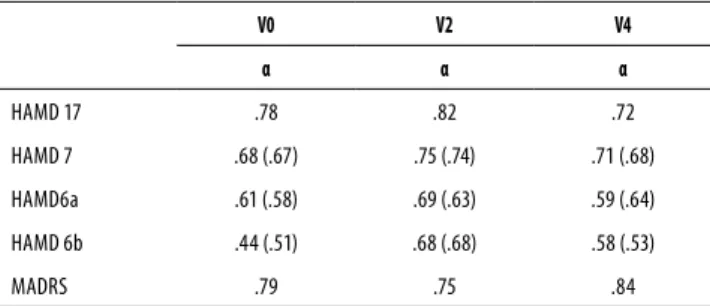
Internal consistency reliability coeicients (α) were calculated considering the four diferent versions at V0, V2 and V4 stages (data are presented in Table 1).
Table 1. Internal consistency reliability coeicients
V0 V2 V4
α α α
HAMD 17 .78 .82 .72
HAMD 7 .68 (.67) .75 (.74) .71 (.68)
HAMD6a .61 (.58) .69 (.63) .59 (.64)
HAMD 6b .44 (.51) .68 (.68) .58 (.53)
MADRS .79 .75 .84
The correction by spearman-brown prophecy is presented inside the parentheses; HAMD: Hamilton Depression Scale; MADRS: Montgomery-Asberg Depression Rating Scale.
V0: entering on treatment; V2: after two weeks of treatment; V4: after four weeks of treatment.
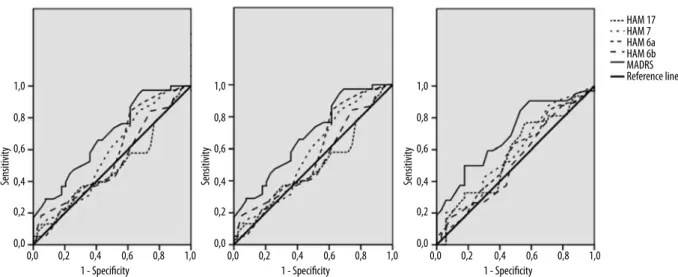
The more reliable stage was at V2 and the least was at V0, and MADRS showed the best internal consistency coeicient at V0, HAMD-17 at V2 and MADRS again at V4. The spearman-brown prophecy did not increase the reliability coeicients. Figure 1 shows area under the curve (AUC) for all HAMD versions and MADRS and Table 2 their respective values.
Visually, Figure 1 shows that MADRS draw the best AUC in the three stages, which is conirmed in Table 2. In general, the HAMD version with better AUC was 7-itens, but always less than MADRS; for V0 the 17-items showed the worst performance. Table 2 shows the statistic results for HAMD versions and MADRS.
The results indicated that the sensitivity and speciicity for distinguishing MDD and BD were low in both versions of HAMD and in MADRS scale in all applications, even thought, the MADRS showed better results. Furthermore, there was a tendency to sensitivity exceed speciicity.
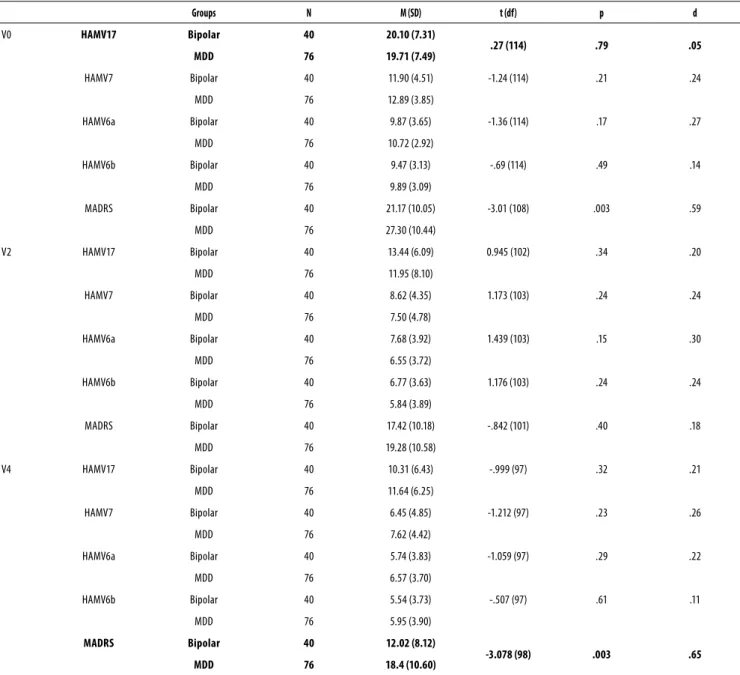
Correlations between the versions of the HAMD with MADRS were high, with few occurrences presenting magnitude lower than 0.80. It should also be considered that the correlation magnitudes seem to show a tendency to increase during the applications. In addition, the logistic regression was calculated, in order to determine logistican Table 3 the t test and Cohen’s d are presented, verifying mean diferences between groups.
Table 2. AUC values for Hamilton (HAMD) and Montgomery Depression Rating Scale (MADRS)
Tests AUC (95% CI); p Raw Ss (95% CI) Sp (95% CI) PPV NPV
V0 HAM 17 .49 (.38-.60); .89 13 84.2 (74.0-91.6) 15.4 (5.71-29.8) 65.3 (55.0-76.6) 33.3 (13.3-59.0)
HAM 7 .57 (.46-.69); .19 10 84.2 (72.8-90.7) 33.3 (17.0-47.6) 70.3 (59.8-79.4) 48 (27.8-68.7)
HAM 6a .56 (.44-.68); .27 9 84.2 (74.0-91.6) 38.5 (22.7-54.2) 71.9 (61.4-80.9) 55.5 (35.3-74.5)
HAM 6b .52 (.41-.64); .65 8 84.2 (74.0-91.6) 25.6 (12.7-41.2) 68.1 (57.7-77.3) 45.4 (24.4-67.8)
MADRS .68 (.58-.79); .01 20 86.8 (77.3-93.5) 38.5 (23.3-55.4) 73.3 (63-82.1) 60 (38.7-78.9)
V2 HAM 17 .42 (.31-.53); .20 13 37.1 (25.9-49.5) 43.7 (27.2-62.1) 57.8 (42.1-72.3) 25.4 (15-38.4)
HAM 7 .42 (.31-.54); .21 10 31.4 (20.8-43.6) 59.4 (39.3-73.4) 59.4 (42.1-75.2) 29.4 (19-41.7)
HAM 6a .42 (.29-.54); .19 9 32.9 (22.1-45.1) 53.1 (36.6-71.2) 59 (42.1-74.4) 28.8 (18.3-41.2)
HAM 6b .43 (.31-.55); .26 8 34.3 (23.3-46.6) 53.1 (36.6-71.2) 60 (43.3-75.1) 29.2 (18.6-41.8)
MADRS .55 (.43-.67); .37 20 44.3 (32.4-56.6) 59.4 (42.1-77.1) 70.4 (54.8-83.2) 33.9 (22.1-47.4)
V4 HAM 17 .57 (.45-.69); .24 13 32.8 (21.6-45.7) 61.8 (44.9-78.5) 61.7 (43.5-77.8) 33.8 (22.6-46.6)
HAM 7 .58 (.46-.70); .19 10 32.8 (21.6-45.7) 70.6 (53.7-85.3) 67.7 (48.6-83.3) 36.7 (25.4-49.3)
HAM 6a .56 (.44-.68); .31 9 32.8 (21.6-45.7) 73.5(53.7-85.3) 67.7 (48.6-83.3) 36.7 (25.4-49.3)
HAM 6b .52 (.40-.65); .67 8 26.6 (16.3-39.1) 70.6 (50.7-83.1) 60.7 (40.6-78.5) 33.8 (23-46)
MADRS .69 (.59-.80); .01 20 50 (36-61.1) 82.4 (65.5-93.2) 84.2 (68.7-94) 45.1 (32.5-58.3)
In bold the test with better sensibility and speciicity. V0: entering on treatment; V2: after two weeks of treatment; V4: after four weeks of treatment.
Figure 1. Area under the Curve (AUC) for HAMD versions and MADRS. HAMD: Hamilton Depression Scale; MADRS: Montgomery-Asberg Depression Rating Scale.
HAM 17 HAM 7 HAM 6a HAM 6b MADRS Reference line 1,0
0,8
0,6
Sensitivity 0,4
0,2
0,0
0,0 0,2 0,4 1 - Specificity
0,6 0,8 1,0 1,0
0,8
0,6
Sensitivity 0,4
0,2
0,0
0,0 0,2 0,4 1 - Specificity
0,6 0,8 1,0 1,0
0,8
0,6
Sensitivity 0,4
0,2
0,0
0,0 0,2 0,4 1 - Specificity
0,6 0,8 1,0
DISCUSSION
Considering the importance of HAMD scale to assess depression, this study aims to compare the diagnostic capacity of HAMD versions compared with MADRS. The psychometric properties of HAMD scale has been questioned, and considered as an imprecise scale. This way, tentatives to reine this scale was proposed, using versions based on core symptoms8,12,13.
In the present study, HAMD 17 scores were reliable and satisfactory, and this could be comparable to Trajkoví et al.1
study, that related good properties in depression patients (primary diagnosis or with comorbidities) and with Bagby et
al.12 revision, that found a Cronbach’s Alpha (α > 0.70) and
the internal reliability Referring to short versions, satisfactory; however, the 7 item version was the most adequate. It is also important mentioning that MADRS as HAMD showed results that conirm their reliability and the idea that this scale are designed to be particularly sensitive to change in patients with antidepressant medication18, although, HAMD was the
best option at V0 and MADRS during treatment (V2 and V4). This result might indicate that, during treatment, when core symptoms are more easily to be detected, MADRS is more indicated to detect change diferences.
Table 3. Groups comparison using Hamilton (HAMD) and Montgomery Depression Rating Scale (MADRS)
Groups N M (SD) t (df) p d
V0 HAMV17 Bipolar 40 20.10 (7.31)
.27 (114) .79 .05
MDD 76 19.71 (7.49)
HAMV7 Bipolar 40 11.90 (4.51) -1.24 (114) .21 .24
MDD 76 12.89 (3.85)
HAMV6a Bipolar 40 9.87 (3.65) -1.36 (114) .17 .27
MDD 76 10.72 (2.92)
HAMV6b Bipolar 40 9.47 (3.13) -.69 (114) .49 .14
MDD 76 9.89 (3.09)
MADRS Bipolar 40 21.17 (10.05) -3.01 (108) .003 .59
MDD 76 27.30 (10.44)
V2 HAMV17 Bipolar 40 13.44 (6.09) 0.945 (102) .34 .20
MDD 76 11.95 (8.10)
HAMV7 Bipolar 40 8.62 (4.35) 1.173 (103) .24 .24
MDD 76 7.50 (4.78)
HAMV6a Bipolar 40 7.68 (3.92) 1.439 (103) .15 .30
MDD 76 6.55 (3.72)
HAMV6b Bipolar 40 6.77 (3.63) 1.176 (103) .24 .24
MDD 76 5.84 (3.89)
MADRS Bipolar 40 17.42 (10.18) -.842 (101) .40 .18
MDD 76 19.28 (10.58)
V4 HAMV17 Bipolar 40 10.31 (6.43) -.999 (97) .32 .21
MDD 76 11.64 (6.25)
HAMV7 Bipolar 40 6.45 (4.85) -1.212 (97) .23 .26
MDD 76 7.62 (4.42)
HAMV6a Bipolar 40 5.74 (3.83) -1.059 (97) .29 .22
MDD 76 6.57 (3.70)
HAMV6b Bipolar 40 5.54 (3.73) -.507 (97) .61 .11
MDD 76 5.95 (3.90)
MADRS Bipolar 40 12.02 (8.12)
-3.078 (98) .003 .65
MDD 76 18.4 (10.60)
V0: entering on treatment; V2: after two weeks of treatment; V4: after four weeks of treatment.
to predict cases, results indicated that full version showed the worst performance, whereas HAMD 7 and MADRS, the best. Sensitivity relects how much the scale is efective to identify correctly individuals who don’t have depression (false-negative results), this way, the MADRS and HAMD 7 version are the most indicated rating scales to evaluate depressive individuals on this sample. Nonetheless, reliability results for short versions indicated that that scales has good sensitivity and speciity scores23 and HAMD
was not sensitive to specify depression symptoms as expected12,13,17.
Addictionally, in contrast to the other subscales the McIntyre et al.8 subscale perform the best reliability and
sensibility scores, and was the best version to predict results as HAMD 17, and showed the best correlation indices. So far, MADRS was the unique scale able to diferentiate depressive symptoms between groups, showing that at entering time (V0) and after one month after medication (V4) the scale was able to detect and diferentiate groups, indicating that MDD group has more symptoms than BD.
CONCLUSION
while BD patients could present results were considered and included with mild depression. This can contribute for interpreting depressive symptoms among groups. Second point is that there are limitations about the sample size. Considering that was applied classical methods of analyzes that could be inlated by the “n”, we try to reduce this bias with other methods, as r prophecy and Cohen D.
Despite this limitations, these indings indicates that core versions could be considered appropriated to assess depressive symptoms among ambulatory patients as good options considering time to administrate scales and for clinical trials, principally HAMD 7 version item. Concerning to 17 item version, results indicated a satisfactory internal reliability, but a unsatisfactory sensibility to discriminate false cases. Making an allowance for MADRS, it is important to consider that this scale was the one that presented results that are more reliable.
INDIVIDUAL CONTRIBUTIONS
Adriana Munhoz Carneiro, Lucas de Francisco Carvalho
– Contributed to conception and design, analysis and interpretation of data.
Ricardo Alberto Moreno – Had substantially contributed
to drafting the article or revising it critically for important intellectual content.
André Cavalcanti – Had given the inal approval of the
version to be published.
CONFLICTS OF INTEREST
The author declare that there is no conlict of interest related to this research.
Clinical trial registration: NCT00976794
ACKNOWLEDGEMENTS
This work was supported by grants from the Fundação de
Amparo à Pesquisa do Estado de São Paulo (Fapesp). AMC and
RAM received research grants from Fapesp.
REFERENCES
1. Trajkoví G, Stařeví V, Latas M, Leštareví M, Ille T, Bukumirí Z, et al. Reliability of the Hamilton Rating Scale for Depression: a meta-analysis over a period of 49 years. Psychiatry Res. 2011;189:1-9.
2. Iannuzzo RW, Jaeger J, Goldberg JF, Kafantaris V, Sublette ME. Development and reliability of the HAM-D/MADRS Interview: an integrated depression symptom rating scale. Psychia-try Res. 2006;145:21-37.
3. Hamilton M. A rating scale for depression. J Neurol Neurosurg Psychiatry. 1960;23:56-62. 4. Faries D, Herreraa J, Rayamajhib J, DeBrotaa D, Demitracka M, Pottera WZ. The
responsive-ness of the Hamilton Depression Rating Scale. J Psychiatr Res. 2000;34:3-10.
5. Fleck MP de A, Chaves MLF, Poirier-Littré MF, Bourdel MC, Henri L, Gueli JD. Depression in France and Brazil: factorial structure of the 17 item Hamilton Depression Scale in Inpa-tients. J Nerv Ment Dis. 2004;192:103-10.
6. Kunigi H, Koga N, Hashikura M, Noda T, Shimizu Y, Kobayashi T, et al. Validation of com-puter-administered clinical rating scale: Hamilton Depression Rating Scale assessment with Interactive Voice Response technology--Japanese version Psychiatry Clin Neurosci. 67:253-8.
7. López-Pina JA, Sánhez-Meca J, Rosa-Alcázar AI. The Hamilton Rating Scale for Depression: a meta analytic reliability generalization study. Int J Clin Health Psychol. 2009;9:143-59. 8. McIntyre RS, Konarski JZ, Mancini DA, Fulton KA, Parikh SV, Grigoriadis S, et al. Measuring
the severity of depression and remission in primary care: validation of the HAMD 7 scale. CMAJ. 2005;11:1327-34.
9. Dractu L, Ribeiro L da C, Calil HM. Depression assessment in Brazil: the irst application of the Montgomery-Asberg Depression Rating Scale. Br J Psychiatry. 1987;150:797-800. 10. Carneiro AM, Fernandes F, Moreno RA. Hamilton depression rating scale and
Montgomery-Asberg depression rating scale in depressed and bipolar I patients: psychometric proper-ties in a Brazilian sample. Health Qual Life Outcomes. 2015;13:42.
11. Freire MA, Figueiredo VLM de, Gomide A, Jansen K, Silva RA da, Magalhaes PVS, et al. Es-cala Hamilton: estudo das características psicométricas em uma amostra do sul do Brasil. J Bras Psiquiatr. 2014;63:281-9.
12. Bagby RM, Ryder AG, Schuller DR, Marshall MB. The Hamilton Depression Rating Scale: has the gold standard become a lead weight? Am J Psychiatry. 2004;161:2163-77. 13. Gibbons RD, Clark DC, Kupfer DJ. Exactly what does the Hamilton Depression Rating Scale
measure? J Psychiatr Res. 1993;27(3):259-73.
14. Bech P, Gram LF, Dein E, Jacobsen O, Vitger J, Bolwig TG. Quatitative rating of depressive states. Acta Psychiatr Scand. 1975;51:161-70.
15. Bech P, Allerup P, Gram LF, Reisby N, Rosenberg R, Jacobsen O, et al. The Hamilton De-pression Scale: evaluation of objectivity using logistic models. Acta Psychiatr Scand. 1981;63:290-9.
16. Bech P, Allerup N, Reisby N, Gram LF. Assessment of symptom change from improvement curves on the Hamilton depression scale in trials with antidepressants. Psychopharmacol-ogy. 1984;84:276-81.
17. Isacsson G, Adler G. Randomized clinical trials underestimate the eicacy of antidepres-sants in less severe depression. Acta Psychiatrica Scandinavica. 2012;125:453-9. 18. Montgomery AS, Åsberg M. New Depression Scale Designed to be Sensitive to Change. Br
J Psychiatry. 1979;134:382-9.
19. Maier W, Philipp M, Heuser I, Schlegel S, Buller R, Wetzel H. Improving depression sever-ity assessment--I. Reliabilsever-ity, internal validsever-ity and sensitivsever-ity to change of three observer depression scales. J Psychiatr Res. 1988;22:3-12.
20. Faries D, Herrera J, Rayamajhi J, DeBrota D, Demitrack M, Potter WZ. The responsiveness of the Hamilton Depression Rating Scale. J Psychiatr Res. 2000;34:3-10.
21. Hooper CL, Bakish D. An examination of the sensitivity of the six item Hamilton Rating Scale for Depression in a sample of patients sufering from major depressive disorder. J Psychiatry Neurosci. 2000;25:178-84.
22. Isacsson G, Adler M. The Hamilton Depression Rating Scale cannot reliably measure mild or moderate depression. Eur Psychiatry. 2012;1:1.
23. Helmreich I, Wagner S, König J, Kohnen R, Szegedi A, Hiemke C, et al. Hamilton depression rating subscales to predict antidepressant treatment outcome in the early course of treat-ment. J Afect Disord. 2015;175:199-208.
24. Campos RN, Costa LF, Bio DS, de Souza MG, Garcia CRL, Demétrio FN, et al. LICAVAL: com-bination therapy in acute and maintenance treatment of bipolar disorder. Clinical Trials. 2010;11:72. Registration NCT00976794.
25. American Psychiatric Association [APA]. Diagnostic and statistical manual of mental disor-ders: DSM-IV-TR, American Psychiatric Publishing, Inc. 2002.
26. First MB; Spitzer RL, Williams JB. Structured Clinical Interview for DSM-IV Axis I Disorders Scid-I. Washington, DC: American Psychiatric Press, Inc. 1996.
27. McIntyre RS, Konarski JZ, Mancini DA, Fulton KA, Parikh SV, Grigoriadis S, et al. Measuring the severity of depression and remission in primary care: validation of the HAMD-7 scale. CMAJ. 2005;173:1327-34.