Cognitive Functions, Self-Esteem and Self-Concept of Children
with Attention Defi cit and Hyperactivity Disorder
Funções Cognitivas, Autoestima e Autoconceito de Crianças
com Transtorno de Défi cit de Atenção e Hiperatividade
Iuri Victor Capelatto
, Ricardo Franco de Lima, Sylvia Maria Ciasca
& Cíntia Alves Salgado-Azoni
Universidade Estadual de Campinas, Campinas, São Paulo, Brasil
Abstract
The study aimed to compare the performance of children with ADHD and children without learning and/or attention diffi culties in tasks of visual attention, executive functions, esteem and self--concept. Participants were34 children, 17 with ADHD and 17in the control group, with a mean age of 9.92 years. For the evaluation, the following tests were used: Cancellation Test, Trail Making Test, Stroop Color Word Test, Tower of London, Children’s Depression Inventory, Self-Esteem Multidimensional Scale, and Children’s Self-Concept Scale. The results indicated that children with ADHD showed worse out comes in attention and executive functions evaluations, in the belief of doing things the wrong way, in feelings of guilt and in low self-esteem, both in the general result as well as in self-perception.
Keywords: Attention defi cit and hyperactivity disorder, cognition, self-esteem, self-concept, children.
Resumo
O estudo objetivou comparar o desempenho de crianças com TDAH e crianças sem queixas de apren-dizagem e/ou atenção em tarefas de atenção visual, funções executivas, autoestima e autoconceito. Fizeram parte do estudo 34 crianças, sendo 17 com TDAH e 17 do grupo controle, com idade média de 9,92 anos. Para a avaliação, foram utilizados: Teste de Cancelamento; Trail Making Test; Stroop Color Word Test; Torre de Londres; Children’s Depression Inventory; Escala Multidimensional de Auto-Estima, Escala de Autoconceito Infanto-Juvenil. Os resultados indicaram que crianças com TDAH apresentaram piores resultados nas avaliações atencionais, de funções executivas, na crença em fazer as coisas do jeito errado e sentimentos de culpa, e na autoestima, tanto no resultado geral como na Percepção de Si.
Palavras-chave: Transtorno da falta de atenção com hiperatividade, cognição, autoestima, autocon-ceito, crianças.
Attention Defi cit and Hyperactivity Disorder (ADHD) is a neurobehavioral disorder of early onset, characterized by psychomotor restlessness, sustained attention diffi culty and cognitive and social impulsivity. The main characte-ristics of ADHD are diffi culties in maintaining attention on tasks that require concentration, completing tasks and remaining seated, low performance on assessments, disor-ganized material and work, constant speech, conversations and/or noises at inappropriate times, low performance in attentional and executive functions tasks (Barkley, 2008;
Mailing Address: Departamento de Neurologia,
Fa-culdade de Ciências Médicas, Universidade Estadual de Campinas, Rua Tessália Vieira de Camargo, 126, Caixa Postal 6111. Campinas, SP, Brasil 13083-970. E-mail: [email protected]
Paper parcially presented on the XXI Nacional ABEN-EPI Congress – São Paulo/SP and on the 63rd Annual IDA Conference: Reading, Literacy and Learning Inter-national Congress de Baltimore, EUA
DuPaul & Stoner, 2007; Eiraldi, Power, Karustis, & Gol-dstein, 2000; Simão, Toledo, & Ciasca, 2010).
ADHD has a pattern of inattention and/or hyperactivity/ impulsivity, which is more frequent and severe than in people at the same age development. In the last edition of the Diagnostic and Statistical Manual of Mental Disorders ([DSM-IV-TR], American Psychiatric Association, 2002), the disorder is divided into 3 subgroups: predominantly inattentive subtype, predominantly hyperactive/impulsive subtype and combined subtype. There is a problem of lack of self-control, with broad implications in the development, learning ability and social adaptation (Albert, López--Martín, Fernández-Jaén, & Carretié, 2008; Cardo et al., 2010; López-Villalobos et al., 2007).
in working memory, low performance in reading and un-derstanding, internalizing symptoms (such as depression and anxiety), learning diffi culties, perceptual-motor tasks, diffi culties in focusing attention and cognitive disorder. Hyperactivity can be expressed by the child who is fi d-geting all the time, excessive speech and activity, restles-sness, diffi culty on completing sequential tasks, higher reaction time, more school failure, motor and/or vocal agitation, controlling impulses and selfregulation diffi -culties and behavioral inhibition (Biederman et al., 1996; Simão et al., 2010). Children with ADHD often have low performance in attentional and executive functions tasks, as reported in studies concerning this disorder (Barkley, 2008; Ciasca, Rodrigues, & Salgado, 2010).
ADHD is a common condition, multifactorial and complex etiology, with high prevalence rates when com-pared to other childhood disorders. It is believed that it affects approximately 3-5% of children and adolescents population. It is a topic much studied in the literature regarding academic problems, behavioral, substance abuse and excessive absences at school (Barkley, 2008; Biederman, 2005; Biederman et al., 1996; Glass, Flory, Martin, & Hankin, 2011; Mattos, Serra-Pinheiro, Rohde, & Pinto, 2006).
Regarding the models of which brain areas are involved in the disorder, fi rst it was credited to the prefrontal-striatal areas as altered in ADHD subjects. Subsequently, it was discovered involvement of cerebellar areas. This occurred primarily because the prefrontal striatal circuits are res-ponsible for the functioning of executive functions and the dysfunctions of these processes are correlated with ADHD (Castellanos & Proal, 2012).
The network known as the executive control circuit, or fronto-parietal circuits, includes the lateral frontal lobe, the anterior cingulate cortex, dorsolateral and ante-rior prefrontal cortex, lateral cerebellum, anteante-rior insula gyrus, caudate nucleus and inferior parietal lobe regions. This network involves functions such as mental fl exibility (change responses in accordance with the change of con-text) and making decisions related to goals (Castellanos & Proal, 2012), commonly altered in children with ADHD (Castellanos & Proal, 2012; Ciasca et al., 2010).
The correct diagnosis of this disorder is crucial, since impairments may occur in quality of life of children and adolescents. Therefore, it should be done by an interdisci-plinary team, which will evaluate all aspects related to the individual: neuropsychological, psychiatric, neurological, educational and speech. However, this takes time and is expensive (Ciasca et al., 2010).
Depressive Symptoms, Self-Esteem and Self-Concept According to the defi nition of Coopersmith (Gobbita & Guzzo, 2002), self-esteem is related to the assessment that the person does about him or herself, expressing approval or disapproval and indicates how capable he or she considers him or herself important and valuable. Thus, the concept is just a value judgment expressed by the
attitudes that the individual cultivates for him or herself. However, the self-concept is defi ned as a multidimensional assumption resulting from the interaction of humans with the environments with which it interacts during the process of social construction, with self-assessment of their skills, accomplishments, experiences and representations (Sisto & Martinelli, 2004).
The self-concept begins in childhood, is developed throughout life and is directly related to the impact of other’s opinion. It is a construct broader than self-esteem because it includes cognitive (set of characteristics with what the person describes itself and that guides it way of being and guide itself), affective (also posted here as self-esteem, concerning the affection and emotions that come with the description of itself) and behavioral aspects (behavior infl uenced by the concept that a person has of him or herself), while the second component (self-esteem) is seen as more limited and evaluative of the fi rst (Sisto & Martinelli, 2004).
There are few data in the literature on self-esteem in children with ADHD, especially when considering the importance of this aspect in neuropsychological interven-tions. Studies on the functioning of the skills related to emotional competence in children with ADHD are scarce (Albert et al., 2008).
Gobitta and Guzzo (2002) claim that there are at least fi ve reasons for the need to develop research focusing on self-esteem: it’s a construct more complex than assumed; it is related to the psychological well-being and mental health; many negative mental elements, such as depres-sion and suicide, are related to the absence or decline of self-esteem; it is relevant to the social sciences, and it is currently a concept with high social importance
It is common for people with ADHD have comorbid with other psychiatric disorders such as anxiety, mood changes (unipolar and bipolar depression or dysthymia) and school diffi culties (Albert et al., 2008; Biederman, 2005; Biederman et al., 1996; Eiraldi et al., 2000; Krauel et al., 2009). Eiraldi et al. (2000) demonstrated in their study that 3.5% of children with ADHD showed depres-sive disorders.
Sisto and Martinelli (2004) describe that experience failure in performance on academic tasks can generate feelings of insecurity and lack of confi dence in children, as studies are the main activity during childhood and adolescence. As it is characteristic of most children and adolescents with ADHD have an impact on school perfor-mance, it is likely to impact on the formation of school self-concept, which is related to the representations of one’s accomplishments school abilities and assessments that the person does about them.
Children and adolescents with ADHD may have pro-blems in skills that relate to emotional competence, such as recognition of facial expressions, emotional and affective prosody, regulation and expression of emotions. Studies show that these diffi culties are related to the combined and hyperactive-impulsive subtypes, but there are no data regarding the inattentive subtype (Albert et al., 2008).
Krauel et al. (2009) found in their research that people with ADHD and comorbid oppositional defi ant disorder or conduct disorder are often characterized by negative emotions and also seem to prefer to process negative information, particularly in social situations emotionally ambiguous.
These conditions lead to the importance of making a survey of self-esteem and self-concept of children with ADHD, related to possible changes in brain areas invol-ved in attention and executive functions, infl uencing their social and educational development.
The aim of this study was to compare the performance of children with ADHD with children without learning and/or attention diffi culties in tasks of visual attention, executive function, depressive symptoms, self-esteem and self-concept.
Method
Participants
This study enrolled 34 public school children, aged 8-13 years-old, (mean age: 9.92 years), attending middle school. Participants were divided into two groups: study group (SG), formed by 17 children with ADHD diagnosis; and control group (CG), formed by 17 children without attention and learning diffi culties.
Children in SG were selected from referrals to the La-boratory of Learning Disabilities and Attention Disorder, State University of Campinas, Brazil. Initially, the children underwent diagnostic evaluation performed by an interdis-ciplinary team (child neurology, psychiatry, psychologist, speech therapist and pedagogue), according to the DSM--IV at time of evaluation, and were included in the study after confi rming the diagnosis. The criteria for inclusion in these groups were as follows: consent form signed by the parents; ADHD diagnosis, presenting an intellectual level as expected, i.e., intelligence quotient (IQ) above 80; ab-sence of sensory or motor defi cits; not using psychotropic medication and having no other neurological symptoms. Initially, during the period of the study, 57 children with
attention diffi culties complaints were evaluated, and 40 were excluded for not confi rming the diagnosis of ADHD or lack of continuity of the evaluation process or because the parents did not sign the consent form. Thus, the total study sample consisted of 17 children with interdiscipli-nary diagnostic of ADHD.
Children in CG, who were selected from the appoint-ment of teachers at a school in the metropolitan region of Campinas/SP, should not have learning diffi culties and poor academic performance. Children were selected ac-cordingly, matched for age and sex with other groups and assessed in the school context. The criteria for inclusion in the group were as follows: a consent form signed by parents; no complaints about attention and learning diffi -culties and satisfactory academic performance; presenting an intellectual level as expected (i.e., intelligence quotient [IQ] above 80); no sensory or motor defi cits, psychotropic medication and others neurological symptoms.
Instruments
Attention Evaluation. Cancellation Test (CT; Lima, Azoni, & Ciasca, 2011; Lima, Travaini, & Ciasca, 2009). A performance test that requires continuous rapid visual selectivity and repetitive motor response and aims to assess sustained visual-spatial attention. It was used two versions: (a) Geometric Figures (CT-GF): composed of a sheet with pseudo-random sequence, i.e., pseudo-random simple ge-ometrical fi gures, in which the child had to mark all found circles (a total of 92) as fast as he could; (b) Letters in Row (CT-LR): composed of lyric sheets distributed at random, in which the child had to check all the letters “A” (a total of 60) as fast as he could. For both versions, there was no set time limit to perform the tasks. Scores were obtained: (a) Time: time in seconds that the child needs to perform the task; (b) Omission Errors: number of target stimuli that the child did not check; (c) Addition Errors: number of non-target stimuli the child checked.
Trail Making Test A (TMT-A; Lima et al., 2011; Lima et al., 2009; Spreen & Strauss, 1998). Part A of TMT assesses visual sustained attention and is composed of a sheet with circles numbered 1 to 25, and the child was randomly assigned to draw a line connecting the sequence of numbers as fast as he could. Scores were obtained: (a) Time: time in seconds to perform the task and (b) Number of Errors: number of links wrongly sequenced.
whe-ther the children properly recognized numbers and letters randomly and sequentially.
Stroop Color Word Test – Victoria version (SCWT; Lima et al., 2011; Spreen & Strauss, 1998). This test eva-luates the ability of inhibitory control and selective visual attention. We used the four-color version (red, yellow, blue and green) and 24 stimuli in each of three parts: (a) “Color Card” (SCWT-C): with squares in four colors, using pseudorandom order; the child had to name the colors as quickly as possible; (b) “Words Card” (SCWT-W): with color names printed in colors corresponding to which the child had to name; (c) “Color-Word Card” (SCWT-CW): with names of colors, but printed in incongruent colors, for example, the word “green” printed in blue and the child had to say the name of the color and not read the word. Scores were obtained for time and errors for each of the cards, and additional scores were calculated: (a) Facilitation: the facilitation process obtained from the presentation of congruent stimuli. The score is obtained by subtracting time (facilitation-time) and error (facilitate-errors) sco-res: “color card” – “words card”; (b) Interference: which represents the “stroop effect” due to the incongruous situ-ation of the test. The score is obtained by subtracting time (interference-time) and error (interference-errors) scores: “color-word card” – “color card”.
Tower of London (ToL; Lima et al., 2011; Tunstall, 1999). The ToL assesses the mental ability to plan and consists of a wooden base with three vertical pins and three colored circles with a hole in the center to allow the groove on the pin. The goal is to rearrange the position of the circles from a fi xed initial order to get different orders defi ned by the evaluator. Ten items showed increasing degree of diffi culty depending on the number of moves needed to reach the fi nal position. For each item, the exa-miner placed the circles in early position and then in fi nal position; the child had to play using the fewest possible moves. The scores for each item could range from 1-3 points. The fi nal score was expressed as the sum of scores for each item.
Depressive Symptomatology Evaluation. Children‘s Depression Inventory (CDI; Gouveia, Barbosa, Almeida, & Gaião, 1995; Kovacs, 1992). Adapted for the Brazilian population, this inventory is widely used in epidemiolo-gical and clinical studies in Brazil and internationally. It is a self-assessment scale consisted of 20 items designed to identify depressive symptoms (affective, cognitive and behavioral) in children and adolescents of 7-17 years of age, using a cutoff of 17 for identifying signifi cant symp-toms. The subject must indicate one of three possible responses for each item, so that the score ranges from 0 (no symptoms) to 2 (severe symptoms). When applying with children, he/she is guided to select the item that best describes his/her feelings in the last two weeks and expla-nations are provided for any questions.
Self-Esteem and Self-Concept Evaluation. Multidi-mensional Scale of Self-Esteem (EMAE; Gobbita, 2003; Gobbita & Guzzo, 2002). Translated from the instrument
originally developed by Stanley Coopersmith in 1967 and 1989, this is a self-assessment inventory with 56 questions designed to identify the concept of self-esteem of children and adolescents aged 7-18 years. The individual must in-dicate for each question one of fi ve alternatives, ranging from 0 to 5 points. The alternatives are related to each person’s judgment as to that statement refers to his or her way of being, acting and/or thinking. The total maximum score for the overall scale is 280 points and the minimum of 56. The answers are divide into fi ve dimensions, na-mely: Dimension 1 – Social acceptance, composed of 15 items that express judgments about characteristics of one’s self on social relationships, such as social accep-tance, socialization, social skills, extroversion, ability to infl uence the other, expression of own opinions, feelings expression, affections and moods, and others. Dimension 2 – Self Perception, with 15 items that express negative judgments about self’s aspects, such as physical personal and social characteristics; Dimension 3 – Family, with 11 items that express judgments about characteristics of the relationships within the family, such as the acceptance or not, by parents, of his feelings and thoughts, and attention, care and affection perceived; Dimension 4 – Performance, with 10 items that express judgments about the perceived characteristics of the personal performance, effectiveness and involvement in demands and expectations of the relational group, especially in the family and the school context; Dimension 5 – Self Acceptance, with 5 items that express judgments about self’s characteristics, such as physical appearance and life satisfaction.
Self-Concept Scale for Children and Youth (EAC-IJ; Sisto & Martinelli, 2004). This is a 20 questions self-asses-sment scale divided into 4 categories, which were personal self-concept, with 5 questions, social self-concept, with 5 questions, school self-concept, with 4 questions, family self-concept, with 6 questions. All questions must be answered with just one answer among three alternatives: always, sometimes, or never.
Procedures
Results
Participants
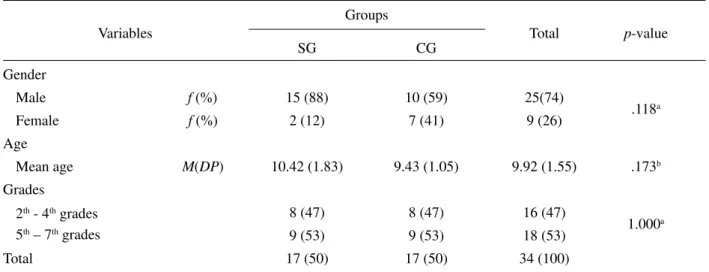
There was no statistically signifi cant difference (p = .173) between the two groups of subjects regarding their ages, gender and grades (Table 1), but it’s possible to observe that there were more boys than girls.
Attentional Evaluation
In attentional tests, it is worth mentioning that the longer and/or larger numbers of errors, the worse the test
result. In Cancellation Test, the SG showed more diffi -culties in visual sustained attention, with more omission errors at Geometric Figures and at Letters in Row (i.e., some fi gures and letters were not crossed out), with a statistically signifi cant difference in both parts of the test, as shown in Table 2.
Regarding the Trail Making Test (TMTA) - Part A, the SG showed worse performance than the CG with a higher number of errors, again demonstrating diffi culty in visual sustained attention, which was statistically sig-nifi cant (Table 2).
Table 1
Sample Characterization
Variables
Groups
Total p-value
SG CG
Gender
Male f (%) 15 (88) 10 (59) 25(74)
.118a
Female f (%) 2 (12) 7 (41) 9 (26)
Age
Mean age M(DP) 10.42 (1.83) 9.43 (1.05) 9.92 (1.55) .173b
Grades
2th - 4th grades
5th – 7th grades
8 (47) 8 (47) 16 (47)
1.000a
9 (53) 9 (53) 18 (53)
Total 17 (50) 17 (50) 34 (100)
Note. Sig.: signifi cance; n: number of group subjects; SG: study group; CG: control group.
aFischer’s Exact Test; b Mann-Whitney Test.
Table 2
Comparison of Average Attention Tests Scores among Groups
Variable
Group
Sig. (p-value)
SG CG Total
Media SD Media SD Media SD
CT-GF Time 94.59 31.00 83.71 11.98 89.15 23.80 .228
CT-GF Omission Errors 3.53 4.65 .53 1.01 2.03 3.65 .008*
CT-GF Addition Errors .12 .49 7.71 31.52 3.91 22.28 .552
CT-LR Time 162.00 50.66 134.53 25.02 148.26 41.74 .082
CT-LR Omission Errors 8.71 5.83 2.76 4.15 5.74 5.82 .001*
CT-LR Addition Errors .06 .24 .00 .00 .03 .17 .317
TMTA Time 65.71 27.46 51.35 12.63 58.53 22.27 .148
TMTA Errors 1.41 1.94 .06 .24 .74 1.52 < .001*
Note. Mann-Whitney Test; Sig.: signifi cance; CT-GF: Cancellation Test – Geometric Figures; CT-LR: Cancellation Test – Letters in Row; TMTA: Trail Making Test – Part A.
Executive Functions Evaluation
In mental fl exibility and alternating attention evalua-tions, assessed by Trail Making Test (TMT)-Part B, the SG performance showed a statistically signifi cant difference
compared to the CG on all evaluated items, i.e., the group composed of subjects with ADHD required more time to perform the test, has committed more alternating and sequence errors, as shown in Table 3.
Table 3
Comparison of Average Executive Functions Tests Scores among Groups
Variable
Group
Sig. (p-value)
SG CG Total
Media SD Media SD Media SD
TMTB Time 256.76 102.06 143.65 49.89 200.21 97.74 .001**
TMTB Switching erros 3.12 3.35 .18 .53 1.65 2.80 < .001**
TMTB Sequencing erros 1.71 1.80 .24 .56 .97 1.51 .003**
SCWT-C Time 27.24 15.47 17.24 4.02 22.24 12.23 .004**
SCWT-C Errors 1.41 1.77 .18 .39 .79 1.41 .008**
SCWT-W Time 31.29 46.90 13.00 4.08 22.15 34.07 .001**
SCWT-W Errors .59 1.00 .06 .24 .32 .77 .016*
SCWT-CW Time 55.47 30.70 35.53 9.38 45.50 24.54 .005**
SCWT-CW Errors 4.53 4.69 1.65 1.41 3.09 3.71 .021*
SCWT Interference Time 28.24 20.66 18.29 6.70 23.26 15.94 .068
SCWT Interference Errors 3.12 4.47 1.47 1.28 2.29 3.34 .248
SCWT Facilitation Time -4.06 34.12 4.18 3.64 .06 24.26 .407
SCWT Facilitation Errors .82 1.67 .12 .49 .47 1.26 .242
TOL 16.47 3.74 21.76 2.54 19.12 4.14 < .001**
Note. Mann-Whitney Test; Sig.: signifi cance, TMTB: Trail Making Test – Part B; SCWT-C: Stroop Color Word Test – Color Card; SCWT-W: Stroop Color Word Test – Words Card; SCWT-CW: Stroop Color Word Test – Color-Word Card; TOL: Tower of London. *p<.05; **p<.01.
It is worth mentioning that, in the TMT – Part B, as well as attentional tests, the longer and/or higher number of errors, the worst result in the test.
In the Stroop, which evaluated the individual ability to select relevant stimuli and ignore irrelevant stimuli, the SG showed better performance diffi culties regarding time and errors in the 3 cards. However, when comparing the inter-ference and facilitation scores, there were no signifi cant differences for these cases, as shown in Table 3. Again, it should be considered that the longer and/or higher number of errors, the worst result in the test.
This shows again that subjects with ADHD have more diffi culties in visual sustained attention. However, when the impact of the incongruent stimulus was evaluated to verify the impact on visual selective attention, the level of interference was the same as the control group, with no statistically signifi cant difference for visual selective attention on the Stroop effect.
In the evaluation of the mental ability to plan, the SG showed more diffi culties in the Tower of London test, which was statistically signifi cant (Table 3), noting that, in this test, the higher the result, the better the performance.
Depressive Symptomatology Evaluation
Table 4
Comparison of Average Depressive Symptoms CDI Scores among Groups
Variable
Group
Sig. (p-value)
SG CG Total
Media SD Media SD Media SD
CDI 7.53 6.77 5.29 3.90 6.41 5.56 .521
CDI 3 Wrong .47 .62 .12 .49 .29 .58 .025*
CDI 8 Guilt .59 .71 .12 .33 .35 .60 .022*
Note. Mann-Whitney Test; Sig.: signifi cance; CDI:Children‘s Depression Inventory. *p<.05.
Table 5
Comparison of Average EAC-IJ and EMAE Tests Scores among Groups
Variable
Group
Sig. (p-value)
SG CG Total
Media SD Media SD Media SD
EACIJ Total 23.76 5.29 26.24 4.15 25.00 4.84 .162
EACIJ Personal Total 4.71 1.61 5.53 1.59 5.12 1.63 .163
EACIJ Scholar Total 4.76 1.79 5.00 1.84 4.88 1.79 .739
EACIJ Family Total 5.24 1.48 5.18 1.78 5.21 1.61 .792
EACIJ Social Total 9.06 2.88 10.53 1.70 9.79 2.45 .148
EMAE Total 214.71 34.22 245.06 19.56 229.88 31.47 .006*
EMAE Media 3.83 .61 4.38 .35 4.10 .56 .006*
EMAE Dim 1 Total 56.00 9.55 60.41 5.71 58.21 8.06 .276
EMAE Dim 1 Media 4.00 .68 4.32 .41 4.16 .58 .262
EMAE Dim 2 Total 57.88 11.65 70.94 6.87 64.41 11.51 < .001*
EMAE Dim 2 Media 3.54 .78 4.43 .43 3.99 .77 < .001*
EMAE Dim 3 Total 40.47 8.22 45.71 3.70 43.09 6.82 .052
EMAE Dim 3 Media 4.07 .80 4.57 .37 4.32 .66 .052
EMAE Dim 4 Total 39.76 7.29 45.24 5.85 42.50 7.08 .062
EMAE Dim 4 Media 3.61 .66 4.11 .53 3.86 .64 .058
EMAE Dim 5 Total 20.59 5.06 22.76 2.33 21.68 4.04 .293
EMAE Dim 5 Media 4.12 1.01 4.55 .47 4.34 .81 .293
Note. Mann-Whitney Test; Sig.: signifi cance; EAC-IJ: Escala de Autoconceito Infanto-Juvenil; EMAE: Escala Multidimensional de Auto-Estima.
Self-Esteem and Self-Concept Evaluation
The self-concept evaluation occurred through EAC IJ, where the higher the score, the better the outcome. The total general and in each dimension results showed no statistically signifi cant differences between groups. The same was true when comparing the results of the EAC- IJ quartile, in which there were no statistically signifi cant differences in both the overall result as for all dimensions. In the assessment of self-esteem, there was a statistically signifi cant difference in the overall total and average, and Dimension 2: Self Perception (items that express negative judgments about self’s aspects, such as physical personal and social characteristics) in both the total result and the average (Table 5).
This demonstrates that, despite having ADHD, the SD had no signifi cant impact on self-concept in relation to CG; however demonstrate impact on self-esteem of children with ADHD compared to the control group.
Discussion
This study found statistically non-signifi cant differen-ces by age, degree and gender, but it’s possible to observe that there were an increased number of boys in the ADHD group. Several studies mention the difference between gender regarding diagnostic symptoms (Biederman et al., 2002; Dupuy, Barry, Clarke, McCarthy, & Selikowitz, 2013). However, this study cannot claim such categoriza-tion by gender and subtype, since the sample of girls with the diagnosis is limited to the comparison. Based on the results, there were performance differences among ADHD children and the control group in different evaluations. Regarding sustained visual attention tests, the group of children with ADHD showed higher scores on omission errors on the Cancellation Test (geometric fi gures and letters in row), and errors on the Trail Making Test-A. It was not observed statistically signifi cant difference on the commission errors among the groups, which is corrobora-ted by the literature (Toledo, 2006).
These results suggest that children with ADHD have diffi culties in tracking, requiring a greater solving time, which increases the number of errors. The results also corroborate the fi ndings in the literature that indicate that children with ADHD show worse response pattern in visual-spatial attention tasks, in which cognitive resour-ces are recruited for visual tracking, causing more errors (Toledo, 2006). Berwid et al. (2005) showed in a study of preschool children that the higher the omission errors, the greater the risk to have ADHD diagnosis, corroborating the fi nds cited above.
Regarding executive functions tests, children with ADHD showed worse results on all aspects on the TMT--B, as required more time to solve the evaluation, as well as more alternation and sequence errors. Toledo (2006) also found difference between control group and ADHD children regarding the time and numbers of errors. She
also highlights that TMT-B is more sensitive for cerebral dysfunction evaluation, and this difference on the time refl ects the ADHD diffi culties on tasks that demands inhibition and response planning, organization and alter-nating attention, which are diffi culties associated to the frontal lobe. The learning diffi culties of ADHD children may be revealed by neuropsychological evaluations, as well as slowness in alternating attention tasks. ADHD children have more errors and diffi culties in planning and systematize their works.
These fi ndings show that children with ADHD had more diffi culties on mental fl exibility. ADHD children had more diffi culties on the TOL test compared to control group, indicating worse mental ability to plan, which are expected fi ndings among children with this diagnosis (Barkley, 2008), since they have diffi culties in working memory and executive inhibitory processes. It is necessary to have good planning abilities to perform well in TOL. These diffi culties mentioned above disrupt this planning and anticipation, causing further errors and, consequently, reducing the total score in the test.
The SCWT test measures the ability to inhibit auto-matic responses, selecting relevant stimuli and ignore irrelevant stimuli (Lima et al., 2011; López-Villalobos et al., 2010). Regarding the selective attention (STROOP effect), children with ADHD showed higher scores on time and errors than control group, however the groups did not differ on the interference and facilitation factors, which suggests that the diffi culty on the sustained attention leads to diffi culties on the selective attention.
Toledo (2006) highlights that not all ADHD children show these diffi culties in selective attention, what could explain why there was no difference when comparing to the control group on the interference factor. Chan et al. (2009) point that many studies have failed to show selec-tive attention defi cits compared to non-ADHD controls on SCWT test, except for studies with large samples, when group differences emerge, but they tend to be small effect sizes. They also discovered that children with ADHD displayed pronounced interference effects when the tar-gets of the tests appeared on the right, and diminished interference effects when targets appeared on the left. On the other side, control group showed opposite results, with higher interference effects with targets on the left and less interference with targets on the right side.
Toledo (2006) also indicates that studies have shown the “participation of the parietal cortex in the information processing that demanded voluntary attention control, hypothesizing that the inferior parietal region is crucial for the onset of motor planning and plays a central role in the modulation of selective attention”. Other Brazilian study also showed results indicating latency changed on the selective attention, suggesting an attentional impairment over a cognitive problem (Simão, 2004).
(Barkley, 2008; Biederman, 2005; Ciasca et al., 2010; Simão, 2008; Toledo, 2006), and may be correlated with abnormal activation of frontostriatal circuits (Fernandez--Mayoralas, Fernandez-Jaen, Garcia-Segura, & Quinones--Tapia, 2010).
Regarding assessments of depressive symptoms, self--concept and self-esteem, children with ADHD showed worse results only on items related to “subject’s belief of doing things the wrong way” and “feelings of guilt for bad things that happen” (CDI); and EMAE: overall outcome and mean, and Dimension 2: Perception of Self (items that express negative judgments about yourself, such as physical, personal and social), both in total and on avera-ge result. The CDI and EAC-IJ total score did not show signifi cant difference of the control group.
Some studies have showed that children with ADHD usually shows a positive illusory bias in their own personal perceptions regarding the operation in the academic, social and behavioral fi elds, and overvaluing the happiness they feel in their lives (Barkley, 2008; Miranda-Casas et al., 2011). These factors could explain why there were not differences on the self-concept and the CDI total scores.
Even so, it was possible to observe that children with ADHD feels more guilty, shows more belief in doing more wrong things and worse self-esteem. Once these children shows more diffi culties on attention and execu-tive functions, worse are the performance in schoolwork and everyday tasks, which can impact the development of self-esteem and causes more guilty feelings.
Further studies should consider increasing the sample groups, so that the level of interference on the emotional symptoms of cognitive functions can be checked.
Conclusion
This study was important to raise issues relating to per-formance evaluations of visual attention, executive func-tion, depressive symptoms, self-esteem and self-concept in children with ADHD. Despite the limited number of children in groups, making it diffi cult to generalize the fi ndings, this study suggests that children with ADHD may show diffi culties in sustained visual attention tasks, especially regarding tracking, requiring a greater solving time, which increased the number of errors. They also showed diffi culties in executive functions, especially on tasks that demands disinhibition and response planning, organization, alternating attention and mental fl exibility, all functions related to frontal lobe. Regarding the depres-sive symptoms, self-esteem and self-concept evaluations, ADHD children showed more guilty, shows more belief in doing more wrong things and worse self-esteem, revealing the emotional impact that can cause ADHD in children if untreated. Further researches are needed to understand better the relationship between performance on attention and executive functions tasks and the development of self--esteem and self-concept of children with ADHD.
Referências
Albert, J., López-Martín, S., Fernández-Jaén, A., & Carretié, L. (2008). Alteraciones emocionales en el trastorno por défi cit de atención/hiperactividad: datos existentes y cuestiones abiertas.
Revista de Neurología, 47, 39-45.
American Psychiatric Association. (2002). Diagnostic and statistical manual of mental disorders (DSM-IV-TR) (4th ed.)
Washington, DC: Author.
Barkley, R. A. (Ed.). (2008). Transtorno de défi cit de atenção/ hiperatividade: Manual para diagnóstico e tratamento (3. ed.). Porto Alegre, RS: Artmed.
Berwid, O. G., Kera, E. A. C., Marks, D. J., Santra, A., Bender, H. A., & Halperin, J. M. (2005). Sustained attention and response inhibitionin young children at risk for attention defi cit/hyperactivity disorder. Journal of Child Psychology and Psychiatry, 46(11), 1219-1229
Biederman, J. (2005). Attention-defi cit/hyperactivity disorder: A selective overview. Biological Psychiatry, 57, 1215-1220. Biederman, J., Faraone, S. V., Milberger, S., Curtis, S., Chen,
L., Marrs, A., …Spencer, T. (1996). Predictors of persistence and remission of ADHD: Results from a four-year prospective follow-up study of ADHD children. Journal of American Academic Child Adolescent Psychiatry, 38, 966-975. Biederman, J., Mick, E., Faraone, S. V., Braaten, E., Doyle, A.,
Spencer, T., …Johnson, M. A. (2002). Infl uence of gender on attention defi cit hyperactivity disorder in children refer-red to a psychiatric clinic. American Journal Psychiatry,
159, 36-42.
Cardo, E., Nevot, A., Redondo, M., Melero, A., Azua, B., Banda, G. G., & Servera, M. (2010). Trastorno por défi cit de atención/ hiperactividad: ?un patrón evolutivo? Revista de Neurología,
50(Supl. 3), S143-S147.
Castellanos, F. X., & Proal, E. (2012). Large-scale brain systems in ADHD: Beyond the prefrontal–striatal model. Trends in Cognitive Sciences, 16(1), 17-26.
Chan, E., Mattingley, J. B., Huang-Pollock, C., English, T., Hester, R., Vance, A., & Bellgrove, M. A. (2009). Abnormal spatial asymmetry of selective attention in ADHD. Journal of Child Psychology and Psychiatry, 50(9), 1064-1072. Ciasca, S. M., Rodrigues, S. D., & Salgado, C. A. (Eds.). (2010).
TDAH: Transtorno do Défi cit de Atenção e Hiperatividade
(pp. 23-36). Rio de Janeiro, RJ: Revinter.
DuPaul, G. J., & Stoner, G. (2007). TDAH nas escolas: Estra-tégias de avaliação e intervenção. São Paulo, SP: M. Books. Dupuy, F. E., Barry, R. J., Clarke, A. R., McCarthy, R., & Seli-kowitz, M. (2013). Sex differences between the combined and inattentive types of attention-defi cit/hyperactivity disorder: An EEG perspective. International Journal of Psychophy-siology, 89(3), 320-327.
Eiraldi, R., Power, T., Karustis, J., & Goldstein, S. (2000, March). Assessing ADHD and comorbid disorders in children: The Child Behavior Checklist and the Devereux Scales of Mental Disorders. Journal of Clinical Child Psychology, 29(1), 3-16. Fernandez-Mayoralas, D. M., Fernandez-Jaen, A., Garcia-Segura,
J. M., & Quinones-Tapia, D. (2010). Neuroimagen en el transtorno por defi cit de atencion/hiperactividad. Revista de Neurología, 50(Supl. 3), S125-S133.
Gobbita, M. (2003). Escala multidimensional de auto-estima (EMAE): Construção e validação com crianças e adolescentes brasileiro (Tese de doutorado, Centro de Ciências da Vida, Pontifícia Universidade Católica de Campinas, Campinas, SP, Brasil).
Gobitta, M., & Guzzo, R. S. L. (2002). Estudo inicial do Inven-tário de Auto-Estima (SEI) – Forma A. Psicologia: Refl exão e Crítica, 15(1), 143-150.
Gouveia, V. V., Barbosa, G. A., Almeida, H. J. F., & Gaião, A. A. (1995). Inventário de Depressão Infantil - CDI: Estudo de adaptação com escolares de João Pessoa. Jornal Brasileiro de Psiquiatria, 44, 345-349.
Kovacs, M. (1992). Children Depression Inventory CDI: Manual. New York: Multi-Health Systems.
Krauel, K., Duzel, E., Hinrichs, H., Rellum, T., Santel, S., & Baving, L. (2009). Emotional memory in ADHD patients with and without comorbid ADD/CD. Journal Neural Trans-mission, 116, 117-120.
Lima, R. F., Azoni, C. A. S., & Ciasca, S. M. (2011). Attentional performance and executive functions in children with learning diffi culties. Psicologia: Refl exão e Crítica, 24(4), 685-691. Lima, R. F., Travaini, P. P., & Ciasca, S. M. (2009). Amostra de
desempenho de estudantes do ensino fundamental em testes de atenção e funções executivas. Psicopedagogia, 26(80), 188-199.
López-Villalobos, J. A., Serrano-Pintado, I., Andrés-De Llano, J. M., Delgado Sánchez-Mateos, J., Alberola-López, S., & Sánchez-Azón, M. I. (2010). Utilidad del test de Stroop en el trastorno por défi cit de atención/hiperactividad. Revista de Neurología, 50, 333-340.
López-Villalobos, J. A., Serrano-Pintado, I., Delgado Sánchez--Mateos, J., Ruiz Sanz, F., Sánchez-Azón, M. I., & Sacristán Martín, M. A. (2007). Transtorno por défi cit de atención/ hiperactividad: perfi l intelectual y factor de independencia a la distracción. Revista de Neurología, 44(10), 589-595. Mattos, P., Serra-Pinheiro, M. A., Rohde, L. A., & Pinto, D.
(2006). Apresentação de uma versão em português para uso no Brasil do instrumento MTA-SNAP-IV de avaliação de sintomas de transtorno do défi cit de atenção/hiperatividade e sintomas de transtorno desafi ador e de oposição. Revista de Psiquiatria, 28(3), 290-297.
Miranda-Casas, A., Presentación-Herrero, M. J., Colomer-Diago, C., & Roselló, B. (2011). Satisfacción con la vida de niños con trastorno por défi cit de atención/hiperactividad: estudio de posibles factores de riesgo y de protección. Revista de Neurología, 52(Supl. 1), S119-S126.
Simão, A. N. P. (2004). Avaliação neuropsicológica em crian-ças com transtorno e défi cit de atenção e hiperatividade
(Dissertação de mestrado, Faculdade de Ciências Médicas, Universidade Estadual de Campinas, Campinas, SP, Brasil). Simão, A. N. P. (2008). Treino em solução de problemas com
crianças que apresentam transtorno de défi cit de atenção e hiperatividade (Tese de doutorado, Faculdade de Ciências Médicas, Universidade Estadual de Campinas, Campinas, SP, Brasil).
Simão, A. N. P., Toledo, M. M., & Ciasca, S. M. (2010). Trans-tornos de défi cit de atenção e hiperatividade. In S. M. Ciasca, S. D. Rodrigues, & C. A. Salgado (Eds.), TDAH: Transtorno do défi cit de atenção e hiperatividade (pp. 23-36). Rio de Janeiro, RJ: Revinter.
Sisto, F. F., & Martinelli, S. C. (2004). Escala de Autoconceito Infanto – Juvenil (EAC-IJ). São Paulo, SP: Vetor.
Spreen, O., & Strauss, E. (1998). A compendium of neuropsycho-logical tests- administration, norms and commentary. New York: Oxford University Press.
Taanila, A. M., Hurtig, T. M., Miettunen, J., Ebeling, H. E., & Moilanen, I. K. (2009). Association between ADHD symp-toms and adolescents’ psychosocial well-being: A study of the northern Finland Birth cohort 1986. International Journal of Circumpolar Health, 68(2), 133-144.
Toledo, M. M. (2006). Comparação do diagnóstico e resposta a um treino de atenção em crianças com os subtipos de trans-torno e défi cit de atenção/hiperatividade (Tese de doutorado, Faculdade de Ciências Médicas, Universidade Estadual de Campinas, Campinas, SP, Brasil).
Tunstall, J. R. (1999). Improving the utility of Tower of London: A neuropsychological test of planning (Master’s thesis of Phi-losophy, School of Applied Psychology, Faculty of Healthy Sciences, Griffi th University, Queensland, Australia).