https://doi.org/10.1590/0004-282X20170030 ARTICLE
Attention-deficit/hyperactivity disorder: the
impact of methylphenidate on working memory,
inhibition capacity and mental flexibility
Transtorno do déficit de atenção/hiperatividade (TDAH): o impacto do metilfenidato na
memória operacional, capacidade inibitória e flexibilidade mental
Cristiana Bolfer1, Sandra Pasquali Pacheco2,Miriam Harumi Tsunemi3, Walter Souza Carreira4,
Beatriz Borba Casella5, Erasmo Barbante Casella1,6
Attention-deicit/hyperactivity disorder (ADHD) is the most common behavioural disorder of childhood, adolescence and adulthood with an estimated prevalence in children from 3% to 6%. he worldwide prevalence of ADHD is about 5.2%, according to a systematic review and meta regression analysis1,2.
A diagnosis of ADHD is fundamentally clinical, based on clear and well-deined operational criteria, derived from
classiication systems such as the Diagnostic and Statistical Manual of Mental Health Disorders, 2013 (DSM-5)1
.
Executive functions (EFs) represent major functions that allow anticipation and the establishment of objectives, as well as the monitoring of results, by comparing them to the initial objective and reaching a inal result. hese abilities enable a human being to perceive stimuli in their environment,
1Universidade de São Paulo, Faculdade de Medicina, Departamento de Neurologia, São Paulo SP, Brasil; 2Universidade de São Paulo, Faculdade de Medicina, Departamento de Pediatria, São Paulo SP, Brasil; 3Universidade de São Paulo, Instituto de Matemática e Estatística, São Paulo SP, Brasil;
4Centro Universitário de Maringá, Maringá PR, Brasil;
5Universidade de São Paulo, Departamento de Pediatria, São Paulo SP, Brasil;
6Universidade de São Paulo, Faculdade de Medicina, Hospital das Clínicas, Instituto da Criança, Clínica de Deiciência de Aprendizagem, São Paulo SP, Brasil. Correspondence: Cristiana Bolfer; Avenida Rio Branco 917/Zona 05; 87015-380 Maringá PR, Brasil; E-mail: [email protected]
Conflict of interest: Erasmo Barbante Casella has worked as an advisor and speaker for Shire Pharmaceutical Company. Received 15 August 2016; Received in inal form 30 November 2016; Accepted 22 December 2016.
ABSTRACT
Objective: To compare children with attention-deicit/hyperactivity disorder (ADHD), before and after the use of methylphenidate, and a control group, using tests of working memory, inhibition capacity and mental lexibility. Methods: Neuropsychological tests were administrated to 53 boys, 9–12 years old: the WISC-III digit span backward, and arithmetic; Stroop Color; and Trail Making Tests. The case group included 23 boys with ADHD, who were combined type, treatment-naive, and with normal intelligence without comorbidities. The control group (n = 30) were age and gender matched. After three months on methylphenidate, the ADHD children were retested. The control group was also retested after three months. Results: Before treatment, ADHD children had lower scores than the control group on the tests (p ≤ 0.001) and after methylphenidate had fewer test errors than before (p ≤ 0.001) Conclusion: Methylphenidate treatment improves the working memory, inhibitory control and mental lexibility of ADHD boys.
Keywords: attention deicit disorder with hyperactivity; working memory; methylphenidate.
RESUMO
Objetivo: Comparar crianças com transtorno de déicit de atenção/hiperatividade (TDAH) com controles, utilizando testes de memória de trabalho, capacidade inibitória e lexibilidade mental, em meninos de 9 a 12 anos. Métodos: Testes neuropsicológicos administrados: teste de ordem inversa dos dígitos, teste aritmético (WISC-III), Teste Stroop e Teste de Trilhas. Grupo experimental meninos (n=23), com TDAH combinado, virgens de tratamento, inteligência normal sem comorbidades. Grupo controle (n = 30) com as mesmas características do grupo experimental em termos de idade e sexo. Após três meses com metilfenidato, os grupos TDAH e controle foram novamente testadas. Resultados: Antes do tratamento, as crianças com TDAH apresentaram menor pontuação do que o grupo controle nos testes analisados (p≤ 0.001) e o grupo com TDAH apresentou menos erros nos testes após metilfenidato (p ≤ 0.001). Conclusão: O tratamento com metilfenidato melhora a memória de trabalho, controle inibitório e lexibilidade mental de meninos com TDAH.
respond dequately, change direction in a lexible ay, antici -pate future objectives, consider the consequences and respond in an integrated way, using all these abilities to reach a inal objective3,4,5,6,7.
Attention-deicit/hyperactivity disorder can be consid -ered a neurobiological condition that presents with changes in some brain areas and their associated circuits, mainly the prefrontal and parietal cortex, cerebellum, and basal ganglia, which may imply problems in EF, such as working memory (WM), inhibition capacity (IC) and mental lexibility (MF)7,8.
Working memory is an EF that is characterized as a com -plex cognitive mechanism to maintain, control and manipu -late relevant information. It is considered the “online mem -ory” that allows a person to understand what is happening at the moment. It is retained just for a few seconds, to enable understanding of the rest of the story or context. Deicits related to WM afect the ability to maintain control, and manipulate goal-related information7,8.
Another important characteristic of ADHD from a neu -ropsychological point of view has been widely debated. Barkley’s theory proposes a deicit speciically in behav -ior inhibition. his view considers inhibitory processes as a core deicit in ADHD that secondarily disrupts other EF processes6
. Adaptive inhibition requires a multitude of inter -related processes, such as the monitoring of behavior, sus -tained attention, conlict detection and others, before the inhibition of theplanned course of action and the behavior can be adjusted according to the moment7,8,9,10,11.
A wide variety of neuropsychological tests indicate that ADHD children exhibit relatively weak, or sub-average, per -formances on various EFs5,6,7,8,9,10,11,12,13,14,15,16,17.
Stimulants are the most commonly-used medications in the treatment of ADHD and their clinical eicacy is well estab -lished14. However, research on the efect of methylphenidate on
EF has produced uncertain results. Pietrzak et al.15 found that
methylphenidate improved performance in MF and IC tasks in 71.4% and 69.7% of studies, respectively. However, improve -ment in WM tasks occurred in only 50% of the studies15.
The aim of the current study, therefore, was to assess the EFs (WM, IC and MF) of children with ADHD, and also to evaluate the evolution after three months of methylphenidate therapy.
METHODS
A group of 23 individuals was selected. Inclusion crite -ria were: treatment naïve with methylphenidate; male; ages 9-12 years (m = 10.13, SD = 1.10); clinical diagnosis of ADHD combined type, based on criteria of the Diagnostic and Statistical Manual of Mental Disorders (4th ed.; DSM-IV17),
IQ ≥ 89 (m = 105.61, SD = 12.13); and no comorbidities. After the initial screening with SNAP-IV18 by a child neurologist,
children were included or not, according the DSM-IV17.
he control group had 30 children, IQ (m = 116.38, SD = 9.85). hey were public school students, age (m = 10.25, SD = 1.15) and gender-matched. he SNAP-IV18 questionnaire
was applied to the control group. Teachers and parents rein -forced that the children did not have symptoms suggested of hyperactivity, impulsiveness or inattention.
he exclusion criteria for both groups were: regular use of medication, visual, hearing, heart, rheumatic, orthopedic or neurological disabilities and severe behavioral disorders.
Treatment was with methylphenidate 0.3–0.5 mg/kg immediate release, twice a day. All participants were free from any other type of treatment with medication or inter -ventions during the period of the study.
his study was approved by the Ethics Committee. All participating parents and teachers gave written consent and the children gave written assent.
Tests
All ADHD children were administered tests before, and three months after methylphenidate, which was given one hour before the sessions.
Neuropsychological tests were used to assess WM, IC and MF. he neuropsychological tests were conducted by an expe -rienced child neuropsychologist during single sessions. Both ADHD and control group children were re-evaluated after three months with the SNAP-IVquestionnaire with the same tests. he ADHD children were tested over three days in a week. In the irst and second session they completed the Wechsler Intelligence Scale for Children-3rd edition (WISC III)19. In the
third session, they completed the Trail Making Test –Part B20
and Stroop Color Test - Word Interference Card21.
he WM was measured using two subtests from the WISC III: digit span backward and arithmetic. On the digit span backward, the child has to repeat a sequence of num -bers read out by the examiner, in reverse order. he WM was measured using the total score for the backward version of the digit span subtest. In this study, the scores were stan -dardized into each individual score. he arithmetic subtest comprised 20 elementary arithmetic problems. hese prob -lems were posed as oral questions to be solved without paper and pencil. he arithmetic test also measured systematic problem-solving abilities19.
he neuropsychological test used to assess MF was the Trail Making Test – Part B. he test requires the child to draw pencil lines alternating between consecutive numbers and letters in ascending order (e.g., 1-A-2-B-3-C). During the test, the child could not lift the pencil of the paper20.
Statistical analyses
he t-Student, was used to compare the performance of the ADHD group and their individually matched controls on measures of WM, IC and MF. Statistical signiicance was set at the p < 0.05 level. Receiver-operating characteristic curves were conducted to compare diagnostic tests. Statistical signii -cance was set when the area exceeded 80%. Efect size classii -cation, according to Cohen22,23, is given as d = 0.02 to 0.15 cor -responding to a small efect, d = .015 to 0.35 cor-responding to a medium efect, and d > 0.35 representing a large efect23.
RESULTS
he results for all task evaluations showed that before methylphenidate, scores were signiicantly lower in the ADHD children than in the control group.
Table 1 shows the performance on measures of WM, IC and MF in the ADHD group (n = 23) and the matched control group (n = 30) in the irst evaluation.
Table 2 shows the results of the control group in the irst evaluation and after three months, and the results of the ADHD group before and after three months of treatment. he ADHD group had the best results after three months of meth -ylphenidate, a change that was not seen in the control group. Table 3 shows the receiver-operating characteristic curves and the efect on the ADHD group before and after three months of treatment. he ADHD group had high results on their WM, IC and MF after three months of methylphenidate.
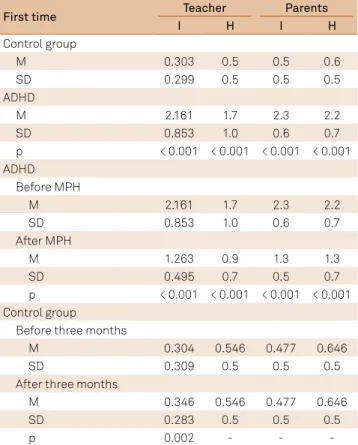
Table 4 shows the results of inattention and hyperactivity for the control group and ADHD children at the beginning of the
study; the ADHD group before and after three months of treat -ment; and the control group before and after three months.
DISCUSSION
he aim of this study was to compare the performances of ADHD in children (9–12-year-old boys) before and after treatment with methylphenidate with a control group, using tests of WM, IC and MF. he medication efect results showed a signiicant alteration in WM, IC and MF as well as an EF efect.
Although ADHD and EF disturbances are frequently related, the executive disorder is neither pathognomonic, nor necessary, for the ADHD diagnosis. Children without ADHD may also present with some executive disorder and many indi -viduals with ADHD do not show signiicant impairment in tests that analyze EF3,24. Brown24 highlights the importance of
changes in the EFs in the daily activities of people with ADHD. As the EFs are a group of cognitive functions that include inhibition, response selection and alteration, behavioural monitoring and WM, it is considered that children with ADHD exhibit a range of diiculties, which results in a worse perfor -mance compared to individuals without ADHD6,7,10,25,26,27,28,29,30.
Our results are consistent with many studies on neuro -psychological evaluation and ADHD, showing an improve -ment in WM, IC, and MF, as well as a relevant medication efect on EF performance at various levels11,13,15, 27,28.
Other studiesthat also analyzed attention and EF, and the efects of methylphenidate treatment in children with ADHD, did not ind similar results to ours, but most of them
Table 2. Performance on measures of working memory, inhibitory control and mental lexibility in both groups in the irst, and
second time of evaluation.
Measure
Control group ADHD
Before After three months
p Before After three months p
M (SD) M (SD) M (SD) M (SD)
Digit span backward 4.6 (0.8) 4.8 (0.8) 0.094 3.4 (1.1) 4.9 (1.2) < 0.001
Arithmetic 12.4 (2.2) 12.5 (2.1) 0.502 10.6 (2.8) 13.1 (2.9) < 0.001
Trail making test part B (time) 55.4 (26.5) 53.5 (28.0) 0.188 4.6 (4.7) 0.7 (0.8) < 0.001
Stroop color test – Word interference card (errors) 2.2 (2.2) 1.9 (2.1) 0.125 72.0 (31.6) 47.8 (15.1) < 0.001
ADHD: attention-deicit/hyperactivity disorder; M: mean; SD: standard deviation; p: t-student probability statistical signiicance was set at the p < 0.05 level.
Table 1. Performance on measures of working memory, inhibitory control and mental lexibility, in ADHD (n = 23) and matched
Control Group (n = 30) in the irst assessment.
Measure ADHD M (SD) Control Group M (SD) p
Digit span backward 3.4 (1.1) 4.6 (0.8) < 0.001
Arithmetic 10.6 (2.8) 12.4 (2.2) 0.011
Trail making test part B (time) 4.6 (4.7) 2.2 (2.2) 0.017
Stroop color test – Word interference card (errors) 72.0 (31.6) 55.4 (26.5) 0.033
did not have the same degree of selection of individuals, with -out comorbidities, same sex and narrow age range as spec -iied in our study27,28,31. We believe that the diferent results
found in these studies may be associated with the absence of the speciications and other factors that could be related.
In our study, the ADHD children showed changes in the EF than that observed in other studies with adults, which may be related to the fact that in children, the brain maturation is still developing and the diferences in control is greater at this time. hese impairments may interfere with academic progress and disrupt activities of daily living at home and in social settings25.
Normative data on typical children have shown adequate developmental progression, highlighting the diferences between the irst assessment and after methylphenidate in the children with ADHD. hese results suggest that these mea -sures provide an important tool to assess children at risk for ADHD showing deicits in attention areas and EF11,13,15,27,28,31.
We used the WISC III digit span backward and arithmetic tests to evaluate WM abilities19. It is important to emphasize
that these tasks also assess selective attention (the ability to focus the cognitive resources on information relevant to our goals), which is important to processes the diferent stages of WM. Our data indicated that ADHD treatment demon -strated a signiicant increase in WM and we believe that it was through an increase of selective attention27.
In the current literature, IC by commission errors can also be evaluated with the Stroop Color Test – Word Interference Card. he test is used as a measure of the inhibition capac -ity function. Indeed, it is often referred to as a measure of the speciic inhibition’s controlling behavior (e.g., prepotent response). he Stroop Color Test – Word Interference Card creates a conlict between the stimuli of color naming and color reading. Errors made during the performance on the Word Interference Card most likely represent a result of inhibiting the prepotent impulse14.
Although the Stroop Test commission errors were used for analysis of inhibition function (e.g., impulsivity), it is impor -tant to note that the test interferes with selective and sus -tained attention, WM and self-control7,14. he current study
showed that errors in the Stroop interference efect could be
explained mainly by impulsivity and that it represents a good marker for response to treatment
In this way, the improvement in IC in the ADHD group with methylphenidate can be correlated with the assessment of SNAP-IV, and this is consistent with the arguments that ADHD children have diiculty in inhibiting impulses.
On the point of MF, our indings appear consistent with the study by Hale et al.26, which found diferences in the Trail
Making Test – Part B errors, between ADHD children and a control group, corroborating that, generally, ADHD children needed more time to complete the test than the control group. his is an indication of slower set-shifting, which suggests that children with ADHD are less capable of divided attention26,32.
Our results showed noticable deicits in WM, IC and MF in children with ADHD. hese deicits may be associated with poor attention or hyperactivity and also with poor levels of EF. We emphasize that after methylphenidate treatment, ADHD children showed a great improvement in the EFs ana -lyzed, achieving results similar to those of the control group.
As limitations of our study, we considered the small num -ber of children included in the current trial and the fact that we did not investigate ADHD subtypes.
In conclusion, EF deficits are important components in the neuropsychology of ADHD, and the neuropsychological
Table 4. Results concerning the subscales (inattention;
hyperactivity) of the SNAP-IV for the control group and ADHD (attention-deicit/hyperactivity disorder) children.
First time Teacher Parents
I H I H
Control group
M 0.303 0.5 0.5 0.6
SD 0.299 0.5 0.5 0.5
ADHD
M 2.161 1.7 2.3 2.2
SD 0.853 1.0 0.6 0.7
p < 0.001 < 0.001 < 0.001 < 0.001
ADHD Before MPH
M 2.161 1.7 2.3 2.2
SD 0.853 1.0 0.6 0.7
After MPH
M 1.263 0.9 1.3 1.3
SD 0.495 0.7 0.5 0.7
p < 0.001 < 0.001 < 0.001 < 0.001 Control group
Before three months
M 0.304 0.546 0.477 0.646
SD 0.309 0.5 0.5 0.5
After three months
M 0.346 0.546 0.477 0.646
SD 0.283 0.5 0.5 0.5
p 0.002 - -
-ADHD: attention-deicit/hyperactivity disorder.; M: mean; SD: standard deviation; p: t-student probability statistical signiicance was set at the p < 0.05 level; MPH: methylphenidate; I: inattention; H: hyperactivity.
Table 3. Performance on measures of working memory,
inhibitory control and mental lexibility in ADHD group, before and after treatment.
Measure ADHD Before / After MPH ROC Cohen’s d
Digit span backward 0.870 1.455
Arithmetic 0.899 1.285
Trail making test part B (time) 0.882 0.832
Stroop color test – Word
interference card (errors) 0.843 0.960
assessments showed a high index of changes in EF in boys with ADHD. Moreover, there is a strong correlation between the outcome of methylphenidate treatment and clinical improvement.
An improvement of working memory, inhibition capacity and lexibility deicits in boys, 9–12 years of age, with ADHD combined type, was noted in all these domains after the administration of methylphenidate.
References
1. American Psychiatric Association. Diagnostic and statistical manual of mental disorders. 5th ed. Arlington: American Psychiatric Publishing; 2013.
2. Polanczyk G, Lima MS, Horta BL, Biederman J, Rohde LA. The worldwide prevalence of ADHD: a systematic review and metaregression analysis. Am J Psychiatry. 2007;164(6):942-8. https://doi.org/10.1176/ajp.2007.164.6.942
3. Mesulam M. Principles of behavioral neurology. Philadelphia: F. A. Davis; 1985.
4. Skogan AH, Zeiner P, Egeland J, Urnes AG, Reichborn-Kjennerud T, Aase H. Parent ratings of executive function in young preschool children with symptoms of attention-deicit/-hyperactivity disorder. Behav Brain Funct. 2015;11(1):16-28.
https://doi.org/10.1186/s12993-015-0060-1
5. Dovis S, Van der Oord S, Wiers RW, Prins PJ. What part of working memory is not working in ADHD? Short-term memory, the central executive and effects of reinforcement. J Abnorm Child Psychol. 2013;41(6):901-17. https://doi.org/10.1007/s10802-013-9729-9
6. Barkley RA. Behavioral inhibition, sustained attention, and executive functions: constructing a unifying of ADHD. Psychol Bull. 1997;121(1):65-94. https://doi.org/10.1037/0033-2909.121.1.65
7. Diamond A. Executive functions. Annu Rev Psychol. 2013;64(1):135-68. https://doi.org/10.1146/annurev-psych-113011-143750
8. Rhodes SM, Booth JN, Palmer LE, Blythe RA, Delibegovic M, Wheate NJ. Executive functions predict conceptual learning of science. Br J Dev Psychol. 2016;34(2):261-75. https://doi.org/10.1111/bjdp.12129
9. Bari A, Robbins TW. Inhibition and impulsivity: behavioral and neural basis of response control. Prog Neurobiol. 2013;108:44-79. https://doi.org/10.1016/j.pneurobio.2013.06.005
10. Davidson MC, Amso D, Anderson LC, Diamond A. Development of cognitive control and executive functions from 4 to 13 years: evidence from manipulations of memory, inhibition, and task switching. Neuropsychologia. 2006;44(11):2037-78. https://doi.org/10.1016/j.neuropsychologia.2006.02.006
11. Tucha O, Prell S, Mecklinger L, Bormann-Kischkel C,
Kübber S, Linder M et al. Effects of methylphenidate on multiple components of attention in children with attention deficit hyperactivity disorder. Psychopharmacology. 2006;185(3):315-26. https://doi.org/10.1007/s00213-006-0318-2
12. Fan LY, Gau SF, Chou TL. Neural correlates of inhibitory control and visual processing in youths with attention deicit hyperactivity disorder: a counting Stroop functional MRI study. Psychol Med. 2014;44:2661-71.
13. Yang L, Cao Q, Shuai L, Li H, Chan RC, Wang Y. Comparative study of OROS-MPH and atomoxetine on executive function improvement in ADHD: a randomized controlled trial. Int J Neuropsychopharmacol. 2012;15(1):15-26. https://doi.org/10.1017/S1461145711001490
14. Sørensen L, Plessen KJ, Adolfsdottir S, Lundervold AJ. The specificity of the Stroop interference score of errors to ADHD in boys. Child Neuropsychol. 2014;20(6):677-91. https://doi.org/10.1080/09297049.2013.855716
15. Pietrzak RH, Mollica CM, Maruff P, Snyder PJ. Cognitive effects of immediate-release methylphenidate in children with attention-deicit/hyperactivity disorder. Neurosci Biobehav Rev. 2006;30(8):1225-45. https://doi.org/10.1016/j.neubiorev.2006.10.002
16. Coghill DR, Rhodes SM, Matthews K. The neuropsychological effects of chronic methylphenidate on drug-naive boys with attention-deicit/hyperactivity disorder. Biol Psychiatry.
2007;62(9):954-62. https://doi.org/10.1016/j.biopsych.2006.12.030
17. American Psychiatric Association. Diagnostic and statistical manual of mental disorders. 4th ed. Washington, DC: American Psychiatric Association; 1994.
18. Mattos P, Serra-Pinheiro MA, Rohde LA, Pinto D Apresentação de uma versão em português para uso no Brasil do instrumento MTA-SNAP-IV de avaliação de sintomas de transtorno do déicit de atenção/hiperatividade e sintomas de transtorno desaiador e de oposição Rev Psiquiatr Rio Gd Sul. 2006;28(3):1-19. https://doi.org/10.1590/S0101-81082006000300008
19. Wechsler D. WISC III: escala de inteligência Wechsler para crianças: manual/David Wechsler 3a ed: adaptação e padronização de uma amostra Brasileira. São Paulo: Casa do Psicólogo; 2002.
20. Reitan RM. Trail making test manual for administration and scoring. Arizona: Reitan Neuropsychology Laboratory; 1992.
21. Duncan MT. Obtenção de dados normativos para desempenho no teste de Stroop num grupo de estudantes do ensino fundamental em Niterói. São Paulo: Hospital das Clínicas da Faculdade de Medicina da Universidade de São Paulo; 2003.
22. Pagano M, Gauvreau K. Princípios de bioestatística. São Paulo: Pioneira Thompson Learning; 2004.
23. Lindenau JD, Guimarães LSP. Calculating the effect size in SPSS. Rev HCPA. 2012;32(3):363-81. Portuguese.
24. Brown TE. Executive functions and attention deicit hyperactivity disorder: implications of two conlicting views. Int J Disabil Dev Educ. 2006;53(1):35-46. https://doi.org/10.1080/1034912050051002
25. Shaw P, Eckstrand K, Sharp W, Blumenthal J, Lerch JP, Greenstein D et al. Attention-deicit/hyperactivity disorder is characterized by a delay in cortical maturation. Proc Natl Acad Sci USA. 2007;104(49):19649-54. https://doi.org/10.1073/pnas.0707741104
26. Hale JB, Reddy LA, Decker SL, Thompson R, Henzel J, Teodori A et al. Development and validation of an attention-deicit/hyperactivity disorder (ADHD) executive function and behavior rating screening battery. J Clin Exp Neuropsychol. 2009;31(8):897-912. https://doi.org/10.1080/13803390802687423
27. Dopheide JA. The role of pharmacotherapy and managed care pharmacy interventions in the treatment of ADHD. Am J Manag Care. 2009;15(Suppl 5):S141-50.
28. Coghill D. Use of stimulants for attention deicit hyperactivity disorder: FOR. BMJ. 2004;329(7471):907-8. https://doi.org/10.1136/bmj.329.7471.907
29. Gazzaley A, Nobre AC. Top-down modulation: bridging selective attention and working memory. Trends Cogn Sci. 2012;16(2):129-35. https://doi.org/10.1016/j.tics.2011.11.014
30. Bolfer C, Casella EB, Baldo MV, Mota AM, Tsunemi MH, Pacheco SP. Reaction time assessment in children with ADHD. Arq Neuropsiquiatr. 2010;(2):282-6. https://doi.org/10.1590/S0004-282X2010000200025
31. Cao AH, Yu L, Wang YW, Wang JM, Yang LJ, Lei GF. Effects of methylphenidate on attentional set-shifting in a genetic model of attention-deicit/hyperactivity disorder. Behavioral and Brain Functions. 2012;8(1):10-21. https://doi.org/10.1186/1744-9081-8-10