http://dx.doi.org/10.1590/1980-57642018dn12-030013
Correlation between cognitive functions
and central auditory processing in
adolescents with non-cholesteatomatous
chronic otitis media
Márcia Salgado Machado1, Adriane Ribeiro Teixeira2, Sady Selaimen da Costa3
ABSTRACT. Auditory deprivation associated with early otitis media with effusion has been considered a risk factor for central auditory processing (CAP), as well as for the development of a number of cognitive functions. Objective: To study the neuropsychological functions of attention, working memory and executive function in adolescents with and without non-cholesteatomatous chronic otitis media (NCCOM) and analyze their interrelationships with the behavioral evaluation of CAP. Methods: Sixty-eight adolescents were recruited, 34 were diagnosed with NCCOM (study group – SG), and 34 had no otological history (control group – CG). The Neupsilin Brief Neuropsychological Assessment Instrument was used. CAP was assessed by: Masking Level Difference, Synthetic Sentence Identification, Random Gap Detection Test, Duration Pattern Sequence Test and Dichotic Digits Test. Results: The results of Neupsilin showed lower scores in the study group when compared to the control group on the following tests: digit sequence repetition, ascending digit ordering, auditory sentence span, and phonemic verbal fluency. An association was found between central auditory processing tests and Neupsilin subtests. Conclusion: The effects of NCCOM on attention, memory and executive function related to central auditory processing disorder in adolescents seem to be enhanced by the severity of the disease.
Key word: auditory perception, adolescent, attention, memory, executive function.
CORRELAÇÃO ENTRE FUNÇÕES COGNITIVAS E PROCESSAMENTO AUDITIVO CENTRAL EM ADOLESCENTES COM OTITE MÉDIA CRÔNICA NÃO COLESTEATOMATOSA
RESUMO. A privação auditiva associada à otite média precoce com efusão tem sido considerada um fator de risco para o processamento auditivo central (CAP), bem como para o desenvolvimento de diversas funções cognitivas. Objetivo: Estudar as funções neuropsicológicas da atenção, memória de trabalho e função executiva em adolescentes com e sem otite média crônica não-colesteatomatosa (NCCOM) e analisar suas inter-relações com a avaliação comportamental da PAC. Métodos: Sessenta e oito adolescentes foram recrutados, 34 foram diagnosticados com NCCOM (grupo de estudo – GE) e 34 não tinham história otológica (grupo controle – GC). Utilizou-se o Instrumento de Avaliação Neuropsicológica Breve de Neupsilin. O CAP foi avaliado por: Diferença de Nível de Mascaramento, Identificação de Frase Sintética, Teste de Detecção de Intervalo Aleatório, Teste de Sequência de Padrão de Duração e Teste de Dígitos Dicóticos. Resultados: Os resultados de Neupsilin mostraram menores escores no grupo de estudo quando comparados ao grupo controle nos seguintes testes: repetição de sequência de dígitos, ordenação de dígitos ascendentes, extensão de sentenças auditivas e fluência verbal fonêmica. Foi encontrada uma associação entre os testes do processamento auditivo central e os subtestes de Neupsilin. Conclusão: Os efeitos do NCCOM na atenção, memória e função executiva relacionados ao transtorno do processamento auditivo central em adolescentes parecem ser potencializados pela gravidade da doença. Palavras-chave: percepção auditiva, adolescente, atenção, memória, função executiva.
This study was conducted at the Department of Speech Pathology, Federal University of Health Sciences of Porto Alegre, Porto Alegre, RS, Brazil.
1Speech Therapist, Ph.D. Adjunct Professor, Department of Speech Pathology, Federal University of Health Sciences of Porto Alegre, Porto Alegre, RS, Brazil. 2Speech
Therapist, Ph.D., Associate Professor, Department of Health and Human Communication, Federal University of Rio Grande do Sul, Porto Alegre, RS, Brazil.. 3
Otorhi-nolaryngologist, Ph.D., Associate Professor, Department of Ophthalmology and Otorhinolaryngology, Federal University of Rio Grande do Sul, Porto Alegre, RS, Brazil.
Marcia Salgado Machado. Rua Sarmento Leite, 245 / Department of Speech Pathology – 90050-170 Porto Alegre RS – Brazil. E-mail: [email protected]
Disclosure: The authors report no conflicts of interest.
C
entral auditory processing consists of a summa-tion of specific skills necessary for the individual to understand what they hear.1 However, central auditoryprocessing is also shared with other cognitive functions,2
such as attention, memory, language, executive func-tions, among others.3 These functions share actions with
specific auditory structures of the auditory central ner-vous system during the processing of auditory informa-tion.4 Therefore, it is necessary to study and include
neu-roscience on the understanding of the interfaces between central auditory processing and cognitive functions.5
The literature indicates evidence of attention func-tion impairment in individuals with a history of otitis media,6,7 as well as likely associations between
work-ing memory and hearwork-ing in a noisy environment.8-10 In
addition, a study11 observed that the executive function
shares cognitive mechanisms underlying auditory skills. Thus, there is great interest in the interrelationships between auditory and cognitive abilities.12 In this regard,
auditory deprivation associated with early otitis media with effusion has been considered a risk factor not only for central auditory processing but also for the develop-ment of some cognitive functions.13 A number of studies
have investigated the effects of early otitis media with effusion on cognitive development,6,7,14-17 but no studies
on subjects with chronic otitis media were found. The aim of this study was to investigate the neuro-psychological functions of attention, working memory and executive function in adolescents with and without NCCOM and to analyze their interrelationships with the behavioral evaluation of central auditory processing and with the variables: gender, age, education repetition, age of onset of otitis media, unilaterality or bilaterality of auditory alteration, maternal education and family income.
METHODS
This study consisted of a controlled cross-sectional, observational study for which 68 adolescents aged 12 – 18 years18 were recruited, 34 of whom had
non-choles-teatomatous chronic otitis media (study group – SG), while 34 had no otological history (control group – CG). For the control group, the following inclusion criteria were applied: adolescents from public schools, with no history of otitis media, with normal audiological assess-ment and typical overall developassess-ment. The study group consisted of adolescents from public schools with a diag-nosis of unilateral or bilateral NCCOM and average of auditory thresholds (obtained from tonal audiometry) at the frequencies of 500, 1000, 2000 and 4000 Hz ≤ 40 dB HL in the affected ear(s).
For both groups, the following exclusion criteria were considered: presence of mental, neurological dis-orders or genetic syndromes, being left-handed, hav-ing a history of formal music education and presenthav-ing with other risk factors for hearing loss. The informa-tion about these criteria was collected by analyzing the clinical records of each patient (study group) or through anamnesis with their parents (control group).
The subjects who agreed to participate in the study underwent the following procedures: anamnesis; audio-logical assessment (pure tone audiometry and speech audiometry); central auditory processing behavioral evaluation battery; and neuropsychological assessment of attention, working memory and executive functions (verbal fluency). All proposed assessments were formed by duly trained researchers experienced in per-forming the tests described.
The test battery assessing auditory processing was composed of the following tests: MLD (Masking Level Difference), SSI (Synthetic Sentence Identification), RGDT (Random Gap Detection Test), DPS (Duration Pattern Sequence test) and DDT (Dichotic Digits Test), according to the recommendations of the Academia Brasileira de Audiologia19 related to the minimum
proto-col for CAP behavioral evaluation. MLD was performed at 70dB intensity in the ear (s) with normal auditory thresholds (mean square ≤25dB) or 50dBLS (decibel level of sensation) in the ear (s) with altered auditory thresholds (mean square >25dB). The SSI was applied at a 40dBLS intensity in the main message, and the intensity of the ipsilateral competitive message was performed under two signal-to-noise ratio conditions (0 and –15dB). RGDT, DPS and DDT were performed at an intensity level of 50dBLS in each ear. The intensity of application of the tests (dBLS) was calculated from the mean airway auditory thresholds of 500, 1000 and 2000 Hz frequencies of each ear.
of 500 to 4000 Hz.20 In order to evaluate the
neuropsy-chological aspects selected for this study, the Neupsilin Brief Neuropsychological Assessment Instrument21,22
was applied according to the instructions described in the instrument manual. However, only the follow-ing subtests were conducted: attention (reverse count-ing and digit sequence repetition), workcount-ing memory (ascending digit ordering and auditory sentence span), and executive function (verbal fluency test).
On the reverse counting test, the maximum score was 20 points, each point representing a correct answer. On the digit sequence repetition test, the maximum score was seven points. Thus, the total score for the attention tests was 27 points.
On the ascending digit ordering task, the maximum score was ten points, while, for auditory sentence span, the maximum score was 28 points.
On the phonemic verbal fluency test, the score was established by the number of items uttered during the time stipulated for the test.
It is important to clarify that the criteria of normal-ity set forth in the test manual had to be adapted to the study sample, since the mean and standard deviation values available in the manual are presented according to grades (7th and 8th grades in elementary school and
1st, 2nd and 3rd grades in high school). However, some
subjects in this study, although having the minimum age for administration of the test (12 years), were not yet in the 7th grade (due to school repetition). As a result the
parameter indicated for the 7th grade was used, because,
due to the chronological aspect, it should be the current grade for these subjects. Furthermore, by virtue of the
change in the number of grades in elementary schools in the country (which rose from eight to nine years), subjects who attended the 9th grade were included in the
parameters of normality for the 8th grade, since the test
manual does not provide parameters for this grade. The sample size was calculated using the WINPEPI software, version 11.43. For a significance level of 5%, 90% power, and a minimum effect size of 0.8 standard deviations between groups, a minimum total of 33 indi-viduals were obtained per group, totaling 66 indiindi-viduals.
The statistical analysis of data was performed as fol-lows: the qualitative variables were expressed as abso-lute and relative frequencies, Pearson’s Chi-square test or Fisher’s exact test were used for the comparison of proportions, and the Pearson (symmetrical distribu-tion) or Spearman (asymmetric distribudistribu-tion) correla-tion coefficients were applied to evaluate the associacorrela-tion between test results. The level of significance was set at 5% (p≤0.05), and analyses were carried out using the SPSS software version 21.0.
This study was approved by the Research Ethics Committee of the Institution of the study, with approval protocol 41689215.7.0000.5327.
RESULTS
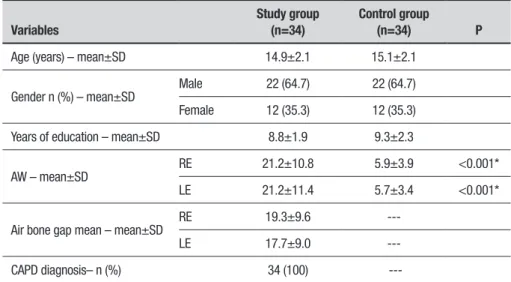
The characteristics of the sample studied can be seen in Table 1.
Table 2 shows the results for the Neupsilin subtests conducted in the control and study groups.
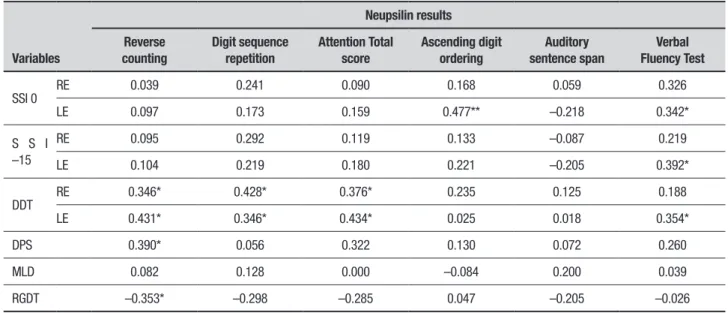
Table 3 shows the association between central audi-tory processing tests and neuropsychological tests using the Spearman correlation coefficient.
Table 1. Sample characteristics.
Variables
Study group (n=34)
Control group
(n=34) P
Age (years) – mean±SD 14.9±2.1 15.1±2.1
Gender n (%) – mean±SD
Male 22 (64.7) 22 (64.7)
Female 12 (35.3) 12 (35.3)
Years of education – mean±SD 8.8±1.9 9.3±2.3
AW – mean±SD
RE 21.2±10.8 5.9±3.9 <0.001*
LE 21.2±11.4 5.7±3.4 <0.001*
Air bone gap mean – mean±SD
RE 19.3±9.6
---LE 17.7±9.0
---CAPD diagnosis– n (%) 34 (100)
Table 2. Neuropsychological test results.
Variables
Study group (n=34)
Control group
(n=34) P
Attention – Reverse counting
Normal 29 (85.3) 34 (100)
0.053
Abnormal 5 (14.7) 0 (0.0)
Attention – Digit sequence repetition
Normal 27 (79.4) 34 (100)
0.011*
Abnormal 7 (20.6) 0 (0.0)
Attention – Total score
Normal 30 (88.2) 34 (100)
0.114
Abnormal 4 (11.8) 0 (0.0)
Working memory – Ascending digit ordering
Normal 28 (82.4) 34 (100)
0.025*
Abnormal 6 (17.6) 0 (0.0)
Working memory – Auditory sentence span
Normal 25 (73.5) 34 (100)
0.002*
Abnormal 9 (26.5) 0 (0.0)
Executive function – Verbal Fluency Test
Normal 23 (67.6) 34 (100)
0.001*
Abnormal 11 (32.4) 0 (0.0)
n: number; *p≤0.05 (level of statistical significance).
Table 3. Association between CAP tests and neuropsychological tests using the Spearman correlation coefficient.
Variables
Neupsilin results
Reverse counting
Digit sequence repetition
Attention Total score
Ascending digit ordering
Auditory sentence span
Verbal Fluency Test
SSI 0
RE 0.039 0.241 0.090 0.168 0.059 0.326
LE 0.097 0.173 0.159 0.477** –0.218 0.342*
S S I –15
RE 0.095 0.292 0.119 0.133 –0.087 0.219
LE 0.104 0.219 0.180 0.221 –0.205 0.392*
DDT
RE 0.346* 0.428* 0.376* 0.235 0.125 0.188
LE 0.431* 0.346* 0.434* 0.025 0.018 0.354*
DPS 0.390* 0.056 0.322 0.130 0.072 0.260
MLD 0.082 0.128 0.000 –0.084 0.200 0.039
RGDT –0.353* –0.298 –0.285 0.047 –0.205 –0.026
*p<0.05; **p<0.01; RE: right ear; LE: left ear; SSI: Synthetic Sentence Identification; DDT: Dichotic Digits Test; DPS: Duration Pattern Sequence; MLD: Masking Level Difference; RGDT: Random Gap Detection Test. *p≤0.05 (level of statistical significance).
No association was found between the results for the Neupsilin subtests when compared for gender (p>0.20), age (p> 0.05), school repetition (p>0.2), age at otitis media onset (p>0.3), maternal education (p>0.4) and family income (p>0.05). All SG individuals had altera-tions in at least two physiological mechanisms of CAP, demonstrating 100% of central auditory processing
note-worthy that the scores were numerically worse in the UG on the SSI, MLD and DPS tests. It is important to note that the BG group had better results on the RGDT test, since lower absolute value represents a better result on this test.
DISCUSSION
This study showed alterations and correlations of some neuropsychological functions with the CAP of the adolescents evaluated. In addition, a change in the CAP of adolescents with NCCOM was observed, with a more significant impact on subjects who had a unilateral conductive component.
The Neupsilin results showed lower scores in the study group when compared to the control group on the following tests: digit sequence repetition (attention), ascending digit ordering (working memory), auditory sentence span (working memory), and phonemic verbal fluency (executive function). An association was found between the DD, DPS and RGDT tests and the reverse counting test (attention), and there was also an asso-ciation between the DDT and the digit sequence rep-etition (attention) subtest and the overall score for the attention function and phonemic verbal fluency (execu-tive function). In addition, the SSI was associated with working memory (ascending digit ordering subtest) and executive function (phonemic verbal fluency).
Regarding the changes on the attention test (digit sequence repetition), a likely relationship between attention and CAP is believed to exist, and has previ-ously been documented in some studies conducted in
individuals with a history of otitis media.6,7,23 The study
by Haapala et al.,23 who investigated the consequences
of recurrent acute otitis media on the involuntary audi-tory attention of two-year-old infants through late-latency evoked potentials is noteworthy In the study, the authors detected an immature control of attentional shift in children with recurrent acute otitis media and associ-ated it with the typical distraction behavior of these chil-dren. Additionally, they also identified increased MMN (mismatch negativity) latency, which suggests a delay in attentional reorienting for resumption of an ongoing activity in the sample studied. Therefore, when exposed to disturbing sounds, the subjects with a history posi-tive for otitis media showed atypical neural organization in the neural mechanisms of involuntary attention.23
It should be noted that, in this study, two subtests were used to assess the attention function. However, only one of them (digit sequence repetition) showed a significant difference between the study and control groups. This is believed to have occurred due to the ease of the reverse counting test, while the digit sequence repetition test is more complex and, consequently, poses a higher degree of attentional requirement.
Concerning the differences observed between the groups on the working memory assessment subtests, it should be noted that, when there is a deficit in auditory input processing, so much effort is spent on understand-ing the auditory information that little energy is left for it to be remembered.24 Thus, in cases of slow auditory
input processing, the information presented at the beginning of the communication cannot be kept in the working memory at the point when the last part of the message is processed and, as a result, the whole message may be “forgotten” or not fully understood.22
Addition-ally, this interrelationship has already been described in the literature8-10,25 as these are tasks performed by
neighboring brain regions.8 An example of this is the
hippocampus in its lower medial portion of the anterior temporal lobe. On the other hand, a study26 found no
relationship between speech perception in the presence of noise and working memory in schoolchildren when investigating the biological and cognitive processes involved in speech perception in a noisy environment during early childhood. However, the author stressed the complexity of speech perception in the presence of noise, which consists of a complex task requiring the simultaneous integration of sensory processing, atten-tion, memory, and linguistic knowledge.26
With respect to the difference observed between groups on the subtest assessing phonemic verbal flu-ency, this is an expected result, since verbal fluency is Table 4. Central auditory processing tests in SG subjects with unilateral
and bilateral conductive loss.
Variables UG (n=17) BG (n=16) P
SSI 0 – mean±SD
RE 52.9±9.9 55.0±19.7 0.710
LE 52.9±10.5 55.6±18.6 0.610
SSI 15 – mean±SD
RE 25.9±13.7 33.1±17.8 0.198
LE 27.0±10.5 37.5±18.1 0.055
DDT – mean±SD
RE 94.7±5.5 97.8±2.7 0.049*
LE 96.6±3.5 98.9±1.8 0.027*
DPS – mean±SD 43.9±23.3 46.0±21.5 0.784
MLD – mean±SD 8.9±4.1 9.3±3.0 0.807
RGDT – mean±SD 12.9±6.5 15.3±6.4 0.287
essential for individuals to be able to present complex and interconnected behaviors, both in social/commu-nicative interaction contexts and in complex cognitive situations that require greater mental control and rea-soning1 as in CAP. Additionally, in the study by Prando
et al.,11 the executive function was found to be one of
the tasks that was least dissociated from CAP tasks, showing that this function shares cognitive mechanisms underlying the auditory abilities and therefore supports the findings in this study.
Regarding the associations identified between the Neupsilin subtests and the CAP behavioral evaluation tests, a previous study11 can help elucidate the results
observed in the present study. The authors demon-strated strong correlations between the performance of adolescents on tests assessing CAP and tasks assessing neuropsychological skills such as attention and working memory, explained by the sharing of underlying cogni-tive abilities between them.
In this regard, from a cognitive neuroscience per-spective, there are few (if any) fully compartmental-ized areas in the brain that are responsible for only one sensory modality,11 since brain organization is not
modular.27 According to the American
Speech-Language-Hearing Association,28 there are indications that the
pro-cessing of sensory information is interdependent and integrated into cognitive domains that include attention and memory. Hence, the correlations observed in this study between the CAP tests and Neupsilin tasks can be understood.
Prando et al.11 observed a correlation between
the SSI and an attention task, which was justified by the authors as a result of the high attention demand required to perform the task. However, this correlation was not observed in the present study, but instead a relationship of the SSI with the working memory and verbal fluency tasks was demonstrated. These results are similar to other studies, which observed correlations between speech perception in a noisy environment and working memory.8-10,25
The other associations observed in this study were not found in the literature. However, it is believed that these occurred due to the overlapping of brain areas involved in performing general auditory and cognitive tasks,29 which maintained a relationship of
interde-pendence between these processes.24 Likewise, Prando
et al.,11 stressed that there is no causal relationship
between neuropsychological function deficits and audi-tory perception deficits; therefore, the CAP evaluation should be performed and analyzed so as to complement the neuropsychological assessment.
The results presented in this study confirm the find-ings in the literature related to the correlations observed between CAP skills and attention and memory func-tions.11,24 However, studies involving these correlations
are still scarce,11 which prevents this issue from being
fully elucidated.
As regards NCCOM, specifically, it is important to note that the extent of the auditory deprivation effect required to cause a cognitive alteration in humans is unknown,30 since this is a dynamic disease31 that should
be regarded as an event that is part of a continuous dis-ease process.32 Regarding the effects of unilateral
con-ductive hearing loss, Polley et al (2013)33 emphasized
that attenuation and delay in sound conduction would cause distortions of acoustic cues used for sound local-ization and other aspects of binaural hearing. Williams and Jacobs (2009)34 also pointed out that the unilateral
conductive hearing loss present in otitis media can cause asymmetry in the auditory levels of the ears, which jus-tifies the results observed in this study in relation to the adolescents with unilateral and bilateral conductive alterations associated with the NCCOM.
In addition, the auditory deprivation arising from NCCOM does not occur only in the developmental period of the central auditory nervous system, but accompanies the individual in a fluctuating or perma-nent manner over long periods.
Therefore, the role of otitis media in the develop-ment of neuropsychological aspects still divides profes-sionals with different views.13,34 However, it is accepted
in the literature that an early history of chronic otitis media with effusion is associated with a higher incidence of learning difficulties, language deficits and attention disorders.24 The hypothesis is that this occurs because
the reception and analysis of sound characteristics (such as frequency, intensity, and duration) serve as a basis for constructing language, especially with regard to the development of the memory of sound patterns in language.35
However, it is important to stress that no simi-lar studies on subjects with chronic otitis media were found, where related studies tend to focus on early otitis media with effusion. Therefore, it can be assumed that, in NCCOM, the effects on CAP and cognition are prob-ably enhanced by the severity of the disease.
instru-ment to allow the analysis of other hypotheses involving other cognitive functions.
Given that the data obtained reinforces the hypoth-esis that the central auditory function involves far more than a central nervous system roadmap to the auditory portion,11 this study raises questions about changes in
neuropsychological functions in subjects with NCCOM and CAPD, which should be addressed and investigated in further studies.
This study found that the neuropsychological tions of attention, working memory and executive func-tion (phonemic verbal fluency) showed alterafunc-tions in
adolescents with NCCOM when compared with the con-trol group. In addition, associations were found between the results for the subtests assessing neuropsychological functions and the tests used for the behavioral evalua-tion of central auditory processing in adolescents with NCCOM. Thus, the effects of NCCOM on the tested attention, memory and executive functions relating to the central auditory processing disorder in adolescents seem to be enhanced by the severity of the disease.
Author contributions. All authors contributed
signifi-cantly to, and approved, the content of this manuscript.
REFERENCES
1. Ramos BD, Costa-Ferreira MID, Guedes MC, Alvarez AM. Processa-mento auditivo e transtornos de aprendizagem. In: Junior DC, Burns DAR, Lopez FA. Tratado de pediatria: Sociedade Brasileira de Pediatria. Barueri, SP: Manole; 2014:2341-50.
2. American Academy of Audiology. Clinical Practice Guidelines: Diagnosis, treatment and management of children and adults with central auditory processing disorder. 2010. Recuperado de www.audiology.org 3. Zimmermann N, Cardoso CO, Moraes AL, Liberatone M, Fonseca
RP. Funções executivas e linguagem na infância: conceitos e relações entre componentes cognitivos para a interpretação neuropsicológica e neuropsicológica. In: Fonseca RP, Prando ML, Zimmermann N. (Eds.). Tarefas para avaliação neuropsicológica. Volume 1. Avaliação de linguagem e funções executivas em crianças. São Paulo, SP: Memnom; 2016:15-25.
4. Sanchez ML, Alvarez AMMA. Processamento auditivo central: avaliação. In: Costa, SS, Cruz OLM, Oliveira JAA. (Eds.). Otorrinolaringologia: prin-cípios e prática. Porto Alegre, RS: Artmed; 2006:191-202.
5. Jorge V. Neuropsicologia: área de atuação na avaliação e intervenção fonoaudiológica. Revista Conselho Regional de Fonoaudiologia Nossa Voz. 2016;13:13-4.
6. Klausen O, Moller P, Holmefjord A, Reisaeter S, Asbjornsen A. Lasting effects of otitis media with effusion on language skills and listening performance. Acta Otolaryngol. 2000;543:73-6.
7. Asbjornsen A, Holmefjord A, Reisaeter S, Moller P, Klausen O, Prytz B, Boliek C, & Obrzut JE. Lasting auditory attention impairment after persis-tente middle ear infections: a dichotic listening study. Developmental Medicine & Child Neurology, 2000;42:481-6.
8. Katz J, Tillery KL. An introduction to auditory processing. In: Lichtig I, & Carvallo RMM. (Eds), Audição: abordagens atuais).Carapicuiba, SP: Pró-Fono; 1997:119-43.
9. Brannstrom KJ, Zunic E, Borovac A, Ibertsson T. Acceptance of back-ground noise, working memory capacity, and auditory evoked potentials in subjects with normal hearing. J Am Acad Audiol. 2012;23:542-52. 10. Yathiraj A, Maggu AR. Screening test f auditory processing (STAP): a
preliminar report. J Am Acad Audiol 2013;24:867-78.
11. Prando ML, Pawlowski J Fachel JMG, Misorelli MIL, & Fonseca RP. Relação entre habilidades de processamento auditivo e funções neurop-sicológicas em adolescentes. Rev CEFAC. 2010;12:646-61.
12. Pereira LD. Introdução ao processamento auditivo central. In: Bevilacqua, M.C. (Ed.). Tratado de audiologia. São Paulo, SP: Santos; 2013: 279-91. 13. Northern JL, Downs, MP. Audição na infância. Rio de Janeiro, RJ:
Guanabara Koogan; 2005.
14. Zinkus PW, Gottlieb MI, Schapiro, M. Developmental and psychoeduca-tional sequelae of chronic otitis media. Am J Dis Child.1978;132: 1100-4. 15. Sak RJ, Ruben RJ. Recurrent middle ear effusion in childhood: Implica-tions of temporary auditory deprivation for language and learning. Annals of Otology, Rhinology, and Larynogology. 1981;90:546-51.
16. Johnson DL, Swank PR, Owen MJ, Baldwin CD, Howie VM, McCormick DP. Effects of early middle ear effusion on child intelligence at three, five, and seven years of age. Journal of Pediatric Psychology. 2000;25:5-13. 17. Niclasen J, Obel C, Homoe P, Korvel-Hanquist A, Dammeyer J. Associa-tions between otitis media and child behavioural and learning difficulties: results from a Danish cohort. International Journal of Pediatric Otorhino-laryngology. 2016;84:12-20.
18. Brasil. Lei 8.069, de 13 de Julho de 1990. Recuperado de: http://www2. camara.leg.br/legin/fed/lei/1990/lei-8069-13-julho-1990-372211-publi-cacaooriginal-1-pl.html
19. Academia Brasileira de Audiologia. Fórum de diagnóstico audiológico do 31º Encontro Internacional de Audiologia. 2016. Recuperado de: http:// www.audiologiabrasil.org.br/31eia/pdf/forum_f.pdf
20. Schlauch RS, Nelson P. Pure tone evaluation. In: Katz J, Chasin M, English, K Hood LJ, Tillery KL. Handbook of Clinical Audiology. Phila-delphia: Wolters Kluwer Health, 2015: 29-49.
21. Fonseca RP, Salles JF, Parente MAMP. Development and contente validity of the Brazilian Brief Neuropsychological Assessment Battery Neupsilin. Psychol Neurosci. 2008;1:55-62.
22. Pawlowski J, Fonseca RP, Salles JF, Parente MAMP, Bandeira DR. Evidências de validade do instrumento de avaliação neuropsicológica breve Neupsilin. Arq Bras Psicol. 2008;60:101-16.
23. Haapala S, Niemitalo-Haapola E, Raappana A, Kujala T, Suominen K, Jansson-Verkasalo E, Kujala T. Long-term influence of recurrent acute otitis media on neural involuntary attention switching in 2-year-old chil-dren. Behav Brain Funct. 2016;12:1.
24. Bellis TJ. Assessment and management of central auditory processing disorders in the educational setting from Science to practice. Clifton Park, NY: Thomson/Delmar Learning; 2003.
25. Mody M, Schwartz RG, Gravel JS, Ruben RJ. Speech perception and verbal memory in children with and without histories of otitis media. J Speech Lang Hearing Res. 1999;42:1069-79.
26. Thompson EC, Carr KW, White-Schwoch T, Otto-Meyer S, Kraus N. Individual diferences in speech-in-noise perception parallel neural speech processing and attention in preschoolers. Hearing Res. 2017;344: 148-57. 27. Jerger J, Musiek F. Report of the consensus conference on the diag-nosis of auditory processing disorders in school-age children. J Am Acad Audiol. 2000;11:467-74.
28. American Speech-Language-Hearing. (Central) auditory processing disorders [Technical Report]. 2005. Recuperado de www.asha.org/policy 29. Musiek FE, Bellis TJ, Chermak GD. Nonmodularity of the central auditory nervous system: implications for (central) auditory processing disorder. Am J Audiol. 2005;14:128-38.
30. Ruben RJ. An inquiry into the minimal amount of auditory depriva-tion which results in a cognitive effect in man. Acta Otolaryngol. 1984; 14(Suppl):157-64.
31. Ramos BD, Pereira MBR, Costa SS. Otite média aguda e otite média aguda recorrente. In: Costa SS, Cruz OLM, Oliveira JAA. (Eds.). Otorrinolaringologia: princípios e prática. Porto Alegre, RS: Artmed; 2006:274-82.
32. Pereira MBR, Ramos BD, Costa SS. Otite média com efusão. In: Costa, SS, Cruz, OLM, & Oliveira, JAA (Eds.). Otorrinolaringologia: princípios e prática. Porto Alegre, RS: Artmed; 2006:283-8.
33. Polley DB, Thompson JH, Guo W. Brief hearing loss disrupt binaural integration during two early critical periods of auditory córtex develop-ment. Nat Commun. 2013;4:2547.
34. Williams CJ, Jacobs AM. The impact of otitis media on cognitive and educational outcomes. Med J Aust. 2009;191:s69-s72.