R E S E A R C H
Open Access
Contextual factors related to chronic
condition in portuguese adolescents:
highlights from the HBSC/WHO study
Teresa Santos
1,3*, Margarida Gaspar de Matos
1,2,3, Maria Celeste Simões
1,2and Maria do Céu Machado
4Abstract
Adolescence’s changes may become more pronounced when living with a chronic condition (CC). This study aims
to examined the differences in satisfaction with family life, perception of school competence and“pressure with homework”of Portuguese adolescents’1) living with CC; 2) how living with CC affects school participation; taking into account age, gender and family socioeconomic status (SES).
Five thousand fifty Portuguese adolescents (mean age 14 ± 1.85) of the Health Behaviour in School-aged Children (HBSC/WHO) were included. Results showed increased vulnerability in adolescents living with CC, presenting a lower satisfaction with family life and poor school outcomes. Younger boys, having a higher SES and not having CC are significantly associated with satisfaction with family life. Older girls, having a lower SES and living with CC were associated with more stress related to school work.
Future interventions should include these features combined with‘listening’to adolescents and their needs, allowing their participation in the promotion of personal health.
Keywords:Adolescents, Chronic condition, Satisfaction with family life, School perception, Socioeconomic status
Background
Research that compares adolescents with and without a chronic condition (CC), or different diseases, has been contradictory (Combs-Orme et al. 2002). Some studies suggest an increased risk in chronic population (Barlow and Ellard 2006), while others suggest the possibility of a successful adaptation (Barros et al. 2008). Responses are not homogeneous and depend on various specific individ-ual and contextindivid-ual factors, on the type of disease/condi-tion and on emerging limitadisease/condi-tions (Lee et al. 2013). In spite of medical advances, children and adolescents living with a CC still face numerous challenges and can be at higher risk for a healthy psychological development (Verhoof et al. 2012), psychological well-being (Santos et al. 2015) and more adjustment problems (Oeseburg et al. 2010a).
The effects of a CC extend to the entire family system (Quittner et al. 2011), which can be a major adaptation fa-cilitator or, on the contrary, a barrier to adjustment (Braconnier and Marcelli 2000). Parents and parental styles are important in the adaptation process to diseases (Santos et al. 2013a). However, in those situations, parents seem to be more restrictive, overprotective and authoritar-ian; still, most families have a good overall functioning and adaptation (Pinquart 2013). Good communication (Hartos and Power 1997), a secure attachment relationship, a democratic parenting style and a good social support net-work are suggested as important protective familiar fac-tors, both in children and adolescents (Moreno 2004).
In addition, adolescents living with a CC can also ex-perience numerous school difficulties (Harris et al. 2013) and academic setbacks (Bethell et al. 2012) including truancy (Boonen and Petry 2012), poor academic per-formance, poor self-perception of academic competence, impaired ability to cope with the demands of a class-room (Logan and Simons 2010), gaps in knowledge/low cognitive development, decreased readiness to learn (Layte and McCrory 2012) and isolation from peer * Correspondence:[email protected]
1FMH, Faculdade de Motricidade Humana (Projecto Aventura Social-Social
Adventure Team)/Universidade de Lisboa, Lisboa, Portugal
3William James Center of Research, ISPA - Instituto Universitário, Ciências
Psicológicas, Sociais e da Vida, Lisboa, Portugal
Full list of author information is available at the end of the article
group (Mazur and Małkowska-Szkutnik 2010). Young people’s perceived school performance and feeling pres-sured by schoolwork can influence a wide range of non-academic outcomes such as health, health behaviour and well-being (Currie et al. 2012). Missing school, grade re-tention and school problems are potentially impeding school success variables, placing those adolescents at higher risk for poor educational, vocational and social outcomes in adulthood (Maslow et al. 2011).
However, the individual’s perception of disease and adaptation to a CC is a dynamic and changeable process, moderated by gender, age, corresponding socio-cognitive developmental level (Holden et al. 1997), real perception, exposure to cultural/familiar beliefs and construction of concepts of health/illness (Taylor et al. 2008). Generally, in Europe, school pressure increases with age and is higher in older girls and younger boys. Perceived good academic achievement tend to decrease with age, and girls are more likely to enjoy school and report higher school performance (Currie et al. 2012). In addition, cross-cultural data suggests an association between better health and financial satisfaction (Oishi et al. 1999; Olén et al. 2012). Thus, high SES adolescents have better classmate support, communication with mother/father and a higher perceived academic achievement (Currie et al. 2012). On the opposite, students living with a CC from lower socio eco-nomic status (SES) families tend to miss school clas-ses more frequently (Meng et al. 2012) and are at higher risk of perceiving school work and demands as “heavy” (Mazur and Małkowska-Szkutnik 2010).
In Portugal, the studies Health Behaviour School-Aged Children (HBSC/WHO) (Matos and Equipa Aventura Social 2000) and Kidscreen (Gaspar and Matos 2008) have shown similar tendencies, suggest-ing higher vulnerability population with chronic con-ditions. These studies also point out the importance of a good communication with parents and peers for adolescents’ health (Matos et al. 2006; Tomé et al. 2012) and that school satisfaction is related with higher scores of academic achievement (Simões et al. 2010). In addition, difficulties in communication are associated with violent behaviors in school and also with both physical and psychological symptoms; while a better parental communication is associated with feeling happier (Matos and Equipa Aventura Social 2000). Further details on Portuguese data con-cerning chronic diseases and in adolescents, related to individual factors, risk behaviours and psycho-logical well-being have been already published (San-tos et al. 2013b; San(San-tos et al. 2014; San(San-tos et al. 2015). It seems, therefore, relevant to study the im-pact of: 1) living with a chronic condition; and 2)
living with a chronic condition that affects school participation, and its association with satisfaction with family life (Cantril 1965), “Feeling pressure with homework” and “Perception of school competence”. The demographic factors studied within these vari-ables are age, gender and family SES by a proxy (FAS: Family Affluence Scale) (Boyce et al. 2006).
Method Participants
The present study refers to the Portuguese HBSC 2010 study (Matos et al. 2012a, b), consisting of 5050 Portuguese adolescents attending the 6th, 8th and 10th grades, ran-domly selected from 256 classes and 125 national public schools. From the total group of adolescents were included all (N= 4647) that answered the question corresponding to having or not having a long term disease or health problem that has been diagnosed by a doctor (missing values excluded). These group has a mean age of 14 years (SD= 1.85, it is composed by 52.3 % girls and 47.7 % boys and the majority of the participating children and adolescents have Portuguese nationality (94.4 %).
Research design and questionnaire
A self-administered questionnaire from the Portuguese study of the Health Behaviour in School-aged Children (HBSC) was used. This study has been carried on every 4 years since 1996 (Matos and Equipa Aventura Social 2000).
HBSC is a school-based, self-report questionnaire de-veloped cooperatively between international researchers according to protocol, and used in collaboration with the World Health Organization to assess children and adolescents’ mental and physical health (Currie et al. 2001; Currie et al. 2009; Roberts et al. 2009).
The aim of the study is to understand health behav-iours and well-being among adolescents, within their so-cial context (Roberts et al. 2007). Espeso-cially designed to be appropriate for adolescents aged 11–15, this survey consists of items measuring background factors (e.g., cioeconomic status, family structure), individual and so-cial resources (e.g., body image, school environment), health behaviours (e.g., smoking, dieting, sexual behav-iour, violence), and health outcomes (e.g., life satisfac-tion, psychological well-being, and self-reported health). For the purpose of the present work a set of variables was selected, described in Table 1).
Measures
the extent to which having chronic disease affects school participation. Other variables included in this study are described in Table 1.
Procedure
Data was collected in 139 schools, randomly selected from the official national list of public schools, stratified by region. In each school, according to the international protocol, the class was the analysis’s unity and classes were randomly selected in order to meet the required number of students for each grade (Currie et al. 2001). The HBSC study followed all the research rules defined by the Portuguese Ministry of Education and Regional Offices of Education, and was approved by the scientific committee, national ethics committee and national data protection. All participating schools collected informed parental consent.
Questionnaires were sent to schools and, according to the protocol, teachers administered the questionnaires in the classroom with voluntary’s student participation. Confidentiality was ensured with anonymous response to the questionnaire and restricted access to HBSC re-search team members. The response rate was of 92 % for schools.
Data analysis
Data was analysed using the Statistical Package for Social Sciences (SPSS), version 19.0 for Windows. After a de-scriptive analysis, ANOVA was used to compare life sat-isfaction and Familly affluence in the different CC conditions, Qui-square tests were used to analyse the distribution of gender, age groups, school competence and pressure with schoolwork in the different CC
conditions and finally Multiple Linear Regressions were used to determine the relationship and the strength of the associations between the variables.
Results
The majority of the children and adolescents do not have a CC (81 %; N= 3763), and the group who has (19 %;N= 884) mainly reports chronic diseases (88.2 %), followed by sensorial (5.2 %), motor (4.4 %) and cogni-tive/psychological (2.2 %) conditions. Teens that indicate to have a chronic health condition mostly report that the disease does not affect their participation and regular attendance in school (85.7 %;N= 1180).
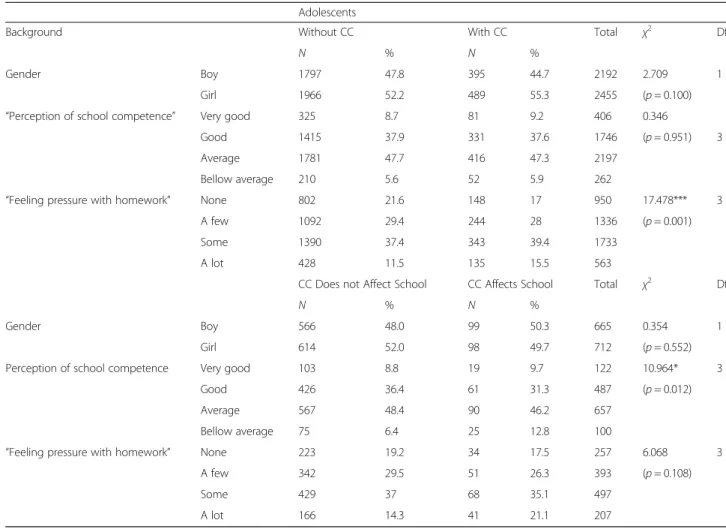
Qui-Square tests were used to better understand specific differences or associations between the study variables and 1) having or not a CC, and 2) if that CC affects or not participation and regular attendance in school.
“Having or not a chronic condition” (Table 2) was not significantly associated with gender or “Perception of school competence”. Data showed a significantly different distribution according to “Feeling pressure with school homework” [χ2 (3, N= 4582) = 17.48, p≤0.001]. Adoles-cents living with a CC present more frequently (15.5 %)
“Feel like that a lot” compared with adolescents without chronic condition (11.5 %).
“Having a chronic condition (CC) and feeling that it affects or not the participation and regular attendance in school”(Table 2) were not significantly associated with gen-der nor with “Feeling pressure with homework”. However, a significant association was found regarding“Perception of school competence” [χ2 (3, N= 1366) = 10.96, p≤0.05]. Adolescents with a chronic condition who feel that the Table 1Variables included in the study
Study variables Range
Gender 1 = Boy; 2 = Girl
Age Min = 11 years old; Max = 16 years old
Having or not having a long term disease or health problem that has been diagnosed by a doctor (Having/not having a chronic condition–CC);
1 = No; 2 = Yes
Feeling that the disease affects or not participation and regular attendance in school;
1 = No; 2 = Yes
Satisfaction with family life (Cantril, 1965) 0 = Very bad relationship; 1;2;3;4;5;6;7;8;9;10 = Very good relationship
Family Affluence Scale–FAS (Boyce et al.,2006): composed by 4 items, and used to assess familiar socioeconomic status (SES):
“Does your family have a car, van or other mean of transport?” 1 = No; 2 = Yes, one; 3 = Yes, two or more
“How many computers do you have at home?” 1 = None; 2 = One; 3 = Two; 4 = More than two
Spending holidays with family in the last 12 months 1 = None; 2 = One; 3 = Two; 4 = More than two
“Do you have a bedroom only for yourself?” 1 = No; 2 = Yes
“Feeling pressure with homework” 1 = None; 2 = A few; 3 = Some; 4 = A lot
disease affects school participation, more frequently (12.8 %) “Feel like being a student below average” than adolescents who felt that the disease does not affect school participation (6.4 %).
ANOVA was used to analyze the differences between adolescents’ satisfaction with family life (Table 3) data showed statistical differences between adolescents hav-ing or not a CC, and between adolescents feelhav-ing that CC affects or not participation in school. The group who does not have a CC has in average higher satisfac-tion with family life (F(1.4541; 15.47,p≤.001) (M= 8.52, SD= 1.88), and the same in the group who has a CC but does not feel it affects participation in school (F(1.1335; 19.29,p≤.001) (M= 8.41,SD= 1.94).
Adolescents’family affluence (FAS) showed no signifi-cant difference regarding having or not a CC. Neverthe-less, the group who has a CC but feels that the disease does not affect participation in school, has a higher FAS (F(1.1331; 5.27,p≤.05) (M= 5.86,SD= 1.86).
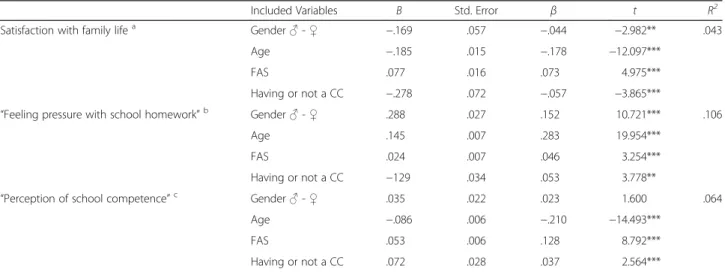
A set of multiple linear regression models was carried out to estimate the relationship between: 1) adolescents’
satisfaction with family life, 2) adolescent’s “Feeling pressure with school homework”, and 3) adolescent’s
“Perception of school competence”, using as predictors gender, age, socioeconomic status (Family Affluence Scale -FAS) and the chronic disease “status”: having or not a CC (Table 4), or, feeling that CC affects or not participation and regular attendance in school (Table 5).
Chronic condition (Table 4)
An adjusted model was achieved for satisfaction with family life [F(4) = 50.611, p≤.05], and the variance explained by
the final model was of 4.3 %. Table 4 shows that although all the four independent variables in the equation are sig-nificantly associated to satisfaction with family life, there is a low impact of gender, FAS and having a CC. The higher association is with age (older adolescents feeling worst about family life), and, although with a much lower impact, being a girl and having a CC makes adolescents feel worst about family life. Also in a lower impact, the adolescents who have higher FAS feel more satisfied with family life. Table 2Bivariate analysis (Χ2) of study independent variables and 1) having or not a chronic condition (CC), and 2) CC affecting or not participation/regular attendance in school
Adolescents
Background Without CC With CC Total χ2 Df
N % N %
Gender Boy 1797 47.8 395 44.7 2192 2.709 1
Girl 1966 52.2 489 55.3 2455 (p= 0.100)
“Perception of school competence” Very good 325 8.7 81 9.2 406 0.346
Good 1415 37.9 331 37.6 1746 (p= 0.951) 3
Average 1781 47.7 416 47.3 2197
Bellow average 210 5.6 52 5.9 262
“Feeling pressure with homework” None 802 21.6 148 17 950 17.478*** 3
A few 1092 29.4 244 28 1336 (p= 0.001)
Some 1390 37.4 343 39.4 1733
A lot 428 11.5 135 15.5 563
CC Does not Affect School CC Affects School Total χ2 Df
N % N %
Gender Boy 566 48.0 99 50.3 665 0.354 1
Girl 614 52.0 98 49.7 712 (p= 0.552)
Perception of school competence Very good 103 8.8 19 9.7 122 10.964* 3
Good 426 36.4 61 31.3 487 (p= 0.012)
Average 567 48.4 90 46.2 657
Bellow average 75 6.4 25 12.8 100
“Feeling pressure with homework” None 223 19.2 34 17.5 257 6.068 3
A few 342 29.5 51 26.3 393 (p= 0.108)
Some 429 37 68 35.1 497
A lot 166 14.3 41 21.1 207
An adjusted model was achieved for “Feeling pressure with school homework” [F(4) = 133.776, p≤.05], and the
variance explained by the final model was of 10.6 %. As for this variable, there is a significant but low impact of FAS and having a CC. The higher association is with age (older adolescents feeling more pressure), and with gender (girls reporting more pressure). Although with a much lower im-pact, not having a CC and reporting a higher FAS makes adolescents feel more“pressure with school homework”.
Finally, an adjusted model was achieved for the “ Per-ception of school competence” [F(4) = 76.944, p≤.05]
and the variance explained by the final model was of 6.4 %. For this variable there is no significant impact of
gender, and there is a significant but low impact of hav-ing a CC. The higher association is with age (older ado-lescents reporting lower school competence), and with FAS (more affluent adolescents reporting more compe-tence) and, although with a much lower impact, having a CC makes adolescents have a higher perception of school competence.
Chronic condition affecting participation and regular attendance in school (Table 5)
Table 5 repeat the same models but instead of the vari-able having/not having a CC, it considers whenever “CC affects/not affects school participation”.
Table 4Predicting 1) Adolescents’satisfaction with family life and 2)“Feeling pressure with school homework”and“perception of school competence, using as predictors gender, age, FAS and having or not a CC (multiple linear regression model)”
Included Variables B Std. Error β t R2
Satisfaction with family lifea Gender♂-♀ −.169 .057 −.044 −2.982** .043
Age −.185 .015 −.178 −12.097***
FAS .077 .016 .073 4.975***
Having or not a CC −.278 .072 −.057 −3.865***
“Feeling pressure with school homework”b Gender♂-♀ .288 .027 .152 10.721*** .106
Age .145 .007 .283 19.954***
FAS .024 .007 .046 3.254***
Having or not a CC −129 .034 .053 3.778**
“Perception of school competence”c Gender♂-♀ .035 .022 .023 1.600 .064
Age −.086 .006 −.210 −14.493***
FAS .053 .006 .128 8.792***
Having or not a CC .072 .028 .037 2.564***
B and Std. Error: unstandardized coefficients;β: standardized coefficients ***p≤.001; **p≤.01
aF= 50.611 bF= 133.776 cF= 76.944
Table 3Adolescents’satisfaction with family life and FAS comparing 1) having or not CC, and 2) feeling that CC affects or not school participation (ANOVA)
Adolescents
Satisfaction with family life With CC Without CC
M SD M SD F Df P
8.23 2.06 8.52 1.88 15.466*** 1 .000
CC Affects School CC does not Affect School
M SD M SD F Df P
7.71 2.47 8.41 1.94 19.293*** 1 .000
FAS With CC Without CC
M SD M SD F Df P
5.91 1.84 5.88 1.83 0.291 1 .590
CC Affects School CC does not Affect School
M SD M SD F Df P
5.53 1.84 5.86 1.86 5.277* 1 .022
An adjusted model was achieved for satisfaction with family life [F(4) = 16.497, p≤.05], and the variance
ex-plained by the final model was of 4.6 %. Considering sat-isfaction with family life, there is no significant impact of gender and a low impact of FAS. The higher association is with age (older adolescents feeling worst with fam-ily life) and having a CC that affects school participa-tion makes adolescents feel worst with family life, with a much higher impact than merely considering having or not a CC. With a much lower impact, hav-ing a higher FAS makes adolescents feel more satis-faction with family life.
An adjusted model was also achieved for “Feeling pres-sure with school homework” [F(4) = 45.462, p≤.05], and
the variance explained by the final model was of 12 %. As for this variable, there is no significant impact of FAS and of having a CC that affects school participation. The higher association is with age (older adolescents feeling more pres-sure), and with gender (girls reporting more pressure).
Finally an adjusted model was achieved for“Perception of school competence” [F(4) = 19.620, p≤.05], and the
variance explained by the final model was of 5.3 %. For this variable there is no significant impact of gender nor of having a CC that affects school participation. The higher association is with age (older adolescents report-ing higher school competence), and with FAS (more af-fluent adolescents reporting less competence).
Interestingly age seems the worst“risk factor”for (in) sat-isfaction with family life, pressure with school work and (low) perception of school competence. Focusing on CC, having a CC has a significant but really low impact upon
those situations. Interestingly as well is that when consider-ing only havconsider-ing a CC that affects school participation, the impact upon school pressure and perception of school competence decreases, and the impact upon family life increases.
Discussion
A brief overview of main results shows that adolescents living with a CC present higher levels of “pressure with homework” and feel that their school competence is below average. On the other hand, adolescents living without a CC perceive their satisfaction with family life as more satisfying. This data supports the hypothesis ev-idenced in the literature, proposing that adolescents liv-ing with a CC may have increased risk and vulnerability (Barlow and Ellard 2006; Gaspar and Matos 2008; Matos and Equipa Aventura Social 2000; Oeseburg et al. 2010a, b; Santos et al. 2013a, b; Santos et al. 2014; Verhoof et al. 2012), mainly in satisfaction with family life (Michaud et al. 2007; Quittner et al. 2011) and school success (Bethell et al. 2012; Layte and McCrory 2012).
This study also supports previous research that sug-gests changes can be influenced by gender, age and SES (Currie et al. 2012; Holden et al. 1997; Oishi et al. 1999; Olén et al. 2012; Taylor et al. 2008).
Parents have an important role in the adaptation process to a CC and, concerning school outcomes, par-ental encouragement can be considered to have a spe-cific positive effect on adolescent health, beyond the effect of school environment and family communication addressed individually (Matos et al. 2006). Thus, family Table 5Predicting 1) adolescents’satisfaction with family life and 2)“feeling pressure with school homework”and“perception of school competence, using as predictors gender, age, FAS and feeling that CC affects or not school participation (multiple linear regression model)”
Included Variables B Std. Error β t R2
Satisfaction with family lifea Gender♂-♀
−.166 .111 −.040 −1.491 .046
Age −.179 .030 −.161 −5.919***
Socioeconomic Status (FAS) .068 .030 .062 2.276*
Feeling CC affects/not affects school −.662 .160 −.113 −4.139***
“Feeling pressure with school homework”b Gender♂-♀ 0.269 0.050 0.139 5.363*** 0.120
Age 0.166 0.014 0.317 12.142***
Socioeconomic Status (FAS) 0.017 0.014 0.033 1.255
Feeling CC affects or not school 0.090 0.072 0.033 1.254
“Perception of school competence”c Gender♂-♀
−0.064 0.040 −0.042 −1.585 .053
Age 0.069 0.011 0.167 6.195***
Socioeconomic Status (FAS) −0.60 0.011 −0.147 −5.563***
Feeling CC affects or not school 0.037 0.058 0.017 0.631
B and Std. Error: unstandardized coefficients;β: standardized coefficients ***p≤.001; *p≤.05
is necessarily an intervention target when pediatric dis-abling conditions occur in order to help parents deal with children/adolescents’CC and associated changes in the family environment (Russo et al. 2012). Parental in-terventions should provide key aspects focused on edu-cational, therapeutic and organizational dimensions.
This study has some limitations namely findings were entirely based on adolescents’self-reports (a widely-used procedure in a national survey design) and the results are cross-sectional (and not ideally longitudinal). Not-withstanding these limitations, this is one of the first in-vestigations concerning the impact of living and attending school in adolescents with CC, using a wide national representative study (HBSC Portuguese study).
Conclusions
Adolescents frequently feel that their lives are ruled by the medical system and so it is increasingly important to include their perspectives in healthcare, highlighting their specific needs, knowledge, competences and rights (Matos et al. 2013; Michaud et al. 2004; Ottova et al. 2013). It is also important to consider their suggestions to parents, such as learning better parenting styles, having greater confidence in their children, and grad-ually transferring to them the responsibility for med-ical treatment (Bregnballe et al. 2011).
Therefore, a multifaceted approach and prevention of CCs in schools is highlighted and may reduce the costs of special education services, help adolescents to better control the disease and improve a healthy development into adulthood (Logan and Simons 2010). In addition, when designing and implementing school-based inter-vention programs, it seems important to promote school assets as important features on school satisfaction and academic achievement for all students and, in particular, for those more vulnerable to achieve success (Simões et al. 2010). Building competences in adolescents with a CC, strengthening connectedness and a better commu-nication within the family, school, peer group and health care professionals will enhance resilience and increase the opportunities to improve health outcomes in this population, creating opportunities to support their school and future professional career (Matos et al. 2012a, b; Oeseburg et al. 2010b).
Competing interests
None of the authors reported any financial interests or potential conflicts of interest.
Authors’contributions
TS and MGM conceived the study, participated in its design and coordination, draft and authored the manuscript; CS and MCM participated in the study design, interpretation of the data, and helped to draft manuscript revisions. All authors read and approved the final manuscript.
Acknowledgements
The authors would like to thank“Aventura Social”team members for their work on data collection and management. HBSC/WHO 2010 in Portugal was co-financed by Alto Comissariado da Saúde, Ministério da Saúde (High Commission for Health, Health Ministry) and Coordenação Nacional para a Infecção VIH/SIDA (National Coordination for HIV/AIDS).
Funding
Santos, T. is supported by a PhD grant from the Portuguese Foundation for Science and Technology (FCT) (Grant Number: reference SFRH/BD/82066/2011). The William James Center for Research, ISPA - Instituto Universitário is supported by a grant from the Portuguese Foundation for Science and Technology (FCT) (Grant Number: UID/PSI/04810/2013).
Author details
1
FMH, Faculdade de Motricidade Humana (Projecto Aventura Social-Social Adventure Team)/Universidade de Lisboa, Lisboa, Portugal.2ISAMB, Instituto
de Saúde Ambiental, Faculdade de Medicina, Universidade de Lisboa, Lisboa, Portugal.3William James Center of Research, ISPA - Instituto Universitário,
Ciências Psicológicas, Sociais e da Vida, Lisboa, Portugal.4Departamento de Pediatria do Hospital de Santa Maria, CAML, Centro Académico de Medicina de Lisboa, Lisboa, Portugal.
Received: 8 February 2016 Accepted: 2 March 2016
References
Barlow JH, Ellard DR. The psychosocial well-being of children with chronic disease, their parents and siblings: an overview of the research evidence base. Child Care Health Dev. 2006;32(1):19–31.
Barros L, Matos MG, Batista-Foguet J. Chronic diseases, social context and adolescent health: results of the Portuguese National Health Behaviour in school-aged children survey. Revista Brasileira de Terapias Cognitivas. 2008; 4(1):29.
Bethell C, Forrest CB, Stumbo S, Gombojav N, Carle A, Irwin CE. Factors promoting or potentially impeding school success: disparities and state variations for children with special health care needs. Matern Child Health J. 2012;16 Suppl 1:S35–43. http://dx.doi.org/10.1007/s10995-012-0993-z. Boonen H, Petry K. How do children with a chronic or long-term illness perceive
their school re-entry after a period of homebound instruction? Child Care Health Dev. 2012;38(4):490–6. http://dx.doi.org/10.1111/j.1365-2214.2011. 01279.x.
Boyce W, Torsheim T, Currie C, Zambon A. The family affluence scale as a measure of national wealth: validation of an adolescent self-report measure. Soc Indicator Res. 2006;78(3):473–87.
Braconnier A, Marcelli D. As mil faces da adolescência [The Thousend Faces of Adolescence]. Lisboa: CLIMEPSI Editores; 2000.
Bregnballe V, Schiøtz PO, Lomborg K. Parenting adolescents with cystic fibrosis: the adolescents’and young adults’perspectives. Patient Preference Adherence. 2011;5:563–70. http://dx.doi.org/10.2147/PPA.S25870. Cantril H. The pattern of human concerns. New Brunswick: Rutgers University
Press; 1965.
Combs-Orme T, Helfinger CA, Simpkins C. Comorbidity of mental health problems and chronic health conditions in children. J Emotion Behav Disord. 2002;2:116–25.
Currie C, Samdal O, Boyce W, Smith R. HBSC, a WHO cross national study: research protocol for the 2001/2002 survey. Copenhagen: WHO; 2001. Currie C, Gabhainn N, Godeau E, The International HBSC Network Coordinating
Committee. The Health Behaviour in School-Aged Children: WHO collaborative cross-National (HBSC) study: origins, concept, history and development 1982–2008. Int J Public Health. 2009;54 Suppl 2:131–9. http:// dx.doi.org/10.1007/s00038-009-5404-x.
Currie C, Zanotti C, Morgan A, Currie D, De Looze M, Roberts C, et al. Social determinants of health and well-being among young people. Health Behaviour in School-aged Children (HBSC) Study: International Report from the 2009/2010 Survey. Copenhagen: WHO Regional Office for Europe; 2012. Gaspar T, Matos MG. Qualidade de Vida em Crianças e Adolescentes Versão
Harris RF, Menard-Katcher C, Atkins D, Furuta GT, Klinnert MD. Psychosocial dysfunction in children and adolescents with eosinophilic esophagitis. J Pediatr Gastroenterol Nutr. 2013;57(4):500–5. http://dx.doi.org/10.1097/MPG. 0b013e31829ce5ad.
Hartos JL, Power TG. Mothers’awareness of their early adolescents’stressors: Relation between awareness and adolescent adjustment. J Early Adolesc. 1997;17(4):371–89.
Holden EW, Chmielewski D, Nelson CC, Kager VA. Controlling for general and disease-specific effects in child and family adjustment to chronic childhood illness. J Pediatr Psychol. 1997;22(1):15–27.
Layte R, McCrory C. Paediatric chronic illness and educational failure: the role of emotional and behavioural problems. Soc Psychiatry Psychiatr Epidemiol. 2012;48(8):1307–16. http://dx.doi.org/10.1007/s00127-012-0609-3. Lee SL, Cheung YF, Wong HSW, Leung TH, Lam TH, Lau YL. Chronic health
problems and health-related quality of life in Chinese children and adolescents: a population-based study in Hong Kong. BMJ Open. 2013;3(1): e001183. http://dx.doi.org/10.1136/bmjopen-2012-001183.
Logan DE, Simons LE. Development of a group intervention to improve school functioning in adolescents with chronic pain and depressive symptoms: a study of feasibility and preliminary efficacy. J Pediatr Psychol. 2010;35(8):823–36. http://dx.doi.org/10.1093/jpepsy/jsq008.
Maslow GR, Haydon A, McRee AL, Ford CA, Halpern CT. Growing up with a chronic illness: social success, educational/vocational distress. J Adolesc Health. 2011;49:206–12.
Matos MG, Equipa Aventura Social. Aventura Social & Saúde, A saúde dos adolescentes portugueses - Relatórios Nacionais do Estudo HBSC 2000, 2002 e 2006, [Social Adventure & Health: Portuguese Adolescents’s Health - Final report from HBSC 2000/02/06 Study]. Lisboa: CMDT/IHMT/UNL, FMH/UTL; 2000. Matos MG, Dadds M, Barrett P. Family-related school issues and the mental
health of adolescents: post hoc analyses of the portuguese national health behaviour in school-aged children survey data. J Fam Stud. 2006;12(2):261–75. http://dx.doi.org/10.5172/jfs.327.12.2.261.
Matos MG, Gaspar T, Ferreira M, Tomé G, Camacho I, Reis M, et al. Keeping a focus on self-regulation and competence:“find your own style”, a school based program targeting at risk adolescents. J Cogn Behav Psychotherapies. 2012a;12(1):39–48.
Matos MG, Simões C, Tomé G, Camacho I, Ferreira M, Ramiro L, et al. Aventura Social & Saúde, A Saúde dos adolescentes portugueses–Relatório Final do Estudo HBSC 2010. Lisboa: CMDT/IHMT/UNL; FMH/UTL; 2012b.
Matos MG, Tomé G, Santos T, Gaspar T, Ramiro L, Consórcio RICHE/UE. RICHE: Trajetórias para a saúde da criança e do adolescente em Portugal. Lisboa: Centro Malária e Outras Doenças Tropicais/IHMT/UNL; FMH/Universidade Técnica de Lisboa; 2013.
Mazur J, Małkowska-Szkutnik A. Chronic diseases and perception of school demands among school children aged 11–15 years in Poland. Medycyna Wieku Rozwojowego. 2010;14(2):160–8.
Meng Y, Babey SH, Wolstein J. Asthma-related school absenteeism and school concentration of low-income students in California. Prev Chronic Dis. 2012;9: 110312. http://dx.doi.org/10.5888/pcd9.110312.
Michaud PA, Suris JC, Viner R. The adolescent with a chronic condition. Part II: healthcare provision. Arch Dis Child. 2004;89:943–9. http://dx.doi.org/10.1136/ adc.2003.045377.
Michaud PA, Suris JC, Viner R. The Adolescent with a Chronic Condition. Epidemiology, developmental issues and health care provision. Geneva: Department of Child and Adolescent Health and Development. WHO Discussion Papers on adolescence; 2007.
Moreno C. Desenvolvimento social durante a adolescência [Social Development During Adolescence]. In: Coll C, Marchesi A, Palácios J, et al., editors. Desenvolvimento psicológico e educação, Vol. 1-Psicologia Evolutiva. 2nd ed. Porto Alegre: Artmed; 2004. p. 350–70.
Oeseburg B, Jansen DE, Groothoff JW, Dijkstra GJ, Reijneveld SA. Emotional and behavioural problems in adolescents with intellectual disability with and without chronic diseases. J Intellect Disabil Res. 2010a;54(1):81–9. http://dx. doi.org/10.1111/j.1365-2788.2009.01231.x
Oeseburg B, Jansen DE, Reijneveld SA, Dijkstra GJ, Groothoff JW. Limited concordance between teachers, parents and healthcare professionals on the presence of chronic diseases in ID-adolescents. Res Dev Disabil. 2010b;31(6): 1645–51. http://dx.doi.org/10.1016/j.ridd.2010.04.015
Oishi S, Diener EF, Lucas RE, Suh EM. Cross-cultural variations in predictors of life satisfaction: perspectives from needs and values. Pers Soc Psychol Bull. 1999; 25(8):980–90.
Olén O, Bihagen E, Rasmussen F, Ludvigsson JF. Socioeconomic position and education in patients with coeliac disease. Dig Liver Dis. 2012;44(6):471–6. http://dx.doi.org/10.1016/j.dld.2012.01.006.
Ottova V, Alexander D, Rigby M, Staines A, Hjern A, Leonardi M, Ravens-Sieberer U, The RICHE Project Group. Report on the roadmaps for the future, and how to reach them. 2013; http://doras.dcu.ie/19732/1/WP4_D8_RICHE_ Roadmap.pdf
Pinquart M. Do the parent–child relationship and parenting behaviors differ between families with a child with and without chronic illness? A meta-analysis. J Pediatr Psychol. 2013;38(7):708–21. http://dx.doi.org/10.1093/ jpepsy/jst020.
Quittner AL, Romero SL, Kimberg CI, Blackwell LS, Cruz I. Chronic Illness. Encyclopedia Adolesc. 2011;3:91–9.
Roberts C, Currie C, Samdal O, Currie D, Smith R, Maes L. Measuring the health behaviours of adolescents through cross-national survey research: recent developments in the Health Behaviour in School-aged Children (HBSC) study. J Public Health. 2007;15(3):179–86.
Roberts C, Freeman J, Samdal O, Schnohr C, Looze S, Gabhainn N, et al. The Health Behaviour in School-aged Children (HBSC) study: methodological developments and current tensions. Int J Public Health. 2009;54 Suppl 2:140–50. http://dx.doi. org/10.1007/s00038-009-5405-9.
Russo E, Trevisi E, Zulian F, Battaglia MA, Viel D, Facchin D, Martinuzzi A. Psychological Profile in Children and Adolescents with Severe Course Juvenile Idiopathic Arthritis. Sci World J.2012; http://dx.doi.org/10.1100/2012/841375 Santos T, Matos MG, Simões C, Camacho I, Tomé G, Moreno MC. Estilos Parentais
E Desenvolvimento Positivo Em Crianças e Adolescentes Com Doença Crónica [Parenting styles and positive development in children and adolescents with chronic condition]. Revista de Psicologia da Criança e do Adolescente/J Child Adolesc Psych. 2013a;4(2):185–204. http://revistas.lis. ulusiada.pt/index.php/rpca/article/view/429/409
Santos T, Matos MG, Simões MC, Fonseca H, Machado MC. Individual factors related to chronic condition in Portuguese adolescents: Highlights from the HBSC/WHO Study. Health Spec Issue Chron Dis Res. 2013b;5(11B):25–34. http://dx.doi.org/10.4236/health.2013.511A2005
Santos T, Ferreira M, Simões MC, Matos MG, Machado MC. Chronic condition and risk behaviours in Portuguese adolescents. Glob J Health Sci. 2014;6(2):227–36. http://dx.doi.org/10.5539/gjhs.v6n2p227.
Santos T, Matos MG, Simões C, Machado MC. Psychological well-being and chronic condition in Portuguese adolescents. Int J Adolesc Youth. 2015; http://dx.doi.org/10.1080/02673843.2015.1007880
Simões C, Matos MG, Tomé G, Ferreira M, Chaínho H. School satisfaction and academic achievement: the effect of school and internal assets as moderators of this relation in adolescents with special needs. Procedia Soc Behav Sci. 2010;9:1177–81. http://dx.doi.org/10.1016/j.sbspro.2010.12.303. Taylor RM, Gibson F, Franck LS. A concept analysis of health-related quality of life
in young people with chronic illness. J Clin Nurs. 2008;17(14):1823–33. http://dx.doi.org/10.1111/j.1365-2702.2008.02379.x.
Tomé G, Matos MG, Camacho I, Celeste C, Diniz JA. Portuguese adolescents: the importance of parents and peer groups in positive health. Span J Psychol. 2012;15(3):1315–24. http://dx.doi.org/10.5209/rev_SJOP.2012.v15.n3.39417. Verhoof E, Maurice-Stam H, Heymans H, Grootenhuis M. Growing into disability
benefits? Psychosocial course of life of young adults with a chronic somatic disease or disability. Acta Paediatrica. 2012;101:19–26. http://dx.doi.org/10. 1111/j.1651-2227.2011.02418.x.
Submit your manuscript to a
journal and benefi t from:
7Convenient online submission
7Rigorous peer review
7Immediate publication on acceptance
7Open access: articles freely available online
7High visibility within the fi eld
7Retaining the copyright to your article