SAGE Open
July-September 2015: 1 –11 © The Author(s) 2015 DOI: 10.1177/2158244015596207 sgo.sagepub.com
Creative Commons CC BY: This article is distributed under the terms of the Creative Commons Attribution 3.0 License
(http://www.creativecommons.org/licenses/by/3.0/) which permits any use, reproduction and distribution of the work without further permission provided the original work is attributed as specified on the SAGE and Open Access page (http://www.uk.sagepub.com/aboutus/openaccess.htm). Article
Early childhood education in the United States has expanded over the years. In 1965, only 16% of 4-year-olds and 5% of 3-year-olds attended school (Barnett & Yarosz, 2007). By 2010-2011, about 75% of children attended public or private preschool programs at age 4 and about 50% at age 3 (Barnett, Carolan, Fitzgerald, & Squires, 2011). Several factors have contributed to the pre-kindergarten (pre-k) expansion, including (a) concerns about children’s school readiness and subsequent academic achievement, (b) advances in neurosci-ence research yielding greater insights on the plasticity and learning capacity of the young brain, (c) expanded need for early child care due to the tremendous increase in working mothers, (d) more advocacy for pre-k education, particularly in view of research touting its widespread societal benefits (e.g., reduced dependency costs, increased employment and associated tax revenue, and reduced crime), and develop-ment of national goals and standards on education (Goldsmith & Meyer, 2006; Lowenstein, 2011; National Association for the Education of Young Children [NAEYC], 2012).
The goal of pre-k education is to prepare young children for kindergarten and school by ensuring that they have the requisite cognitive, socio-emotional, and behavioral attri-butes of school readiness. Today, we know much more about how young children develop and how early childhood pro-grams can make a difference (Isaacs & Roessel, 2008; Melhuish, 2011; Weiss, 2004). Evidence indicates that high-quality pre-k programs indeed improve children’s cognitive, social, and emotional skills, decrease the need for grade retention and special education services, and narrow the achievement gap. We know now more than ever before about the importance of early intervention and education services for young children. These programs, when delivered at the
1
Howard University, Washington, DC, USA
Corresponding Author:
Jo-Anne L. Manswell Butty, Center for Urban Progress, Howard University, 1840 7th Street NW, Rm. 145, Washington, DC 20001, USA. Email: [email protected]
Going Full Circle With Teacher Feedback:
Conducting Responsive Evaluations in
Urban Pre-K Classrooms
Jo-Anne L. Manswell Butty
1, Lucy A. Wakiaga
1,
Brooke K. McKie
1, Veronica G. Thomas
1, Rodney D. Green
1,
Neilabh Avasthi
1, and Caryn L. Swierzbin
1Abstract
Research on the evaluation of early childhood programs focuses mainly on its outcomes rather than its process with often little attention given to the role that feedback to teachers in pre-kindergarten (pre-k) programs plays in the larger cycle of the evaluation process. This article provides a case example of a multiyear evaluation of community-based pre-k programs serving about 360 three- and four-year old children over a 5-year period in the District of Columbia. The Closing the Loop Evaluation Model proposed represents a responsive evaluation approach that illustrates the interconnected interactions between teacher feedback during the evaluation process and two supporting evaluation methodologies that emphasize social justice and utility. Findings from the case example highlight the responsive evaluation approach, feedback process, and ensuing conceptual and instrumental changes that occurred among stakeholders from whole-group feedback to small-group “report card” meetings with add-ons such as technical assistance, teacher-generated action plans, and teacher follow-up and feedback to close the evaluation loop. The authors discuss lessons learned about the evaluation process from the case example around aspects of feedback, including timing, audience, and function. Findings highlight the importance of feedback being timely and prompt, high quality in focus and content, non-punitive, collaborative, concise, and useful. The authors conclude that an evaluation process that includes teacher feedback, couched in social justice and utility, can have positive outcomes for all stakeholders and will likely lead to higher quality early childhood education programs.
Keywords
appropriate levels of quantity and quality, have meaningful and lasting positive impacts on children and families (Gilliam & Leiter, 2003; Reynolds, Temple, Ou, Arteaga, & White, 2011).
A 2010 analysis of 123 evaluations concluded that pre-k programs provide a real and enduring benefit to children, which persists beyond the early elementary years (Camilli, Vargas, Ryan, & Barnett, 2010). The reality is that too many children do not attend high-quality early childhood programs and children from low-income families are more likely to attend lower quality programs (National Education Association Policy Brief, 2010). Many states have taken steps toward universal pre-k education. However, the states are faced with the challenge of how to best design and imple-ment a statewide program that provides high-quality services to all children being served. Although pre-k enrollment con-tinues to grow, large disparities in access and program qual-ity exist. As a result, there have been greater calls by researchers, policy makers, and practitioners for evidenced-based data on the effectiveness of such programs, particu-larly for children from disadvantaged backgrounds and their contribution in narrowing the achievement gap (Ferguson, 2007; Rashid, 2013).
Program evaluation is defined as the systematic process of describing the components and outcomes of an organized intervention or service with the aim to improve the quality of services received or to document a program’s beneficial impacts (Gilliam & Leiter, 2003). The primary purpose of pre-k program evaluations is to improve the quality of educa-tion and other services provided to young children and their families (NAEYC, 2003). Standardized observational data provide an objective overall picture of the classroom, a basis for teacher reflection and self-assessment, and input into the development and refinement of pre-k programs. Objective feedback from classroom observations helps teachers reflect in productive ways, thus bridging the gap between knowl-edge about what matters to students and changes in teachers’ actual practice (Stuhlman, Hamre, Downer, & Pianta, n.d.). Program evaluators can have an important impact on profes-sional practice by providing relevant data, which in the con-text of quality mentoring and support help create high-quality and responsive classroom environments served by high-quality pre-k teachers (Lambart, Rowland, Taylor, & Wheeler, 2010). High-quality evaluations to document the fidelity and effectiveness of pre-k programs, particularly those serving diverse urban communities, are therefore increasing in demand.
The evaluation of pre-k education is both a labor-inten-sive and complex process, in large part, because program models vary considerably. There is a growing body of litera-ture on the evaluation of pre-k and early childhood programs (Green & McKie, 2007; Green, McKie, & Manswell Butty, 2008, 2009, 2010; Hustedt, Barnett, Jung, & Friedman, 2010; Peisner-Feinberg & Schaaf, 2008). However, much of this work focuses on outcomes evaluation and less on process
evaluation for improvement. It is, therefore, our contention that pre-k program evaluations should not simply aim at assessing a program’s merit and worth but should also pro-vide sufficient useful feedback to pre-k staff. The feedback can then be used to improve teaching by providing teachers with strategies to elevate the cognitive, socio-emotional, and behavioral development of children. In other words, evalua-tors entrusted with examining pre-k programs, particularly those serving urban populations, must do more than simply analyze and report students’ scores on standardized tests. To reveal a more complete picture, evaluators should examine a host of social and other contextual factors (e.g., issues of access, equity, opportunities to learn, and rigor of curricula) that impact the learning of pre-k students. Evaluators of edu-cational programs cannot ignore the fact that they are part of the never-ending struggle to make judgment calls about edu-cation, a social activity that creates the conditions or obsta-cles for social mobility.
This article focuses on process, not outcome, evaluation for improvement and provides a case example of a multiyear evaluation of community-based pre-k programs serving about 360 three- and four-year-old children in the District of Columbia. The responsive evaluation (RE) approach used was not simply a scientific endeavor in search of objective “truths” and “solutions.” We also viewed it as a social justice enterprise, whereby we argued for the use of teacher feed-back and pre-k evaluation results to advocate change and restructuring for improvements in the education of young children.
Evaluation Process and the Importance
of Feedback
Evaluation Model
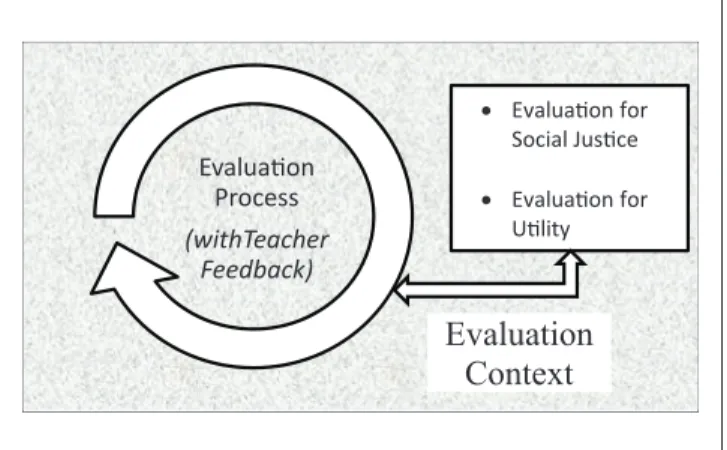
Figure 1 highlights the Closing the Loop Evaluation Model we developed for our evaluation process. The model is embedded in a RE approach. During the evaluation, we saw the value of collaboration and participation through feedback
Evaluaon Process
(withTeacher Feedback)
Evaluaon for Social Jusce
Evaluaon for Ulity
Evaluation
Context
to “close the loop” and to steadily improve program quality. Through this process, we ensured that the evaluation process was poised to positively address issues of social justice and utility. The model in Figure 1 considers the primary purpose of evaluation as seeking to improve the quality of education and other services provided to young children and their fami-lies. With this in mind, we hoped that our evaluations (a) had a positive impact on teacher quality and consequently on the education of all children, including the underserved and underrepresented, and (b) presented findings and recommen-dations that were useful to all stakeholders. These two impor-tant aspects of our evaluation address issues of social justice and evaluation for utility which are fundamental to the evalu-ation process and provide teaching staff with the feedback they need to reflect on findings and implement recommenda-tions. The following section addresses the three major com-ponents of the model: (a) teacher feedback, (b) evaluation for social justice, and (c) evaluation for utility.
Teacher feedback. Feedback can be conceptualized as infor-mation provided by an agent (e.g., teacher or peer) regarding aspects of one’s performance or understanding (Hattie & Timperley, 2007). It is a process that involves a two-way non-judgmental communication with the purpose of provid-ing information about the quality of work to enhance one’s ability (Hamid & Mahmood, 2010).
Studies show that providing teacher feedback is still an area of concern and identifies a lack of adequate teacher feedback as a primary problem (Weisberg, Sexton, Mulhern, & Keeling, 2009) in the school setting. Evidence from one study suggests that while nearly three of four teachers may go through an evaluation process, few receive specific feed-back about how to improve their practice. Furthermore, even when supervisors do provide feedback, it is often too infre-quent to improve performance (Mielke & Frontier, 2012). As the Center for Teaching Excellence (2012) notes, feedback is important to improve individual performance because it can reinforce existing strengths, keep goal-directed behavior on course, clarify the effects of behavior, and increase an indi-vidual’s ability to detect and remedy errors independently. According to Williamson (2012), feedback is an important part of the learning process because it allows individuals to become effectively independent, especially when they can be observed putting the feedback into practice. When adult learners are empowered to objectively analyze and under-stand their own practice and have a clear vision of where they can improve, they are intrinsically motivated to embark on a pathway that leads to expertise (Mielke & Frontier, 2012). This empowerment also increases the individual’s self-esteem.
The literature clearly supports three general conclusions about feedback that should be adopted into practice: (a) feed-back is better than no feedfeed-back, (b) immediate feedfeed-back is bet-ter than delayed feedback, and (c) feedback that is immediate, specific, positive, and corrective holds the most promise for
bringing about lasting change in teaching behavior (Scheeler, Ruhl, & McAfee, 2004). To evaluate feedback practice, Brookhart (2008) identified different types of feedback strate-gies (e.g., timing, amount of feedback, mode, audience, focus, content, function, and valence) that research has found to be important for student achievement.
In early learning classrooms, conducting classroom obser-vations along with mentoring or coaching approaches pro-vides ongoing feedback and support about instruction and classroom practices. These approaches are acknowledged as potentially effective and perhaps are a more direct path to producing high-quality teaching in pre-k classrooms (Hamre & Pianta, 2005; Landry, Swank, Smith, Assel, & Gunnewig, 2006). Given the relevance of these approaches, it is not sur-prising that coaching and mentoring now dominate the teacher-training landscape as forms of feedback.
We argue that it is imperative that professional develop-ment models aimed to improve student outcomes include the component of teacher feedback as well as (a) focus on spe-cific teacher–child interactions and implementations as tar-gets; (b) anchor interaction targets in standardized, validated measurement systems; and (c) use consultation procedures that are both justifiable and standardized for training and supporting teachers to improve teaching and classroom qual-ity (Pianta, Mashburn, Downer, Hamre, & Justice, 2008).
Evaluation for social justice. The other component of the model, “evaluation for social justice,” highlights the impor-tance of promoting equity in varying contexts to advance democracy. The term “social justice” has varying definitions. While the definitions vary depending on the source, the com-mon themes that exist include dignity, equality, justice, human rights, and responsibility.
House and Howe offer several questions to guide a delib-erative democratic evaluation: (a) Whose interests are repre-sented? (b) Are major stakeholders reprerepre-sented? (c) Are there power imbalances? (d) Are there procedures to exclude power imbalances? (e) How do people participate in the evaluation? (f) How authentic is the evaluation? (g) How involved are the interactions? (h) Is there reflective deliberation? and (i) How considered and extensive are the deliberations?
The implications for this approach involve including the perspectives of all members of the group, ensuring that all are represented in conversations and decisions, and employ-ing an array of mixed methods to draw conclusions of the program. Thus, the use of results could be used to advocate change and restructure improvement. This methodology requires the evaluator to promote a democratic sense of justice.
Evaluation for utility. A third component of the model, “evalu-ation for utility,” highlights the importance of the “use” of evaluation. Patton and Horton (2009) define program evalu-ation as the systematic collection of informevalu-ation about the activities, characteristics, and outcomes of programs so as to make judgments about the program, improve program effec-tiveness, and/or inform decisions about future programming. Undoubtedly, the use of evaluation results is one of the key assumptions underlying the planning, implementation, and dissemination of any evaluation. It is generally assumed that a good evaluation will yield information that will be used by a decision maker to take future action. It is important to develop and conduct evaluations in a way that increases the usefulness of the findings and the evaluation process to inform decisions and improve performance (Better Evalua-tion, 2012).
Patton (2013) suggests that evaluators should carefully consider the development of the evaluation design and pro-cess in terms of how it will affect use. He notes that the eval-uation process is value laden. Thus, he expresses that evaluators are obligated to clearly identify the primary intended users of the evaluation who will in turn be respon-sible for using the findings and recommendations. Patton also notes that evaluation for utility is situational and per-sonal. This calls for the evaluators to work with the intended users to develop an evaluation that meets their unique needs, that is, an evaluation developed within the confines of defined evaluation standards and principles. He also notes that a utility-focused evaluation can be conducted for any evaluative purpose (formative, summative), any data type (qualitative, quantitative), and any kind of focus (process, outcome, impact). Thus, he asserts that utilization-focused evaluation is a process of making decisions about varied issues in collaboration with an identified group of primary users focusing on their intended use(s) of evaluation.
As we embarked upon planning and implementing a pre-k program evaluation, the concept of using evaluation to improve and guide mid-course corrections for enhancing
student outcomes was central to our work. In particular, we focused much of our planning and implementation efforts on facilitating how pre-k staff in their early childhood education settings would experience the evaluation process and how they could apply evaluation findings. As the pre-k programs under study served children of color in primarily low-income urban communities, we were particularly interested in ensur-ing that our evaluations yielded information that promoted the creation of more equitable and socially just practices in these educational settings. The evaluative framework adopted avoided blaming the victim by offering insights for improving classroom instruction leading to enhanced student developmental outcomes. Equally important to this evalua-tion was the meaningful use of results disseminated to early learning teachers. Results disseminated to the teachers were often modified to improve their utility. The underlying assumptions and tenets that this evaluation framework relied upon were adopted from other evaluation work discussed elsewhere (see Manswell Butty, Reid, & LaPoint, 2004; Thomas, 2004; Thomas & McKie, 2006).
The Case Example: Pre-Kindergarten
Program (PKP) Evaluation
Overview of Evaluation
The District of Columbia’s PKP, formally the Pre-Kindergarten Incentive Program, is a standards-based dem-onstration program designed to provide high-quality, comprehensive early care and education to 3- and 4-year-olds in the District of Columbia. The demonstration program was implemented in community-based settings in 2005 which comprised of 8 to 10 sites, 21 to 30 classrooms, and 283 to 360 children over the course of the 5-year program. The basis of the program was to serve as a blueprint for cre-ating and ensuring a delivery system of high-quality pre-k classrooms (Kamara, Sykes, & Young, 2004). PKP required (a) a standards-based curriculum, (b) technical assistance and ongoing professional development for all teaching staff, (c) qualified teachers, (d) parental involvement, (e) support for English Language learners, (f) comprehensive health and early diagnostic screenings, (g) small classroom sizes, (h) nutritious meals, and (i) accreditation from a national organization.
During the fourth year of PKP in 2008, the District of Columbia’s City Council unanimously passed the Pre-k Enhancement and Expansion Program Act aimed at creating high-quality universally available pre-k education services in the District of Columbia. The legislation required the devel-opment of a 5-year expansion plan to ensure that a minimum of 15% of unserved children are enrolled in pre-k programs each year, and a minimum of 25% of expansion programs are operated by community-based organizations.
instructional services for a total of 180 full days. The com-munity-based centers varied in type and included for-profit, non-profit, and faith-based centers. PKP providers used one of six approved research-based preschool curricula: Creative Curriculum, High/Scope, CORE Knowledge Preschool Program, Open the World to Learning, Scholastic Early Childhood Program, and Scholastic Building Language for Literacy.
The evaluation sought to answer evaluation questions that included the fidelity of the PKP’s delivery systems and stu-dents’ developmental gains while in the program. Data were collected from classroom observations, curriculum-based assessments, focus groups, questionnaires, and standardized assessments. During the course of the PKP study, three stan-dardized observation instruments were used to assess all of the pre-k classrooms: Early Language and Literacy Classroom Observation (ELLCO), Early Childhood Environmental Rating Scale–Revised (ECERS-R), and Classroom Assessment Scoring System (CLASS). The pur-pose of these assessments was to provide feedback that could be used to improve (a) teaching practices relative to chil-dren’s emergent language and literacy skills; (b) spatial, pro-grammatic, and interpersonal features of the classroom; and (c) dimensions of instructional practices and quality of the classroom environment.
For the purpose of this article, the following discussion focuses on the evaluation approach and its link to improve-ments and outcomes. It should be noted that the discussion centers on teacher feedback and the process involved in con-ducting classroom observations, rather than on student outcomes.
Evaluation Approach
Our approach for the evaluation of PKP was built upon two similar theories: (a) RE theory (Abma & Stake, 2001; Stake, 2004) and (b) contextually responsive evaluation (CRE) framework (Manswell Butty et al., 2004; Thomas, 2004). The first theory (RE) asserts that REs respond to audience requirements for information and take into account the dif-ferent value perspectives held by stakeholders in reporting a program’s successes and failures (Abma & Stake, 2001; Stake, 2004). This theory is oriented more toward program activities than to program intents. In this type of evaluation, flexibility is important. Evaluation activities and events do not have to be performed in a predetermined or linear order. The responsive evaluator goes where the data and emerging conclusions and opportunities lead. With this theory, it is essential that the responsive evaluator presents findings for-mally and inforfor-mally to different stakeholders to increase their input, participation, “buy-in,” and use of the findings. The RE could also be described as a participatory evaluation approach. The objective of responding to the requirements of project staff and orienting to program activities provided a useful framework to foster both long-term and short-term
behavior changes in the classrooms because creating quality pre-k classrooms was the long-term outcome for the project.
The second framework (CRE) is an outgrowth of the RE theory. CRE reinforces social justice elements and argues for the use of evaluation results to advocate change and restructuring for improvements, in schools, especially schools serving poor, urban students (Thomas, 2004). In addition, CRE emphasizes both process and outcomes as the intent to:
•
• generate a more profound understanding of urban education, its students, and its context (knowledge development)
•
• help strengthen urban students and schools ( develop-mental evaluation)
•
• provide information that will enlighten and empower those who have been oppressed by or marginalized in school systems (transformative evaluation)
•
• examine the merit, worth, productivities, and values of reform efforts (accountability and outcomes evaluations)
The CRE approach demonstrates the evaluators as being involved in decision making in all phases of program devel-opment and evaluation at the early learning centers to best meet the needs of all stakeholders. The long-term outcomes of this approach aim to improve classroom quality for all students, especially underserved students, who are consid-ered as assets during evaluation planning, implementation, and dissemination.
Linking Evaluation to Improvements and
Outcomes
Use of the results was one of the key assumptions underlying the planning and implementation of the PKP evaluation. We were mindful in documenting how PKP stakeholders experi-enced the evaluation process and applied the evaluation find-ings to make improvements. The following sections discuss conceptual and instrumental changes that took place with PKP teachers and the evaluation from year to year during the course of the project, especially as a result of the “report card” meetings.
by three classroom observation instruments: ELLCO, ECERS-R, and CLASS. The evaluators felt that reporting the findings back to school staff, in a timely manner, would allow them to use the feedback to make overall quality improvements in the classroom. The feedback also portrayed their strengths and areas needing improvement. At each report card meeting, the evaluators collected data from two internally developed instruments: (a) the Pre-K Documenta-tion Form, which was used to evaluate the implementation and usefulness of the “report card” meetings, and (b) the Pre-K Assessment Report Card Questionnaire, which solic-ited information about how staff felt about the meeting.
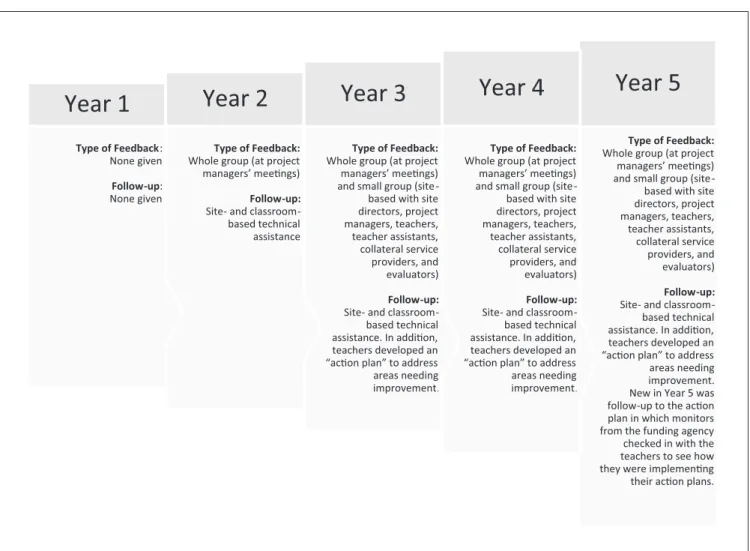
The following section describes the changes made during 2005 to 2010 to report the findings back to the project staff and to give them feedback (see Figure 2).
During Year 1, at the start of the project, the ELLCO instrument was the only classroom observation tool used to observe the classroom’s language and literacy environment. The observation occurred at the end of the school year and was conducted by T&TA, a collateral service provider, and not by the evaluation team.
Feedback to teachers began in Year 2 (2006-2007). It took the form of a whole-group approach in which feedback of classroom observation results was incorporated in monthly whole-group professional development workshops and train-ings attended by project managers. At these meettrain-ings, results were disseminated to the project managers who then deliv-ered them to teachers and teacher assistants at their centers. This was followed by site- and classroom-based targeted technical assistance provided by T&TA.
During Year 3 (2007-2008), the feedback approach changed and included both large-group and small-group for-mats. The evaluators presented the overall program results to project managers at project managers’ meetings in a whole-group format. Feedback of classroom observation results was further given in site-based, small-group “report card” meetings. The meetings were collaborative, with all stake-holders present (site directors, project managers, teachers, teacher assistants, collateral service providers, and evalua-tors). At these meetings, “report card” documents were issued and discussed. This was followed by targeted techni-cal assistance provided by collateral service providers to
Type of Feedback:
Whole group (at project managers’ meengs) and small group (site -based with site directors, project managers, teachers, teacher assistants, collateral service providers, and evaluators)
Follow-up:
Site- and classroom-based technical assistance. In addion, teachers developed an “acon plan” to address areas needing improvement. New in Year 5 was follow-up to the acon plan in which monitors from the funding agency checked in with the teachers to see how they were implemenng their acon plans.
Year 5
Type of Feedback:
Whole group (at project managers’ meengs) and small group (site -based with site directors, project managers, teachers, teacher assistants, collateral service providers, and evaluators)
Follow-up:
Site- and classroom-based technical assistance. In addion, teachers developed an “acon plan” to address areas needing improvement.
Year 4
Type of Feedback:
Whole group (at project managers’ meengs) and small group (site -based with site directors, project managers, teachers, teacher assistants, collateral service providers, and evaluators)
Follow-up:
Site- and classroom-based technical assistance. In addion, teachers developed an “acon plan” to address areas needing improvement.
Year 3
Type of Feedback:
Whole group (at project managers’ meengs)
Follow-up:
Site- and classroom-based technical assistance
Year 2
Type of Feedback:
None given
Follow-up:
None given
Year 1
individual sites. The “report card” format allowed for more one-on-one targeted support for staff as they learned of their areas of strengths and areas needing improvement.
During Year 4 (2008-2009), small-group feedback contin-ued where program staff received feedback from classroom observations in site-based, small-group report card meetings with all stakeholders present. Large-group feedback was also conducted with project managers. Similar to Year 3, feed-back was followed by targeted technical assistance provided by T&TA to individual sites. In addition, teachers developed an “action plan” to address areas needing improvement. The teachers were allowed to discuss the action plan and strate-gies to implement the plan at the report card meetings. This again allowed for more one-on-one targeted support for school staff as they learned of their areas of strengths and areas needing improvement.
During Year 5 (2009-2010), the small-group feedback approach continued. Similar to program Years 3 and 4, class-room observation feedback during Year 5 was given in site-based, small-group report card meetings. This again allowed for more one-on-one targeted support for program staff as they learned of their areas of strength and areas needing improve-ment. This was followed by targeted technical assistance pro-vided by collateral service providers to individual sites. Overall program results were also given at project managers’ meetings. During Year 5, teachers were again asked to develop and present an “action plan” around areas needing improve-ment. New in Year 5 was follow-up to the action plan in which monitors from the funding agency checked in with the teach-ers to see how they were implementing their action plans.
The action plan and monitoring were added to close the evaluation loop, making the evaluation process go full circle. As a result of the process changes over the 5-year period, the evaluation team was able to document desired changes based on conceptual use and instrumental use.
Conceptual use. Process changes through conceptual use involve conceptual behavior changes observed among teach-ers based on their awareness of being evaluated and their experience of the evaluation process. The process change occurs when teachers conceptually rethink activities that take place in the classroom. These changes were seen in a number of ways throughout the project cycle.
Conceptual changes were observed in the area of class-room practice. During the “report card” meetings, project staff received feedback about their strengths and weaknesses in the classroom in the areas of language and literacy activi-ties, and teacher–student interactions. Based on the feedback teachers received and their awareness of what constitutes a high-quality classroom, many positive changes were noted from pre- to post-observation. Teachers were allowed to review the findings and have input on action plans that out-lined specific activities for improvement. As a result, scores gradually increased across sites and classrooms from pre- to post-observation over the years.
Enhanced discourse among teachers was another area of conceptual change. Initially, during the evaluation and “report card” meetings, teachers had to become more famil-iar with evaluation and instructional terms and concepts. As a result of professional development training and collabora-tion among teachers at report card meetings, conceptual changes were observed in the understanding and use of terms and concepts related to issues around early childhood educa-tion (e.g., self- and parallel-talk, phonological awareness, scaffolding, and environmental print). Enhanced discourse was observed at trainings and “report card” meetings. This was clearly evident when teachers had to present their action plans and explain the strategies they would use to maintain their strengths and overcome their areas of weaknesses.
Intentional teaching among teachers was another area of conceptual change. To achieve the goals of a quality class-room and a smooth transition to kindergarten, teachers began to focus their attention on their instructional strategies in the classroom. After the “report card” meetings, teachers aimed to improve their scores and classroom quality through inten-tional teaching. Their strategies were all directed to effec-tively organize the classroom environment, engage students in language and literacy activities, and sustain cognitive growth in the classroom.
Conceptual change was also seen in teachers becoming more reflective practitioners. Through discussions and actions, teachers often expressed rethinking their teaching methods, approaches, and strategies to improve classroom quality.
Instrumental use. Changes in instrumental use can be defined as changes in the use of instruments and forms used as a result of the report card meetings. Based on the meetings with teachers and other stakeholders, changes occurred in the type and amount of details in “report card” notes given by evaluators to the teachers and other school staff about the classroom observation instruments. These changes occurred to increase the utility of the documents and feedback given to the teachers. Initial feedback from the Pre-K Documentation Form and Pre-K Assessment Report Card Questionnaire highlighted the fact that the notes and figures presented were not always clear. As responsive evaluators, we continued to modify the reports given to teachers to make the documents useful, understandable, and concise. As time progressed, teachers reported that they liked the specific feedback they received and the charts and explanation of findings. They also liked the clear descriptions of the notes and detailed explanations.
use to make quality improvements. Completing the action plan came with the support and assistance of team members like T&TA.
Lessons Learned
While evaluating PKP, we learned several things about con-ducting the evaluation in ways that would benefit teachers and school administrators. We used Brookhart’s (2008) types of feedback (e.g., timing, amount of feedback, mode, audi-ence, focus, content, function, and valence) to reflect on our experiences while conducting the evaluation. Our outcome as evaluators was to make this process useful and meaningful in a way that allowed teachers to develop professionally and improve classroom quality for all children. In the following discussion about lessons learned, we infuse the voices of staff and administrators from documentation forms and questionnaires collected during whole-group and small-group meetings.
Timing and Amount of Feedback
We learned that giving results to stakeholders in a timely manner was critical. It helped teachers to use the results to make improvements. We understood that feedback needed to be provided while teachers were still thinking about the goals of the project and working toward a learning target. There were a few instances where returning the results to the teach-ers in a delayed manner did not help them develop profes-sionally. When asked about what could be improved, one teacher responded, “The results could be provided earlier.” Another teacher indicated, “The reports and results need to be given back to us in a timely basis.” Yet, other school staff commented on the timing of the pre- and post-results, indi-cating “We would like to get baseline results soon to imple-ment improveimple-ment strategies before second observations.” Similarly, another teacher responded, “The turnaround time between pre- and post-assessments could be better.”
The amount of feedback provided was also very impor-tant. In some instances, we gave too much feedback and in other instances we gave too little. Over the years, we found ourselves adjusting our feedback reports to find the right bal-ance of information that would be useful to school staff. Feedback from teachers and administrators about the amount and quality of feedback they received assisted in this pro-cess. When asked about the amount of feedback received, one teacher noted, “more information on CLASS.” Another indicated, “more information on the scoring process.” One teacher talked about the level of details in the assessment and stated, “There needs to be more detail in the assessment as to what we need to work on.” For another teacher, the recom-mendation was, “More detail is always better.” Some teach-ers also voiced that they needed “examples of what to improve.” After adjusting the amount of feedback, one teacher expressed, “Examples of the behaviors that were
observed were given and examples were given in order to improve.”
Mode and Audience
Feedback can be delivered in many modalities. We found that a combination of modalities worked well. We used writ-ten and oral feedback to report back to teachers. Writwrit-ten feedback was disseminated in the form of “report cards” and oral feedback in the form of presentations to teachers, both in groups and individually. Feedback to teachers worked best when there was a clear sense of the make-up of the audience (i.e., teacher and teacher assistants, project managers) to con-vey the right feedback. There were some instances when group feedback worked well (e.g., when giving overall results for the program) and other times when it did not (e.g., when focusing on specific strategies). We had to be aware of these instances and make decisions about how to give effec-tive feedback based on the audience type and approach.
Regarding the mode and audience, one teacher indicated, “The [small group] meeting was interactive, open, and infor-mative.” One administrator stated that in addition to the loca-tion of the meeting, she liked “. . . the format of the meeting and conversation style.” Another said, “The group size per-mitted ‘real’ conversations.” Yet, another teacher indicated, “I like the support provided and the roundtable discussions.”
Feedback Focus and Content
of the day’ part that observers score or tally.” Yet another teacher agreed and expressed, “The presenter explained every aspect of the assessments.”
Function and Valence
The function of the feedback given was to describe what we saw with supporting evidence. We did not evaluate or judge teachers’ practices in any way that would stop them from try-ing to make improvements. The objective was to express what we observed during classroom observations and iden-tify areas of strength and areas needing improvement. We ensured that the feedback we gave to teachers was positive and non-punitive. We always began the discussion by high-lighting the teacher’s strengths, then discussing areas need-ing improvement. In addition, we offered useful teachneed-ing strategies and gave suggestions for improvements as a team. The teachers and administrators often expressed they liked that the meetings were professional and challenged the staff to self-reflect and think about how to implement strategies for improvement. As one teacher said, “It was a stress-free meeting.” Yet another teacher indicated, “The meeting was held in a more relaxed state.” One administrator indicted, “I appreciated that the information was not viewed as punitive and the goal was to work together as a team.” Another admin-istrator responded, “The meeting was presented as a place for all to listen and respond (without penalty) and receive clarity.” A teacher agreed, “It [the meeting] was not punitive and the teachers were given the opportunity to express their concerns.” Some teachers felt that because of the tone of the meeting, “it challenged the staff to self-reflect and think about how to implement strategies for improvement.” Similarly, another teacher expressed, “All attendees were professional and listened to teachers’ concerns.” Another teacher indicated that the meetings allowed for “. . . self-reflection and a plan of action.”
Overall, we learned that there were several things we needed to keep in mind. We had to provide timely and prompt feedback to teachers and other early learning staff so that they could implement recommendations and suggestions in real time. Feedback to teachers also needed to be of high quality in focus and content in all settings (e.g., face-to-face or group). Feedback needed to be professionally presented and non-punitive at all times. We learned that a collaborative and responsive team approach always worked best. In our feedback meetings at the sites, we met as a team with the teacher, teacher assistant, director, collateral service provid-ers, and the funder. As a result, feedback came from different professional perspectives all in an effort to assist and support teachers to improve their instruction and classroom quality. We further learned that information given to teachers needed to be concise and useful. Teachers liked information pre-sented in graphs, figures, visuals, and summaries. Teacher involvement in meetings was integral and teachers needed to
use the feedback given to develop, sometimes with support, action plans to close the feedback loop.
Conclusion
From the multiyear PKP case example, we learned that an evaluation that considers teacher feedback, social justice, and utility can have positive outcomes for all stakeholders and will likely lead to higher quality early childhood educa-tion programs. Teachers who are provided with ongoing high-quality feedback that is immediate, specific, positive, and corrective, and that include mentoring and coaching, are much more effective in producing high-quality teaching and learning environments. An evaluation that promotes a demo-cratic sense of justice based on the inter-related principles of inclusion, dialogue, and deliberation ensures that there is dignity, equality, justice, and a shared sense of responsibility and collaboration for all stakeholders involved in the early learning environment. A focus on the meaningful use of eval-uations could result in positive conceptual and instrumental changes seen in classroom practice, discourse, and inten-tional and reflective teaching. From our multiyear PKP eval-uation process and based on our evaleval-uation model, we have become cognizant of the need to conduct REs that integrate the key notions of teacher feedback, social justice, and utility to enhance classroom quality.
Acknowledgments
We wish to acknowledge sites participating in the community-based Pre-K Project evaluation and researchers from the Howard University Center for Urban Progress.
Declaration of Conflicting Interests
The author(s) declared no potential conflicts of interest with respect to the research, authorship, and/or publication of this article.
Funding
The author(s) disclosed receipt of the following financial support for the research and/or authorship of this article: The Pre-K Project evaluation was supported by a grant from the District of Columbia Office of the State Superintendent of Education (OSSE), Division of Early Learning.
References
Abma, T. A., & Stake, R. E. (2001). Stake’s responsive evaluation:
Core ideas and evolution. New Directions for Evaluation, 92,
7-21.
Barnett, W. S., Carolan, M. E., Fitzgerald, J., & Squires, J. H.
(2011). The state of the preschool 2011: State preschool
year-book. New Brunswick, NJ: The National Institute for Early
Education Research.
Barnett, W. S., & Yarosz, D. J. (2007). Who goes to preschool
and why does it matter? (Preschool Policy Brief, Issue 15).
Better Evaluation. (2012). Utilization-focused evaluation. Retrieved from http://betterevaluation.org/plan/approach/utili-zation_focused_evaluation
Brookhart, S. M. (2008). How to give effective feedback to your
students. Alexandria, VA: Association for Supervision and
Curriculum Development.
Camilli, G., Vargas, S., Ryan, S., & Barnett, W. (2010). Meta-analysis of the effects of early education interventions on
cog-nitive and social development. Teachers College Record, 112,
579-620.
Center for Teaching Excellence. (2012). Receiving and giving
effective feedback. Waterloo, Ontario, Canada: University
of Waterloo. Retrieved from https://uwaterloo.ca/centre-for-teaching-excellence/teaching-resources/teaching-tips/ assessing-student-work/grading-and-feedback/receiving-and-giving-effective-feedback
Ferguson, R. F. (2007). Toward excellence with equity: An
emerg-ing vision for closemerg-ing the achievement gap. Cambridge, MA:
Harvard Education Press.
Gilliam, W., & Leiter, V. (2003, July). Evaluating early
child-hood programs: Improving quality and informing policy. Zero
to Three. Retrieved from http://main.zerotothree.org/site/
DocServer/vol23-6a.pdf?docID=2470
Goldsmith, S., & Meyer, E. (2006). Pre-k: Shaping the system that
shapes children (Civic Bulletin, No. 42). Manhattan Institute
for Policy Research. Retrieved from http://www.manhattan-institute.org/html/cb_42.htm
Green, R. D., & McKie, B. K. (2007). First year process
evalu-ation of the pre-kindergarten incentive program 2005
2006. Washington, DC: Center for Urban Progress, Howard
University.
Green, R. D., McKie, B. K., & Manswell Butty, J. L. (2008).
Evaluation of the pre-kindergarten incentive program: 3rd
year report 2007-2008. Washington, DC: Center for Urban
Progress, Howard University.
Green, R. D., McKie, B. K., & Manswell Butty, J. L. (2009).
Evaluation of the pre-kindergarten incentive program: 4th
year report 2008-2009. Washington, DC: Center for Urban
Progress, Howard University.
Green, R. D., McKie, B. K., & Manswell Butty, J. L. (2010).
Evaluation of the pre-kindergarten enhancement and
expan-sion program: Year 5 report 2009-2010. Washington, DC:
Center for Urban Progress, Howard University.
Hamid, Y., & Mahmood, S. (2010). Understanding constructive feedback: A commitment between teachers and students for
academic and professional development. Journal of Pakistan
Medical Association, 60, 224-227.
Hamre, B. K., & Pianta, R. C. (2005). Can instructional and emotional support in the first grade classroom make a difference for children
at risk of school failure? Child Development, 76, 949-967.
Hattie, J., & Timperley, H. (2007). The power of feedback. Review
of Educational Research, 77, 81-112.
House, E. R., & Howe, K. R. (1999). Values in education and social
research. Thousand Oaks, CA: SAGE.
Hustedt, J. T., Barnett, W. S., Jung, K., & Friedman, A. H. (2010).
The New Mexico pre-k evaluation: Impacts from the fourth year
(2008-2009) of New Mexico’s state-funded pre-k program.
New Brunswick, NJ: National Institute for Early Education Research, Rutgers University.
Isaacs, J. B., & Roessel, E. (2008). Impact of early childhood
pro-grams. Retrieved from http://www.brookings.edu/research/
papers/2008/09/early-programs-isaacs
Kamara, B., Sykes, M., & Young, A. (2004, February).
Pre-kindergarten incentive initiative for the District of Columbia:
Concept paper. Paper presented to the Superintendent of the
District of Columbia Public Schools, Washington, DC. Lambart, R., Rowland, B., Taylor, H., & Wheeler, C. (2010).
Resource manual for administrators and principals
super-vising and evaluating teachers of young children. Charlotte,
NC: Center for Educational Measurement and Evaluation, The University of North Carolina at Charlotte.
Landry, S. H., Swank, P. R., Smith, K. E., Assel, M. A., & Gunnewig, S. B. (2006). Enhancing early literacy skills for pre-school children: Bringing a professional development model to
scale. Journal of Learning Disabilities, 39, 306-324.
Lowenstein, A. E. (2011). Early care and education as educational panacea: What do we really know about its effectiveness?
Educational Policy, 25, 92-114.
Manswell Butty, J. L., Reid, M. D., & LaPoint, V. (2004). A cultur-ally responsive evaluation applied to the talent development school-to-career intervention program. In V. G. Thomas & F.
I. Stevens (Eds.), New Directions for Evaluation: Vol. 101.
Co-constructing a contextually responsive evaluation
frame-work: The talent development model of school reform (pp.
37-47). NJ: Jossey Bass.
Melhuish, E. C. (2011). Preschool matters. Science, 333, 299-300.
doi:10.1126/science.1209459
Mielke, P., & Frontier, T. (2012). Keeping improvement in mind.
Educational Leadership, 70(3), 10-13.
National Association for the Education of Young Children. (2003).
Early childhood curriculum, assessment, and program: Building an effective, accountable system in programs for
chil-dren birth through age 8. Retrieved from http://www.naeyc.
org/files/naeyc/file/positions/pscape.pdf
National Association for the Education of Young Children. (2012).
The common core state standards: Caution and opportunity for
early childhood education. Washington, DC: Author.
National Education Association Policy Brief. (2010). Raising the
standards for early childhood professionals will lead to
bet-ter outcomes. Washington, DC: NEA Education Policy and
Practice Department, Center for Greater Public Schools.
Patton, M. Q. (2013). Utilization-Focused Evaluation (U-FE)
Checklist. Evaluation Checklists Project. Retrieved from http://
www.wmich.edu/sites/default/files/attachments/u350/2014/ UFE_checklist_2013.pdf
Patton, M. Q., & Horton, D. (2009). Utilization-focused evaluation
for agricultural innovation (Institutional Learning and Change
Brief No. 22). Retrieved from http://www.cgiar-ilac.org/files/ ILAC_Brief22_Utilization_Focus_Evaluation.pdf
Peisner-Feinberg, E. S., & Schaaf, J. M. (2008). Evaluation of the
North Carolina More at Four Pre-Kindergarten Program:
Performance and progress in the seventh year (2007-2008).
Chapel Hill, NC: FPG Child Development Institute.
Pianta, R. C., Mashburn, A. J., Downer, J. T., Hamre, B. K., & Justice, L. (2008). Effects of web-mediated professional devel-opment resources on teacher-child interactions in
pre-kinder-garten classrooms. Early Childhood Research Quarterly, 23,
Rashid, H. (2013). Significant-but not sufficient: Quality early childhood education and the development of young African American boys. In National Black Child Development Institute
(Ed.), Being black is not a risk factor: A strengths-based look
at the state of the Black child (pp. 28-31). Washington, DC:
National Black Child Development Institute.
Reynolds, A. J., Temple, J. A., Ou, S., Arteaga, I. A., & White, B. A. B. (2011). School-based early childhood education and age-28 well-being: Effects by timing, dosage, and subgroups.
Science, 333, 360-364.
Scheeler, M. C., Ruhl, K. L., & McAfee, J. K. (2004). Providing
per-formance feedback to teachers: A review. Teacher Education
and Special Education, 27, 396-407.
Stake, R. E. (2004). Standards-based and responsive evaluation.
Thousand Oaks, CA: SAGE.
Stuhlman, M. W., Hamre, B. K., Downer, J. T., & Pianta, R. C. (n.d.).
How classroom observations can support systematic
improve-ment in teacher effectiveness. Charlotteville, VA: Curry School
of Education, The University Center for Advanced Study of Teaching and Learning, The University of Virginia.
Thomas, V. G. (2004). Building a contextually responsive
evalua-tion framework. In V. G. Thomas & F. I. Stevens (Eds.), New
Directions for Evaluation: Vol. 101. Co-constructing a contex-tually responsive evaluation framework: The talent
develop-ment model of school reform (pp. 3-24). NJ: Jossey Bass.
Thomas, V. G., & McKie, B. K. (2006). Collecting and utilizing evaluation research for public good and on behalf of African
American children. Journal of Negro Education, 75, 341-352.
Weisberg, D., Sexton, S., Mulhern, J., & Keeling, D. (2009). The
widget effect: Our national failure to acknowledge and act on
differences in teacher effectiveness. New York, NY: The New
Teacher Project. Available from http://www.widgeteffect.org
Weiss, H. (2004). From the director’s desk. The Evaluation
Exchange, XI(3). Retrieved from
http://www.hfrp.org/about-hfrp/staff/heather-b.-weiss
Williamson, F. (2012). The importance of effective feedback.
University of Western Sidney. Retrieved from http://www. uws.edu.au/qilt/qilt/teaching_practice/staff_feedback_toolkit/ the_importance_of_effective_feedback
Author Biographies
Jo-Anne L. Manswell Butty, PhD, is a program director at the Research and Evaluation Division, Center for Urban Progress, Howard University and co-director of the Pre-K Enhancement and Expansion Program and Child Care Subsidy Program Evaluations.
Lucy A. Wakiaga, EdD, is a research associate at the Center for Urban Progress, Howard University. She oversees data manage-ment and conducts classroom observation research for the Pre-K Enhancement and Expansion Program and Child Care Subsidy Program Evaluations.
Brooke K. McKie, PhD, is a program director at the Research and Evaluation Division, Center for Urban Progress, Howard University and co-director of the Pre-K Enhancement and Expansion Program and Child Care Subsidy Program Evaluations.
Veronica G. Thomas, PhD, is a professor in the Department of Human Development and Psychoeducational Studies, School of Education, Howard University. She is also a member of the senior research team of the Pre-K Enhancement and Expansion Program and Child Care Subsidy Program Evaluations.
Rodney D. Green, PhD, is a professor, chair, and executive direc-tor of the Center for Urban Progress, Department of Economics, Howard University. He is the principal investigator of the Pre-K Enhancement and Expansion Program and Child Care Subsidy Program Evaluations.
Neilabh Avasthi,MEd, is a research assistant at the Center for Urban Progress, Howard University. He oversees data quality con-trol and conducts classroom observations for Pre-K Enhancement and Expansion Program and Child Care Subsidy Program Evaluations.