Correspondence: A. M. Souza. Departamento de Análises Clínicas, Toxicológi-cas e BromatológiToxicológi-cas, Faculdade de Ciências FarmacêutiToxicológi-cas de Ribeirão Preto – USP. Avenida do Café s/n - Monte Alegre - 14040-903 - Ribeirão Preto - SP, Brasil. E-mail: [email protected].
A
vol. 47, n. 4, oct./dec., 2011
Deregulated expression of
A1, Bcl-2, Bcl-x
L, and
Mcl-1
antiapoptotic proteins and
Bid, Bad,
and
Bax
proapoptotic genes in
polycythemia vera patients
Elainy Patricia Lino Gasparotto
1, Raquel Tognon
1, Aline Fernanda Ferreira
1, Gislane Lelis Vilela
Oliveira
1, Patrícia Vianna Bonini Palma
4, Maria Aparecida Zanichelli
2, Elizabeth Xisto Souto
2,
Carlos Eduardo Engel Velano
3, Belinda Pinto Simões
3, Rita de Cassia Viu Carrara
4, Simone
Kashima
4, Dimas Tadeu Covas
3,4, Fabíola Attie de Castro
1, Ana Maria de Souza
1,*1Department of Clinical Analyses, Toxicology and Food Sciences, Faculty of Pharmaceutical Sciences of Ribeirão Preto, University
of São Paulo; 2Brigadeiro Hospital, São Paulo3, Department of Clinical Medicine, Faculty of Medicine of Ribeirão Preto, University
of São Paulo; 4Hemotherapy Center of Ribeirão Preto, School of Medicine of Ribeirão Preto, University of São Paulo
Apoptosis deregulation might have a role in the pathophysiology of polycythemia vera (PV). This study evaluated Bcl-2 molecule expression in CD34+ cells and leukocytes in 12 PV patients. Gene expression was investigated by real time PCR using SybrGreen Quantitect kit and protein expression was evaluated by western-blotting. JAK2 V617F mutation was detected according to Baxter et al (2005). CD34+ cells from PV patients presented higher levels of A1 and Mcl-1 expression (median: 22.6 and 5.2, respectively) in comparison with controls (0.9 and 0.5, p=0.004 and p=0.020); while Bcl-2 and Bcl-xLexpression
decreased in PV patients (0.18 and 1.19) compared with controls (1.39 and 2.01, p=0.006 and p=0.020). CD34+ cells in PV patients showed an elevated Bid expression (14.4) in comparison with healthy subjects (1.0; p=0.002). Patients’ leukocytes showed an A1 augmentation (7.41, p=0.001) and a reduced expression of Bax (0.19; p=0.040) and Bad (0.2; p=0.030). There was no correlation between JAK2 V617F allele burden and molecular expression. PV patients showed alterations in Bcl-2 members’ expression, which may interfere with control of apoptotic machinery and contribute to disease pathogenesis.
Uniterms: Polycythemia vera. Gene mutation. Gene expression. Apoptosis. Bcl-2 family members.
A desregulação da apoptose parece participar da isiopatologia da policitemia vera (PV). Este estudo avaliou a expressão das moléculas da família Bcl-2 em células hematopoéticas CD34 + e leucócitos de 12 pacientes com PV. Foram realizados: a quantiicação da expressão gênica por PCR em tempo real utilizando kit Sybrgreen Quantitect, avaliação da expressão de proteínas por western-blot e detecção da mutação JAK2 V617F segundo Baxter et al. (2005). Células CD34 + dos pacientes com PV apresentaram maior expressão de A1 e Mcl-1 (mediana: 22,6 e 5,2, respectivamente) em comparação com controles (0,9 e 0,5, p = 0,004 e p = 0,020) e expressão de Bcl-2 e Bcl-xL diminuída nestes pacientes (0,18 e 1,19) em relação aos controles (1,39 e 2,01, p = 0,006 e p = 0,020). Células CD34 + dos pacientes com PV mostraram expressão elevada de bid (14,4) em comparação aos controles (1,0; p = 0,002). Leucócitos dos pacientes mostraram aumento de A1 (7,41, p = 0,001) e expressão reduzida do Bax (0,19; p = 0,04) e Bad (0,2; p = 0,030). Não houve correlação entre percentagem de alelos JAK2 V617F mutados e expressão molecular. Pacientes com PV apresentaram alterações na expressão de moléculas Bcl-2 que podem interferir no controle da apoptose e contribuir para a patogênese da doença.
INTRODUCTION
The 2001 WHO classiication considered that the
major myeloproliferative disorders (MPDs) are: chronic myelogenous leukemia (CML), polycythemia vera (PV), essential thrombocythemia (ET), and idiopathic
myelo-ibrosis (IMF). The discovery of a mutation in the Janus
kinase led to an understanding of the pathogenesis of the classic MPDs.In 2008the WHO classiication revisions reorganized the MPDs into myeloproliferative neoplasms (MPNs) (Tefferi, Vardinam, 2008; Wadleigh, Tefferi, 2010).
Polycythemia vera is a clonal disorder arising in a multipotent hematopoietic progenitor cell, exhibiting ac-cumulation of normal red and white cells, platelets, and
their progenitors in the absence of a deinable stimulus.
The hallmark of PV is the trilineage hematopoietic cell hyperplasia, but erythrocytosis is its most remarkable clinical manifestation (Spivak, 2002).According the 2008 WHO guidelines, the major PV diagnostic criteria are: hemoglobin levels > 18.5 g/dL in men, 16.5 g/dL in women or other evidence of increased red cell volume and presence of the Janus kinase 2 mutation (JAK2 V617F), or other functionally similar mutation such as JAK2 exon 12 mutation. The minor PV diagnostic criteria are: bone marrow biopsy showing hypercellularity with trilineage myeloproliferation; serum erythropoietin (EPO) level below the normal reference range; in vitro endogenous ery-throid colony (EEC) formation. Diagnosis de PV requires meeting either both major criteria and one minor criterion
or the irst major criterion and two minor criteria (Tefferi,
Vardinam, 2008; Wadleigh, Tefferi, 2010).
The JAK2 V617F somatic mutation has been
detect-ed in 95% of PV patients and in 40 to 60% of ET or IMF patients. It is responsible for the activation of downstream
target genes of JAK/STAT pathways, which seem to be linked to cell apoptosis impairment. Furthermore, there are indications that there may be an association between the mutation status, PV pathogenesis, and prognosis. The JAK2 V617F homozygous mutation could promote the development of a polycythemic phenotype, since homo-zygosis for the JAK2 mutation occurs in roughly 30% of patients with PV (Baxter et al., 2005; James et al., 2005; Kralovics et al., 2005; Levine et al., 2005; Levine et al., 2007).
Notwithstanding the new knowledge about PV and the description of new prognostic and diagnostic mark-ers, the etiology and pathogenesis of this disease remains unclear. The mechanisms involved in PV molecular basis
are still elusive. It seems that PV is a myeloaccumulative
disorder rather than a myeloproliferative disorder (Spivak,
2002). In this context, we postulate that apoptosis deregu -lation may have a role in its pathophysiology.
Apoptosis could be triggered by mitochondrial
(intrinsic) and death receptor (extrinsic) pathways. In the
intrinsic pathway, cytochrome c is released upon stimula-tion by a variety of cell-death triggers such as ultra violet light, cellular stress, chemotherapy, virus infection, cyto-kine deprivation, and DNA damage. Cytochrome c release, in turn, leads to activation of Apaf-1 (apoptosis protease activating factor-1), caspase-9, and caspase-3 (Borner, 2005;Jin; El Deiry, 2005; Yan, Shi, 2005).
The extrinsic apoptotic pathway involves the inter-action of death receptors such as Fas and caspase-8, which lead to caspase-3 activation and cell death by apoptosis (Fulda; Debatin, 2006).Cell apoptotic machinery is mainly regulated by Bcl-2 family members (Borner, 2005), proba-bly acting through the control of mitochondrial membrane permeability. Bcl-2 members could be divided in pro- (Bid, Bik, Bim, Bmf, Bok, Puma, Noxa, Bak, Bad, and Bax) and anti- apoptotic (A1, Bcl-2, Bcl-xL, Mcl-1,and Bcl-w) molecules (Borner, 2005; Sharper, Arnoult, Youle, 2004).
The association between PV pathogenesis and apoptosis has been poorly investigated but its role in other myeloproliferative diseases was well established. The A1 protein seems to have an important role in the pathogenesis in several B-cell malignancies and acute leukemias(Simpson et al., 2006; Brien et al., 2007).The literature reports the association of the overexpression of the Mcl-1 antiapoptotic molecule with solid tumors, chronic lymphocytic leukemia, and chronic myeloid leu-kemia pathogenesis and with resistance to chemotherapy (Kitada, Reed, 2004). Economopoulos et al. (2008) described an increase in A1 and Mcl-1 mRNA levels in blastic cells of myelodysplastic syndrome patients. Del Poeta et al.(2008)reported an increase in the expression of Bcl-2, Bcl-xL and Mcl-1 in acute myeloid leukemia. Zhang et al.(2004)showed that CD34+ cells from ET patients presented a high expression of Bcl-xL in the initial differentiation phase of megakaryocytes induced by thrombopoietin.
Zeuner et al. (2006)reported that PV patients had abnormal erythropoiesis, EPO independence or hyper-sensitivity, and c-Flip overexpression, which could have contributed to apoptosis resistance and erythropoiesis alteration in some patients with the disease. Garçon et al. (2006)observed that only a sustained level of Bcl-xL
is capable of giving rise to Epo-independent erythroid colony formation suggesting that, in PV patients, JAK2 V617F may induce EEC via the STAT5/Bcl-xL pathway;
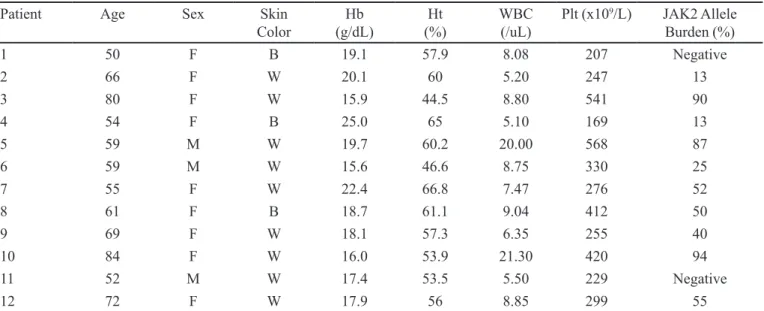
TABLE I - Demographic features, hematological parameters, and JAK2 V617F allele burden from PV patients
Patient Age Sex Skin
Color
Hb (g/dL)
Ht (%)
WBC (/uL)
Plt (x109/L) JAK2 Allele
Burden (%)
1 50 F B 19.1 57.9 8.08 207 Negative
2 66 F W 20.1 60 5.20 247 13
3 80 F W 15.9 44.5 8.80 541 90
4 54 F B 25.0 65 5.10 169 13
5 59 M W 19.7 60.2 20.00 568 87
6 59 M W 15.6 46.6 8.75 330 25
7 55 F W 22.4 66.8 7.47 276 52
8 61 F B 18.7 61.1 9.04 412 50
9 69 F W 18.1 57.3 6.35 255 40
10 84 F W 16.0 53.9 21.30 420 94
11 52 M W 17.4 53.5 5.50 229 Negative
12 72 F W 17.9 56 8.85 299 55
Abbreviations: PV, polycythemia vera; M, male; F, female, Hb, hemoglobin; Ht, hematocrit; WBC, white blood cell count; Plt, platelets; W, white; B, black.
survival.Deregulated erythropoiesis in PV involves EPO hypersensitivity and apoptosis resistance of erythroid precursor cells associated with abnormally increased acti-vation of RAS-ERK and phosphoinositide-3 kinase-AKT pathways (Laubach et al., 2009).
These literature observations are leading investi-gators to focus on studies to understand how cell death deregulation is relevant to the neoplasm’s pathophysiol-ogy and to develop more effective therapeutic strategies. Therefore, the objective of this study was to investigate the expression of genes and proteins of Bcl-2 family members in CD34+ hematopoietic stem cells and leukocytes in PV patients and healthy subjects. The potential correlation between gene and protein expression with JAK2 muta-tion allele burden and lymphocyte resistance to apoptosis is also analyzed.
SUBJECTS AND METHODS
Patients and controls
Twelve PV patients, not treated, were evaluated in this study and included only when PV diagnosis was confirmed according to the 2008 WHO criteria.Their demographic and clinical-laboratorial parameters are
de-scribed in Table I. The patients’ mean age was 63.4 years
old (range 50-84 years). Three males and nine females were included in the study.
Peripheral blood samples were provided by healthy subjects recruited at the Faculty of Pharmaceutical
Sciences, University of São Paulo (USP) at Ribeirão Preto. Marrow donors were obtained at the Bone Marrow Transplantation Unit of the University Hospital, Faculty of Medicine of Ribeirão Preto-USP. The samples were collected from 19 healthy subjects, whose mean age was 38.4 years old (range 14-54 years), 12 males and 7 females. Leukocytes were obtained from 14 healthy individuals, 5 males and 9 females, whose mean age was 54.4 years (range 41-80 years). The local ethics committee approved the study and all samples were collected after the subjects
signed the Informed Consent Form.
Peripheral blood mononuclear cell and leukocyte separation
Peripheral blood mononuclear cells (PBMC) were isolated by the Ficoll-Hypaque method (His-topaque®-1077, Sigma, St. Louis, Missouri, USA) accord-ing to instructions by the manufacturer and as described by Boyum (1976).
Peripheral blood leukocytes were obtained from pa-tients and controls using Haes-Steril® reagent (Voluven®,
Frasenius Kabi, Campinas, Brazil). Briely, the peripheral
CD34+ hematopoietic stem cell isolation
Bone marrow mononuclear cells were separated by Ficoll-Hypaque centrifugation (Histopaque®-1077, Sigma, St. Louis, MO, USA) and CD34+ hematopoietic stem cells (HSC) were obtained by positive selection us-ing an immunomagnetic column accordus-ing to the manu-facturer’s protocol (MACS, Milteny Biotec, Bergisch Gladbach, Germany).
After selection, the purity of CD34+ HSC was
veri-ied by low cytometry. CD34+ HSC population’s purity
was more than 91.80% in bone marrow transplantation donors and 87.06% in PV patients.
SDS-PAGE and western-blot analysis
Peripheral leukocytes (2x10⁹cel/L) from 4 healthy individuals and 4 PV patients were chosen to represent and investigate the results obtained by gene expression. The samples were chosen because we have more leukocyte aliquots from them than the others patients and because according to gene expression results they present a gene expression close to the median value of the evaluated mol-ecule, which were washed once in ice-cold PBS, lysed di-rectly in SDS-sample buffer (50 mM Tris-HCl, pH 6.8, 2% SDS, 10% glycerol, 2.5% β-mercaptoethanol) and boiled for 5 min. Samples were resolved under reducing condi-tions for two hours at 80 volts in SDS-polyacrylamide gels. Separated proteins then were blotted onto polyvinylidene
difluoride (PVDF) membranes (Pierce, Rockford, IL,
USA) at 500 mA for two hours. Blots were blocked over-night in TBST buffer (10 mM Tris-HCl, pH 7.4, 150 mM NaCl, 0.05% Tween) containing 0.1% sodium azide and 5% non fat dried milk and then probed during two hours or overnight with an appropriate dilution of A1 polyclonal antibody (Santa Cruz, Santa Cruz, California, USA), Bad
monoclonal antibody (PharmingenTM BD Biosciences, San Diego, California, USA), Bcl-xL polyclonal antibody
(Biotechnology.Inc Santa Cruz, California, USA), and
Bim polyclonal antibody (PharmingenTM BD Biosci-ences). Proteins reactions to primary antibody were sec-ondary antibody conjugated to horseradish peroxidase
(GE Amersham, Arlington, IL, USA) using enhanced
chemiluminescence (GE Amersham). A semi-quantitative assessment of protein expression was performed by band relative densities detection using the Alphaease software
(Alpha Inotech, San Leandro, California, USA). Protein
expressions were normalized by β-actin (Sigma-Aldrich,
St. Louis, Missouri, USA) or β-tubulin (Sigma-Aldrich)
endogenous expression. The densitometry methodology was applied to quantify the proteins, which were expressed
by integrated density value (IDV). The protein expression
results are presented as supplementary data.
Total RNA extraction, cDNA synthesis and real time PCR
Leukocyte and CD34+ HSC total RNAs were obtained according to the Trizol protocol. RNA concentration and
purity was determined by measuring luorescence at 260 nm
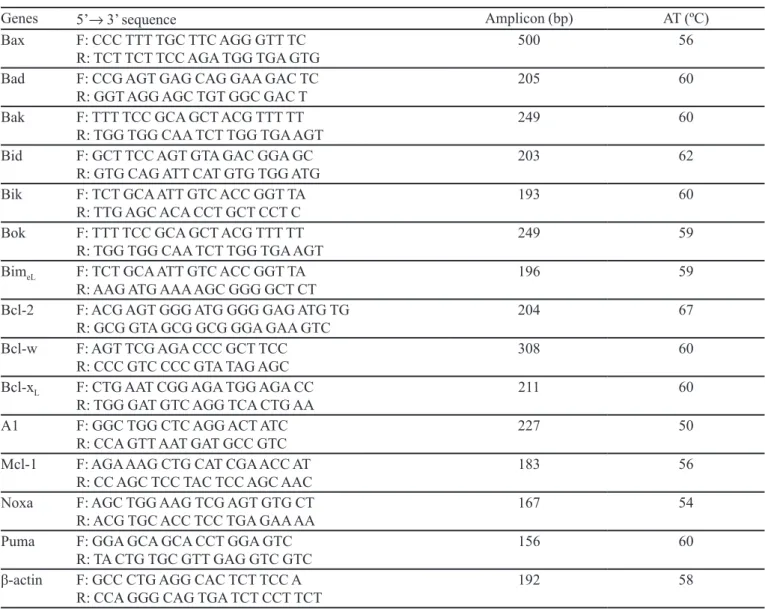
and 280 nm. One microgram of RNA was used for cDNA synthesis by High Capacity cDNA Reverse Transcription Kit (Applied Biosystems, Foster City, CA, USA), according to manufacturer instructions. Real time PCR assay was car-ried out in cDNA to determine proapoptotic (Bad, Bak, Bax, Bid, Bik, Bim-EL, and Bok) and antiapoptotic gene expression
(Bcl-2, Bcl-xL, Bcl-w, Mcl-1, and A1) using SybrGreen PCR Master Mix Kit (Applied Biosystems), specific primers
(Table II), and ABIPrism 7700 (Applied Byosytems).
Βeta-actin gene was used as housekeeping genes and the results were given as 2-∆∆Ct. Beta-actin was chosen as a housekeep-ing gene because its expression is high in hematopoietic cells and it has a minimal expression variability between the samples evaluated in this study.
JAK2/V617F mutation detection and allele burden calculation
The JAK2 V617F mutation was detected by real time PCR according to Baxter et al. (2005)and the results were presented as negative or allele burden of JAK2 posi-tive mutation.
Apoptosis resistance assay
Mononuclear cells from patients and controls were cultured with 2µg/mL of phytohemagglutinin (Sigma,
St. Louis, MO, USA) in complete RPMI 1640 medium
(Sigma) supplemented with 10% bovine fetal serum, 10mM HEPES, 2mM L-glutamine, 100units/mL of peni-cillin and 100ug/mL streptomycin, at 37 ºC in a 5% CO2 during three days.
Then, the mononuclear cells were treated with apop-tosis inducers such as: actinomycin (ACT, 1 and 5 µM, Sigma-Aldrich), cycloheximide (CHX, 25 and 50 µM, Sigma-Aldrich), cytarabine (ARA-C, 25µM, Pfizer®,
Milan, Italy), etoposide (VP-16, 25µM, Bristol-Meyers-Squibb®, Mayaquez, Porto Rico), teniposide (VM-26, 25 µM, Bristol-Meyers-Squibb®), staurosporine (STS, 1 and 5 µM, Sigma-Aldrich) for twelve hours.
TABLE II - Primers sequences, amplicon size and their speciic annealing temperature for quantitative real-time PCR
Genes 5’→ 3’ sequence Amplicon (bp) AT (ºC)
Bax F: CCC TTT TGC TTC AGG GTT TC
R: TCT TCT TCC AGA TGG TGA GTG
500 56
Bad F: CCG AGT GAG CAG GAA GAC TC
R: GGT AGG AGC TGT GGC GAC T
205 60
Bak F: TTT TCC GCA GCT ACG TTT TT
R: TGG TGG CAA TCT TGG TGA AGT
249 60
Bid F: GCT TCC AGT GTA GAC GGA GC
R: GTG CAG ATT CAT GTG TGG ATG
203 62
Bik F: TCT GCA ATT GTC ACC GGT TA
R: TTG AGC ACA CCT GCT CCT C
193 60
Bok F: TTT TCC GCA GCT ACG TTT TT
R: TGG TGG CAA TCT TGG TGA AGT
249 59
BimeL F: TCT GCA ATT GTC ACC GGT TA
R: AAG ATG AAA AGC GGG GCT CT
196 59
Bcl-2 F: ACG AGT GGG ATG GGG GAG ATG TG
R: GCG GTA GCG GCG GGA GAA GTC
204 67
Bcl-w F: AGT TCG AGA CCC GCT TCC
R: CCC GTC CCC GTA TAG AGC
308 60
Bcl-xL F: CTG AAT CGG AGA TGG AGA CC
R: TGG GAT GTC AGG TCA CTG AA
211 60
A1 F: GGC TGG CTC AGG ACT ATC
R: CCA GTT AAT GAT GCC GTC
227 50
Mcl-1 F: AGA AAG CTG CAT CGA ACC AT
R: CC AGC TCC TAC TCC AGC AAC
183 56
Noxa F: AGC TGG AAG TCG AGT GTG CT
R: ACG TGC ACC TCC TGA GAA AA
167 54
Puma F: GGA GCA GCA CCT GGA GTC
R: TA CTG TGC GTT GAG GTC GTC
156 60
β-actin F: GCC CTG AGG CAC TCT TCC A
R: CCA GGG CAG TGA TCT CCT TCT
192 58
Abbreviations: AT: annealing temperature; bp: base pair; F: forward; R: reverse.
10 minutes, 4 ºC), washed once with annexin buffer (10 mM HEPES pH 7.4; 150 mM NaCl; 5 mM KCl; 1 mM MgCl2; 1,8 mM CaCl2) and incubated for 20 minutes with 100 µL
of Annexin-V FITC. Subsequently, ten thousand cells
were acquired with 40 µL of a propidium iodide solution (50 µg/mL) and the data were analyzed by the DIVA soft -ware in a FACSCanto Flow Cytometer (Becton & Dickin-son, San Jose, CA, USA). The results were expressed as
percentage of apoptotic cells labeled with Annexin-V-FITC.
Statistical analysis
The Mann Whitney U-test was used to determine statistical differences in gene expression and protein expression between controls and PV patients. The Spear-man’s correlation test was carried out to detect the
associa-tions of JAK2 V617F allele burden and gene expression, JAK2 V617F allele burden and percentage of apoptotic mononuclear cells, and gene expression and percentage of apoptotic mononuclear cells. The results were considered
statistically signiicant when p values were < 0.05.
RESULTS
Gene expression of Bcl-2 family members in
hematopoietic stem cells and peripheral leukocytes
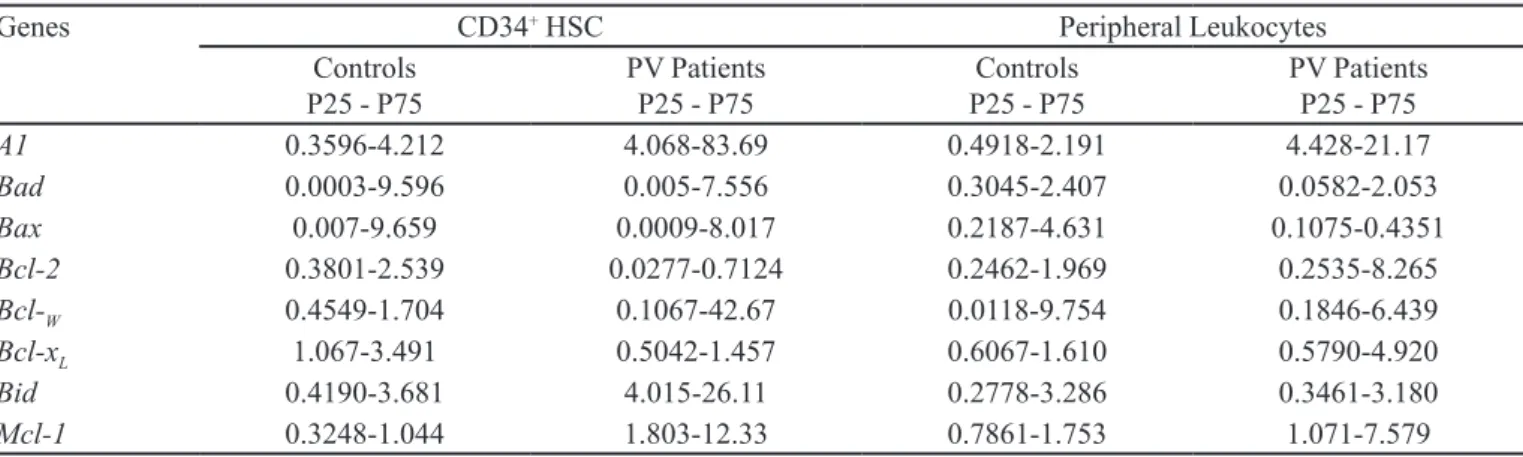
were decreased in PV patients CD34+ HSC (0.18, 1.19, 6.76, 0.24) compared with controls (1.39, 2.01, 10.5 and 4.42; p=0.006, p=0.020, p=0.010 and p=0.010) (Figures 1 and 2). CD34+ HSC of PV patients showed increased Bid expression (14.4) in relation to normal individuals (1.0; p=0.002) (Figure 2; Supplementary Table S1).
In contrast to controls (median A1=1.02, Bax=1.25
and Bad=1.18), patient leukocytes showed an augmented
A1 gene expression (7.41, p=0.001) (Figure 1) and a re-duced expression of Bax (0.19; p=0.020) and Bad (0.2;
p=0.030) (Figure 2). No signiicant differences between controls and PV patients were veriied regarding expres -sion of genes Bcl-w (Figure 1), Bik, Bim-EL, Bok, Noxa, and Puma (data not shown).
FIGURE 1 - Antiapoptotic genes expressed in CD34+ HSC and leukocytes from PV patients and controls. Βeta-actin gene was
used as endogenous control. The genes relative expression were detected by real time PCR and results were given as 2-∆∆Ct. The horizontal lines represent the median of gene expression in each group analyzed. A1 and Mcl-1 are overexpressed (median: 22.6 and 5.2, respectively) in CD34+ HSC from PV patients in comparison with controls (median: 0.9 and 0.5, p=0.002 and p=0.008).
Bcl-2 and Bcl-xL mRNA levels were decreased in PV patients’ CD34+ HSC (0.18 and 1.19) in relation to controls (1.39 and 2.01;
p=0.006 and p=0.020). Patients’ leukocytes also showed an A1 gene expression augmentation (7.41, p=0.001). There were no
statistically signiicant differences in mRNA levels of Bcl-2, Bcl-xL and Mcl-1 in patient leukocytes. No signiicant differences in
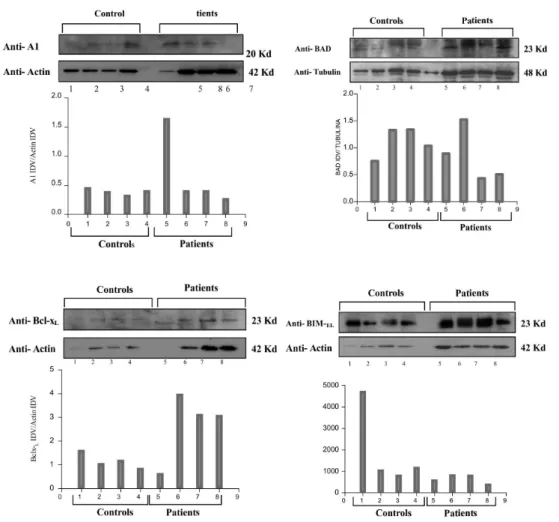
Bad, Bim-EL, Bcl-xLand A1 protein expression in peripheral leukocytes
Bad, BimEL, Bcl-xL and A1 protein expressions (Online Supplementary Figure S1) detected in peripheral leukocyte lysates from four healthy individuals and four PV patients were taken to represent the expression of these molecules in the whole group of patients and controls. Patient’s samples were randomly chosen to support and
check gene expression results.
We chose samples with gene expression values similar to median of Bad, BimEL, Bcl-xL and A1.
Evalua-tion of protein expressions was performed to conirm gene
expression data. The results showed high Bcl-xL and A1
expression and low levels of Bad protein in PV patients in comparison to controls. Bim-EL expression was performed
just because it is known that this molecule is susceptible to post-transcriptional regulation mechanisms. Bim-ELproteic
FIGURE 2 - mRNA levels of Bid, Bax and Bad proapoptotic moleculesin CD34+ HSC and leukocytes from PV patients and controls. Βeta-actin gene was used as endogenous control. Gene relative expressions were detected by real time PCR and results were given
as 2-∆∆Ct. The horizontal lines represent the median of gene expression in each group analyzed. PV patients’ CD34+ HSC showed
Bid elevated expression (median=14.4, p=0.002) in relation to normal individuals. The Bax (median= 6.76, p=0.010) and Bad (0.24, p=0.010) expression were reduced in patients’ CD34+ HSC. The Bad (0.2; p=0.030) and Bax (0.19; p=0.020) levels were
levelswere also reduced in patients, PV leukocytes having only 35% of Bim-EL normal values. Bad protein expression
was signiicantly lower in PV patients in relation to controls,
which were 60% higher. PV patients had triple Bcl-xL ex-pression compared with control leukocytes. Hence, Bcl-xL
and Bim-EL protein expression are different; they were
op-posite from that observed in PV gene expression proiles,
whereas A1 and Bad data supported the mRNA level results.
JAK2 V617F mutation allele burden did not correlate with gene expression of Bcl-2 family members
No correlation was detected between JAK2 V617F allele burden and antiapoptotic protein (A1, Bcl-2, Bcl-w,
Bcl-xL, and Mcl-1) or proapoptotic gene expression (Bad,
Bak, Bax, Bid, Bik, Bim-EL, and Bok) in CD34+ HSC or
leukocytes (Supplementary Table S2).
Mononuclear cells from PV patients were resistant to apoptosis
Concerning assessment of mononuclear cell apop-tosis, PV patients cells were more resistant to ACT-D 1µM (median = 29.95; p=0.015), CHX 25µM and 50 µM (median = 5.53 and 19.80; p=0.002 and 0.001), STS 1 µM
(median = 6.59; p<0.001), ARA-C 25µM (median = 2.76; p<0.001), VM26 25 µM (median = 22.80; p<0.003) and VP16 25 µM (median = 12.25; p<0.001) than controls
(median = 39.70) (Figure 3).
JAK2 mutation allele burden is not associated with the percentage of mononuclear cells apoptosis in PV patients
No signiicant correlation between the percentage of
JAK2 V617F allele burden and mononuclear cell apoptosis
FIGURE 3 - Percentage of mononuclear cell apoptosis induced by drugs in the PV and control groups. Patient’s mononuclear cells were more resistant to ACT-D 1 µM (p=0.015), CHX 25 µM and 50 µM (p=0.002 and 0.001), STS 1 µM (p<0.001), cytarabine
induced by STS, CHX, ACT-D, ARA-C, VP16 and VM26 (data not shown) was found in PV patients.
Gene expression of Bcl-2 family members
is linked to mononuclear cells’ resistance to apoptosis in PV patients
A negative correlation was detected between the per-centage of PV cells apoptosis induced by ACT-D (1uM), CHX (50 µM) and ARA-C (25 µM) and A1 mRNA levels (r=-6527, p=0.044); r=-0. 527; p=0.033 and r=-0.900; p=0.041, respectively); ACT (5 µM), STS (1 µM) and CHX (50 µM) and Bcl-2 (r=-0.857; p=0.012; r=-0.691; p=0.038 and r=-0.9; p=0.040, respectively); ARA-C and
Mcl-1 (r=-0.728, p=0.015). Another interesting result was that Bad expression was positively correlated with cell percentage of apoptosis induced by VM26 (r=0.7857; p=0.024). Thus, low levels of Bad gene are related to a decrease in cell apoptosis percentage mediated by VM26. These results indicate that death resistance to apop-togenic inducers in PV patients is linked to A1, Mcl-1 and
Bcl-2 antiapoptotic protein and Bad proapoptotic genes levels.
DISCUSSION
Several studies have addressed the clinical and laboratorial features in chronic MPDs these diseases, but the cellular and molecular mechanisms involved in the pathogenesis of MPD cells are still unclear.
Altered apoptosis regulation seems to contribute to the physiopathology of several diseases like neoplasia, autoimmune disorders, neurodegenerative disorders, my-elodysplastic syndromes, and acute and chronic leukemia (Del Poeta et al.,2008; Economopoulou et al., 2008; Yan, Shi, 2005).The association of apoptosis-related proteins deregulation with PV pathogenesis, examined in the pres-ent study, has been scarcely explored elsewhere.
A differential proile of Bcl-2 family members’ genes
expression was veriied in PV patients in relation to controls.
Data suggest disequilibrium in anti- and proapoptotic gene expressions related to the intrinsic pathway, which is
repre-sented by a signiicant increase in A1 and Mcl-1 expression in marrow stem cells and A1 in peripheral blood and by a reduction in mRNA levels of Bad and Bax molecules. In ad -dition, the low expression of these proapoptotic molecules is related to drug-induced mononuclear cells resistance, such as topoisomerase inhibitors, cytarabine, and cycloheximide. Furthermore, our results indicate a potential augmented survival in CD34+ HSC and peripheral leukocytes, leading to promoted clonal expansion and perpetuation of myeloid
lineage cells characteristic of the disease.
The literature shows that inhibition of apoptosis by
A1 and Mcl-1 genes may occur through inactivation of the Bak protein. Conformational change of Bak and mito-chondrial MOMP formation are prevented by the A1 and
Mcl-1 molecules, blocking release of cytochrome C and other apoptogenic factors, not activating caspase-3 and suppressing apoptosis (Chipuk, Green, 2008; Thomadaki, Scorilas, 2006).It is possible to speculate that the patients included in the present study showed cell resistance to apoptosis through this mechanism, as stem cells or leuko-cytes showed elevation of A1 and Mcl-1 and decrease of
Bad, Bim-EL and Bax in comparison with controls.
Another inding is related only to the increase in the
Bcl-xL protein (supplementary data), a potent antiapoptotic
molecule, which may contribute to a phenotype with a higher survival and myeloaccumulation of myeloid cells in
PV patients. The indings in this investigation also include
decreased levels of Bcl-2 and increased Bid, a paradox, since these molecules promote apoptosis potentiating and
not blocking. It is possible that these molecules do not play
a relevant role in the physiopathology of PV.
In addition, since apoptosis unleashing is dependent
on the interaction and equilibrium of several proteins of the Bcl-2 family(Chipuk; Green, 2008),the increase of
A1, Mcl-1, and Bcl-xL antiapoptotic molecules and the decreased expression of Bax and Bad would be suficient
to prevent cellular death in PV.
A1 protein is abundantly expressed in bone marrow cells, spleen, and lung in several lineages originating in thymus, testicle, and intestine cancers(Thomadaki; Sco-rilas, 2006).It has an important role in high risk leukemia and other B cell malignancies. This molecule is a direct target in the transcription of NF-κβ, which is involved in myeloid and lymphoid differentiation, in apoptosis resistance by different stimuli, like the activation of death receptors (Simpson et al., 2006; Brien et al., 2007).
Mcl-1 protein probably participates in the immune
system development and hematopoiesis. In hematopoi -etic cells the protein is regulated by ERK, JAK/STAT, p38, MAPK, P13K/AKT signaling and phosphorylation of elf2α and E2F1 and may be phosphorylated by JNK, GSK-3α/β, a cyclin-dependent kinase (Inoue et al., 2008).
It may be inactivated and/or degraded by a caspase medi -ated cleavage or other proteins (ubiquitin-proteasome pathway) (Wuillème-Toumi et al., 2006).In chronic my -eloid leukemia (Aichberger et al., 2005), expression of
Mcl-1 protein is frequently associated with resistance to
an insignificant expression of Bcl-2 (Wuillème-Toumi
et al., 2005). Increase in Mcl-1 levels is correlated with disease severity, turning the molecule into a potential therapeutic target in MM.
Mcl-1 protein neutralizes the proapoptotic func-tion of Bim and prevents activation of death receptors (Wuillème-Toumi et al., 2006). Regulating the Mcl-1
expression is important to break the Bim/Mcl-1 complex and induce Bim activation in HMCL-human myeloma
and Hek-293-human embryonic kidney cell lines. It has
been shown recently that Bim, a direct activator of Bax/ Bak, protects the mitochondrial membrane permeability dependent on the pair of proteins by loosing its activity (Chipuk, Green, 2008).Thus, increased levels of this protein interfere with mitochondrial membrane perme-ability and activation of apoptosis extrinsic pathway, both
contributing to the resistance proile to apoptosis shown
by PV patient cells.
The results in this study suggest that A1 and Mcl-1
contribute to apoptosis resistance by means of direct or indirect Bax inhibition, by blocking the activation of Bad, tBax or Bim molecules and/or compromising the activation equilibrium of other proapoptotic proteins such as Bok and Noxa, which inhibit cytochrome liberation and caspase 3 activation and suppress the apoptotic cascade.
Increased amounts of Bcl-xL protein in PV patients’
leukocytes conirm the data in the literature. Bcl-xL protein
is increased in erythroid precursors and provokes cell ac-cumulation in PV (Silva et al., 1998). Other reports con-sider the molecule as the most potent antiapoptotic agent, its high levels being partially responsible for cell apoptosis resistance in patients with chronic myeloid leukemia
(CML). It seems that Bcl-xL instead of Bcl-2 mediates the
most prominent antiapoptotic effect of Bcr-abl tyrosine kinase in CML patients. Amarante-Mendes et al. (1998) showed that treatment with antisense oligonucleotides tar-geted to Bcl-xL downregulates the expression of Bcl-x and
increases Bcr-Abl positive cell susceptibility to apoptosis induced by staurosporine in CML.
The sensitive profile of PV mononuclear cells to several apoptogenic drugs (actinomycin D, staurosporine, cycloheximide, cytarabine, etoposide, and teniposide) was also evaluated in this research. Substances with diverse mechanisms of action were employed to induce cell death, aiming to analyze cell apoptotic machinery at a functional
level and its relation to the expression proile of molecules
of the Bcl-2 family members.
Our results suggest that PV patients’ mononuclear cells resistance to cell death is related to alterations in
the gene expression proile of the molecules regulating
apoptosis intrinsic pathway.
The percentage of JAK2 mutated alleles relects the
tumoral load in the disease and is linked to worse prognosis (Passamonti, Rumi, 2009; Finazzi, Barbui, 2008; Gangat
et al., 2008; Vannucchi et al., 2007). Lack of correlation between the JAK2 (V617F) mutation and the genes in the study does not exclude the relation between the expression of these genes to the activity of JAK2-mutated tyrosine kinase or the presence of different mutations in JAK2 or
other kinases. It is worth emphasizing that in the present
study we only evaluated the JAK2 V617F mutation in the exon 14 in PV patients, we did not measure JAK2 activity or detect other mutations associated with PV pathogenesis, such as MPL or JAK2 mutation in the exon 12 (Vainchen-ker, W. et al., 2011).
Nussenzveig et al.(2007) showed that events related to the JAK2 V617F mutation may not give rise to PV,
but identiication of the genetic lesion is essential to the
development of therapeutic strategies, since inhibitors of active, constitutive tyrosine kinase JAK2 are not
suf-icient to eradicate the disease. The authors correlated the
frequency of the JAK2/V617F mutant allele with clonal-ity and presence of endogenous erythroid colonies with allele homozygosis and demonstrated that PV is not only provoked by the mutation, which seems to be a second-ary genetic event. However, the primsecond-ary molecular lesion
responsible for the clonal hematopoiesis was not deined.
JAK2 inhibitors have been explored as the most
ef-icient therapeutic agents in MPDs but some patients do
not respond to therapy and some are JAK2 negative. Thus, the importance of describing new therapeutic targets, as inserted in this context, for Bcl-2 family members.
Apoptosis resistance to stimuli by drugs such as ac-tinomycin D, cycloheximide, cytarabine, teniposide, and staurosporine correlates with high levels of A1, Mcl-1 and low expression of Bad and Bax.
Actinomycin D acts inhibiting the synthesis of RNA and it seems to potentiate Fas-mediated apoptosis, prevent binding of NF-κβ to DNA (Wang et al., 2007), decrease the expression of the extrinsic antiapoptotic pathway, c-Flip, and stimulate Puma and Noxa expression of p53 and APAF-1 pathway (Kalousek et al. , 2007). ACT-D and
cycloheximide conduct cells to apoptosis via the TRAIL
protein or TNF-α receptor. Both drugs are able to reduce
RIP expression, a kinase having a death domain involved
in TNF-R1 signaling that mediates NF-κβ activation, which, in turn, may be antiapoptotic. They also reduce
XIAP expression, a member of the IAP family responsible
that PV patients’ lymphocyte resistance to apoptosis in-duced by STS and ACT-D may be a consequence of low levels of Bax mRNA.
Cytarabine, a cytotoxic antineoplastic agent shows
cell phase speciicity, initially destroying cells that synthe -size DNA and, under certain conditions, blocking progres-sion of phase G1 to phase S. The mechanism of action is not completely known, but the drug seems to inhibit DNA polymerase during replication and damage DNA, thus ac-tivating the p53 pathway.Other antineoplastic drugs tested in this study were etoposide (Vepesid)and teniposide,both
inhibitors of topoisomerase II; their main effects may be
related to rupture of DNA double loop by enzyme inter-action or production of free radicals; the drugs increase
TRAIL receptor expression and stimulate p53 pathway by
damaging DNA (Karpinish et al., 2002; Li et al., 2006). The percentages of cell death detected in PV patients suggest mononuclear cells resistance to most drugs and indicate that cells may show alterations in at least one of the regulatory mechanisms of cellular apoptosis. The decreased cell susceptibility to death may be associated with cell accumulation in PV, being partially responsible for the morbidity/mortality of patients with the disease.
In conclusion, high levels of A1 and Mcl-1 and a reduced expression of antiapoptotic Bcl-2 and Bcl-xL
and proapoptotic Bad and Bax genes in CD34 HSC were
detected in PV patients. In leukocytes, A1 expressionwas elevated and Bad and Bax mRNA levels were decreased. Thus, overexpression of the above antiapoptotic genes and a low mRNA level of Bax and Bad proapoptotic molecules may be associated with PV pathogenesis.
Additionally, a low expression of Bad and Bax
proapoptotic genes also seems to be linked to PV lympho-cyte resistance to apoptosis and contribute to the disease physiopathology.
ACKNOWLEDGMENTS
The authors would like to thank Marcella Grando and Zita M. O. Gregório for technical assistance. We are also grateful to Amélia Regina de Albuquerque for
assist-ing in the creation of the igures. E.L.P.G. is the recipient of
a fellowship from the Conselho Nacional de
Desenvolvim-ento Cientíico e Tecnológico (CNPq, National Council for
Scientiic and Technological Development. Funding: This work was supported by a FAPESP grant (No. 06/50094-8).
REFERENCES
AICHBERGER, K.J.; MAYERHOFER, M.; KRAUTH, M.T.; SKVARA, H.; FLORIAN, S.; SONNECK, K.; AKGUL, C.; DERDAK, S.; PICKL, W.F.; WACHECK, V.; SELZER, E.; MONIA, B.P.; MORIGGL, R.; VALENT, P.; SILLABER, C. Identification of Mcl-1 as a BCR/ABL-dependent
target in chronic myeloid leukemia (CML): evidence for cooperative antileukemic effects of imatinib and Mcl-1 antisense oligonucleotides. Blood, v.105, n.8, p.3303-3311, 2005.
AMARANTE-MENDES, G.P.; MCGAHON, A.J.; NISHIOKA, W.K.; AFAR, D.E; WITTE, O.N.; GREEN, D.R.
Bcl-2-independent Bcr-abl-mediated resistance to apoptosis: protection is correlated with upregulation of Bcl-xL.
Oncogene, v.16, n.11, p.1383-1390, 1998.
BAXTER, E.J.; SCOTT, L.M.; CAMPBELL, P.J.; EAST, C.; FOUROUCLAS, N.; SWANTON, S.; VASSILIOU,
G.S.; BENCH, A.J.; BOYD, CURTIN, E.M.N.; SCOTT,
M.A.; ERBER, W.N.; GREEN, A.R. Acquired mutation of the tyrosine kinase JAK2 in human myeloproliferative disorders. Lancet, v.365, n.9464, p.1054-1061, 2005.
BORNER, C. The Bcl-2 protein family: sensors and checkpoints for life-or-death decisions. Mol. Immunol., v.39, n.11, p.615-647, 2003.
BOYUM, A. Isolation of lymphocytes, granulocytes and
macrophages. Scand. J. Immunol., v.5, suppl.s5, p.9-15, 1976.
BRIEN, G.; TRESCOL-BIEMONT, M.C.; BONNEFOY-BERARD, N. Downregulation of Bl-1 protein expression
sensitizes malignant B cell to apoptosis. Oncogene., v.26, n.39, p.5828-5832, 2007.
CHIPUK, J. E.; GREEN, D.R. How do BCL-2 proteins induce
mitochondrial outer membrane permeabilization? Trends Cell Biol., v.18, n.4, p.157-164, 2008.
DEL POETA, G.; BRUNO, A.; DEL PRÍNCIPE, M.I.; VENDITTI, A.; MAURILLO, L.; BUCCISANO, F.; STASI, R.; NERI, B.; LUCIANO, F.; SINISCALCHI, A.; FABRITIIS, P.; AMADORI, S. Deregulation of the
ECONOMOPOULOU, C.; PAPPA, V.; KONTSIOTI, F.; PAPAGEORGIOU, S.; KAPSIMALI, V.; PAPASTERIADI, C.; ECONOMOPOULOU, P.; PAPAGEORGIOU, E.;
DERVENOULAS, J.; ECONOMOPOULOS, T. Analysis of apoptosis regulatory gene expression in the bone marrow (BM) of adult de novo myelodysplastic syndromes (MDS). Leukemia Res.. v.32, n.1, p.61-69, 2008.
FINAZZI, G.; BARBUI, T. Evidence and expertise in
the management of polycythemia vera and essential thrombocythemia. Leukemia, v.22, n.8, p.1494-1502, 2008.
FULDA, S.; DEBATIN, K.M. Extrinsic versus intrinsic
apoptosis pathways in anticancer chemotherapy. Oncogene, v.25, p.4798-4811, 2006.
FULDA, S.; MEYER, E.; DEBATIN, K.M. Metabolic inhibitors
sensitize for CD95 (APO/Fas) induced apoptosis by down-regulating Fas-associated death domain-like interleukin
1-converting enzyme Inhibitory protein expression. Cancer Res., v.60, n.14, p.3947-3956, 2000.
GANGAT, N.; STRAND, J.; LASHO, T.L; FINKE, C,M.; KNUDSON, R,A.; PARDANANI, A.; CHIN-YANG L.; KETTERLING, R. P.; TEFFERI, A. Cytogenetic studies at
diagnosis in polycythemia vera: clinical and JAK2V617F allele burden correlates. Eur. J. Haematol., v.80, n.3, p.197-200, 2008.
GARÇON , L.; RIVAT, C.; JAMES, C.; LACOUT, C.;
CAMARA-CLAYETTE, V.; UGO, V.; LECLUSE, Y.;
BENNACEUR-GRISCELLI, A.; VAINCHENKER, W.
Constitutive activation of STAT5 and Bcl-xLoverexpression
can induce endogenous erythroid colony formation in human primary cells. Blood, v.108, n.5, p.1551-1554, 2006.
INOUE, S.; WALEWSKA, R.; DYER, M.J.S.; COHEN, G. M.
Downregulation of Mcl-1 potentiales HDCAi-mediated apoptosis in leukemic cells). Leukemia, v.22, n.4, p.819-825, 2008.
JAMES, C.; UGO, V.; COUÉDIC, J.P.; STAERK, J.;
DELHOMMEAU, F.; LACOUT, C.; GARÇON, L.;
RASLOVA, H.; BERGER, R.; GRISCELLI, A.B.; VILLEVAL, J.L.; CONSTANTINESCU, S.N.; CASADEVAL, N.; VAINCHENKER, W. A unique clonal JAK2 mutation leading
to constitutive signaling causes polycythemia vera. Nature, v.434, n.7037, p.1144-1148, 2005.
JIN, Z.; EL-DEIRY, W.S. Overview of cell death signalling
pathways. Cancer Biol. Ther., v.4, n.2, p.139-163, 2005.
KALOUSEK, I.; BRODSKA, B.; OTEVRELOVA, P.;
RÖSELOVA, P. Actinomycin D upregulates proapoptotic protein Puma and downregulates Bcl-2 mRNA in normal peripheral blood lymphocytes. Anti-cancer Drugs, v.18, n.7, p.763-772, 2007.
KARPINICH, N.O.; TAFANI, M.; ROTHMAN, R.J.; RUSSO,
M,A.; FARBER, J.L. The Course of Etoposide-induced Apoptosis from Damage to DNA and p53 Activation to Mitochondrial Release of Cytochrome c. J. Biol. Chem., v.277, n.19, p.16547-16552, 2002.
KITADA, S.; REED, J.C. MCL-1 Promoter Insertions Dial-Up
Aggressiveness of Chronic Leukemia. J. Natl. Cancer Inst., v.96, n.9, p.642-643, 2004.
KRALOVICS, R.; PASSAMONTI, F.; BUSER, A.S.; TEO, S.S.; TIEDT, R.; PASSWEG, J.R. TICHELLI, A.; CAZZOLA,
M.; SKODA, R.C. A gain-of-function mutation of JAK2 in myeloproliferative disorders. New Engl. J. Med., v.352, n.17, p.1779-1790, 2005.
LAUBACH, J.P.; FU, P.; JIANG, X.; SALTER, K.H.; POTTI,
A.; ARCASOY, M.O. Polycythemia vera erythroid precursors exhibit increased proliferation and apoptosis
resistance associated with abnormal RAS and PI3K pathway
activation. Exp. Hematol., v.37, n.12, p.1411-1422, 2009.
LEVINE, R.L.; PARDANANI, A.; TEFFERI, A.; GILLILAND,
D.G. Role of JAK2 in the pathogenesis and therapy of myeloproliferative disorders. Nat. Rev. Cancer, v.7, n.9, p.673-683, 2007.
LEVINE R.L.; WADLEIGH, M.; COOLS, J.; EBERT, B.J.; WERNIG, G.; HUNTLY, B.J.P. BOGGON, T.J.; WLODARSKA, I.; CLARK, J.J.; MOORE, S.;
ADELSPERGER, J.; KOO, S.; LEE, J.C.; STACEY
G.; MERCHER, T.; D’ANDREA, A.; FRÖHLING, S.;
DÖHNER, K.; MARYNEN, P.; VANDENBERGHE
P.; MESA, R.A.; TEFFERI, A.; GRIFFIN, J.D.; ECK,
M.J.; SELLERS, W.R.; MEYERSON, M.; GOLUB,
T.R.; LEE, S.J.; GILLILAND, D.G. Activating mutation
in the tyrosine kinase JAK2 in polycythemia vera, essential thrombocythemia, and myeloid metaplasia with
myeloibrosis. Cancer Cell, v.7, n.4, p.387-397, 2005.
LI, J.; CHEN, W.; ZHANG, P.; LI, N. Topoisomerase II trapping
NUSSENZVEIG, R.H.; SWIERCZEK, S.I.; JELINEK, J.; GAIKWAD, A.; LIU, E.; VERSTOVSEK, S.; LIUC, E.;
VERSTOVSEKA, S.; JAROSLAV F.; PRCHAL, J.T. PRCHAL. Polycythemia vera is not initiated by JAK2 V617F mutation. Exp. Hematol., v.35, n.1, p.32-38, 2007.
PASSAMONTI, F.; RUMI, E. Clinical relevance of JAK2
(V617F) mutant allele burden. Haematologica, v.94, n.1, p.7-10, 2009.
SHARPE, J.C.; ARNOULT, D.; YOULE, R.J. Control of mitochondrial permeability by Bcl-2 family members. Biochim. Bioph. Acta, v.1644, n.2-3, p.107-113, 2004.
SIMPSON, L.A.; BURWELL, E.A; THOMPSON, K.A.;
S H A H N A Z , S . ; C H E N , A . R . ; L O E B , D . M . T h e antiapoptotic gene A1/BFL1 is a WT1 target gene that mediates granulocytic differentiation and resistance to chemotherapy. Blood, v.107, n.12, p.4695-4702, 2006.
SPIVAK, J.L. Polycythemia vera: myths, mechanisms and
management. Blood, v.100, n.13, p.4272-4290, 2002.
TEFFERI, A.; VARDIMAN, J.W. Classiication and diagnosis
of myeloproliferative neoplasms: The 2008 World Health Organization criteria and point-care diagnostics algorithms. Leukemia, v.22, n.1, p.14-22, 2008.
THOMADAKI, H.; SCORILAS, A. Bcl2 Family of Apoptosis-Related Genes: Functions and Clinical Implications in
Cancer. Crit. Rev. Clin. Lab. Sci., v.43, n.1, p.1-67, 2006
VA I N C H E N K E R , W. ; D E L H O M M E A U , F . ; CONSTANTINESCU, S.N.; BERNARD, O.A. New
mutations and pathogenesis of myeloproliferative neoplasms. Blood, v.118, n.7, p.1723-1735, 2011.
WADLEIGH, M.; TEFFERI, A. Classiication and diagnosis
of myeloproliferative neoplasms according to the 2008 World Health Organization criteria. Int. J. Hematol., v.91, n.2, p.174-179, 2010.
WANG, M.J.; LIU, S.; LIU, Y.; ZHENG, D. Actinomycin D enhances TRAIL-induced caspase-dependent and
independent apoptosis in SH-SY5Y neuroblastoma cells. Neurosci. Res., v.59, n.1, p.40-46, 2007.
YAN, N.; SHI, Y. Mechanisms of apoptosis through structural
biology. Annu. Rev. Cell Dev. Biol., v.21, p.35-56, 2005.
ZEUNER, A.; PEDINI, F.; SIGNORE, M.; RUSCIO, G.;
MESSINA, C.; TAFURI, A. GIRELLI, G.; PESCHLE,
C.; DE MARIA, R. Increased death receptor resistance
and FLIPshort expression in Polycythemia vera erythroid
precursor cells. Blood, v.107, n.9, p.3495-3502, 2006.
ZHANG, Y.; FOUDI, A.; GEAY, J.F.; BERTHEBAUD, M.; BUET, D.; JARRIER, P.; JALIL, A.; VAINCHENKER, W.; LOUACHE, F . Intracellular localization and constitutive
endocytosis of CXCR4 in human CD34+ hematopoietic
progenitor cells. Stem Cells, v.22, n.6, p.1015-1029, 2004.
Received for publication on 17th February 2011
Accepted for publication on 30th June 2011
TABLE S1 - Percentiles 25 and 75 ofgene expression 2-∆∆Ct from Bcl-2 family members in hematopoietic stem cells and peripheral leukocytes in PV patients and controls
Genes CD34+ HSC Peripheral Leukocytes
Controls P25 - P75
PV Patients P25 - P75
Controls P25 - P75
PV Patients P25 - P75
A1 0.3596-4.212 4.068-83.69 0.4918-2.191 4.428-21.17
Bad 0.0003-9.596 0.005-7.556 0.3045-2.407 0.0582-2.053
Bax 0.007-9.659 0.0009-8.017 0.2187-4.631 0.1075-0.4351
Bcl-2 0.3801-2.539 0.0277-0.7124 0.2462-1.969 0.2535-8.265
Bcl-W 0.4549-1.704 0.1067-42.67 0.0118-9.754 0.1846-6.439
Bcl-xL 1.067-3.491 0.5042-1.457 0.6067-1.610 0.5790-4.920
Bid 0.4190-3.681 4.015-26.11 0.2778-3.286 0.3461-3.180
Mcl-1 0.3248-1.044 1.803-12.33 0.7861-1.753 1.071-7.579
HSC: Hematopoietic Stem Cells; PV: Polycythemia Vera; P: Percentile.
FIGURE S1 - A1, Bcl-xL, Bad, and Bim-EL protein expression determined in peripheral leukocyte lysates from four PV patients
and four controls. A1, Bcl-xL, Bad, and Bim-ELexpression were assessed by immunoblot with speciic antibody. Protein loading
is controlled by beta-actin or tubulin. Results were shown by blotting igures and protein expression quantiication detected by densitometry and expressed by the ratio of target protein integrated density values (IDV) and beta-actin or tubulin IDV. Bcl-xL and
A1 presented a high expression while Bad protein levels were decreased in PV patients in comparison with controls. Bim-ELproteic
levelsare also reduced in PV patient leukocytes being only 35% of the values in normal individuals.
TABLE S2 - Correlation between JAK2 V617F allele burden and genes expression of Bcl-2 family members in PV patients
Genes CD34+ HSC Peripheral Leukocytes
r p r p
A1 0.1763 p>0.05 -0.03647 p>0.05
Bad -0.3465 p>0.05 -0.09726 p>0.05
Bak -0.3404 p>0.05 -0.08113 p>0.05
Bax -0.2979 p>0.05 -0.03647 p>0.05
Bcl-2 -0.6565 p>0.05 0.1216 p>0.05
Bcl-w -0.1398 p>0.05 0.3536 p>0.05
Bcl-xL -0.2675 p>0.05 0.01824 p>0.05
Bid -0.2614 p>0.05 -0.2349 p>0.05
Bik -0.1094 p>0.05 -0.04863 p>0.05
Bim-EL -0.2675 p>0.05 -0.1702 p>0.05
Bok -0.2371 p>0.05 -0.1885 p>0.05
Mcl-1 0.1216 p>0.05 0.3161 p>0.05