* Corresponding author. Mailing address: Instituto de Tecnologia de Alimentos-ITAL – Av. Brasil, 2880. CEP 13.073-001, Campinas, SP, Brasil. FAX (+5519) 241-5034. Email: [email protected]
I N T R O D U C T I O N
Lactococcus lactis strains are widely used as starter cultures for several types of cheese, fermented milk products, and ripened cream butter. The composition of many mesophylic starters includes the acid-producing cultures (L. lactis subsp.
lactis and L. lactis subsp. cremoris) and the citric-acid-fermenting bacteria, L. lactis subsp. lactis var. diacetylactis. The fermentation of sugars, leading to a pH decrease is important for the clothing of the milk and reduction or prevention of adventitious microbial growth. Indeed, some cultures produce antimicrobial substances in smaller amounts, like hydrogen peroxide, diacetyl, organic acids, secondary reaction products, and bacteriocin (7). Competition for essential nutrients, accumulation of D-aminoacids, lowering of oxidation-reduction potential and coagregation may also be involved in antagonism (34).
By definition, bacteriocins are biologically active proteins or protein complexes displaying a bactericidal mode of action
exclusively towards Gram-positive bacteria and particularly closely related species (36). They form a heterogeneous group with respect to the producing-bacterial species, molecular size, antibacterial spectrum, stability and physical and chemical properties, and mode of action (9, 10). Production of bacteriocin has been detected in all genera of lactic acid bacteria (9, 10). A large variety of bacteriocins occur within the species L. lactis
and nisin is the most studied (16, 17). Two types are known, nisin A and Z (16, 27). Some bacteriocins characterized include diplococcin (8, 30), lactostrepcins (20), lactococcins (11, 13, 15, 29), dricin (35), lacticin (33) among others (4, 13, 19, 28). In the last years, the bacteriocins of lactic acid bacteria have attracted much attention because of their potential to increase safety and to extend shelf life of food (12). Currently, only nisin has been granted Generally Recognized As Safe (GRAS) status by the Food and Drug Administration (FDA). The objective of this study was to determine the physical-chemical characteristics and antimicrobial spectrum of bacteriocins detected previously (26).
CHARACTERIZATION OF BACTERIOCINS PRODUCED BY LACTOCOCCUS LACTIS STRAINS
Izildinha Moreno1*; Alda L.S. Lerayer1; Vera L.S. Baldini2; Mauro F. de F. Leitão3
1Centro de Tecnologia de Laticínios, Instituto de Tecnologia de Alimentos - ITAL, Campinas, SP, Brasil; 2Centro de
Bioquímica e Nutrição Aplicada, Instituto de Tecnologia de Alimentos-ITAL, Campinas, SP, Brasil; 3Faculdade de
Engenharia de Alimentos, Universidade Estadual de Campinas-UNICAMP, Campinas, SP, Brasil
Submitted: April 14, 2000; Returned to authors for corrections: August 16, 2000; Approved: September 15, 2000
ABSTRACT
Bacteriocins produced by fifteen strains of Lactococcus lactis (14 L. lactis subsp. lactis and one L. lactis
subsp. cremoris)were heat resistant, sensitive to several proteolytic enzymes and active over a wide range of pH. Their resistance to the heating was greatly influenced by the pH. Only the strain L. lactis subsp.
lactis ITAL 383 produced a bacteriocin with a wide activity spectrum, similar to nisin of L. lactis subsp.
lactis ATCC 11454. This bacteriocin inhibited closely related species and other Gram-positive microorganisms including Listeria monocytogenes and Staphylococcus aureus, but it was not active against the Gram-negative bacteria tested. The identification of partially purified antimicrobial compounds by SDS-PAGE showed that bacteriocin produced by strain ITAL 383 had the same molecular weight of nisin produced by L. lactis subsp. lactis ATCC 11454.
MATERIALS AND METHODS
Microorganisms and culture media
Bacteriocin-producing L. lactis strains previously selected as well as other genus of lactic acid bacteria used in this study are listed in Table 1. Stock cultures were maintained in frozen storage at –20°C in 14% solids of sterile reconstituted skim milk powder. Before use, the cultures were transferred twice in M17 broth (Oxoid) supplemented with 0.5% (w/v) glucose (GM17) and incubated at 30°C for 16-18h.
The spoilage and food-borne microorganisms used in the experiments are listed in Table 2. These cultures were maintained at 4°C on agar slants. The culture media and growth conditions used were: brain heart infusion (BHI, Oxoid) for
Staphylococcus aureus (37°C), triypticase soy broth (TSB, Difco) for Salmonella typhimurium (30°C), Yersinia enterocolitica (30°C) and Bacillus subtilis (37°C), triyptcase soy broth supplemented with 0,6% (w/v) yeast extract (TS-YE, Difco) for Listeria sp. (30°C) and reinforced clostridial medium (Oxoid) for Bacillus (37°C). A non-pathogenic Listeria innocua Lin 11 (Pasteur Institute, Paris, France) was used as the indicator microorganism for antimicrobial assays. The nisin-producing L. lactis subsp. lactis ATCC 11454 was used as positive control.
Activity spectrum
The well diffusion direct assay described by Tagg and McGiven (36) and modified by Benkerroum et al. (1) was utilized to detect the inhibition of the sensitive strain. The
GM17 broth was supplemented with sodium β
-glycerophosphate (2%) and catalase (Sigma Chemical Co., Dorset, England) at final concentration of 100U. Twenty milliliters of GM17 agar inoculated with 1% (105-106 cfu ml-1)
of stationary phase sensitive indicator cultures was poured in a sterile Petri dish and allowed to harden. Holes were punched out of the agar, by using a cork bore (4 mm of diameter). The base of each hole was sealed with 50 µl of GM17 soft agar (0.75% agar) and then filled with 50 µl overnight test strains. The inoculated plates were incubated at 30°C for 18-24h and checked for the presence of clear zones of inhibition as a result of antimicrobial activity.
Sensitivity to proteases
Sterile cell-free supernatants at pH 6.5 were treated with the following enzymes (0.2 mg ml-1): proteinase K in 20 mM
Tris-HCl, pH 7.0; ficin in 20 mM sodium phosphate, pH 7.0; trypsin in 40 mM Tris-HCl, pH 8.2; α-chymotrypsin in 20 mM Tris-HCl, pH 8.0; pronase E in 20 mM Tris-HCl, pH 7.8; pepsin in 0.002 N HCl; lipase in 0.1 M potassium phosphate, pH 6.0; and papain in 0.05 M sodium phosphate acetate (31). All these solutions were filter-sterilized through Millex (Millipore) GV 0.22 µm filters and then added to supernatants (v/v, 1/1).
Controls consisted of enzyme solutions without bacteriocin and only bacteriocin in sodium 0.1 M phosphate buffer. The samples and controls were incubated at 37°C for 2h and heated at 100°C for 5 min to denature the enzymes. This treatment did not affect the antimicrobial activity of bacteriocins. The remaining bacteriocin activity was determined by serial twofold dilution assay described by Mayr-Harting et al. (23). The title was defined as the reciprocal of the highest dilution showing an inhibition of the indicator strain multiplied by 100 to express the results as activity units by milliliter (AUml-1).
Cell-free supernatants from bacteriocin-producing strains were collected by centrifugation (7,500g/10 min, 4°C) of overnight GM17 broth cultures. The supernatants were neutralized to pH 6.5 with 10 N NaOH and sterilized through Millex-HV (0.22 µm, Millipore Corp.).
Activity of bacteriocins at different pH levels and effect of heat treatment
To determine the thermal stability at different pH levels, the sterile cell-free supernatants adjusted at different pH values (2.0, 4.0, 6.0, 7.0, 8.0, 9.0, 10.0 and 12.0) were autoclaved at 121oC
for 10 min. The treated and untreated control samples were assayed for activity by the critical dilution assay (23). Sterile cell-free supernatants of L. lactis subsp. lactis ITAL 383 and ATCC 11454 adjusted to pH 2.0 and 6.0 were also heated in a boiling bath. Residual activity was assayed at 10, 20, 30 and 60 min by the critical dilution assay (23) with appropriate controls. To determine the activity of bacteriocins at different pH levels, sterile cell-free supernatants were adjusted with sterile NaOH or HCl to different pH values (2.0, 4.0, 6.0, 7.0, 8.0, 9.0, 10.0 and 12.0). The activity of bacteriocins was assayed after 30 min. by the critical dilution assay of Mayer-Harting et al. (23).
Activity detection in SDS-PAGE
RESULTS AND DISCUSSION
Inhibitory spectrum
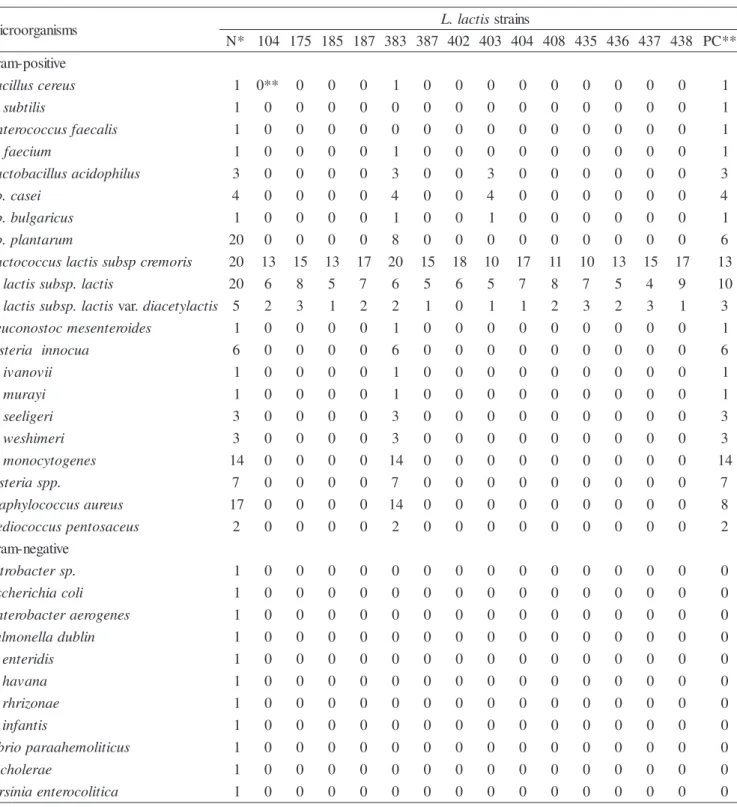
The inhibitory spectrum of bacteriocins against several Gram-positive and Gram-negative microorganisms is shown in Table 3. This is an important characteristic in order to evaluate the possibility of using the bacteriocin-producing strains as an additional barrier against spoilage and/or food-borne microorganisms in foods. Only 1 (6.7%) out of 15 bacteriocin-producing strains exhibited wide activity spectrum against pathogenic and spoilage microorganisms tested. This result is similar to that of Gupta and Batish (14) who found 1.5% of bacteriocin-producing lactococci among 600 strains isolated of buffalo milk. The antimicrobial spectrum of the bacteriocin of ITAL 383 was similar to nisin of L. lactis subsp.
lactis ATCC 11454. It showed a wide spectrum of inhibitory activity affecting closely related species and all other Gram-positive microorganisms examined. The only difference between the antimicrobial spectra of ITAL 383 and ATCC 11454 was the inhibition of E. faecalis and B. subtilis
by the last one. It is interesting to observe the resistance of Lb. plantarum strains to bacteriocin of ITAL 383 and nisin of
ATCC 11454. Among the 20 strains tested, 40% were inhibited by ITAL 383 and 30% by ATCC 11454. Specific inactivating enzymes or nisinases are produced by nisin-resistant strains of Lb. plantarum (10). Otherwise, bacteriocin of ITAL 383 and nisin of ATCC 11454 inhibited all Listeria
strains examined. The sensitivity difference of each strain was previously demonstrated (25). Bacteriocin produced by 12 strains (11 L. lactis subsp. lactis and 1 of L. lactis subsp.
cremoris) exhibited a narrow spectrum of activity related only to bacteria belonging to the same species. One culture of L. lactis subsp. lactis ITAL 403 showed activity towards related bacteria belonging to the same genera and a limited numbers of Lactobacillus strains(3 Lb. acidophilus, 4 Lb. casei subsp.
casei and 1 Lb. delbrueckii subsp. bulgaricus). The bacteriocins did not inhibit any of the Gram-negative tested. This inability of the bacteriocins over some microorganisms was previously reported (2, 5, 6, 14, 19, 24, 31, 37).
Sensitivity to proteases
Since bacteriocins are by definition proteinaceous substances they must be sensitive to at least one proteolytic enzyme. Consequently, protease sensitivity is a key criterion
s n i a r t s f o r e b m u
N Species Origin
1 L.lactissubsp.lactis11454 ATCC 1 L.lactissubsp.lactis150 CNRZ
8
3 L.lactissubsp.lactis Rawbuffalomlik 0
1 L.lactissubsp.lactis Cheesewhey 0
1 L.lactissubsp.lactis Commercialcutlures 2
1 L.lactissubsp.lactis Cheesestarterscutlures 0
3 L.lactissubsp.lactis Regionalcheese 8 L.lactissubsp.lactis INRA
2 L.lactissubsp.cremoris Rawmlik
8 L.lactissubsp.cremoris Commercialcutlures 1 L.lactissubsp.cremoris INRA
8
3 L.lactissubsp.cremoris Cheesestarterscutlures 0
1 L.lactissubsp.lactisbiovar.diacetylactis Commercialcutlures 4 Lactobacillusacidophilus Commercialcutlures 4 Lab.caseisubsp.casei Commercialcutlures
s u c i r a g l u b . b a
L Commercialcutlures
0
2 Lab.plantarum Forrage
1 Leuconostoccremoris Commercialcutlures 2 Pediococcuspentosaceus Commercialcutlures Table 1. Origin of lactic acid bacteria strains.
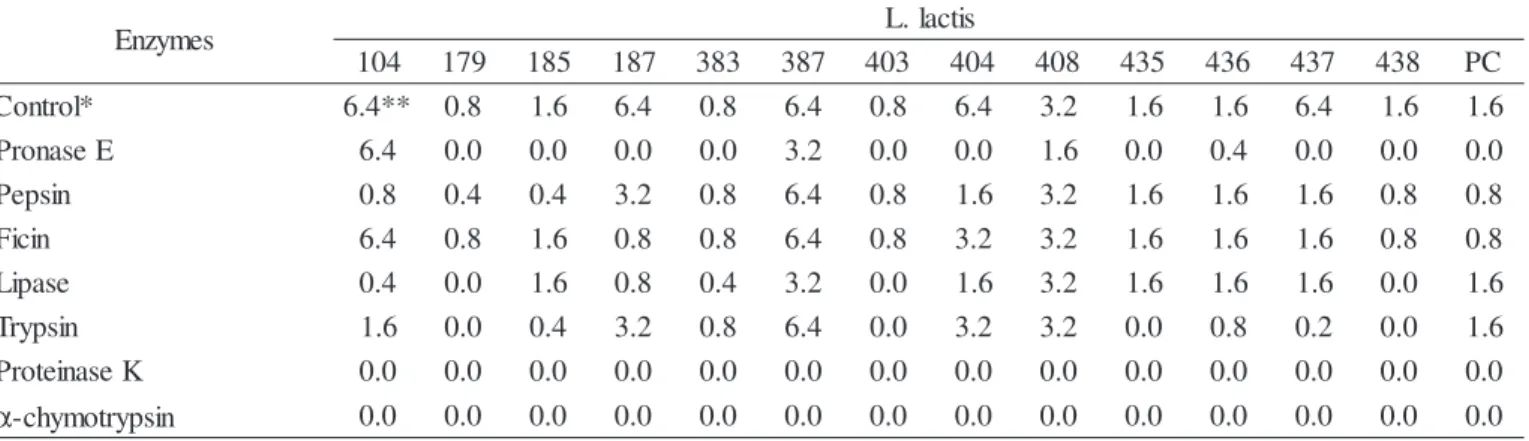
in their characterization. The effect of various proteolytic and lipolytic enzymes over the bacteriocins is shown in Table 4. The loss of the antimicrobial activity after treatment with enzymes indicated the sensitivity of the active compounds secreted by L. lactis strains. All bacteriocins, including nisin
of ATCC 11454, were fully or partially inactivated by proteinase K, pronase E, and α-chymotrypsin. Exception was noted in ITAL 104, which was fully resistant to pronase E. Some authors distinguish the nisin from other bacteriocins based on the strength of their sensitivity to α-chymotrypsin. However, the
s e i c e p
S Origin Species Origin s i l i t b u s .
B Commercialcutlures L.welshimeri LW1 Dairyindustries INRA
. p s r e t c a b o r t i
C Commercialcutlures L.welshimeri LW2 Cheese INRA
s e n e g o r e a .
E Commercialcutlures L.welshimeri LW3 Processedmeat FEA
i l o c .
E Commercialcutlures L.welshimeri LW4 Cheese FEA
s e n e g o t y c o n o m .
L V7 Rawmlik Listeriasp. L1 INRA
t t o c S s e n e g o t y c o n o m .
L ASA Cilnicalmaterial Listeriasp. L2 INRA
o i h O s e n e g o t y c o n o m .
L OH Cheese Listeriasp. L3 INRA
a i n r ó f i l a C s e n e g o t y c o n o m .
L CA Cheese Listeriasp. L4 INRA
s e n e g o t y c o n o m .
L type1LM1 Mlik,INRA Listeriasp. L5 INRA
s e n e g o t y c o n o m .
L type1LM2 Mlik,INRA Listeriasp. L6 INRA
s e n e g o t y c o n o m .
L type1LM3 Mlik,INRA Listeriasp. L7 INRA
s e n e g o t y c o n o m .
L type1LM4 Mlik,INRA S.aureus S8 INRA
s e n e g o t y c o n o m .
L type1LM5 Cheese,INRA S.aureus S9 INRA
s e n e g o t y c o n o m .
L type1LM6 Cheese,INRA S.aureus S10 INRA
s e n e g o t y c o n o m .
L type4LM7 Mlik,INRA S.aureus S11 INRA
s e n e g o t y c o n o m .
L type4LM8 Cheese,INRA S.aureus S12 INRA
s e n e g o t y c o n o m .
L type4LM9 Cheese,INRA S.aureus S15 INRA
s e n e g o t y c o n o m .
L type4LM10 Mlik,INRA S.aureus S18 INRA
a u c o n n i .
L LIN1type6A Materialmeat,INRA S.aureus S22 INRA
a u c o n n i .
L LIN2type6B Cheese,INRA S.aureus S23 INRA
a u c o n n i .
L LIN3 Meat,INRA S.aureus S26 INRA
a u c o n n i .
L LIN4 Mlik,FEA S.aureus Sa1 ITAL
a u c o n n i .
L LIN5 Meat,FEA S.aureus Sa2 ITAL
a u c o n n i .
L LIN6 Cheese,FEA S.aureus Sa3 ITAL
a u c o n n i .
L LIN7 Processedmeat,FEA S.aureus Sa4 ITAL
a u c o n n i .
L LIN11 Mlik,INRA S.aureus Sa5 ITAL
i i v o n a v i .
L LIV Dairyindustries,INRA S.aureus Sa6 ITAL
i y a r r u m .
L LM Meat,FEA S.aureus Sa8 ITAL
i r e g i l e e s .
L tipo6BLS1 Meat,INRA S.typhimurium ITAL
i r e g i l e e s .
L tipo1-2LS2 Meat,INRA V.parahemoliticus ITAL
i r e g i l e e s .
L LS3 Processedmeat,FEA Y.enterocolítica ITAL
i r e g i l e e s .
L LS4 Cheese,FEA
Table 2. Origin of spoilage and/or food-borne microorganisms.
s m s i n a g r o o r c i
M L.lactisstrains
*
N 104 175 185 187 383 387 402 403 404 408 435 436 437 438 PC*** e v i ti s o p -m a r G s u e r e c s u l l i c a
B 1 0** 0 0 0 1 0 0 0 0 0 0 0 0 0 1
s i l i t b u s .
B 1 0 0 0 0 0 0 0 0 0 0 0 0 0 0 1
s i l a c e a f s u c c o c o r e t n
E 1 0 0 0 0 0 0 0 0 0 0 0 0 0 0 1
m u i c e a f .
E 1 0 0 0 0 1 0 0 0 0 0 0 0 0 0 1
s u l i h p o d i c a s u l l i c a b o t c a
L 3 0 0 0 0 3 0 0 3 0 0 0 0 0 0 3
i e s a c . b
L 4 0 0 0 0 4 0 0 4 0 0 0 0 0 0 4
s u c i r a g l u b . b
L 1 0 0 0 0 1 0 0 1 0 0 0 0 0 0 1
m u r a t n a l p . b
L 20 0 0 0 0 8 0 0 0 0 0 0 0 0 0 6
s i r o m e r c p s b u s s i t c a l s u c c o c o t c a
L 20 13 15 13 17 20 15 18 10 17 11 10 13 15 17 13
s i t c a l . p s b u s s i t c a l .
L 20 6 8 5 7 6 5 6 5 7 8 7 5 4 9 10
s i t c a l . p s b u s s i t c a l .
L var.diacetylactis 5 2 3 1 2 2 1 0 1 1 2 3 2 3 1 3
s e d i o r e t n e s e m c o t s o n o c u e
L 1 0 0 0 0 1 0 0 0 0 0 0 0 0 0 1
a u c o n n i a i r e t s i
L 6 0 0 0 0 6 0 0 0 0 0 0 0 0 0 6
i i v o n a v i .
L 1 0 0 0 0 1 0 0 0 0 0 0 0 0 0 1
i y a r u m .
L 1 0 0 0 0 1 0 0 0 0 0 0 0 0 0 1
i r e g i l e e s .
L 3 0 0 0 0 3 0 0 0 0 0 0 0 0 0 3
i r e m i h s e w .
L 3 0 0 0 0 3 0 0 0 0 0 0 0 0 0 3
s e n e g o t y c o n o m .
L 14 0 0 0 0 14 0 0 0 0 0 0 0 0 0 14
. p p s a i r e t s i
L 7 0 0 0 0 7 0 0 0 0 0 0 0 0 0 7
s u e r u a s u c c o c o l y h p a t
S 17 0 0 0 0 14 0 0 0 0 0 0 0 0 0 8
s u e c a s o t n e p s u c c o c o i d e
P 2 0 0 0 0 2 0 0 0 0 0 0 0 0 0 2
e v i t a g e n -m a r G . p s r e t c a b o r t i
C 1 0 0 0 0 0 0 0 0 0 0 0 0 0 0 0
i l o c a i h c i r e h c s
E 1 0 0 0 0 0 0 0 0 0 0 0 0 0 0 0
s e n e g o r e a r e t c a b o r e t n
E 1 0 0 0 0 0 0 0 0 0 0 0 0 0 0 0
n i l b u d a l l e n o m l a
S 1 0 0 0 0 0 0 0 0 0 0 0 0 0 0 0
s i d i r e t n e .
S 1 0 0 0 0 0 0 0 0 0 0 0 0 0 0 0
a n a v a h .
S 1 0 0 0 0 0 0 0 0 0 0 0 0 0 0 0
e a n o z i r h r .
S 1 0 0 0 0 0 0 0 0 0 0 0 0 0 0 0
s i t n a f n i .
S 1 0 0 0 0 0 0 0 0 0 0 0 0 0 0 0
s u c i t i l o m e h a a r a p o i r b i
V 1 0 0 0 0 0 0 0 0 0 0 0 0 0 0 0
e a r e l o h c .
V 1 0 0 0 0 0 0 0 0 0 0 0 0 0 0 0
a c i t i l o c o r e t n e a i n i s r e
Y 1 0 0 0 0 0 0 0 0 0 0 0 0 0 0 0
Table 3.Evaluation of inhibition of Gram-positive and Gram-negative microorganisms by the well direct diffusion assay.
*N: Number of strains examined ** Number of strains sensitive.
resistance of nisin to α-chymotrypsin (4, 21) and their sensitivity to trypsin (34, 36), pronase (4, 19, 21, 35, 38, 39) and ficin (4) was demonstrated. Bacteriocins produced by four strains of L. lactis (ITAL 187, ITAL 404, ITAL 437 and ITAL 438) and nisin of ATCC 11454 were inactivated by ficin. Both sensitivity (4) and resistance (31) of nisin to ficin were reported. Seven bacteriocins showed sensitivity to trypsin (ITAL 104, ITAL 179, ITAL 185, ITAL 403, ITAL 435, ITAL 437 and ITAL 438). Likewise, bacteriocins produced by
L. lactis subsp. lactis S50 (19) and bacteriocins of groups I, II, III, IV, V and VII (13) were sensitive to this enzyme. The resistance to trypsin was detected in four bacteriocins (ITAL 179, ITAL 185, ITAL 387 and ITAL 408) and nisin of ATCC 11454. This characteristic was related to nisin produced by L. lactis subsp. lactis NP45 (19) and ATCC 11454 (21, 35, 39) and commercial nisin (4, 39) and others bacteriocins (4, 13, 14, 37). Treatment with pepsin promoted inactivation of the bacteriocins produced by seven strains (ITAL 104, ITAL 179, ITAL 185, ITAL 187, ITAL 404, ITAL 437 and ITAL 438) and nisin of ATCC 11454. Likewise, nisin produced by L. lactis subsp. lactis S50 was sensitive (19). The resistance to this enzyme was detected for bacteriocins produced by ITAL 383, ITAL 387, ITAL 403, ITAL 408, ITAL 435 and ITAL 436 strains. Bacteriocins resistant to trypsin reported in the literature are the ones produced by L. lactis subsp. lactis
NP45 (19) and ATCC 11454 (4), commercial nisin (4) and the bacteriocins of seven L. lactis strains. Bacteriocins of nine strains (ITAL 104, ITAL 179, ITAL 187, ITAL 383, ITAL 387, ITAL 403, ITAL 404, ITAL 437 and ITAL 438) and nisin of ATCC 11454 were fully or partially inactivated after treatment with lipase. They can have a lipid moiety in their chemical composition (10). Bacteriocin activity is frequently associated with large aggregates in cell free extracts, which include not
only proteinaceous component, but also lipids and other macromolecule (28).
In this study, the bacteriocin produced by L. lactis subsp.
lactis ITAL 383 showed sensitivity to proteases similar to that found in nisin of L. lactis subsp. lactis ATCC 11454 except for lipase and pepsin. However, several factors can have an effect on antimicrobial activity including the interaction between bacteriocin and constituents from the cells or the growth medium (28), purity and concentration of enzyme (31) and the technique used to test for enzymatic sensitivity (31). The inactivation of antimicrobial activity by proteases suggested that the substances evaluated in this study could be antimicrobial peptides or bacteriocins. The proteases themselves did not produce any visible alteration of indicator strains.
Activity of bacteriocins at different pH levels and effect of heating treatment
Bacteriocins differ greatly with regard to their sensitivity to inactivation by changes in pH and temperature. Many are stable only in acid and neutral conditions, and are even inactivated at pH 8.0, for example, nisin and lactostrepcins.
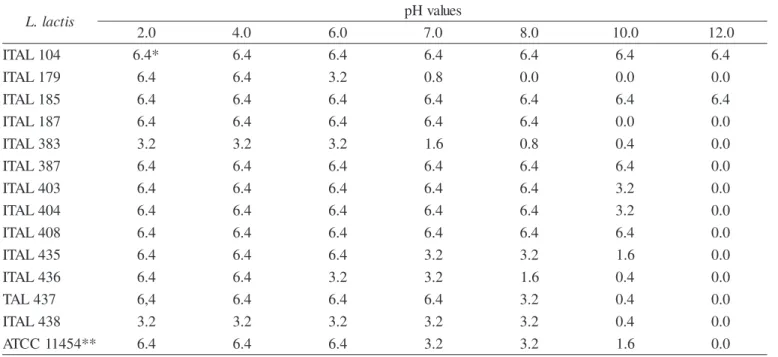
The stability of bacteriocins in different pH level is shown in Table 5. The strains ITAL 104 and ITAL 185 were active in a wide range of pH from 2.0 up to 12.0. This result was similar to bacteriocin S50 produced by L. lactis subsp. lactis S50 (19). All the others bacteriocins were fully or partly active at range of pH 2.0-10.0 and completely inactivated at pH 12.0. Similar to nisin of ATCC 11454, bacteriocin of ITAL 383 was stable at neutral and acid pH (2.0-6.0), partly active at pH 6.0-10.0 and completely inactive at pH 12.0. Nisin is the most stable at pH 2.0 and its activity decreases drastically or is lost at pH > 7.0 at room temperature (16).
Table 4. Sensitivity of bacteriocins produced by L. lactis strains and nisin of L. lactis subsp. lactis ATCC 11454 to treatment with proteolytic and lipolytic enzymes
*Phosphate buffer + sterile cell-free supernatants;
**Results expressed in activity (arbitrary unity x 103ml-1);
***PC: L. lactis subsp. lactis ATCC 11454 used as positive control s
e m y z n
E L.lactis
4 0
1 179 185 187 383 387 403 404 408 435 436 437 438 PC *
l o r t n o
C 6.4** 0.8 1.6 6.4 0.8 6.4 0.8 6.4 3.2 1.6 1.6 6.4 1.6 1.6 E
e s a n o r
P 6.4 0.0 0.0 0.0 0.0 3.2 0.0 0.0 1.6 0.0 0.4 0.0 0.0 0.0 n
i s p e
P 0.8 0.4 0.4 3.2 0.8 6.4 0.8 1.6 3.2 1.6 1.6 1.6 0.8 0.8 n
i c i
F 6.4 0.8 1.6 0.8 0.8 6.4 0.8 3.2 3.2 1.6 1.6 1.6 0.8 0.8 e
s a p i
L 0.4 0.0 1.6 0.8 0.4 3.2 0.0 1.6 3.2 1.6 1.6 1.6 0.0 1.6 n
i s p y r
T 1.6 0.0 0.4 3.2 0.8 6.4 0.0 3.2 3.2 0.0 0.8 0.2 0.0 1.6 K
e s a n i e t o r
P 0.0 0.0 0.0 0.0 0.0 0.0 0.0 0.0 0.0 0.0 0.0 0.0 0.0 0.0
s i t c a l .
L pHvalues
0 .
2 4.0 6.0 7.0 8.0 10.0 12.0 4
0 1 L A T
I 6.4* 6.4 6.4 6.4 6.4 6.4 6.4
9 7 1 L A T
I 6.4 6.4 3.2 0.8 0.0 0.0 0.0
5 8 1 L A T
I 6.4 6.4 6.4 6.4 6.4 6.4 6.4
7 8 1 L A T
I 6.4 6.4 6.4 6.4 6.4 0.0 0.0
3 8 3 L A T
I 3.2 3.2 3.2 1.6 0.8 0.4 0.0
7 8 3 L A T
I 6.4 6.4 6.4 6.4 6.4 6.4 0.0
3 0 4 L A T
I 6.4 6.4 6.4 6.4 6.4 3.2 0.0
4 0 4 L A T
I 6.4 6.4 6.4 6.4 6.4 3.2 0.0
8 0 4 L A T
I 6.4 6.4 6.4 6.4 6.4 6.4 0.0
5 3 4 L A T
I 6.4 6.4 6.4 3.2 3.2 1.6 0.0
6 3 4 L A T
I 6.4 6.4 3.2 3.2 1.6 0.4 0.0
7 3 4 L A
T 6,4 6.4 6.4 6.4 3.2 0.4 0.0
8 3 4 L A T
I 3.2 3.2 3.2 3.2 3.2 0.4 0.0
* * 4 5 4 1 1 C C T
A 6.4 6.4 6.4 3.2 3.2 1.6 0.0
Table 5. Activity of bacteriocins of L. lactis subsp. lactis strains at different pH levels.
*Results expressed in activity (arbitrary unity x 103ml-1);
**L. lactis subsp. lactis ATCC 11454 used as positive control
s i t c a l . L
s e u l a v H p 0
.
2 4.0 6.0 7.0 8.0 10.0 12.0
*
C RA** C RA C RA C RA C RA C RA C RA
4 0 1 L A T
I 6.4*** 6.4 6.4 6.4 6.4 6.4 6.4 1.6 6.4 0.0 6.4 0.0 6.4 0.0
9 7 1 L A T
I 6.4 6.4 6.4 6.4 3.2 3.2 0.8 0.8 0.0 0.0 0.0 0.0 0.0 0.0 5
8 1 L A T
I 6.4 1.6 6.4 1.6 6.4 1.6 6.4 0.2 6.4 0.0 6.4 0.0 6.4 0.0
7 8 1 L A T
I 6.4 6.4 6.4 6.4 6.4 0.8 6.4 0.8 6.4 0.0 0.0 0.0 0.0 0.0 3
8 3 L A T
I 3.2 3.2 3.2 0.8 3.2 0.4 1.6 0.0 0.8 0.0 0.4 0.0 0.0 0.0 7
8 3 L A T
I 6.4 6.4 6.4 6.4 6.4 6.4 6.4 6.4 6.4 0.8 6.4 0.0 0.0 0.0
3 0 4 L A T
I 6.4 3.2 6.4 3.2 6.4 0.8 6.4 0.2 6.4 0.0 3.2 0.0 0.0 0.0 4
0 4 L A T
I 6.4 6.4 6.4 6.4 6.4 1.6 6.4 0.8 6.4 0.2 3.2 0.0 0.0 0.0
8 0 4 L A T
I 6.4 6.4 6.4 6.4 6.4 3.2 6.4 1.6 6.4 1.6 6.4 0.0 0.0 0.0 5
3 4 L A T
I 6.4 6.4 6.4 6.4 6.4 0.8 3.2 0.0 3.2 0.0 1.6 0.0 0.0 0.0
6 3 4 L A T
I 6.4 3.2 6.4 3.2 3.2 0.4 3.2 0.0 1.6 0.0 0.4 0.0 0.0 0.0 7
3 4 L A T
I 6.4 6.4 6.4 3.2 6.4 0.2 6.4 0.0 3.2 0.0 0.4 0.0 0.0 0.0 8
3 4 L A T
I 3.2 3.2 3.2 3.2 3.2 0.2 3.2 0.0 3.2 0.0 0.4 0.0 0.0 0.0
4 5 4 1 1 C C T
A 6.4 6.4 6.4 3.2 6.4 1.6 3.2 0.0 3.2 0.0 1.6 0.0 0.0 0.0 Table 6. Effect ofheat treatment (121oC for 10 minutes) on activity of bacteriocins of L. lactis subsp. lactis strains at different
pH levels.
*Control: bacteriocin activity before heat treatment; **Residual activity after heat treatment;
The results of resistance of bacteriocins to heat treatment at 121°C for 10 minutes at different pH levels are shown in Table 6. All bacteriocins, except ITAL 104, ITAL 403 and ITAL 436, were stable to heating at pH 2.0 with-reduced activity at range of pH 4.0 to 7.0, with complete loss of its activity in alkaline conditions (pH ≥ 8.0). In this last situation the only exception was ITAL 408 that was active at pH 8.0. Nisin produced by ATCC 11454 lost 50% activity at pH 4.0 and 75-100% at pH 6.0 and 7.0, respectively. ITAL 383 showed loss of 75% at pH 6.0 and 100% at pH 7.0. These results indicated that the active substances were thermal stable. The activity was lost irreversibly, and it could not be regained upon lowering the pH to 7.0. Irreversible inactivation can be the result of a combination of denaturation and chemical modifications of the molecule (22). According to Hurst (16) nisin solutions can be boiled in diluted hydrochloride acid at pH 2.5 or less without any loss of activity. Moreover, nisin remains stable after autoclaving at 115.6°C at pH 2.0, but loses 40% of its activity at pH 5.0 and more than 90% at pH 6.8 (16).
Similar to nisin, bacteriocin of ITAL 383 was stable after treatment for 60 min at pH 2.0 and lost 50% of its activity after 30 min at pH 6.0 (Table 7). Klaenhaemmer (18) observed resistance to treatment at 100°C for 10 min, at acid conditions. Likewise, Vandenbergh et al. (38) showed that nisin produced by eight L. lactis strains isolated from vegetables did not loose their activities after treatment at 100°C for 2h.
Detection of activity in SDS-PAGE
To determine if the antimicrobial activity of partially purified bacteriocin produced by L. lactis subsp. lactis ITAL 383 was due to nisin, the detection and identification of antimicrobial peptides in SDS-PAGE were done. When the preparation of bacteriocin ITAL 383 was submitted to electrophoresis on 20% polyacrylamide gel in the presence of 0.1% SDS, one band revealed by silver staining had the same antimicrobial activity and molecular weight (MW) when compared to similar preparation from L. lactis ATCC 11454.
This antimicrobial activity that corresponded to the band of nisin of preparations of L. lactis ATCC 11454 was demonstrated by clear zone of inhibition when the other half of the SDS-PAGE gel was overlaid with a layer of the sensitive indicator (L. innocua LIN 11) (results not shown).
Our results confirmed that all inhibitory substances produced by the tested L. lactis strains were bacteriocins. The sensitivity of these bacteriocins to proteolytic enzymes indicated their proteinaceous nature. Similar to nisin in molecular weight, the bacteriocin of strain ITAL 383 showed a wide spectrum of activity and heat resistance.
A C K N O W L E D G E M E N T S
Izildinha Moreno would like to thank the Conselho Nacional de Desenvolvimento Científico e Tecnológico-CNPq for the concession of a scholarship for probation in the Institut National de Recherches Agronomiques-INRA, Jouy-en-Josas, France and to her supervision by Dr. Jean Richard and Dr. Michel Desmazeaud.
R E S U M O
Caracterização de bacteriocinas produzidas por linhagens de Lactococcus lactis
Bacteriocinas resistentes ao aquecimento produzidas por quinze linhagens de Lactococcus lactis (14 L. lactis subsp.
lactis e 1 L. lactis subsp. cremoris) foram sensíveis à enzimas proteolíticas e ativas em uma ampla faixa de pH. A resistência dessas bacteriocinas ao aquecimento foi fortemente influenciada pelo pH do meio. Somente a linhagem L. lactis subsp. lactis
ITAL 383 produziu uma bacteriocina com um amplo espectro de atividade, semelhante ao da nisina de L. lactis subsp. lactis
ATCC 11454. Esta bacteriocina inibiu as espécies relacionadas e outros microorganismos gram-positivos, inclusive Listeria monocytogenes e Staphylococcus aureus, mas não as bactérias Gram-negativas examinadas. A identificação do composto antimicrobiano parcialmente purificado por SDS-PAGE revelou um peso molecular similar entre a bacteriocina ITAL 383 e a nisina de L. lactis subsp lactis ATCC 11454.
Palavras-chave: bacteriocinas, L. lactis, espectro de atividade, características físico-químicas
REFERENCES
1. Benkerroum, N., Sandine, W. E. Inhibitory action of nisin against Listeria monocytogenes. J. Dairy Sci., 71: 3237-3245, 1988.
2. Broadbent, J. R., Chou, Y. C., Gillies, K., Kondo, J. K. Nisin inhibits several gram-positive, mastitis-causing pathogens. J. Dairy Sci., 72: 3342-3345, 1989.
3. Bhunia, A.K., Johnson, M.G. A modified method to directly detect in SDS-PAGE the bacteriocin of Pediococcus acidilactici. Letters Appl. Microbiol., 15: 5-7, 1992.
s i t c a l .
L pH Control Time(minutes)
0
1 20 30 60 3
8 3 L A T
I 2.0* 1.6 1.6 1.6 1.6 1.6 0
.
6 1.6 1.6 1.6 0.8 0.8 4
5 4 1 1 C C T
A 2.0 1.6 1.6 1.6 1.6 1.6 0
.
6 1.6 1.6 1.6 0.8 0.8 Table 7. Effect ofheat treatment (100oC for 10, 20, 30 e 60
minutes) on the activity of bacteriocins of L. lactis subsp. lactis
ITAL 383 and nisin of L. lactis subsp. lactis ATCC 11454 at pH 2.0 and 6.0.
4. Carminati, D., Giraffa, G., Bossi, M. G. Bacteriocin-like inhibitors of
Streptococcus lactis against Listeria monocytogenes. J. Food Prot., 52: 614-617, 1989.
5. Chung, K-T., Dickson, J. S., Crouse, J. D. Effects of nisin on growth of bacteria attached to meat. Appl. Environ. Microbiol., 55: 1329-1333, 1989. 6. Cilano, L., Rosso, D., Bosso, M. G. Azione di sostanze inibitrici prodotte da
batteri lattici verso microrganismi patogeni. L’Industria del Latte, 27: 3-20, 1991.
7. Daeschel, M. A. Antimicrobial substances from lactic acid bacteria for use as food preservative. Food Technol., 43: 164-167, 1989.
8. Davey, G. P., Richardson, B.C. Purification and some properties of diplococcin from Streptococcus cremoris 346. Appl. Environ. Microbiol.,41: 84-89, 1981.
9. Davidson, P.M., Hoover, D.G. Antimicrobial components from lactic acid bacteria. In: Salminen and Von Wright, A. (eds). Lactic Acid Bacteria. 1993, p. 127-150.
10. De Vuyst L. and Vandamme, E.J. Lactic acid bacteria and bacteriocins: their practical importance. In: De Vuyst, L. & Vandamme, E.J. (eds). Bacteriocins of Lactic AcidBacteria. Microbiology, Genetics and Application. Chapman & Hall, New York, 1994, p. 1-12.
11. Dufoir, A., Thuaut, D., Boulliou, A., Bourgeor, C.M., Le Pennec, J-P. Plasmid-encoded determinants for bacteriocin production and immunity a Lactococcus lactis strain and purification of the inhibitory peptides. J. General Microbiol.,
137:2723-2491, 1991.
12. Eckner, K.F. Bacteriocins and food application. Dairy Food Environ. Sanitation, 12: 204-209, 1992.
13. Geis, A., Singh, J., Teuber, M. Potential of lactic streptococci to produce bacteriocin. Appl. Environ. Microbiol., 45: 205-211, 1983.
14. Gupta, R. K. and Batish, V. K. Screening of lactic streptococci for antibacterial activity, plasmid profils and biochemical performance. MAN.,8: 45-52, 1990. 15. Holo, H., Nielssen, O., Nes, I.F. Lactococcina A, a new bacteriocin from
Lactococcuslactis subsp. cremoris: isolation and characterization of the protein and its gene. J. Bacteriol., 173: 3879-3887, 1991.
16. Hurst, A. Nisin. Adv. Appl. Microbiol., 27: 85-123, 1981.
17. Kalra, M.S. and Dudani, A.T. Isolation of nisin-producing streptococci by a plating technique using Micrococcusflavus. Indian J. Dairy Sci.,26: 208-209, 1973.
18. Klaenhammer, T.D. Bacteriocins of lactic acid bacteria. Biochimie, 70: 337-349, 1988.
19. Kojic, M., Svircevic, J., Banina, A.L., Topisirovic L. Bacteriocin producing strain of Lactococcus lactis subsp. diacetylactis S50. Appl. Environ. Microbiol., 57: 1835-1837, 1991.
20. Kozak, W., Bardowski, J., Dobrzanski, W.T. Lactostrepcins-acid bacteriocins produced by lactic streptococci. J. Dairy Res., 45: 247-257, 1978. 21. Lewus, C.B., Kaiser, A., Montville, T.J. Inhibition of food-borne bacterial
pathogens by bacteriocins from lactic acid bacteria isolated from meat. Appl. Environ. Microbiol., 57: 1683-1688, 1991.
22. Liu, W. and Hansen, J.N. Some chemical and physical properties of nisin, a small-protein antibiotic produced by Lactococcus lactis. Appl. Environ. Microbiol., 56: 2551-2558, 1990.
23. Mayr-Harting, A., Hedges, A.J., Berkeley, C.W. Methods for studyng bacteriocins. In: Norris, J. R. and Ribbons, D. W. (eds). Methods in Microbiology. Academic Press Inc., New York, 1972, p. 316-422.
24. Motlagh, A. M., Johnson, M. C., Ray, B. Viability loss of food-borne pathogens by starter culture metabolites. J. Food Prot. 54: 873-878, 1991.
25. Moreno, I., Lerayer, A. L. S., Leitão, M.F.F. Caracterização antimicrobiana da bacteriocina Bac 383 produzida por Lactococcus lactis subsp. lactis
ITAL 383. I. Sensibilidade de Listeria monocytogenes, Listeria sp. e
Staphylococcus aureus. Anais do XVI Congresso Brasileiro de Ciência e Tecnologia de Alimentos, 2: 847-850, 1998.
26. Moreno, I., Lerayer, A.L.S., Leitão, M.F.F. Detection and characterization of bacteriocin-producing Lactococcus lactis strains. Revista de Microbiologia,
30: 130-136, 1999.
27. Mulders, W. M., Boerrigter, I.J., Rollema, H.S., Siezen, R.J., De Vos, W.M. Identification and characterization of the lantibiotic nisin Z, a natural nisin variant. FEBS., 201: 201-284, 1991.
28. Ness, I.F., Diep, D.B., Håvarstein, L.S., Brurberg, M.B. Biosynthesis of bacteriocins in lactic acid bacteria. Antonie van Leeuwenhoeck, 70: 113-128, 1996.
29. Nissen-Meyer, J., Holo, H. Havarstein, L.S., Sletten, K., Nes, I.F. A novel lactococcal bacteriocin whose activity depends on the complementary action of two peptides. J. Bacteriol., 174: 5686-5692, 1992.
30. Oxford, A. E. Diplococcin, an antibacterial protein elaborated by certain milk stretococci. Biochemical J., 38: 179-182, 1944.
31. Piard, J.C., Delorme, F., Giraffa, G., Commissaire, J., Desmazeaud, M. Evidence for a bacteriocin produced by Lactococcus lactis CNRZ 481. Neth. Milk Dairy J., 44:143-158, 1990.
32. Piard, J. C., Muriana, P. M., Desmazeaud, M. J., Klaenhammer, T. R. Purification and partial characterization of lacticin 481, a lanthionine containing bacteriocin produced by Lactococcus lactis CNRZ 481. Appl. Environ. Microbiol., 58: 279-281, 1992.
33. Powell, I.B., Ward, A.C., Hillier, A.J., Davidson, B.E. Simultaneous conjugal transfer in Lactococcus to genes involved in production bacteriocin and reduced susceptibility to bacteriophages. FEMS Microbiol. Lett., 72: 209-214, 1990
34. Schillinger, U. Bacteriocins of lactic acid bacteria. In: Bills, D.D. and Kung, S. (eds). Biotechnology and Food Safety. Butterworth-Heinemann, Boston, 1990, p. 55-74.
35. Spelhaug, S.R., Harlander, S.K. Inhibition of food-borne bacterial pathogens by bacteriocins from Lactococcus lactis and Pediococcus pentosaceus. J. Food Prot., 52: 856-862, 1989.
36. Tagg, J.R. and McGiven, A.R. Assay system for bacteriocins. Appl. Microbiol.
21: 943, 1971.
37. Uhlman, L., Schillinger, U., Rupnow, J.R., Holzapfel, W.H. Identification and characterization of two bacteriocin-producing strains of Lactococcus lactis isolated from vegetables. Int. J. Food Microbiol., 16: 141-151, 1992. 38. Vandenberg, D.J.C., Smits, A., Pot, B., Ledeboer, A. M., Kersters, K., Verbakel, J. M. A., Verrips, T. Isolation, screening and identification of lactic acid bacteria from traditional food fermentation processes and culture collections. Food Biotechn., 7: 189-205, 1993.