KINETIC ANALYSIS OF BATCH ETHANOL ACETYLATION IN ISOTHERMAL NON-STATIONARY
MULTIPHASE SYSTEMS BY LYOPHILIZED MYCELIUM OF ASPERGILLUS ORYZAE
Emilio Palazzi1, Francesco Molinari2, Bruno Fabiano1, Adalberto Pessoa Jr3, Attilio Converti1*
1
Department of Chemical and Process Engineering “G.B. Bonino”, University of Genoa, via Opera Pia 15 - 16145 Genoa, Italy;
2
Department of Food and Microbiological Science and Technology, University of Milan, Italy; 3Departamento de Tecnologia
Bioquímico-Farmacêutica, Universidade de São Paulo, São Paulo, SP, Brasil.
Submitted: March 16, 2010; Approved: June 21, 2010.
ABSTRACT
A relatively complex network of reactions has been investigated, using as a network model the isothermal
batch esterification of acetic acid with ethanol in n-heptane catalyzed by lyophilized mycelium of
Aspergillus oryzae. The kinetic analysis was firstly carried out on the whole system, without any
simplification, by means of the well-known integral method. Owing to the poor results obtained by this
way, we developed an alternative approach, combining initial rates and integral analysis and reducing the
number of empirical parameters to be determined by the use of equilibrium data. All the values of the
parameters calculated according to this “composite” approach to kinetic analysis well correlate with
experimental data.
Key words: Aspergillus oryzae, Complex network, Enzyme reactions, Esterification, Organic solvent
INTRODUCTION
The study of any reaction network in isothermal,
non-steady-state systems could be carried out, in principle, by
means of the integral method of kinetic analysis. As is known,
such a method allows estimating, by regression, the parameters
of a model using the experimental values of concentrations of
the involved components along the time.
However, the results obtained by the integral approach are
often scarcely useful for practical purposes, especially in the
case of complex reaction networks and multiphase systems,
when the correlation between model and experimental data is
poor, or else when the values of some parameters are
meaningless. Moreover, different values of these could fit
equally well with experimental results, making it difficult to
select the most reliable set of data.
Nevertheless, the effectiveness of the integral method can
be greatly enhanced by reducing the number of parameters to
be determined. This option doesn’t necessarily require a
simplification of the model, but it can also be done by direct
calculation of some of the parameters by different methods
and/or using chemical equilibrium data. These topics are
discussed in the present work, taking as a reference model the
esterification of acetic acid with ethanol in n-heptane,
catalyzed by lyophilized mycelium of Aspergillus oryzae.
Various innovative processes of bioesterification in
hydrophobic environment were extensively studied, making
use of batch, isothermal reactors and different combinations of
Palazzi, E. et al. Ethanol acetylation by A. oryzae
reagents, enzymes, organic solvents and operating conditions
(2-4, 8-12), because most of them allow the enantiomeric
resolution of racemic compounds of pharmaceutical
significance, among which solketal (12), ketoprofen and
ibuprofen (1).
Chemical transformations occurring in these systems are
well described by the so-called “ping-pong” mechanism
proposed by Yang and Russell (13), which is opposite to that
presented by Jencks (7) for esters hydrolysis in water.
Substitution of water with organic solvents, useful to move the
chemical equilibrium towards the ester production, somewhat
complicates some physical aspects of the kinetics, owing to the
formation of different phases in the reacting fluid.
In previous works (2, 4), we studied the process kinetics
applying the method of the initial rates to a simplified form of
the model, so as to obtain results useful for practical
applications. Some of these results are used here, implemented
with equilibrium data, in order to simplify the kinetic analysis
of the general, more comprehensive model, by means of the
integral method.
MATERIALS AND METHODS
Chemicals, mycelium preparation, procedures and
analytical methods were previously described (2, 4, 10). The
optimal process conditions were previously determined by an
extensive experimental work, performed at different
temperatures and concentrations of the lyophilized mycelium
of Aspergillus oryzae MIM and substrates, and a simplified
kinetic model based on the method of the initial rates was
successfully used (2, 4). The kinetic investigation is extended
in this work to the overall duration of the process, so as to
evaluate the whole set of model parameters. All bioconversions
were performed in triplicate at a temperature of 50 °C and
using a lyophilized mycelium of Aspergillus oryzae MIM as a
catalyst at concentrations of 10 and 20 g/L.
THEORY
Under particular circumstances, a rather complex network
of reactions can be studied in a relatively simple way. The case
of ethanol acetylation by mycelium-bound carboxylesterase of
Aspergillus oryzae is chosen in this work as an example. The
process was performed in organic solvent (n-heptane) (2, 4, 10)
to shift the chemical equilibrium towards the esterification (6).
The involved reaction network, corresponding to the so-called
ping-pong mechanism (13), is:
k1
E + A
↔
EA + W (1)k’1
k2
EA + B
↔
EP (2)k’2
k3
EP
↔
E + P (3)k’3
where E is the active free enzyme, A the acetic acid, B the
ethanol, P the ethyl acetate, EA and EP the complexes of the
enzyme with acetic acid and ethyl acetate, respectively, W the
water, while k1, k2, k3 are the specific rate constants of the
direct reactions (1-3) and k’1, k’2, k’3 those of their respective
inverse reactions.
Taking into accounts Equations (1-3), A, B and P balances
can be written as:
dA/dt = - k1 E A + k’1 EA W (4)
dB/dt = - k2 EA B + k’2 EP (5)
dP/dt = k3 EP - k’3 E P (6)
the italic symbols of the chemical species representing their
molar concentrations.
Because at the beginning of the process are EA0 = EP0 = P0
= 0, the concentrations of the complexed and free enzyme at
any instant are given by:
EA = A0 – A + B – B0 (7)
EP = Bo – B – P (8)
Starting from the water balance in the phase where the reaction
takes place:
W = W0 + A0 – A – Kr W (10)
one can write:
W = (W0 + A0 – A) / (1 + Kr) (11)
where Kr W is the molar concentration of water in the
non-reacting phase and Kr the corresponding partition coefficient.
Substitution of Equations (7-9) and (11) into Equations
(4-6) gives:
dA/dt = - k1 E0 A k1 A (E – E0)+ k’1* W0 EA + k’1* EA(A0 –A) (12)
dB/dt = - k2 B EA + k’2 EP (13)
dP/dt = k3 EA k’3 EP P (14)
where:
k’1* = k’1 / (1 + Kr) (15)
RESULTS AND DISCUSSION
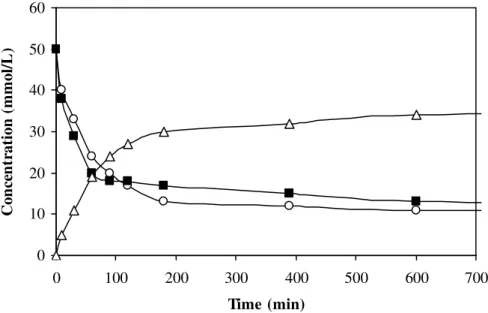
Figures 1 and 2 show the results of ethanol acetylation
obtained under optimal operating conditions, i.e.: T = 50°C,
concentration of the lyophilized mycelium, CM, of 10 and 20
g/L, respectively. In fact, as previously stressed, under these
conditions, the effect of enzyme inactivation can reasonably be
neglected (2, 4).
0
10
20
30
40
50
60
0
100
200
300
400
500
600
700
Time (min)
C
o
n
ce
n
tr
a
ti
o
n
(
m
m
o
l/
L
)
Figure 1. Experimental results of ethanol acetylation performed at 50°C with lyophilized mycelium of A. oryzae at concentration of 10 g/L. ( ) Acetic acid; ( ) ethanol; ( ) ethylacetate. Starting conditions: acetic acid 50 mmol/L; ethanol 50 mmol/L.
Equilibrium conditions were obtained after 2880 min as follows: acetic acid 9 mmol/L; ethanol 11 mmol/L; ethylacetate 38
Palazzi, E. et al. Ethanol acetylation by A. oryzae 0 10 20 30 40 50 60
0 100 200 300 400 500 600 700
Time (min) C o n ce n tr a ti o n ( m m o l/ L )
Figure 2. Experimental results of ethanol acetylation performed at 50°C with lyophilized mycelium of A. oryzae at concentration of
20 g/L. ( ) Acetic acid; ( ) ethanol; ( ) ethylacetate. Starting conditions: acetic acid 50 mmol/L; ethanol 50 mmol/L. Equilibrium
conditions were obtained after 2880 min as follows: acetic acid 8 mmol/L; ethanol 10 mmol/L; ethylacetate 37 mmol/L.
Integral method
As already remarked, the study of the process kinetics
was firstly performed by means of the integral method (5),
which requires formally integrating Equations (12-14) with
respect to time:
At - A0 =- k1E0 0
t Adt - k1
0 t
A(E - E0)dt+ k’1* W0 0
t EA dt +
+ k’1* 0
t
EA(A0 -A)dt (16)
Bt - B0 = - k20 t
BEAdt + k’20 t
EP dt (17)
Pt = k30 t
EPdt - k’3E00 t
Pdt - k’30 t
P(E-E0)dt (18)
then numerically calculating the integrals in Equations (16-18),
taking into accounts Equations (7-9) and the experimental
data, and finally estimating by linear regression the parameters
appearing in Equations (16-18).
Unfortunately, the values of some parameters resulted to
be meaningless (e.g., k’3 < 0), probably due to the limitations
of the method mentioned in the Introduction. Therefore, as
discussed in the next session, a different approach is
developed, presenting a two-step analysis as a tool for
estimation of all relevant kinetic parameters.
Two-step method
The method adopted to calculate the kinetic parameters is
based on the possibility of splitting the whole process into two
stages. According to the experimental results, up to few tenths
of minutes since the beginning of the esterification, the
predominant reaction is certainly the attack of acetic acid to the
active site of the enzyme, so the kinetics can be adequately
described by Equations (4) and (9).
Making reference to the first 30 min of the process, where
P ≅ 0 and W ≅ W0 ≅ 0, since the biocatalyst is lyophilized,
combination of Equations (4) and (9) gives:
dA/dt = - k1 A (E0 + A – A0) (19)
By integration, one can obtain:
(20)
From the experimental results obtained under the optimal
conditions, we then estimated the values of the parameters k1
and Eo listed in Table 1.
[
]
[
k
E
A
t
]
Table 1. Kinetic constant of acetylation and concentration of the active free enzyme.
CM (g L-1) k1 (L mmol-1 h-1) E0 (mmol L-1)
10 0.161 11.4
20 0.133 23.3
As it can be seen, the values of k1 are comparable one to
the other, while those of the concentration of the active free
enzyme are nearly proportional to the ones of the mycelium
used in the runs. As regards the next phase of the process, the
results demonstrate that equilibrium conditions (dA/dt = dB/dt
= dP/dt = 0) were achieved after about 2 days, so:
A = A∞; B = B∞; P = P∞ (21)
∞ 0 ∞ ∞ 0 (22)
∞ 0– B∞ - P∞ (23)
∞ 0+ A∞ - A0 P∞ (24)
Then we obtain from Equations (12-14):
k’1* =k1 A∞ E∞ / [(A0 - A∞) EA∞] (25)
k’2 = k2 B∞ EA∞ / EP∞ (26)
k’3 = k3 EP∞ / (P∞ E∞) (27)
The value of k’1* was directly calculated by Equation
(25). As far as the other parameters are concerned, substitution
of Equations (26-27) into Equations (17-18) gives:
Bt – B0 = k2 0 t
(B∞ EA∞ EP / EP∞ – B EA) dt (28)
Pt = k3 0 t
[EP – EP∞ E P/ (P∞ E∞)] dt (29)
The kinetic constants k2 and k3 were then calculated by
means of the integral method, and, finally, k’2 and k’3 by
Equations (26) and (27), respectively. Table 2 lists all the
values estimated for these parameters.
The developed analysis allowed calculating in a simple
and reliable way all the relevant kinetic parameters of the
reaction network, including conventional rate constant and
“pseudo kinetic” rate parameters, accounting for the active
free enzyme concentration (k’1* and k’3 ).
Table 2. Kinetic parameters of the process steps following enzyme acetylation.
CM
(g L-1)
k’1*
(L mmol-1 h-1)
k2
(L mmol-1 h-1)
k’2
(h-1) k3
(h-1)
k’3
(L mmol-1 h-1)
10 0.30 0.32 2.1 9.6 0.060
20 0.28 0.35 1.9 11.0 0.049
CONCLUSIONS
A two-step approach was proposed to analyze complex
enzyme reaction networks in a multiphase system.
Applicability of the method was demonstrated in the reaction
scheme of bioesterification of acetic acid with ethanol in
n-heptane, catalyzed by lyophilized mycelium of Aspergillus
oryzae. The first step of the framework considered as key
reaction the attack of acetic acid to the active site of the
enzyme; the subsequent step was based on the integral method,
applied at the equilibrium conditions and allowed estimating all
the kinetic parameters of the complete model. Such a novel
Palazzi, E. et al. Ethanol acetylation by A. oryzae
overcoming possible incongruities of the well-established
integral method.
REFERENCES
1. Carvalho, P.O.; Contesini, F.J.; Ikegaki, M. (2006). Enzymatic resolution of (R,S)-ibuprofen and (R,S)-ketoprofen by microbial lipases from native and commercial sources. Braz. J. Microbiol. 37(3), 329-337.
2. Converti, A.; Del Borghi, A.; Gandolfi, R.; Lodi, A.; Molinari, F.; Palazzi, E. (2002). Reactivity and stability of mycelium-bound carboxylesterase from Aspergillus oryzae. Biotechnol. Bioeng. 77, 231-237.
3. Converti, A.; Del Borghi, A.; Gandolfi, R.; Molinari, F.; Palazzi, E.; Perego, P.; Zilli, M. (2002). Simplified kinetics and thermodynamics of geraniol acetylation by lyophilized cells of Aspergillus oryzae. Enzyme Microb. Technol. 30, 216-223.
4. Converti, A.; Del Borghi, M.; Gandolfi, R.; Molinari, F.; Palazzi, E.; Zilli, M. (2002). Ethanol acetylation by mycelium-bound carboxylesterase of Aspergillus oryzae: estimation of thermodynamic parameters and integral productivity. World J. Microbiol. Biotechnol. 18, 409-416.
5. Froment, G.F.; Bischoff, K.B. (1990). Chemical Reactor Analysis and Design. Wiley & Sons, New York, USA.
6. Halling, P.J. (1994). Thermodynamic predictions for biocatalysis in non
conventional media: theory, tests and recommendations for experimental design and analysis. Enzyme Microb. Technol. 16, 178-206.
7. Jencks, W.P. (1987). Catalysis in Chemistry and Enzymology. Dover, New York, USA.
8. Lojudice, F.H.; Silva, D.P.; Zanghin, N.I.T.; Pessoa, A. (2001). Overexpression of glucose-6-phosphate dehydrogenase in genetically modified Saccharomyces cerevisiae. Appl. Biochem. Biotechnol. 91(3), 161-169
9. Molinari, F.; Gandolfi, R.; Aragozzini, F. (1996). Microbial catalyzed esterification of primary and secondary alcohols in organic solvent.
Biotechnol. Techniques 10. 103-108.
10. Molinari, F.; Gandolfi, R.; Aragozzini, F.; Converti, A.; Zilli, M. (2000). Mycelium-bound carboxylesterase from Aspergillus oryzae: an efficient catalyst for acetylation in organic solvents. Enzyme Microb. Technol. 27, 626-630.
11. Pessoa, A.; Vitolo, M. (1998). Evaluation of cross-flow microfiltration membranes using a rotary disc-filter. Process Biochem. 33(1), 39-45. 12. Romano, D.; Ferrario, V.; Molinari, F.; Gardossi, L.; Sanchez Montero,
J.M.; Torre, P.; Converti, A. (2006). Kinetic resolution of (R,S)-1,2-O-isopropyldeneglycerol by esterification with dry mycelia of moulds. J. Mol. Catal. B-Enzym. 41, 71-74.