Enhanced production of prodigiosin by
Serratia marcescens
MO-1
using ram horn peptone
Esabi Basaran Kurbanoglu
1, Murat Ozdal
1,2, Ozlem Gur Ozdal
1, Omer Faruk Algur
1 1Department of Biology, Faculty of Science, Ataturk University, Erzurum, Turkey. 2
Department of Food, Ispir Hamza Polat Vocational School, Ataturk University, Erzurum, Turkey.
Submitted: October 25, 2013; Approved: October 07, 2014.
Abstract
This work addresses the production of prodigiosin from ram horn peptone (RHP) using MO-1, a local isolate in submerged culture. First, a novel gram-negative and rod-shaped bacterial strain, MO-1, was isolated from the body of the grasshopper (Poecilemon tauricolaRamme 1951), which was collected from pesticide-contaminated fields. Sequence analysis of 16S rDNA classified the microbe as
Serratia marcescens. The substrate utilization potential (BIOLOG) and fatty acid methyl ester profile (FAME) ofS. marcescenswere also determined. The effect of RHP on the production of prodigiosin byS. marcescensMO-1 was investigated, and the results showed that RHP supplementation pro-moted the growth of MO-1 and increased the production of prodigiosin. A concentration of 0.4% (w/v) RHP resulted in the greatest yield of prodigiosin (277.74 mg/L) after 48 h when mannitol was used as the sole source of carbon. The pigment yield was also influenced by the types of carbon sources and peptones. As a result, RHP was demonstrated to be a suitable substrate for prodigiosin production. These results revealed that prodigiosin could be produced efficiently byS. marcescens
using RHP.
Key words:prodigiosin,Serratia marcescens, ram horn peptone, agricultural waste.
Introduction
Natural pigments are synthesized by living organ-isms, such as plants, animals, fungi and bacteria. Prodi-giosin (C20H25N3O) is a linear tripyrrole red pigment and bioactive secondary metabolite that accumulates on cell membranes and intracellular granules. Although S. marcescensis the major producer of prodigiosin, this pig-ment is also produced by other bacteria, such as
Streptomyces coelicolor, S. lividans, Hahella chejuensi,
Pseudovibrio denitriccans,Pseudoalteromonas rubra, P. denitrificans, Vibrio gazogenes, V. psychroerythreus,
Serratia plymuthicaandZooshikella rubidus(D’Aoust and Gerber, 1974; Kim et al., 2007; Lee et al., 2011; El-Bondklyet al., 2012).
Prodigiosins have recently received renewed atten-tion for their antialgal, antibacterial, antifungal, anti-malarial, antiprotozoal, anticancer, immunosuppressive, antiproliferative and UV-protective activities (Montaner
and Perez-Thomas, 2001; Soto-Cerratoet al., 2004; Boric
et al., 2011; Leeet al., 2011; Parket al., 2012); however, its insecticidal activity was also reported (Wanget al., 2011). Because of its potential use in medical and textile applica-tions (Sivaet al., 2012), prodigiosin is attracting an increas-ing interest.
The production of prodigiosin has been shown to be influenced by many factors, such as species type and envi-ronmental factors, including inorganic phosphate availabil-ity, dissolved oxygen level, light, media composition, tem-perature, pH and incubation time (Williamset al., 1971; Witneyet al., 1977; Soléet al., 1997; Slater et al., 2003; Wanget al., 2011; Ryazantsevaet al,. 2012). A cost reduc-tion in prodigiosin producreduc-tion could be achieved using in-expensive substrates. Potential substrates, such as vegeta-ble oils (Giriet al., 2004; Wei and Chen, 2005), ethanol (Canget al., 2000), cassava wastewater, corn steep liquor (Araújoet al., 2010) and squid pen powder (Siva et al., 2012), have been investigated.
Send correspondence to M. Ozdal. Department of Biology, Faculty of Science, Ataturk University, 25240 Erzurum, Turkey. E-mail: [email protected].
Many studies demonstrated that inorganic nitrogen sources, especially ammonium salts, such as (NH4)2SO4, NH4Cl, NH4NO3and also urea, inhibit the production of the pigment, because ammonium is a poor nitrogen atom donor and perhaps indicating the toxicity of ammonium salts to-wards the organism (Hejazi and Falkiner, 1997; Canget al., 2000). Therefore, there exists a need for new, available and cheap organic nitrogen sources. Moreover, organic nitro-gen sources such as peptones contain different amino acids, which increase the production of prodigiosin. Ram horns, which largely consist of fibrous proteins, are significant waste products of the meat industry and are produced in many areas of the world. For example, the slaughterhouses in Turkey directly discharge approximately 600 tons of ram horns per year (Kurbanoglu, 2004a). In previous studies, the addition of ram horn hydrolysate to a substrate en-hanced the production of citric acid (Kurbanoglu and Kur-banoglu, 2004), xanthan gum (Kurbanoglu and Kurbano-glu, 2007) and lactic acid (KurbanoKurbano-glu, 2004b). In the current study, RHP was added as a supplement during the production of prodigiosin. The aim of the present study was to utilize RHP (as a complete substrate and nitrogen source) in submerged culture for the production of prodigiosin by our local isolate,S. marcescensMO-1, to enhance prodi-giosin production and reutilize this abundant animal waste.
Materials and Methods
Materials
The chemicals, culture media and media components used in this study were purchased from Oxoid (Basing-stoke, UK), Sigma-Aldrich (St Louis, MO, USA), Merck (Darmstadt, Germany) and Difco (Detroit, MI, USA). All of the reagents used were of analytical grade. RHP was re-produced according to the method of Kurbanoglu and Kurbanoglu (2004).
Isolation and identification ofS. marcescensstrain MO-1
S. marcescensMO-1 capable of producing chitinase was isolated by Okayet al.(2013) from fields contaminated with pesticides. Preliminary identification of MO-1 was performed using MIS (Microbial Identification System) to analyze the fatty acids and BIS (Biolog Identification Sys-tem) to analyze the substrate utilization capacity. The anal-ysis of the fatty acids of MO-1 was performed according to the method described by the manufacturer’s manual (Sherlock Microbial Identification System version 4.0, MIDI, Inc., Newark, DE, USA). FAMEs were separated by GC with a fused-silica capillary column (25 m x 0.2 mm) with cross-linked 5% phenyl methyl silicone. The FAME profile of the bacterial strain was identified by comparing the commercial databases with the MIS software package. The BIOLOG tests were performed using substrate plates designed from gram-negative bacteria. MO-1 was verified
by the analysis of the16S rDNA sequence (Refgen Life Sciences, Ankara, Turkey) which was compared with the National Center for Biotechnology Information (NCBI) da-tabase using the web-based BLAST program (http://www.ncbi.nlm.nih.gov/BLAST) and resubmitted to GenBank (Accession Number: JX315621.2). The isolate was named asS. marcescensstrain MO-1.
Media and culture conditions
One loop of cells grown on NA plates for two days was used to inoculate a 250 mL flask containing 50 mL of Nutrient Broth (NB; Merck). For prodigiosin production, the bacteria were grown in NB at 28 °C and 200 rpm for 18 h. One milliliter (2%) of culture was added to 50 mL of control and production media in a 250 mL flask and incu-bated in a shaker at 200 rpm and 28 °C. The control medium (CM) was composed of yeast extract 0.4% (w/v) and 1% (w/v) D-Mannitol. To determine the effects of RHP on prodigiosin production, 0.1-0.6% (w/v) RHP were added to the CM. The pH was adjusted to 7 before autoclaving at 121 °C for 20 min. Later, RHP was compared with three commercial peptones (tryptone (TP), bacto peptone (BP), fish peptone (FP) at the optimal RHP concentration. For the experiments exploring the effect of carbon sources on pro-digiosin production, the mannitol in the CM was replaced by glycerol (1%, v/v) and glucose (1%, w/v).
Analytical methods
The prodigiosin content was measured using UV-spectrophotometry and was expressed in mg/L. For this purpose, the supernatant of the culture broth (1 mL) was centrifuged at 10,000 rpm for 10 min. The supernatant was discarded and the pellet was resuspended in acidified meth-anol (4.0 mL of 1 N HCI - 96.0 mL of methmeth-anol) to extract prodigiosin from the cells. The cell debris was removed by a second centrifugation step and the supernatant was trans-ferred to a spectrophotometer cuvette for absorbance mea-surements. The prodigiosin content of the supernatant was measured by spectrophotometry at 535 nm and compared to a standard curve prepared with a prodigiosin extract (Giri
et al., 2004). The biomass was determined following centri-fugation at 5,000 rpm for 20 min at 4 °C, drying the cell mass at 80 °C overnight and weighing the resulting dry cell biomass.
Statistical analysis
Results and Discussion
Bacterial strain and its characterization
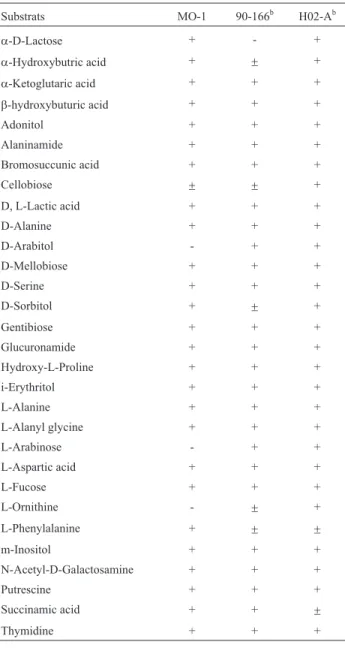
MO-1 formed red-pigmented smooth colonies on nu-trient agar plates. Classical tests showed that it was a gram-negative, rod-shaped and mobile organism. The re-sults of the MIS analysis identified the MO-1 asSerratia marcescenswith a percentage of 96.25%. The cellular fatty acids of MO-1 and some other isolates (ZJ-C0701 and ZJ-S0801) are given in Table 1. As shown in Table 1, 18 different fatty acids were detected in the MO-1 strain. Fif-teen of them (10:0; 10:0 3OH; 12:0; 12:0 20OH; 12:0 3OH; 14:0; 14:0 2OH; 14:0 3OH; 15:0; 16:0; 16:0 3OH; 17:0; 17:0 cyclo; 18:0; and 19:0 cyclo) are saturated fatty acids. Palmitic acid (16:0; n-hexadecanoic acid) had a higher rela-tive mass compared to the remaining FAMEs, whereas 10:0; 12:0 2OH; 15:0; 16:0 3OH; 17:0; and 18:0 were found to have quite low relative mass ratios. Except for the fatty acids 12:1 30H; 15:0; and 19:0 cyclo, all of the other fifteen fatty acids were present in the cells of the three iso-lates; however, 12:1 3OH; 15:0; and 19:0 cyclo fatty acids were only present in the strain MO-1. The BIOLOG Micro-plate assay showed that MO-1 is capable of using 79 of the 95 substrates in the panel and confirmed that MO-1 dis-played similarity to BIOLOG’s standard identification. Partial reactions of the BIOLOG kit are presented in Ta-ble 2. Strain 90-166 and H02-A (Rascoeet al., 2003) had
similar utilization reactions with MO-1 for some substrates on the Biolog plates. Finally, 1450 bp 16S ribosomal DNA sequence of the strain was BLAST searched (http://www.ncbi.nlm.nih.gov/BLAST) and aligned withS. marcescens sequences. The sequence was deposited in GenBank with the accession number of JX315621.2. A phylogenetic tree was constructed based on the 16S rDNA sequences (Figure 1). The isolate was named as S. marcescensstrain MO-1.
Effect of RHP on the growth of MO-1 and its prodigiosin producing potential
The effects of RHP on the growth of MO-1 is summa-rized in Figure 2. The results showed that the growth of
Table 1- The percentage of fatty acids in the isolate of MO-1 and two other strains ofS. marcescens.
Fatty acids Strains
MO-1 ZJ-0701a ZJ-S0801a
10:0 0.31 0.23 0.25
10:0 3OH 14.08 3.01 2.89
12:0 1.61 1.12 1.38
12:0 2OH 0.68 0.40 0.51
12:0 3OH 4.29 1.51 1.35
12:1 3OH 3.51 0 0
14:0 4.50 4.86 5.12
14:0 2OH 1.84 3.80 2.10
14:0 3OH 6.40 7.05 8.12
15:0 0.34 0 0
16:0 25.62 30.80 28.55
16:0 3OH 0.20 0.18 0.22
16:1 w7c 11.78 11.46 12.20
17:0 0.18 1.19 1.00
17:0 cyclo 9.89 15.26 14.71
18:0 0.26 0.26 1.20
18:1 w7c 12.40 15.12 16.58
19:0 cyclo 1.47 0 0
aLiet al., 2011.
Table 2- Partial substrate utilization results of MO-1 and two other strains
ofS. marcescensusing the BIOLOG Microplate.
Substrats MO-1 90-166b H02-Ab
a-D-Lactose + - +
a-Hydroxybutric acid + ± +
a-Ketoglutaric acid + + +
b-hydroxybuturic acid + + +
Adonitol + + +
Alaninamide + + +
Bromosuccunic acid + + +
Cellobiose ± ± +
D, L-Lactic acid + + +
D-Alanine + + +
D-Arabitol - + +
D-Mellobiose + + +
D-Serine + + +
D-Sorbitol + ± +
Gentibiose + + +
Glucuronamide + + +
Hydroxy-L-Proline + + +
i-Erythritol + + +
L-Alanine + + +
L-Alanyl glycine + + +
L-Arabinose - + +
L-Aspartic acid + + +
L-Fucose + + +
L-Ornithine - ± +
L-Phenylalanine + ± ±
m-Inositol + + +
N-Acetyl-D-Galactosamine + + +
Putrescine + + +
Succinamic acid + + ±
Thymidine + + +
+: positive result, -: negative results. b
MO-1 was very low in the control medium (CM). For ex-ample, the maximum growth yield of MO-1 in the CM was 0.94 g/L for a 48 h growth period, whereas the addition of RHP to the substrate increased the biomass yield. When the effects of different RHP concentrations on growth were compared, the maximum growth promoting effect was ob-served with the application of 0.4% (w/v) RHP (2.54 g/L for a 48 h growth period); however, the growth yield de-creased at RHP concentrations greater than 0.5% and the lowest biomass yield (1.56 g/L) was obtained from the ap-plication of 0.1% (w/v) RHP (except for CM apap-plication).
The effects of RHP on the production of prodigiosin are presented in Figure 3. Prodigiosin is a known secondary metabolite that does not have a role in growth, development and reproduction, as do the primary metabolites, and is typ-ically formed during the end or near the stationary phase of growth. Observed together, Figures 2 and 3 reveal that the production of prodigiosin increases linearly between 12 and 36 h. Additionally, the characteristics of the production curve are similar to the production pattern of secondary me-tabolites. According to Figures 2 and 3, biomass and prodigiosin production increase with increasing RHP
con-Figure 2- Comparison of the effect of RHP at various concentrations on biomass using mannitol as a carbon source. Culture conditions: initial pH 7.0, 200 rpm, 28 °C.
Figure 1- Phylogenetic tree based on the 16s rDNA sequences of strain MO-1 and related species.
centrations up to 0.4%; beyond 0.4% RHP concentrations (at 0.5 and 0.6% RHP) the productions decrease.
Similar to the growth of MO-1, the production of prodigiosin was significantly (p < 0.05) affected by the ad-dition of RHP and the maximum prodigiosin yield (277.74 mg/L) was obtained with the application of 0.4% (w/v) RHP.
The yield produced with the application of 0.4% RHP was more than 7 times greater than that obtained in the CM (40.12 mg/L). This prodigiosin production promoting ef-fect of RHP may be due to many factors related to the chemical composition of RHP. We previously analyzed (Kurbanoglu and Kurbanoglu, 2004) the chemical compo-sition of RHP and determined that it is very rich in both or-ganic and inoror-ganic nutrients and contains many amino acids and inorganic materials (data are not given). Others have reported that some amino acids (alanine, serine, histi-dine, cystine, methionine, glutamate, tryptophan and pro-line) contribute to the formation of prodigiosin (Williamset al., 1971; Qadri and Williams, 1973; Witneyet al., 1977). The results of our previous studies (Kurbanoglu and noglu, 2004; Kurbanoglu 2004b; Kurbanoglu and Kurba-noglu, 2007) showed that RHP contains all of these amino acids at varying concentrations and is especially rich in alanine, cysteine, glutamate and proline.
Trace elements are known to have important effects on secondary metabolites. RHP also contains some of the trace elements such as Fe, Mn, Zn, Mg and Cu, and conse-quently offers a rich source for culture media. As a high concentration of phosphate is known to have an inhibitory effect on prodigiosin yield (Witneyet al., 1977) and RHP is poor in inorganic phosphate, we did not use phosphate salts in the preparation of RHP. In addition, some investigators have reported that Ca, Mg, K, Na, Cl (Lewis and Corpe, 1964) and Fe (Silverman and Munoz, 1973) ions are neces-sary for the pigmentation produced byS. marcescens. As a result, the prodigiosin production promoting effect of RHP may be due to its organic and inorganic richness.
The carbon/nitrogen ratio (C/N) of a substrate plays a vital role in the production of different metabolites. Some researchers reported that prodigiosin production may also be affected by the C/N ratio (Wei and Chen, 2005; Wanget al., 2011; Sivaet al., 2012). As mentioned above, RHP is rich in amino acids, which are the main reservoir of nitro-gen in living tissues and cells. For this reason, as the RHP ratio in the media increased, the C/N decreased. In the light of this information, we can speculate that the addition of 0.4% RHP to the CM may provide the proper C/N ratio for prodigiosin biosynthesis; however, RHP addition de-creased both biomass and prodigiosin yields at concentra-tions above 0.4%. Our previous studies also showed that, at high concentrations, RHP decreased the production yields of citric acid (Kurbanoglu and Kurbanoglu, 2004), xanthan (Kurbanoglu and Kurbanoglu, 2007), and lactic acid
(Kur-banoglu, 2004b). This inhibitive effect may be due to its high salt concentration and unknown toxic materials.
Effect of different peptones on the production of prodigiosin
The concentration and type of nitrogen sources are very important for the growth and pigment production ofS. marcescens. Four peptones were tested for the production of prodigiosin (Table 3). The production of prodigiosin in the culture medium byS. marcescensMO-1 using RHP was better than the prodigiosin production using TP, BP and FP under the same conditions (p < 0.05). Kurbanoglu and Kurbanoglu (2004) reported that the nitrogen contents of RHP, BP, TP and FP are 8.0, 13.8, 10 and 10.1 (g/100 g), re-spectively. Chemical analysis of the peptones showed that FP, TP and BP were richer in nitrogen than RHP; however, the amino acid and rich mineral content of RHP stimulated cell growth and prodigiosin biosynthesis inS. marcescens
MO-1. This result indicates that the nutrients in RHP are suitable for microbial growth and prodigiosin production.
Effect of different carbon sources on the production of prodigiosin
S. marcescensMO-1 demonstrated an ability to uti-lize different carbon sources for growth and prodigiosin production but to different extents (Table 4). When glucose was supplied as a carbon source,S. marcescensMO-1 sig-nificantly decreased the production of prodigiosin. Some carbon sources, such as glucose and maltose, had a repres-sive effect on prodigiosin synthesis because they lowered the pH of the medium or repressed catabolites (Gargalloet al., 1987; Soleet al., 1997). Moreover, in production me-dium containing glucose,S. marcescensmay produce the glucose-6-phosphate dehydrogenase alloenzyme, which inhibits pigment production (Gargallo et al., 1987). S.
marcescensgrown on mineral media did not produce pig-ment when the carbon source was glucose or the nitrogen source was ammonium chloride, though proline was pres-ent in the medium (Hejazi and Falkiner, 1997). Glycerol and mannitol were used as carbon sources in a production medium, which resulted in a better yield of prodigiosin. In
Table 3- The effect of peptones on prodigiosin and biomass yields ofS.
marcescensMO1.
Medium Biomass (g/L) PG (mg/L)
CM 1.32±0.08c 40.12±2.01e
CM+RHP 2.54±0.09a 277.74±7.26a
CM+FP 2.48±0.07a, b 232.49±5.6c
CM+ TP 2.31±0.07b 213.14±11.49d
CM+ BP 2.62±0.14a 252.02±8.95b
this study, S. marcescens produced 184.32 mg/L and 277.74 mg/L of prodigiosin in glycerol and mannitol con-taining medium, respectively (Table 4). Mannitol was found to be suitable for growth and prodigiosin production (Araújoet al., 2010) instead of glycerol (p < 0.05). Other studies have reported different results associated with pro-digiosin production. Wei and Chen (2005) observed 56-790mg/mL of prodigiosin cultured in oil supplemented Luria-Bertani broth medium. The production of prodi-giosin was reported in mutantS. marcescens02 at a concen-tration of 96.5-583 mg/L (Taoet al., 2005). Additionally, Gutierrez-Roman et al. (2012) reported a production of prodigiosin of 60 mg/L byS. marcescensCFFSUR-B2 cul-tivated in peanut medium.
Conclusion
Organic nitrogen sources are known to be superior ni-trogen sources for prodigiosin production compared to in-organic nitrogen sources. Therefore, there is a need for new, easily available and cheap organic nitrogen sources. Moreover, organic nitrogen sources, such as peptones con-tain different amino acids, which increase the production of prodigiosin production as described above. As is known, pollution continues to increase due to agricultural and in-dustrial wastes. Consequently, these waste materials can be converted to highly valued commercial products, such as prodigiosin. The present study demonstrated that RHP sig-nificantly increased the production of prodigiosin fromS. marcescens because of its high mineral and amino acid contents. Using RHP to produce prodigiosin can be cost-effective and environmentally beneficial.
References
Araújo HW, Fukushima K, Takaki GM (2010) Prodigiosin pro-duction by Serratia marcescensUCP 1549 using renew-able-resources as a low cost substrate. Molecules 15:6931-6940.
Boric M, Danevcic T, Stopar D (2011) Prodigiosin fromVibrio sp. DSM 14379; a new UV-protective pigment. Microbiol Ecol 62:528-536.
Cang S, Sanada M, Johdo Oet al. (2000) High production of prodigiosin bySerratia marcescensgrown on ethanol. Bio-technol Lett 22:1761-1765.
D’Aoust JY, Gerber NN (1974) Isolation and purification of prodigiosin from Vibrio psychroerythrus. J Bacteriol 118:756-757.
El-Bondkly AAM, El-Gendy MMM, Bassyouni RH (2012) Over-production and biological activity of prodigiosin-like pig-ments from recombinant fusant of endophytic marine Streptomycesspecies. Antonie van Leeuwenhoek 102:719-734.
Gargallo D, Loren JG, Guinea Jet al.(1987) Glucose-6-phos-phate dehydrogenase alloenzymes and their relationship to pigmentation in Serratia marcescens. Appl Environ Mi-crobiol 53:1983-1986.
Giri AV, Anandkumar N, Muthukumaran Get al.(2004) A novel medium for the enhanced cell growth and production of prodigiosin from Serratia marcescens isolated from soil. BMC Microbiol 4:11-18.
Gutiérrez-Román MI, Holguín-Meléndez F, Bello-Mendoza Ret al.(2012) Production of prodigiosin and chitinases by tropi-cal Serratia marcescens strains with potential to control plant pathogens. World J Microbiol Biotechnol 28:145-153. Hejazi A, Falkiner FR (1997)Serratia marcescens. J Med
Micro-biol 46:903-912.
Kim D, Lee JS, Park YKet al.(2007) Biosynthesis of antibiotic prodiginines in the marine bacterium Hahella chejuensis KCTC 2396. J Appl Microbiol 102:937-944.
Kurbanoglu EB (2004a) Enhancement of citric acid production with ram horn hydrolysate by Aspergillus niger. Biores Technol 92:97-101.
Kurbanoglu EB (2004b) Enhancement of lactic acid production with ram horn peptone by Lactobacillus casei. World J Microbiol Biotechnol 20:37-42.
Kurbanoglu EB, Kurbanoglu NI (2004) Ram horn peptone as a source of citric acid production byAspergillus niger, with a process. J Ind Microbiol Biotehnol 131:289-294.
Kurbanoglu EB, Kurbanoglu NI (2007) Ram horn hydrolysate as enhancer of xanthan production in batch culture of Xanthomonas campestrisEBK-4 isolate. Process Biochem 42:1146-1149.
Lee JS, Kim YS, Park Set al.(2011) Exceptional production of both prodigiosin and cycloprodigiosin as major metabolic constituents by a novel marine bacterium, Zooshikella rubidusS1-1. Appl Environ Microbiol 77:4967-4973. Lewis SM, Corpe WA (1964) Prodigiosin-producing bacteria
from marine sources. Appl Microbiol 12:13-17.
Li B, Yu R, Liu Bet al.(2011) Characterization and comparison ofSerratia marcescensisolated from edible cactus and from silkworm for virulence potential and chitosan susceptibility. Braz J Microbiol 42:96-104.
Montaner B, Perez-Thomas R (2001) Prodigiosin induced apop-tosis in human colon cancer cells. Life Sci 68:2025-2036. Okay S, Ozdal M, Kurbanoglu EB (2013) Characterization,
anti-fungal activity and cell immobilization of a chitinase from Serratia marcescensMO-1. Turk J Biol 37:639-644. Park H, Lee SG, Kim TKet al.(2012) Selection of extraction
sol-vent and temperature effect on stability of the algicidal agent prodigiosin. Biotechnol Bioprocess Eng 17:1232-1237. Qadri SMH, Williams RP (1973) Role of methionine in
biosyn-thesis of prodigiosin bySerratia marcescens. J Bacteriol 116:1191-1198.
Rascoe J, Berg M, Melcher Uet al.(2003) Identification, phylo-genetic analysis, and biological characterization ofSerratia
Table 4- The effect of carbons on prodigiosin and biomass yields ofS.
marcescensMO1.
Carbons (%1, w/v) Biomass (g/L) PG (mg/L)
Mannitol 2.54±0.09a 277.74±7.6a
Glycerol 2.32±0.05b 184.32±5.9b
Glucose 2.07±0.11c 6.35±1.6c
marcescens strains causing cucurbit yellow vine disease. Phytopathology 93:1233-1239.
Ryazantseva IN, Saakov VS, Andreyeva INet al. (2012) Re-sponse of pigmentedSerratia marcescensto the illumina-tion. J Photoch Photobio B 106:18-23.
Silverman MP, Munoz EF (1973) Effect of iron and salt on prodigiosin synthesis in Serratia marcescens. J Bacteriol 114:996-1006.
Siva R, Subha K, Bhakta Det al.(2012) Characterization and en-hanced production of prodigiosin from the spoiled coconut. Appl Biochem Biotechnol 166:187-196.
Slater H, Crow MA, Everson Let al.(2003) Phosphate availabil-ity regulates biosynthesis of two antibiotics, prodigiosin and carbapenem, in Serratia via both quorum-sensing-depen-dent and-indepenquorum-sensing-depen-dent pathways. Mol Microbiol 47:303-320.
Solé M, Francia A, Rius Net al.(1997) The role of pH in the glu-cose effect on prodigiosin production by non-proliferating cells ofSerratia marcescens. Lett Appl Microbiol 25:81-84.
Soto-Cerrato V, Llagostera E, Montaner Bet al.(2004) Mito-chondria-mediated apoptosis operating irrespective of multidrug resistance in breast cancer cells by the anticancer agent prodigiosin. Biochem Pharmacol 68:1345-1352. Wang SL, Wang CY, Yen YHet al.(2011) Enhanced production
of insecticidal prodigiosin from Serratia marcescens TKU011 in media containing squid pen. Process Biochem 47:1684-1690.
Wei Y, Chen WC (2005) Enhanced production of prodigiosin-like pigment fromSerratia marcescensSMDR by medium im-provement and oil-supplementation strategies. J Biosci Bioeng 99:616-622.
Williams RP, Gott CL, Qadri SMH (1971) Induction of pigmenta-tion in nonproliferating cells ofSerratia marcescensby ad-dition of single amino acids. J Bacteriol 106:444-448. Witney FR, Failia ML, Weinberg ED (1977) Phosphate inhibition
of secondary metabolism inSerratia marcescens. Appl En-viron Microbiol 33:1042-1046.
Associate Editor: Rosane Freitas Schwan