www.elsevier.nlrlocaterhydromet
Bioleaching of zinc and nickel from silicates using
Aspergillus niger cultures
I.M. Castro
a,), J.L.R. Fietto
a, R.X. Vieira, M.J.M. Tropia
´
a, L.M.M. Campos
b,
E.B. Paniago
c, R.L. Brandao
˜
aa
Laboratorio de Bioquımica e Fisiologia de Microrganismos, Escola de Farmacia, Nucleo de Pesquisas em Ciencias Biologicas,´ ´ ´ ´ ˆ ´
UniÕersidade Federal de Ouro Preto, Campus do Morro do Cruzeiro 35.400-000 Ouro Preto, MG, Brazil
b
Departamento de Produtos Farmaceuticos, Faculdade de Farmacia, Uniˆ ´ Õersidade Federal de Minas Gerais, Belo Horizonte, MG, Brazil
c
Departamento de Quımica, Instituto de Ciencias Exatas e Biologicas, Uni´ ˆ ´ Õersidade Federal de Ouro Preto, Campus do Morro do
Cruzeiro 35.400-000 Ouro Preto, MG, Brazil
Received 4 September 1998; received in revised form 6 March 2000; accepted 20 March 2000
Abstract
In this work, we investigated the role of bacteria from the genera Bacillus and Pseudomonas and fungi from the genera
Ž .
Aspergillus and Penicillium in the leaching process of two different silicates calamine and garnierite . Since the results
obtained with A. niger were better than those with different bacteria, a more detailed investigation of the leaching process with this microorganism was conducted. Moreover, although it is clear that the citric acid generated by fungi could be an important leaching agent acting in the solubilization of the used silicates, other products of metabolism could be involved.
Ž .
Related to this, the results obtained with chemical leaching using low concentrations of citric acid lower than 10 mM showed, for both calamine and garnierite, that the respective dissolution of zinc and nickel was much lower when compared to those processes in which cultures or supernatant liquor of A. niger cultures were used and in which the maximum
Ž
concentration of citric acid was 8 mM. The results obtained also suggest that the type of mineral andror the metal present
.
in it presents a different susceptibility to the bioleaching process and also demonstrate that depending of the situation, the presence of the fungi cells seem to improve the leaching process. From a practical point of view, the high yield rate of extracting metals from silicates obtained by using for example, supernatant liquors of A. niger cultures, is noteworthy. This
Ž .
bioleaching process present two advantages as compared to conventional chemical leaching processes: a the very low
Ž .
concentrations of organic compounds present in such a situation represent a lower ecological risk; and b even with a lower final yield, the economical cost of a such process. Both characteristics could facilitate its industrial application. q2000 Elsevier Science B.V. All rights reserved.
Keywords: Aspergillus niger; Zinc; Nickel
)Corresponding author. Fax:q55-31-559-1679.
Ž .
E-mail address: [email protected] I.M. Castro .
1. Introduction
The world’s nickel and zinc reserves are about 71 million and 90 million tons, respectively. Despite this apparent abundancy, the treatment of silicate
0169-4332r00r$ - see front matterq2000 Elsevier Science B.V. All rights reserved.
Ž .
minerals will become increasingly important because the escalating depletion of high-grade ores will make it necessary to obtain metals from the abundant low-grade silicate minerals. Microorganisms may contribute to the extraction of metals from carbona-ceous low-grade ores and mining wastes, as well as from metals containing secondary raw materials and
w x
industrial intermediate products like slags 1 . Among the advantages of extracting metals from industrial wastes by using microorganisms is that these meth-ods are less polluting and less energy-consuming
w x than conventional methods 2 .
Three groups of microorganisms are used for the w x
leaching process: autotrophic bacteria 3 ,
hetero-w x w x
trophic bacteria 4,5 and fungi 4,6 . In the bioleach-ing of silicates, different groups of microorgan-isms have been used to extract metals, such as magnesium, zinc, copper, aluminum. Among active
Ž .
organisms, Aspergillus niger aluminosilicates ,
Ž .
Thiobacillus ferrooxidans sulfide minerals ,
Penicil-Ž .
lium sp. nickel and zinc silicates . Bacteria from Pseudomonas, Erwinia and Bacterium genus pro-duce 2-ketogluconic acid when grown on a glucose medium. It was demonstrated that the dissolution of silicates by these microorganisms is a consequence of the complexation of the cationic elements present
w x
in different silicated minerals 7,8 . At the same time, complexation often reduces the toxicity of
w x
metals ions 9,10 . A second example of biosolubi-lization of silicates is obtained by the utibiosolubi-lization of the bacteria Sarcina ureae. Grown in the presence of urea, this species produces ammonia, which results in the high alkalinization of the media. The siloxan binding is disrupted in this condition. It has been demonstrated that silicon can be released from nepheline, plagioclase or quartz by S. ureae grown
w x
on peptone and urea 11 . It is also known that Bacillus mucilaginosus are able to prompt the release of silicon from quartz. The data obtained suggest an indirect mechanism in which the siloxan binding is
w x disrupted by the action of exopolysaccharides 11 .
Besides bacteria, fungi from genus Aspergillus, Botrytis, Mucor, Penicillium and Trichoderma are able to solubilize Ca, Mg and Zn from silicates. This is due to the fact that these species produce organic
Ž .
acids oxalic and citric . In other silicates — such as
Ž .
in the case of aluminum-silicates plagioclase , the solubilization of silicon is not the result of the direct
action of acids, but occurs through the complexation of metals. As a consequence, there is a reorganiza-tion of the mineral’s structure with the release of
w x silicon 12 .
The purpose of this investigation was to deter-mine the ability of a number of microorganisms, specially A. niger, to extract Ni or Zn from silicate minerals. First, we tried to isolate heterotrophic mi-croorganisms from the ore sample. Inorganic and
Ž .
organic acids oxalic and citric acids were also used to study the extraction of metals and the results were compared with those of microbial leaching.
2. Materials and methods
2.1. Strains
The strains used throughout the present work are: A. niger ATCC 1015, B. megaterium ATCC 21916,
Ž
B. circulans a kind gift from S. Groudev, Sofia,
. Ž .
Bulgaria , Pseudomonas sp. ATCC 21025 and
Sporosarcina ureae ATCC 6473. Stock cultures were kept at 48C in malte extractrpeptonersucroseragar
ŽMPSA agar slants. ŽA. niger , potato. rdextroser
Ž . Ž .
agar PDA slants B. megaterium and B. circulans
Ž
or nutrient agar slants Pseudomonas sp. and
.
Sporosarcine ureae . They were subcultured every month. Spores or conidias of 5- to 7-day-old cultures incubated at 308C were used for the preparation of inocula to be added to the sterile medium.
2.2. Growth conditions
The standard medium for A. niger contained
Ž .
5–15% wrv sucrose, 0.025% MgSO4P7H O,2
Ž .
0.25% NH4 2CO , 0.25% KH PO , 0.06 mgrl3 2 4
Ž .
ZnCl , 1.3 mgrl FeCl or Fe SO2 3 2 4 3. The pH in the medium was adjusted to 7.5 by adding NaOH. B. megaterium, B. circulans and Psedumonas sp. were
Ž .
grown in a medium containing 2% wrv peptone, 0.2% yeast extract, 0.075% KH PO , 0.03% MgSO2 4 4 P7H O and 2% glucose. Sporosarcina ureae was2
Ž .
2.3. Substrates
Ž .
The Zn silicate calamine-SiO2 and the Ni
sili-Ž .
cate garnierite-SiO2 were supplied by the mining
Ž .
companies: Cia Mineral de Metais Vazante, MG
Ž .
and Acesita Timoteo, MG, Brazil , respectively.
´
These silicates were ground to 100 mesh.
The chemical analysis of the silicates used in this work showed the following compositions: calamine — 40.7% SiO , 10.9% ZnO, 6.7% Fe O , 8.65%2 2 3 CaO, 4.13% MgO; garnierite — 43.2% SiO , 0.90%2 Ni.
2.4. Microbial leaching technique
Two different types of experiments were carried
Ž .
out. In one of them direct process , the leaching has carried out in 250-ml Erlenmeyer flasks containing 5 g of ore and 100 ml of the growth medium inocu-lated with microbial culture. Prior to leaching, media and ore samples were sterilized at 1218C for 20 min. The flasks were incubated on a rotary shaker at 308C at an operating speed of 200 rpm. At regular inter-vals, samples were withdrawn for pH measurements and filtered through 0.45-mm-pore-size membrane filter for elemental analysis. Subsequently, the vol-ume was made up by sterile culture medium. In a second set of experiments, the supernatant liquor of a microbial culture was collected after the cellular
Ž
growth and used as the leaching agent indirect
.
process .
2.5. Chemical leaching with organic and inorganic acids
Ž
To determine the effect of organic acids
inter-mediate or final products of the microbial
.
metabolism as well as of inorganic acids on the extraction of nickel and zinc from silicates, experi-ments were carried out using citric acid, oxalic acid, H SO , at a pulp density of 5 gr100 ml, in the2 4 presence of sodium azide 10 mM, to inhibit micro-bial growth.
2.6. Analytical methods
Zinc and nickel were measured by atomic absorp-tion spectrophotometry using standard condiabsorp-tions, after the filtration of the medium through a 0.45-mm-pore-size membrane filter to remove biomass.
Organic acids were determined by two different
Ž .
methods. a High-pressure liquid chromatography
ŽHPLC : The separation of citric acid and oxalic acid.
was carried out in an Aminex HPX 87 H cation exchanger column and an Aminex Micro Guard Cation H precolumn; mobile phase, 5 mM H SO ;2 4 flow rate, 0.5 mlrminy1
; temperature, 308C;
detec-Ž .
tion, UV detector at 213 nM. b Enzymatic assay in a Beckman spectrophotometer, Model DU 68- Citric acid was measured in a reaction system containing 50 mM triethanolaminerHCl pH 7.4, 10 mM
MgSO , 5 mM EDTA and 0.2 mM NADH. The4
NADH oxidation after the addition of citrate liase
Table 1
Yield of zinc and nickel extractions from the respective substrates by different groups of microorganisms
Ž .
In the direct process, the silicate pulp density was 5%. The corresponding times h for maximum dissolution are enclosed by parentheses.
Ž .
Microorganism Yield of extraction %
Zinc Nickel
Direct process Indirect process Direct process Indirect process
Ž . Ž . Ž . Ž .
B. megaterium 7.8 185 4.2 230 5.1 60 10.3 230
Ž . Ž . Ž . Ž .
B. circulans 5.6 212 2.5 230 4.5 31 6.3 182
Ž . Ž . Ž . Ž .
Pseudomonas 4.3 162 1.2 230 3.3 119 4.7 67
Ž . Ž . Ž . Ž .
Sporosarcina urea 8.0 162 11.1 20 22.3 114 5.0 O2
Ž . Ž . Ž . Ž .
A. niger cultivated in different 5% 36 120 14 04 42 120 11 71
Ž . Ž . Ž . Ž .
sucrose concentrations 10% 66 148 41 146 54 120 71 237
Ž . Ž . Ž . Ž .
15% 62 300 54 43 78 325 83 237
Ž . Ž .
and malate dehydrogenase to the reaction system was taken as the control. The reaction, monitored at 340 nm, was started by addition of supernatant sam-ples of the medium, filtered through Whatman filter paper. Oxalic acid was measured using a Sigma Diagnostic Kit for oxalate. Oxalate was oxidized to carbon dioxide and hydrogen peroxide by oxalate oxidase. The hydrogen peroxide reacts with
3-Ž .
methyl-2-benzothiazolinone hydrazone MBTH and
Ž . Ž .
3- dimethylamine benzoic acid DMAB in the
presence of peroxidase to yield an indamine dye, which has a maximum absorbance at 590 nm.
All experiments were performed at least three times. The representative results are shown in this paper.
3. Results and discussion
Before testing the ability of selected microorgan-isms to solubilize zinc and nickel from the respective silicates, attempts were made to isolate bacteria and fungi from the ore samples. Since the screening that was carried out did not lead to the discovery of any microorganism usually used for the leaching process, we focused on the knowledge of biohydrometallurgy accumulated up to date, viz., the ability of a number of bacteria and fungi to solubilize large amounts of metals from solid materials. Since bacteria from the genera Bacillus and Pseudomonas and fungi from the genera Aspergillus and Penicillium are capable of reducing andror dissolving heavy metals from
Ž .
Fig. 1. Amounts of zinc extracted from calamine by the supernatant liquor of cultures of A. niger via the indirect process A and the direct
Ž . Ž . Ž . Ž .
process C and the pH variation in the indirect process B and direct process D as a function of time. Sucrose concentrations: v 5%,
w x
minerals and the surface of the rocks 12 , we inves-tigated the role of five of these microorganisms in the leaching process.
Table 1 shows the maximum values of zinc and
Ž .
nickel extraction and the corresponding time from calamine and garnierite, respectively, both by direct
Ž
process experiments were carried out incubating the microorganisms in a medium containing ore
sam-. Ž
ples and indirect process using supernatant liquor
.
of the cultures as a leaching agent . The results of the atomic absorption spectrophotometric analysis show that the highest concentration of soluble zinc and nickel was reached by using A. niger in the leaching process. This is probably due to the nature of the leaching active metabolite excreted by A.
niger and not to the toxicity of heavy metal ions towards the other microorganisms that were used in this investigation. We also observed higher extrac-tion rates with the increase of sucrose concentraextrac-tion in the growth medium of A. niger cultures. Control
Ž .
experiments uninoculated media were performed in the absence of microorganisms.
Analyzed altogether, the results expressed in Table 1 seem to suggest that the efficiency of the leaching process using A. niger may vary according to the metal being extracted and the leaching process. While the extraction of zinc from calamine appeared to be higher by the direct than the indirect process, no consistent differences were observed in the extrac-tion of nickel from garnierite.
Ž .
Fig. 2. Amounts of nickel extracted from garnierite by the supernatant liquor of cultures of A. niger via the indirect process A and the
Ž . Ž . Ž . Ž .
direct process C and the pH variation in the indirect process B and direct process D as a function of time. Sucrose concentrations: v
Ž . Ž .
Since the results obtained with A. niger were better than those obtained with different bacteria, we decided to investigate in more detail the process of leaching with this microorganism. Fig. 1A summa-rizes the results obtained by the action of the super-natant liquor from A. niger culture grown in 5%, 10% and 15% sucrose in the zinc solubilization process. A clear influence of sucrose concentration can be observed in the results of experiments where increased sucrose concentration exerted a noticeable improvement on the leaching process. The treatment was extended beyond 15 days in order to determine the maximum leaching capacity of the medium. In this condition, using the clear liquor from the
fer-Ž .
mentation indirect process , there was an increase in the amount of dissolved zinc, reaching a plateau after
Ž .
the first day. In another study Fig. 1C the fungus
Ž
was grown in the presence of the mineral direct
.
process . The maximum leaching capacity was ob-tained again with sucrose at higher concentrations
Ž10–15% . Zinc dissolution shows considerable fluc-.
tuation with time in the direct process.
Fig. 2 shows the microbial leaching of nickel using the supernatant liquor of the A. niger culture
Ž .
as the leaching agent indirect process, Fig. 2A and the leaching activity produced by A. niger grown in
Ž .
the presence of garnierite direct process, Fig. 2C . Similar to the experiments carried out with calamine
ŽFig. 1A and C , the best leaching index was ob-. Ž
tained with higher concentrations of sucrose 10–
.
15% . However, when A. niger was grown in the presence of garnierite, after 170 h there was a strong reduction in the level of nickel solubilized even in 10% sucrose. On the other hand, with the 15% sucrose medium, the level of solubilization increased consistently until 330 h of culture.
Since the efficiency of the dissolution of both metals was higher when the sucrose concentration reached 10–15%, we decided to study in more detail some parameters of cellular growth of A. niger as a function of the sucrose concentration present in the
Ž .
growth medium. In Fig. 3 Panel A , it can be seen that an increase in sucrose concentration resulted in a
Ž .
faster cellular growth rate mainly with sucrose 15% and in a higher amount of cells at the end of the
Ž .
experiment 10–15% sucrose . A higher production of citric acid as a function of sucrose concentration
ŽFig. 3, Panel B was also observed. The optimum.
Ž . Ž .
Fig. 3. Cellular growth A , citric acid production B and oxalic
Ž .
acid production C by A. niger cultivated in different
concentra-Ž . Ž . Ž .
tions of sucrose: v 5%, ` 10% and % 15%.
initial concentration of sucrose for citric acid produc-tion was found to be between 10% and 15%, the
acid was produced in low concentrations only during
Ž .
the first hours of growth Fig. 3, Panel C . Whatever the sucrose concentration, it was observed a strong external acidification was observed and the final pH
Ž .
reached was around 2 data not shown .
Our results demonstrated that high concentrations of carbon sources are required for the fast growth and high citrate yields, raising the hypothesis that one of the leaching agents present in the fungi cultures is citric acid. However, since these cultures were carried out in the absence of ores, there is no evidence of the possible influence of the minerals on the organic acid production by A. niger. To test this possibility, we have measured the levels of citric and oxalic acids produced by A. niger grown in the
Ž .
presence of calamine Fig. 4, Panels A and B or
Ž .
garnierite Panels C and D . The maximum concen-trations found for citric acid were about 4 mM
Žcalamine and 8 mM garnierite , and about 2 and 4. Ž .
mM oxalic acid in the presence of calamine and garnierite, respectively. These results are of the same order of magnitude as the ones shown in Fig. 3, suggesting that the presence of the silicates has no significant effect on the organic acid production.
In the leaching of zinc from calamine, using supernatant liquors, the situation is quite similar to the one observed for nickel dissolution from gar-nierite, reinforcing the idea that the intensity of metal dissolution is proportional to the amount of citric
Ž .
acid produced see Figs. 1A–3 and confirming the results from the literature that the leaching efficiency of heterotrophic microorganisms depends on the
ex-Ž . Ž . Ž . Ž
Fig. 4. Levels of citric A and C and oxalic B and D acids produced by A. niger grown in presence of calamine A and B or garnierite C
. Ž . Ž . Ž .
tent of the production of organic metabolites, which are excreted in the culture media and which then induce the dissolution of metals. Another aspect that has to be considered in the leaching process is the external pH variation. The incubation of both ores
Žcalamine or guarnierite with supernatants from A..
niger cultures showed a tendency of alkalinization
ŽFigs. 1B and 2B . On the other hand, when the ores.
Ž .
were incubated with A. niger cells direct process , there was a clear tendency of external acidification
ŽFigs. 1D and 2D ..
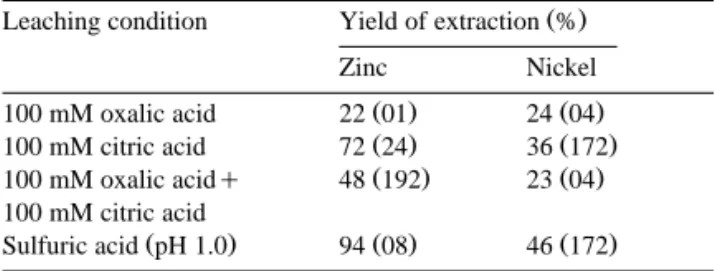
Considering that the organisms of the Aspergillus genus produce a rich variety of organic acids and are able to accumulate mainly citric and oxalic acids, we investigated the importance of organic acids nor-mally produced by this fungus species in the leach-ing process of calamine and garnierite. The results
ŽTable 2 and Fig. 5 show that chemical leaching.
using citric acid was more effective than with oxalic acid or even than a combination of both of them in the dissolution of zinc and nickel from calamine and garnierite, respectively. The yield obtained with cit-ric acid for both silicates was around 76–78% of the yield obtained when sulfuric acid was used as a control. On the other hand, the kinetics shown in Fig. 6 suggest that, when oxalic acid is used as the chemical leaching for the solubilization of nickel from garnierite, after a very effective solubilization in the first hours of exposure to the acid medium, there is a decrease in the amount of metal extracted that probably results from a precipitation process of the metal ion already dissolved.
Ž
However, when lower concentrations of citric 10
. Ž . Ž
mM and oxalic 5 mM acids were tested data not
Table 2
Yield of chemical leaching of zinc and nickel from the respective silicates by different acids
Ž .
The silicate pulp density was 5%. The corresponding times h for maximum dissolution are enclosed by parentheses.
Ž .
Leaching condition Yield of extraction %
Zinc Nickel
Ž . Ž .
100 mM oxalic acid 22 01 24 04
Ž . Ž .
100 mM citric acid 72 24 36 172
Ž . Ž .
100 mM oxalic acidq 48 192 23 04
100 mM citric acid
Ž . Ž . Ž .
Sulfuric acid pH 1.0 94 08 46 172
Ž . Ž .
Fig. 5. Amounts of zinc A and nickel B extracted from the
Ž . Ž .
respective silicates by: v 100 mM citric acid; ` 100 mM
Ž . Ž .
oxalic acid; ^ 100 mM citricq100 mM oxalic acids and '
sulfuric acid.
.
shown , the solubilization of zinc and nickel was drastically reduced when compared with the results presented in Figs. 1 and 2. This is an important point since under the conditions used in the direct process, the levels of citric and oxalic acids produced by A.
Ž
niger reached only 8 and 4 mM, respectively Fig.
.
4 .
super-Fig. 6. Simulation for the chemical species distribution of Zn for a solution containing 40 mM Zn2q, 4 mM citrate and 2 mM oxalate
as a function of pH.
Ž
natant liquor of A. niger cultures 8 mM citric acid,
.
Fig. 3B, 15% sucrose . However, comparison of the data obtained with chemical leaching and the direct
Ž .
process 4 mM citric acid; Fig. 4C, 10–15% sucrose shows that the maximum yields reached are almost the same. On the other hand, the results reported in this work demonstrate that chemical leaching using citric acid was less effective in the extraction of Ni
Ž
from garnierite compared to both the direct 8 mM
. Ž
citric acid; Fig. 4C and the indirect process 8 mM
.
citric acid; Fig. 3B .
In this way, our results seem to be in disagree-ment with those reported by Sukla and
Pan-w x
chanadikar 14 . They showed that chemical leach-ing, using oxalic and citric acids, was more effective in extracting the metal from the nickeliferous lat-eritic ore than the use of supernatants from As-pergillus sp. isolated from the same ore. Our work
Ž
not only suggests that the type of mineral andror
.
the metal present in it presents a different suscepti-bility to the bioleaching process, but also indicates that the acid concentrations, the medium pH and the metal concentration are important.
In order to understand the leaching process, one has to consider in the first place that the external pH variation shows opposite tendencies, alkalinization in the indirect process and acidification in the direct
one. Considering that the amount of organic acids present in both cases is the same, one can conclude that the pH increase in the indirect process is due to proton consumption while converting the oxides in each mineral into soluble metal salts, while the pH decrease in the direct process reveals that the amount of protons produced in this case exceeds the demand for this reaction. At the same time, even though the
Ž .
production of organic acids citric or oxalic in-creased as a function of sucrose concentration, some-times the number of moles of metal ions dissolved exceeds the number of moles of organic acids pro-duced. Therefore, the leaching process is mainly the reaction of an oxide with protons, even though cit-rate, which is an important metal coordinating agent, is certainly instrumental in keeping the metal ions soluble, once they have been leached from the re-spective mineral.
This can be understood, if it is considered that in aqueous media, the equilibria involving the metal
2q 2q Ž 2q.
ions Zn or Ni M with the anions citrate
Table 3
Ž .
Stoichiometric coefficients a, b and c and equilibrium constants
Žlogb.of the, chemical species resulting from the interaction of the anions citrate and oxalate with Zn2qand Ni2q
Data taken from A. Ringbom, ‘‘Complexation in Analytical Chemistry’’, Interscience, NY, 1963, pp. 323–324.
2q q
Compound Anions M H logb
3y 2y 2q 2q
Cit Ox Zn Ni
2y
HCit 1 1 6.1
y
H Cit2 1 2 10.5
H Cit3 1 3 13.5
y
HOx 1 1 4.0
H Ox2 1 2 5.1
NiHCit 1 1 1 9.0
y
NiCit 1 1 4.0
4y
Ž .
Ni Cit2 2 1 5.1
NiOx 1 1 4.1
2y
Ž .
Ni Ox2 2 1 7.2
4y
Ž .
Ni Ox3 3 1 8.5
ZnHCit 1 1 1 8.7
y
ZnCit 1 1 4.5
q
ZnHOx 1 1 1 5.6
Ž .
Zn HOx2 2 1 2 10.8
ZnOx 1 1 3.7
2y
Ž .
ŽCit3y.and oxalate OxŽ 2y.or Any, for brevity, can
be represented by the generic expression:
aM2qqbAnyqcHqsM A Ha2qcyb n a b c
for which a, b and c represent the stoichiometric
Ž .
coefficients and the equilibrium constant b is given by:
a2qcyb n
bs
Ž
M A Ha b c.
a b c
2q ny q
w
x
w
x
w
x
r
Ž
M P A P HEvidently, according to this expression when ‘‘a’’ is zero, we are simply considering the protonation of the citrate and oxalate anions. The species that can result from this equilibrium in an acidic medium are shown in Table 3.
We have calculated the chemical species distribu-tion at different citrate and oxalate concentradistribu-tions as a function of pH as well as metal ion concentrations. An example is shown in Fig. 6, for a solution containing 40 mM Zn2q, 4 mM citrate and 2 mM oxalate. These concentrations of Zn2q, citrate and
oxalate are somewhat equivalent to the results of Zn dissolution from calamine by cultures of A. niger shown in Figs. 1 and 4. As shown in figure, the concentrations of zinc containing citrates or oxalate are below 10%, in the pH range of 2.5–6, which means that — under these conditions — zinc is present in the solution mainly as the bare ion Zn2q.
There is also one important aspect to be noticed, i.e.,
Ž .
the concentration of ZnOx zinc oxalate shown in Fig. 6 is of the order of 5% of 40 mM or 2 mM, which is well above the solubility limit of this compound. In other words, under these conditions, both the Zn2qextracted from the mineral and oxalate produced by the fungus would be only partially soluble. This fact can explain the fluctuation in the level of dissolution of metals in the direct process
ŽFigs. 1C and 2C . Particularly in the case of the.
dissolution of nickel from garnierite, our results combined with the simulations, suggest that for a
Ž
lower citric concentration produced with lower
su-.
crose concentration and at pH values between 3 and
Ž .
4 Figs. 1D and 2D , there would be a predominance of these insoluble oxalates.
Finally, it should be mentioned that the super-natant liquors of A. niger cultures, containing very
low concentrations of organic compounds, produced maximal extractions of metals from silicates that represented 76–78% of the those obtained with sul-furic acid. It is obvious that the bioleaching process represents a lower ecological potential risk and that even with a lower final yield, the economical cost of a such process would be more attractive.
Acknowledgements
Supported by a grant CBS1058r96 from Fundac
¸
ao˜
Ž .
de Amparo a Pesquisa de Minas Gerais FAPEMIG Minas Gerais, Brazil.
References
w x1 W. Burgstaller, F. Schinner, Leaching of metal with fungi, J.
Ž .
Biotechnol. 27 1993 91–116.
w x2 W. Burgstaller, H. Strasser, H. Wobking, F. Shinner, Solubi-lization of zinc oxide from filterdust with Penicillium
simpli-cissimum: bioreactor, leaching and stoichiometry, Environ. Ž .
Sci. Technol. 26 1992 340–346.
w x3 A.E. Torma, K. Bosecker, Bacterial leaching, Prog. Ind.
Ž .
Microbiol. 16 1982 77–118.
w x4 H. Kiel, W. Schwartz, Leaching of a silicate and carbonate copper ore with heterotrophic fungi and bacteria producing
Ž .
organic acids, Z. Allg. Mikrobiol. 20 1980 627–636. w x5 C. Munier-Lamy, J. Berthelin, Formation of polyelectrolyte
complexes with the major elements Fe and Al and the trace elements U and Cu during heterotrophic microbial leaching
Ž .
of rocks, Geomicrobiol. J. 5 1987 119–147.
w x6 S.M. Siegel, Solubilization and accumulation of copper from elementary surfaces by Penicillium notatum, Environ. Biol.
Ž .
Med. 2 1973 19–22.
w x7 D.M. Webley, M.E.K. Henderson, I.F. Taylor, The
micro-Ž .
biology of rocks and weathered stones, J. Soil. Sci. 14 1963 102–112.
w x8 M.E.K. Henderson, R.B. Duff, The release of metallic and silicates ions from minerals, rocks, soils by fungal activity, J.
Ž .
Soil. Sci 14 1963 236–246.
w x9 Z.A. Avakyan, I.L. Rabotnova, Comparative toxicity of free ions and complexes of copper with organic acids for
Can-Ž .
dida utilis, Microbiology 40 1971 262–266.
w10 H. Babich, G. Stotzky, Environmental factors that influencex the toxicity of heavy metal and gaseous pollutants to
mi-Ž .
croorganisms, CRC Crit. Rev. Microbiol. 8 1980 99–145. w11 Z.A. Avakyan, Microflora of rock and its role in the leachingx Ž .
w12 H.L. Ehrlich, G. Rossi, Other bioleaching processes, in: H.L.x Ž .
Ehrlich, C.L. Brierley Eds. , Microbiol Mineral Recovery, McGraw-Hill, NY, 1990, pp. 149–170.
w13 D.-B. Xu, C.P. Madrid, M. Rohr, C.P. Kubicek, The influ-x ¨ ence of type and concentration of the carbon source on
production of citric acid by Aspergillus niger, Appl.
Micro-Ž .
biol. Biotechnol. 30 1989 553–558.
w14 L.B. Sukla, V. Panchanadikar, Bioleaching of lateritic nickelx ore using a heterotrophic micro-organism, Hydrometallurgy
Ž .