Trends in evolution of 5S rRNA of deuterostomes: bases and homogeneous
clusters
Sandra Maria Rodrigues Subacius*
1and Romeu Cardoso Guimarães
2 1Departamento de Microbiologia, Instituto de Ciências Biomédicas, Universidade de São Paulo,
São Paulo, SP, Brazil.
2
Departamento de Biologia Geral, Instituto de Ciências Biológicas, Universidade Federal de Minas Gerais,
Belo Horizonte, MG, Brazil.
Abstract
Evolution of metazoan 5S rRNA sequences was analyzed through base composition and types, location and fre-quency of clustered bases. Characters from sequences of protostomes did not show regular trends as compared with paleontology dating or organism complexity. Trends of increasing G and C, stronger in G clusters, and decreas-ing A and U, were detected in deuterostomes, in parallel with evolution of complexity. The multifunctional domain 71-104 was highlighted among conserved stretches. Clusters of C were typical of helices. Those of G were longer, extending from helices into loops or related to bulges, which is suggestive of functional significance. Deuterostomian trends were installed early in the lineage and reached full development in aquatic organisms, not increasing further after reptiles. It can be suggested that ribosomal RNA structures participated in deuterostomian high regulatory com-plexity, either specifically or as part of the widespread processes of chromosomal regionalization.
Key words:ribosomal RNA, evolution, repetitive sites, deuterostomes, protostomes.
Received: March5, 2002; accepted: June 17, 2002.
Introduction
Early molecular evolution studies utilized 5S rRNA sequences intensively due to their small sizes and con-served secondary structure, scarcity of modified bases and the availability of a large data bank (Fox et al., 1987). Phylogenies based on 5S rRNA produced inconsistencies (Steeleet al., 1991; Halanych, 1991) attributed to conserva-tism of the molecule and close proximity of interdependent functional domains, which lowered the number of nearly neutral sites. Otherwise, 5S rRNA remained informative for wide range evolutionary studies (Gomeset al., 1985; Guimarães and Erdmann, 1992) and for understanding its structure and functions (Digweedet al., 1986; Guo-Ronget al., 1988; Subacius, 1994; Guimarães et al., 1997; Rezek-Ferreira, 1997).
Homogeneous clusters of nucleotides are interesting hot-spots for recombinatory or replicative slippage and as sites withpeculiar interactions: redundancy lowers
infor-mational content of sequences but, on the other hand, would guarantee availability for binding of a base which may be slightly displaced, that is, flexibility with positional ambiguity. The frequency of adenine clusters was shown to increase in organelles and mycoplasmas, decreasing in lin-eages from simple to complex organisms (Guimarães and Erdmann, 1992).
A survey of all types of clusters in 5S rRNA of meta-zoans is reported here. Clear trends originating early in the deuterostomes lineage were depicted.
Material and Methods
The Berlin RNA Databank as of August 1987 (BRDb, containing 513 molecules of 5S rRNA; see Guimarães and Erdmann, 1992) was used, withsome additions of se-quences from metazoans (Rice et al., 1993; see also Szymánskiet al., 1997). Sequences from deuterostomes to-taled 23 in the 1987 database (18 aquatic and 5 terrestrial organisms, the latter from reptiles to mammals) and 34 in the 1993 database (samples from aquatic organisms in-creased to 29, being 25 from somatic tissues [echinoderms to mammals] and nine from oocytes [cyclostomes to am-phibians]). There were 49 sequences from protostomes (21 arthropods), plus 7 from cnidarians. Four pseudogene
www.sbg.org.br
*Present address: Faculdade de Ciências Biológicas, Exatas e Experimentais, Universidade Presbiteriana Mackenzie, São Paulo, SP. E-mail: [email protected].
Send correspondence to R.C. Guimarães. Departamento de Biolo-gia Geral, Instituto de Ciências Biológicas, Universidade Federal de Minas Gerais, 31270-901 Belo Horizonte, MG, Brazil. E-mail: [email protected].
nucleotides of a molecule. When the repetition of a base was >2 (TriN or longer), the number of DiN in the cluster was total size minus 1. This way of counting DiN in homo-geneous clusters considers a unit to be equivalent to the re-gion between two identical bases, withpartial overlap of contiguous DiN.
For graphical comparisons, averages of each taxon were normalized into standard deviation units (SDU) through the equation (Z-score): Z = (X - Xg) / SDg, where X = average of a taxon, Xg = average of the whole sample, SDg = SD of the whole sample. For any variable, Xg be-came the zero baseline and taxon averages were plotted in SDU.
Regression analyses were carried out withnon-trans-formed variables and included all gene sequences. Paleon-tology dating corresponded to the most remote fossil evidence of organisms phenotypically similar to their mod-ern analogues (Subacius, 1998).
Positions refer to individual bases or the first base of a DiN, according to the eukaryote model of Szymánskiet al.
(1997). Location of clusters considered the three types of secondary structure; borders indicated extension of clusters from helices into loops. Frequency of DiN in a position, among molecules in a group, was a measure of the variabil-ity of the character. Frequency and types of base changes were computed per molecule of deuterostomesversusthe molecule of mammals; no size alteration occurred. Bases are presented in the hydropathy order (Guimarães, 1998).
Results
Protostomes and deuterostomes
Among all molecules in the databank, G and C were the most abundant bases, U and A less frequent. Most of the occurrences of U and A were isolated while about half of the content of G and C occurred in homogeneous clusters. The correlation indicated above was not maintained in the G and C couple, the former being more abundant along the whole molecule, but C clustered more frequently than G (Table I). Among metazoans, deuterostomes showed high-est levels of G and C clusters (Figures 1 and 2). A temporal trend in base and cluster composition was detected in the deuterostomes lineage (Figure 1). Protostomes presented an earlier paleontology record and contained the better sampled arthropod lineage, but depicted no trend, showing variations around the baseline (Figure 2). Few unbalanced molecules were noted in platyhelminths and tentaculates, withhighU and low DiC. In deuterostomes, A and U de-creased, and G and C increased withpaleontology dating and organism complexity, but changes were most intense in
G than in other bases. DiG contents increased up to reptiles, thereafter becoming constant. DiC increased up to cyclo-stomes, somewhat further into amphibians but decreased slightly afterwards. Decreases in DiU were more regular than those in DiA. Continuous increase in isolated G was depicted by birds and mammals, after DiG had stabilized.
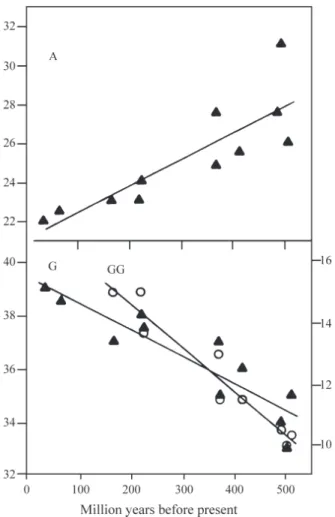
Transitions were indicated, from hemi- and urochor-dates to cyclostomes and fishes, and from these to the rep-tile emergence after amphibians (Figure 1). These and other species-specific variations, however, did not produce large deviations from the linear fit between purine base composi-tion, throughout the entire range of data, or DiG, in the range up to reptiles, and paleontology dating. Increases in DiG were steeper than in G (Figure 3).
Location of G and C clusters in deuterostomes
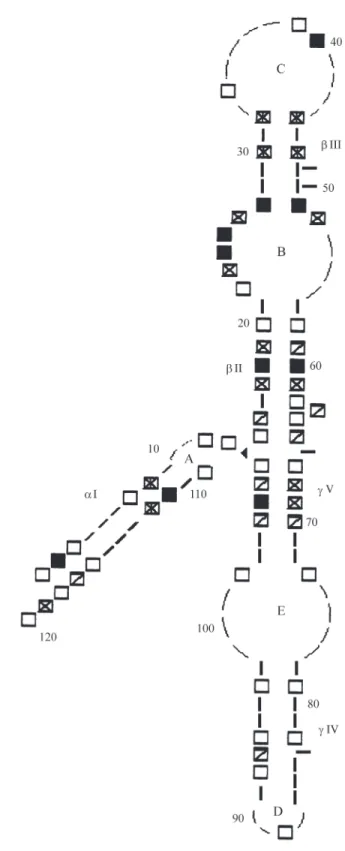
Clusters of C were typical of helices but those of G usually extended into more complex arrangements (Figure 4, Table II). Eachtype of cluster occurred 11 times, but the former were detected only once at a border (helixαI-loop A) and once in loop C, this being only in aquatics, and vari-ably. The latter were longer (3 TriC, 6 TriG) and involved withthe borders of loops A and E (TriGs withinvariant Gs), the border of loop D (TriG), and all bulges: bulge 49-50 was inserted in a TriG, and bulges 63 and 83 were contiguous to a TriG and a DiG, respectively. These sites were fixed either in all deuterostomes or in terrestrials; loop B was the only one generally free of G or C clusters. Conti-guity of different types of clusters generated mixed G and C dinucleotides, which were more frequently CG (7 sites: 29, 30, 40, 46, 47, 69, 105) than GC (2 sites: 8, 66).
Molecules from terrestrials were nearly homoge-neous in G and C cluster sites. Only one site was variable (DiC 2 at helixαI), while such variability was abundant in aquatics. Excess of G over C clusters in terrestrials was concentrated in helicesαI,βII andγV (Table II).
Base substitutions in deuterostomes
Comparing sequences of earlier deuterostomes with those of mammals (Table III), the least changes were shown by G sites, a characteristic also observed in
G 34.67±3.58 17.47±2.99 (50.39) 10.10±3.06
C 32.00±3.96 13.55±2.52 (42.34) 10.48±2.76
U 25.14±4.21 16.97±3.07 (67.50) 4.32±2.48
Total 118.94 64.31 (54.07) 30.95
pseudogenes. Gene sequences showed a higher rate (10x) of A→G transitions than pseudogenes (7 x) and reversed the trend of higher C → U than U → C transitions of pseudogenes. Addition of higher rates of C→G and U→G
transversions in somatic molecules to their A → G transitions made them enriched in G and C, while oocyte molecules were only enriched in C.
Conserved regions were concentrated in the core of helixα1, parts of the complex helixβIII, all loops but one side of B, all bulges but site 63, and the whole region 71-104 of domainγ(Figure 5).
Figure 1- Frequency of bases and dinucleotides in the 5S rRNA of deuterostomesvs. paleontology dating. Total of a base (∆), isolated G (K ); dinucleotides (O) and z-scores calculated as in Material and Methods. HEMIchordates, ASCIdian, ECHInoderms, CYCLostomes, CHONdri-chtians, OSTEichthians, AMPHibians, CHELonian, SQUAmate, MAM-Malians.
Discussion
Study of the evolution of adenine clusters in 5S rRNA informed on their concentration in loops, abundance in sim-pler organisms, increase in simplified organelles and myco-plasmas, and decrease in all routes of increased organism complexity (Guimarães and Erdmann, 1992). The neces-sary complement of other base clusters, now presented in metazoans, highlighted the regular increase of G and C clusters, in contrast withthose of A and U clusters.
The already low number of bases could be halved into simple indices such as the G + C contents, based on the long known parallelism between complementary bases, largely necessary for structuring helical segments, or into the pu-rine / pyrimidine balance (Subacius and Bussab, 1998), possibly necessary also for maintaining adequate sequence complexity. Suchindicators might be interesting for studies of heterogeneous sequences or very wide range evolution.
Nonetheless, these were considered too rough for the
pres-ent purpose of describing details in a small RNA sequence, where single stranded stretches are abundant, and inside one division of metazoans. Accordingly, changes in G were singled out among all bases.
Variations among protostomes did not depict inter- or intragroup regularities, being distributed around the overall
Figure 3- Trends in purine base composition and in guanine dinucleotide frequency in the 5S rRNA of deuterostomes. Linear regression of group averagesvs.paleontology dating. Dinucleotide data beyond squamates not utilized, due to having become constant (see Figure 1). A = 21.070 + 0.013 x, r = 0.848; G (▲, left ordinate) = 39.453 - 0.010 x, r = -0.904; GG (¦,
right ordinate) = 17.521 - 0.014 x, r = -0.966.
baseline. These can be described as non-biased and com-pensated as to base composition, and cluster sites were found distributed as apomorphisms (not shown). Deute-rostomian complexification was paralleled by increases in G and C clusters. Bothwere typical of helices but G clusters were related to complex features of the molecule such as helix-loop borders and bulge sites. It was indicated that loops remained the most complex segments of the mole-cule, due to their scarcity in all types of clusters and wide conservatism.
Functional derivation from RNA structures, in the context of nucleoprotein complexes, should consider their interdependence withproteins. Data on deuterostomes
would indicate evolution towards stronger participation of RNA in helix stabilization and for protein recognition and binding, while those on protostomes indicated that endoge-nous RNA helix thermal stability was not so important for
Table II- Location and frequency of G and C clusters in aquatic and terrestrial deuterostomes.
Position Aquatic Terrestrial
HelixαI DiC 2: 53 37
DiG 116 65 100
DiG 7 65 100
DiC 9 (border loop A) 100 100
HelixβII DiC 14: 75 100
TriG 64 (border loop A, bulge 63)
78 100
65 87 100
TriC 17: 53 100
TriG 59 56 100
DiG 21 (border loop
B, apomorphic in aves)
HelixβIII TriC 28 100 100
29: 63 100
TriG 47 (inserted bulge 49-50) 56 100
48 100 100
DiG 30: 34 0
DiC 46 35 0
DiC 39 (loop C) 53 0
HelixγV TriC 67 79 87
68: 14 0
TriG 106 18 87
107 100 100
DiG 70: 87 100
DiC 104 87 87
HelixγIV DiC 78 (apomorphic in am-phibian oocytes)
DiG 81: (border bulge 83) 91 100
DiC 94 91 100
TriG 85: (border loop D) 100 100
DiC 91 91 87
TriG 97 (border loop E) 100 100
Frequency (%) among molecules in the group;:, paired clusters; see also Figure 4 for locations.
guaranteeing functionality, which could be helped by pro-teins whenever necessary.
Early installation of the deuterostome trend of in-creased G and C cluster content, already fully developed in aquatics, should be related to an intrinsic property of the lineage, as opposed to environmental influences. Forces behind the process would point to their increasing loss of egg determinations and the corollary dependence on inter-cellular induction (Raff and Kaufman, 1983; Kauffman, 1993; Gerhart and Kirschner, 1997), which should be at the root and basis for further complexification. It is indicated that 5S rRNA interactions with proteins and the transcrip-tion and translatranscrip-tion machinery reflected and participated fully in the organism trends.
Localization of 5S rRNA in early replicating chromo-somal regions, together with the clustering of most house-keeping genes (Gilbert, 1986; Guinta et al., 1986; Holmquist, 1987), would be a mechanism enabling its ac-quisition of G and C, which are supposedly not among the most abundant in nucleotide pools (see Guimarães and Erdmann, 1992).
If, as indicated elsewhere (Bernardi et al. 1985 ; Bernardi and Bernardi, 1991; and many others ), endo-thermy participated in further enhancement of the trend, leading to the clear demarcation of chromosomal heavy isochores, it would have been a superimposed late pro-cess.
The transition for depicting chromosomal regiona-lization in endotherms would not be well represented in rRNA due to its early response to the basic complexi-fication forces and, especially in the case of 5S rRNA, to its
precocious filling withG and C sites (isolated or clustered), as shown by the high and stabilized DiG content already in reptiles. The 5S rRNA might also be peculiar, as indicated by its enrichment in CG sites, as opposed to GC sites, which is contrary to the genome tendency, found in eukaryotes, of reducing CG doublets.
The long conserved stretches depicted by our muta-tion analyses might contribute to the mapping of deute-rostomian multifunctional overlapping domains, since they corresponded approximately to some previous determina-tions (Braunet al.1992; Leeet al., 1995): loop B (53-56) and the invariant A of bulge 50, included in the TriG 47, matched the region of the internal promoter (50-83) and the TFIIIC binding site (box A, 50-61); region 71-104 matched precisely the Neurospora box C (73-103), which was found shorter in other eukaryote genes (yeast 81-94, human 80-97, Drosophila ‘internal control region IV’ 78-98) but longer in the RNA binding site for TFIIIA (53-105); the bacterial U89 of loop D was found to interact withC2475, at the peptidyl-transferase site of 23S rRNA (Dokudovs-kayaet al., 1996).
Acknowledgments
CNPq and FAPEMIG support to RCG; SMRS is spe-cially grateful to Dr. Gabriel Padilla (ICB-USP) and FAPESP for the post-doctoral fellowship.
References
Bernardi G and Bernardi G (1988) Compositional constraints and genome evolution.J Mol Evol 24:1-11.
Somatic A - 1.27 0.46 0.24 1.97
G 0.13 - 0.30 0.02 0.45
C 0.02 0.26 - 0.67 0.95
U 0.21 0.24 1.10 - 1.55
Total 0.36 1.77 1.86 0.93 4.92
Oocytic A - 0.81 0.18 0.06 1.05
G 0.06 - 0.06 0.06 0.18
C 0.02 0.04 - 0.83 0.89
U 0.06 0.02 0.94 - 1.02
Total 0.14 0.87 1.18 0.95 3.14
Pseudogene A - 3.50 1.75 0 5.25
G 0.50 - 0 0.75 1.25
C 0.50 0.50 - 4.25 5.25
U 1.00 0.25 3.00 - 4.25
Total 2.0 4.25 4.75 5.00 16.00
Bernardi G and Bernardi G (1991) Compositional properties of nuclear genes from cold-blooded vertebrates. J Mol Evol 33:57-67.
Braun BR, Bartholomew B, Kassavetis GA and Geiduschek EP (1992) Topography of transcription factor complexes on the S. cerevisiae5S RNA gene. J Mol Biol 228:1063-1077. Digweed M, Pieler T and Erdmann VA (1986) A comparative
analysis of structural dynamics in 5S rRNA. In: Van Knippenberg PH and Hilbers CW (eds). Structure and Dy-namics of RNA. Plenum Press, New York, pp 205-217. Dokydovskaya S, Dontsova O, Shpanchenko O, Bogdanov A and
Brimacombe R (1996) Loop IV of 5S ribosomal RNA has contacts bothto domain II and to domain V of the 23S rRNA. RNA 2:146-152.
Fox GE, Stackebrandt RB, Hespel RB et al. (16 co-authors) (1987) The phylogeny of prokaryotes. Science 209:457-463. Gerhart J and Kirschner M (1997) Cells, embryos and evolution.
Blackwell, Malden MA, USA.
Gomes E, Guimarães RC, Padovani CA and BlochDP (1985) The universal dinucleotide asymmetry rule does not hold for the 5S rRNA. Arq Biol Tecnol 28:3.
Guimarães RC (1998) Genetic code: hydropathic, dinucleotide type and aminoacyl-tRNA synthetase class organization. In: Chela-Flores, J and Raulin F (eds) Exobiology - matter, en-ergy and information in the origin and evolution of life in the universe Kluwer, Dordrecht, pp 157-160.
Guimarães RC and Erdmann VA (1992) Evolution of adenine clustering in 5S rRNA. Endocyt. Cell Res 9:13-45. Guimarães RC, Trifonov EN and Lagunez-Otero J (1997)
Taxon-omy of 5S ribosomal RNA by the linguistic technique: Probing withmitochondrial and mammalian sequences. J Mol Evol 45:271-277.
Guinta DR, Tso JY, Narayanswami S, Hamkalo BA and Korn LJ (1986) Early replication and expression of oocyte-type 5S RNA genes in aXenopus somatic cell lineage carrying a translocation. Proc Nat Acad Sci USA 83:5150-5154.
Guo-Rong Q, Gong-Jie C, Peng J, Xiao-Li F and Xiang-Rong G (1988) Studies on the sites expressing evolutionary changes in the structure of eukaryotic 5S ribosomal RNA. J Mol Evol. 27:336-340.
HalanychKM (1991) 5S ribosomal RNA sequences inappropriate for phylogenetic reconstruction. Mol Biol Evol 8:249-253. Holmquist GP (1987) Role of replication time in the control of
tis-sue-specific gene expression. Am J Hum Gen 40:151-173. Kauffman SA (1993) The origins of order. Self-organization and
selection in evolution. Oxford University Press, Oxford, UK.
Lee Y, Erkine AM, VanRyk DJ and Nazar RL (1995)In vivo anal-yses of the internal control region in the 5S rRNA genes fromS. cerevisiae. Nucl Acids Res 23:634-640.
Raff RA and Kaufman TC (1983) Embryos, genes and evolution. Macmillan, New York.
Rezek-Ferreira RH (1997) Análise linguística e taxonômica do RNAr 5S de fungos. PhD Thesis, Universidade Federal de Minas Gerais, Belo Horizonte - MG, Brasil.
Rice CM, Fuchs R, Higgins DG, Stoehr PJ and Cameron GN (1993) The EMBL data library. Nucl Acids Res 21:2967-2971.
Steele KP, Holsinger KE, Jansen RK and Taylor DW (1991) As-sessing the reliability of 5S rRNA sequence data for phylo-genetic analysis in green plants. Mol Biol Evol 8:240-248. Subacius SMR (1994) Evolução do RNAr 5S. PhD Thesis,
Uni-versidade de São Paulo, São Paulo - SP, Brasil.
Subacius SMR and Bussab WO (1998) Purine and pyrimidine composition in 5S rRNA and its mutational significance. Genet Mol Biol 21:255-258.
Subacius SMR (1998) Dating the emergence of the deuterostomes during the Proterozoic Eon based on 5S rRNA. An Acad Bras Ci 70:491-500.