Mailing address: Frida Liane Plavnik - Hospital do Rim e Hipertensão – Fundação Osvaldo Ramos - Rua Borges Lagoa, 960 - 04038-002
E-mail: [email protected]
Objective - To evaluate the efficacy and tolerability of telmisartan, given once a day to patients with mild to moderate hypertension, as well as to assess the 24-hour blood pressure profile with ABPM.
Methods - Initially, 163 patients over 18 were selected, regardless of sex, with blood pressure levels >140/90mmHg at visit 1, which was confirmed at visit 2. One hundred thirty-four patients completed the study. After a 4-week placebo run-in phase, telmisartan 40mg/daily was given for 6 weeks. In those patients whose blood pressure (BP) levels were lower than 140/90mmHg, the same dosage was kept for an additional period of 6 weeks. For those who had BP higher than 140/90mmHg, the dosage was increased to 80mg/daily. Sixty-two patients were included in a subgroup that underwent ABPM 3 different times during the study.
Results - In the overall group, blood pressure reduc-tion ranged from 162.3±14.5/101.3±5.75 mmHg (baseline) to 147.3±20.1/90.8±10.9 mmHg (week 12) (p<0.05). Mean blood pressure decreases were 14.4mmHg for systolic BP and 10.3mmHg for diastolic BP, after 12 weeks of active treatment. A subanalysis showed that 47 (35%) patients took telmisartan 40mg throughout the study and 81 (65%) had the dosage increased to 80mg daily. Using ABPM, an 8-mmHg reduction in systolic BP as well as a 5-8-mmHg reduc-tion in diastolic BP were observed, when compared with ba-seline values in the final 6 hours (18-24 hours after the last dose of study medication).
Conclusion - Our results confirm that telmisartan given once a day is effective in reducing blood pressure levels in mild to moderate hypertensive patients. This re-duction occurs in a sustained and gradual manner during a 24-hour period confirmed by ABPM.
Key-words: telmisartan, hypertension, ABPM
Arq Bras Cardiol, volume 79 (nº 4), 345-50, 2002
Frida Liane Plavnik and Artur Beltrame Ribeiro (on behalf of the Brazilian Group of Telmisartan Investigators *)
São Paulo, SP
A Multicenter, Open-Label Study of the Efficacy and Safety of
Telmisartan in Mild to Moderate Hypertensive Patients
The ideal antihypertensive agent must have the fol-lowing profile: it must promote effective blood pressure (BP) reduction, maintain blood pressure control over 24 hours with a single daily dose, be as effective as possible for a great number of hypertensive patients, cause no un-desirable side effects have no negative effects on
meta-bolic parameters 1, and finally be reasonably affordable.
None of the antihypertensive agents currently available have all of these characteristics. More recently, some new drugs have demonstrated some of the desired characte-ristics of an ideal drug.
The maintenance of blood pressure reduction during the first hours of the morning, after the patient wakes up, is another major point to be considered, because the most likely peak time for cardiovascular events occurs between
06:00-11:00 2-5. The goals for blood pressure levels have
become increasingly rigorous. The new goals are based on the results from the most recent prospective clinical
stu-dies, such as HOT 6 and UKPDS 7, which demonstrate that
more rigorous blood pressure control provides greater pro-tection against cardiovascular morbidity and mortality in hy-pertensive populations. These findings emphasize that an-tihypertensive agents must keep blood pressure under control for the longest period of time possible.
The renin-angiotensin system (RAS) plays an impor-tant role in the pathogenesis and maintenance of the me-chanisms involved in the development of essential
hyper-tension. Some of its actions have been well characterized 8.
Briefly, angiotensin II (AII) acts by binding to its specific
subtype AT1 receptor, leading to vasoconstriction,
increa-sing peripheral resistance (raiincrea-sing blood pressure levels), and promoting some trophic actions (wall and heart vessels hypertrophy).
A new class of antihypertensive agents, the angioten-sin II (AII) antagonist receptors (AIIAR) (ie, losartan, val-sartan, irbeval-sartan, candeval-sartan, and telmisartan), blocks the
binding of AII to its subclass receptor AT1. This action
Although different drugs of this class have a similar phar-macokinetics and pharmacodynamic profile, it has been shown that telmisartan seems to have some special charac-teristics, such as a longer half-life (24-hour elimination) and
an “insurmountable” antagonism to the AT1 receptor in a
concentration-dependent manner 9. It means that
telmisar-tan has a slower dissociation rate from its receptor, provi-ding greater and longer stability. AIIARs have an excellent tolerability profile, and telmisartan has a tolerability profile
at least similar to that observed with placebo 9.
The aim of this study was to evaluate the efficacy and tolerability of telmisartan given once daily to patients with mild to moderate hypertension, as well as to assess the 24-hour blood pressure profile by using ambulatory blood pressure monitoring (ABPM).
Methods
Patients with blood pressure levels of 140/90mmHg or higher (confirmed on 2 consecutive visits), who were 18 years old and older, regardless of sex, were selected. The ex-clusion criteria were as follows:
Suspected or known diagnosis of arterial hyperten-sion with a secondary cause; women who were not using any effective method of contraception, or who were preg-nant, or breast-feeding; systolic blood pressure >200mmHg or diastolic blood pressure >115mmHg; laboratory test valu-es twofold above the upper normal limit; previous intole-rance to angiotensin conversion enzyme inhibitors or AIIAR; New York Heart Association class III or IV heart failure; history of stroke in the 6 months prior to entry into the study; uncontrolled type 2 diabetes mellitus, defined as fasting glucose levels >140 mg/dL on 3 consecutive asses-sments; patients who were included in another investiga-tional drug study in the past 30 days.
At the initial evaluation (visit 1), each patient received a detailed explanation of the objectives and procedures of this study. They were asked to sign an informed consent to participate before any procedure was done. All patients had a history of previous treatment for high blood pressure.
This protocol was submitted to and approved by the Ethics Committee of each participating center.
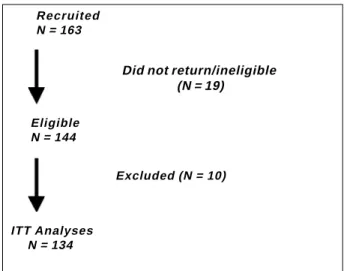
This was an open, phase IV, prospective, run-in with placebo, 12-week active treatment, multicenter study (14 sites). Figure 1 shows the recruitment algorithm and the number of patients screened in this study.
The study consisted of a placebo run-in period in which the placebo was given in the morning for 4 weeks to confirm blood pressure levels and to allow assessment of treatment compliance. That was followed by a 6-week period when all patients received 1 tablet of telmisartan 40 mg once a day in the morning. At the end of this period, patients whose ambulatory blood pressure levels were below 140/ 90mmHg were asked to continue taking 40mg for an additio-nal period of 6 weeks. Patients whose blood pressure was higher than 140/90mmHg had their telmisartan dosage in-creased to 80mg/day, 2 tablets in the morning.
Sixty-two (50%) patients underwent ambulatory blood pressure monitoring (ABPM) on 3 different occasions: at the end of visits 2, 4, and 6, which correspond to the end of the placebo phase, the telmisartan 40-mg phase, and the end of the study, when they received 40 or 80mg of telmi-sartan, respectively.
Laboratory safety assessments were performed at the end of the run-in period and at the end of the study. The as-sessed parameters were hematology (count of red blood cells, white blood cells, differential and platelets), creatini-ne, sodium, potassium, glucose, AST/SGOT (serum gluta-mic-oxaloacetic transaminase), ALT/SGPT (serum glutamic-pyruvic transaminase), and ECG (electrocardiogram).
The primary efficacy variables were SBP/DBP varia-tion, obtained 24 hours after the last dose (through values) at the office, after 6 and 12 weeks, from a baseline measure-ment taken with the patient seated.
The secondary efficacy variables were response
per-centile (DBP <90mmHg and/or decrease ≥10mmHg; SBP
<140mmHg and/or a reduction >10mmHg) and blood pres-sure values changes on ABPM after 6 and 12 weeks of treat-ment. The safety evaluation was based on the reports of clinical adverse events or laboratory findings. Figure 2 shows the study design.
Office blood pressure was measured according to
American Heart Association guidelines 10. Blood pressure
measurement was performed 3 times with the patient seated, after a 5-minute rest. The average was used for the subse-quent data analysis. A heart rate was also taken (measured for 30 seconds and expressed as beats per minute).
Ambulatory blood pressure monitoring was perfor-med with an automated device (SpaceLabs model 90207). The measurements were transmitted to the analysis system (SpaceLabs model 90209, Data Interface Unit), which per-forms the measurements with an oscillating method. The period of 24-hour clock time was divided into day vigil (the time between waking up and going to sleep) and night sleep (the time between the moment that the patient falls asleep until the moment he wakes up). During the vigil period, BP
Fig. 1 - Algorithm for patient selection; ITT, intention to treat. Did not return/ineligible
(N = 19)
Excluded (N = 10)
ITT Analyses N = 134
Eligible N = 144
measurements were taken every 15 minutes (4/hour), and during the sleeping period, the measurements were taken every 20 minutes (3/hour). The monitor was installed in the
morning, turned on between 08:00 AM - 10:00 AM, always
be-fore the daily medication dose was taken. The appraised parameters were the 24-hour SBP/DBP average, the SBP/ DBP average for the vigil and sleeping periods. The exami-nation was considered valid when more than 80% of the readings were available. In the case of measurement flaws for 3 consecutive hours or 6 nonconsecutive hours, the examination was repeated.
The data are shown as average and standard devia-tion and, when appropriate, as a funcdevia-tion of the sample dis-tribution characteristics, for the median and its confidence intervals. The database was stored and analyzed with Sigma Stat 1.0 software (Chicago, IL, 1991). The following statisti-cal tests were used: paired t test (ABPM measurements), ANOVA (comparison of the clinical BP measurements in the whole group). The telmisartan 40-mg and 80-mg subgroups were analyzed with the nonpaired t test or the Mann-Whit-ney test, when the sample distribution homogeneity was not seen. It was considered significant a p < 0.05.
Results
As shown in figure 1,163 subjects were initially re-cruited. One hundred thirty- four of those recruited patients were included in the study. Twenty-nine patients were ex-cluded from the study: 19 did not return for their scheduled appointments (visit 2) or were not eligible, and 10 patients were excluded due to loss to follow-up, withdrawal of con-sent, or blood pressure levels outside the range specified in the protocol. A subanalysis of the whole group showed that 47 (35%) patients received telmisartan 40mg for 12 weeks, and 81 (65%) patients had their dosage increased to 80mg.
The mean age was 57±10 years old (ranging from 32– 80 years). The group had 93 females and 41 males. With re-gard to ethnic background, 54.4% were white, 23% mulatto, 21% black, and 1.5% Asian or unknown. The time between the hypertension diagnosis and the beginning of the study was 10.7 (3.9-18.9) years. Sixty-seven percent of the pati-ents never smoked, 24.6% were former smokers, and 8.4% were smokers. With regard to alcohol consumption, 89.5% never consumed any type of alcoholic drink and 10.5% consumed alcohol sporadically.
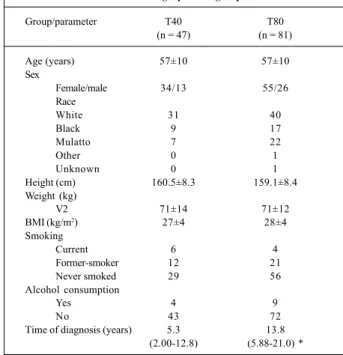
Table I shows the data of the 2 dosage subgroups. No statistically significant difference was observed between demographic characteristics, except for the time of the diagnosis of hypertension. This subgroup (n=47) reported a more recent diagnosis than the group that received 80mg. Table II shows the BP values and heart rate averages taken after placebo use (V2), 6 weeks after telmisartan 40mg use (V4), and at the end of the study (V6) for the entire gro-up. No differences were observed in heart rate at any point. The BP level differences are shown elsewhere. Figure 3 shows BP reductions observed after 6 and 12 weeks of
treatment with telmisartan. Those patients requiring 80mg of the study drug showed a statistically significant BP level reductions after 6 weeks of treatment, which persisted after doubling the dosage.
The average BP reduction was 14.4mmHg for systolic BP and 10.3mmHg for the diastolic BP after the 12-week treatment.
Sixty-two patients participated in ABPM. A statisti-cally significant BP reduction was seen after the drug treat-ment compared with that at the end of placebo period, both after 6 and 12 weeks of treatment, as shown in figures 4 to 7. According to the ABPM data, a reduction of 8mmHg in SBP and 5mmHg in DBP was observed in the last 6 hours recorded, after 6 weeks of therapy (18-24 hours after drug intake), compared with baseline values. In addition, the ABPM performed after 12 weeks, following the beginning of treatment showed 5-mmHg and 4-mmHg reductions, res-pectively (p<0.05 vs. placebo).
Regarding the response percentiles, a reduction in the
Table I – Clinical and demographic subgroup characteristics
Group/parameter T40 T80
(n = 47) (n = 81)
Age (years) 57±10 57±10
Sex
Female/male 34/13 55/26
Race
White 31 40
Black 9 17
Mulatto 7 22
Other 0 1
Unknown 0 1
Height (cm) 160.5±8.3 159.1±8.4 Weight (kg)
V2 71±14 71±12
BMI (kg/m2) 27±4 28±4
Smoking
Current 6 4
Former-smoker 12 21
Never smoked 29 56
Alcohol consumption
Yes 4 9
No 43 72
Time of diagnosis (years) 5.3 13.8 (2.00-12.8) (5.88-21.0) *
* P=0.001; T 40mg vs. T 80mg. (Mann-Whitney test). T40 = patients receiving telmisartan 40mg throughout the study; T80 = patients who had their dose increased to 80mg after 6 weeks of treatment with telmisartan 40mg daily due to poor blood pressure control.
Table II - Mean and standard deviation of blood pressure and heart rate values obtained in the office (n = 134)
Group/parameter V2 V4 V6
SBP (mmHg) 162 ± 14 152 ± 22 147 ± 20 DBP (mmHg) 101 ± 6 94 ± 12 91 ± 11
HR (bpm) 73 ± 9 73 ± 9 72 ± 8
SBP levels < 140mmHg (around 10 mmHg in 63% of the patients), while the DBP reduction to 90mmHg or lower (10mmHg in 57.5% of the patients). BP control (DBP < 90mmHg) was reached by 52% of the patients.
Sixty-nine patients (51%) reported 118 clinical adverse
events. Most of them (72.4%) were considered mild. Two se-rious adverse events not related to the study medication were reported: a case of bronchopneumonia and a stroke in a patient who discontinued the medication independently at the beginning of the study.
The events more commonly reported (incidence > 1%) were migraine, gastric pain, throat infections, and palpita-tion (at the end of the placebo phase). Other adverse even-ts, such as migraine, nasal bleeding, and upper airways in-fection, were reported after 6 weeks of treatment. Migraine, dizziness, bronchitis, and back pain were reported at the end of the study.
Migraine was reported mostly during the placebo period (13.5% in the placebo period versus 9% in the active treatment period; p < 0.05 vs. placebo phase). Other clinical adverse events considered not serious had no significant differences.
Table III shows the laboratory evaluations before and after treatment. No significant or clinical changes were observed in blood count, and metabolic, hepatic, and renal function tests after telmisartan treatment.
Significant alterations were not observed in the ECG pattern before and after treatment with telmisartan.
Discussion
The choice of 40mg and 80mg doses of telmisartan used in this study is based on previous studies evaluating the efficacy of different dosages (range: 20-160mg daily) on
blood pressure reduction 9,11,12. In these studies, the authors
observed that 40mg of telmisartan provides significant
de-Fig. 2 - Study design.
Fig. 3 - Effect of telmisartan on systolic and diastolic blood pressure levels after 6 and 12 weeks of treatment (n=134).
SBP DBP
Week 12
Baseline Week 6
mmH
g
* p < 0.05 vs. baseline ** p < 0.01 vs. week 6
Fig. 4 - Hourly average values at ABPM - systolic blood pressure (baseline vs. week 6). 08: 00 09: 00 10: 00 11: 00 12: 00 13: 00 14: 00 15: 00 16: 00 17: 00 18: 00 19: 00 20: 00 21: 00 22: 00 23: 00 00: 00 01: 00 02: 00 03: 00 04: 00 05: 00 06: 00 07: 00
SPB Baseline SBP - Week 6
Fig. 5 - Hourly average values at ABPM - systolic blood pressure (baseline vs. week 12).
10: 00
12:00 14: 00
16:00 18:00 20: 00
22: 00
00:00 02: 00
04:00 06: 00 08:00
SPB Baseline SPB - Week 12
Fig. 6 - Hourly average values at ABPM - diastolic blood pressure (baseline vs. week 6). 08: 00 09: 00 10: 00 11: 00 12: 00 13: 00 14: 00 15: 00 16: 00 17: 00 18: 00 19: 00 20: 00 21: 00 22: 00 23: 00 00: 00 01: 00 02: 00 03: 00 04: 00 05: 00 06: 00 07: 00
DPB - Baseline DPB - Week 6
Fig. 7 - Hourly average values at ABPM - diastolic blood pressure (baseline vs. week 12).
10:00 12:00 14:00 16:00 18:00 20:00 22:00 00:00 02:00 04:00 06:00 08:00
creases in blood pressure, from 9-11mmHg and 6-8mmHg, respectively, for systolic and diastolic BP, and increasing the dosage to 80mg resulted in a greater antihypertensive res-ponse than with the 40mg dosage. They also observed that dosages of 120-160 mg did not promote further decreases. Therefore, the telmisartan dosages established to obtain an effective reduction in BP levels without impairment of tole-rability were 40 and 80mg/daily.
This study showed that in this group of hypertensive subjects, a mean reduction occurred of 10/7mmHg (SBP and DBP, respectively) after 6 weeks of treatment with telmi-sartan 40mg, once a day. An additional reduction was obser-ved when the dosage was increased to 80mg a day (4.4/3.3 mmHg for SBP and DBP). An overall reduction of 14.4/10.3 mmHg (SBP and DBP) was seen in all subjects after 12 weeks of treatment. These data are consistent with data
re-ported by Neutel et al 9 and Smith et al 11 who obtained a
sig-nificant reduction in blood pressure levels with 40mg and an additional reduction with 80mg.
Analyzing the group of patients who took only 40mg of telmisartan throughout the study, we observed that a reduction of 22.4/16.3 mmHg (SBP and DBP, respectively) occurred after the first 6 weeks of treatment. This decrease was considered consistent and was maintained until the end of the study. For the group of patients whose medica-tion dosage was increased to 80mg, a slight reducmedica-tion oc-curred (9.9/7.1 mmHg, with SBP/DBP, respectively). The me-an reduction for the entire group is shown in figure 8. Some authors described similar findings, showing reductions of 11.3/7.3 mmHg with telmisartan 40mg and 13.7/8.1 mmHg
with telmisartan 80mg a day compared with placebo 9,11 and
average reductions of 10-11.9 mmHg for systolic and 8.6-9.7 mmHg for diastolic BP when different dosages of
telmisar-tan were evaluated 12. Some studies 13 have found BP
de-creases similar in magnitude to those that we observed. The percentage of patients who achieved a satisfac-tory response in our study is also consistent with that in
preliminary studies 9. These data show a good response by
51% for SBP and 43% for DBP with telmisartan 40mg once a day, and 57% and 55% for SBP and DBP, respectively, with
telmisartan 80mg a day 9. In general, the percentage of
pati-ents with a good response to telmisartan was 63% for SBP and 57.5% for DBP. When we analyzed separately those patients who received 40mg of telmisartan for 12 weeks, we
Table III - Laboratory tests at the end of the placebo period and after 12 weeks of treatment with telmisartan
Parameter Baseline V6
Sodium (mEq/L) 140 ± 3 140 ± 3 Potassium (mEq/L) 4.2 ± 0.5 4.3 ± 0.7 Creatinine (mg/dL) 0.8 ± 0.2 0.9 ± 0.2 * Glucose (mg/dL) 98 ± 18 98 ± 23
ALT (UI/L) 21 ± 8 20 ± 7
AST (UI/L) 19 ± 9 19 ± 8
* p = 0.006 vs. baseline creatinine; AST/SGOT- serum glutamic-oxaloa-cetic transaminase ALT/SGPT- serum glutamic-pyruvic transaminase.
noted that 87.2% had a good response for both systolic and diastolic BP. For the group receiving 80 mg, the percentage of responders at the end of the 12 weeks of evaluation was 53.7% for systolic and 46.2% for diastolic.
Regarding BP control (DBP < 90mmHg), 82% of the patients who took telmisartan 40mg had their blood pressure under control, and 33.7% of those whose medication was raised to 80mg a day achieved BP control.
A lower percentage of patients achieved BP control with telmisartan 80mg. This finding has been reported by other authors, and it may be related to the fact that a larger number of patients in this group had basal BP levels bet-ween 110-114 mmHg (14.8%) compared with the group that took telmisartan 40mg (2.1%). Although we could not de-tect a good response to treatment or control of DBP, we ob-served a statistically significant reduction in the average BP in this group of patients (111.7±1.4 vs. 101.9±12.2 p = 0.002). No difference was observed with telmisartan and its ef-fect on BP control regarding sex, age, or ethnic background. Based on ABPM, sustained 24-hour BP control has been shown with telmisartan. Also, this effect on BP persis-ted during the last 6 hours of the 24-hour BP monitoring and corresponded to that during the 18-24 hours after the inges-tion of the last dose of the medicainges-tion, maintaining BP circa-dian rhythm, and preventing sudden BP elevation in the first hours of the morning.
Some previous studies have already demonstrated the maintenance of BP control in the last 4 hours with other an-tihypertensive drugs. It has been shown that telmisartan performs excellently in controlling nocturnal BP when com-pared with other antihypertensive agents, or even when it is
compared with other drugs of its class 14-16. This
long-las-ting effect on BP control has been attributed to its longer half-life of approximately 24 hours, with a through to peak ratio greater than 80%. Although these data show that tel-misartan maintains its action for 24 hours, we cannot con-clude this because we have not compared telmisartan with other antihypertensive agents.
Concerning the tolerance profile, we noted that telmi-sartan was very well tolerated at both dosages. The inci-dence of adverse events was smaller during the active treat-ment phase (22% in the treattreat-ment phase with telmisartan
Fig. 8 - Mean blood pressure reduction after 12 weeks of treatment with telmisartan (systolic and diastolic, N = 134).
1. Meredith PA, Perloff D, Mancia G, Pickering T. Blood pressure variability and its implications for antihypertensive therapy. Blood Press 1995; 4: 5-11. 2. White WB. Cardiovascular risk and therapeutic intervention for the early morning
surge in blood pressure and heart rate. Blood Press Monit 2001; 6: 63-72. 3. Muller JE. Circadian variation and triggering of acute coronary events.Am Heart
J 1999; 137(4 Pt 2): S1-S8.
4. Sloan MA, Price TR, Foulkes MA, et al. Circadian rhythmicity of stroke onset. Intracerebral and subarachnoid hemorrhage. Stroke 1992; 23: 1420-6. 5. Elliott WJ. Circadian variation in the timing of stroke onset: a meta-analysis.
Stroke 1998; 29: 992-6.
6. Hansson L, Zanchetti A, Carruthers SG, et al. Effects of intensive blood-pressure lowering and low-dose aspirin in patients with hypertension. Lancet 1998; 351: 1755-62.
7. UK Prospective Diabetes Study Group. Tight blood pressure control and risk of macrovascular and microvascular complications in type 2 diabetes: UKPDS 38. Br Med J 1998; 317: 703-13.
8. Nicholls MG, Charles CJ, Crozier IG, et al. Blockade of the renin-angiotensin system. J Hypertens 1994; 10(suppl): S95-S103.
9. Neutel JM, Smith DH. Dose response and antihypertensive efficacy of the AT1 receptor antagonist telmisartam in patients with mild to moderate hypertension. Adv Ther 1998; 15: 206-17.
10. Perloff D, Carlene G, Flack J, Frohlich ED, Hill M, McDonald M, Morgenstern BZ. Human blood pressure determination by sphygmomanometry. Circulation 1993; 88 (Part1): 2460-70.
40mg, and 29% in the treatment phase with 40 or 80mg) com-pared with that in the placebo period (39%). Among all the reported adverse events, migraine was the most common. Its incidence was significantly higher for the placebo period versus the active treatment (13.5% vs. 5.1 vs. 3.4%, p <0.05). This excellent tolerability profile seems not to be spe-cific to telmisartan, but an effect of the angiotensin II
anta-gonist class of drugs 9,15,17. And also, analyzing more than
1400 patients who received this drug versus 380 who took placebo, migraine was the most common adverse event re-ported. The incidence of adverse events was greater during the placebo period compared with that during the active
treatment period 18 .
No significant major laboratory changes could be de-tected with telmisartan use, which indicates a good labora-tory safety profile. The statistical difference that was noted for serum creatinine has no clinical relevance. The mean va-lues before and after treatment remained within the normal range, and, as described for the pharmacokinetics of the drug, renal excretion does not contribute to telmisartan clea-rance, and no need exists for dosage adjustment in patients with mild to moderate renal impairment. A comparative stu-dy between telmisartan (40-80mg) and enalapril (10-20mg) in 71 patients with moderate renal impairment showed with re-nal clearance techniques that telmisartan did not induce
any relevant deterioration in renal function. However, in se-vere renal insufficiency this drug is contraindicated.
Our results confirm that telmisartan, an angiotensin II antagonist, when administered in a daily single dose effec-tively decreases BP in patients with mild to moderate hyper-tension and that this decrease is maintained during a 24-hour period. ABPM evaluation confirmed that 24-24-hour BP control, without lapses during the day or increasing BP during the evening, maintains the circadian rhythm pattern. The BP control in the last 6 hours (during a 24-hour control) showed, on average, a persistent reduction compared with baseline values, preventing the sudden BP elevation in the first hours of the morning, which has been associated with cardiovascular events. The tolerability profile was, at least, comparable to that of placebo.
In summary, telmisartan has been shown to be an excellent therapeutic option for treating patients with mild to moderate hypertension, with maintained BP reduction in office blood pressure values as well as BP measurements using 24-hour ABPM. Its tolerability profile is similar to that of placebo. Telmisartan was effective in preventing sudden BP elevation during the first hours of the morning. It has be-en shown to be a good option for monotherapy if used in a single daily dose, allowing better patient compliance to pharmacological treatment.
References
11. Smith DH, Matzek KM, Kempthorne-Rawson J. Dose response and safety of telmisartan in patients with mild to moderate hypertension. J Clin Pharmacol 2000; 40(Pt 1): 1380-90.
12. Smith DHG, Neutel JM, Morgenstern P. Once-daily telmisartan compared with enalapril in the treatment of hypertension. Av Ther 1998; 15: 229-40. 13. Karlberg BE, Lins LE, Hermansson K for the TEES Study Group. Efficacy and
safety of tlmisartan, a selective AT1 receptor antagonist, compared with enalapril in elderly patients with primary hypertension. J Hyperten 1999; 17: 293-302. 14. Lacourcière Y, Lenis J, Orchard R, et al. A comparison of the efficacies and
duration od action of the angiotensin II receptor blockers telmisartan and amlodipine. Blood Press Monit 1998; 3: 295-302.
15. Littlejohn T, Mroczek W, Marbury T, et al. A prospective, randomized, open-label trial comparing telmisartan 80mg with valsartan 80mg in patients with mild to moderate hypertension using ambulatory blood pressure monitoring. Can J Cardiol 2000; 16: 1123-32.
16. Mallion J, Siche J, Lacourciere Y. ABPM comparison of the antihypertensive profiles of the selective angiotensin II receptor antagonists telmisartan and losartan in patients with mild-to-moderate hypertension. J Hum Hypertens 1999; 13: 649-50.
17. Neutel JM. Safety and efficacy of angiotensin II receptor antagonists. Am J Cardiol 1999; 84: 13K-17K.