PARENTAL CARE IN THE BUFFY-TUFTED-EAR
MARMOSET (
Callithrix aurita
) IN WILD AND CAPTIVE
GROUPS
SANTOS, C. V.1 and MARTINS, M. M.2
1Dinâmica Projetos Ambientais, Rua Jerônimo Coelho, 280, sala 403, CEP 88010-030, Florianópolis, SC, Brazil 2PG Ciências Biológicas/Zoologia, Instituto de Biociências, Universidade Estadual Paulista, Unesp,
Rio Claro, SP, Brazil
Correspondence to: Milene M. Martins, Departamento de Zoologia/IB/Unicamp, C.P. 6109, CEP 13.083-970, Campinas, SP, Brazil, e-mail: [email protected]
Received June 22, 1999 – Accepted January 28, 2000 – Distributed November 30, 2000
(With 2 figures)
ABSTRACT
Studies on cooperative care of offspring in callitrichid primates are biased in favor of observations in captivity. In the wild, however, individuals have to deal with environmental pressures, which may influence their social behavior. We compared the individual effort attributed to parental care offered by members of a wild group (couple, plus a subadult helper) and two captive groups (A: couple, plus an subadult helper, B: couple, plus four adult helpers) of the buffy-tufted-ear marmoset, Callithrix aurita, from weeks 1-12 after the infants’ birth. The carrier (breeding male and female or helper) and the infant’s feeding (food sharing and foraging for food) were recorded. Up to week four, while the wild breeding pair shared infant carrying at similar proportions, the male from captive group A carried 100% of the time. Adult helpers from group B were the main carriers. Carrying behavior extended up to week 12 only in the wild group. Food provisioning to the infant was observed earlier in the groups wild and A, but general proportion of feeding records was lower in the wild than in captiv-ity. Energetic cost of travelling and searching for food may be associated with equal division of carrying behavior by the wild breeding pair. Higher proportions of carrying in the groups wild and B may have delayed the development of the infants’ motor skills required in foraging. Our data agree with pre-vious studies: the father’s lower investment in carrying when adult helpers are present and lower contri-bution of subadult non-reproductive members.
Key words: parental care, Callithrix aurita, carrying, wild, captivity.
RESUMO
Cuidado parental em grupos de sagüis-da-serra-escuros (Callithrix aurita)
silvestre e de cativeiro
Estudos sobre cuidado parental em primatas calitriquídeos têm sido conduzidos principalmente em cativeiro. Na natureza, os grupos estão expostos às pressões ambientais, as quais podem influenciar o comportamento social. Comparamos a contribuição individual no cuidado parental oferecida por membros de um grupo silvestre (casal com um ajudante subadulto) e dois grupos de cativeiro (A: casal com um ajudante subadulto, B: casal com quatro ajudantes adultos) de sagüis-da-serra-escuros,
e A, mas a proporção total do número de registros foi menor na natureza. Os custos do deslocamento e forrageio podem estar associados à divisão igualitária do transporte pelo par silvestre. Maiores fre-qüências de transporte nos grupos silvestre e B podem ter provocado um atraso no desenvolvimento das habilidades motoras dos filhotes, as quais são necessárias no forrageio. Os dados concordam com estudos anteriores: menor investimento no transporte pelo macho reprodutor na presença de adultos ajudantes e baixa contribuição de ajudantes subadultos no carregamento.
Palavras-chave: cuidado parental, Callithrix aurita, transporte, natureza, cativeiro.
INTRODUCTION
Communal care of dependent offspring by group members other than the mother is the most conspicuous social characteristic in callitrichid primates. The evolution of communal care has been explained by the high energetic costs to the bree-ding female of raising infants twice a year. In most of the births, she bears twins which have nearly 20% of an adult weight (Leutenegger, 1980; Gol-dizen, 1990). Meanwhile, Caine (1993) believes that the vigilance against predators might have co-evolved with cooperative breeding. Infant carrying, the most frequently observed form of parental care, is performed by the breeding pair and helpers (older siblings and others non-reproductive members, including those unrelated to the infants). Studies on captivity on different species of callitrichids indicate that prior to the fourth week, carrying behavior occurs on 85% of the time, and gradually decreases between the fourth and the tenth week of the infant’s life (Box, 1977; Tardif et al., 1993). Different mechanisms have been described to explain the effort of group members on infant carrying. For instance, it has been suggested that the extent to which the breeding male participate on infant carrying might change according to the presence of helpers. It has been documented a negative correlation between the number of adult helpers and infant transport by the father (McGrew, 1988; Tardif et al., 1990; Price, 1992a; Santos et al., 1997). The engagement on infant carrying by the breeding female, on the other hand, may be affected by litter size, maternal condition, and parity (Price, 1992a; Tardif et al., 1984). Helpers’ age and their previous experience on infant care can affect their performance on carrying behavior (Ingram, 1977; Cleveland & Snowdon, 1984; Price, 1992b). Studies on Callithrix jacchus have shown that, in general, the patterns of infant carrying are similar in free-range and captive groups, but helpers
must be an important resource for wild pairs (Ya-mamoto et al., 1996; see Snowdon, 1996, for a review).
Food provisioning, another form of communal care among callitrichids, has been described as an important adaptation which increases the chances of infant’s survival (Terborgh & Goldizen, 1985; Ferrari, 1987; Feistner & Price, 1991). Differences in the social environment could play a role on food provisioning, and on infant development as well. In this context, it has been suggested that group size has a favorable effect on infant independence and acquisition of solid items throughout food sharing, since more individuals in a group would mean more opportunities for the infant to be cared (Ferrari, 1987; Feistner & Price, 1991; Price, 1992a). Meanwhile, the skills needed to search, capture and manipulate food items, especially invertebrate prey, must be developed by the infant during the first months of life. For instance, Ferrari (1987) reported that young Callithrix flaviceps were first observed capturing animal prey only at their seventh month of age.
food items at their disposal and do not deal with food searching. Our results are compared to pre-vious studies on callitrichid cooperative breeding.
MATERIAL AND METHODS
Studied Groups
The social composition of the three observed groups is described on Table 1. All individuals from the captive groups were related to each other, but kinship relations among members from the wild group were unknown. Data on the free-range group
were obtained during a 12-month ecological study. This group occupied a secondary semideciduous forest fragment in Fazenda Lagoa, Minas Gerais, south-eastern Brazil. Both captive groups were main-tained in cages (4 x 3 x 2 m) at the Rio de Janei-ro Primate Center (CPRJ), situated in Guapimirim, Rio de Janeiro, south-eastern Brazil, managed by State Environmental Foundation (FEEMA). Food and water were supplied twice daily to the captive groups. Morning feeding consisted of bread enriched with vitamins, proteins, cereal, and milk; in the afternoon fruit and mealworms were provided.
TABLE 1
Description of the studied groups.
Groups Group size1 Number of helpers2 Number of born infants
Wild 4 1SAF 1
A (Captive) 4 1SAF 1
B (Captive) 8 4AM 2
1. Includes the breeding pair, helpers and infants. 2. SAF = subadult female; AM = adult male.
Procedure
Individuals in the three groups were recog-nized by their distinctive natural features such as size and fur pigmentation. In the field, observations were made during the whole activity period of the group during 6-10 days each month, whereas capti-ve groups were subjected to observation sessions of thirty minutes twice a week in varied daily hours. Data on parental behavior were collected from the first to the twelfth week after birth. Difficulties in the field prevented observation on the seventh and the eighth weeks.
Scan sampling (Altmann, 1974) at one and five-minute intervals was used throughout the study, respectively on the captive and wild groups. The infant was considered as being carried when most of its body was clinging on the carrier’s body. On each sample, the carrier was identified as the bre-eding male and female, or helper. Febre-eding records of infants either eating by itself (foraging) or sha-ring food with another individual were recorded. Data collection were grouped in six blocks of two weeks each (1-2, 3-4, 5-6, 7-8, 9-10, 11-12), and the percentages of carrying and feeding records were calculated for each block.
RESULTS
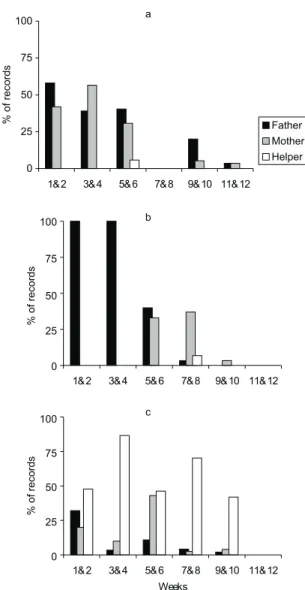
weeks, varying from 42% to 87%. During weeks 1-2, the three categories of carriers showed almost similar frequencies of infant carrying (Fig. 1c).
Infant transportation extended up to the 12th week in the wild group, whereas in the captive groups (A and B) infants were fully independent
in locomotion by that time (Fig. 1a, b and c). Meanwhile, from the fifth to the tenth weeks, the infants of group B were carried at a higher frequency than either the infant of group A and the wild group.
a
0
0
0 25
25
25 50
50
50 75
75
75 100
100
100
1& 2 3& 4 5& 6 7& 8 9& 10 11& 12
%
of
records
%
of
records
%
of
records
Father Mother Helper
b
1& 2 3& 4 5& 6 7& 8 9& 10 11& 12
c
1& 2 3& 4 5& 6 7& 8 9& 10 11& 12
Weeks
Fig. 1 — Percentage of records of infant carrying behavior by members category in the groups a) wild, b) captive A, and c) captive B.
In groups with similar social composition (wild and A), the initiation into eating solid items was observed earlier than in a more socially complex
DISCUSSION
Despite the small sample size, which precluded a statistical analysis, our results showed tendencies in agreement with previous studies. Social composition interferred in the participation of fathers and helpers in transportation of infants. The father’s lower investment in carrying when adult helpers were present, demonstrated for captive groups of other callitrichid species (McGrew, 1988; Tardif et al., 1990; Price, 1992a; Santos et al., 1997), were also observed here at group B. Similarly to the result obtained for free-range (see Terborgh & Goldizen, 1985; Goldizen, 1987; Yamamoto et al., 1996) and captive callitrichid groups (Ingram, 1977; Price, 1992b; Yamamoto et al., 1996; Santos et al., 1997), lower contribution to carrying by subadult alloparents (groups wild and captive A) relative to adult helpers (group B) was also recorded in our study. It is reasonable to expect that environmental pressures would cause wild breeding pairs without an adult helper to share equally the carrying burden, as it was recorded here. However, wild groups formed by a breeding pair and a sibling are rare among callitrichids, commonly regarded as extended families (see Ferrari & Digby, 1996). In this scenario, we may speculate that the male and female from the wild shared the infant transportation due to costs of locomotion during daily activities, whereas the captive female from group A held it almost exclu-sively during the suckling bouts.
In the present study, social conditions seem to interfere in the start of the process of food acqui-sition. Observations on both the wild and captive group A (one non-adult helper besides the breeding pair), revealed that infants were more motivated to obtain food by sharing and to forage for food by
themselves earlier than in group B, which had many adult helpers. The higher number of potential carriers on group B appeared to create more opportunities for the infants to be carried until the tenth week, but not to increase their frequencies of food sharing or food searching. Although the infant from the wild group has shown solid food ingestion as early as the infant in the captive group A, the general feeding proportion of the former was the lowest recorded among all observed groups. We may speculate that, in both wild and captive B groups more carrying due to travelling and more individuals to take care could have caused a delay on acquisition of solid food by the immature infants. Our suggestion disagrees with Ferrari (1987) and Price (1992a) who inferred that more helpers must increase the chances of food sharing by the infant with its caretakers. Because data on food sharing and foraging were both considered here, an alternative view can be proposed. Infants carried longer may also show a delay on locomotion, which in turn could affect the development of the necessary skills, especially on food searching and manipulation. Few studies have been conducted on this species until now. The results presented here suggest that more investigations on callitrichid infant development are needed, since social and environmental differences may act on the performance of parental care.
Acknowledgments — We thank Ademar F. Coimbra-Filho and Alcides Pissinatti for permission to study the marmosets at the Centro de Primatologia do Rio de Janeiro (CPRJ/FEEMA) and Maria Cristina Weyland for permission to conduct field research at Fazenda Lagoa. We are also greatful to Ivan Sazima for providing critical comments. This work was supported by grants from the Brazilian National Science Council-CNPq (135729/91-2) to CVS and from the Brazilian Higher Education Authority-Capes (33004137003 M3) and Fundação MB/ University of Campinas to MMM.
15
0 5 10 20
1&2 3&4 5&6 7&8 9&10 11&12
Weeks
%
of
records
Wild Captive A Captive B
REFERENCES
ALTMANN, J., 1974, Observational study of behavior: sam-pling methods. Behaviour, 49: 227-267.
BOX, H. O., 1977, Quantitative data on the carrying of young captive monkeys (Callithrix jacchus) by other members of their family groups. Primates, 18(2): 475-484. CAINE, N. G., 1993, Flexibility and co-operation as unifying
themes in Saguinus social organization and behavior: the role of predation pressures, pp. 200-219. In: A. B. Ry-lands (ed.), Marmosets and Tamarins: Systematics, Beha-viour, and Ecology. Oxford University Press, Oxford. CLEVELAND, J. & SNOWDON, C. T., 1984, Social
devel-opment during the first twenty weeks in the cotton-top tamarins (Saguinus o. oedipus). Anim. Behav., 32: 432-444.
FEISTNER, A. & PRICE, E., 1991, Food offering in New World primates: two species added. FoliaPrimatol., 57: 165-168.
FERRARI, S. F., 1987, Food-transfer in a wild marmoset group. FoliaPrimatol., 48: 203-206.
FERRARI, S. F. & DIGBY, L. J., 1996, Wild Callithrix groups: extended families? Am. J. Primatol., 38: 19-27. GOLDIZEN, A. W., 1987, Facultative polyandry and the role
of infant-carrying in wild saddle-back tamarins (Saguinus fuscicollis). Behav. Ecol. Sociobiol., 20: 99-109. GOLDIZEN, A. W., 1990, A comparative perspective on the
evolution of tamarin and marmoset social systems. Int.
J. Primatol., 11(1): 63-83.
INGRAM, J. C., 1977, Interactions between parents and in-fants, and the development of independence in the com-mon marmoset (Callithrix jacchus). Anim. Behav., 25: 811-827.
LEUTNEGGER, W., 1980, Monogamy in callitrichids: a consequence of phyletic dwarfism. Int. J. Primatol., 1: 95-99.
McGREW, W. C., 1988, Parental division of infant caretaking varies with family composition in cotton-top tamarins.
Anim. Behav., 36: 285-286.
PRICE, E. C., 1992a, The benefits of helpers: effects of group and litter size on infant care in tamarins (Saguinus oedipus). Am. J. Primatol., 26: 179-190.
PRICE, E. C., 1992b, Contribution to infant care in captive cotton-top tamarins (Saguinus oedipus): the influence of age, sex, and reproductive status. Int. J. Primatol., 13(2): 125-141.
SANTOS, C. V., FRENCH, J. A. & OTTA, E., 1997, Infant carrying behavior in Callitrichid primates: Callithrix and
Leonthopithecus. Int. J. Primatol., 18(6): 889-907. SNOWDON, C. T., 1996, Infant care in cooperatively
breed-ing species, pp. 643-689. In: J. S. Rosenblatt & C. T. Snowdon (eds.), Parental Care: evolution, mechanisms, and adaptative significance. Academic Press, Inc. TARDIF, S. D., RICHTER, C. B. & CARSON, R. L., 1984,
Reproductive performance of three species of Callitri-chidae. Lab. Anim. Sci., 34: 272-275.
TARDIF, S. D., CARSON, R. L. & GANGAWARE, B. L., 1990, Infant-care behavior of mothers and fathers in a communal-care primate, the cotton-top tamarin (Saguinus oedipus). Am. J. Primatol., 22: 73-85.
TARDIF, S. D., HARRISON, M. L. & SIMEK, M. A., 1993, Communal infant care in marmosets and tamarins: rela-tion to energetics, ecology, and social organizarela-tion, pp. 220-234. In: A. B. Rylands (ed.), Marmosets and Tama-rins: systematics, behaviour, and ecology. Oxford Uni-versity Press, Oxford.
TERBORGH, J. & GOLDIZEN, A. W., 1985, On the mat-ing system of the cooperatively breedmat-ing saddle-backed tamarin (Saguinus fuscicollis). Behav. Ecol. Sociobiol.,
16: 293-299.