STUDIES ON CALCIUM CONTENT IN SEA WATER.
III. CALCIUM IN THE WATERS OF CANANÉIA LAGOON AND ITS ADJACENT
REGIONS, STATE OF SÃO 'PAULO, BRAZIL
(Received for publication in 1959)
K ENJI KATO
*
Faculty of Fisheries, Hokkaido University Japan Oceanographic Institute, University of São Paulo - Brazil
SYNOPSIS
In this paper a series of geochemical investigations are reported with res-pect to calcium contents in different waters collected from the sea off the coast of Cananéia, the lagoon surrounding Cananéia Island and from Nóbrega river (one of the saline branches from the Iagoon, aIso calIed "marigot").
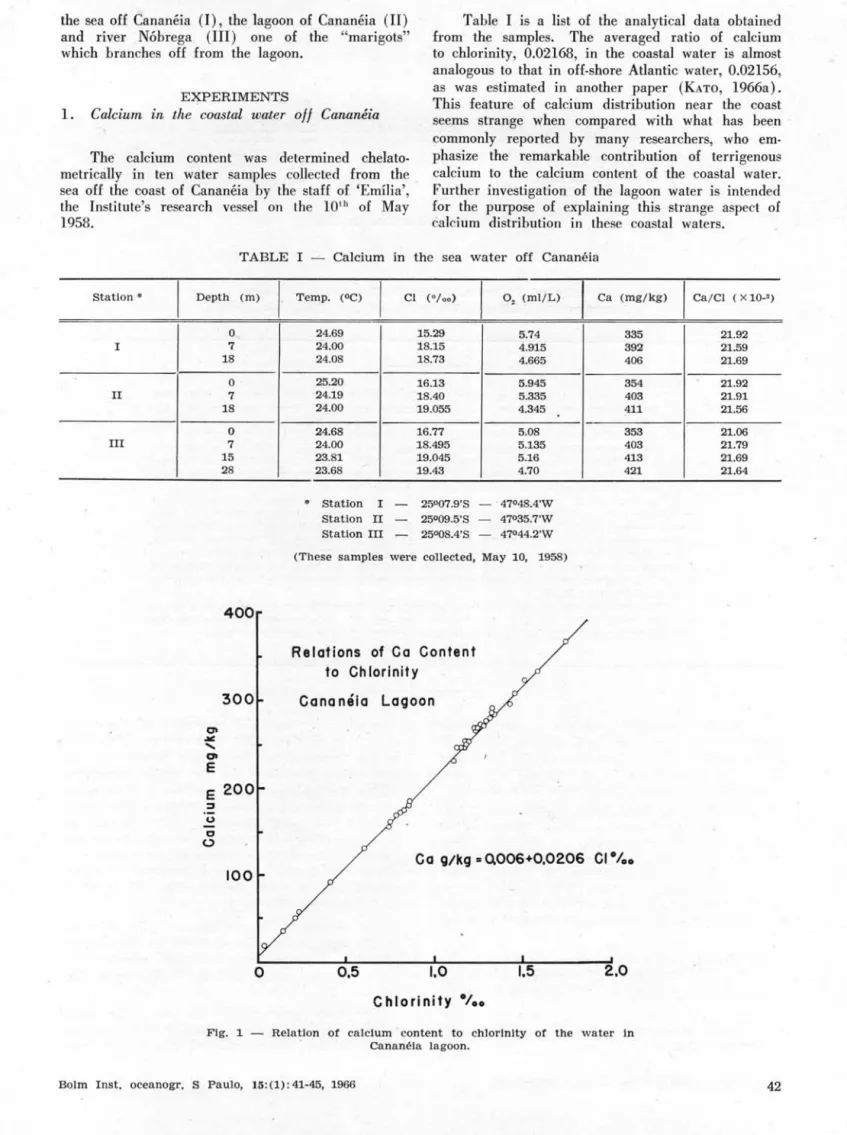
An almost direct relation of calcium to chlorinity, 0.02168 in average, similar to that of the outer Atlantic water, 0.02156, was observed in the coastaI water. This indicates that the terrigenous supply of calcium might not contribute very much to the calcium content in the coastal water.
The inflow of Iand water to the lagoon of Cananéia does not increase the calcium content of the lagoon water, where a slight depression of the Ca/ CI gra-dient (namely 0.0206) was observed. This characteristic of the calciÍlm distribution is more remarkable in the water of the "mangot", branching off from the Iagoon. An extremely low gradient of calcium to chlorinity, 0.0177 is one of the geochemical characteristics fotmd in tropical estuaries where active bacteriaI decomposition of deposited organic materiaIs renders the geochemicaI properties of the water more acid and more reduced.
The low content of calcium in Iand water, 4-6 mg/ Ca/ kg, has also of course, a close relationship to this peculiar aspect of the calcium distribution in the coastal water, and further in the Atlantic water off the Brazilian coast.
INTRODUCTION
•
After having studied calcium oceanochemically in the Atlantic Ocean oH Brazil (KATO, 1966a) . the author studied the calcium contents in the waters of the lagoon of Cananéia and its adjacent region in the southern coast of São Paulo State, Brazil.
The lagoon of Cananéia comprises several belt-like channcls, extending over 110 km from the "Bar-ra do A"Bar-ra"Bar-rapi"Bar-ra" (ent"Bar-rance to the A"Bar-ra"Bar-rapi"Bar-ra Chan-nel) or the western end, to " Foz do Ribeira de Iguape" (Estuary of the Ribeira de Iguape River) , or the eastern end. Of these channels, the principal region of research is the ring-like channel surround-ing " Ilha de Cananéia" (Cananéia Island) (BESNARD,
is controlled by the tidal movement of the water and by the dilution with fresh water which runs into the lagoon from the nearby watershed. The coastal wind prevailing in the region sometimes modifies the hydrographical conditions. The saline water channels which branch oH from the lagoon are called " marigots" (BESNARD, 1950) because of their geographical characteristics. Chemically the wa-ter of these channels is characwa-terized by a very acid medium, near to pH 5, and by a deveIoped reduction-condition due to active decomposition of deposited organic materiaIs (KATO, 1966b).
1950). .
Periodical observations were made from No-vember of 1957 to 1958 on the geochemistry of the lagoon. The hydrographicaI condition of the Iagoon
• At present In the Faculty of Fisheries, Prefectura l University of Mie, Tsu, J a pa n.
Bolm Inst. oceànogr. S Paulo, 15: (1): 41-45, 1966
The oceanographic condition off the coast of Cananéia was periodically observed by the Section of Physical Oceanography (EMILSSON, unpublished) from the Oceanographic Institute, University of São Paulo.
The present paper reports the results of a series of geochemicaI investigations referring to the calcium contents in the waters collected respectiveIy from
the sea oH Cananéia
(I),
thelagoon of Cananéia (11) and river Nóbrega (111) one of the "marigots" which branches off from the lagoon.EXPERIMENTS
1. Calcium m the coas tal water off Cananéia
The calcium content was determined chelato· metrically in ten water samples collected from the sea oH the coast of Cananéia by the staff of 'Emília', the Institute's research vessel on the 10th of May
1958.
Table I is a list of the analytical data obtained from the samples. The averaged ratio of calcium to chlorinity, 0.02168, in the coastal water is almost analogous to that in off·shore Atlantic water, 0.02156, as was estimated in another paper (KATO, 1966a). This feature of calcium distribution near the coast seems strange when compared with what has been commonly reported by many researchers, who em· phasize the remarkable contribution of terrigenous calcium to the calcium content of the coastal water. rurther investigation of the lagoon water is intended for the purpose of explaining this strange aspect
oi
calcium distribution in these coastal waters.TABLE I - Calcium in the sea water off .Cananéia
Statlon •
I
II
lU
Depth (m) Temp. (OC) CI (%0) 02 (ml/L)
I
Ca (mg/kg)I
Ca/CI (X 10.3 )CJ>
~ ...
CJ> E
o 7 18
O 7 18
O 7 15 28
400
300
E 200
u
o
(,)
100
o
24.69 24.00 24.08
25.20 24.19 24.00
24.68 24.00 23.81 23.68
* Statlon I
Station U Statlon UI
15.29 18.15 18.73
16.13 18.40 19.055
16.77 18.495 19.045 19.43
25007.9'S
25009.5'S 25008.4'S
5.74 4.915 4.665
5.945 5.335 4.345
5.08 5.135 5.16 4.70
47°48.4'W 47°35.7'W 47044.2'W
(These samples were cOllected, May 10, 1958)
Relations of Ca Content to Chlorinity
Cana néia Lagoon
335 392 406
354 403 411
353 403 413 421
Ca g/kg .. Q006+0.0206 CI%.
0.5
1.01.5
2.0Chlorinity·/ ••
Flg. 1 - Relatlon or calclum content to chlorlnlty or the water in
Cananéla lagoon.
21.92 21.59 21.69
21.92 21.91 21.56
21.06 21.79 21.69 21.64
2. Calcium in lhe lagoon waler of Cananéia
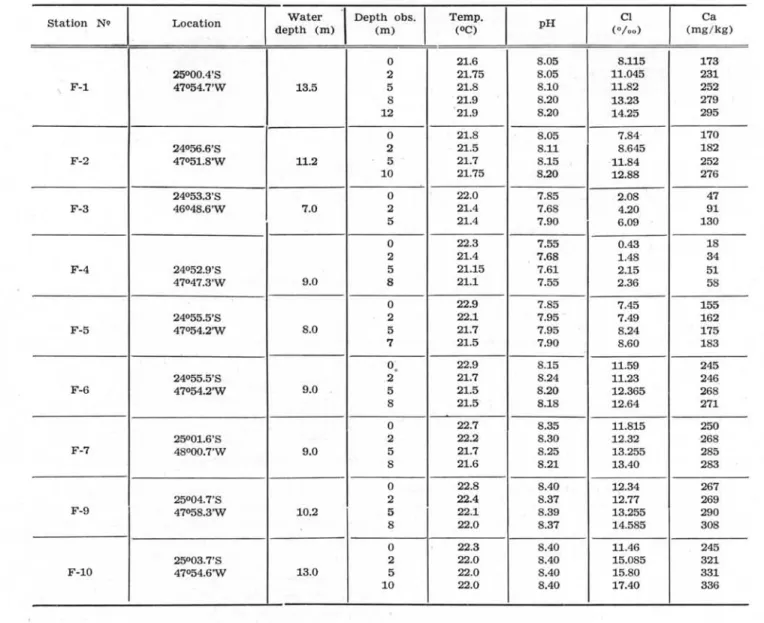
Determination of calcium was done in 36 water • samples, collected ,during the oceanographic observa·
tions on the 10t h of May 1958, from 9 stations
(KATO 1966c, Fig. 1) in the lagoon surrounding Ilha de Cananéia. These results are given In Table 11.
TABLE II - Distribution of calcium in the lagoon of Cananéia (May 10, 1958>
8tatlon No Location
I
WaterI
Depth obs.
I
Temp.
I
pHI
Cl
I
Cadepth (m) (m)
O
25°00.4'8 2
\ F-l 47°54.7'W 13.5 5
8 12
o
24°56.6'8 2
F-2 47051.8'W 11.2 5,
10
24°53.3'8 O
F-3 46048.6'W 7.0 2
5
O 2
F-4 24°52.9'8 5
47047.3'W 9.0 8
O
24°55.5'8 2
F-5 47°54.2'W 8.0 5
7
O ~
24°55.5'8 2
F-6 47054.2'W 9 .0 5
8
O
25°01.6'8 2
F-7 48°00.7'W 9.0 5
8
O
25°04.7'8 2
F-9 47058.3'W 10.2 5
8
O
25°03.7'8 2
F-lO 47°54.6'W 13.0 5
10
Calcium content in the lagoon water, as illustrat· ed in Figure 2, shows a direct relation to the chlorin-ity. This aspect of calcium distribution in the lagoon , water looks somewhat different from those in common estuarine water, to which a fairly }ligh amount of calcium is usually added by the inflowing land water. Consequently the land water streaming into the la-goon does not increase the amount of calcium in the lagoon water, but merely di lutes the saline water physically which flows into it from the outer sea when the tide rises. The calcium content, approx-imately 6 mg-Ca/ kg, as extrapolated to O 0/00 in chIo r-inity (Figure 1), gives the quantity of calcium in the land water of the watersheds adjacent to the lag.oon. In consequence, oH the Brazilian coast, mixture of the sea water with the land water will not always contribute to the rise of Ca/ CI factor in the coastal water.
Bolm Inst. oceanogr. 8 Paulo, 15: (1): 41-45, 1966
(OC) ( 0/ 00 ) (mg / kg)
21.6 8.05 8.115 173
21.75 8 .05 11.045 231
21.8 8.10 11.82 252
21.9 8.20 13.23 279
21.9 8.20 14.25 295
21.8 8.05 7.84 170
21.5 8.11 8.645 182
21.7 8.15 ·11.84 252
21.75 8.20 12.88 276
22.0 7.85 2.08 47
21.4 7.68 4.20 91
21.4 7.90 6.09 130
22.3 7.55 0.43 18
21.4 7.68 1.48 34
21.15 7.61 2.15 51
21.1 7.55 2 .36 58
22.9 7.85 7.45 155
22.1 7 .95 7.49 162
21.7 7.95 8.24 175
21.5 7.90 8.60 183
22.9 8.15 11.59 245
21.7 8.24 11.23 246,
21.5 8.20 12.365 268
21.5 8.18 12.64 271
22.7 8.35 11.815 250
22.2 8.30 12.32 268
21.7 8.25 13.255 285
21.6 8.21 13.40 283
22.8 8.40 12.34 267
22.4 8.37 12.77 269
22.1 8.39 13.255 290
22.0 8.37 14.585 308
22.3 8.40 11.46 245
22.0 8.40 15.085 321
22.0 8.40 15.80 331
22.0 8.40 17.40 336
It is also noteworthy that the lagoon water gives a - rather lower gradient of calcium to chlorinity, 0.0206, when compared to the oceanic water gra-dient, 0.02156. This lowering of the gradient in the lagoon water proves that a bio-geochemical pre-cipitation of dissolved calcium takes places. This reducing eHect of the Ca/ CI factor, as will be men-tioned in the succeeding section is very remarkable In the "marigot" water.
3. Calcium in 'lhe "marigot" water
The "marigot", or the saline branch of the Ca-nanéia Lagoon, has some peculiar characteristics from the geochemical point of view (KATO, 1966b). 1. The hydrographic features of the system are principally controlled by a hydrodynamical equili-brium between the tidal water from the outer sea
and the fresh water due to meteoroIogicaI precipita-tion as weIl as to underground water oozing out into the channeIs.
2. A remarkabIe reduction condition, prevail-ing throughout the "marigot", aHected by active bacteriaI decoPlposition of deposited organic mate-riaIs. Consequently, the scanty dissoIved oxygen, accompanying the biochemicaI reduction by bacteria Iimits the deveIopment of organisms in the "mar
i-got".
3. ReIated to the reduced condition, a Iow vaIue of pH (5) is IikeIy to be observed throughout the waterway of the " marigot" and probably hàs influence on the geochemical alteration of the water properties and on the diagnosis of the sediments_
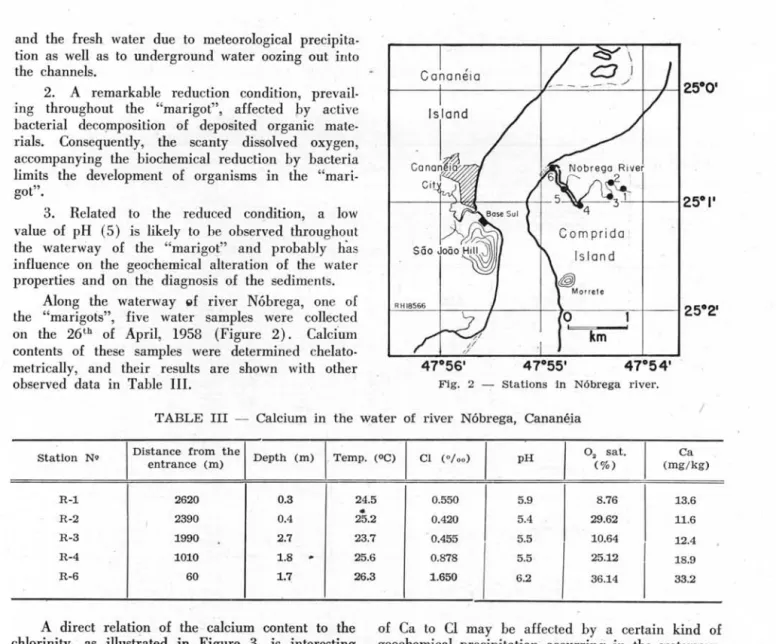
AIong the waterway ilf river Nóbrega, one of the "marigots", five water samples were coIlected on the 26th of April, 1958 (Figure 2). Ca!ci"um
contents of these samples were determined chelato-metrically, and their results are shown with other observed data in Table 111.
47°54'
stations in Nóbrega rlver.I
TABLE IH - Calcium in the water of river Nóbrega, Cananéia
Distance from the Depth (m)
I
Temp. (OC)I
CI ( 0/00)I
pHI
°2
sat.I
Ca statlon No
entrance (m) (%) (mg/kg)
R-1 2620 0.3 24.5
•
R -2 2390 0.4 25.2
R-3 1990 2.7 23.7
R-4 1010 1.8 ~ 25.6
}t-6 60 1.7 26.3
A direct relation of the calcium content to the chlorinity, as ilIustrated in Figure 3, is interesting as it shows that the reIativeIy Iow gradient, 0.0177,
co ..c
...
co
40
30
E 20
E
:::o u
o
<.;)
10
O 0.5 1.0 1.5 2.0
Chlorlnlty 0/00 .
Fig. 3 - Relation of calcium content to chlorinity of the water in Nóbrega river.
Bolm Inst. oceanogr. S Paulo, 15: (1): 41-45, 1966
0.550 5.9 8.76 13.6
0.420 5.4 29.62 11.6
0.455 5.5 10.64 12.4
0.878 5.5 25.12 18.9
1.650 6.2 36.14 33.2
of Ca to CI may be aHected by a certain kind of geochemicaI precipitation occurring in the waterway. The soIubility of calcium carbonate reduces with the Iowering of the pH as . the chlorinity in the sampIe decreases (WATTENBERG & TIMMERMANN, 1936).
A definite value of caIcium content, about 4 mg. Ca/ kg, as extrapoIated to 00/ 00 in chlorinity in Figure 3, indicates the approximate quantity of cal· cium in the fresh water added, and is aImost similar to the estima te made for the Iagoon water, -6 mg· CaJkg. In consequence, a caIcium content of 4-6 mg-Ca/kg gives the probabIe quantity of calcium in the land water in relation to the lagoon. KLEERE-KOPER (1944) estimated the calcium content in the river waters in São Paulo as approximately 2-4.5 mg-Ca/l. This relatively Iow content of caIcium seems to be one of the geochemical characteristics of . Brazilian land ~ater.
RESUMO
Neste trabalho relata-se uma sene de investiga-ções geoquímicas com respeito ao teor de cálcio em diferentes amostras de água, coletadas no mar dian-te de Cananéia, na lagoa que circunda a Ilha de Ca-nanéia e no rio Nóbrega (um dos ramos salinos da lagoa, também chamado "marigot").
Foi encontrada, nas águas costeiras, uma relação quase direta entre cálcio e clorinidade, 0,02168 em média, similar a 0,02156, para as águas distantes do Atlántico. Isso indica que o suprimento continental de cálcio não deve contribuir muito para o conteúdo de cálcio das águas costeiras.
A entrada de água continental para a lagoa de Cananéia, não aumenta o teor de cálcio das águas da lagoa, onde foi observada ligeira depressão do gradiente Ca/Cl (notadamente 0,0206). Essa
carac-terística da distribuição do cálcio é mais marcada nas .águas do "marigot", o ramo de escoamento da lagoa. Um gradiente extremamente baixo de cálcio para a clorinidade, 0,0177, é uma das características geoquímicas encontradas em estuários tropicais, onde a decomposição bacteriana ativa dos depósitos de ma-terial orgânico estabelece as propriedades das águas mais ácidas e mais reduzidas.
°
baixo teor de cálcio nas águas continentais,4-6 mg/Ca!kg, tem, por certo, estreita relação com
êsse aspecto peculiar da distribuição do cálcio em águas costeiras e também nas águas distantes · do Atlântico da costa brasileira.
BESNARD, W.
1950.
REFERENCES
Considerações gerais em tôrno da re-gião lagunar de Cananéia-Iguape. I.
Bolm Inst. oceanogr. S Paulo, 15: (1): 41-45, 1966
KATO, K. 1966a.
1966b.
1966c.
Bolm Inst. paul. oceanogr., voI. 1, n.o 1, p. 9-26.
Studies on calcium content in sea water. 11. Distribution of calcium in the Atlan-tic water off South BraziI. Bolm Inst. oceanogr. S Paulo, voI. 15, n.o 1, p. 29-39.
Geochemical studies on the mangrove region of Cananéia, BraziI. 11. Physico-chemical observations on the reduction states. Bolm Inst. oceanogr. S Paulo, voI. 15, n.o 1, p . . 21-24.
Chemical investigations on the hydro· graphical system of Cananéia lagoon. Bolm Inst. oceanogr. S Paulo, voI. 15, n.o 1, p. 1-12.
KLEEREKOPER, H.
1944. Introdução ao estudo da limnologia. Rio de Janeiro, Minist. Agric. Servo Inform. Agric., 329 p.
WATTENBERG, H. & TIMMERMANN, E.
1936. Ueber die Sattigung des Seewassers an CaCOa. Annln Hydrogr., Berlin, p. 23.