O
BJECTIVETo analyze intracoronary release of inflammatory markers (IM) after percutaneous coronary interventions (PCI) and compare their concentrations concerning the type of PCI used (rotablator vs. balloon angioplasty).
M
ETHODSTwenty-two patients with average age of 60±11.9 years old, 12 of male sex, with stable coronary disease, submitted to elective treatment of a single coronary lesion, using rotablator (N=11) or balloon pre-dilatation (N=11) for stent implant were randomized. Samples were collected at aorta root and coronary sinus, immediately before and 15 minutes after intervention. All dosages were made before stent implant, and the cytokines TNF-a, IL-6 and IL-1 and the soluble adhesion molecules ICAM-1, E-selectin and P-selectin were analyzed by using ELISA method.
R
ESULTSTNF-a and IL-6 concentrations increased after PCI, respectively from 9.5±1.5 pg/ml to 9.9±1.8 pg/ml (p=0.017) and from 6.0±2.4 pg/ml to 6.9±3.0 pg/ml (p<0.001). There was no significant changes in IL-1, ICAM-1 and P-selectin, and a decrease in E-selectin concentrations after the procedures (52.0±17.5 ng/ ml to 49.3±18.7 ng/ml; p=0.009) was observed. There were no significant differences between IM concentrations after PCI, concerning the type of procedure used.
Mailing address:Wilson Salgado Filho - Incor • Av. Dr. Enéas de Carvalho Aguiar, 44 - Bloco II, 2ºandar, S/4 • 05403-900 •São Paulo - SP - Brazil
E-mail: [email protected] Received on 10/23/2003 • Accepted on 03/04/2005
Intracoronary Inflammatory Markers after
Percutaneous Coronary Interventions
Wilson Salgado Filho, Eulógio E. Martinez Filho, Pedro Horta, Pedro A. Lemos, Bruno C. Migueletto,
Carlos Vicente Serrano Jr., José Antonio Franchini Ramires, Tania Leme da Rocha Martinez
Instituto do Coração do Hospital das Clínicas (FMUSP) - São Paulo, SP - Brazil
C
ONCLUSIONAt the early period, post-percutaneous coronary interventions, an increase of intracoronary concentrations of TNF-a and IL-6, and absence of significant difference between concentrations of inflammatory markers released in coronary flow through rotablator and balloon angioplasty were observed.
K
EY WORDSOur understanding on the role of coronar y atherosclerosis pathogenesis inflammation1 and in stable
and unstable coronary syndromes2 has been developed
very much in the last decade. Inflammatory response is mediated by macrophages that multiply at subendothelial region. They originate from blood flow monocytes. So, mononuclear cell accumulation cycles, smooth muscle cell migration and proliferation, and fibrous tissue formation result in an additional increase of the lesion becoming covered by a fibrous capsule, covering lipidic nucleus and necrotic tissue. Activation of those cells leads to the release of inflammatory markers (IM), such as cytokines and soluble adhesion molecules in coronary and peripheral flow3. Atherogenesis participant cytokines
were first identified as connected to natural immunity, and constitute proteic hormones especially produced by mononuclear phagocytes or T-lymphocytes. Like other polypeptidic hormones, they start their action through the connection to specific receptors on surfaces of target-cells, with autocrine, paracrine or endocrine effects. For many cells, cytokines regulate cell division, by acting as growth factors. They are produced by different cell types and influence the synthesis of other cytokines, leading to the formation of cascades, which may perform positive or negative regulating mechanisms for immune and inflammatory responses. TNF-alpha (TNF-a), produced especially by macrophages and T-lymphocytes, makes endothelial cells become adhesive for leucocytes, stimulates several cell types for the production of IL-1 and IL-6, acts like a pyrogen in hypothalamus, inducing fever. TNF-a, IL-1 and IL-6 act on hepatocytes, increasing the expression of C Reactive Protein. Both experimental studies and clinical ones show that the circulating leucocyte adhesion to vascular wall, specifically monocytes, is an essential phenomenon in inflammatory response, requiring adhesion molecule expression on both endothelial and monocytic surfaces. So, the release of adhesion molecules, such as ICAM-1 (intercellular adhesion molecule) and selectins, seems to constitute the earliest event of atherogenesis. ICAM-1 is a prototype protein from immunoglobulin super-family, produced by endothelial cells, fibroblasts, epithelial and hematopoietic cells, with its expression intensified by cytokines, such as TNF-aand IL-1; LDL lipoprotein, smoking and advance glycation end products. E-selectin and P-selectin, belonging to selectin super-family, were described in accordance to the type of cells where they had been inicially founded, respectively in endothelium and platelets. However, the presence of P-selectin was also observed in endothelial cells. Cytokines and adhesion molecules have been analyzed as biomarkers of the atherosclerotic process in many studies4-8. Chronic
vascular inflammation process, of low intensity, present along the natural history of atherogenesis, may be intensified with the progression of the disease, going from the clinical form of stable coronary syndromes to unstable and acute features, in accordance to instalibility and rupture process of the plaque. In acute event, variable
concentrations of cytokines and adhesion molecules9 are
released in the coronary flow. To a certain extent, that situation can be reproduced in percutaneous coronary interventions (PCI)10. Simultaneously to the release of
inflammatory mediators, originated from plaque rupture, additional quantities of inflammatory markers (IM) originated from brief myocardial ischemia occurred during PCIs, can be added.
Our primary objective was to study the effects of percutaneous myocardial revascularization procedures on intracoronary release of cytokines and adhesion molecules involved in atherogenesis process. Further on, IM concentrations found in coronary flow after PCIs were compared, in accordance to the procedure used: rotational atherectcomy (rotablator) vs. balloon angioplasty.
M
ETHODS
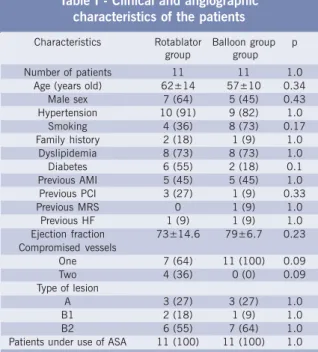
During an 18-months period, 22 patients, carriers of coronary artery disease (CAD) confirmed through coronariography at Hemodynamics Service of InCor -HCFMUSP, were selected. Their average age was 60±12.54 years old, being 12 of male sex. All of them showed clinical and angiographic indication for percutaneous treatment of a single large coronary lesion, to the extent of justifying the option for the use of adjuvant ablation techniques, such as rotational atherectcomy (rotablator). Through randomization, the patients were
AMI = acute myocardial infarction; PCI = percutaneous coronary in-ter-ven-tion; MRS = myocardial revascularization surgery; HF = hear t failure; ca-tegorical va-riables = number of patients (percentage); type of lesion = mor-phologic clas-sification of coronariographic stenosis by AHA/ACC (Task Force on As-sessment of Diagnostic and Therapeutic Cardiovascular Pro-ce-dures - 1988); continuous variables = mean ± standard deviation.
Table I - Clinical and angiographic characteristics of the patients
Characteristics Rotablator Balloon group p group group Number of patients 11 11 1.0
Age (years old) 62±14 57±10 0.34 Male sex 7 (64) 5 (45) 0.43 Hypertension 10 (91) 9 (82) 1.0
Smoking 4 (36) 8 (73) 0.17 Family history 2 (18) 1 (9) 1.0
Dyslipidemia 8 (73) 8 (73) 1.0 Diabetes 6 (55) 2 (18) 0.1 Previous AMI 5 (45) 5 (45) 1.0 Previous PCI 3 (27) 1 (9) 0.33 Previous MRS 0 1 (9) 1.0
Previous HF 1 (9) 1 (9) 1.0 Ejection fraction 73±14.6 79±6.7 0.23 Compromised vessels
One 7 (64) 11 (100) 0.09 Two 4 (36) 0 (0) 0.09 Type of lesion
divided in two groups according to the PCI used: 11 using the rotablator and 11 submitted to balloon pre-dilatation. The prevalence of clinical and angiographic characteristics in studied patients is in table I. All 22 patients were under use of acetylsalicylic acid, 200 mg/day, started at least a day before intervention. Ticlopidin, 500 mg/day, was initiated on the day of the intervention. All those medications were orally administrated. The other ones, also orally, were used in accordance to clinical indication: coronar y vasodilator, calcium channel blockers, angiotensin-converter enzyme inhibitors and beta-blockers. PCIs were performed through femoral percutaneous way with the insertion of 8F introducers, with a 10,000 U EV heparinization being instituted. Balloon pre-dilatation was performed with an approximated pressure of 6 atm and balloon/artery rate of 1/1. In atherectomy-submitted group, the rotational burr was displaced twice through the lesion at speeds from 160,000 to 180,000 rotations per minute, being used a solution containing verapamil, nitroglycerin, heparin and fisiologic solution before and after every burr rotation session. Samples for inflammatory markers concentrations measurements were collected 15 minutes after the end of pre-dilatation, either through rotablator
or through balloon, prior to stent implant, and stored in a freezer at -80º C, being simultaneously defrosted at the end of the study. Patients were selected by taking on account the presence of technically favorable anatomic characteristics of the artery to be treated, in a manner that times elapsed for pre-dilatation were very short with both techniques used. Samples were obtained in aorta root and coronary sinus before procedures (Ao1 and CS1) and 15 minutes after their use (Ao2 and CS2). For the analysis of inflammatory markers concentrations, we considered that measurements in aorta root were including released quantities in coronary flow and that, through reflow, would reach the arterial system. So, for the comparison of their concentration in pre and post-procedure situations, the values measured at aorta root and coronary sinus were calculated and respectively expressed by (Ao1+CS1)/2 and (Ao2+CS2)/2.
Cytokines TNF-a, IL-1 and IL-6 and soluble adhesion molecules ICAM-1, E-selectin and P-selectin were dosed through ELISA technique, Quantikine human - R&D system. In statistical analysis, the matching t-test of Student for statistical analysis of moments before and after the procedures, and the t-test of Student for independent samples in the comparison between rotablator- and balloon angioplasty-submitted groups were applied. Categorical variables were compared by using the exact test of Fisher. The significance level used in the tests was 5%. The 311/98 research protocol was approved at the Ethics Commission of Hospital das Clínicas da FMUSP.
R
ESULTS
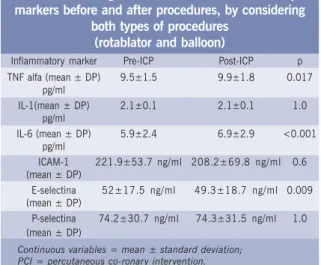
Concentrations of TNF-a and IL-6 (pg/ml) increased after PCIs, going respectively from 9.5±1.5 to 9.9±1.8 (p=0.017) and from 6.0±2.4 to 6.9±3.0 (p<0.001). Table II shows the concentrations of cytokines TNF-a, IL-1 and IL-6 and soluble adhesion molecules ICAM-IL-1, E-selectin and P-E-selectin in 22 patients, before and after PCIs.
There was no significant change in the expression of IL-1, ICAM-1 and P-selectin, by observing a decrease in concentrations of E-selectin (ng/ml) after the procedures (52.0±17.5 to 49.3±18.7; p=0.009), according to table II.
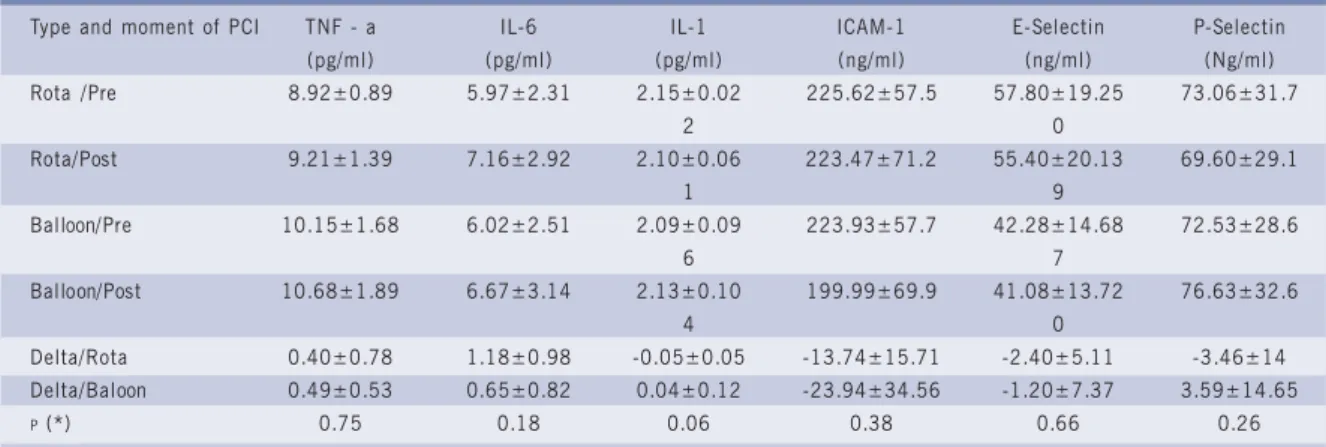
Data referring to IM concentrations, before and after PCIs in 22 patients, and their variations (deltas), were distributed in accordance to the type of procedure used (rotablator or balloon angioplasty) and displayed in table III. Comparative statistical analysis did not show
significant difference among variations (deltas) of cytokine and adhesion molecule concentrations released before and after rotablator-type interventions in relation to those determined by balloon pre-dilatation.
D
ISCUSSION
In the present study, we observed that percutaneous procedures determine increases of the mean concentrations of some inflammatory markers dosed in aorta root and coronary sinus, without significant differences when comparing their values variations (deltas), after the use of rotablator in relation to balloon angioplasty
High levels of soluble inflammatory markers have been found in ischemic syndrome carriers, when compared to normal controls. They have been correlated with a greater incidence risk of coronary events6,8. TNF-a values,
observed in patients in our study, showed similar Table II - Average concentrations of inflammatory markers before and after procedures, by considering
both types of procedures (rotablator and balloon)
Continuous variables = mean ± standard deviation; PCI = percutaneous co-ronary intervention.
Inflammatory marker Pre-ICP Post-ICP p TNF alfa (mean ± DP) 9.5±1.5 9.9±1.8 0.017
pg/ml
IL-1(mean ± DP) 2.1±0.1 2.1±0.1 1.0 pg/ml
IL-6 (mean ± DP) 5.9±2.4 6.9±2.9 <0.001 pg/ml
ICAM-1 221.9±53.7 ng/ml 208.2±69.8 ng/ml 0.6 (mean ± DP)
E-selectina 52±17.5 ng/ml 49.3±18.7 ng/ml 0.009 (mean ± DP)
concentrations to those found in CAD carriers in CARE study9, approximately 95% with values over 4.18 pg/ml.
Similarly, IL-6 concentrations, found in our research patients, were higher than 5.0 pg/ml, corresponding to findings by Liuzo et al.10, who studied CAD carriers
submitted to percutaneous coronary interventions. In both studies, the dosages of those markers were performed through an analogous methodology to the one used in our work (Quantikine human TNF-a, IL-6 R&D system). The increase in the expression of IMs determined through percutaneous coronary procedures has been reported by some authors11. Serrano et al12, using
sophisticated techniques, such as flow cytometry that allows for adhesion molecule quantification incorporated to cell membranes of white blood cells, investigated the neutrophil inflammatory activation during coronary angioplasty. The comparative analysis between samples obtained at aorta root and coronary sinus evinced an increase of the expression of adhesion molecules on
Table III - Concentrations of inflammatory markers, in accordance to the type of PCI used, in pre- and post-procedure situations
PCI = percutaneous coronary intervention; Rota = Rotablator; Balloon = balloon angioplasty; Delta = variation in concentrations; Continuous variables = mean ± standard deviation; p (*) referring to the comparison between Deltas (Rota x Balloon).
Type and moment of PCI TNF - a IL-6 IL-1 ICAM-1 E-Selectin P-Selectin (pg/ml) (pg/ml) (pg/ml) (ng/ml) (ng/ml) (Ng/ml) Rota /Pre 8.92±0.89 5.97±2.31 2.15±0.02 225.62±57.5 57.80±19.25 73.06±31.7
2 0
Rota/Post 9.21±1.39 7.16±2.92 2.10±0.06 223.47±71.2 55.40±20.13 69.60±29.1
1 9
Balloon/Pre 10.15±1.68 6.02±2.51 2.09±0.09 223.93±57.7 42.28±14.68 72.53±28.6
6 7
Balloon/Post 10.68±1.89 6.67±3.14 2.13±0.10 199.99±69.9 41.08±13.72 76.63±32.6
4 0
Delta/Rota 0.40±0.78 1.18±0.98 -0.05±0.05 -13.74±15.71 -2.40±5.11 -3.46±14 Delta/Baloon 0.49±0.53 0.65±0.82 0.04±0.12 -23.94±34.56 -1.20±7.37 3.59±14.65
P (*) 0.75 0.18 0.06 0.38 0.66 0.26
neutrophiles, which demonstrated induction of post-PCI inflammatory response.
Increments in the release of soluble adhesion molecules, detected by ELISA method, were observed during the performance of many types of PCI. It was observed that such procedures determined non-uniform changes in relation to several types of dosed markers, both in coronary sinus and in peripheral vessel. So, Siminiak et al.13,analyzing ICAM-1 and E-selectin soluble
adhesion molecules concentrations in coronary sinus and peripheral arteries of seven angioplasty-submitted patients, before and after the first balloon blowing, found a significant increase of ICAM-1 levels in the coronary sinus, but not in peripheral blood samples. Soluble E-selectin was unchangeable after the procedure. Different results were noted by Mulvihill et al14, studying ten patients
submitted to coronary angioplasty performed in anterior descending artery. Those authors did not find significant
differences in ICAM-1 and VCAM-1 concentrations from samples collected simultaneously in coronary sinus, left coronary ostium and femoral vein, immediately before PCI; soon after and 4 hours after the procedure. The main findings from this works were that ICAM-1, VCAM-1 and E-selectin concentrations in systemic flow were directly comparable to coronary flow concentrations in both stable and unstable coronary syndromes. The authors concluded that dosage performed in peripheral veins directly reflect the soluble adhesion molecule levels presents in coronary flow, legitimating the use of peripheral samples for monitoring and stratification of risk in both stable and unstable CAD situations.
In our study, we justify collections in central compartments because the patients have been studied prior to the publication by Mulvihill et al. The study carried out by those authors did not detect transcardiac gradient in serum levels of any soluble adhesion molecules analyzed before, during or after coronary angioplasty.
immediate release of soluble ICAM-1 in coronary sinus, due to an endothelial mechanical injury produced by the balloon, as opposed to E-selectin, which is not constitutively present in endothelial cells15. According to
those data, we believe that in the samples collected 15 minutes after the interventions, according to our study, a reduction in ICAM-1 concentrations could have already happened, which would result in the absence of significant procedure changes. The absence of significant post-procedure variations in P-selectin can be justified for being also about constitutive adhesion molecule of fast release and ephemeral life, with a possible return to basal values in samples collected 15 minutes after interventions.
Besides the different temporal courses of IMs, the lack of homogeneity in relation to the results obtained has been also attributed to the individual variation in inflammatory response against the same PCI stimulus. Some works show a genetically determined variability in the response of cytokine production by human monocytes after stimulation through endotoxin in vitro16. Such
understanding was consistent with the observations by Liuzo, which found hypersensitivity in monocyte response to the stimulus produced by the lipopolysacharide (LPS)
in vitro, in unstable angina carriers. In conformity with those experimental data, the same authors in clinical study verified that the trauma caused by balloon angioplasty was followed by greater increases in IL-6 concentrations among unstable angina carriers, when compared to stable coronary syndrome carriers, by attributing such difference as due to hyperresponsitivity of the formers against the same inflammatory stimulus of the procedure.
Another aspect to be considered as a determinant of a greater scope in inflammatory response after intervention, is about the presence of “more active” lesions containing infiltrates richer in lymphocytes and monocytes/ macrophages; greater amounts of oxidized LDL (which can activate the direct release of cytokines) and even of other reactive species, producing a greater quantity of cytokines in response to subliminal stimuli17.
In our study, the increase of TNF-a and IL-6 concen-trations after PCIs confirmed the literature data, being attributed especially to the immediate release stimulus of those cytokines present in atheroma plaques (particularly in macrophages), submitted to the maceration effect produced by interventions. The potential pro-inflammatory tardive stimulus associated to PCIs, resulting in additional cytokine increases, cannot be recorded considering the precociousness of sample collection. The finding of decrease in E-selectin levels at post-PCI condition did not correspond to findings by other authors17.
In accordance to observations by some authors such as Grossman et al18, the use of rotablator was associated
to the segmental dysfunction of left ventricular contraction much more lasting than that unleashed by balloon angioplasty. Such difference was attributed as being
consequent to embolizations from detached material from arterial wall, than to microcirculation spasm, microth-rombosis or, occasionally, to a greater stimulation of inflammatory process during the use of rotational burr. We did not note differences in relation to inflammatory markers concentrations when we compare the group of patients submitted to ablation through rotablator with those submitted to balloon angioplasty. Possibly, such result is consequent to the action mechanism of the peculiar instrument in the effect that ablation is restricted to the structure of atheroma plaque, with a minimum trauma to the arterial wall. As opposed to what occurs with the other atherectcomy techniques, which are based on the section and removal of plaque material (directional atherectcomy), or in section and sucking (atherectcomy through transluminal extraction catheter), rotational atherectomy (rotablator) is based on the plaque abrasion and pulverization. Through the physical principle of differential section, the instrument tends to selectively pulverize non-elastic tissues (in the case, atheroma plaque), whereas the elastic tissue (normal vessel wall) is repelled away from the burr in high rotation18. The
plaque is pulverized in particles from 20 to 50 micra of diameter, which surpass microcirculation and are further phagocytized in the liver, spleen and lungs. The use of cutting balloon, apparently more traumatic as well, determined less release of inflammatory markers than balloon angioplasty (Inoue et al.19). The authors attributed
such phenomenon to the reduction of circumferential stress when the resistance to balloon expansion is minimized by the small incisions caused by the cutting balloon blades. We opted to obtain blood samples for inflammatory markers dosages before stent implants, so we could compare the consequences from balloon dilatation to those from the use of rotational atherectomy.
In conclusion, in the early percutaneous coronary post-intervention period, an increase of intracoronary TNF-a and IL-6 concentrations and the absence of significant difference between the quantities of inflammatory markers released through rotablator and through balloon angioplasty were observed.
is similar, though, to that of studies with similar technology published in international literature12-14. We used rigid
catheters for collections in the coronary sinus, often deeply inserted, especially in cases of anterior interventricular
1. Ross R. Atherosclerosis - an inflammatory disease. N Engl J Med 1999; 340: 115-26.
2. Entman ML, Ballantyne CM. Inflammation in acute coronar y syndrome. Circulation 1993; 88: 800-803.
3. Libby P, Ross R. Cytokines and growth regulatory molecules. In: Fuster V, Ross R, Topol EJ. Eds. Atherosclerosis and Coronary Artery Disease. Vol. I. Philadelphia: Lippincott-Raven 1996: 585-94.
4. Ridker PM, Buring JE, Rifai N. Soluble P-selectin and the risk of future cardiovascular events. Circulation 2001; 103: 491-5.
5. Ridker PM, Hennekens CH, Roitman- Johnson B. Plasma concentration of soluble intercellular adhesion molecule 1 and risks of future myocardial infarction in apparently healthy men. Lancet 1998; 351: 88-92.
6. Ridker PM, Rifai N, Pfeffer M et al. Elevation of tumor necrosis factor (alpha) and increased risk of recurrent coronar y events after myocardial infarction. Circulation 2000; 101: 2149-53.
7. Rifai N, Joubran R, Yul H, Asmi M, Jouma M. Inflammatory markers in men with angiographically documented coronary heart disease. Clin Chem 1999; 45: 1967-73.
8. Deliar yris EN, Raymond RJ, Theoharides TC et al. Sites of Interleukin-6 Release in Patients with Acute Coronary Syndromes. Am J Cardiol 2000; 86: 913-18.
9. Ridker PM, Rifai N, Stampfer MJ et al. Plasma concentration of interleukin-6 and the risk of future myocardial infarction among apparently healthy men. Circulation 2000; 101: 1767-72.
10. Liuzzo G, Buffon A, Biasucci LM et al. Enhanced inflammatory response to coronary angioplasty in patients with severe unstable angina. Circulation 1998; 98: 2370-6.
R
EFERENCES
11. Kurz RW, Graf B, Gremmel F, Wurnig C, Stockenhuber F. Increased serum concentrations of adhesion molecules after coronary angioplasty. Clin Sci 1994; 87: 627-33.
12. Serrano CV, Ramires JAF, Arie S et al. Coronary angioplasty results leukocyte and platelet activation with the adhesion molecule expression. J Am Coll Cardiol 1997; 29: 1276-83.
13. Siminiak T, Dye JF, Egdell RM et al. The release of soluble adhesion molecules ICAM-1 and E-selectin after acute myocardial infarction and following coronary angioplasty. Intern J Cardiol 1997; 61: 113-18.
14. Mulvihill NT, Foley JF, Walsh MA, Crean PA. Relationship between intracoronary and peripheral expression of soluble cell adhesion molecules. Intern J Cardiol 2001; 77: 223-29.
15. Lefer AM. Role of selectins in myocardial ischemia-reperfusion injury. Ann Thorac Surg 1995; 60: 773-7.
16. Santamaria P, Gehrz RC, Bryan MK, Barbosa JJ. Involvement of class II MHC molecules in the LPS-induction of IL-1/TNF secretions by human monocytes. Quantitative differences at the polymorphic level. J Immunol 1989; 143: 913-22.
17. Liao W, Floren CH. Endotoxin, cytokines, and hyperlipidemia. Scand J Gastroenterol 1993; 28: 97-103.
18. Grossman W, Baim DS. Cardiac Catheterization, Angiography and Intervention. Fourth Edition. Philadelphia: Lea & Febinger Ed., 1991.
19. Inoue T, Sakai Y, Hoshi K, Yaguchi I et al. Lower expression of neutrophil adhesion molecule indicates less vessel wall injury and might explain lower restenosis rate after cutting balloon angioplasty. Circulation 1998; 97: 2511-18.