ARTICLE
Nucleoplasty as a therapeutic option for
lumbar disc degeneration related pain:
a retrospective study of 396 cases
Nucleoplastia como opção terapêutica para dor relacionada à degeneração do disco
lombar: um estudo retrospectivo de 396 casos
José Lourenço Kallás1,2, Bruno Loyola Godoy1, Cesar Fantezia Andraus1, Felipe Gonçalves de Carvalho1,
Maria Emilia Cosenza Andraus3
he management of the lumbar disc degeneration related pain is a common and yet controversial issue in the neuro-surgical practice. Since its irst description by Dandy1, at the
beginning of last century, the surgical strategies have contin-ued to improve, providing a myriad of diferent therapeutic options. Despite a faster relief of an acute attack by surgical discectomy compared with the conservative treatment, there
is no clear evidence in the literature of a long-term beneit2.
here is also a paucity of data showing consistent evidence of beneits with the many described minimally invasive tech-niques for disc herniation3.
he irst papers about percutaneous thermic discectomy were published in 19854 and the term nucleoplasty was
de-ined by Chen in 2003, using a patent required technology
1Neurosurgery Service, Hospital Universitário Clementino Fraga Filho, Universidade Federal do Rio de Janeiro (HUCFF/UFRJ), Rio de Janeiro RJ, Brazil; 2Master in Science Program in Surgical Sciences Student, UFRJ, Rio de Janeiro RJ, Brazil;
3Neurology Service, Santa Casa da Misericórdia do Rio de Janeiro; Permanent Professor of Strictu Sensu Postgraduation Program in Neurology, Universidade
Federal do Estado do Rio de Janeiro (UNIRIO), Rio de Janeiro RJ, Brazil.
Correspondence: José Lourenço Kallás; Rua Camaragibe 12; 20520-130 Rio de Janeiro RJ - Brasil; E-mail: [email protected]
Conflict of interest: This study was partially supported by Optika/Arthrocare® Corporation.
Received 04 April 2012; Received in final form 05 September 2012; Accepted 12 September 2012
ABSTRACT
Objectives: To make a retrospective analysis and evaluate a clinical response to the control of disc degeneration related pain of 396 patients submitted to percutaneous lumbar nucleoplasty; and to make a record of visual analogical scale (VAS) up to a three-year follow-up after the surgical procedure. Methods: Analysis of VAS score in 396 patients with lumbar disc degeneration related pain, according to anamnesis, clinical examination and magnetic resonance imaging (MRI), without improvement of previous clinical treatment, submitted to percutaneous nucleoplasty. Results: A total of 26% of the patients presented 100% remission of pain or paresthesia, of whom 75% showed at least 50% of pain improvement. The median VAS pain improvement was about 67%. Conclusions: The median VAS improvement in inferior disc levels was higher than four points. The VAS showed improvement of the pain and paresthesia up to a three-year follow up after the surgical procedure.
Key words: nucleoplasty, disc degeneration, lumbar disc herniation, thermic discectomy, radiculopathy, low back pain, percutaneous discectomy.
RESUMO
Objetivos: Analisar retrospectivamente a resposta clínica no controle da dor relacionada à degeneração discal em 396 pacientes submetidos à nucleoplastia percutânea lombar; e fazer um registro da escala analógica visual (EAV) com seguimento de três anos após a cirurgia. Mé-todos: Análise da EAV de 396 pacientes com diagnóstico de hérnia de disco, de acordo com anamnese, exame clínico e imagens por meio de ressonância magnética (RM), sendo que nenhum deles apresentou melhora com tratamento clínico prévio. Estes pacientes foram submeti-dos à nucleoplastia percutânea. O estudo utilizou, para avaliação, o registro de escala analógica visual (EAV) durante seguimento de até três anos após o procedimento cirúrgico. Resultados: Um total de 26% apresentou 100% de remissão da dor ou parestesia; 75% apresentaram pelo menos 50% de melhora da dor. A mediana da EAV de melhora da dor foi de aproximadamente 67%. Conclusões: Houve melhora da EAV, com mediana maior do que quatro pontos nos pacientes com acometimento nos níveis discais inferiores. A EAV mostrou melhora da dor e parestesia num período de seguimento de até três anos após o procedimento cirúrgico.
called Coblation (ArthroCare® – Sunnyvale, California, USA)5.
Al-Zain et al.6, in a prospective study with 69 patients,
pre-sented that 58% of them had an improvement of the radicu-lar pain for more than 50% after one year. Manchikanti et al.7
published a systematic review based on Cochrane Library criteria, showing a level II-III (multiple type series with or without intervention) evidence of beneit for mechanical lumbar percutaneous disc decompression for treatment of radicular pain.
his technology was approved for using in the USA by the Food and Drug Administration (FDA) and by the Agência Nacional de Vigilância Sanitária (ANVISA) in Brazil. It has been used by the neurosurgery authors since 2004, at the
Hospital Universitário Clementino Fraga Filho, Universidade Federal do Rio de Janeiro (HUCFF-UFRJ) and in the pri-vate practice, with satisfactory results and low incidence of complications.
his work intended to analyze retrospectively a total of 396 cases submitted to percutaneous lumbar nucleoplasty with Coblation Technology (ArthroCare® – Sunnyvale, CA, USA), showing the procedure efects in the control of lumbar disc herniation related pain.
METHODS
We performed a retrospective analysis of 396 patients, with lumbar disc herniation related pain, and no improve-ment after previous conservative clinical treatimprove-ment. All of them were submitted to percutaneous nucleoplasty, per-formed from August 2004 to February 2008.
he patients were included when they presented pain with clinical-radiological correlation; magnetic resonance imaging (MRI) showed disc protrusions or contained hernia; at least 2/3 of intervertebral space height preservation; and previous treatment with short rest period, pain medications and motor physiotherapy, without satisfactory improvement.
Cases were excluded: in the presence of obvious disc frag-ment sequestration (with or without longitudinal migration); loss of more than 1/3 of the intervertebral space height; dif-fuse or multilevel degenerative disc changes on imaging ex-ams; no signs of radicular involvement or axial pain associat-ed with the degeneratassociat-ed level; patients previously diagnosassociat-ed or with antecedents of psychological and/or psychiatric dis-orders, or in cases of its suspicion by the history; uncontrolled systemic diseases, as well as active infection or neoplasm.
Surgical technique
he procedures were performed in the operation room (OR) with continuous heart and respiratory monitoring, peripheral venous access punctured by an anesthesia staf member familiar with that surgical routine. All patients were previously informed that they would need to be awake dur-ing the procedure and kept in the same position. hey were
prepared in the prone position, without cushioning, except for some hyperlordotic cases, where cushions were used to augment the entry space.
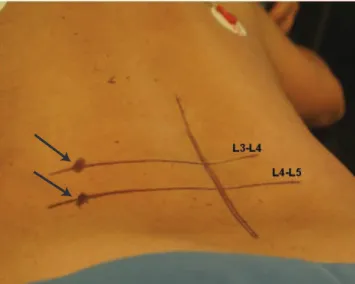
After monitoring and positioning, the access point of the disc was marked on the skin, using the safe triangular work-ing zone, as well as the middle line and those of projection of the intervertebral spaces targeted forming an orthogonal angle. he radioscopy device was used for that purpose. he triangular safety zone for lumbar disc access is shaped like a rectangle triangle, limited by the facet articulations, the su-perior plateau of the inferior vertebrae, and the lateral pro-jection of the nerve root. Lateral incidence images of the lum-bar spine were made for measuring the distance between the lumbar supericial limit and the geometric center of the disc. his distance was then plotted in the horizontal disc line irst marked, laterally from the middle line, providing the ex-act point of the needle entrance in the skin. he special disc puncture needle (Arthrocare® – Sunnyvale, CA, USA) pene-trated the skin and the subcutaneous tissue at a 45º target-ing the disc space (Fig 1). he progression of the access was guided by radioscopy in the posteroanterior and lateral in-cidences, and alternated with local anesthesia of the tissues with lidocaine 2% (without vasoconstrictors). Multiple X-ray incidences were necessary for providing safety in the needle guidance in order to avoid the main vessels, neural roots, and spinal dura mater.
With the tip of the needle at the center of the disc, the in-ner guide wired was retrieved, the inin-ner radiofrequency de-livering needle was inserted, and its position was checked (Fig 2). he irst incursion was then executed, 1 cm in length in the ablation function, intensity 1, followed by a corre-spondent 1 cm withdrawal of the needle, in the coagula-tion funccoagula-tion (each one taking in 12 seconds). If the patient complained about pain or paresthesias, the needle was re-positioned to a more central point of the disc. Otherwise, the
protruded in the older group, while disc L5/S1 was more pro-truded in the younger one (under 45 years-old).
he analysis of the distribution of the VAS scores accord-ing to the age group and disc levels showed that there was signiicant diference only in the discs L2/3 and L4/5.
Among all the patients, 26% presented a 100% (complete) pain remission or paresthesia; 13% had a 90% pain improve-ment; 15% had an 80% pain improveimprove-ment; and 75% showed at least 50% of pain improvement in the VAS. he median pain improvement was about 67% according to the VAS scores.
here was an incidence of 2% of morbid complications. All bradycardia episodes were related to poor tolerance to minor pain by the patients. here were no complications re-lated to toxic side efects of local anesthetics. he one convul-sive episode occurred as a consequence of prolonged pain-induced bradycardia in a patient receiving dexmedetomidine as sedative, which led us to avoid any bradycardia induc-ing sedatives for this procedure. A total of 25 (6%) patients had no improvements with the treatment. If we also consider ‘no improvement’ as a type of complication, this provides us an 8% complication rate (Table), which we consider accept-able, and it proves that nucleoplasty is quite a safe procedure when performed by an experienced surgeon, with the anes-thesiologist giving sedation on an on-demand basis.
Table. Complications related to the procedure (396 patients).
Complications Patients Incidence (%)
Radicular paresthesia 02 0.50
Bradycardia 04 1.00
Discitis 01 0.25
Worsening of pain 01 0.25
Convulsive crisis 01 0.25
No improvement after the procedure 25 6.30
Fig 2. Needle placed at the center of intervertebral L4-L5 disc, anteroposterior incidence.
procedure went on, by repeating six incursions with the same methodology, and only this time in intensity 2.
As the radiofrequency needle was pulled out, about 0.5 mL (20 mg) of methylprednisolone succinate was admin-istered to the periradicular foraminal area of that level, ac-cording to preconized standard techniques8.
Once the nucleoplasty was inished, the patient was sent to his/her room to remain in bed rest, with local cold com-presses for about 20 minutes in three-hour breaks, with con-stipation prevention diet and hospital discharge scheduled for the next 12 hours.
Data collection and statistical analysis
The clinical results were measured by the visual ana-logical scale (VAS), first on treatment day 1, and then regu-larly up to a 36-month follow-up, with an average of a one-year follow-up. Statistical analysis was carried out with the Statistical Package for Social Sciences (SPSS) software, version 13.0.
Exploratory analysis used frequencies of categorical vari-ables (age group and disc level) and measures (mean, median, and interquartile range) to describe the continuous variable (VAS). In the association analysis between the diferent disc levels and the age groups (over or under 45 years-old), the ex-act test of Fisher was used. he existence of diference in the post-treatment VAS scores between each disc level and age group was veriied by the nonparametric Mann-Whitney’s test. he use of a nonparametric test had been indicated be-fore by the Kolmogorov-Smirnov test, which rejected the hy-pothesis of normality in the VAS scores. he p-values lower than 0.05 indicated statistical signiicance in those tests.
his study was approved by the Ethic Committee Research of the hospital and all patients included signed an informed consent term.
RESULTS
he statistical analysis showed that the most frequent af-fected level was L4-L5, followed by L5-S1, and then the asso-ciation L4-L5/L5-S1. he levels L3-L4, L2-L3 and L1-L2 had very low frequency. he best clinical results also came from L4-L5 level. here was no clear relation between age and clin-ical beneit, as well as the measurement time.
he age distribution among the patients was symmetric: mean age of 45 to 87 years-old, median age of 46, and range of 17 to 79 years-old. All of the 396 patients included answered the post-treatment VAS questionnaire, and the distribu-tion was asymmetric and non-normal, with a mean of 21.29 points, a median of 10 points, and an interquartile range from 0 to 30 points.
1. Dandy WE. Loose cartilage from intervertebral disk simulating tumor of spinal cord. Arch Surg 1929;19:660-672.
2. Gibson JN, Waddell G. Surgical interventions for lumbar disc prolapse. Cochrane Database Syst Rev 2007;CD001350.
3. Mixter WJ, Barr JS. Rupture of intervertebral disc with involvement of the spinal canal. N Engl J Med 1934;211:210-215.
4. Ascher PW. Status quo and horizons of laser therapy in neurosurgery. Lasers Surg Medical 1985;5:499-506.
5. Chen YC, Lee SH, Chen D. Intradiscal pressure study of percutaneous disc decompression with nucleoplasty in human cadavers. Spine 2003;28:661-665.
6. Al-Zain F, Lemcke J, Killeen T, Meier U, Eisenschenk A. Minimally
References
DISCUSSION
Lumbar disc diseases (prolapse, protrusion, or extru-sion) account for less than 5% of all low back complains, however they are the most common causes of nerve root pain and surgical interventions7. Although the standard
treatment for lumbar disc herniation is lumbar microdis-cetomy, percutaneous nucleoplasty ofers a relatively new technique with encouraging results in well-selected cases, especially if the conservative treatments have failed and the patients are not considered good candidates for open sur-gery9. his procedure is minimally invasive and manages
in-tradiscal herniation through energy-based removal of part of the nucleus pulposus6,9-17.
Few medical or surgical procedures show such a high number of papers with good clinical results as the micro-discectomy for the lumbar disc herniation, which one can describe as the total or partial removal of the intervertebral disc by open microscopic surgery technique10. Some
au-thors had already shown that patients treated with partial disc removal present the same, if not better, clinical pain im-provement compared with total disc removal6. It seems that
the intradiscal pressure variations in patients with lumbar degenerative disc disease have a close relation with lumbar nociceptive pain by the activation of annular nociceptors, which is similar to the radicular pain caused by root direct compression against neural foramen due to annulus ibro-sus insuiciency. he best results were achieved in the in-ferior lumbar levels, for they bear more weight than the su-perior ones, with a median improvement of more than four points in the VAS scores.
Percutaneous nucleoplasty complications are directly re-lated to puncture of the disc, the surgeon’s expertise as well as to the aseptic procedures care. Infection of the disc can occur, but that can be prevented when the procedure is car-ried out in a fully equipped surgical room with all the rou-tine care taken for a regular surgery. Lesions of neural and vascular structures are quite rare, but they can also happen. Accidental nerve root lesion or puncture is frequently asso-ciated with a relex increase in the vagal tonus, which may cause profound bradycardia and even asystole. Extreme care should be taken with the needle introduction, which should always be slowly and with the patient frequently being asked about any diferent symptoms arising. Intradural lesions are
possible if the needle crosses the middle line. here is a risk of abdominal vascular injury if the needle is positioned beyond the limit of the vertebral disc. In order to prevent that, con-tinuous luoroscopy is mandatory.
Bleeding and infection can follow the introduction of the cannula18. he most common complications reported by
Bhagia et al.19 at the procedure after 24 hours in 49 patients
were: soreness at the needle insertion site in 76%; new numb-ness in 26%; increased intensity of pre-procedure back pain in 15% and new areas of back pain in 15% of the patients. At two weeks post-procedure, no patient had soreness at the needle insertion site nor new areas of back pain, but new numbness was present in 15% of the patients. Two patients (4%) had increased intensity of the back pain. Many of these complications may be remitted with anti-inlammatory med-ication20. Anesthetic complications are mainly related to the
act of sedating the patient in prone position, which may re-sult in hypoxemia (especially in the obese) and agitation20. It
is also important to monitor toxic efects of local anesthetics, respecting the anesthetic dosage limit for each patient. Many of our patients do not receive any sedation, and we generous-ly iniltrate the entire needle route with 1% lidocaine.
he high and growing prevalence of lumbar degenerative disc disease in modern society brings the need for fast, safe, minimally invasive, eicient, and low cost treatment proce-dures, like nucleoplasty has proved to be15,17. he advantages
of this method include percutaneous access, local anesthesia and intravenous sedation, reducing surgery time and avoid-ing the epidural scarravoid-ing risk20. his procedure can be
repeat-ed at the same level or at adjacent levels and it does not con-traindicate the open surgery if it will be considered20.
he authors conclude, from this retrospective analysis of 396 cases, that radiofrequency percutaneous nucleoplasty may be a safe and eicient therapeutic option for patients with leg and lumbar pains, after a conservative treatment ( for a period not inferior to 30 days) has failed. he median VAS improvement in inferior disc levels was higher than four points. he VAS showed improvement of the pain and pares-thesia in these studied patients, up to a three-year follow-up after the surgical procedure.
invasive spinal surgery using nucleoplasty: a 1-year follow-up study. Acta Neurochir 2008;150:1257-1262.
7. Manchikanti L, Derby R, Benyamin RM, Helm S, Hirsch JA. A systematic review of mechanical lumbar disc decompression with nucleoplasty. Pain Physician 2009;12:561-572.
8. Gerszten PC, Smuck M, Rathmell JP, et al. Plasma disc decompression compared with fluoroscopy-guided transforaminal epidural steroid injections for symptomatic contained lumbar disc herniation: a prospective, randomized, controlled trial. J Neurosurg Spine 2010;12:357-371.
9. Azzazi A, Almekawi S, Zein M. Lumbar disc nucleoplasty using coblation technology: clinical outcome. J Neurointerv Surg 2011;3:288-292.
10. Yasargil MG. Microsurgical operations for herniated lumbar disc. Adv Neurosurg 1977;4:81-82.
11. Karaman H, Tufek A, Kavak OG, et al. Effectiveness of nucleoplasty applied for chronic radicular pain. Med Sci Monit 2011; 17:461-466.
12. Gerges FJ, Lipsitz SR, Nedeljkovic SS. A systematic review on the effectiveness of the nucleoplasty procedure for discogenic pain. Pain Physician 2010;13:117-132.
13. Masala S, Massari F, Fabiano S, et al. Nucleoplasty in the treatment
of lumbar diskogenic back pain: one year follow-up. Cardiovasc Intervent Radiol 2007;30:426-432.
14. Sharps LS, Isaac Z. Percutaneous disc decompression using nucleoplasty. Pain Physician 2002;5:121-126.
15. Caspar W, Campbell B, Barbier DD, Kretschemmer R, Gotfried Y. The Caspar microsurgical discectomy and comparison with a conventional standard lumbar disc procedure. Neurosurgery 1991;28:78-87.
16. Singh V, Piryani C, Liao K, Nieschulz S. Percutaneous disc decompression using coblation (nucleoplasty) in the treatment of chronic discogenic pain. Pain Physician 2002;5:250-259.
17. Sinan T, Sheikh M, Buric J, Dashti K, Al-Mukhaimi A. Percutaneous coblation nucleoplasty in patients with contained lumbar disc prolapse: 1 year follow-up in a prospective case series. Acta Neurochir l 2010;108:S107-S112.
18. Rathmell JP, Saal JS, Saal J. Discography, IDET, percutaneous discectomy, and nucleoplasty: complications and their prevention. Pain Medicine 2008;9:S73-S81.
19. Bhagia S, Slipman CW, Nirschl M, et al. Side effects and complications after percutaneous disc decompression using coblation technology. Am J Phys Med Rehabil 2006;85:6-13.