TEM Journal, 4(4):358-365, 2015.
Blended Learning Possibilities in Enhancing
Education, Training and Development in
Developing Countries:
A Case Study in Graphic Design Courses
Hanan Atef
1and Mervat Medhat
21
Emirates College of Technology, UAE
2Art and Design Academy, Higher Institute of Applied Arts,Egypt
Abstract - Blended learning is not a new concept; recently, there has been a renewed focus on this learning strategy, both in the education and corporate sectors. Although the definition of blended learning is somewhat inchoate, it is generally described as an environment that includes the use of different modes of teaching and learning. Blended learning holds particular promise for developing countries because it can make availability of resources, regional, and international educational institutions. The perspective we adopt in this paper, where we aim to take a realistic look at the potential of blended learning in developing countries, giving consideration to the various possibilities and most importantly, to the accessibility of technology both today and in the future.
Keywords- Blended learning, Studio based learning, Developing countries, virtual classroom, traditional education.
1. Introduction
Distance education has long been solidly established in most of urban countries, and e-learning initiatives have been appearing for more than a decade. In developing countries, although projects are fewer, there have been some landmark accomplishments in distance education. In particular, in the most populous countries, such as China and India, education managers have long been aware of the multiplier effects arising from the possibility of reaching learners through various media: the written word, radio, television, and the Internet. In developing countries, there are lots of problems to apply blended learning such as: Internet access is limited and browsing the Web a bit mysterious for some, this showcase of global knowledge appeals to people even in the most remote villages of Africa. For many educators and trainers, “a blended learning” approach provides innovative educational solutions through an effective mix of traditional classroom teaching with mobile learning and online
activities. The idea of providing instruction through a screenrather than through face-to-face interactions with a teacher is not a new one. In the 1950s and 1960s this medium was used in public schools as part of the curriculum, especially in the social and physical sciences [1].Early computer-based training was more interactive, and used a technique of “drill and practice” to communicate its content to users. The next step in the progression came in the form of internet-based training, which began its rise in the 1990s. There exist many different definitions of the term “blended learning.” According to Staker and Horn (2012) [2], blended learning has the following components: (1) it involves teaching and learning within a formal education program. (2) Students learn at least in part through online delivery of content and instruction. (3) Students have some level of control over time, place, path, and/or pace of instruction. (4) Part or all of instruction is delivered away from home in a supervised location. Gardiner (1994, 1998) insists that the need for classroom change to allow students to acquire more significant kinds of cognitive learning or critical thinking skills. He argued that if we add new vision to a university education as education in the conduct and strategy of inquiry itself, then the university becomes society’s unique site where students learn how to think, learn, produce, and evaluate knowledge [3].Blended learning is an important building block of the new universities that offers students both flexibility and convenience. According to Colis and Moonen (2001), blended learning is a mix of traditional face-to-face and online learning so that instruction occurs both in the classroom and online, and where the online component becomes a natural extension of traditional classroom learning [4].
weekly online assessments and synchronous chat, asynchronous discussions, e-mail, and a final face-to-face meeting with a proctored final examination [5].
2. What is Blended Learning?
The recent literature review exhibits two trends in blended learning definitions and research: (1) educational-focus and (2) technological-focus: Many view described, “blended learning” as a way of preparing students for the 21st century workplace, which is increasingly based on information and services. Students in this case are generally more active and interactive learners than students who take online courses, because they communicate more readily among themselves, with their instructors, and with outside resources. Also, “Blended learning” has the potential to be more economical than traditional face-to-face learning, as it requires fewer teachers’ load to supervise students. “Blended learning” is likely to become far more common than face-to-face learning or online learning alone.Singh and Reed (2001) define blended learning as learning using a variety of instructional modalities [6]. In 2006 Maise maintains, “it is the use of two or more styles of content or context delivery or discovery” [7]. Ross and Cage (2006) view blended learning as a “spectrum of learning modes that range from the traditional face to face classrooms to fully online degree programs” [8]. Adapting the same opinion, Verkroost et al (2008) define blended learning as the total mix of pedagogical methods, using a combination of different learning strategies with or without technology [9]. More commonly definitions of blended learning suggest that the feature of blended learning is the combination of face-to-face teaching and technologies. Although the general term “technologies” used in some definitions refers to the online learning.
In some definitions focusing on the online
technology and face-to-face, Garnham&Kaleta, (2002) defined blended learning according to the proportion of learning activities that have been moved online rather than in the classroom, reducing but not eliminating classroom time [10]. Blended learning is a method that has proven to be not only effective in terms of learning outcomes, but ranks high on ratings of satisfaction with students and instructors [11]. Allen and Seaman (2007) identify blended courses and programs as having between 30-79% of content delivered online. 80%+ online content is categorized as online, 1-29% online content is categorized as web-facilitated [12]. Blended learning is realized in teaching and learning environments where there is an effective integration of different modes of delivery, models of teachingand styles of learning as a result of adopting a strategic and systematic approach to the use of technology combined with the best features of face- to- face interaction [13].
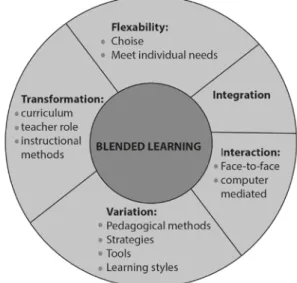
There are many definitions of blended learning, in this paper we define blended learning as structured opportunities to learn, which use more than one learning or training method, inside or outside the classroom. This will includes different learning methods (lecture, discussion, guided practice, reading, games, case study, simulation), different delivery methods (live classroom or computer mediated), different scheduling (synchronous or asynchronous) and different levels of guidance (individual, instructor or expert led, or group/social learning). Blended learning offers the potential to create effective training, to save time and money for the Institute, to make training more engaging and convenient for learners, and to offer learning professionals the chance to innovate.
Figure 1.Key pedagogical ideas associated with the blended learning definitions
3. Blended Learning modes
TEM Journal, 4(4):358-365, 2015.
In all blended learning courses it is required that the instructors approach their role as guides and mentors as opposed to a purveyor of information [14]. In Blended learning students are more responsible for their own education than traditional students. “Blended learning extends teaching and learning beyond the classroom walls, developing critical thinking, problem solving, communication, collaboration and global awareness” [15].Blended learning covers a wide range of activities between traditional face-to- face interactions and those that are fully online. Griffith’s university identifies three modes of Blended Learning to indicate the level of use of technology in learning and teaching. In graphic design courses we aim to achieve these three modesas we described in the following Table 1.
Table 1.The modes of blended learning
Mode (1)
Technology is used to facilitate course management and resources for learner support. For example, to provide information and resources to students through our college Moodle web site.
Mode (2)
Technology is used to enrich the quality of the student learning experience through interactive learning activities like: face-to-face classroom interactions, collaboration, online assessment and case study.
Mode (3)
Technology is used to support learning that is largely self-directed but also involves the use of interactive and collaborative learning activities. In this mode courses are delivered fully online.
Benefits of blended learning includes the following [16]:
• Blended learning allows teaching to continue when schools / university close.
• Students become active learners. They can communicate their needs and interests to their teachers to become more successful. • Blended learning can mitigate the negative
effect of poorly designed online programs with high quality instructor-led sessions.
• In-class settings have proven to be more
effective for building and maintaining the relationships that underlie success in the process of reflection.
4. How to design blended course
Blended learning is a powerful strategy for many reasons. If well designed, it addresses more learning style requirements, a wider audience and increased performance or learning results.
Graphic design teaching environment builds most on a foundation of project-based learning using
problem-based learning. Designing blended course in graphic design engaged students in Small group problem based learning activities, also the course was managed more effectively and efficiently within a large class by using an online collaborative workspace, allowing for greater transparency in group work assessment as well as providing an archive of resources for current and future students. This section will provide guidance for staff in the process of in Designing, developing, implementing and evaluating for blended learning in university courses and curricula. Designing for blended learning requires a systematic approach, starting with: 1. Planning for integrating blended learning into your course. 2. Designing and developing the blended learning elements. 3. Implementing the blended learning design. 4. Reviewing (evaluating) the effectiveness of your blended learning design [17].
4.1. Planning
4.2. Designing and developing
Before designing the blended learning components, you have to review some general design principles in which you can integrate blended learning experiences in your course: Course learning objectives, teaching and learning activities that need to directly support student’s achievement of the stated learning objectives, and the assessment tasks need to be in alignment with the activities and the objectives, all of them need to allow students to demonstrate those learning objectives. This is called “constructive alignment” [19]. During the work it is helpful to use the a constructive alignment approach and creating a course map or plan that shows the elements of the course in relationship to one another and shows how each element works together to support student achievement of particular learning outcomes.
Elements of course design:Course curricula are often conceived in relation to the following major components: content and resources, student activity and collaboration, assessment, course communication and course administration. In general here are some guidelines helping in applying these elements of course design [17]:
• When putting lecture materials online we must consider the File size and image compression; Timing and release of materials; printing costs; Format and purpose of materials.
• Whatever blended learning elements, it is important that they are integrated into the whole course experience for example:Recording lectures may encourage students to not attend class and only view the recordings instead. However, viewing or listening to a recorded lecture takes as much or more time as live recording lectures. Thenthe instructor can provide online discussion to be sure that learning was a cured.
• Virtual Classrooms are really useful, it is a real time, online classroom environment that sharing applications and documents to present content such as a PowerPoint presentation to a live audience. Itfacilitates off-campus students in building a sense of community through live interaction also effective in providing additional access to teachers (and other students) in blended courses.
• Providesthe course Documents with journal articles, book chapters, tutorial guides, and work booklets now in Digitizing format as
aPDF or animated power point and made accessible online to provide timely and ongoing access for students.
• There are many existing online resources we can include as adjunct to the core course materials or integrate them as part of the official curriculum as tutorial-type. By using these resources the instructor can save considerable development time and effort and can quickly provide students with additional learning resources that they can access at any time activities can be accessed at the College/ UniversityMoodle learning system.
• When students go beyond the passive tasks of listening, reading or viewing. Active engagement can be facilitated through additional individual as well as collaborative activity like Class discussion, small group work and collaborative learning.
• Before deciding on a particular collaborative activity tool/application, it is important to define the purpose for the activity.Here isan overview of some of the commonly used tools for designing student activity: Wiki, blogs, Discussion forum, E-portfolio, Online quizzes,surveys and In-class quizzes and polling.
• The level of learning that students achieve is often dependent on the type of activities and assessment tasks, following Bloom’s Taxonomy in this step is very useful, it is a hierarchical classification of the different objectives for students. Bloom taxonomy revision includes suggestions for tasks that can be used to support particular objectives [20].
• Blended Learning technologies also support the management of the assessment process (submission, grading, and feedback). To monitor student progress frequently and more easily (e.g., online quizzes, individual or group contributions to a discussion forum or wiki).
TEM Journal, 4(4):358-365, 2015.
The impact of online communicating regularly with students can be far greater than what we can imagine. It can create a sense of care and community within the course but first make sure the students are aware of and understand their roles and responsibilities and the expectations that you have of them.Working in a blended learning environment can offer a range of strategies and tools to support the
efficient and effective management and
administration of a course, suchas managing Course site, organization and graphical design, Managing your students to Keeping students on track, Managing assessments and grading, and Managing providing assessments feedback.
4.3. Implementing
When implementingthe blended learning course the instructor should get his students ready for blended learning by creating an opportunity for students and staff to come together as a group in Course orientation during the first face-to-face or online session) to provide guidelines and tips on how to use the online course technology the purpose and expectations of the course.
4.4. Reviewing (evaluating)
Evaluation step not necessary to wait until the very end of a course, lecturer should collect feedback for continuous improvement throughout the course at different points to conduct an evaluation and obtain feedback from students. Evaluating in the blended learning environment entails the same basic elements of a course, because of “blend” and the use of technology, these will present an additional range of issues to gather data about. In Herrington et. al. study (2001) he creates a model of evaluation for online learning and teaching which is based around three main areas [21]: Pedagogies - the learning activities which underpin the unit;Resources - the content and information which are provided for the learners; andDelivery strategies - issues associated with the ways in which the course is delivered to the learnerssuch as accessibility, usability, consistency, and integration, as well as information relating to good pedagogical practices.
5. Blended learning in developing countries
The term Blended Learning has many definitions. According to Larry Ragan of Rice University’s Blended Learning is “the planned integration of online and face-to-face instructional approaches in a way that maximizes the positive features of each respective delivery mode.” The goal is to build from each approach “to create an innovative and effective
learning experience for students” [22]. In this case, theinstructor employs online multimedia teaching objects to improve his/her teaching effectiveness and efficiency. Now the instructorsare using traditional teaching objects that constitute the backbone of class activities, then “plays” the technology-enabled teaching objects and assesses students’ understanding via a range of online and in-class activities or exercises. Blended Learning can offer the potential of courses or training through the wise choice of the blend, Blended Learning mix the strengths of current in-class teachers; demonstrate great variety in how the face-to-face ratio to online time is distributed. For example, in some courses instructors might choose to replace one class per week with online assignments or virtual class. Others might meet with their students in class for several weeks and then turn to virtual class for several weeks as the students work independently or in teams on online assignments.
The most effective way to make it accessible and valuable for high school and university teachers and students in developing countries is to keep it “as simple as possible”. This is true from a technological perspective as discussed above, but maybe valid from a pedagogical perspective. Most teachers and studentsin developing countries have been educated in a didactic manner and will not necessarily understand the new role of instructor as “facilitator” in e-learning education, rather than as a “teacher” in the traditional sense. Therefore, the important here is that going online will help both teachers and students to overcome fears about computers and develop a range of new skills. All available literature on Blended Learning emphasizes the importance of integrating the online material with the teaching goals of a classroom subject. Regarding this, the teacher’s guide for each module will outline what classroom content should be covered ahead of time, in order for the module to be most effective as a teaching tool.
6. Further Benefits of Blended Learning in developing countries
colleges. Flexible study time with learning anytime or anywhere, to meet learners’ needs wherever they want.
In addition, the Sharpe et al. (2006) study found that some universities see other benefits of blended learning, notably [24]:
• The ability to support operating in a global context.
• Offering greater efficiencies, especially with increased student numbers/group sizes.
• The support it can offer to
professional/work-based skills development.
7. Methodology
Apply blended learning in graphic design
course:in this paper we aim to examine our
experiment in designing a blended course for graphic design diploma in the United Arab Emirates. This course consists of theatrical and practical parts. As our respondents are experimenting with blended solutions and learning by trial and error, there’s a need to share best practice so as to accelerate the development of graphic design lecturer expertise in blended learning.
Survey Results
1) How is blended learning used in graphic
course? In the first part of our survey we looked
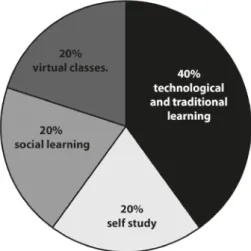
at how our responders are using blended learning in the selected graphic course: 40% combine technological and traditional learning methods in class room, 20% self study, 20% are social learning and 20% virtual classes.
Figure 2.Blended learning solution includes
2) What factors influenced the choice of learning methods to include in a blend course our respondents drew on a wide range of factors: As shown in the figure below, our respondents have to take into account a wide range of factors, the most popular factor was ‘how the methods will apply to accomplish the learning objectives’ (average rating of 4 out of 5); second was the organization factors such as resources to support the learning methods (average rating of 4 out of 5). Third is the Communication between learners (average rating of 3 out of 5); and finally the geographical spread of learner population (average rating of 3 out of 5).
Figure 3.Factors influenced the choice of learning methods
3) How student evaluate the different methods in blended course: According to our respondents, the average is different between male and female students, as illustrated in bellow figure.
Figure 4.How student evaluate the different methods in blended course
4) The benefits to be gained from blended learning in graphic studio: Our respondents’ views that blended solutions will increasingly be common in the future, and we can apply to many
0% 50% 100%
learning objectives’ organization
factors Communication
geographical spread
rarely frequently
0% 50% 100%
face-to-face virtual self-study discussion and
wiki
female
TEM Journal, 4(4):358-365, 2015.
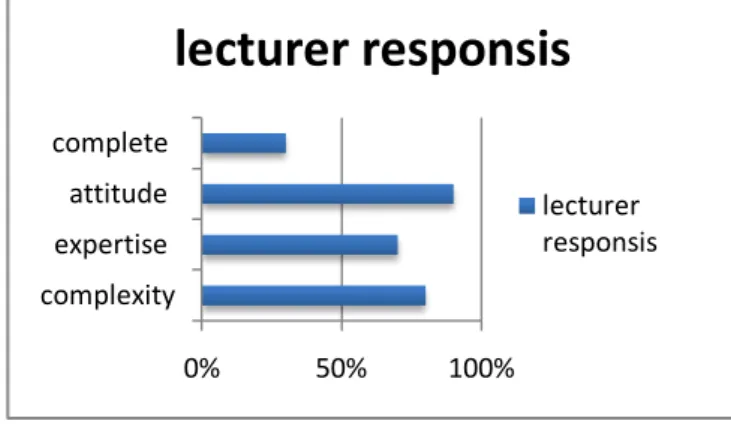
courses according to the structures, our respondents identify the key challenges that they face in development and implementing blended solutions in graphic course:
a) The time and complexity of designing and development a blend course were key factors 80%
b) Lack of internal expertise and cost 70% c) The attitude of learners to blended solutions
90% and concern that learners won’t complete the learning 30%.
Figure 5. The benefits from blended learning in graphic studio
8. Conclusions
The concept of blended learning has been used for some time and really builds on the good practice of blending teaching and learning styles for the benefit of the learner. Instructors who adopt a variety of teaching styles are more likely to offer their learners a more rewarding and successful educational experience. This is what happens when e-learning and online learning is added to the mix, as it would be for integration of practical work in graphic design students and industrial visits. The use of new technologies can be maximized when you see how best to blend E-learning with existing programs to the benefit of learners.Blended learning is a valuable tool to have at our disposal when building and delivering our educational programs and we should be using it wherever appropriate to enhance our provision and offer tailored learning to meet the needs of our learners.
In our research appears to show that most of instructors have accepted that the learning these days needs to encompass a wide range of learning methods, the survey identified four key conclusions: First, Blended learning solutions are an important part of the learning & development plan, with the most of our respondents combining technological and
traditional learning methods frequently or sometimes. Combining more than one learning method in one class is no longer unusual. Second, In designing a blend course we take into account both learning objectives and university drivers which is the most common factor used in selecting learning methods to include in a blend is “appropriateness in meeting learning objectives”, other key factors are linked to university drivers such as “company infrastructure & resources to support learning methods” and factors such as speed to reach all your learners, time to deliver and geographical dispersal of the learner population.Third, our Blended courses are currently being designed using the well-established learning methods such as face-to-face training, self-paced E-learning and E-learning resources – and virtual classes. However, our respondents expect face-to-face training to reduce, and that there will be a significant increase in virtual classrooms and social learning. Fours, There are some challenges facing those wanting to introduce blended solutions in developing countries, particularly in dealing with the complexity of blended solutions and lack of internal expertise, on a positive note, our respondents are less worried about the attitudes of learners to blended solutions.
One challenge for the future is to see how we can work with learners to add the growing use of social tools and technologies into our blend courses, so that we can incorporate, for example, smart phones into our teaching and learning mix. However, the question might be, ‘will our students let us’, as these technologies are very personal to the individual and many students don’t want work mixed with leisure/pleasure.
References
[1].Mackay, Stephen and Gary J. Stockport. “Blended Learning, Classroom and E-Learning.” Business Review, Cambridge, 5:1, September 2006.
[2].Stalker, H., & Horn, M. B. (2012). Classifying K–12 blended learning. Mountain View, CA: Innosight Institute, Inc.
[3].Gardiner, L. (1994). Redesigning higher education: Producing dramatic gains in student learning. ASHE-ERIC Higher Education Report 7. Washington, DC.: George Washington University.
[4].Colis, B., and Moonen, J. (2001). Flexible learning in a digital world: Experiences and expectations. London: Kogan-Page.
[5].Martyn, M. (2003). The Hybrid Online Model: Good practice. Educause Quarterly, 1, 18 – 23.
[6].Singh, H., & Reed, C. (2001). A White Paper; Achieving success with blended learning. ASTD State of the Industry Report, American Society for Training and Development. Retrieved October 2, 2010,
0% 50% 100%
complexity expertise attitude complete
lecturer responsis
fromhttp://www.chriscollieassociates.com/BlendedLe arning.pdf
[7].Maise, E. (2006). The Blended Learning Imperative. In C. Bonk, & C. Graham (Eds.), The handbook of blended learning: Global perspectives, local designs (pp. 22-26). San Francisco.
[8].Ross, G., & Cage, K. (2006). Global Perspectives on Blended Learning: Insight from WebCT and Our Customers in Higher Education. In C. Bonk, & C. Graham (Eds.), The Handbook of Blended Learning:Global Perspectives, Local Designs (pp. 155-168). San Francisco.
[9].Verkroost, M., Meijerink, L., Linsten, H., &Veen, W. (2008). Finding a Balance in Dimensions of Blended Learning. International Journal on E-Learning Academic Research Library, 7 (3), 499-522.
[10]. Garnham, C., &Kaleta, R. (2002). Introduction to hybrid courses. Teaching with Technology Today, 8 (6).
[11]. Blended Learning (2004), Dziuban, Hartman J. and Moskal P., EDUCAUSE Center for Applied Research
[12]. Allen, E. & Seaman, J. (2007) Online Nation. Five Years of Growth in Online Learning. New York: The Sloan Consortium.
[13]. Abrami, P.C..&Barret, H. (2005) Directions for research and development on electronic portfolios.
Canadian Journal of Learning and Technology 31 (3)
[14]. Watson, J., “Blended Learning: The Convergence of Online and Face-to-Face Education.” North American Council for Online Learning, April 2008, p. 17.
[15]. Pape, Liz. “Blended Teaching & Learning.” The School Administrator, 67:4, April 2010.
[16]. Riel, Margaret and Paul Sparks. “Collaborative Knowledge Building: Blending In-Class and Online Learning Formats.” Distance Learning, 6:3, 2009. [17]. Debra B., and John B., Getting Started with
Blended Learning, Griffith Institute for Higher Education 2010, ISBN: 978-1-921760-24-2
[18]. Dorman W., Blended Learning Strategies:
Selecting the Best Instructional Method, Skillsoft Ireland Limited, May 2012, www.skillsoft.com [19]. Biggs, J.B. (1999) Teaching for quality learning
at university. Buckingham: Society for Research in Higher Education
[20]. Bloom, B. S. (1956). Taxonomy of educational objectives. Boston: Allyn and Bacon.)
[21]. Herrington, A., Herrington, J., Oliver, R., Stoney, S. & Willis, J. (2001). Quality assurance of online courses:The development of an instrument to audit online units. In G. Kennedy, M. Keppell, C. McNaught& T. Petrovic (Eds.) Meeting at the crossroads: Proceedings of ASCILITE 2001, (pp 263-270). Melbourne: The University of Melbourne. [22]. Richard C. Larson, M. Elizabeth Murray Open
Educational Resources For Blended Learning In High Schools: Overcoming Impediments In Developing Countries, Journal of Asynchronous Learning Networks, Volume 12: Issue 1
[23]. Eddie Gulc, Senior Adviser, Higher Education Academy, Using Blended Learning to Accommodate Different Learning Styles, September 2006
[24]. Sharpe, R et al (2006) The undergraduate experience of blended e-learning: A review of UK literature and practice undertaken for the Higher Education Academy,