Submitted22 January 2016 Accepted 28 June 2016 Published26 July 2016
Corresponding author Breno Barros,
Academic editor James Reimer
Additional Information and Declarations can be found on page 10
DOI10.7717/peerj.2268
Copyright 2016 Queiroz et al.
Distributed under
Creative Commons CC-BY 4.0
OPEN ACCESS
Morphometric comparisons of
plant-mimetic juvenile fish associated
with plant debris observed in the
coastal subtropical waters around
Kuchierabu-jima Island, southern Japan
Alexya Cunha de Queiroz1, Yoichi Sakai2, Marcelo Vallinoto1,3and
Breno Barros1,2,4
1Instituto de Estudos Costeiros, Laboratório de Evolu¸cão, Universidade Federal do Pará, Bragan¸ca, Pará, Brazil 2Graduate School of Biosphere Science, Laboratory of Aquatic Resources, Hiroshima University,
Higashi-Hiroshima, Japan
3Centro de Investiga¸cão em Biodiversidade e Recursos Genéticos, Universidade do Porto, Vairão, Portugal 4Campus de Capanema, Universidade Federal Rural da Amazônia, Capanema, Pará, Brazil
ABSTRACT
The general morphological shape of plant-resembling fish and plant parts were com-pared using a geometric morphometrics approach. Three plant-mimetic fish species,
Lobotes surinamensis (Lobotidae), Platax orbicularis(Ephippidae) and Canthidermis maculata (Balistidae), were compared during their early developmental stages with accompanying plant debris (i.e., leaves of several taxa) in the coastal subtropical waters around Kuchierabu-jima Island, closely facing the Kuroshio Current. The degree of similarity shared between the plant parts and co-occurring fish species was quantified, however fish remained morphologically distinct from their plant models. Such similarities were corroborated by analysis of covariance and linear discriminant analysis, in which relative body areas of fish were strongly related to plant models. Our results strengthen the paradigm that morphological clues can lead to ecological evidence to allow predictions of behavioural and habitat choice by mimetic fish, according to the degree of similarity shared with their respective models. The resemblance to plant parts detected in the three fish species may provide fitness advantages via convergent evolutionary effects.
SubjectsAnimal Behavior, Aquaculture, Fisheries and Fish Science, Ecology, Marine Biology, Zoology
Keywords Protective camouflage, Masquerade, Coastal environments, Convergent evolution, Shape analysis
INTRODUCTION
Mimesis is defined as a phenotype evolved in response to selective pressures favouring individuals that can disguise their identity by masquerading as another organism (Pasteur,
1982; Skelhorn, Rowland & Ruxton,2010; Skelhorn et al., 2010). Mimesis in fish is a relatively well-studied subject (Wickler,1968;Moland, Eagle & Jones,2005;Robertson,
examples of protective resemblance (Breder,1946;Randall & Randall,1960;Randall,2005a;
Vane-Wright,1980;Sazima et al.,2006). Although these reports have addressed the patterns and general similarities in morphology or colouration of model plant parts and mimetic fish, few studies have examined similarities among them based on morphological and/or ethological details (Barros et al.,2008;Barros et al., 2011;Barros et al., 2012).
Studies focusing on morphology and geometric morphometrics frequently used fish species as models, and several authors have suggested that morphological clues can be used as ecological predictors from basic behavioural constraints, such as swimming mode (Walker,2004;Comabella, Hurtado & García-Galano,2010;Xiong & Lauder,2014), feeding behaviour (Galis,1990;Franssen, Goodchild & Shepard,2015) and habitat choice (Loy et al.,
1998;Gibran,2010;Soares, Ruffeil & Montag,2013), especially in juvenile fish, suggesting that such changes are important for improving fitness and increasing the chance for survival during subsequent ontogenetic stages (Barros et al.,2011;Comabella et al.,2013). Neverthe-less, such a tool has not been used to establish comparisons among distant taxa belonging to completely different groups (i.e., fish and plants). In the present study, previously well-known plant-mimetic juvenile fish, the tripletail,Lobotes surinamensis(Bloch, 1790), the orbicular batfish, Platax orbicularis (Forsskål, 1775) and the ocean triggerfish,
Canthidermis maculata(Bloch, 1786) were compared with their respective plant models co-occurring in the field to objectively evaluate their resemblance in shape to their respective models. All fish and plant models were observed and sampled from Kuchierabu-jima Island and its surrounding waters, which are subjected to a strong influence of Kuroshio Current.
Lobotes surinamensisis generally found in shallow brackish water habitats but may occur far offshore with drifting algae or flotsam, and juveniles may lie on their side matching the colour of the plant debris, from near black to yellow (Randall,2005b). Juveniles are usually dark-coloured, presenting drifting swimming patterns among dry leaves, exhibiting similar movements to their associated plant model (Uchida,1951;Randall,2005b).Uchida(1951) also described that youngC. maculataresemble pieces of pine bark and were observed drifting among pieces of bark in a horizontal swimming posture, suggesting mimetic effects. Juveniles of P. orbicularislook similar to yellow waterlogged jack tree leaves (genus
Rhizophora) and greatly resemble floating dead leaves (Willey,1904;Breder,1946).Randall & Randall(1960) reported that larger individuals (87 mm standard length (SL)) resemble large sea hibiscus leaves (Hibiscus tiliaceus) with a yellowish-brown colouration, with dorsal and anal fins appearing to lengthen with growth. Such drastic changes in morphological shape occur in juvenileP. orbiculariswhile they maintain a resemblance to drifting leaves (Barros et al.,2015).
‘‘mimetic fish’’ and all plant part samples as ‘‘models,’’ instead of adopting the terminology as proposed by Skelhorn, Rowland & Ruxton(2010). This is due to the highly dynamic environments such fish usually occur, where mimetic behaviour is achieved not only by appearance, but also through actively behaving alike the drifting models (Barros et al.,2008;
Video S1).
MATERIAL AND METHODS
Sampling
Sampling was mainly conducted in the port of Honmura, Kuchierabu-jima Island (Ohsumi Group, 30◦28′N, 130◦10′E), southern Japan, during diurnal observations July 3–14, 2011
(Fig. S1). The island closely faces the Kuroshio Current and maintains a rich subtropical fish fauna (Gushima & Murakami,1976). Fish samples and plant debris were collected using hand nets, and the sampled fish were euthanized using 5 ml 95% eugenol in 1 L ethanol as a stock solution. Of this, 20 ml was added to each 1 L of water containing the fish to be euthanized to minimise suffering, following international ethical standards (Jenkins et al.,2014). All fish samples were preserved in order to maintain integrity of peripheral structures and general shape, and were photographed as soon as possible, in order to avoid any arching or deformation effect from the fixation protocols established (Valentin et al.,2008). All plant materials were sampled at the island along with their associated fish. As there is no national Japanese licensing framework, samples were collected following the ‘‘Guidelines for Proper Conduct of Animal Experiments’’ set out by the Hiroshima University Animal Research Committee, which are based on international ethical standards, and only after obtaining local community permission.
Fish samples from Kuchireabu-jima Island were identified to as low a taxonomic category as possible, according to available literature (Nakabo,2002;Nelson,2006;Okiyama,2014). Fifteen mimetic fish specimens of three species (Figs. 1A–1C) were observed to drift around plant debris:Lobotes surinamensis(Lobotidae;n=6, TL=3.89±0.46 cm; AVE±SDEV values), Platax orbicularis(Ephippidae;n=7 TL=2.05 ±0.42 cm) andCanthidermis maculata(Balistidae;n=2, TL=3.15±0.98 cm). An additional 24 fish specimens (n=14 forL. surinamensis,n=10 forC. maculata) sampled in subtropical waters of Kagoshima Prefecture were also obtained from the collections of the Kagoshima University Museum (KAUM) to enhance and equalize sample size of our data set for the statistical analyses (see below). The KAUM samples were all juveniles, with relatively similar standard length as those observed (L. surinamensisTL=4.92±2.02 cm, andC. maculataTL=
3.95 ±0.98 cm) and collected near to the present study area, i.e., Satsuma Peninsula of mainland Kagoshima, Tanega-shima Island, and Yaku-shima Island (31◦28′–31◦33′N,
130◦11′–130◦51′E) (for details refer toDataset S1). Of these, the most images were provided
Figure 1 Mimetic fish and plant models.Examples of mimetic fish and their models (i.e., floating plant debris) occurring in the shallow waters of Honmura Port, Kuchierabu-jima Island, southern Japan. (A)Lobotes surinamensis, (B)Canthidermis maculataand (C)Platax orbicularisare the mimetic fish observed. The models were subdivided using three criteria of: (D) round leaves, and (E) elongated leaves. The established landmarks and semilandmarks are denoted in (A) for the mimetic fish and in (F) for the models, respectively. White bars indicate 1 cm.
to explain such posture variations by any possible biological factors, as allometric growth or even sexual dimorphism (Valentin et al.,2008).
Also, additional twelve samples ofP. orbicularis(TL=2.05±0.91 cm) collected during previous surveys on Kuchierabu-jima Island (Barros et al.,2008;Barros et al.,2011) were eventually employed, in order to equalize N size. These were also fixed using the same protocol as standardized herein, being photographed soon after sampling. A total 52 individual mimetic fishes were analysed.
Table 1 List of landmarks.List of homologous landmarks and criteria adopted for selecting each land-mark used for the mimetic fish.
Landmark Landmark description
1 Tip of the snout
2 Nasal cavity
3 Posterior limit of supra-occipital
4 Anterior insertion of dorsal fin
5 Edge of last hard spine
6 Insertion of soft rays
7 Maximum height of dorsal fin
8 Posterior insertion of dorsal fin
9 Upper limit of caudal fin
10 Hypural joint
11 Lower limit of caudal fin
12 Posterior insertion of anal fin
13 Maximum height of anal fin
14 Anterior insertion of anal fin
15 Insertion of pelvic fin
16 Lower occipital edge
regardless of taxonomy and dried in paper envelopes until they were photographed for further analyses.
High resolution digital pictures of the left lateral view of the mimetic fish and model samples were taken over a black background using a Nikon D700 equipped with AF-S 60-mm i60-mmersive lens and a stand table with a reference scale of 1 cm for the fish and models. The left lateral view of the models was defined as the ‘‘dorsal view of leaves with the petiole oriented to the right.’’ Artificial light was used to avoid shading morphological structures.
Data analyses
Sixteen landmarks (LM) were established for the mimetic fish and models using ImageJ v. 1.47 software for geometric morphometrics purposes (Abramoff, Magelhaes & Ram,
instead of fins insertions only, in order to check for general appearance of mimetic fish with the plant models.
Data analyses were performed with Geomorph v. 2.0 software (Adams & Otarola-Castillo,
2013). A post-hoc general Procrustes analysis (GPA) and principal components analysis (PCA) were run followed by analysis of variance (ANOVA) to compare the mimetic fish and models plotted together in the analyses. Also, a linear discriminant function was run, in order to visualize how close were these group associations, using the package MASS v. 7.3-42 (Venables & Ripley,2002).
In addition, individual TL and relative body area (BA, cm2/TL) of the fish and models
were calculated using ImageJ to establish interdependent comparisons among the fish species and plant debris via analysis of covariance (ANCOVA), followed by a linear discrim-inant analysis (LDA), to accurately predict whether the mimetic fish can be misclassified as a model. BA was chosen because of its importance for discriminating teleost aggregations (Gómez-Laplaza & Gerlai,2013). Fish were measured from the tip of the snout to the edge of the caudal fin (TL), and models were measured from edge to edge and considered TL. All statistical analyses were conducted in ‘R’ v. 3.1.3 (R Development Core Team,2015), and all relevant data for the current analysis are available within this paper (Dataset S1).
RESULTS
Mimetic fish were observed mimicking plant debris near the water surface in all extensions of the port of Honmura. The mimetic assemblages resembled the models in shape, colour and drifting movements, having shared the same environment during the entire sampling period. All fish drifted among fallen plant debris near the water surface.
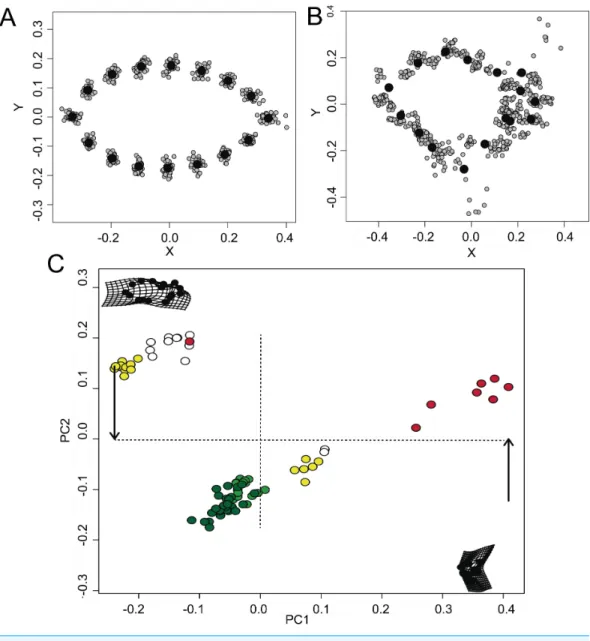
The visual GPA analysis indicated a significant variance in the shape configurations among the different models (Fig. 2A) and mimetic fish (Fig. 2B). All-pooled data showed a relative tendency of the mimetic fish to resemble plant debris with∼24% of the variation explained in PC1 and∼10% of the variation explained in PC2 (ANOVAF2,52=40.97,P<
0.001,Fig. 2C), yet remaining morphologically distinct, as observed in the GPA analyses.
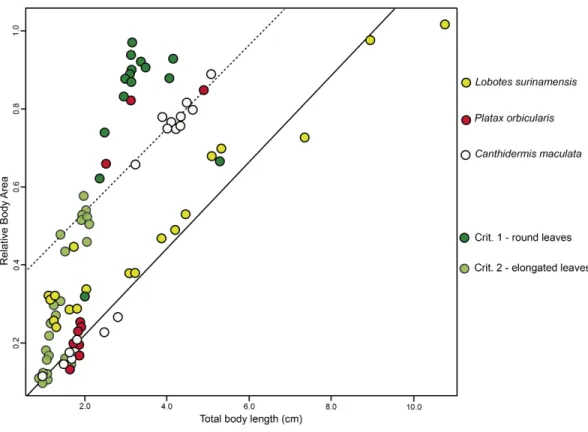
BA of the mimetic fish and models regressed against TL revealed a significant inter-dependency (ANCOVA,F2,96=92.06,P<0.001;Fig. 3), where juvenileL. surinamensis, P. orbicularisand C. maculatahave shown a size gradient, sharing similar BA with round and elongated leaves of different sizes, accordingly to different growth stages of each mimetic fish species, with some deviation observed for the round leaf models. These results were corroborated by LDA, which has shown high similarities in shape of mimetic fish and models, with a 52.52% probability of misclassification among the observed individuals. Details on both ANCOVA and LDA can be found inDataset S1.
DISCUSSION
Figure 2 Morphometric relationships among mimetic fish and plant models.Diversity of shapes ob-served for the models (i.e., floating plant debris) (A) and fish mimics (B), via a general Procrustes analy-sis (GPA); and principal components analyanaly-sis (PCA; (C)), of all- pooled data indicating a high tendency for shape similarities shared by the mimetic fish and models (i.e., floating plant debris), where green plots represent leaf models (dark green representing rounded leaf models and lighter green representing elon-gated leaf models). Mimetic fish are represented byLobotes surinamensis(yellow),Platax orbicularis(red), andCanthidermis maculata(white).
(Wickler,1968;Pasteur,1982). Although the importance of floating plant debris for passive transportation, providing shelter and feeding grounds for fish in coastal environments has been evaluated (Castro, Santiago & Santana-Ortega,2001;Vandendriessche et al.,2007), the closeness of these interactions has not been investigated, particularly regarding plant resemblance by fish.
Figure 3 ANCOVA.Similar relative body area values were observed among the models (i.e., floating plant debris) and mimetic fish, where mimetic fish are represented byLobotes surinamensis(yellow), Can-thidermis maculata(white) andPlatax orbicularis(red), and plant models are represented by green plots (dark green representing rounded leaf models and lighter green representing elongated leaf models).
museum specimens with our own samples, we have selected only intact individuals for the present analyses. According to observed shape similarities shared among the mimetic fish and models, it was clear that the present fish assemblage accompanied their respective models, being probably dependent on drifting plant material for survival, also suggested by the linear model of covariance shared amongst drifting fish and plants. While not the primary goal of the present study, such association might suggest an allometric dependence for the plant mimetic species, at least until a given ontogenetic stage when such fish species suffer significant changes in morphology and behaviour, cessing with the mimetic association with plants (Barros et al.,2015).
All species tested in the present study, such asL. surinamensis(Lobotidae),C. maculata
(Balistidae) andP. orbicularis(Ephippidae) have been described previously as resembling dried leaves in shallow water (Uchida,1951;Breder,1946;Randall & Randall,1960;Barros et al.,2008;Barros et al., 2011;Barros et al., 2012), and are commonly found in the surveyed area (Motomura et al.,2010).
Although coastal fish resembling a plant via cryptic colouration has been an intriguing subject since the early reports, the present study is the first attempt to establish analytical comparisons between mimetic fish and models at the morphometrics level. Kelley & Merilaita(2015) suggested that successful crypsis in fish is more likely achieved through colouration, via a background matching effect. Although we did not test the predation rate of mimetic fish nor for any colour influence, our results add relevant information, in which background matching is achieved not only by cryptic colouration (Breder,1946;Randall & Randall,1960;Randall,2005b), but also through shape and behavioural resemblance of mimetic fish to their respective models. The present level of protective camouflage shared by the fish assemblage analysed herein might be important against potential aerial and bottom predators, as background colour matches surrounding environments (Donnelly & Whoriskey Jr,1991;Cortesi et al.,2015;Kelley & Merilaita,2015). However, no predatory attempt by a bird species has been observed. Further experiments and field observations of all observed species are necessary to test this assumption.
The co-occurring mimetic assemblages observed herein are a typical example of conver-gent evolution in a coastal environment (Endler,1981;Hamner,1995;Johnsen,2014). Some taxa analysed undergo numerous morphological and ethological changes. For example,
P. orbicularisadults inhabit deeper environments, changing in both shape and behaviour within the settlement (Kuiter & Debelius,2001;Barros et al.,2011). As major morphological changes are usually expected through ontogeny of several fish groups (Galis,1990;Loy et al.,1998;Comabella, Hurtado & García-Galano,2010;Leis et al.,2013;Nikolioudakis, Koumoundouros & Somarakis,2014;Barros et al.,2015), resemblance to leaves by the fish species observed here may be crucial for first settlement, as it could improve survival chances (Johnsen,2014).
ACKNOWLEDGEMENTS
We thank all members of the Kuchierabu-jima Island community, particularly M Yamaguchi, the crew of the Laboratório Multi-Imagem and FRR de Oliveira (UFPA), and A Akama (MPEG) for criticism and logistic and technical support during this study. We are deeply grateful to Dr. Hiroyuki Motomura (Kagoshima University Museum) for supplying additional samples, and Dr. Yuki Kimura and Ms. Misaki Fujisawa (Hiroshima University) for technical support. This study is in memory of Dr. Kenji Gushima.
ADDITIONAL INFORMATION AND DECLARATIONS
Funding
This study was financially supported by CAPES (process #6718-10-8), FAPESPA (process # 456780/2012), and the following research projects: ‘‘Fluxos (Água, Sedimentos, Nutrientes e Plâncton) Amazônicos ao longo do Continuum Rio-Estuário-Costa e Implica¸cões para a Biodiversidade Vegetal Costeira Amazônica’’ (Programa CAPES Pró-Amazônia: Biodiversidade e Sustentabilidade—Edital 047/2012) AUXPE no. 3290/2013, and ‘‘Descoberta de um Novo Bioma Marinho Amazônico’’ (Programa IODP/CAPES-Brasil—Edital 038/2014) Processo no. 88887.091707/2014-01. The funders had no role in study design, data collection and analysis, decision to publish, or preparation of the manuscript.
Grant Disclosures
The following grant information was disclosed by the authors: CAPES: process #6718-10-8.
FAPESPA: process #456780/2012.
Competing Interests
The authors declare there are no competing interests.
Author Contributions
• Alexya Cunha de Queiroz conceived and designed the experiments, performed the experiments, analyzed the data, contributed reagents/materials/analysis tools, wrote the paper, prepared figures and/or tables.
• Yoichi Sakai conceived and designed the experiments, analyzed the data, contributed reagents/materials/analysis tools, wrote the paper, reviewed drafts of the paper, sampling.
• Marcelo Vallinoto conceived and designed the experiments, analyzed the data, contributed reagents/materials/analysis tools, wrote the paper, reviewed drafts of the paper.
Animal Ethics
The following information was supplied relating to ethical approvals (i.e., approving body and any reference numbers):
As there is no national Japanese licensing framework, samples were collected following the ‘‘Guidelines for Proper Conduct of Animal Experiments’’ set out by the Hiroshima University Animal Research Committee, which are based on international ethical standards (Jenkins et al.,2014), and only after obtaining local community permission.
Data Availability
The following information was supplied regarding data availability: The raw data and video has been supplied asSupplementary Files.
Supplemental Information
Supplemental information for this article can be found online athttp://dx.doi.org/10.7717/ peerj.2268#supplemental-information.
REFERENCES
Abramoff MD, Magelhaes PJ, Ram SJ. 2004.Image processing with imageJ.Biophotonics
International11:36–42.
Adams DC, Otarola-Castillo E. 2013.Geomorph: an R package for the collection and
analysis of geometric morphometric shape data.Methods in Ecology and Evolution 4:393–399DOI 10.1111/2041-210X.12035.
Barros B, Sakai Y, Hashimoto H, Gushima K. 2008.Feeding behaviors of leaf-like
juveniles of the round batfishPlatax orbicularis(Ephippidae) on reefs of Kuchierabu-jima Island, southern Japan.Journal of Ethology 26:287–293
DOI 10.1007/s10164-007-0066-8.
Barros B, Sakai Y, Hashimoto H, Gushima K. 2011.Effects of prey density on nocturnal
zooplankton predation throughout the ontogeny of juvenilePlatax orbicularis
(Teleostei: Ephippidae).Environmental Biology of Fishes91(2):177–183
DOI 10.1007/s10641-011-9770-x.
Barros B, Sakai Y, Hashimoto H, Gushima K, Vallinoto M. 2012.‘‘Better off alone than
in bad company’’: agonistic colour display in mimetic juveniles of two ephippid species.Journal of Fish Biology 81(3):1032–1042
DOI 10.1111/j.1095-8649.2012.03377.x.
Barros B, Sakai Y, Pereira PHC, Gasset E, Buchet V, Maamaatuaiahutapu M, Ready JS,
Oliveira Y, Giarrizzo T, Vallinoto M. 2015.Comparative allometric growth of the
mimetic ephippid reef fishesChaetodipterus faberandPlatax orbicularis.PLoS ONE 10:e0143838DOI 10.1371/journal.pone.0143838.
Breder CM. 1946.An analysis of the deceptive resemblances of fishes to plant parts, with
Castro JJ, Santiago JA, Santana-Ortega AT. 2001.A general theory on fish aggregation to floating objects: an alternative to the meeting point hypothesis.Reviews in Fish Biology and Fisheries11:255–277DOI 10.1023/A:1020302414472.
Comabella Y, Azanza J, Hurtado A, Canabal J, García-Galano T. 2013.
Allomet-ric growth in cuban gar (Atractosteus tristoechus) larvae.Universidad y Ciencia
29(3):301–315.
Comabella Y, Hurtado A, García-Galano T. 2010.Ontogenetic Changes in the
Morphol-ogy and Morphometry of Cuban Gar (Atractosteus tristoechus).Zoological Science 27:931–938DOI 10.2108/zsj.27.931.
Cortesi F, Feeney WE, Ferrari MCO, Waldie PA, Phillips GAC, McClure EC, Sköld
HN, Salzburger W, Marshall NJ, Cheney KL. 2015.Phenotypic plasticity confers
multiple fitness benefits to a mimic.Current Biology25:949–954
DOI 10.1016/j.cub.2015.02.013.
Donnelly WA, Whoriskey Jr FG. 1991.Background color acclimation of Brook Trout for
crypsis reduces risk of predation by Hooded MergansersLophodytes cucullatus.North American Journal of Fisheries Management 11:206–211
DOI 10.1577/1548-8675(1991)011<0206:BCAOBT>2.3.CO;2.
Douglas ME, Matthews WJ. 1992.Does morphology predict ecology? Hypothesis testing
within a freshwater fish assemblage.Oikos65:213–224DOI 10.2307/3545012.
Endler JA. 1981.An overview of the relationships between mimicry and crypsis.
Biologi-cal Journal of the Limnean Society16:25–31DOI 10.1111/j.1095-8312.1981.tb01840.x.
Franssen NR, Goodchild CG, Shepard DB. 2015.Morphology predicting ecology:
incorporating new methodological and analytical approaches.Environmental Biology of Fishes98(2):713–724DOI 10.1007/s10641-014-0306-z.
Galis F. 1990. Ecological and morphological aspects of change in food uptake through
the ontogeny ofHaplochromis piceatus. In: Hughes RN, ed.Behavioural mechanisms of food selection. Proceedings of the NATO advanced research workshop on behavioural mechanisms of food selection. Berlin: Springer, 281–302.
Gibran FZ. 2010.Habitat partitioning, habits and convergence among coastal nektonic
fish species from the São Sebastião Channel, southeastern Brazil.Neotropical Ichthyology 8:299–310DOI 10.1590/S1679-62252010000200008.
Gómez-Laplaza LM, Gerlai R. 2013.The role of body surface area in quantity
discrimi-nation in angelfish (Pterophyllum scalare).PLoS ONE8:e83880
DOI 10.1371/journal.pone.0083880.
Gushima K, Murakami Y. 1976.The reef fish fauna of Kuchierabu, offshore island of
southern Japan.Journal of the Faculty of Fisheries and Animal Husbandry15:47–56.
Hamner WM. 1995.Predation, cover, and convergent evolution in epipelagic oceans.
Marine and Freshwater Behaviour and Physiology26:71–89
DOI 10.1080/10236249509378930.
Jenkins JA, Bart Jr HL, Bowker JD, Bowser PR, MacMillan JR, Nickum JG, Rose JD,
Sorensen PW, Whitledge GW, Rachlin JW, Warkentine BE. 2014. Use of fishes in
Herpetologists). In:Guidelines for the use of fishes in research. Bethesda, Maryland: American Fisheries Society.
Johnsen S. 2014.Hide and seek in the open sea: pelagic camouflage and visual
counter-measures.Annual Review of Marine Science6:369–392
DOI 10.1146/annurev-marine-010213-135018.
Kelley JL, Merilaita S. 2015.Testing the role of background matching and self-shadow
concealment in explaining countershading coloration in wild-caught rainbowfish.
Biological Journal of the Linnaean Society114:915–928 DOI 10.1111/bij.12451.
Kimura M, Morii Y, Kuno T, Nishida H, Yoshimura H, Akishige Y, Senta T. 1998.
Floatsam ichthyofauna in the tropical waters of the West Pacific Japan.Bulletin of the Faculty of Fisheries, Nagasaki University 79:9–20.
Klingenberg CP. 2011.MorphoJ: an integrated software package for geometric
morpho-metrics.Molecular Ecology Resources11:353–357
DOI 10.1111/j.1755-0998.2010.02924.x.
Kuiter RH, Debelius H. 2001.Surgeonfishes, rabbitfishes, and their relatives: a
comprehen-sive guide to acanthuroidei. TMC Publishing: Chorleywood.
Leis JM, Hay AC, Sasal P, Hicks AS, Galzin R. 2013.Pelagic to demersal transition
in a coral-reef fish, the orbicular batfishPlatax orbicularis.Journal of Fish Biology
83(3):466–479DOI 10.1111/jfb.12182.
Loy A, Mariani L, Bertelletti M, Tunesi L. 1998.Visualizing allometry: geometric
morphometrics in the study of shape changes in the early stages of the two-banded sea bream,Diplodus vulgaris(Perciformes, Sparidae).Journal of Morphology
237(2):137–146
DOI 10.1002/(SICI)1097-4687(199808)237:2<137::AID-JMOR5>3.0.CO;2-Z.
Moland E, Eagle JV, Jones GP. 2005.Ecology and evolution of mimicry in coral
reef fishes.Oceanography and Marine Biology—An Annual Review43:455–482
DOI 10.1201/9781420037449.ch9.
Motomura H, Kuriiwa K, Katayama E, Senou H, Ogihara G, Meguro M, Matsunuma M, Takata Y, Yoshida T, Yamashita M, Kimura S, Endo H, Murase A, Iwatsuki Y,
Sakurai Y, Harazaki S, Hidaka K, Izumi H, Matsuura K. 2010. Annotated checklist
of marine and estuarine shes of Yaku-shima Island, Kagoshima, southern Japan. In: Motonomura H, Matsuura K, eds.Fishes of Yaku-shima Island—A world heritage island in the Osumi Group, Kagoshima Prefecture, Southern Japan. Tokyo: National Museum of Nature and Science.
Nakabo T (ed.) 2002.Fishes of Japan with pictorial keys to the species. english edition.
Tokyo: Tokai University Press.
Nelson JS. 2006.Fishes of the world. Hoboken: John Wiley & Sons, 624 p.
Nikolioudakis N, Koumoundouros G, Somarakis S. 2014.Synchronization in allometric
and morphological changes during metamorphosis: comparisons among four sparid species.Aquatic Biology21:155–165DOI 10.3354/ab00579.
Okiyama M (ed.) 2014.An atlas of early stage fishes in Japan. 2nd edition. Tokyo: Tokai
Oliveira EF, Goulart E, Breda L, Minte-Vera CV, Paiva LRS, Vismara MR. 2010.
Ecomorphological patterns of the fish assemblage in a tropical floodplain: effects of trophic, spatial and phylogenetic structures.Neotropical Ichthyology8:659–586.
Pasteur G. 1982.A classification review of mimicry systems.Annual Review of Ecology
and Systematics13:169–199 DOI 10.1146/annurev.es.13.110182.001125.
R Development Core Team. 2015.R: a language and environment for statistical
comput-ing. Vienna: R Foundation for Statistical Computing.Available athttp:// www.R-project.org/.
Randall JE. 2005a.A review of mimicry in marine fishes.Zoological Studies44(3):299–328.
Randall JE. 2005b.Reef and shore fishes of the South Pacific: new Caledonia to Tahiti and
the Pitcairn Island. Honolulu: University of Hawai’i Press.
Randall JE, Randall HA. 1960.Examples of mimicry and protective resemblance in
tropical marine fishes.Bulletin of Marine Science10:444–480.
Robertson DR. 2013.Who resembles whom? Mimetic and coincidental look-alikes
among tropical reef fishes.PLoS ONE8(1):e54939
DOI 10.1371/journal.pone.0054939.
Robertson DR. 2015.Coincidental resemblances among coral reef fishes from different
oceans.Coral Reefs34:977 DOI 10.1007/s00338-015-1309-8.
Sazima I, Carvalho LN, Mendon¸ca FP, Zuanon J. 2006.Fallen leaves on the water-bed:
diurnal camouflage of three night active fish species in an Amazonian streamlet.
Neotropical Ichthyology4(1):119–122DOI 10.1590/S1679-62252006000100013.
Scholtz G. 2010.Deconstructing morphology.Acta Zoologica91:44–63
DOI 10.1111/j.1463-6395.2009.00424.x.
Skelhorn J, Rowland HM, Ruxton GD. 2010.The evolution and ecology of masquerade.
Biological Journal of the Linnaean Society99:1–8.
Skelhorn J, Rowland HM, Speed MP, Ruxton GD. 2010.Masquerade: camouflage
without crypsis.Science327:51DOI 10.1126/science.1181931.
Soares BE, Ruffeil TOB, Montag LFA. 2013.Ecomorphological patterns of the fishes
inhabiting the tide pools of the Amazonian Coastal Zone, Brazil.Neotropical Ichthyology 11:845–858DOI 10.1590/S1679-62252013000400013.
Uchida K. 1951.Notes on a few cases of mimicry in fishes.Science Bulletin of the Faculty
of Agriculture of Kyushu University13:294–296.
Valentin AE, Penin X, Chanut J-P, Sévigny J-M, Rohlf FJ. 2008.Arching effect on fish
body shape in geometric morphometric studies.Journal of Fish Biology 73:623–638
DOI 10.1111/j.1095-8649.2008.01961.x.
Vandendriessche S, Messiaen M, O’Flynn S, Vincx M, Degraer S. 2007.Hiding and
feeding in floating seaweed: floating seaweed clumps as possible refuges or feeding grounds for fishes.Estuarine, Coastal and Shelf Science71:691–703
DOI 10.1016/j.ecss.2006.09.017.
Vane-Wright RI. 1980.On the definition of mimicry.Zoological Journal of the Linnean
Society13:1–6DOI 10.1111/j.1095-8312.1980.tb00066.x.
Venables WN, Ripley BD. 2002.Modern applied statistics with S. 4th edition. Berlin
Walker JA. 2004.Kinematics and performance of maneuvering control surfaces in teleost fishes.IEEE Journal of Oceanic Engineering 3:572–584DOI 10.1109/JOE.2004.833217.
Wickler W. 1968.Mimicry in plants and animals. New York: McGraw Hill.
Willey A. 1904.Leaf-mimicry.Spolia Zeylan2:51–55.
Xiong G, Lauder GV. 2014.Center of mass motion in swimming fish: effects of speed
and locomotor mode during undulatory propulsion.Zoology117:269–281