American Journal of Applied Sciences 8 (10): 992-996, 2011 ISSN 1546-9239
© 2011 Science Publications
Corresponding Author: B. Sathya Bama, Department of Electronics and Communication Engineering,
Thiagarajar College of Engineering, Madurai, Tamil Nadu, India Tel: +91-98433-94792 Fax: +91-452-2483427
992
Quaternion Photometric Stereo for Rotation Invariant
Surface Texture Classification
Balakrishnan Sathyabama, Srinivan Raju and Abhaikumar Varadhan
Department of Electronics and Communication Engineering,
Thiagarajar College of Engineering, Madurai, Tamil Nadu, India
Abstract: Problem statement: The escalating growth of computer vision applications has increased the need for faster and more accurate image analysis algorithms. One application of image analysis that has been studied for a long time is texture analysis. The majority of existing texture analysis methods makes the explicit or implicit assumption that texture images are acquired from the same viewpoint. This study presents a rotationally invariant descriptor for textures with different orientations based on the Quaternion Representation. Approach: A novel Quaternion Photometric Stereo (QPS) was proposed for Rotation invariant classification of 3D surface textures. QPS was constructed by placing each pixel of three images of same texture with different orientation into the three imaginary parts of the quaternion, leaving the real part zero. The Peak Distribution Norm Vector (PDNV) was extracted from the radial plot of the Quaternion Fourier spectrum as rotation invariant texture signature used for texture classification. Results: The quaternion representation of stereo images was to be effective in the context of Rotation Invariant Texture classification. Conclusion: The proposed Quaternion approach gives a successful classification rate with computational advantages than the previously developed Monochrome and Color Photometric Stereo Methods.
Key words: Quaternion Fourier spectrum, radial plot, Peak Distribution Norm Vector (PDNV), monochrome and color photometric stereo, Quaternion Photometric Stereo (QPS)
INTRODUCTION
Texture plays an important role in image analysis that has been studied for a long time, its analysis and classification are essential in a variety of image processing applications. Early methods for texture classification focus on the statistical (Chai et al., 2011), structural, model based and signal processing analysis of texture images (Tuceryan and Jain, 1993). In general their classification results are good as long as the training and test samples have identical or similar orientations. However, the rotations of real-world textures will vary arbitrarily, severely affecting the performance of the former methods and suggesting the need for rotation invariant methods of texture classification. Many texture classification schemes have been presented that are invariant to image rotation (Porter and Canagarajah, 1997). They normally derive their features directly from a single image and are tested using rotated images. However, in many cases rotation of a textured surface produces images that differ significantly from those provided by pure image rotation (Dana et al., 1999; Wu and Chantler, 2000).
Few have taken into account these problems. Varma and Zisserman (2005) dealt this topic using single image, (Dong et al., 2008) proposed SVM and wavelet packet based approach, Lin et al. (2008) classified the 3D textures based on self similarity and Wu and Chantler and (2003) and Barsky and Petrou (2007) approached the same issue using Photometric Stereo. Among these, photometric stereo based methods have been successfully and widely applied to surface rotation invariant texture classification. This is because it gives us the ability to estimate surface properties using several images of a surface taken from the same viewpoint but under illuminations from different directions. But the photometric stereo representation of images has not been considered to make the system more efficient.
This study presents a rotationally invariant descriptor for textures with different orientations based on the novel Quaternion Photometric Stereo. The property of quaternion arithmetic is that the pixels from stereo images can be represented and analyzed as a single entity.
Texture Signatures from Quaternion Fourier Spectrum and the experimental results for classification and comparative study. Finally the conclusion is summarizes.
MATERIALSANDMETHODS
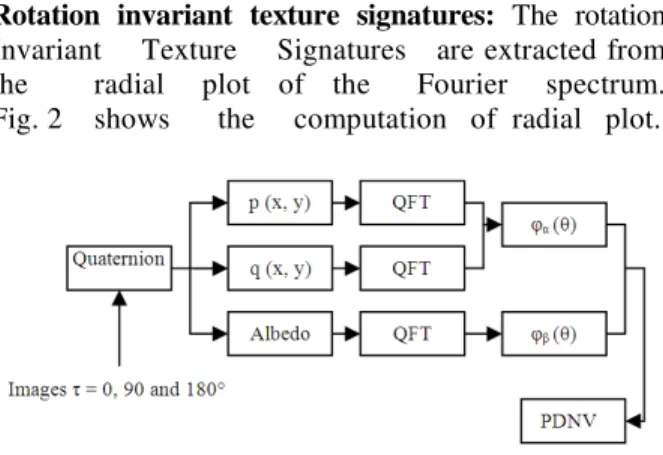
Figure 1 shows the complete Rotation Invariant 3D Texture Classification scheme using quaternion. At first each pixel of three images of same texture with different orientation are converted to a quaternion pixel by placing the three components into the three imaginary parts of the quaternion, leaving the real part zero. Then using the gradient method partial derivatives and albedo information are extracted from the Quaternion Image. After that, Quaternion Fourier transform is applied to get the gradient spectrum. Next the Rotation invariant Texture signatures are extracted from the radial plot which is derived from the spectrum. These signatures are used for classification.
Quaternion photometric stereo: Photometric stereo gives us ability to estimate local surface orientation by using several images of the same surface taken from the same viewpoint but under illumination from different directions. Photometric stereo is a way in which the ill-posed problems in shading from shading can be resolved. It uses several images of the same surface under different illumination directions. In the proposed Quaternion Photometric Stereo each pixel of three images of same texture with different orientation are converted to a quaternion pixel by placing the three components into the three imaginary parts of the quaternion, leaving the real part zero:
1 2 3
q
I =( 0, i ,i ,i ) (1)
where , m
i , m=1, 2,3, are the pixels of three images, H is the quaternion. The quaternion representation of color is shown to be effective in the context of image analysis (Sangwine, 2000; Sathyabama et al., 2011). Here, Quaternion is introduced to prove the efficiency of quaternion arithmetic in stereo images where, the stereo image can be represented and analyzed as a single entity thereby overcoming the computational limitations of conventional photometric stereo. For color images the initial Quaternion is formed by combining the three color channels r, g, b of an image, then the these quaternion’s taken from three different orientations are combined to form the photometric stereo. It is a bi-quaternion approach Eq. 2:
1 1 1 1
r g b
i =( 0, i ,i ,i ) (2)
where , 1 c
i ,c=r,g, b, the red, green and blue band images for image1.Similarly, i2 and i3are formed for other two images then the QPS is formed using Eq. 1.
Then the QPS is used to obtain the required partial derivative fields by gradient method. They are Fourier transformed and combined to provide a frequency domain function that does not contain the directional artifacts associated with partial derivatives.
Quaternion Fourier transform: The Quaternionic Fourier Transform (QFT) plays a vital role in the representation of signals. It transforms a real (or quaternionic) 2D signal into a quaternion-valued frequency domain signal (Sangwine and Ell, 2001). The four QFT components separate four cases of symmetry in real signals instead of only two in the complex FT.
The discrete Quaternion Fourier transform of an image Iq(m, n) for two variables based on Ell’s formula Eq. 3:
mu nv M 1 N 1
2 M N
q q
m 0 n 0 1
F (u, v) e I (m, n)
MN
− − − πµ +
= =
=
∑ ∑
(3)where, the discrete array f(m,n) is of dimension M×N. The inverse transform is Eq. 4:
mu nv M 1 N 1
2 M N
q q
u 0 v 0 1
I (m, n) e F (u, v)
MN
− − πµ +
= =
=
∑ ∑
(4)It transforms an image into a quaternion-valued frequency domain signal. Here the fast algorithm of Quaternion Fourier Transform has been employed. An important point is that the QFT depends of the definition of has to represent any unit pure quaternion.
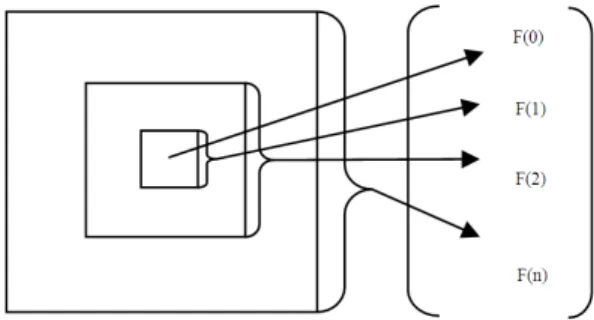
Rotation invariant texture signatures: The rotation Invariant Texture Signatures are extracted from the radial plot of the Fourier spectrum. Fig. 2 shows the computation of radial plot.
994 It is calculated by integrating all the contributions at each radial frequency in Fourier spectrum. The Peak Distribution Norm Vector (PDNV), computed from the radial plot provides a set of Rotation Invariant Texture Signatures.
Norm is taken to the Quaternion Fourier Spectrum. The Fourier of the Quaternion has both real and imaginary components. However, the norm of Fourier of quaternion is always a real quantity.
The norm N(Fq) is a real-valued function and the norm of a product of quaternion satisfies the following properties Eq. 5:
a a
a
a
a
N(R ) N(R ) and N(R )N(R ) N(R(F ) N(R F R )
N(R )N(F )N(R ) N(R )N(F )N(R ) N(F )
θ θ θ θ
θ θ
θ θ
θ θ
= = = = =
(5)
The norm of the unrotated vector Fq equates to the norm of the rotated version. The energy (amplitude), here the norm, of an image should be the same irrespective of the orientation of the image and any transform applied to this image should essentially be able to demonstrate that. This property of rotation invariance is achieved by these PDNV signatures. Followed by the classification done by comparing the PDNV of training and test textures using sum of square distance metric.
RESULTS
To demonstrate the significance of the proposed method, textures from the Photex texture album are used. The textures contained in the database are of size 256× 256. For our experimental procedure we take 150×150 sizes of non overlapping samples. We consider texture samples with surface rotations of 0,30,60,90,120,150 and 180° taken under three illumination directions 0, 90 and 180° respectively. Therefore, each texture sample will have 7 textures for a single illumination direction and thus an overall of 21 textures under a single sample. Sample image used for training will have an orientation of 0° while test images will have orientations from 0-180°.
Figure 3 and 4 shows the quaternion gradient spectrum and radial plot of texture gr2 respectively.
Table 1 shows the classification results per texture gr2 of the classifier by using the texture signatures extracted from radial plot. For gr2 the classifier was trained using 0° orientation and tested with eight angles of rotation of the same texture with different tilt angles. And also it is compared and tested with every eight rotated samples of each texture in the data base.
Fig. 2: Radial Plot computation from QFT spectrum
Fig. 3: Input Image and it Quaternion Fourier spectrum for various rotations (0, 90, 120°)
Fig. 4: Radial Plot of gr2 for various rotations
DISCUSSION
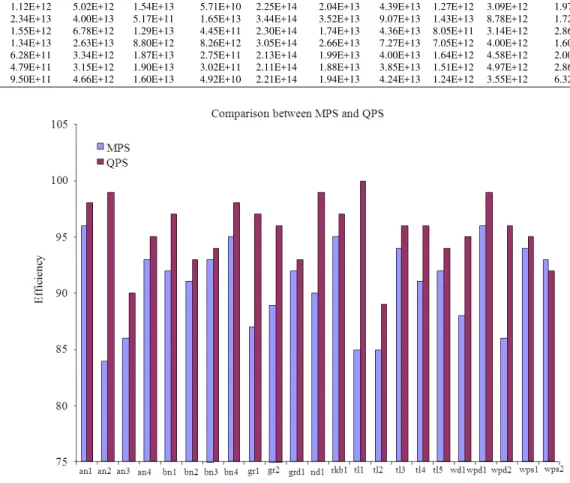
From the results shown in Table 1 we can observe that the proposed classifier gives minimum distance against gr2 compared to other textures, this improves the classification accuracy. The average classification accuracy of 89% was achieved by conventional Photometric stereo and 96% by proposed method.
Table 1: Classification results of texture gr2
Texture an1_0 an2_0 an3_0 an4_0 bn1_0 bn2_0 bn3_0 bn4_0 gr1_0 gr2_0 grd1_0
gr2_0 1.30E+12 5.03E+12 1.55E+13 5.66E+10 2.26E+14 2.14E+13 4.50E+13 1.49E+12 2.92E+12 0.00E+00 1.16E+12 gr2_45 1.12E+12 5.02E+12 1.54E+13 5.71E+10 2.25E+14 2.04E+13 4.39E+13 1.27E+12 3.09E+12 1.97E+10 1.39E+12 gr2_90 2.34E+13 4.00E+13 5.17E+11 1.65E+13 3.44E+14 3.52E+13 9.07E+13 1.43E+13 8.78E+12 1.72E+13 1.71E+13 gr2_135 1.55E+12 6.78E+12 1.29E+13 4.45E+11 2.30E+14 1.74E+13 4.36E+13 8.05E+11 3.14E+12 2.86E+11 2.51E+12 gr2_180 1.34E+13 2.63E+13 8.80E+12 8.26E+12 3.05E+14 2.66E+13 7.27E+13 7.05E+12 4.00E+12 1.60E+12 9.45E+12 gr2_225 6.28E+11 3.34E+12 1.87E+13 2.75E+11 2.13E+14 1.99E+13 4.00E+13 1.64E+12 4.58E+12 2.00E+11 1.92E+12 gr2_270 4.79E+11 3.15E+12 1.90E+13 3.02E+11 2.11E+14 1.88E+13 3.85E+13 1.51E+12 4.97E+12 2.86E+11 2.29E+12 gr2_315 9.50E+11 4.66E+12 1.60E+13 4.92E+10 2.21E+14 1.94E+13 4.24E+13 1.24E+12 3.55E+12 6.32E+10 1.74E+12
Fig. 5: Classification results
of more than 85% for each texture is obtained and it is compared with that of the previously developed photometric stereo based surface texture classifier which gives classification accuracy of 91.8% which is shown in Fig. 2. Also the compact representation by Quaternion and Quaternion Fourier Transform provides computational efficiency. The QDFT or its FFT implementation requires fewer real multiplications than three complex DFT/FFTs and hence is more efficiently computed for stereo image, as well as requiring less memory. QDFT directly implemented would require 75% of the real multiplications and additions required by three complex DFTs used in conventional Photometric stereo.
CONCLUSION
In this study, a Novel Quaternion Photometric stereo has been proposed and has been applied for rotation-invariant 3D surface texture Classification. Stereo image processing in Quaternion domain has
been quite efficient with less number of mathematical computations as well as requiring less memory. The theory and experiment has demonstrated the ability of Quaternion Photometric Stereo to make efficient rotation invariant texture classification.
ACKNOWLEDGMENT
We are very much thankful to the Management and Department of Electronics and Communication Engineering of Thiagarajar College of Engineering for their support and assistance to carry out this work.
REFERENCES
996 Barsky, S. and M. Petrou, 2007. Surface texture using
photometric stereo data: Classification and direction of illumination detection. J. Math. Imag. Vis., 29: 185-204. DOI: 10.1007/s10851-007-0031-8
Chantler, M.J. and J. Wu, 2000. Rotation Invariant Classification of 3D Surface Textures using Photometric Stereo and Surface Magnitude Spectra. British Machine Vision Conference, 2: 486-495.
Dana, K.J., B.V. Ginneken, S.K. Nayar and J.J. Koenderink, 1999. Reflectance and texture of real world surfaces. ACM Trans. Graphics, 18: 1-34. Dong, J., Y. Duan and Z. Yang, 2008.
Three-dimensional surface texture classification based on support vector machines and wavelet packets. Proceedings of the 2nd International Symposium on Intelligent Information Technology Application, Dec. 20-22, IEEE Xplore Press, Shanghai, pp: 124-127. DOI: 10.1109/IITA.2008.587
Lin, Q., Z. Linjie, D. Junyu, Y. Zhenwei and Y. Ailing, 2008. Self-similarity based classification of 3d surface textures. Proceedings of the Congress on Image and Signal Processing, May 27-30, IEEE Xplore Press, Sanya, China, pp: 402-406. DOI: 10.1109/CISP.2008.294
Porter, R. and N. Canagarajah, 1997. Robust rotation invariant texture classification: Wavelet, Gabor filter and GMRF based schemes. IEE Proc. Vis. Image Signal Process., 144: 180-188. DOI: 10.1049/ip-vis:19971182
Sangwine, S.J. and T.A. Ell, 2001. Hypercomplex Fourier transforms of color images. Proceedings of the IEEE International Conference on Image Processing, Oct. 7-10, IEEE Xplire Press, Thessaloniki, Greece, pp: 137-140. DOI: 10.1109/ICIP.2001.958972
Sangwine, S.J., 2000. Color in image processing. Electronics Commun. Eng. J., 12: 211-219.DOI: 10.1049/ecej:20000503
Sathyabama, B., P. Chitra, D.V. Gayathri, 2011. Quaternion wavelets based rotation, scale and translation invariant texture classification and retrieval. J. Sci. Indus. Res., 70: 256-263.
Tuceryan, M. and A.K. Jain, 1993. Texture Analysis. In: Handbook of Pattern Recognition and Computer Vision, Chen, C.H., L.F. Pau and P.S.P. Wang (Eds.). World Scientific, Singapore, ISBN: 9810222769, pp: 235-276.
Varma, M. and A. Zisserman, 2005. A statistical approach to texture classification from single images. Int. J. Comput. Vis., 62: 61-81. DOI: 10.1023/B:VISI.0000046589.39864.ee