A COMPARISON OF ACCURACIES OF THE RPC MODELS : HOMO- AND HETERO-
TYPE STEREO PAIRS OF GEOEYE AND WORLDVIEW IMAGES
S. Y. Choi a,*, J. M. Kang b, D. S. Shin a a
3ATRC-1, ADD, 111, Sunam-dong, Yuseong-gu, Daejeon, 305-152, Korea - (sychoi, dsshin)@add.re.kr b
Dept. of Civil Engineering, Chung-Nam National Uni., Yuseong-gu, Daejeon, 305-763, Korea - [email protected]
Commission IV, WG IV/3
KEY WORDS: Accuracy, RPC Model, Homo-type stereo, Hetero-type stereo, GeoEye-1 images, WorldView-2 images
ABSTRACT:
We investigated the accuracy in three dimensional geo-positioning derived by two homo-type stereo pairs and four hetero-type stereo pairs of high resolution satellite images using the vendor-provided rational polynomial coefficients (RPC) in this research. The results of 3D geo-positioning from six different stereo combinations were assessed with seventeen GPS points which were commonly well distributed in the scenes. Recently, satellite image vendors provide homo-type stereo pair images taken by the same sensor during a short time period. Stereo pair images have good geometry for achieving accurate ground coordinates. However it is difficult to acquire them at the request time because of the revisit time of the satellite and current weather conditions. Due to these reasons, a new methodology using hetero-type stereo pairs has been suggested to derive ground coordinates. High resolution satellite images include the rational function model in the form of RPC which represents the relationship between the image coordinates and object coordinates with rational polynomials. RPC makes it fast, accurate, and simple to calculate ground coordinates without any exterior orientation parameters of satellites. We constituted six different stereo pairs from four images of GeoEye-1 in-track stereo pair images and WorldView-2 in-track stereo pair images which were collected for the same region (17.5km x 10.0km) of the west coast in Korea. We collected GCPs by differential GPS surveying. The ground coordinates derived from six different pairs without and with some GCPs were compared to all GPS points respectively. The accuracy of ground coordinates from hetero-type stereo pairs is equivalent to the accuracy from homo-type stereo pairs. This research demonstrates that we can achieve comparatively accurate ground coordinates without GCPs using any stereo combinations of images containing proper RPCs, although we don't have in-track stereo pair images. Furthermore, some proper combinations of images with GCPs can improve the positioning accuracy.
1. INTRODUCTION
Since IKONOS was launched in 1999 and provided publicly available high-resolution imagery at 1- and 4-meter resolution, high resolution satellite imagery has become indispensible for aspects of various areas such as urban management, large scale map development, etc.
Recently GeoEye-1 and WorldView-2 satellites have provided high resolution (0.5m) in-track stereo-pair images. As in-track stereo pair is taken from two different perspectives during one orbital pass, in-track stereo data acquisition has a strong advantage over multi-date cross-track stereo data acquisition. It reduces radiometric image variations (temporal changes, sun illumination, etc.), and thus increases the correlation success rate in any image matching process (Toutin, 2004).
In addition, when using high resolution satellite imagery for topographic mapping, in-track stereo pair images can ensure the geometric accuracy of generated DSM. However with respect to spatial information collection, the limitation such as expensive data acquisition fee, insufficiency of imaging regions and archived data is apparent (Zhu, 2008). Provided the images acquired from various satellite sensors are available, the full exploitation of these images will extend the possibility of spatial information collection, cut down expenses, and save time to prepare taking photographs.
Most of recent satellite images such as GeoEye-1 and WorldView-2 images provide a rational polynomial coefficient (RPC) model which is a kind of generic sensor model that is widely used in the processing of high-resolution satellite images. Unlike traditional physical camera models, an RPC model has 80 coefficients and simulates the sensor’s position, attitude, and
interior orientation, so the RPC model has no physical interpretation and is applicable to any images regardless of an acquisition sensor. This means hetero-type stereo pairs can be used for determining the precise position. In this paper, there are two kinds of stereo pairs. One is homo-type stereo pairs that is a stereo model using stereo pairs acquired from the same sensor, and the other is hetero-type stereo pairs that is a stereo model using stereo pairs acquired from different sensors.
There have been not many studies for regarding the application of high resolution satellite hetero-type stereo pairs. Zhu investigated the geometric accuracy of DSMs and orthoimages, which were obtained from homo-type and hetero-type stereo pairs of four IKONOS and two QuickBird panchromatic images, in 2008.
In this study, two kinds of homo-type stereo pairs and 4 kinds of hetero-type stereo pairs were used to make RPC stereo models using in-track stereo pairs of GeoEye-1 images and in-track stereo pairs of WorldView-2 images. We investigated the accuracy in three dimensional geo-positioning without and with GCPs for each 6 stereo pairs. The stereo acquisition geometry of the stereo pairs is used to analyze the relationship between the geometric accuracy of the RPC model and the geometric parameter such as B/H (Base to Height) ratio, BIE (Bisector Elevation Angle), and CA (Convergence Angle) (Zhu, 2008, Tong, 2008). The results show that RPC models of any stereo pairs of high resolution satellite stereo images have the potential to be used for three dimensional geo-positioning.
2. DATASETS AND RPC MODELS
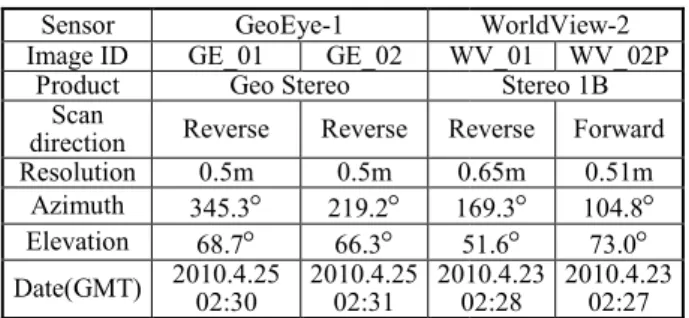
For this study, GeoEye-1 and WorldView-2 in covering the same area of the west coast of The test area covers both high and low altitud the properties of the used satellite images.
Sensor GeoEye-1
Image ID GE_01 GE_02 WV
Product Geo Stereo Scan
direction Reverse Reverse Rev
Resolution 0.5m 0.5m 0.6
Azimuth 345.3
°
219.2°
169Elevation 68.7
°
66.3°
51Date(GMT) 2010.4.25 02:30
2010.4.25 02:31
2010 02 Table 1. Properties of the used satelli Seventeen Ground Control Points (GCPs) we test area with 3cm in horizontal and 5cm in v The GCPs were used as control points for RP check points for evaluating the geometric modeling. Figure 1 shows the configuration center point (#37) and the points (#9, distributed in the boundary regions were used respectively. All of the seventeen GCPs were Differential Global Positioning System (DGP painted white triangle-shaped marks on the and collected GPS signals on the center of the
Figure 1. Configuration of GCP The RPC model used in this study proposed Dial (2003) is briefly summarized here. The the object-space (
ϕ
,λ
,h) coordinates to im Sample) coordinates. The RPC functional mo of a ratio of two cubic polynomials of object Separate rational functions are used to expre to line and the object-space to sample coord To improve numerical precision, image coordinates are normalized to (-1, 1) range offsets as shown below.P
L
h
where φ : latitude offset, φ : latitude scale λ : longitude offset, λ : longitude sc h : height offset, h : height scale
2 in-track stereo pairs of Korea were used. altitudes. Table 1 shows
WorldView-2 WV_01 WV_02P
Stereo 1B Reverse Forward
0.65m 0.51m 169.3
°
104.8°
51.6
°
73.0°
2010.4.23 02:28
2010.4.23 02:27 satellite images CPs) were collected in the
m in vertical accuracies. for RPC modeling and as etric accuracy of RPC ration of the GCPs. The 9, #11, #61, #100) e used for control points s were acquired through (DGPS) processing. We n the black paved road, of the mark.
of GCPs
oposed in Grodecki and The RPC model relates to image-space (Line, nal model is in the form object-space coordinates. express the object-space oordinates relationship. age- and object-space range using scales and
(1) (2) (3) scale
ude scale
The normalized line and sample i and X, respectively) are then calcu rational polynomial functions g(.) an Y g φ, λ, h ,
,
where
1 L P H LP LH PH L! P! H! PLH L
" c$ c! % c!& '
( 1 d! % d!& '
And similarly
X h φ, λ, h + , ,
1 L P H LP LH PH L! P! H! PLH L
, e$ e! % e!& '
. 1 f! % f!& '
Using line and sample offsets a normalized image-space coordinat Line is the image line number exp zero as the center of the first line, number expressed in pixels with pi left-most sample, are finally comput
Line Y · Line 3 Line
Sample X · Sample 3 Sample
where
Line : line offset, Line : line sc
Sample : sample offset, Sample
Observation equation used is as belo point j.
F;: <Line:;3 a&;3 a$;S:3 a!;L:3 = >
= >
F?:; <Sample:;3 b&;3 b$;S:3 b!;L:3
To validate modeling accuracy, the check points are initialized with th offset (φ ,λ ,h ). We used horizo uncertainty at 1.0e+5 for the check control points.
In the RPC block modeling, fir transformation for bias compensat and (9), but we used shift transfo because it is simple and there are between the results of shift transformation through several expe
3. ACCURACY ANALYSIS O
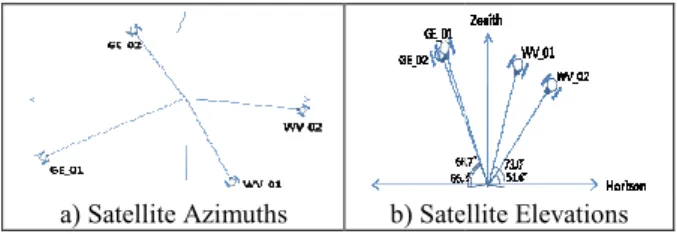
The geometries of GeoEye-1 image are shown in Figure 2. The geometr in in-track orbit is usually good Figure 2, the azimuths of GE_0 WV_01 and WV_02 images are 3
ple image-space coordinates (Y calculated from their respective g(.) and h(.): i.e.,
, ,A ,A
"B
(B (4)
LC LP! LH! L!P PC PH! L!H P!H HC '
, ,A ,A
,B
.B (5)
LC LP! LH! L!P PC PH! L!H P!H HC '
sets and scale factors, the de-rdinates (Line, Sample), where er expressed in pixels with pixel t line, and Sample is the sample ith pixel zero as the center of the omputed as
Line (6)
Sample (7)
line scale
Sample : sample scale
as below based image i and image
, ,A
, ,A · L;3 L; 3 ε;: 0 (8) +=
> , ,A +=
> , ,A · S;3 S;3 ε?:; 0 (9) the ground coordinates of the with the object space coordinates horizontal object coordinates for check points and 1.0e-5 for the g, firstly we considered affine pensation as above equations (8) ransformation(a$=a!=b$=b!=0), re are no significant differences transformation and affine l experiments.
SIS OF STEREO MODELS
images and WorldView-2 images eometry of stereo images collected good for 3D geo-positioning. In GE_01 and GE_02 images and are 345.3
°
, 219.2°
, 169.3°
, and68.7
°
, 51.6°
, and 73.0°
respectively. Any com image pairs has good geometry to perform spatial intersection.a) Satellite Azimuths b) Satell Figure 2. Image Geometry
3.1 Geometry of Satellites
It is clear that a geometric stereo model nee with respect to the relationship between the geometry and the geometric accuracy in a environment (Cain, 1989). There are some to express the geometry. The B/H ratio is the between the two satellites to the average fly ground level. The B/H ratio has been widely triangulation. However, the B/H ratio is no measure of the geometry for the satellite ste should consider the curvature of the earth (Li, the angle that represents how much the epip about flight line. The CA is the angle betwe the convergence or epipolar plane. An angle degrees is ideal. The AA is the apparent offs view that a stereo pair has and should (GEOIMAGE, 2010).
We used only B/H ratio and BIE that parameters related to the accuracy of satel (Zhu, 2008) . Figure 3 shows the geometr which is used in this study. We set up coordinate system where the origin is the ce
S$ and S! are the positions of two satellites.
the satellite orbit above ground level, R is the
e; is the elevation of the satellite i, and Az; is satellite i. We can find the positions of two sa (11).
Figure 3. Geometry of Satelli
ny combination of stereo perform geolocation via
atellite Elevations metry
needs to be analyzed en the stereo acquisition in a variable geometric ome kinds of parameters is the ratio of the length ge flying altitude above widely used in the aerial is not appropriate as a stereo models which (Li, 2008). The RA is e epipolar plane rotates between the two rays in angle between 30 and 60 nt offset from the centre ould be under 20 deg that are the important f satellite stereo models ometry of two satellites et up a local Cartesian the centre of the scene. llites. H is the altitude of R is the radius of the earth,
is the azimuth of the two satellites in (10) and
Satellites
S$ H
X$
Y$
Z$
J HOSOS$$· cos e· cos e$$··
OS$· sin
S! H
X!
Y!
Z!
J HOSOS!!· cos e· cos e!!
OS!· sin
Baseline (B) and B/H ratio can be de (13).
B lengthPS$S!Q R X$< X! !3
B/H ratio VWXVYU
Y
Equation (14) shows how we calcula
u$ [?W\\\\\\\\]
^[?W\\\\\\\\]^, u! ^[?Y[?Y\\\\\\\\]\\\\\\\\]^
BIE sin $a\\\\]bW \\\\]Y |\\\\]bW \\\\]|Y · z]d
3.2 Bias of pixel in forward RPC
Biases in RPCs generated from se generally attributed to small system tracker recordings, have been show by zero-order shifts in image spac shows these biases quantified computing image coordinates via th coordinates of the GPS points. It ca mean of discrepancies are -0.4 ~ 3. of differences are less than 0.37 pixe that compensating image biases inh geopositioning accuracies.
GE_01
WV_01
Figure 3. Bias vectors of
Images RMSE ME
Line Sample Line GE_01 3.846 0.440 3.842 GE_02 0.861 0.535 0.781 WV_01 2.049 1.360 2.029 WV_02 3.625 0.873 3.612 Table 2. Biases of the im
· sin Az$
· cos Az$
sin e$
J (10)
· sin Az!
· cos Az!
sin e!
J (11)
n be derived by formulas (12) and
3 Y$< Y! !3 Z$< Z! ! (12)
(13)
calculate BIE.
(14)
RPC
om sensor orientation, which are systematic errors in gyro and star shown to be adequately modeled e space (Fraser, 2009). Figure 3 tified by differences between via the RPCs and measured image . It can be seen that, although the ~ 3.8 pixels, the standard errors pixels. This instance is to show ses inherent in RPCs can increase
GE_02
WV_02 of image coordinates
MEAN S.D.
Line Sample Line Sample 3.842 -0.398 0.188 0.194 0.781 0.450 0.373 0.297 2.029 -1.345 0.300 0.206 3.612 -0.840 0.312 0.245
image coordinates
3.3 Accuracy of Stereo Models
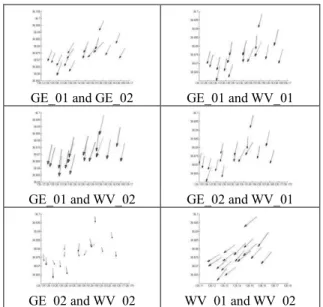
Figure 4 shows ground coordinate biases in RPC sensor orientation for the homo- and hetero-type stereo models without GCPs. The worst systematic bias errors in object points of -0.3m in easting and -2.1m in northing at the ‘GE_01 and WV_02’ stereo pair and 2.2m in height at the ‘GE_01 and GE_02’ stereo pair resulted. In any case of all six stereo pairs, there are shift bias patterns in both planimetry and height regardless of homo-type or hetero-type stereos.
GE_01 and GE_02 GE_01 and WV_01
GE_01 and WV_02 GE_02 and WV_01
GE_02 and WV_02 WV_01 and WV_02 Figure 4. Residuals of stereo models without GCPs Figure 5 shows the residuals of the six stereo models using single GCP(#37) located in the middle of the test area. Only one GCP compensates bias error efficiently and the accuracies are remarkably improved to 0.39 meters in CEP(90) and 0.62 meters in LEP(90). However, the random errors exist in the RPC models provided with the GCP.
GE_01 and GE_02 GE_01 and WV_01
GE_01 and WV_02 GE_02 and WV_01
GE_02 and WV_02 WV_01 and WV_02 Figure 5. Residuals of stereo models with single GCP Figure 6 shows ground coordinate biases in RPC sensor orientation for the six stereo models using four well distributed
GCPs(#9, #11, #61, #100). The accuracy of this case has a strong resemblance to that of the single GCP.
GE_01 and GE_02 GE_01 and WV_01
GE_01 and WV_02 GE_02 and WV_01
GE_02 and WV_02 WV_01 and WV_02
Figure 6. Residuals of stereo models with four GCPs
3.4 Results and Discussions
Table 3 shows the results of our investigation. The geometric accuracy is assessed in planimetry and height using no GCP, 1 GCP, and 4 GCP respectively. The accuracy of stereo models dramatically improved with only one GCP, however when we used more GCPs, the accuracy slightly increased. Regarding stereo types, it was concluded that there is no significant difference in accuracy between homo-type and hetero-type stereo pairs if they have good stereo geometry such as B/H, and BIE. In the case of ‘GE_02 and WV_02’ hetero-type stereo pair, planimetry accuracy without GCP is the best.
Image
pairs B/H BIE
No GCP 1 GCP 4 GCPs CEP
(90) LEP (90)
CEP (90)
LEP (90)
CEP (90)
LEP (90) GE_01 &
GE_02 0.74 79.3 1.33 2.53 0.25 0.53 0.25 0.62 GE_01 &
WV_01 1.16 81.4 1.35 2.07 0.24 0.41 0.21 0.38 GE_01 &
WV_02 0.69 79.9 2.25 0.76 0.20 0.38 0.19 0.46 GE_02 &
WV_01 0.61 61.3 1.24 2.13 0.30 0.48 0.26 0.53 GE_02 &
WV_02 0.73 78.3 0.69 1.56 0.39 0.62 0.29 0.51 WV_01 &
WV_02 0.71 65.5 1.60 2.39 0.37 0.57 0.33 0.58 Table 3. Accuracy of Stereo Models
4. CONCLUSION
In this study, GeoEye-1 in-track stereo pair and WorldView-2 in-track stereo pair were collected in the same region. We compared the three-dimensional geopositioning accuracy of different combinations from these four images. According to the results in table 3, the following conclusions can be
In-track stereo pairs of GeoEye-1 and WorldView-2 are meaningfully accurate for developing geo-spatial information for a map of 1/5,000 without any GCPs. The accuracies of hetero-type stereo pairs which have good geometry(B/H and BIE) are as accurate as that of homo-type in-track stereo pairs.
The hetero-type stereo pair model of the images with different ground sample distances could be comparatively accurate, because RPC model is independent on sensors.
References :
Cain, J. 1989, Stereomodel Acquisition Geometry, Ph.D. thesis, U.C. Berkeley.
Fraser, C.S. and Hanley, H.B., 2003. Bias Compensation in Rational Functions for Ikonos Satellite Imagery, Photogrammetric Engineering & Remote Sensing, 69(1), pp. 53-57
Fraser, C.S. and Ravanbakhsh, M., 2009. Georeferencing accuracy of GeoEye-1 imagery, Photogrammetric Engineering & Remote Sensing, 75(6), pp. 634- 640.
GEOIMAGE, 2010, “Digital Elevation Models from Satellite Imagery”.
http://www.geoimage.com.au/geoimage/uploads/Geoimage_DE M_brochure_Oct10_small_lowres.pdf
Grodecki, J. and Dial, G., 2003. Block adjustment of high-resolution satellite images described by rational polynomials, Photogrammetric Engineering & Remote Sensing, 69(1), pp. 59-68.
Li, J., Shao, Y., Wang, J., and Yang, J.(2008), The Research and Design of The Base-Height Ratio for the Three Linear Array Camera of Satellite Photogrammetry, The International Archives of the Photogrammetry, Remote Sensing and Spatial Information Sciences, Vol. XXXVII.Part B1.Beijing, pp. 757-760
Li, R., Zhou, F., Niu, X., and Di, K., 2007. Integration of Ikonos and QuickBird Imagery for Geopositioning Accuracy Analysis, Photogrammetric Engineering & Remote Sensing, 73(9), pp. 1067-1074.
NIMA, 2000, The Compendium of Controlled Extensions for the National Imagery Transmission Format, ver. 2.1.
Toutin, T., 2004. DTM Generation from Ikonos In-Track Stereo Images Using a 3D Physical Model, Photogrammetric Engineering & Remote Sensing, 70(6), pp. 695–702.
Zhu, L., Umakawa, H., Guan, F., Tachibana, K., and Shimamura, H., 2008. Accuracy Investigation of Orthoimages Obtained from High Resolution Satellite Stereo Pairs, The International Archives of the Photogrammetry, Remote Sensing and Spatial Information Sciences, Beijing, Vol. XXXVII. Part B1. pp.1145-1148