39
Processing and Application of Ceramics 3 [1-2] (2009) 39–42* Corresponding author: tel: +40 213 167 912
fax: +40 213 121 149, e-mail: [email protected]
Phase formation and electrical properties of the LaCoO
3obtained by
water-based sol-gel method with citric acid
Luminita Predoana
1, Barbara Malic
2, Marija Kosec
2, Mariana Scurtu
1, Monica Caldararu
1,
Maria Zaharescu
1,*1“Ilie Murgulescu” Institute of Physical Chemistry, Romanian Academy, 202 Splaiul Independentei, 060021
Bucharest, Romania
2Jozef Stefan Institute, 39 Jamova, 1001 Ljubljana, Slovenia
Received 17 October 2008; received in revised form 17 February 2009; accepted 16 March 2009
Abstract
In the present work the LaCoO3 formation from gel precursors obtained by water-based sol-gel method with citric acid was studied. As precursors La and Co nitrates were used. The obtained gels were analyzed by TG/ DTA and TG/EGA. The decomposition of the gels takes place in two main steps with the evolution of the same volatile compounds (H2O, CO2 and NO2) leading to the conclusion that two types of bonding of the components in the gels occurred. The decomposition of the gels takes place up to 400°C. The gels thermally treated at 600°C lead to single pure perovskite rhombohedral phase of lanthanum cobalt oxide (LaCoO3). Some electri-cal properties of LaCoO3 measured in “operando” conditions, i.e. in gas fl ow, at atmospheric pressure (by using the differential step technique DST) are presented and discussed.
Keywords: sol-gel method, LaCoO3, electrical properties
I. Introduction
LaCoO3 has a lot of potential applications such as:
oxygen permeable membranes, materials for electrodes in combustion cells with solid electrolytes (SOFC) and can be used as chemical sensors or in catalysis.
In order to prepare LaCoO3, the oxide-mixing
meth-od followed by solid state reaction between the metal oxides components is still used. This method offer low-er manufacturing cost and more simple preparation pro-cess but usually requires annealing temperature higher than 1000°C in order to ensure the complete reaction of the starting oxides and the obtaining of the fi nal product as a single phase. In the literature data in order to over-come the inevitable disadvantages of the solid state re-action procedure, some methods including sol–gel, hy-drothermal and coprecipitation techniques have been proposed [1–8].
The main objective of this work was to prepare
La-CoO3 by sol-gel method, aqueous route, starting with
inorganic salts in the presence of citric acid as chelat-ing agent.
II. Experimental
Precursors gel preparation
Lanthanum cobalt oxide was prepared from gel pre-cursors obtained by sol-gel method, inorganic-carbox-ylic route. A lanthanum cobalt citrate (La-Co-CA) pre-cursor with La : Co : CA = 1 : 1 : 1 was prepared by the following procedure. An aqueous solution of 0.25 M of Co(NO3)2·6H2O and 0.25 M of La(NO3)3·6H2O was realized. To this solution solid citric acid was added in the molar ratio of citric acid/total cations of 1, and the mixture was intensively stirred until a clear solu-tion was formed. The solusolu-tion was gelled at 100°C for 24 h. The La-citric (La-CA) and Co-citric (Co-CA) mono-component gels were also obtained by a simi-lar procedure.
Gel and powder characterization
The thermal behaviour of the precursor gels was determined by TG/DTA using a Netzsch-STA 409C/ CD instrument coupled with a Balzers Thermastar GSD 300D mass spectrometer. The measurements
were carried out in Al2O3 crucibles, air atmosphere, at
40
L. Predoana et al. / Processing and Application of Ceramics 3 [1-2] (2009) 39–42
The structural evolution of the annealed samples
were determined by X-ray diffraction, using a CuKα
(λ = 0.1540 nm) radiation source in a Bruker AXS D4
Endeavor X-ray diffractometer. The diffraction angle
(2θ) ranging between 10° and 90° was scanned.
The particle size and morphology of the samples was characterized with a JEOL JSM-5800 scanning mi-croscope.
The ac electrical conductivity of the sample was
measured in situ, in operando conditions, by using a
special reaction cell coupled to a semiautomatic RLC bridge Tesla BM 484 (at 1592 Hz) and the differential step technique (DST). As shown previously [9], it con-sists of successive heating-cooling cycles of the same sample in various atmospheres that in our case were dry helium and dry oxygen.
III. Results and discussion
In the experimental conditions presented above an amorphous red La-Co-CA gel was obtained.
Based on the literature data [10] the following gelation mechanism could be considered as:
1) Dissolution of metal salts in water. In the salts solution with pH = 2, aquo-cations are formed:
La(NO3)3
⎯
dissolutio⎯
⎯
⎯
n→
La3+ + 3(NO 3)1-
⎯
⎯
solvation⎯
⎯
→
[La(H 2O)6]3+ + [(NO 3)
1-] 3
Co(NO3)2
⎯
dissolutio⎯
⎯
⎯
n→
Co2+ + 2(NO 3)1-
⎯
⎯
solvation⎯
⎯
→
[Co(H 2O)6]2+ + [(NO 3)
1-] 2
2) Complexation and chemically controlled condensation in the presence of citric acid:
[La(H2O)6]3+ + x(C 6H5O7)
3- ´ [La(C
6H5O7)x(H2O)6-x]
3-x {[(NO 3)
-]
3 (H2O)x}
[Co(H2O)6]2+ + y(C 6H5O7)
3-´ [Co(C
6H5O7)y(H2O)6-y]
2-y {[(NO 3)
-]
2(H2O)y}
3) Formation of metals-citric acid chelate:
[La(C6H5O7)x(H2O)6-x]3-x{[(NO 3)
1-]
3 (H2O)x} + [Co(C6H5O7)y(OH2)6-y]
2-y{[(NO
3) 1-]
2(H2O)y} ´
´ [LaCo(C6H5O7)y+x-z(OH2)6-y-x (NO3)3z1-] [(C
6H5O7)z(NO3)2
1-]·x + yH 2O
Figure 1. The DTA/TG curves of the thermal decomposition of La-Co-CA gel
Figure 2. The TG/DTA curves of the thermal decomposition of monocompoment gels: a) Co-CA and b) La-CA
41
L. Predoana et al. / Processing and Application of Ceramics 3 [1-2] (2009) 39–42
DTA/TG analysis of the obtained La-Co-CA gel is presented in Fig. 1. The total weight loss is 68%. It starts at 80°C with evaporation of absorbed water and occurs stepwise. Over the temperature of 400°C there is a low change in weight loss slope without thermal effects. On the DTA curve, a strong exother-mic effect, with a maximum at 350°C is observed, indicating that the thermal events can be primarily associated with the gel-compounds decomposition accompanied with the burning out of the organic res-idues.
Based on the thermal behaviour of the binary gel, the thermal behaviour of the mono-component gel was also studied. The TG/DTA curves of the mono-compo-nent Co-CA and La-CA gels are presented in the Fig. 2a and Fig. 2b, respectively. An important exothermal effect in the case of the Co nitrate-citric acid (Co-CA) gel is observed at 322°C, while for the La nitrate-cit-ric acid (La-CA) gel a similar effect occurs at 418°C. The main decomposition effect of the binary La-Co com plex (La-Co-CA) gel lies between the decomposi-tion effects of the mono-component complexes. Thus,
it can be concluded that in the case of the binary sys-tem a mixture of phases does not occur, but a complex gel was formed.
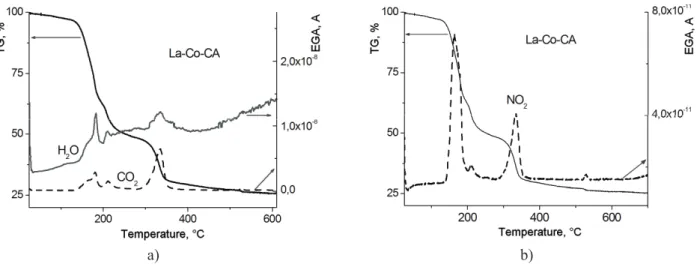
The thermal decomposition of the gel precursors af-ter drying at 80°C was followed by simultaneous mal analysis (thermogravimetry and differential ther-mal analysis) coupled with a mass spectrometer for the analysis of evolved gases (EGA). The TG/EGA curve for the La-Co-CA gel is presented in Fig. 3. The TG/ EGA results show that the complex gel decomposes at two different temperatures (200°C and 350°C), with the
evolution of the same gases (NO2, CO2 and H2O). This
means that the water, citric acid and nitric reagents are bound on two different ways in the complex gel. The initially proposed formula based on literature [10] date was the following:
[LaCo(C6H5O7)y+x(H2O)6-y-x] [(NO3)1-]
5·x+yH2O
In this formula citric acid is bound on the position of a coordinated ligand. But, based on the TG/AEG results the real formula could be the following:
[LaCo(C6H5O7)y+x-z(OH2)6-y-x (NO3)3z1-] [(C
6H5O7)z(NO3)2 1-] · x+yH
2O
In this formula citric acid and the nitrate are bound on two positions as weekly bound ligands (I) and as co-ordinated ligands (II). The decomposition of the com-plex gel occurs in the following steps:
- In the fi rst step, in the range of 150–250°C, the total weight loss was 37.84% and the weakly bound ligands were eliminated.
- In the second step, in the range of 250–400°C, the to-tal weight loss was 28.82% and the coordinated ligands were eliminated; one may assume that at 400°C the gel
precursor decomposition is fi nished.
- In the third step, in the range of 400–700°C, thetotal
weight loss was 7.30% and could be assigned to the evolution of the gases retained on the resulted oxide nanoparticles.
Figure 3. TG/EGA curves of La-Co-CA gel, evolution of a) H2O and CO2 and b) NO2
Figure 4. The XRD pattern of LaCoO3, thermally treated at 600°C (* Al holder)
a) b)
°
42
L. Predoana et al. / Processing and Application of Ceramics 3 [1-2] (2009) 39–42
Based on the thermal behaviour of the complex gel,
the thermal treatment for the obtained LaCoO3 was the
following: heating rate of 1°C/min up to 400°C with 1 hour plateau and heating rate of 5°C/min up to 600°C with 6 hours plateau.
In Fig. 4 the XRD patterns of LaCoO3 thermally
treated at 600°C are presented. The X-ray diffraction
result evidenced that the pure phase of LaCoO3 with
rhombohedral structure was obtained at 600°C.
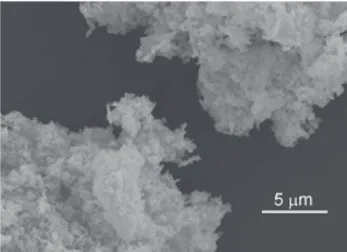
The SEM micrograph of the sample, presented in the Fig. 5 show strongly aggregated particles with
di-mensions in the 10–50 μm range.
Some preliminary investigations on the electrical properties of similar thermally treated powder were pre-viously published [9]. In the present case the protocol of changing the gases was increased to a higher number of cycles in order to achieve a better characterization of the powders (Fig. 6). Three different gases (dry helium,
DHe, dry oxygen, DO, and mixture C3H6 : air = 1 : 22,
CT) and different number of cycles (upto 4) were used. As previously determined, in the present case, at the temperatures between 20 and 400°C the sample also be-haves as an n-type semiconductor (Fig. 6).
IV. Conclusions
LaCoO
• 3 was prepared from precursors obtained by
sol–gel method using citric acid as chelating agent and nitrates as metal precursors.
The TG/DTA coupled with mass spectrometry •
showed the complex composition of the obtained gels and their decomposition in several steps. By adequate thermal treatment, based on the TG/ •
DTA results pure phase of LaCoO3 with
rhombohe-dral structure was obtained at 600°C.
The XRD results confi rmed the formation of
La-•
CoO3 with a perovskite structure.
SEM showed the agglomeration tendency of the La-•
CoO3 particles that forms porous aggregates.
In the temperature range between 20–400°C the •
sample behaves as an n-type semiconductor.
References
T. Yao, Y. Uchimoto, T. Sugiyama, Y. Nagai, “Synthe-1.
sis of (La,Sr)MeO3 (Me = Cr, Mn, Fe, Co) solid
solu-tion from aqueous solusolu-tions”, Solid State Ionics, 135
[1-4] (2000) 359–364.
H. Taguchi, S. Yamada, M. Nagao, Y. Ichikawa, K. Ta-2.
bata, “Surface characterization of LaCoO3 synthesized using citric acid”, Mater. Res. Bull., 37 (2002) 69–76. M. Popa, J. Frantti, M. Kakihana, “Characterization 3.
of LaMeO3 (Me: Mn, Co, Fe) perovskite powders
ob-tained by polymerizable complex method”, Solid
Sta-te Ionics, 154-155 (2002) 135–141.
J. Guo, H. Lou, Y. Zhu, X. Zheng, “La-based per-4.
ovskite precursors preparation and its catalytic activi-ty for CO2 reforming of CH4”, Mater. Lett., 57 (2003) 4450–4455.
C.C. Chen, C.H. Shen, R.S. Liu, J.G. Lin, C.Y. Huang, 5.
“Synthesis and characterization of the colossal mag-netoresistance manganite La1.2(Sr1.4Ca0.4)Mn2O7 by citric gel”, Mater. Res. Bull., 37 [2] (2002) 235–246. E. Bontempi, L. Armelao, D. Barreca, L. Bertolo, G. 6.
Bottaro, E. Pierangelo, L.E. Depero, “Structural char-acterization of sol-gel lanthanum cobaltite thin fi lms”, Crystal Eng., 5 (2002) 291–298.
S. Nakayama, M. Okazaki, Y.L. Aung, M. Sakamoto, 7.
“Preparations of perovskite-type oxides LaCoO3 from
three different methods and their evolution by
homo-geneity, sinterability and conductivity”, Solid State
Ionics, 158 (2003) 133–139.
N. Orlovskaya, N. Browning, A. Nicholls, “Ferroelas-8.
ticity in mixed conducting LaCoO3 based perovskites:
a ferroelastic phase transition”, Acta Mater., 51 (2003) 5063–5071.
L. Predoana, B. Malic, M. Kosec, M. Carata, M. Calda-9.
raru, M. Zaharescu, “Characterization of LaCoO3
pow-ders obtained by water-based sol-gel method with citric acid”, J. Eur. Ceram. Soc., 27 (2007) 4407–4411. J. Livage, “Sol-gel synthesis of heterogeneous cat-10.
alysts from aqueous solutions”, Catal. Today, 41
(1998) 3–19. Figure 6. Temperature dependence of LaCoO3 conductance
G during heating in various atmospheres (DHe - dry helium, DO - dry oxygen, CT – C3H6/air mixture) Figure 5. SEM image of the sample thermally treated at 600°C
°