Introduction
Many efforts have been made to the develop-ment of new chemically modified electrodes, which can be used as simple and rapid analytical test for determining concentrations of important substances. Different materials, as polymers [1], oxides [2], zeo-lites [3], inorganic or organic films [4,5], have been used to immobilize different electroactive species on electrode surfaces to use as amperometric sensors.
Humic substances are organic compounds largely distributed in natural soil and water, repre-senting about 80% of the organic matter in these sys-tems [6-8]. They result of vegetal and animal resi-dues in advanced stages of decomposition and stron-gly influence the soil properties, as capacity of ions adsorption, pH, color, heat retention, permeability, and others. Humic acids are the fraction of the humic substances that are extracted by dissolution in strongly alkaline medium and precipitated in acid medium. They are formed by molecules of high mo-lecular weigh, in a complex structure, not complete-ly understood, but basicalcomplete-ly composed by C, H, N
and O, with a more or less aromatic character. Hu-mic acids also show a large number of acid sites, car-boxylic and phenolic hydroxylic groups, which are responsible for the capacity of adsorption of cations. Due to this property, humic acids have been used as modifiers in the construction of carbon paste electrodes (CPE-HA) [9-15]. These electrodes were used to voltammetric detection of metal ions. The method is based on metal ion adsorption on the elec-trode surface at the humic acid sites, application of a negative potential to reduction and scan of potential to positive values. The current obtained due to oxi-dation is proportional to the metal ion concentration initially present at the solution. Electroanalytical techniques such as cyclic, square wave or anodic stripping voltammetry have been used to characteri-zation and use of these electrodes.
But the use of humic acids as modifiers to immobilize metal cations at carbon paste elec-trodes to act as electrocatalysts for oxidation or reduction process of other species present in solu-tion, and the use of the electrode as amperometric sensors for this specie, in our knowledge, was not
39 Ecl. Quím., São Paulo, 31(4): 39-43, 2006
www.scielo.br/eq
Volume 31, número 4, 2006
Ascorbic acid determination using a carbon paste electrode
modified with iron(III) ions adsorbed on humic acid
L. S. Silva, T. N. Oliveira, M. A. Ballin, C. R. M. Peixoto*
Departamento de Biologia e Química, Universidade Regional do Noroeste do Estado do Rio Grande do Sul (UNIJUI), Rua do Comércio, 3000, Bairro Universitário, C. P. 560, 98700-000, Ijuí, RS,Brasil.
*e-mail: [email protected].
Abstract: An amperometric sensor was constructed, by using humic acids to immobilize Fe3+ions on
a carbon paste electrode (CPE-HA-Fe), and used for ascorbic acid (H2A) determination. The cyclic
voltammogram of the electrode showed electrochemical response due to the Fe3+/Fe2+ couple at
E1/2=+0.78 VvsSCE, using 0.5 mol L-1KCl and 0.2 mol L-1acetate/0.020 mol L-1phosphate buffer,
at pH = 5.4, as supporting electrolyte. When H2A is added to the electrolyte solution it is observed an oxidation process. The oxidation current, obtained by chronoamperommetry at +0.87 Vvs SCE, is proportional to the concentration, represented by the equation I(µA) = 7.6286 [H2A] (mmol L-1) +
1.9583, r= 0.9996, for concentrations between 0.0 and 1.4 mmol L-1. The electrode showed high
stability and was used for H2A determination in a natural orange juice.
reported in the literature. This is the objective of this work. It was described the construction of a carbon paste electrode modified with humic acids to immobilize iron(III) ions and the use as amper-ometric sensor to determine ascorbic acid (H2A).
Experimental details
Reagents and apparatus
L-ascorbic acid (Reagen), Fe(NO3)3.9H2O
(Vetec), and other chemicals were of analytical rea-gent grade. All electrochemical measurements were performed on a potentiostat model MQPG-01 (Microquímica). A three electrode system was used, with a platinum sheet and saturated calomel elec-trode (SCE) as auxiliary and reference elecelec-trodes, and a carbon paste electrode with Fe3+ions
immo-bilized by use of humic acid (CPE-HA-Fe) as a working electrode. As supporting electrolyte, 0.5 mol L-1potassium chloride (Reagen) and 0.2 mol L -1sodium acetate (Merck)/0.02 mol L-1sodium
phos-phate (Merck) buffer were used, with the pH con-trolled by addition of 6 mol L-1acetic acid (Merck)
or NaOH (Synth). All solutions were prepared with distilled and deionized water, in a Quimis system, and the measurements were made in N2 (White
Martins) atmosphere at 25ºC.
Preparation of the carbon paste electrode Humic acid was extracted from a soil sam-ple collected in a drained bog in Coronel Bicaco city, Rio Grande do Sul state, Brazil (27º42’56” S, 53º42’05” W). The soil sample was air dried and triturated. The organic matter amount was deter-mined by heated sulphocromic solution oxidation and spectrophotometric Cr3+ determination [16].
Humic acid was extracted in accord with the stan-dard method recommended by the International Humic Substances Society (IHSS) [8], using 1 mol L-1NaOH for dissolution, HCl until pH=1 for
pre-cipitation, and purification with HF/HCl 1%. Ash content in the extracted humic acid was deter-mined by calcinations at 700ºC for 5h.
Iron(III) ions were adsorbed on the humic acid by addition of the solid sample (100 mg) to 50 mL of 2x10⁻²mol L-1Fe(NO
3)3.9H2O solution, at
pH=6.5 (adjusted with 6 mol L-1HNO
3or NaOH
solutions). The mixture was stirred for 10 h, and the solid was filtered, washed and dried on vacu-um at 45ºC for 15 h. This material will be repre-sented by AH-Fe. The amount of iron ions adsorbed was determined by calcinations of the
solid at 750ºC for 7 h. The residue was dissolved in concentrated HNO3, and the volume was com-pleted to 25 mL with 1 mol L-1HNO
3. The iron
content was determined by atomic absorption spectrometry using a Perkin Elmer spectrometer.
Finally, the carbon paste electrode, CPE-HA-Fe, was constructed by mixing 10 mg of graphite powder (Merck), 5 mg of AH-Fe and one drop of mineral oil (Nujol).
Electrocatalytic determination of L-ascorbic acid For the electrocatalytic studies, L-ascorbic acid was added to the supporting electrolyte solution at the desired concentrations. To analyze H2A in a real sample, a natural juice obtained directly from orange was used. The H2A concentration was deter-mined by chronoamperometry using the CPE-HA-Fe electrode and the results were compared with the results obtained by the iodometric method [17]. The measurements were repeated forty times.
Results and Discussion
Soil and humic acid characterization
The soil sample organic matter content was 7.1%, and it was obtained 0.94% of humic acid in the extraction process. Practically no ash was found in the extracted humic acids, indicating that the extraction was efficient. The content of iron ions adsorbed by the humic acid was 0.57 mmol g-1.
Electrochemical characterization of the CPE-HA-Fe In Fig. 1a is represented the cyclic voltam-mogram obtained for the CPE-HA-Fe electrode. It was observed a reversible process at E1/2= +0.78 V vsSCE, where E1/2is the half-wave potential, E1/2
= (Epa+ Epc)/2, and Epaand Epcare anodic and the cathodic peak potentials. The peak separation between the two peak potentials was 0.27V, at a scan rate of 10 mV s-1. This response may be
attrib-uted to the Fe2+/Fe3+ process. No response is
observed for the electrode constructed with humic acid with no Fe3+ions (CPE-HA) (Fig. 1c).
The half-wave potential at this positive region indicates that the Fe2+is the species present
at the humic acid sites, indicating that there is reduction of the Fe3+ions when adsorbed. In
stud-ies reported on literature it was also observed the capacity of humic acids to reduce Fe3+ions [18].
Fig. 2 shows the dependence of E1/2 with
pH. Decreasing pH, E1/2 shifts to more positive values. The same dependence was also observed
41 Ecl. Quím., São Paulo, 31(4): 39-43, 2006
Figure 1. Cyclic voltammogram of the CPE-HA-Fe electrode in absence (a) and presence of 2 mmol L-1ascorbic acid (b), and of the CPE-HA electrode in absence (c) and presence of 2 mmol L-1ascorbic acid (d); pH = 5.4; scan rate of 10 mV s-1.
for Fe3+/Fe2+couple in solution. In cyclic
voltam-metric experiments using Fe(NO3)31 mmol L-1at
the same solution conditions, it was observed E1/2=-0.25 and +0.35 VvsSCE at pH values of 6.5 and 2.0, respectively. It indicates that this depend-ence of E1/2with pH is not due to specific interac-tion of the ion with the humic acid, and is in accord with the literature, which attributes the eas-ier oxidation of Fe2+ at higher pH values to the
hydroxo complex formed by the Fe3+specie [19].
Comparing E1/2observed for Fe3+/Fe2+couple in
solution and adsorbed in the humic acid it is observed more positive values for the humic acid immobilized ions, indicating that complexation to the carboxylate groups stabilizes the Fe2+specie.
Electrocatalytic determination of L-ascorbic acid When H2A is added to the electrolyte solution, it is observed an increase in the anodic and a little decrease in the cathodic peak current Figure 2. Half-wave potentials (E1/2) obtained, by cyclic voltammetry at scan rate of 25 mV s-1, for the CPE-HA-Fe electrode at different pH values.
in the cyclic voltammogram (Fig. 1). It is due to electron transfer from dissolved H2A to oxidized immobilized Fe3+ ions, indicating
electrocataly-sis of the H2A oxidation. Using CPE-HA
elec-trode significant H2A oxidation is observed only at higher potentials (Fig. 1d).
In Fig. 3 is shown the intensity of the cur-rent observed for H2A oxidation as a function of
the applied potential, obtained by chronoamper-ometry. It is observed that the electrocatalytic process begins at +0.2 V, and the current increases until +0.87 VvsSCE. At more positive potentials the current remains constant.
The current (I), obtained by chronoamper-ommetry, for H2A oxidation at a fixed potential
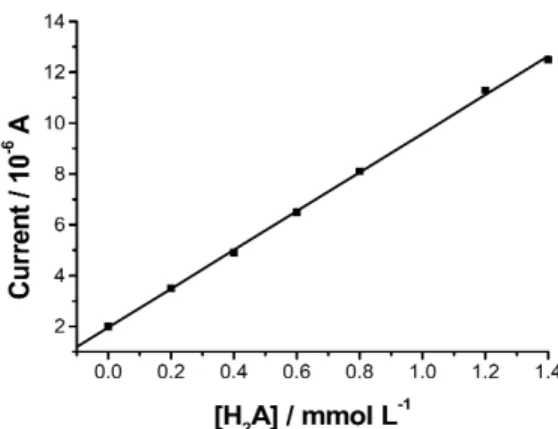
(+0.87 V vs SCE), is shown in Fig. 4. It was obtained a linear relationship with the concentra-tion of dissolved H2A in aqueous solution,
described by the equation I(?A) = 7.6286 [H2A] (mmol L-1) + 1.9583, with a linear correlation
coefficient r = 0.9996, for H2A concentrations between 0.0 and 1.4 mmol L-1. In accord with this
result, this electrode is proposed to be used as a sensor for ascorbic acid in aqueous solution.
Recovery test was performed using a natu-ral orange juice, and the result was very good. The H2A concentration obtained, using
chronoamper-ommetry, by the CPE-HA-Fe electrode was 42.1±1.8 mg/100 mL, and by the use of iodomet-ric method [17] was 42.9±2.2 mg/100mL.
The CPE-HA-Fe electrode showed high stability. It was used continuously for 52 h and no decrease in the peak currents was observed. After 52 h there is a gradual decrease of the current, and after 180 h the response is not observed anymore, and is necessary renovation of the surface.
42 Ecl. Quím., São Paulo, 31(4): 39-43, 2006
immobilize Fe3+ions on a carbon paste electrode.
The metal ion maintained the electrochemical response and the capacity of electron transfer, demonstrated by the electrocatalysis of the ascor-bic acid oxidation. The high stability of the elec-trode and linearity of the current with the concen-tration of the ascorbic acid permitted the use of the electrode as an amperometric sensor.
Humic acid is an abundant material on the nature and may be obtained at low cost. This study demonstrates that humic acid is a suitable materi-al for immobilizing metmateri-al ions on electrodes. Other electrodes may be constructed using other metal ions to be used as sensors for other species.
Acknowledgements
L. S. S. is indebted to FAPERGS for a fel-lowship.
Recebido em: 28/09/2006. Aceito em: 17/11/2006.
Conclusions
The humic acid was very efficient to
L. S. Silva, T. N. Oliveira, M. A. Ballin, C. R. M. Peixoto. Determinação de ácido ascórbico usando eletrodo de pasta de carbono modificado com ions ferro(III) adsorvidos em ácido húmico.
Resumo:Um sensor amperométrico foi construído, usando-se ácidos húmicos para imobilização de íons Fe3+em eletrodo de pasta de carbono (CPE-HA-Fe), e usado para determinação de ácido
ascór-bico (H2A). O voltamograma cíclico do eletrodo apresentou resposta eletroquímica devido ao par
Fe3+/Fe2+a E
1/2=+0.78 VvsECS, em eletrólito suporte KCl 0,5 mol L-1e tampão acetato 0,2 mol L-1
/fosfato 0,020 mol L-1, a pH = 5,4. Quando H
2A é adicionado à solução eletrolítica é observado
proces-so de oxidação. A corrente obtida cronoamperometricamente a +0,87 VvsECS, devido ao processo de oxidação, é proporcional à concentração, de acordo com a equação I(?A) = 7,6286 [H2A] (mmol L-1)
+ 1,9583, r= 0,9996, para concentrações entre 0,0 and 1,4 mmol L-1. O eletrodo apresentou alta
esta-bilidade e foi usado para determinação de H2A em suco de laranja natural.
Palavras-chave: eletrodo de pasta de carbono; ácidos húmicos; íons ferro(III); ácido ascórbico.
References
[1] J. O. Pontólio, N. Ferranti, M. L. A. M. Campos, and J. R. [2] Romero, J. Electroanal. Chem. 584 (2005) 124.
[3] W. S. Cardoso, and Y. Gushikem, J. Electroanal. Chem. 583 (2005) 300.
[4] M. M. Ardakani, Z. Akrami, H. Kazemian, and H. R. Zare, J. Electroanal. Chem. 586(2006)31.
[5] M. H. Pournaghi-Azar, and H. Nahalparvari, J. Electroanal. Chem.583 (2005) 307.
[6] X. Lin, C. Jiang, Anal. Sci. 22 (2006) 697.
[7] F. J. Stevenson, Húmus Chemistry: Genesis, composition, reactions, John Wiley & Sons, INC., New York, 2a ed., 1994. [8] J. C. Rocha, A. H. Rosa, Substâncias Húmicas Aquáticas, Inte-ração com Espécies Metálicas, Ed. Unesp, São Paulo-SP, 2003. [9] R. S. Swift, in: Methods of Soil Analysis Part 3: Chemical Methods (SSSA Book Series No.5.), Sparks, D.L. ed., SSSA and ASA, Madison, WI, 1996.
[10] M. O. O. Rezende, and F. N. Crespilho, Quim. Nova 27 (2004) 964.
[11] W. T. L. Silva, C. Thobie-Gautier, M. O. O. Resende, and N. El Murr, Electroanalysis 14 (2002) 71.
[12] C. Wang, B. Zhu, and H. Li, Electroanalysis 11 (1999) 183. [13] C. Wang, H. Zhang, Y. Sun, and H. Li, Anal. Chim. Acta 361 (1998) 133.
[14] Q. Y. Sun, C. M. Wang, L. X. Li, and H. L. Li, Fresenius J. Anal. Chem. 363 (1999) 114.
[15] Z. Navratilova, and P. Kula, Anal. Chim. Acta 273 (1993) 305. [16] C.D. García, and P.I. Ortiz, Talanta 61 (2003) 547. [17] M. J. Tedesco, C. Geanello, C. A. Bissani, H. E. Bohnen, and S. A. J. Volkweiss, Análises de Solo, Plantas e Outros Materiais, Departamento de Solos, Faculdade de Agronomia, Universidade Federal do Rio Grande do Sul, Porto Alegre, RS, 1995. [18] IMESP, Normas Técnicas do Instituto Adolfo Lutz, São Paulo, SP, Brasil, 1985.
[19] G. Sposito, The Chemistry of Soils, Oxford University Press, New York, 1989.
[20] F. A. Cotton, G. Wilkinson, C. A. Murillo, and M. Bochmann, Advanced Inorganic Chemistry, sixth ed., John Willey & Sons, Inc., New York, 1999.