Mercator, Fortaleza, v. 14, n. 2, p. 99-118, mai./ago. 2015.
THE SHARED MANAGEMENT OF TRANSBOUNDARY WATERS,
BRAZIL AND COLOMBIA
a gestão compartilhada de águas transfronteiriças, Brasil e Colômbia
Christian Ricardo Ribeiro * Oscar Buitrago Bermúdez **
Antonio Cezar Leal ***
Abstract
If in the internal area of the States the complexity that wraps the rational use of the waters is enormous, in the actions of international nature the formulation of rules becomes necessary to make possible the harmonious conciliation of particular interests of the involved States. This study aims to analyze the management of transboundary waters of Brazil and Colombia, countries that stand out for their signiicant water availability and because they share the waters of the Amazon Basin. For this proposal, we intend to analyze the legal framework and institutional arrangements of water resource management speciic to these countries, trying to recognize the consistencies and divergences, as well as the challenges and possible improvements in the sustainable management of transboundary waters of Brazil and Colombia, even taking into account the path followed by the two countries regarding the issue, especially around the Amazon Cooperation Treaty.
Key words: Transboundary waters; Amazon Basin; shared management
Resumo
A complexidade que envolve o uso racional das águas nas ações de natureza internacional torna indispen-sável o estabelecimento de regras norteadoras que possibilitem a conciliação harmoniosa dos interesses particulares dos Estados envolvidos. Assim, este trabalho se propõe a analisar o gerenciamento das águas transfronteiriças de Brasil e Colômbia, países que se destacam por sua signiicativa disponibilidade hídrica e por compartilharem águas da Bacia Hidrográica Amazônica. Para tanto, analisa-se o arcabouço legal e o arranjo institucional da gestão de recursos hídricos especíicos destes países, buscando-se reconhecer as congruências e divergências existentes, bem como os possíveis avanços e desaios para o gerenciamento sustentável das águas transfronteiriças de Brasil e Colômbia, inclusive levando-se em conta a trajetória já percorrida por esses países no que tange à questão, destacando-se aí o Tratado de Cooperação Amazônica.
Palavras-chave: Águas transfronteiriças; Bacia Amazônica; Gestão compartilhada.
Resumen
Si en el ámbito interno de los Estados la complejidad que envuelve el uso racional de las aguas es grande, en las acciones de naturaleza internacional será indispensable el establecimiento de reglas orientadoras que posibiliten la conciliación armoniosa de los intereses particulares de los Estados involucrados. Así, este trabajo se propone analizar la gestión de las aguas transfronterizas compartidas por Colombia y Brasil, paí-ses que destacan por su signiicativa disponibilidad hídrica y por compartir aguas de la cuenca hidrográica Amazónica. Para ello, se analiza la estructura legal e institucional de la gestión de los recursos hídricos especíicos de estos países, buscando reconocer las congruencias y divergencias existentes, así como los posibles avances y desafíos para la gestión sustentable de las aguas transfronterizas de Brasil y Colombia, inclusive teniendo en cuenta la trayectoria ya realizada por esos países en lo que tiene que ver con el tema, destacándose el Tratado de Cooperación Amazónica.
Palabras-clave: Aguas transfronterizas; Cuenca Amazónica; Gestión compartida.
(*) Master in Geography from Universidade Estadual Paulista - Avenida Eugênio do Nascimento, s/n.°, Juiz de Fora (MG), Brazil. Zip Code: 36038-330. Phone: (+55 32) 3239-3700 - [email protected]
(**) Professor Ph. D. of Universidad del Valle - Ciudad Universitaria, Calle 13 # 100 - 00, Ediicio 38 - Departamento de Geografía, Cali, Colombia. Phone: (572) 3212189 - [email protected]
100
Mercator, Fortaleza, v. 14, n. 2, p. 99-118, mai./ago. 2015. RIBEIRO, C. R.; BERMUDEZ, O. B.; LEAL, A. C.
INTRODUCTION
The big problem regarding water scarcity in a large part of the world is related, among other factors, to the unequal distribution of water resources with regards to population concentration. In
this sense, Latin America stands out; a privileged subcontinent in terms of water availability, but not exempt of problems associated with water resources management in the planet. Latin America
is the region that experiences the most comfortable relation between water availability (in 1000 m3) and number of inhabitants in the world. South America stands for 6% of the global population
and 26 % of the global water availability (UNESCO, 2004).
South America also includes some of the richest countries in water reserves of the entire planet.
Among them, Brazil ranked irst place worldwide in terms of rivers discharge (6220 km3/year),
and Colombia ranked eight place worldwide regarding this (1200 km3/year). In addition, both are
classiied as water rich countries (between 10000 and 100000 m3/inhab./year) and as low-use level (between 100 and 500 m3/inhab./year) (MARGAT, 1998). The attention of this research is set upon
these two countries.
Brazil, a country of continental dimensions and with a great diversity of biomes, has a
terri-tory of 8,514,876.599 km2 and a population of 190,732,694 inhabitants, according to Demographic Census of 2010 of Instituto Brasileiro de Geograia e Estatística [The Brazilian Institute of Geography
and Statistics] (IBGE). The predominantly humid climate in great part of the country provides the maintenance of a dense hydrographic network constituted by rivers of high volume of water. The country stands out in the global scenario because of fresh water discharge of its rivers, whose water
production is 177900 m3/sec. When added to the 73100 m3/sec of the remaining Amazon Basin in
other countries, it represents 53% of the fresh water production in the South-American continent
(334000 m3/sec) and 12% of the worldwide total (1,488,000 m3/sec) (COSTA, 2007, p. 06).
Colombia, strategically placed in the center of American continent, has a territory of 1,141,748
km2 and a population of 45,508,205 inhabitants, according to data of Demographic Census of 2005 of Departamento Administrativo Nacional de Estadísticas (DANE). Due to its geographic location
and its terrain conditions, it accounts with an yearly mean precipitation close to 3000 mm, much
greater than the world’s mean of 900 mm and to the 1600 mm of South America’s mean. Such precipitation equals to the yearly water volume of 3425 km3, of which 61% converts to runof, ge
-nerating a yearly volume of 2113 km3, with outlows that range between 1 to 100 l/sec/km2. Only 40% of the water ofer are necessary to maintain the ecosystems and preserve them (MINISTERIO DO MEIO AMBIENTE, 2003).
Colombia and Brazil experience a similar quantity of total renewable water per inhabitant.
However, there is a great diference in the conditions of these resources among these two countries.
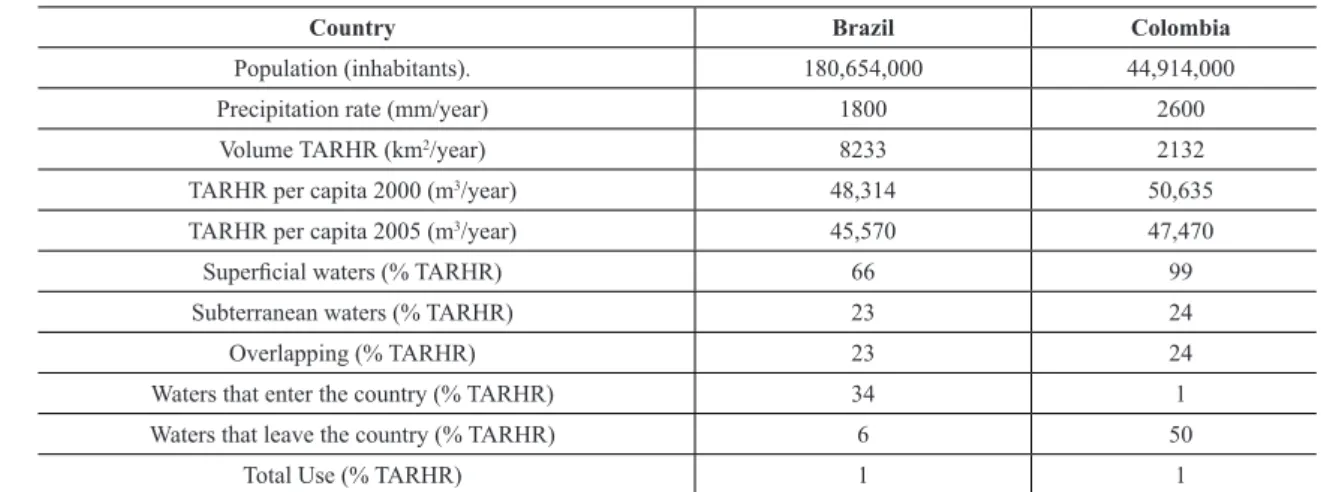
Taking into account the Table 1, it’s seen that 34% of the waters of Brazil come from other countries,
while in Colombia these correspond only to 1%. Otherwise, the water quantity that leaves Brazil is
6%, while in Colombia this value is 50%. It can be highlighted from this analysis that Brazil has a middle level of water dependency, while Colombia can be considered a water producing country.
Brazil and Colombia, together with other six countries in South America, share one of the lar-gest hydrographic basins in the world, the Amazon River basin, with a surface of approx. 7,050,000 km², mostly covered by the Amazon Forest. Even that there are not solid legal bases that obligate
countries to irm agreements for the integrated management and planning of the transboundary
hydrographic basins, the good intentions showed in bilateral or multilateral agreements between
the two countries are the most concrete evidence, which many times don’t have the binding efect with the state policies (DOUROJEANNI, 2010). Amazon Basin is a common point of interest to
eight South-American countries whose sovereign limits are overlapped regarding to it. Thus, this
101
procedures and the dynamization of common decision execution taken by these countries in relation to the region.
Table 1 – Renewable water resources availability in Brazil and Colombia
Country Brazil Colombia
Population (inhabitants). 180,654,000 44,914,000
Precipitation rate (mm/year) 1800 2600
Volume TARHR (km2/year) 8233 2132
TARHR per capita 2000 (m3/year) 48,314 50,635
TARHR per capita 2005 (m3/year) 45,570 47,470
Supericial waters (% TARHR) 66 99
Subterranean waters (% TARHR) 23 24
Overlapping (% TARHR) 23 24
Waters that enter the country (% TARHR) 34 1
Waters that leave the country (% TARHR) 6 50
Total Use (% TARHR) 1 1
Note: TARHR (Current Total of Renewable Water Resources); it relects the available water resources, in theory, for
the development proceeding from every source in the country.
Source: UNESCO (2008).
The creation of a common structure by these countries gains special relevance when is taken into account that the hydrographic basin has been adopted in the world, for a while, as a water
resources management and planning unit. The natural lows do not obey the limits established by
human societies, what draws us to the conclusion that activities developed in areas situated upstream
of the boundary will signiicantly afect the quality and quantity of waters downstream this region.
To interpret the river and its drainage basin as an integral unit results in the consideration that the
artiicial line draw to establish territories of diferent countries must play a role less signiicant in the
integral management and planning of the transboundary waters. Thus, the elaboration of common forums of governability and governance is a challenge to neighboring countries, what would permit the suitable administration of transboundary hydrographic basins, assuring its integral conservation and preservation and avoiding the loss of resources.
Therefore, the celebration of local or regional agreements in transboundary areas requires the previous knowledge of the management systems of natural resources of the involved countries, the inventory of transboundary resources and the comparison of institutional and juridic benchmarks
related to the management of water resources, making possible the prevention of conlicts and the
optimization of equal distribution of gains for its respective populations.
ENVIRONMENTAL AND WATER RESOURCES MANAGEMENT IN BRAZIL AND COLOMBIA
Environmental and water resources management systems in Brazil
The Federal Act no. 6938, dated August 31, 1981, that deals with the National Environment Policy, was responsible for the institution of the National Environment System (SISNAMA), composed by Federal, State, Federal District and Municipal bodies and entities, as well as by foundations instituted by the Public Authority, responsible for the protection and the improvement
of the environmental quality in Brazil. In terms of political and administrative organization, Brazil
102
Mercator, Fortaleza, v. 14, n. 2, p. 99-118, mai./ago. 2015. RIBEIRO, C. R.; BERMUDEZ, O. B.; LEAL, A. C.
is constituted by the following bodies: Conselho de Governo [Government Council] (superior body), Conselho Nacional do Meio Ambiente [National Environment Council] (consultative and deliberative body), Ministério do Meio Ambiente [Environment Ministry] (central body), Instituto Brasileiro do Meio Ambiente e dos Recursos Naturais Renováveis [Environment and Renewable Natural Resources Brazilian Institute] (executive body), state bodies or entities (sectional bodies)
and municipal bodies or entities (local bodies).
The Article 4th deined the instruments of the National Policy for the Environment, that in -clude, among others, the establishment of environmental quality patterns; environmental zoning;
environmental impacts assessment; licensing of activities that are efectively or potentially polluting;
creation of protected areas; the national system of information regarding environment; compensatory
or disciplinary penalties in not fulilling the required measures to the preservation or correction of
environmental degradation; and economic instruments, like forest concession, conservation ease-ment, environmental insurance etc.
Even if it is important to recognize the multiple and signiicant advances already performed in Brazil in the environmental matter area, primarily from the promulgation of the National Environ
-mental Policy and the implementation of the National Environment System, it is impossible not to
highlight that one of the largest challenges to be faced by the country is the necessary integration between the environmental management system and the water resources management system. In
fact, separation and poor integration between the two systems ind their origins in the promulga
-tion of the irst relevant legal benchmark for the waters management in Brazil, Código de Águas [Waters Code], of 1934 (Federal Decree no. 24,643/1934). Besides being old and criticized for the
incitation for the sectoral management of water, the Code was groundbreaking in establishing some concepts and instruments currently conceived as modern, such as water use charging (user pays principle; Article 36, paragraph 2nd), the polluter pays principle (Article 110), the right of water resources use grant (Article 43), the prioritized water use for public supply (Article 36) and the
multiple waters use (Article 51, letter a). For that time, the Water Code established a very complex
an modern water policy.
The Code was instituted in a moment where Brazil was performing the transition between a primary commodity exports economy and a urban-industrial economy, requiring an enhancement in hydroelectric energy production in order to supply and dynamize the industrialization process, reason why it can be stated that “despite of very advanced for that time, the Code led to a subordination of the water management to the interests of the electric energy sector, jeopardizing the integrated
management of water resources” (MAGALHÃES JÚNIOR, 2007, p. 122).
The inluence of global processes linked to environmental protection was relected in a gra -dual and slow way in Brazil, specially in what concerns the worries about the water resources conservation and preservation in their quantitative and qualitative aspects. Re-democratization
and awareness with respect the environmental degradation in the international scope signiicantly
contributed to the increased relevance that the environmental matter had in the country coming from
the state sphere. Thus, in the Federal Constitution of 1988, the environmental matter gains a speciic
chapter, based on the general principle that “everyone has the right to the ecologically balanced environment, a common use asset of people, and essential to healthy quality of life, remaining to
the Public Authority and the collectivity the duty of defending it and preserving it for the current a future generations” (BRASIL, 1988).
The Federal Constitution of 1988 therefore relected the environmental debate modernization
in Brazil, stating that the environmental conservation is directly linked to the development process. The Constitution sets the legal basis of water management in Brazil, determining the legal regimen of watercourses and the administrative and legal competences of the federation units. Setti (2005,
p. 151) believes that the Federal Constitution of 1988 elevated the water resources to a special care
103
competence of instituting a national water resources management system and deining the criteria
of granting the rights of its use.
In a decade in which the debates about the need of a policy and a water management system
were started in the country, the Constitution conirmed the water public domain in Brazil (federal
and state waters) and established the hydrographic basin as a basal territorial unit for the water re-sources planning and management. This is an important aspect because, currently, one of the main instruments for the functionality of the Union domain rivers Hydrographic Basins Committees refers to the fact that, “in practice, the issue of the waters domainality has been constituted as an enormous challenge for the implementation of the water resources management in basins shared
by the Union and the Federation units, and a great opportunity for the Federative Pact exercise”
(MMA, 2006, p. 51).
In 1997 the Federal Act no. 9433 was promulgated, instituting the National Water Resources Policy and the National Water Resources Management System, organizing the planning sector and the water management in the country. The Federal Constitution of 1988 had already foreseen the Union competence for the creation of this system. Lei das Águas [Water Act], the name it became known by, relected “the environmental and institutional crises derived from the irrational use history, water quality degradation and decrease of water supplies in the country” (MAGALHÃES JÚNIOR, 2007, p. 134). The paradigm of water ofer continuous increase and environmental problems struggle
based on palliative measures motivated the seek for water management modernization.
The National Water Resources Policy sets for, in its Article 3rd, some general guidelines for the implementation of the National Water Resources Policy, of which can be highlighted those lines
concerning water resources management articulation with other sectors, specially environmental management, user sector, use of soil and the estuarine systems and coastal zones. Muñoz (2000,
p. 17) states that these matters have not been suiciently handled in the debate that aims to obtain subsidies for the regulation of the Federal Act no. 9433/1997 or to enhance the efective law; but
also recognizes that they are essential for the success of the concrete implementation of the water resources policy because they are aspects said to be of horizontal coordination in the planning and management process.
The approach of integration between environmental and water resources management seems to be inevitable as long as the later constitutes environmental resources. Therefore it acknowledges the
Federal Act no. 6938/1981 (National Environment Policy), by including among the environmental resources, in its Article 3rd, the atmosphere; the interior, supericial and subterranean waters; the estuaries; the territorial sea; the soil; the subsoil; the biosphere elements; the fauna and lora. Because
of that, many understand that the water resources management should be part of the
environmen-tal management performed by SISNAMA. Nevertheless, this is not a generalized understanding. Nowadays, not rarely, but mostly in the common language, the environmental management is
understood in a strict sense. Muñoz (2000, p. 18) emphasizes that the environmental management
is practically identiied with pollution control and fauna and lora protection; in this way, issues such as use conlict administration and water use charge would not be competence of SISNAMA.
Even taking into account that waters management process is recent in the country, what makes that many gains and additions may be recognized only in few years, many identify the absence of strategies, even future ones, for the implementation of a shared and integrated management of the
common interests that rely on a hydrographic basin, as a result of economic, inancial, technical and institutional limitations of the local representatives and of the conjunctural, social and iscal instability of the country (GRISOTTO e PHILLIPPI JÚNIOR, 2003, p. 02).
The specialization of water resources management in an own system constitutes an advance. But it should be highlighted that the law, by anticipating the creation of hydrographic basin agencies as executive bodies of water resources policy, has permitted the institution of a body with similar competences to those of the municipalities, as the municipal territory management is responsibility
104
Mercator, Fortaleza, v. 14, n. 2, p. 99-118, mai./ago. 2015. RIBEIRO, C. R.; BERMUDEZ, O. B.; LEAL, A. C.
allow for the action integration in environmental management with water resources management, taking into account that all the actions to be implemented for the improvement of the quantity and
quality of water should be performed in the municipal territory” (FARIA, ROCHA E GOMES,
2007, p. 06).
Environmental Management System in Colombia
There is not an independent structure that manages water in an uniied way in Colombia;
however, it is possible to identify multiple rules that establish actions regarding this resource. It is possible to identify responsible persons and responsibilities, action levels, instruments and pro-cedures that, acting together, allow for the visibility of the coherent structures related to national
policies, even that they are not related among them. Water management in Colombia obeys envi -ronmental policies coming from the State, that develop themselves in rules of sectoral, vertical and descendent character, what is explained by the fact that the country organizes itself politically and administratively as an unitary republic, in which sovereignty is not divided, with a single center of authority that takes all the political decisions and has the monopoly of the applicable law rules
elaboration throughout the territory and with respect to every citizen. The Political Constitution of 1991 indicated decentralization as a mechanism for regional development, but this is a process
that advances and recedes with changes in government. It also recognizes a high fragmentation of institutionality due to continued transformations of institutional structures, which are a result of
the current tendencies of State modernization, a fact that brings diiculties in providing cohesion
to public management, whether vertically or horizontally.
The last two decades of the 20th century have brought strong political reforms to the country,
that were recorded in the National Constitution of 1991. The diferent international agreements and
conferences executed by the country direct the new way of acting in environmental management. There are approximately 60 articles in the Constitution that handle with natural resources and en-vironmental matter, but the essential aspect lies on recognizing the right to a healthy environment as a collective right, establishing the ecological and social function of the property, and attributing
to the State and the individuals the responsibility regarding National natural riches protection (MI
-NAMBIENTE, CVC, 2002).
National Politics Constitution of 1991 deines the responsibilities of the State and the attri
-butions of the diferent territorial beings. In general terms, the Constitution requires from the State
the sustainability assurance of ecosystems and natural resources: It is State responsibility to protect the environment integrity and diversity, to conserve areas of special ecological importance and to
foment the education needed for the achievement of these purposes (Article 79); the State will plan
the management and the use of natural resources, in order to assure its sustainable development, conservation, restoration or replacement. In addition, it should prevent and control the environmental degradation factors, impose legal sanctions and require the reparation of damages caused. In the same way, it will cooperate with other nations in the sense of the protection of ecosystems placed in transboundary zones (Article 80); the general well-being and the improvement of the quality of
life of the population are State social responsibilities. The solution of the non-fulilled needs on
health, education, environmental health and drinking water will be the essential objective of its activity (Article 366).
Although not being listed in the National Constitution of 1991, water in Colombia has always
been considered a natural resource, but its relevance in conditions of potability is also notable,
something necessary for social well-being (MINAMBIENTE, CVC, 2002). Because of the type
of political and administrative organization of Colombian State, water is managed both in sectoral spheres and territorial spheres. Sectorally, its management primarily lies on the Ministry of
105
Based on the Article 80 of the National Constitution, the Law no. 99 of 1993 was promulgated, which organizes the environmental sector of the country and creates the National Environmental System (SINA), established from the management cycle based on coordinated tasks of knowing, planning, executing and assessing. SINA is conformed by the set of guidelines, rules, activities,
resources, programs and institutions that permit the execution of general environmental principles
contained in the Law no. 99/1993. Therefore, it was created a Ministry in charge of the formulation and direction of environmental policies based on scientiic information, ive research institutes that generate scientiic knowledge, 34 sustainable development autonomous regional corporations
(CARs) and four environmental units of the largest urban centers. Territorial entities of the country
also take part of SINA, i.e. departments, districts, municipalities and ethnic groups territories that have functions of execution. (MINAMBIENTE, CVC, 2002). In addition, SINA incorporates state control institutions, such as National Control Authority. Contraloria General de la República (CGR)
is the highest body of tax control in the State. As such, it has the obligation to provide the good use of public assets and resources and to contribute to the State modernization, pursuant to actions of continued improvement of distinct public entities. It could be stated that the most involved state structure in the water resources planning and management is the environmental sector.
In the national sphere, MAVDT is the body in charge of formulating the national environmental policy and deining the policies and regulations regarding recovery, conservation, ordinance, use,
handling and improvement of national environment and natural resources. Because of this, it is the Ministry’s responsibility to elaborate functions of regulation of the general character for restoration and recovery of natural resources, reduction of water resources pollution and conservation, preser-vation and handling of the environment. Besides, it is responsible for establishing the maximum permitted limits of emission, discharge, transport of substances, products, compounds or any other
matter that can afect the environment or renewable natural resources; in the same way, it is its duty
to prohibit, to restrict or to regulate the manufacture, distribution, use, disposition or reject of subs-tances that cause environmental degradation (Article 5, number 25) or to determine the calculation
factors and to ix the minimum tarif amount of use and improvement taxes of renewable natural resources (Article 5, numbers 29 and 30).
In the regional scope, the Regional Autonomous Corporations constitute the highest environ-mental authority in its jurisdiction area and also are the policies, plans, programs and rules
(outli-ned by MAVDT) executors and, hence, are the responsible for the administration, sustainable use,
improvement, protection, vigilance and control of renewable natural resources, water including; such activities must be performed in collaboration with territorial entities of its jurisdiction, i.e. departments, municipalities and indigenous territorial entities.
Law no. 99/1993 provides Corporations some functions of highest environmental authority in
the area of its jurisdiction (Article 31, number 2). The same law also establishes that Corporations have a public character and are integrated by territorial entities that, by its characteristics, geogra-phically constitute the same ecosystem or conform a geopolitical, biogeographic or hydrographic
unit. They have administrative and inancial authority, and own patrimony, constituting legal en -tities. They are in charge of the law of administering, within its jurisdiction, the environment and
the renewable natural resources and fomenting its sustainable development (Article 23 of Law 99/1993). Currently they are not subject to or linked to the ministry, nor to any entity of national character; however, the inancial autonomy depends on the assignment of resources that diferent members of the boards of directors grant them (PONCE, 2000).
Colombian territory divides its administration in Departments, Districts, Municipalities and
Indian Territorial Entities, which have few degree of liberty with regards its territory management.
Within these limits, territorial entities have the autonomy to self-governate by means of own au -thorities, to perform the due competences, to administer the resources and to establish the required
106
Mercator, Fortaleza, v. 14, n. 2, p. 99-118, mai./ago. 2015. RIBEIRO, C. R.; BERMUDEZ, O. B.; LEAL, A. C.
According to MIMABIENTE/CVC (2002, p. 108), the instruments of environmental ma
-nagement are deined “as multiple types of mechanisms that allow for guiding the actors in the operation of its activities targeted to the fulillment of the National Environment System proposed
objectives”. As it does not exist an exclusive structure to manage water resources in the country, it
is considered that the diferent instruments proposed for the environmental administration are the
same to be used in the water resources management. The environmental management instruments used in Colombia are of many types: of command and control, based on rules that regulate the pair coercion-sanction; administrative, such as the environmental license; economic, based on the polluter pays principle; and of planning, such as the regional environmental management plans, hydrographic basins plans and municipal territorial ordinance plans.
The abundance of water in Colombia and the conlicts for its use impose an enormous challen -ge in the timepoint of establishing policies for its better use. Urban, industrial and agro-industrial development and the improvement of little and middle agriculture occur mainly in mountain ranges, right where the headwaters of almost all the main rivers of the country start, a fact that generate use
conlicts and a strong pressure on water resources.
Otherwise Colombia, despite having rules that assure the citizens participation in the public
life, is still far from incorporating them in the government processes. The development of a public institutional organization based on the congregation of the actors of consumption and production with water planning and management processes becomes urgent and necessary; as well as it is necessary to foment negotiation mechanisms between multiple water users in order to enter the process in a democratic way, before more organized sectors obtain advantages from the current water management system and its democratic conditions and reorientations imply more time, re-sources and social damage.
The situation becomes more diicult and complex in some cases in which it is veriied that the
government instances are deliberately supporting some particular private sector. For this reason, the creation or valorization of regulatory instruments and instances for multiple uses of water, based on the principles of democracy, decentralization and participation, being able to assure the satisfaction of rights of multiple users, prioritizing collective and public interests over private and individual ones. The instances and instruments should seek for the participation in distinct sectors of users and representatives from the nation, departments, municipalities and indigenous territorial entities, with
marked presence in the civil society (BUITRAGO et al., 2010). The Box 1 shows the institutional
structure of the environmental management system in Brazil and Colombia.
Comparative analysis
a) State political and administrative organization
The modern states organization permits the identiication of a territorial action and authority
distribution structure in at least three spatial scales: national, regional and local scale. The vertical
distribution of authority and its ranges in diferent scales depend on each State political and admi -nistrative organization. In this sense, there might be centralized or decentralized States. A primary
relevant diference between Brazil and Colombia resides in this aspect. Brazil is organized as a federative state, while Colombia organizes itself as a decentralized unitary state. This diference deines the competences and responsibilities that distinct territorial levels perform in almost all
sectors of public administration. The Box 2 shows the distinct level of political and administrative organization of territory in each country.
Brazil has a speciic and independent structure for water resources planning and management,
while in Colombia such competences are put in the national environmental structure. In Brazil, the
Federal Constitution of 1988 granted the Union the responsibility of instituting the National Water
107
resources management intended to be articulated to the National Environment System by means of a series of interfaces. In Colombia, nevertheless, water resources management speciicities are
diluted in environmental sector competences.
The diference in the political and administrative organization between the two countries has meaningful consequences. While Brazil experiences a federative political and administrative structure, Colombia is unitary, a fact that directly inluences the decentralization levels of the decisions-making. In Brazil, the politic of participation calls the attention by the existence of dife -rent collegiate bodies in the distinct territorial and institutional levels. In Colombia, although there
are lines in the National Constitution recognizing the participation as a democratic mechanism,
in the territorial and institutional structure a strong degree of centralization of responsibilities and decision-making is clear.
b) Water resources management institutional structure
There is another relevant diference between the two countries concerning the speciic issue of the water resources. The water resources management policies have diferent ranges for presenting diferent orders: in Brazil, they are State policies, while in Colombia they are government policies.
For this reason, it is not rare that the government changes in Colombia result in a new orientation
for the policies, with the common interests being delayed or even forgotten. In 2010, the National Water Resources Policy of Colombia was promulgated by President Álvaro Uribe Vélez, compliant to the National Development Plan (PND) 2006-2010 – “Estado Comunitario: Desarrollo para To -dos” -, that in its Chapter 5 pointed out the need for “a risk and environmental management that promotes the sustainable development”, incorporating the integral management of water resources as an action line. But, the Environment Ministry still has the competence of formulating the long term policies associated with the environment and other natural resources, a responsibility that also lies on the sphere of the government in course.
It is clear that there is a special interest for water resources planning and management in Brazil due to its fundamental role in urban and industrial development, while in Colombia the relative abundance of water resources (in a similar way regarding Brazil) and the energetic matrix of
pre-dominantly hydraulic origin have not constituted suicient conditions to separate its management
from environmental management.
Another essential diference concerns the participation in the decision-making. In the Bra -zilian water resource management system, the structure is composed by institutions with precise responsibilities and by deliberative and consultative bodies formed by State, civil society and users representatives. In this way, a structure with shared authority and decision-making together with the water management actors is formed.
In Colombia, there are collegiate bodies created by Law no. 99/1993 with direction and ad -ministration functions within the institutional structure of some environmental entities, but with restricted functions. The Corporate Assembly and the Regional Autonomous Corporations’ Board
of Directors are examples, with the environmental authority making the decisions in compliance
with the established rules, without consulting users and communities. In Colombia, community participation in many times has only an informative character.
In Brazil, the regional level competences are responsibility of the State Secretariats, but also
of the hydrographic basins committees. Nevertheless, the Secretariats responsibilities in the state
sphere are similar to the Union competences in the national sphere, while the hydrographic basin committees constitute collegiate bodies that act in the rivers hydrographic basins according to their domainality (Union domain rivers or state rivers). In Colombia, acting in the regional sphere is a
1 0 8 M e rc a to r, F o rt a le za , v . 1 4 , n . 2 , p . 9 9 -1 1 8 , m a i. / a go . 2 0 1 5 . RI B E IRO , C . R. ; B E RM U D E Z , O . B .; L E A L , A . C . Institutional scale BRAZIL COLOMBIA Government Council
To assist the President of Republic in the national policy formulation and in the governmental guidelines for the environment and environmental
resources
Environment Ministry/National Environment Council*
To formulate the national environmental policy and to deine the policies and regulations regarding recovery, conservation, ordinance, use, handling, and
improvement of the environment and natural resources
Highest body National Environment Council (CONAMA)
To assist, to study and to propose, to the Government Council, governmental policies guidelines for the environment and natural resources, and to deliberate,
in its competence scope, about compatible patterns and rules to the ecologically balanced environment,
essential to healthy quality of life.
Environment Ministry
To regulate the general conditions for environment sanitation and the use, handling, improvement, conservation, restoration and recovery of natural resources, in order to prevent, restrain, eliminate or mitigate the polluting,
deteriorating or destructive activities impact of the surroundings, and to deine
the execution of programs and projects for this purpose.
Consultative and
deliberative body Environment Ministry
To plan, to coordinate, to oversee and to control, as a federal body, the national policy and the
governmen-tal guidelines set for environment.
Environment Ministry
To plan, to coordinate, to oversee and to control, including in a inter-sectoral and inter-institutional way, as a central body, the national policy and the
gov-ernmental guidelines set for the environment.
Central body
Brazilian Institute of Environment and
Renewable Natural
Resources (IBAMA)
To execute and to enforce, as a federal body, the policy and the governmental guidelines set for the
environment.
Regional Autonomous Corpora-tions/Environment Ministry (in
some cases)
To execute the policies, plans, programs and rules outlined by the
Environ-ment Ministry, including the administraion, sustainable use, improveEnviron-ment, protecion, vigilance and control of renewable natural resources / To adminis
-ter the Naional Natural Parks System and to grant the environmental licenses for the implementaion of dams and barrages with a volume greater than 200 millions of cubic meters, irrigaion systems of more than 20 thousand hect
-ares and transfers with ouflows greater than 2 cubic meters per second.
Executive body State entities or bodies
To execute programs and projects and to control and to oversee the activities that can provoke envi-ronmental degradation. To establish envienvi-ronmental
policies in harmony with the federal legislation.
Regional Autonomous
Corpora-tions/Departments
It is responsibility of the Corporations the execution of policies, plans, pro-grams and rules outlined by the Environment Ministry, including the admin-istration, sustainable use, improvement, protection, vigilance and control of
renewable natural resources. It is responsibility of the Departments the promo -tion and execu-tion of na-tional, regional and sectoral programs and policies
related to natural resources and environment; to perform, in coordination
with other SINA entities and subject to legal distribution of renewable natural
resources and environmental functions of control and vigilance, and compe-tences
Sectional bodies Municipal entities or bodies
To control and to oversee the activities that can provoke environmental degradation. To establish environmental policies in harmony with the federal
and state legislation.
Municipal entities or bodies
To promote and execute naional, regional and sectoral policies and programs related to renewable natural resources and environment; to elaborate mu
-nicipal environmental projects, programs and plans ariculated to naional, departmental and regional projects, programs and plans; to control and to perform the vigilance over the environment and renewable environmental
resources aiming to watch for the fulillment of State duies.
Source: Federal Act no. 6938/1981 (Brazil) and Law no. 99/1993 (Colombia). Organized by the authors.
109 Sourc e: F ede ra l A ct no. 6938/ 1981 (Bra zi l) a nd L aw no. 99/ 1993 (Col om bi a). O rga ni ze
d by t
he a ut hors . * The N at iona l E nvi ronm ent Counc il ha s t he purpos
e of prom
ot ing t he int er -s ec tora l a nd i nt er -ins tit ut iona l c oordi na
tion of t
he e nvi ronm ent al pol ic ie s.
Box 2 – Distinct levels of political and administrative organization of the territory in Brazil and
Colombia
Territorial Scale Brazil Colombia
Naional Union Unitary State
Regional States and Federal District Departments
Local Municipaliies Municipaliies, Districts and Indigenous Territories
the highest level of CARs organogram there are corporate assemblies with the following
responsi-bilities: a. To elect the Board of Directors; b. To assign the iscal reviewer or the internal auditor of
the Corporation; c. To know and to approve the administration management report; d. To know and
to approve the proit and loss accounts of each annual period; e. To adopt the Corporation charters
and the reforms introduced to it.
The CARs’ Boards of Directors functions are as follows: a. To propose to the Corporate
Assembly the adoption of the charters and its reforms; b. To determine the personnel of the Cor-poration; c. To allow for the participation of the Corporation in the constitution and organization of societies or associations and foundations or the admission in the already existing ones; d. To arrange the contracting of external credits; e. To determine the Corporation internal structure; to this purpose, it may create, suppress and fuse facilities, and may grant responsibilities according to the law; f. To approve the incorporation and the subtraction of protected areas; g. To authorize the entity functions delegation; h. To approve the general plan of activities and the annual budget of
investments; i. To name of to remove, in compliance with the charters, the Chief Executive Oicer
of the Corporation. The Box 3 shows the institutional structure of the water resources management of Brazil and Colombia.
c) Instruments of water resources and environmental management
The water resources policy speciicity in Brazil results in speciic management instruments for
it. These management instruments are, in theory, strongly inter-dependent and supplemental from the conceptual point of view, and have the objective of promoting the protection and recovering of water in a hydrographic basin whose physical expression is the set of investments to be performed
there (PEREIRA, 2002). The implementation of these management instruments has demanded te -chnical, political and institutional abilities and requires participation and acceptance by the actors involved, a fact that has limited its development and success.
In Colombian, management instruments of command and control type have been created in order to prevent the water bodies contamination and to determine the payment for use of the re-source. The command and control policies implementation have, nevertheless, incurred high social costs, as the permissible limits of polluters cannot be accomplished by all polluting companies. In
addition, the lack of monitoring of the control mechanisms for the fulillment of the rule prevents the eicacy in the polluter emissions reduction and primarily determines a low level o compromise from the polluting agents (GARCIA, 2009). The Box 4 presents the water resources management
instruments adopted in Brazil and Colombia, and the Box 5 presents the water resources
1 1 0 M e rc a to r, F o rt a le za , v . 1 4 , n . 2 , p . 9 9 -1 1 8 , m a i. / a go . 2 0 1 5 . RI B E IRO , C . R. ; B E RM U D E Z , O . B .; L E A L , A . C . Institutional scale BRAZIL COLOMBIA
Entity Attribution Entity Attribution
Consultative and deliberative body
National Water Resources
Council (CNRH) Highest body of SINGREH, responsible for settling use conlicts ultimately and subsidizing the formulation of the national water resources policy. Not applicable Not applicable
Highest body
Environment
Ministry/Ur-ban Environment and Water
Resources Secretariat
Federal entity in charge of formulating the National Water Resources Policy, subsidizing the formulation of the Union budget and acting like a
executive secretariat of CNRH.
Environment Ministry
(MAVDT)
To formulate the national environmental policy and
to deine the policies and regulations with regards to
recovering, conservation, ordinance, use, handling and improvement of the environment and natural resources; to plan, to coordinate, to oversee and to control,
includ-ing in a inter-sectoral an inter-institutional way, like a central body, the national policy and governmental
guidelines set for the environment.
Central and execu-tive body
National Waters Agency
(ANA) It regulates the use of water resources in rivers in the Union domain and coordinates the implementation of SINGREH in all national territory. Not applicable Not applicable
Sectional bodies State Water Resources Council (CERH)
Highest State body, responsible for settling use conlicts in the State sphere
and subsidizing the formulation of the state water resources policy. Not applicable Not applicable
State managing body
State Water Resources
Manager
Central body and coordinator of the State Water Resources Management System, with similar competences in relation to ANA, where it can be
highlighted the granting and supervision of water resources use in the State domain.
Regional Environmental Authorities CARs
To execute the policies, plans, programs and rules out-lined by the Environment Ministry, including the ad-ministration, sustainable use, improvement, protection,
vigilance and control of renewable natural resources.
Regional collegiate body
Hydrographic Basin Com-mittee (CBH)
Collegiate constituted by the public authority, users and civil society, with competences to approve the basin plan, to follow up its execution, to es-tablish the charge mechanisms and to suggest the amounts to be charged to
CNRH.
Not applicable Not applicable
Executive body of
CBH Hydrographic Basin Agency
Executive branch of the Basin Committees, responsible for the mainte-nance of the updated water balance regarding the water resources avail-ability, the maintenance of the users record, the functionality of the charge, the management of the information system and the elaboration of the basin
plan. To implement projects, among others.
Not applicable Not applicable
Box 3 – Water resources management system institutional structure of Brazil and Colombia
1 1 M e rc a to r, F o rt a le za , v . 1 4 , n . 2 , p . 9 9 -1 1 8 , m a i. / a go . 2 0 1 5 . T h e Sh a re d M a n a ge m e n t o f T ra n sb o u n d a ry W a te rs , B ra zi l a n d C o lo m b ia
Sources: Federal Act no. 9433/1997 (Brazil) and Law no. 99/2003, Decree no. 1729/2002, Law no. 2811/1974, Decree no. 1541/1978, Decree no. 3100/2003, Decree no. 155/2004, Decree no. 1323/2007 and Decree no. 1324/2007 (Colombia).
Instrument Brazil Colombia
Water resources plans
Federal Act no. 9433/1997 sets forth that water resources plans are urban master plans that intend to base and to guide the implementation of the National Water Resources Policy and the water resources
management in national, state and basin scales. They are long-term plans, with a planning horizon compliant with the implementation period of its programs and projects.
As it does not exist a speciic structure for water resources management, the responsibilities of the water planning lie on the environmental sector. The Law no. 99/1993 grants the Corporations the responsibility of coordinating the preparation process of environmental development plans, programs and projects, being their duty to ordinate and to establish rules
and guidelines for hydrographic basins handling.
Water bodies classiication
ac-cording to pre-dominant uses
The water bodies classiication, according to the predominant water uses, has the purpose, such as deined by Article 9th of the Waters Law, of assuring to waters the quality congenial to the most de-manding uses to which they are deined and to reduce the costs of its pollution combat, pursuant to permanent preventive actions. The water bodies classes in Brazil were established by speciic
environ-mental legislation, represented by Resolution CONAMA no. 357, dated March 17, 2005.
Not applicable
Grant for water resources use
right
The grant of water resources use right is an instrument by which the user receives an authorization to make use of water, granted by the Federal or State Public Authority, conforming to the domain of
which such water body takes part. This instrument disciplines the water resources use, constituting the central element of control for the promotion of its rational use. Federal Act no. 9433/1997 states that the grant of water resources use rights intends to assure the quantitative and qualitative control of
water uses and the efective exercise of the water access rights.
The Law Decree no. 2811/1974 handles with the ways of acquiring waters and riverbed use rights. The Decree no. 1541/1978, in addition to indicating that water preservation and
handling are of public utility and social interest, also sets forth the concrete mechanisms for
grants of diferent waters in the country. The same laws set forth that waters and riverbed use rights are acquired by legal efect, pursuant to concession, permission or association.
The pertinent legislation sets forth that all people should have the right to use the public domain waters to satisfy their essential needs, as well as those from their families and
animals, as long as they do not cause damage to third parties.
Charge for water resources use
Federal Act no. 9433/1997 sets forth that the charge for water resources use has the objective of
recognizing water as an economic asset, giving user an indication of its real value; to encourage the
water use rationalization; to obtain inancial resources for the inancing of programs and interventions
stated in water resources plans. The Act institutes the social negotiation character for the implementa-tion of the charge instrument, what prevents the adopimplementa-tion, by the administraimplementa-tion, of a merely collector
nature. Hence, the Act grants the Hydrographic Basin Committees the responsibility of establishing charge mechanisms for water resources use and to suggest the amounts to be charged, by assuming a
broad process of negotiation for the implementation of this instrument.
Colombia adopts two diferent instruments for payment of water use (retributive fee and fee per use), whose payment will be destined to environmental protection.
Retributive fee: Law no. 99/1993 sets forth, in the Article 42, that direct or indirect use of atmosphere, water and soil for the introduction or releasing of agriculture, mineral or in-dustrial rejects and residues, or those from black waters or wastewaters from any origin, of fumes and vapors and of harmful substances that are result of anthropic activities, whether lucrative or not, will be subjected to the payment of compensatory fees for the harmful
consequences of the expressed activities.
Fee per use: Law no. 99/1993, in its Article 43, sets forth that fees for water use by individual or legal entities, whether public of private, will give place to the charge of fees
112
Mercator, Fortaleza, v. 14, n. 2, p. 99-118, mai./ago. 2015. RIBEIRO, C. R.; BERMUDEZ, O. B.; LEAL, A. C.
Sources: Braga (2009, p. 15) and Ministerio del Medio Ambiente (2002).
Typology Brazil Colombia
Territorial ordi-nance
Municipal urban master plan Municipal territorial ordinance plan
Hydrographic basin plan
Hydrographic basin handling and ordinance plan
Prioriizing hydrographic basins
Hydrographic micro-basin plan Not applicable
Urban forest master plan Forest zoning
Regional environmental zoning Regional environmental management plan
Municipal environmental zoning Not applicable
Conservaion units: integral protecion units and sus -tainable use units
Special handling areas: reserve forest zones; natural parks system areas; protecion, study and savage fauna propaga
-ion zones; natural resources integrated handling districts; hydrobiological species integrated handling areas; land
-scape preservaion zones; soils conservaion districts
Other legally protected areas: permanent preservaion area, ‘legal reserve’ and fountainhead protecion area
Reserve forest zone (protecive forest zones): headwater streams of small water courses; margins and hillsides with decliviies higher than 40%; strips with 50 m of width on the margins of fountainheads, watercourses and water deposits; spaces for basin protecion, dams and channels; ways of communicaion
Command and control
Environmental licensing Environmental licensing
Environmental supervision: IBAMA and Insituto Chico
Mendes
Environmental supervision: Accountability Oice of Re
-public and Atorney General’s Oice of Re-public
Water use graning Water concessions
Water use charge Fee per use and retribuive fee
Environmental compensaion Environmental compensaion linked to environmental li
-censing
Decision-making
Water bodies classiicaion Not applicable
Environmental monitoring Environmental monitoring
Water resources and environmental informaion sys
-tems Environmental informaion systems
Environmental educaion Environmental educaion
Environmental decision instances:
CONAMA, CNRH and CBHs
Environmental decision instances: Naional Environment
Council
Economics
Forest ceriicaion Voluntary forest ceriicaion
Clean Development Mechanism Clean Development Mechanism
Environmental insurance Not applicable
Ecologic ICMS Not applicable
Water producion subside Ceriicate of forest incenive and ‘forest keeper’ [
guarda-bosques] families
Box 5 – Water resources and environmental management instruments adopted in Brazil and Colombia according to
113 ADVANCES IN TRANSBOUNDARY WATER RESOURCES SHARED MANAGEMENT OF
BRAZIL AND COLOMBIA
The interest of world countries in relation to transboundary water resources management, expressed through the large number of international conferences, forums and agreements handling this matter demonstrates the lack of regulation in a global scale. The development of an institutional and juridic apparatus for the regulation of the water resources use in a international scale is one of the biggest challenges to be faced by countries that share waters, because it meets the countries
sovereignty and the prevalence of national legislation concerning the water use (RIBEIRO, 2008).
The primary agreement executed by Brazil and Colombia about the Amazon matter is the
Ama-zon Cooperation Treaty (TCA), subscribed in July 03, 1978 by both countries and also by Bolivia, Ecuador, Guiana, Peru, Suriname and Venezuela. This treaty is the juridic instrument that recognizes
the transboundary character of Amazon. From the legal benchmark established by TCA it was
crea-ted, in December 14, 1998, the Amazon Cooperation Treaty Organization (OTCA), that constitutes an international organization that coordinates, by means of its Permanent Secretariat (inaugurated in Brasilia, in May 13, 2002), procedures and dynamizes the execution of its decisions. In 1995,
amazon countries decided to institutionally empower the Amazon Cooperation Treaty (TCA) with
the creation of a Permanent Secretariat with juridical personality. However, the decision was only implemented in 1998, with the Amendment Protocol to TCA approval that oicially instituted the Amazon Cooperation Treaty Organization (OTCA) as a mechanism responsible for the improvement
and strengthening of the cooperation process developed in the TCA sphere.
The Amazon Cooperation Treaty Organization (OTCA) has many action dimensions (poli
-tical-diplomatic, strategic and technical dimension), that correspond to diferent instances of the Amazon Cooperation Treaty (TCA) and assure the fulillment of purposes of the later, as well as of OTCA. One of its functions as a regional body is to coordinate itself together with other initiatives that igure in the territorial space that forms Amazon, whether in the infrastructure, transportation or communication matter. The Permanent Secretariat of OTCA is structured in ive coordinations that contemplate diferent action areas of the organization, namely: Environmental Coordination,
Science, Technology and Education Coordination, Health Coordination, Transport, Infrastructure, Communication and Tourism, and Indigenous Matters Coordination.
TCA reairms the amazon countries sovereignty, also aiming to stimulate, to institutionalize and to guide the regional cooperation process among them. The treaty foresees the scientiic and
technological research increment, information exchange, rational natural resources use, freedom of navigation, cultural patrimony preservation, healthcare management, creation of research sites, establishment of a proper infrastructure of communication and transportation and the increment of transboundary trading and tourism. Its central objective is the promotion of Amazon harmonic development and the incorporation of its territories to the respective national economies, seen as an essential element for the maintenance of balance between economic growth and environmental preservation. The Amazon Cooperation has a Strategic Agenda, approved by Foreign Relations
Ministers in the Member Countries of OTCA in its 10th Meeting, that happened on November 2010, in Lima. The agenda adopted a horizon of eight years for its implementation after a broad
consultation, regional sectoral dialogues and information gathering process in Member Countries
that occurred in the sphere Strategic Plan 2004-2012 review.
The Article 5th of TCA is of special importance for the water resources area, by stating that, “taking into account the importance and multiplicity of functions that amazon rivers perform in
the region’s social and economic development process, The Contracting Parties will make every reasonable efort for the rational use of water resources”.
OTCA also has an Annual Work Plan. The plan was elaborated based on the ongoing processes
conclusions, previously consolidated activities and the priorities set in conversations with member
114
Mercator, Fortaleza, v. 14, n. 2, p. 99-118, mai./ago. 2015. RIBEIRO, C. R.; BERMUDEZ, O. B.; LEAL, A. C.
theme “Sustainable/Sustained Conservation and Use of Renewable Natural Resources”. In the Water Resources sub-theme sphere, many awaited results were pointed, namely: I) To promote the
adoption of an integrated and integral focus of water resources management (adaptation to climate changes, soils, civil society participation); II) To promote actions that facilitate the equitable access, as wide as possible, to quality waters for combined civil society, with an emphasis in the vulnerable populations, indigenous people and tribal communities; III) To promote the discussion of particular
problems of hydrographic basins handling in border areas; IV) To stimulate the participation of
vulnerable populations, indigenous people and tribal communities in water resources debates. The third set of awaited results should be highlighted, dealing exactly with the water resources shared management by amazon countries. This set establishes a series of planned activities for the
year of 2011 that are gathered in Sub-project III.1, that handles with Pilot Projects in Water Resources
Integral Management (MIRH) in the Amazon Basin. Among the multiple planned activities in this
sub-project sphere, two of them stand out: iii.1.4) Joint handling of supericial and subterranean waters and iii.1.5) Joint use of supericial and subterranean water in the region of three borders (Brazil, Colombia and Peru). This last item comprises another sub-item: iii.1.5.1) Environmental,
climate and social-economic characterization of the pilot area.
A fundamental aspect of TCA are the projects and programs to be implemented by member
countries. By signing TCA, the eight member countries have committed to make eforts and joint
actions to promote the harmonic development of their amazon territories, by means of conservation and rational use of natural resources with equitable and mutually useful results. Since the
establish-ment of the Permanent Secretariat of OTCA in Brasilia, agreeestablish-ments were executed and programs and projects were implemented aiming to stimulate Amazon sustainable development. Therefore, OTCA is open to the technical and inancial support of multilateral organisms and cooperative countries.
The programs and projects are executed according to mandates and management instruments of
the Permanent Secretariat of OTCA, attempting to guide its strategies and purposes in accordance with the intents established by member countries and the Strategic Plan 2004-2012.
In the water resources area, the Integrated and Sustainable Transboundary and Amazon
River Basin Water Resources Management Project considering Climatic Changes and Variability,
known as ‘GEF Amazonas’, can be emphasized. The project intends to develop a consensual vi-sion of sustainable development for the region, with the purpose of elaborating and executing an
Action Strategic Plan (PEA) for Amazon Basin and creating a favorable surrounding to its future application. The Action Strategic Plan is considered a key element to the success of sustainable
use of water resources integrated management and to the promotion of the adaptation to climate changes, pursuant to the execution of a supporting activities program.
Piedra-Calderón (2007, p. 71) points out that the proposed dynamic for the Amazon region
harmonic development would involve high costs that certainly could not be assumed by member
countries in an individual manner. Thus, the OTCA’s integration pattern is based on functional cooperation and fusion of decisions that span common interests. In this sense, OTCA contribution
for South America integration should occur by means of consolidation of cooperation instruments between member countries related to Amazon sustainable development and management, some-thing that can be made feasible from the implementation of common policies, plans, programs and projects. Here, ‘GEF Amazonas’ stands out, an initiative that targets the institutional strengthening, aiming to plan and to execute, in a coordinate way, sustainable handling and protection activities for Amazon water resources and soil. Through this project it is intended the provision of integrated solutions, e.g. the water matter in the region, something that gains special importance because of the existent interdependence between amazon countries owning a hydrographic system supplied,
in great proportion, by waters that come from Andes Mountain Range (SERRANO, 2006, p. 90). One of the most important results of TCA for Brazil and Colombia was the adoption of a
Fede-115
rative Republic of Brazil and the Government of the Republic of Colombia, celebrated in March
12, 1981. The main purpose of the agreement was stimulating the development of a cooperation
dynamic for the performance of joint actions for the national experiences exchange in matters of
regional development and scientiic and technological investigation adapted to Amazon Region, willing to reach harmonic development of its respective amazon territories, in beneit of their
populations and properly preserving the zone ecology (Article I). The agreement recognizes that
rational exploration of amazon resources constitutes a valuable contribution in the constant eforts
performed by both countries in the sense of raising the standard of living of their people through a
progressive use of natural resources of Amazon Region. The agreement does not bring any speciic
disposition about environmental protection, conservation and/or preservation of water resources, limiting their commitments, in relation to this matter, to the use for river navigation.
Other important document irmed by the two countries is the Agreement for the Conservation
of Fauna and Flora of Amazon Territories of the Republic of Colombia and Federative Republic of
Brazil, celebrated by both countries in June 20, 1973. The agreement, focusing the conservation of lora and fauna in the amazon territory from these countries, also brings some articles related to the
water resources matter. Article I foresees the performance of researches, whether jointly or not, by these two countries, with the purpose of gathering basic data for the proper handling of renewable water resources of that territories, including pursuant to the establishment of biological reserves
representative of diferent ecosystems and biogeographic unities. Yet, Article II sets forth that the
countries should promote meetings with technicians, with the purpose of tracing guidelines as
uni-form as possible regarding multiple theme areas, of which ishing in interior waters is included.
Finally, other bilateral agreement celebrated between Brazil and Colombia related to water resources management is the Supplemental Covenant to the Basic Agreement of Technical Coo-peration between the Government of the Federative Republic of Brazil and the Government of the
Republic of Colombia about Technical, Scientiic and Technological Cooperation in the Sanitation and Environmental Protection Field. The covenant was celebrated in September 02, 1981. In Brazil, the covenant became efective in February 27, 1986. In Colombia, the covenant received national approval through Law no. 27, dated January 31, 1986. The covenant establishes a series of joint measures for the cooperation between both countries in the sanitation and environmental ield,
directly linked to water resources management.
FINAL CONSIDERATIONS
Although Brazil and Colombia have already irmed three important bilateral agreements related,
directly or indirectly, to water resources management, in practice, few advances were performed by both countries in transboundary waters shared management. Even recognizing the importance of these agreements in the consolidation of national legislations harmonization process, gradually eliminating limits of distinct juridic areas, specially with regards to water pollution, it cannot be ignored the fact that the shared management faces the States sovereignty issue, what makes the development of cooperation in many times a slow process, despite the already reached results
throughout several years (POMPEU, 2006).
Azevedo and Sell (2006, 284-285) point out, in a commentary on the application of principles
of the Water International Law in the Amazon Basin, that “in relation to water resources, the Amazon
Cooperation Treaty discipline limited itself by assuring the freedom of navigation in amazon rivers and the (generic) prediction of natural resources rational use, with regards the prediction that the use and improvement of natural resources in the respective territories is an inherent right of the State,