THE DEVELOPMENT AND IMPROVEMENT OF MEDICAL RECORDS
PROGRAM OF THE PAN AMERICAN HEALTH ORGANIZATION 1
Carol A. Lewis ’ :
The PAHO program in the field of medical records is designed to assist Governments through activities for the education and training of intermediate-level and auxiliarv uersonnel. statisti- cal advisory services, and the publicakon of edicational material.
The Governing Bodies of the Pan Ameri- can Health Organization have shown con- siderable vision in establishing requirements in the field of vital and health statistics. The Pan American Sanitary Code, signed in 1924, contained a section on morbidity and mortality statistics (I), and the XIV Pan American Sanitary Conference in 1954 ap- proved 10 resolutions delineating the statis- tics required in health programs and methods of improving the basic data (2). Since hos- pitals are a source of basic data on births, deaths, cases of notifiable diseases, and hos- pital morbidity statistics, efforts have been directed to the training of hospital personnel in charge of medical records. With the estab- lishment of goals in the Charter of Punta de1 Este (3), the need for statistical data for health planning has resulted in rapid develop- ments in the field of hospital statistics. In addition, the emphasis placed on the plan- ning and administration of hospitals in rela- tion to the cost of the services and the present and potential demand requires that the re- cording of hospital activities be better or- ganized. The program of the Pan American Health Organization in the field of medical records may be summed up under three headings: education and training, consultant services, and documents and materials.
l Published in Spanish in Boletin de la Oficina Sani- taria Panamericana Vol. LXII, No. 6 (June 1967), pp. 477-486). Paper presented at the First Regional Hospital Conference, of the International Hospital Federation, BogotB, Colombia, 30 October to 4 No- vember 1966.
aConsultant in Medical Records, Pan American Sanitary Bureau, Washington, D.C., U.S.A.
Educafion and Training
Personnel at the professional, intermediate or technical, and auxiliary levels are needed for the keeping of medical records. In order to develop and maintain good record systems and to provide basic data for hospital statis- tics, each hospital must have a person re- sponsible for these functions. For Spanish- speaking countries the Pan American Health Organization has adopted the terms oficial de registros hospitalarios (medical record librarian) and auxiEiar de registros hospi- talarios (medical record auxiliary) because it feels that these terms reflect better than those currently used the responsibilities of these categories of personnel in relation to both medical records and statistics. In gen- eral, the difference between the librarian and the auxiliary is that the former has the re- sponsibility of organizing and planning the procedures carried out in the department while the latter only executes them.
It is felt that every hospital of more than 200 beds should have at least one medical record librarian at the intermediate or tech- nician level. Personnel at this level will also be responsible for the training of auxiliary personnel. Auxiliary personnel will assist in
the keeping of records in large hospitals and -under the supervision of local professional personnel -will be in charge of them in smaller ones, applying procedures developed at a provincial or national level.
Personnel at the professional level, with
Lewis * DEVELOPMENT AND IMPROVEMENT OF MEDICAL RECORDS 53
university training, should be responsible for directing the medical record programs at the national or provincial levels and for training intermediate-level medical record personnel.
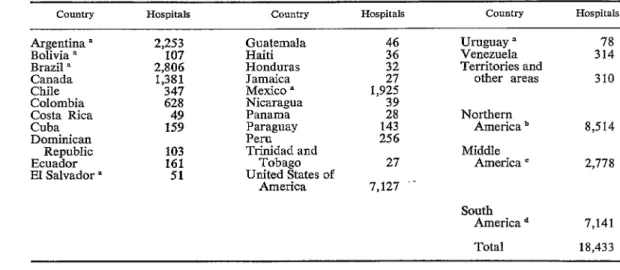
There is an urgent need for preparing medical record personnel. Since each hospi- tal needs at least one person to take charge of medical records, the number of hospitals in a country provides an indication of how many are required. The magnitude of the undertaking can be demonstrated in Table 1, which gives the number of hospitals in the Americas by countries. Of the 18,433 hos- pitals in 1964, 8,514 were in Northern America (Canada, United States, Bermuda, and St. Pierre and Miquelon) and nearly 10,000 in Middle and South America.
Large hospitals require a different type of personnel from those with only a few beds. Unfortunately, there are no complete data available that would permit classifying the hospitals in Latin America by size. However, generalizing from those countries that do have this information, it can be estimated that over half of the 10,000 hospitals have fewer than 50 beds; around 35 per cent have 50 to 199 beds; around 10 per cent have
200 to 399 beds; and fewer than 5 per cent have more than 400 beds.
Assuming only one trained person per hospital, and making no provision for attri- tion, this means that about 10,100 persons are needed to meet immediate minimum needs-S,500 auxiliary personnel for hospi- tals with less than 200 beds, 1,500 inter- mediate-level personnel to direct the medical record departments of hospitals of over 200 beds, and 100 personnel at the professional level whose responsibilities would be to di- rect programs at the national or provincial level and to teach intermediate-level per-
sonnel.
Intermediate-Level Courses
Venezuela is the only country in Latin America that is preparing the required num- ber of medical record personnel at the inter- mediate level. Since 1950 the Ministry of Health and Social Welfare of Venezuela has offered an 11-month course for medical rec- ord librarians, and in 1962 it accepted its first students from other Latin American countries. In the five-year period, 1961-
TABLE I-Number of Hospitals in the Americas, by Country, 1964.
Country Hospitals conntry Hospitals Country Hospitals
Argentina ’ Bolivia a Brazil n Canada Chile Colombia Costa Rica Cuba Dominican
Republic Ecuador El Salvador a
2,253 107 2,806 1,381 347 628
1:;
16 5
Guatemala Haiti Honduras Jamaica Mexico a Nicaragua Panama Paraguay Peru Trinidad and
Tobago United States of
America
Uruguay Venezuela L Territories and
other areas
Northern America b
Middle America c
3:: 310
8,514 2,778 7,127 ‘-
South America d
Total
7,141
18,433
B Previous year.
b Canada, United States, Bermuda, and St. Pierre and Miquelon.
54 BOLETiN DE LA OFICINA SANITARIA PANAMERICANA
1965, the course had 103 graduates. Of these, 93 were from Venezuela and the rest were from Colombia, Costa Rica, the Dominican Republic, Ecuador, El Salvador, Honduras, and Peru.
Intermediate-level courses have also been conducted in Argentina (in 1961) and in Brazil (in 1961 and 1962).
For many years Puerto Rico has con- ducted a one-year program, designed to pre- pare department heads for island hospitals, that requires a university degree of entering students. The entrance requirements make it difficult for Latin Americans who will be working at the hospital level to qualify for admission.
If the number of personnel needed is to be trained in a reasonable period of time, additional training centers should be estab- lished and the courses should be as short as is consistent with good training.
In July 1966, a 4%-month course for medical record personnel at the intermediate level was initiated by the Ministry of Public Health in Costa Rica with consultant services provided by the Organization. Of the 17 students enrolled, 14 were from Costa Rica and the others were from El Salvador, Nica- ragua, and Panama.
The courses conducted by the schools of public health for health statistics technicians have served to prepare polyvalent personnel and accordingly have covered, in part and for a limited period of time, the subject of medical records. Since 1962, the Pan Ameri- can Health Organization has cooperated with the schools of public health of Argentina, Chile, Colombia, and Peru in conducting classes in medical records and hospital statis- tics. Assistance has also been given to the four-month health statistics course provided by the University of the West Indies for stu- dents from English+peaking areas. Although the number of class hours was small in these courses, the lectures served to develop an awareness in those working in hospitals of the need for longer training. As a result, the School of Public Health in Lima, Peru,
is extending its course for health statistics technicians to eight months in order to in- corporate two months of classes on medical records and hospital statistics.
Many factors have to be taken into con- sideration in developing an intermediate-level course in medical records in any given coun- try. Continued experimentation will have to be done to arrive at the optimal duration and content of these courses. The following gen- eral recommendations seem pertinent:
l The course should be centered in a
school of public health, particularly one in which courses on hospital administra- tion are conducted. Having courses for administrators and medical record per- sonnel in the same school permits stu- dents of both disciplines to work on projects together, which promotes an ap- preciation of each other’s roles.
l The minimum requirement for entrance
to the course should be a complete sec- ondary education.
l The course should be 4 to 6 months in
length. The subjects should include medi- cal record science, anatomy and physiol- ogy, medical terminology, introduction to medical sciences, statistics (general, vital and health, hospital) and administration (general, hospital). In addition to these classes, which are theoretical and practi- cal, provision should be made for di- rected practice assignments.
The Regional Advisory Committee on Health Statistics in its Third Report (4) suggested the following institutions as train- ing centers :
School of Public Health, University of Buenos Aires, Buenos Aires, Argentina School of Hygiene and Public Health, Uni- versity of Sao Paulo, Sao Paulo, Brazil Institute of Hygiene, University of Recife,
Recife, Brazil
School of Public Health, University of Chile, Santiago, Chile
Lewis . DEVELOPMENT AND IMPROVEMENT OF MEDICAL RECORDS 55
Medical School, University of Costa Rica, San Jose, Costa Rica
Medical School, University of the West Indies, Kingston, Jamaica
School of Public Health, Mexico City, Mexico
School of Public Health, Lima, Peru School of Public Health, University of
Venezuela, Caracas, Venezuela
Auxilimy-Level Courses
In 1965, with the assistance of the Or- ganization, courses of two and four weeks duration were conducted in Costa Rica, Hon- duras, and Guatemala for hospital medical record and health center personnel; similar four-week courses were conducted in 1966 in Panama and Nicaragua. An average of 40 students participated in each course. In Chile, which has a satisfactory number of trained statistical personnel at the technician (intermediate) level, a two-week course was conducted in 1965 for instructors who were in charge of the statistical functions in nine of the 13 health zones. Each instructor in turn conducted two-week courses in his own zone, and in this way 117 medical record auxiliary personnel were trained that year. These short courses were to continue in 1966, and by 1967 the National Health Serv-
ice in Chile hoped to have completed its first stage of training the auxiliary personnel at all its hospitals.
Venezuela has been giving short courses since 1963. Prior to the opening of a new hospital a course is conducted to train all the auxiliaries who will be working in the medical record department.
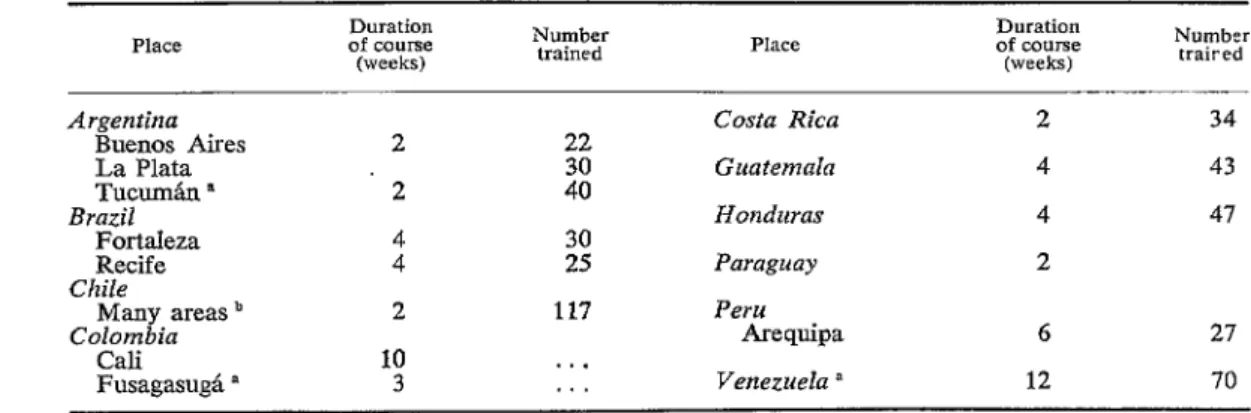
Table 2 shows the short courses conducted during 1965 for auxiliary personnel in hospi- tals and health centers and the number of students trained. The duration of the courses ranged from two weeks (Argentina, Chile, Costa Rica, and Paraguay) to three months (Venezuela). The average duration was four weeks. Chile trained the largest number of auxiliaries, followed by Argentina and Venezuela.
Reliable statistical data on all hospitals in a country will be available only when adequate information is reported from each hospital. The urgent need of this informa- tion to serve many purposes, including the planning and evaluation of health programs, makes it imperative to train a large number of personnel rapidly to provide certain minimal data.
Two different levels of auxiliaries could be prepared: for hospitals of 50-199 beds (one- to two-month courses) and for smaller hospitals (two-week courses).
TABLE Z-Auxiliary Hospital and Health Center Sfafistical Personnel Trained in the Americas, 1965.
Place Duration of course
(weeks)
Number
traired
Argentina
Buenos Aires La Plata Tucm&n ’
Brazil
Fortaleza Recife
Chile
Many areas ’
Colombia
Cali
FusagasugL a
2 2 t
2
10 3
22 z: ;!i
117
. . . . . .
Costa Rica Guatemala Honduras Paraguay Peru
Arequipa Venezuela a
2 34
4 43
4 47
2
6 27
12 70
56 BOLETiN DE LA OFICINA SANITARIA PANAMERICANA
Courses for auxiliary personnel should be practical, limited to functions that they are expected to fulfill at the present time and based on procedures established in each country. In order to train in a uniform man- ner the number needed in the shortest period of time, it is advisable to develop instructor’s manuals and to include in the intermediate- level course techniques that the graduates might use in teaching auxiliaries.
Naturally, the training of auxiliaries is the responsibility of each country. The Pan American Health Organization has assisted countries in developing courses, in prepar- ing teaching materials, and in training in-
structors.
The turnover of auxiliary personnel makes it essential that training at this level be a continuous function. As the hospital pro- grams develop, training will have to be modified or expanded to meet the needs.
Other Courses
In 1965 the Ministry of Health and Social Welfare of Venezuela, with the cooperation of the Organization, conducted a short course for instructors in medical records at the intermediate level. The participants, who were from Argentina, Chile, Colombia, Costa Rica, and Venezuela, had prior training and hospital experience.
Courses on specihc topics such as the
WHO International Classification of Diseases
(5) #should be conducted as needed. The preparation of medical record person- nel at the professional level is an important area that will have to be developed in the future.
Other members of the hospital team should also receive orientation in records and sta- tistics. For example, medical students would profit if their clinical training were in hospi- tals with a well-organized medical record system. Nursing and other hospital person- nel should be aware of their responsibilities in the medical record program. Of para- mount importance, however, is a recogni-
tion by hospital directors and administrators of the significance of medical records and statistics and the role they play in the efficient administration of the hospital. Without a trained hospital administrator it is extremely difficult to obtain the financial and adminis- trative support necessary to implement a medical record system in the hospital or to stimulate interest in using the statistical data collected.
Consul+anf Services
In 1961, because of the interest expressed by the health authorities of Argentina, the Organization initiated a program in the field of medical records in that country. A medical record librarian was employed and was stationed in Buenos Aires to develop demonstration centers and train personnel working in medical record departments in hospitals. Requests for the consultant’s assistance increased, and instruction was given also in schools of public health in Chile, Peru, Colombia, and Brazil, as well as in Argentina. In 1964 she was transferred to Headquarters in Washington so that she would be able to render service throughout the Region and assist in the expansion of the program. In July 1965, at the request of Trinidad, another consultant was assigned to assist in the development of medical records in that country. In August 1965 a third was recruited to continue the work in Argentina and to collaborate as requested in neighboring countries.
Lewis * DEVELOPMENT AND IMPROVEMENT OF MEDICAL RECORDS 57
Salvador and Haiti at the request of the Governments.
Priority is given to requests for advisory services for training programs, for the de- velopment of system-wide procedures, or for the organization of demonstration centers, particularly in teaching hospitals.
The Third Meeting of the Regional Ad- visory Committee on Health Statistics (4) reviewed the requirements for a satisfactory medical record system in each hospital and formuIated recommendations that have guided the consultants in their work.
Individual Medical Record
In some countries it is common practice in hospitals for each clinical service to main- tain its own medical record system, with the result that there are as many different records for a patient as services in which he has been treated. There are hospitals in which inpatient and outpatient records are decentralized. Finally, there are institutions in which the outpatient and occasionally the inpatient record is sketchy or even nonexis- tent. This duplication and/or lack of records results in inefficient utilization of hospital resources and handicaps patient care.
The Committee therefore recommended: (a) That every patient have a medical record.
(b) That this be a unit medical record (only one record in the hospital for each patient) based on a single number.
(c) That at least the following items be included in the records :
Identification number Name
Age Sex Residence Marital status Date of admission Chief complaint Medical history Physical examination Provisional diagnosis
Diagnostic procedures (laboratory, X-ray, electrocardiogram, etc.)
Treatment, medical and surgical Progress notes
Final diagnosis Outcome
Date of discharge or death Post-discharge recommendations Summary
It was recognized that the stage of de- velopment of the hospital and the manpower available would affect the amount of detail to be recorded. Observations by nursing personnel (nurses’ notes) were not included as a minimum requirement because there are countries in which the number of trained nurses is insufficient to permit this.
It was recommended that where the lack of adequate forms is a factor contributing to poor records, Pan American Health Organization staff provide assistance in their design. There are no internationally ap- proved medical record forms, and each country or hospital should develop forms to meet its own needs in the light of its re- sources and stage of development.
Central Department of Hospital Records
To ensure proper handling of the unit medical record the Committee recommended that each hospital maintain a central record room.
Handbook of Procedures
The Committee recommended the prep- aration, publication (in the languages of the Region), and distribution of materials designed especially to assist hospital staffs in the proper handling and filing of medical records and indexes.
Disease and Operation Zndexes
58 BOLETiN DE LA OFICINA SANITARIA PANAMERICANA
adaptation for diagnostic indexing is avail- able in the United States and there are also Adaptations in Spanish and in Portuguese
(6).
Medical Record Committee
It was considered advisable for each hospital to have a medical record com- mittee composed largely of physicians. The purpose of such a committee is to establish standards for the medical records, review the records in order to make sure that the standards are being fulfilled, and develop the necessary forms. It is also responsible for the adequacy of the clinical data recorded and available for many uses, including care of the patients, reports for administrative and statistical purposes, teaching, medical audit, and research.
Statistics on the Hospital and Its Patients
Administrative, morbidity, service, and financial statistics are developed according to the purpose they are to serve. The first objective of hospital statistics is effective administration and operation of a hospital to provide proper care of its patients.
In recommending that plans be made in each hospital for the collection and utiliza- tion of the statistical data cited below, the Committee followed the recommendations included in the Eighth Report of the WHO Expert Committee on Health Statistics (7).
(a) Statistics relating to the hospital. The minimum essentia1 data for each hospital are as follows :
Number, distribution and utilization of beds
Services provided by laboratory, operat- ing room, emergency room, outpatient clinics, etc.
Number and type of staff
Fiscal data, revenues and expenses Financial statistics is a field for the pro- fessional accountant; however, the cost of
operating the hospital is closely connected with the statistics on activities.
(b) Statistics relating to patients. Patient statistics serve two main purposes: to pro- vide data on utilization of hospital beds by types of illnesses and conditions and to pro- vide hospital morbidity statistics for knowl- edge of the health status of the population. These statistics would be derived from the individual medical records maintained in the central record department. The mini- mum data are as follows:
Age and sex Length of stay Diagnosis Operation
Condition at discharge
Documents and Materials
The lack of literature in Spanish on the subject of medical records has long been recognized as an impediment to the rapid expansion of training programs and to the promotion of interest in the field.
In 1961 the Latin American Center for Classification of Diseases prepared the Spanish version of the Znternational Classiji- cation of Diseases Adapted for Zndexing of Hospital Records, which was published and distributed by the Organization, and during
1966 the Portuguese version was issued (6). In order to assist in the teaching of the use of the Adaptation, the Latin American Center also prepared a Spanish version of
Programmed Instruction in the Use of the ZCDA (8).
The American Hospital Association’s
Guide to the Organization of a Hospital Medical Record Department was published in Spanish by PAHO in 1964 and has been widely distributed (9). During 1965 the School of Hygiene and Public Health of the University of SIo Paul0 published the Guide
in Portuguese (10).
Lewis * DEVELOPMENT AND IMPROVEMENT OF MEDICAL RECORDS 59
translations are being distributed through a mimeographed series, the first issue of which appeared in June 1966 (II).
In addition to these formal publications, draft manuals and mimeographed materials for instructors and for students have been prepared, translated, and adapted.
Work is currently under way on the prep- aration of a Urnstrip entitled The Patients’ Name Index. The development of additional visual aids is planned.
sonnel are required at the professional (uni-
versity-trained) and intermediate (medical rec-
ord librarian) levels who, in addition to their
own work, will be responsible for the training
of medical record auxiliaries. These auxiliaries
will assist in large hospitals and will be in charge
of medical records in smaller hospitals. The
author estimates the number of personnel
needed in the Americas, describes the courses
being conducted in some Latin American coun-
tries, and offers suggestions on the training and
orientation of personnel.
Summary
The PAHO program of medical records in- cludes education and training of personnel, advisory services in vital and health statistics,
and the publication of educational material.
To fulfill medical record functions, per-
PAHO has helped several countries to initiate
and operate courses by providing experts and
establishing minimum requirements for a satis-
factory medical record system: clinical his-
tory, procedures, hospital and patient statistics, etc.
In the field of publications, PAHO has issued
various handbooks, manuals, and articles, as
well as visual aids. c1
REFERENCES
(1) Pan American Health Organization. Pnn
American Sanitary Code, in Basic DOCU- ments of PAHO. 7th ed.. Washintion,
D.C., O&al Document 86, 1967. -
(2) Pan American Health Organization. Pro-
ceedings of the XIV Pan American Sani- tary Conference, Washington, D.C., Offi- cial Document 14, 1954.
(3) Organization of American States. Alliance
for Progress, Washington, DC., Official Records, OEA/Ser. H/X11.1, 1961.
(4) Pan American Health Organization. Third
Report of Regional Advisory Committee on Health Statistics, Washington, D.C., Scientific Publication 103, 1964.
(5) World Health Organization. 1 I International Classification of -Diseases, Geneva, Switz- erland, 1957.
(6) U.S. Department of Health, Education, and
Welfare. International Classification of
Diseases, Adapted for Indexing of Hospi- tal Records and Operation Classification,
Washington, DC., Publication 719 (re-
vised ea.), 1962. (The Pan American Health Organization nublished versions in Spanish (scientific Publication 52, 1961)
and in Portuguese (Scientific Publication 126, 1966).)
(7) World Health Organization. Expert Com-
mittee on Health Statistics, Eighth Report,
Geneva, Switzerland, Technical Report
Series 261, 1963.
(8) Commission on Professional and Hospital
Activities. Programmed Instruction in the
Use of the ICDA, Ann Arbor, Michigan, 1963. (Published in Spanish by the Pan American Health Organization in Scien- tific Publication 101, 1964.)
(9) American Hospital Association. Guide to fhe
Organization of a Hospital Medical Record Department, Chicago, Illinois, 1962. (Pub- lished in Spanish by the Pan American Health Organization in Scientific Publica-
tion 110, 1964.)
(IO) University of SBo Paula. Manual de Organi-
za@o he Service de Arquivo Mkdico e Estatistica de urn Hosnital, Faculdade de Higiene e Satide PGbli‘ca da Universidade de SFio Paula, Brazil, 1965.
(II ) Pan American Health Organization. “Ciru-