The use of the Cambridge Neuropsychological Test Automated
Battery (CANTAB) in neuropsychological assessment:
application in Brazilian research with control children and
adults with neurological disorders
Daniela Tsubota Roque, Rosani Aparecida Antunes Teixeira, Elaine C. Zachi and Dora F. Ventura
Universidade de São Paulo, São Paulo, SP, BrazilAbstract
Computerized neuropsychological tests can be effective and have many beneits. This paper addresses these issues using the computer-based Cambridge Neuropsychological Test Automated Battery (CANTAB) to assess Brazilian children and adults. Preliminary normative data for Brazilian children obtained in a series of CANTAB subtests are presented together with data from adults (controls) and samples of patients with multiple sclerosis and Duchenne muscular dystrophy. The results obtained in children conirmed the normative values reported for American children (Luciana & Nelson, 2002), indicating high applicability of the CANTAB battery for children in the evaluation of visual memory, working memory, planning, and set shifting. For multiple sclerosis patients, CANTAB revealed differences between the control and multiple sclerosis groups for all subtests employed, including visual memory, working memory, spatial memory, decision making, inhibitory control, and sustained attention. In children with Duchenne muscular dystrophy, the CANTAB tests revealed speciic detriments in attention and memory. These results of the application of CANTAB in different patient groups indicate that the battery is appropriate for assessing several central nervous system diseases. Keywords: neuropsychological tests, CANTAB, children, multiple sclerosis, Duchenne muscular dystrophy.
Received 15 February 2011; received in revised form 31 August 2011; accepted 12 September 2011. Available on line 10 October 2011
Daniela Tsubota Roque, Rosani Aparecida Antunes Teixeira, Elaine C. Zachi, and Dora F. Ventura, Instituto de Psicologia, Universidade de São Paulo, São Paulo, Brazil. Rosani Aparecida Antunes Teixeira, Elaine C. Zachi, and Dora F. Ventura, Núcleo de Neurociências e Comportamento, Universidade de São Paulo, São Paulo, Brazil. Correspondence regarding this article should be directed to: Daniela Tsubota Roque, Av. Prof. Mello Morais,
1721, Bloco A - Sala D-9, CEP 05508-030, Cidade Universitária,
São Paulo - SP, Brasil. E-mail: [email protected]
Introduction
The Cambridge Neuropsychological Test Automated Battery (CANTAB) is a computerized neuropsychological assessment battery originally written and developed by Barbara Sahakian, Trevor Robbins, and colleagues at
Cambridge University in the 1980s (Fray, Robbins, & Sahakian, 1996; Luciana & Nelson, 2002; Robbins et al., 1998; Sahakian et al., 1988). The irst aim of CANTAB
was to assess the patterns of cognitive decline in dementia in elderly individuals. However, it has been used in a wide
variety of clinical populations (Fray et al., 1996; Levaux et al., 2007; Rasmussen, Soleimani, Carroll, & Hodlevskyy, 2009) with different levels of ability and ages. It has also
been employed in neuropsychological research across
age groups to study the development of a set of cognitive
functions (De Luca et al., 2003; Luciana & Nelson, 2002).
CANTAB incorporates a wide variety of executive and memory tasks that are adapted for use with humans in paradigms developed from the evaluation of damage
to speciic brain areas in experimental animals (Lowe & Rabbitt, 1998), especially damage to temporal and
frontal cortical regions. The relationships between the scores on component tests of CANTAB and evidence
of impairment in speciic cognitive functions and
psychiatric disorders have been demonstrated in a very
extensive set of data (Hadwin, Brogan, & Stevenson, 2005; Liotti et al., 2007; Owen, Sahakian, Semple, Polkey, & Robbins, 1994; Pantelis et al., 1997; Palade & Benga, 2007; Sweeney, Kmiec, & Kupfer, 2000; Steele, Minshew, Luna, & Sweeney, 2007; Torgersen, Helland, Flaatten, & Wester, 2010; Yun da et al., 2011).
The CANTAB tests are administered using a computer with a touch-sensitive screen. Application of the test and feedback are given in a standardized
manner (Fray et al., 1996).
not require extensive training and limits the interaction between the subject and examiner. Responses are recorded and analyzed automatically, and variables that
are quite dificult or impossible to record with manual
administration can be easily obtained using computerized procedures. Features that are intrinsic to computerized
tests that confer beneits over paper-and-pencil
measures include millisecond timing accuracy, reliable and randomized presentation of stimuli over multiple trials and repeated administration, and the unobtrusive measurement of cognitive skills and response times during all aspects of the assessment process. Computerized batteries of this type can record aspects of performance
that are dificult for psychometrists to measure, and these may relect the activity of developing neural
networks with more sensitivity than can be achieved with
traditional tests (Berger, 2006; Luciana, 2003; Schatz & Browndyke, 2002; Strauss, Sherman, & Spreen, 2006).
The use of computers in neuropsychological evaluation requires attention and care from the experimenter or clinician. Potential errors in computerized neuropsychological testing could arise because of hardware and software interactions (e.g., resolution of the display and presentation of stimuli
affected by the monitor type and size; Cernich, Brennana, Barker, & Bleiberg, 2007). Computers are
helpful in the calculations of scores or conversion from raw to standard scores, but automated scoring has limited usefulness in neuropsychological practice if other variables are not controlled. The importance of paying attention to the patient’s response style,
manner of dealing with dificulties, type of interaction
established, and other important sources of clinically
relevant hypotheses has been stressed (Berger, 2006).
The analysis of performance by computers needs to be interpreted in the context of psychometric data together
with aspects of the patient’s history and indings from clinical or neurological examinations (Luciana, 2003).
The normative data for CANTAB have been
obtained from over 2000 studies with normal subjects aged 4 to 90 years who participated in several studies conducted primarily in the United Kingdom (Cambridge Cognition, 2006).
The 22 tests that constitute CANTAB (CANTABeclipse)
examine various areas of cognitive function including visual memory, visual attention, learning and memory, working
memory, planning, set-shifting, sustained attention, and luid
intelligence. The tests are divided into six main groups: motor and visual memory, executive function, working memory and planning, attention, verbal/semantic memory, and decision
making and response control (Cambridge Cognition, 2006).
CANTAB allows the investigator to create his/her own battery using a selection of tests tailored to his/her
research interest. The battery was irst commercialized in 1994. Since then, it has been used by more than 500 academic institutions worldwide and cited in over 600
scientiic papers (Cambridge Cognition, 2006).
In this wide range of studies, we can ind studies that
applied CANTAB in children. Several studies compared
controls and a given pathology or speciic groups.
Examples are the assessment of neuropsychological function after admission to pediatric intensive care
(Elison, Shears, Nadel, Sahakian, & Garralda, 2008),
executive function with regard to inhibition, planning,
lexible shifting of actions, and working memory in
children with high-functioning autism and attention
deicit/hyperactivity disorder (Goldberg et al., 2005),
neuropsychological performance in children with bipolar
disorder (Dickstein et al., 2004), and the effects of a drug
(e.g., methylphenidate) on performance in children with
attention deicit/hyperactivity disorder (DeVito et al., 2009). Control groups composed of age- and educational
level-matched healthy children were employed in these and other studies. However, studies dedicated to obtaining
normative values in children are scarce. We found only two such studies (De Luca et al., 2003; Luciana & Nelson, 2002). De Luca and colleagues described the
development of executive function over the lifespan in
participants who ranged in age from 8 to 64 years. In children, they found functional gains in the eficiency
of working memory capacity, planning, and
problem-solving ability. Luciana and Nelson (2002) assessed CANTAB performance in children aged 4 to 12 years.
CANTAB has been reported to have high applicability in the evaluation of children with weak verbal skills such as those associated with learning disability, autism, or both.
The neurological disorders investigated in the present report (i.e., multiple sclerosis [MS] and Duchenne muscular dystrophy [DMD]) are known to affect neuropsychological function (Balsimelli, Mendes,
Bertolucci, & Tilbery, 2007; Beatty, Goodkin, Monson, & Beatty, 1989; Cyrulnik et al., 2008; D’Angelo & Bresolin, 2006; De Luca, Chelune, Tulsky, Lengenfelder, & Chiaravalloti, 2004; Desguerre et al., 2009; Dorman, Hurley, & D’Avignon, 1988; Giliberto, Ferreiro, Dalamon, & Szijan, 2004; Grant, McDonald, Trimble, Smith, & Reed, 1984; Hinton, De Vivo, Nereo, Goldstein, & Stern, 2001; Laatu, Revonsuo, Hämäläinen, Ojanen, & Ruutiainen, 2001; Miller, Tunnecliffe, & Douglas, 1985; Moizard et al., 1998; Parmenter, Schucerd, Benedict, & Schucard, 2006; Parmenter, Shucard, & Shucard, 2007; Plohmann et al., 1998; ; Rao, 2004; Ruggieri et al., 2003; Santiago, Guardia, Casado, Carmona, & Arbizu, 2007; Vleugels et al., 2000, 2001).
Multiple sclerosis is an autoimmune inlammatory
disease characterized by demyelination and degeneration of the central nervous system. Disease onset usually occurs in young adults and is two- to three-times more frequent in women than men. The average age of onset is between
20 and 40 years, but the disorder may develop at any age.
muscle weakness and irreversible degeneration (Cyrulnik
et al., 2008). It is caused by mutations in the dystrophin
gene. This gene codes for the dystrophin protein, which
is important for maintaining the stability of muscle-iber membranes (Muntoni, Torelli, & Ferlini, 2003).
No studies have used CANTAB in DMD patients, and only one group used the battery in MS patients
(Foong et al., 1997, 1998, 1999). used subtests of the
CANTAB battery (i.e., spatial span, spatial working
memory and Tower of London), reporting a signiicant
difference in spatial span between MS patients and controls. In spatial working memory, the patients also had poorer performance compared with the control group. In
the Tower of London (Stockings of Cambridge [SOC])
subtest, motor initiation and execution times were
signiicantly longer in patients compared with controls.
Intellectual skills, verbal function, and language of DMD patients have been widely reported in the literature. However, there is a lack of visuo-spatial assessment. This is very relevant because DMD patients have recently been shown to present losses in several visual functions (Costa,
Oliveira, Feitosa-Santana, Zatz, & Ventura, 2007).
Although CANTAB has been used in several countries in different types of research, no studies have
used the battery in Brazil. Our objective was to describe
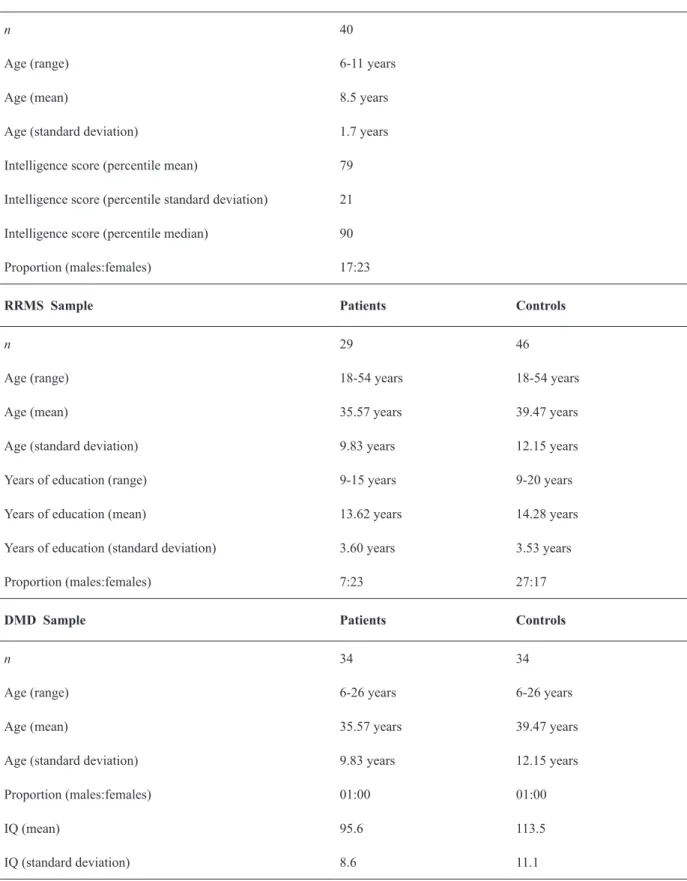
the applicability of CANTAB to different samples of Brazilian subjects. Therefore, we present a summary of its application and use in a group of healthy children and two samples of patients—relapsing-remitting MS (RRMS) and DMD—in a detailed descriptive form.
Data were collected at the Laboratório da Visão,
Institute of Psychology, University of São Paulo. The procedures were approved by the Human Research Ethics Committee of the University Hospital of the University of São Paulo, and written informed consent was obtained from the participants or their guardians before testing. The statistical analysis was performed using Statistica
9.0 software (StatSoft) for the descriptive statistics,
one-way analysis of variance (ANOVA) and analysis of covariance (ANCOVA) for group comparisons, and
the Pearson correlation test for correlational analyses.
Statistical signiicance was deined as p < .05.
Sample 1: Preliminary norms
A sample of 40 children aged 6 to 11 years (8.5 ± 1.7 years) was assessed (17 males and 23 females).
The children were recruited from Escola de Aplicação (Education School, University of São Paulo). The exclusion criteria for the children were a history of epilepsy, brain injury, or psychiatric illnesses, evidence of developmental
disorder, and an intelligence score below the 25th percentile
measured by Raven’s Progressive Matrices Test.
Twenty-three children had an intelligence score in the 80th percentile or higher (mean, 79th percentile; median, 80th percentile).
Sample 2: Multiple sclerosis patients
A group of 29 patients (7 males and 23 females)
were recruited from the Department of Neurology of the Hospital of Clínicas, Faculdade de Medicina
da Universidade de São Paulo. They were aged 18-54 years (35.57 ± 9.85 years) and had 9 to 15 years of education (13.62 ± 3.60). All of the patients had
been clinically diagnosed with MS according to
Poser criteria (Poser & Brinar, 2001) and classiied as
having the RRMS.
To participate in this study, the MS patients had
best-corrected visual acuity of 20/20 or better and an EDSS < 2. The Kurtzke Expanded Disability Status Scale (EDSS) is a method of quantifying disability in MS (Kurtzke, 1983). It quantiies disability in eight functional systems. The EDSS scale ranges from 0 to 10 in 0.5 unit increments that represent higher levels of disability. Our patients had
minimal disability in only one functional system. The
exclusion criteria included the following: less than 8 years
of education, a history of head injury, other diseases, and suspected alcohol or drug abuse.
The results were compared with 46 healthy subjects (29 males and 17 females) aged 18-54 years (39.5 ± 12.1 years) with 9 to 20 years of education (14.3 ± 3.5). Control subjects
were also matched with regard to educational background.
Sample 3: Duchenne muscular dystrophy
patients
Thirty-four subjects with DMD were recruited
from the Associação Brasileira de Distroia Muscular (ABDIM), and 34 controls participated. Both groups were composed of males aged 6 to 26 years. Twenty-nine DMD patients (85%) were wheelchair-dependent. No signiicant difference was found
between the groups with regard to age (p = .09). The inclusion criterion was an intelligence score within normal limits. Twenty-three DMD subjects and all of
the controls had an intelligence quotient (IQ) of ≥ 80 based on the Wechsler scale. Eleven DMD patients were unable to complete the Wechsler performance
tests because of severe motor disability and were assessed with Raven’s Progressive Matrices Test.
Their minimum 25th percentile was within the normal
range. The Raven’s percentile was converted to an IQ
value (Strauss et al., 2006).
A history of epilepsy, brain injury, or evidence of developmental disorders were exclusion criteria for both
groups. Because the DMD patients had signiicantly lower
intelligence scores (F = 12.7, p < .01, one-way ANOVA), IQ scores were added to the analysis as a covariate.
CANTAB subtests
Nine CANTAB subtests were selected. Tasks that measure working memory (Spatial Span [SSP]) and
visual memory (Pattern Recognition Memory [PRM]) were administered to all of the groups. The remaining tests were applied as the following: tasks of sustained attention (Rapid Visual Processing [RVP]) and spatial
Children’s Sample
n 40
Age (range) 6-11 years
Age (mean) 8.5 years
Age (standard deviation) 1.7 years
Intelligence score (percentile mean) 79
Intelligence score (percentile standard deviation) 21
Intelligence score (percentile median) 90
Proportion (males:females) 17:23
RRMS Sample Patients Controls
n 29 46
Age (range) 18-54 years 18-54 years
Age (mean) 35.57 years 39.47 years
Age (standard deviation) 9.83 years 12.15 years
Years of education (range) 9-15 years 9-20 years
Years of education (mean) 13.62 years 14.28 years
Years of education (standard deviation) 3.60 years 3.53 years
Proportion (males:females) 7:23 27:17
DMD Sample Patients Controls
n 34 34
Age (range) 6-26 years 6-26 years
Age (mean) 35.57 years 39.47 years
Age (standard deviation) 9.83 years 12.15 years
Proportion (males:females) 01:00 01:00
IQ (mean) 95.6 113.5
IQ (standard deviation) 8.6 11.1
memory (Spatial Recognition Memory [SRM]) in the neurological groups and visual perception/visual memory (Delayed Matching to Sample [DMS]) in the healthy children and DMD group. RRMS patients and healthy children completed a test of inhibitory control (Stop Signal Task [SST]). Tests of visual planning
(SOC) and set shifting (Intra-Extra Dimensional Set
Shift [IED]) were administered to the children and a task that measures decision making (Information Sampling Task [IST]) was used in the patients with RRMS.
Results and Discussion
Sample 1: preliminary norms
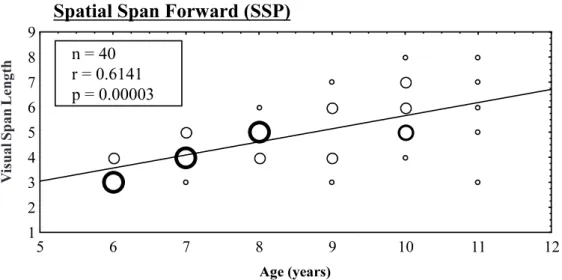
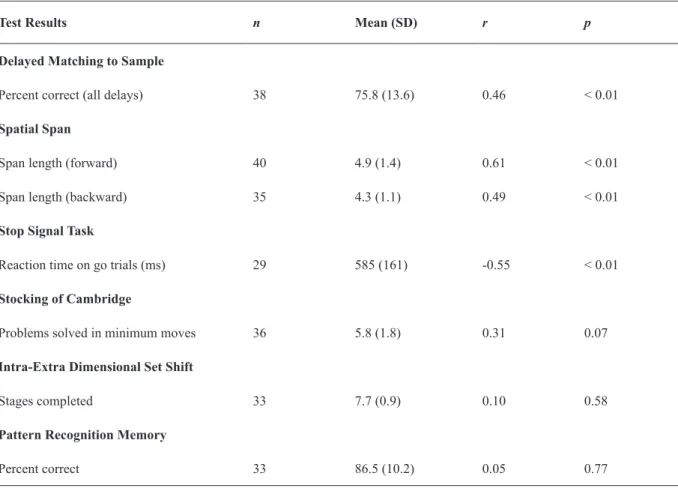
We found positive correlations between spatial
memory span and age in the working memory task (SSP)
for the forward mode (r = 0.61, p = 0.00003; Figure 1) and backward mode (r = 0.49, p = .0026; Figure 2).
For visual memory, the DMS task showed a positive correlation between hits (percent correct) and age (r =
0.46, p = .0036). In the inhibitory control (SST) task, we found a negative correlation between latency on go trials and age (r = -0.55, p = .0022).
In the visual planning (SOC), set shifting (IED), and visual memory (PRM) tests, we did not ind signiicant correlations with age (Table 2).
Sample 2
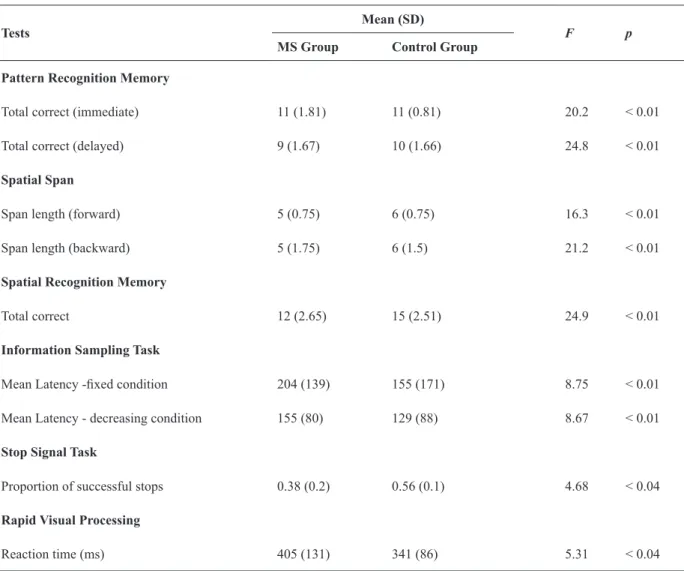
Signiicant differences were found between control
and MS patients in the PRM test that evaluates immediate (p < .01) and delayed (p < .01) visual memory, SSP test that evaluates forward (p < .01) and backward (p <
Figure 2. Correlation between working memory and age for backward visual span length. The size of the circles represents the number at each data point.
Figure 1. Correlation between working memory and age for forward visual span length. The size of the circles represents the number of children at each data point.
V
is
u
al
S
p
an
Le
n
gth
V
is
u
al
S
p
an
Le
n
.01) working memory, SRM test that evaluates spatial
memory (p < .01), IST test that evaluates decision
making latency in the ixed win condition (p < .01) in
which the subject is awarded 100 points for a correct
decision regardless of the number of boxes opened, and decreasing win condition (p < .01) in which the number of points that can be won for a correct decision starts at
250 and decreases by 10 points for every box touched,
SST test that evaluates inhibitory control (p =.03), and RVP test that evaluates sustained attention (p = .03)
relected by reaction time (Table 3).
Sample 3
Duchenne muscular dystrophy patients and
controls differed signiicantly in terms of forward (p =
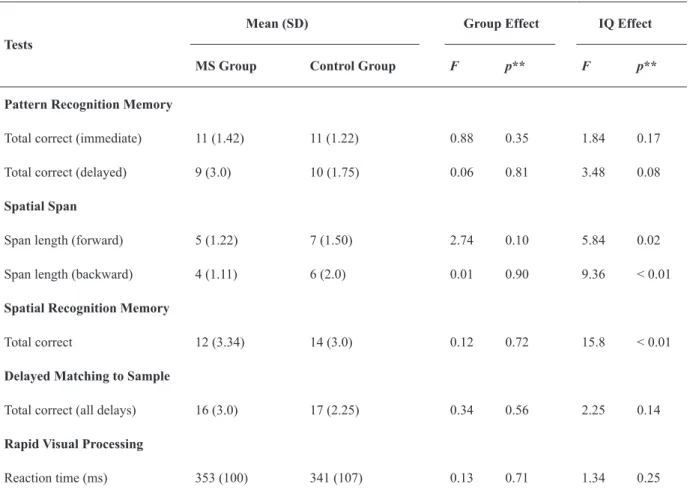
.02) and backward (p < .01) span on the SSP test and spatial memory (p < .01) on the SRM test (Table 3).
The ANCOVA revealed the inluence of IQ on these
results (as shown by the referred p values). However, p
values associated with the disease were not signiicant
(p > .05), suggesting no effect of DMD on the patients’
worse performance (Table 4).
Preliminary norms
The results obtained with the three samples generally agree with both the literature that utilized
CANTAB as a testing tool and the assessments of the same neuropsychological functions performed with other types of tests.
In the children’s sample, a comparison between
our data and data of Luciana and Nelson (2002) found
similar results. The children tested here obtained scores near the mean and within the standard deviation for
the visual memory (PRM; Figure 3), working memory (SSP; Figure 4), planning (SOC; Figure 5), and set shifting (IED; Figure 6) tasks.
The results found with the children’s sample indicate the high applicability of CANTAB within this group. An increase in SSP performance was found with age, suggesting developmental improvement in
visuo-spatial working memory. Our results conirm
a previous report that found improvement in SSP performance in children between the ages of 5 years
and 11 to 13 years, who reached the results of adults (Nichelli, Bulgheroni, & Riva, 2001).
For the visual planning (SOC) and set-shifting (IED) subtests, we did not ind a correlation between
age and performance in the children. Similar results
were found by De Luca et al. (2004) and Luciana and Nelson (2002). These indings together suggest the
nonlinear development of executive function until maturation at 11 years of age.
Test Results n Mean (SD) r p
Delayed Matching to Sample
Percent correct (all delays) 38 75.8 (13.6) 0.46 < 0.01
Spatial Span
Span length (forward) 40 4.9 (1.4) 0.61 < 0.01
Span length (backward) 35 4.3 (1.1) 0.49 < 0.01
Stop Signal Task
Reaction time on go trials (ms) 29 585 (161) -0.55 < 0.01
Stocking of Cambridge
Problems solved in minimum moves 36 5.8 (1.8) 0.31 0.07
Intra-Extra Dimensional Set Shift
Stages completed 33 7.7 (0.9) 0.10 0.58
Pattern Recognition Memory
Percent correct 33 86.5 (10.2) 0.05 0.77
Table 2. Correlations between age and test results for children
In the visual memory subtests, we found interesting results. The PRM subtest did not show a correlation between age and performance, but the DMS subtest showed this correlation. These subtests differ in their measurement of visual memory. The DMS subtest utilizes complex stimuli in which shape, color, and their combination are relevant for discrimination. In the PRM subtest, the relevant aspect of the stimulus is only the
shape; the color aspect is not relevant for discrimination.
The greater complexity of DMS stimuli requires more attention to memorize and recognize the pattern in the future discrimination. Therefore, the DMS correlation
with age relects the development of attention with age,
whereas the aspect of visual memory assessed by the PRM subtest does not exhibit a developmental trend in
the 6- to 11-year age range.
Tests
Mean (SD)
F p
MS Group Control Group
Pattern Recognition Memory
Total correct (immediate) 11 (1.81) 11 (0.81) 20.2 < 0.01
Total correct (delayed) 9 (1.67) 10 (1.66) 24.8 < 0.01
Spatial Span
Span length (forward) 5 (0.75) 6 (0.75) 16.3 < 0.01
Span length (backward) 5 (1.75) 6 (1.5) 21.2 < 0.01
Spatial Recognition Memory
Total correct 12 (2.65) 15 (2.51) 24.9 < 0.01
Information Sampling Task
Mean Latency -ixed condition 204 (139) 155 (171) 8.75 < 0.01
Mean Latency - decreasing condition 155 (80) 129 (88) 8.67 < 0.01 Stop Signal Task
Proportion of successful stops 0.38 (0.2) 0.56 (0.1) 4.68 < 0.04
Rapid Visual Processing
Reaction time (ms) 405 (131) 341 (86) 5.31 < 0.04
Table 3. Neuropsychological performance in patients and controls of sample 2
Figure 3. Percentage of correct responses in the CANTAB PRM test in children from 6 to 11 years of age. A comparison is shown between the results from the present study and data from Luciana and Nelson (2002).
In the inhibitory control task (SST), the negative correlation between reaction time and age indicated an
improvement in the responses, relecting development
in motor and processing skills in the ages assessed.
Luciana and Nelson (2002) discussed children’s
vulnerability to fatigue and boredom and included a break between tasks according the child’s need. To avoid these problems, our evaluation of children was divided into two or three sessions, and a break between subtests was used when necessary. The comparison between our data and
data presented by Luciana and Nelson (2002) in several
CANTAB tasks showed similar results, despite the language and cultural differences between our samples.
However, independent of the ease of application of CANTAB, establishing good rapport with children is important in the evaluation. The examiner should take a few minutes to talk to the child about play, school, or any subject that is interesting to the child. If good rapport is established with the child, then they more easily engage in the test.
Multiple sclerosis
In the MS sample, the present results agree with Tests
Mean (SD) Group Effect IQ Effect
MS Group Control Group F p** F p**
Pattern Recognition Memory
Total correct (immediate) 11 (1.42) 11 (1.22) 0.88 0.35 1.84 0.17
Total correct (delayed) 9 (3.0) 10 (1.75) 0.06 0.81 3.48 0.08
Spatial Span
Span length (forward) 5 (1.22) 7 (1.50) 2.74 0.10 5.84 0.02
Span length (backward) 4 (1.11) 6 (2.0) 0.01 0.90 9.36 < 0.01
Spatial Recognition Memory
Total correct 12 (3.34) 14 (3.0) 0.12 0.72 15.8 < 0.01
Delayed Matching to Sample
Total correct (all delays) 16 (3.0) 17 (2.25) 0.34 0.56 2.25 0.14
Rapid Visual Processing
Reaction time (ms) 353 (100) 341 (107) 0.13 0.71 1.34 0.25
Table 4. Neuropsychological performance in patients and controls of sample 3
*ANOVA, **ANCOVA.
Figure 5. Mean moves (4-move problems) in the CANTAB SOC test in children from 6 to 11 years of age. A comparison is shown between the results from the present study and data from Luciana and Nelson (2002).
those of previous studies that also showed impairment
in visual memory (Beatty et al., 1989; Grant et al., 1984; Ruggieri et al., 2003), working memory (Parmenter et al., 2006; Santiago et al., 2007), visuo-spatial function (Laatu et al., 2001; Rao, 2004; Vleugels et al., 2000, 2001), and information processing speed (Balsimelli et al., 2007; De Luca et al., 2004; Parmenter et al., 2007; Plohmann et al., 1998).
Cognitive deicits may affect 40-65% of MS patients and signiicantly contribute to their disability (Amato, Zipoli, & Portaccio, 2006). The cognitive domains most
commonly impaired are memory and learning, attention,
executive function, and visuo-spatial ability (Rao, Leo, Bernardin, & Unverzagt, 1991).
In the early stages of MS, the patient already suffers
deicits in the main areas of memory, including
short-term memory, learning, and long-short-term memory, with the
verbal and nonverbal domains equally affected (Grant et al., 1984). We conirmed these indings in the present
study in which MS patients showed impairment in both the immediate and delayed recall tests.
In the SSP, a computerized version of the Corsi Block Tapping Task, which assesses the ability to remember a sequence of squares lit up on the screen
(forward and backward), a signiicant difference was
found between patients and controls, a result similar to
that of Foong et al. (1997).
The patients also showed impairment in inhibitory control, reaction time, and response latency in decision
making. These indings are all attributable to the fact that the
speed of information processing in MS patients is greatly
impaired (De Luca et al., 2004; Parmenter, et al., 2007). Our results showed that cognitive decline was present
even when physical disability was not yet severe, but it was mild and did not limit the patients’ ability to work as
previously reported by Ruggieri et al. (2003). Glanz, Healy, Hviid, Chitnis, and Weiner (2011) observed a deterioration
in working memory and visual spatial memory in subjects with early MS over a period of up to 5 years.
Our results are similar to those of Ruggieri et al. (2003) who found that cognitive decline was present in
MS patients even before the decline in physical function.
A more recent study by Glanz et al. (2011) showed that
individuals who had the disease for less than 5 years already presented a decline in working memory, visual memory, and spatial memory.
Duchenne muscular dystrophy
CANTAB scores in DMD patients indicated impairment in working memory and spatial memory. To
our knowledge, this is the irst time that patients with
DMD were assessed with CANTAB.
Similar to the previous two samples, the present results in DMD patients agree with studies that reported
deicits in verbal working memory (Bresolini et al., 1994; Hinton, De Vivo, Fee, Goldstein, & Stern, 2000;
Hinton et al., 2001; Hinton, De Vivo, Fee, Goldstein, & Stern, 2004; Hinton, Fee, Goldstein, & De Vivo, 2007; Wicksell, Kihlgren, Melin, & Eeg-Olofsson, 2004). One investigation included young children aged 3 to 6 years
and found visuospatial working memory impairment
(Cyrulnick et al., 2008).
The DMD population presents lower IQs and higher
rates of mental retardation (D’Angelo & Bresolin, 2006; Felisari et al., 2000; Giliberto et al., 2004). With regard
to memory, several studies that used non-computerized tests support the impairment of verbal working memory
in DMD patients (Bresolini et al., 1994; Hinton et al., 2000, 2001, 2004, 2007; Wicksell et al., 2004). Our indings showed a loss of memory in the visual domain, with impaired performance in the SSP subtest. We suggest that a general working memory deicit may
be present in these patients. Although the patients had normal intelligence scores, only IQ emerged as a
predictor of deicits in spatial memory and working memory. This inding suggests a primary intelligence deicit that underlies other neuropsychological deicits
in patients with DMD.
Despite the inluence of IQ on neuropsychological performance, rather than the inluence of the disease, the
strength of this descriptive approach is that CANTAB was useful with this patient sample and sensitive to
speciic deicits. The use of the mouse instead of the
touch screen in the adaptation to the patient’s motor limitations was appropriate and enables their assessment because DMD patients are unable to complete various regular visuospatial neuropsychological tests.
General comments about CANTAB
The CANTAB battery is particularly appropriate for assessing various diseases for which early detection is very important. Moreover, the wide range of data already collected in several countries gives this battery a very reliable database. Additionally, the applicability of experimental tests developed for animal research
(Strauss et al., 2006) to humans opens the way for studies in children with special dificulties because of
the easy application of the test.
As mentioned by Luciana and Nelson (2002), the
fact that CANTAB tests are mostly non-verbal enables its administration in many countries and makes it independent of language and culture. Its testability in different samples in the present study allows us to
conirm the applicability of CANTAB in these samples
of the Brazilian population.
clinical indings, etc.), and this type of interpretation
and understanding cannot be made by a computer. CANTAB exhibited many advantages in our studies. Its easy administration enables its application in different samples, controls, and patients with neurodegenerative conditions, with little change in the standard procedure, such as using a mouse instead of a touch screen for testing subjects with motor limitations. It also can be used with different age groups (i.e., in both children and adults), allowing the evaluation of
children as young as 6 years old.
CANTAB’s design allows its use in subjects with weak interaction skills, such as very young children, for whom the user-friendly format is especially helpful because it entertains them and maintains their attention during the test. The battery also offers a pretest phase for some subtests. Similar to a training phase, this stage provides the experimenter an opportunity to verify the subject’s understanding of the instructions and to clarify the procedure with more detailed information if necessary. For children, the SSP backward mode was applied after the SSP forward mode. The pretest phase was quite important for these subjects because when they see the same arrangement on the screen again,
they quickly respond similarly to the irst time (forward
mode), despite the new instructions.
Studies that utilize CANTAB may lead to the
development of speciic protocols that are sensitive to
conditions that can impair neural function. Further work should include larger samples and develop reliability studies.
Acknowledgment
This work was supported by grants from the Foundation for Research Support of the State of
São Paulo (FAPESP) Projeto Temático 02/12733-8 (DFV), Doctoral Fellowship (05/53823-8; ECZ), and Undergraduate Fellowship (08/590001-8; DTR). RAAT
received a Doctoral Fellowship from the National
Council for Scientiic and Technological Development
(CNPq). DFV has a CNPq 1A Research Fellowship.
References
Amato, M.P., Zipoli, V., & Portaccio, E. (2006). Multiple sclerosis-related cognitive changes: a review of cross-sectional and longitudinal studies.
Journal of Neurological Science, 245(1-2), 41-46.
Balsimelli, S., Mendes, M.F., Bertolucci, P.H.F., & Tilbery, C.P. (2007). Attention impairment associated with relapsing-remitting multiple sclerosis patients with mild incapacity. Arquivos de Neuropsiquiatria, 65, 262-267.
Beatty, W.W., Goodkin, D.E., Monson, N., & Beatty, P.A. (1989). Cognitive disturbances in patients with relapsing remitting multiple sclerosis. Archives of Neurology, 46, 1113-1119.
Berger, M. (2006). Computer assisted clinical assessment. Child and Adolescent Mental Health, 11, 64-75.
Bresolin, N., Castelli, E., Comi, G.P., Felisari, G., Bardoni, A., Perani, D., ... Scarlato, G. (1994). Cognitive impairment in Duchenne muscular dystrophy. Neuromuscular Disorders, 4, 359-369.
Cambridge Cognition (2006). Neuropsychological Test Automated
Battery (CANTABeclipse) manual. Cambridge: Cambridge Cognition Limited.
Cernich, A.N., Brennana, D.M., Barker, L.M., & Bleiberg, J. (2007). Sources of error in computerized neuropsychological assessment.
Archives of Clinical Neuropsychology, 22(Suppl. 1), S39-S48.
Costa, M.F., Oliveira, A.G.F., Feitosa-Santana, C., Zatz, M., & Ventura, D.F. (2007). Red-green color vision impairment in Duchenne muscular dystrophy. American Journal of Human Genetics, 80, 1064-1075.
Cyrulnik, S.E., Fee, R.J., Batchelder, A., Kiefel, J., Goldstein, E., & Hinton, V.J. (2008). Cognitive and adaptive deicits in young children with Duchenne muscular dystrophy (DMD). Journal of the International Neuropsychological Society, 14, 853-861.
D’Angelo, M.G., & Bresolin, N. (2006). Cognitive impairment in neuromuscular disorders. Muscle and Nerve, 34, 16-33.
De Luca, J., Chelune, G.J., Tulsky, D.S., Lengenfelder, J., & Chiaravalloti, N.D. (2004). Is speed of processing or working memory the primary information processing deicit in multiple sclerosis? Journal of Clinical and Experimental Neuropsychology,
26, 550-562.
De Luca, C.R., Wood, S.J., Anderson, V., Buchanan, J.A., Profitt, T.M., Mahony, K., & Pantelis, C. (2003). Normative data from the CANTAB: I. Development of executive function over the lifespan.
Journal of Clinical and Experimental Neuropsychology, 25, 242-254.
Desguerre, I., Christov, C., Mayer, M., Zeller, R., Becane, H.M., Bastuji-Garin, S., …Gherandi, R.K. (2009). Clinical heterogeneity of Duchenne muscular dystrophy (DMD): deinition of sub-phenotypes and predictive criteria by long-term follow-up. PLoS One, 4, e4347.
DeVito, E.E., Blackwell, A.D., Clark, L., Kent, L., Dezsery, A.M., Turner, D.C., Aitken, M.R.F., & Sahakian, B.J. (2009) Methylphenidate improves response inhibition but not relection-impulsivity in children with attention deicit hyperactivity disorder (ADHD). Psychopharmacology, 202, 531-539.
Dickstein, D.P., Treland, J.E., Snow, J., McClure, E.B., Mehta, M.S., Towbin, K.E., Pine, D.S., & Leibenluft, E. (2004). Neuropsychological performance in pediatric bipolar disorder.
Biology Psychiatry, 55(1), 32-39.
Dorman, C., Hurley, A.D., & D’Avignon, J. (1988). Language and learning disorders of older boys with Duchenne muscular dystrophy.
Developmental Medicine and Child Neurology, 30, 316-327.
Elison, S., Shears, D., Nadel, S., Sahakian, B., & Garralda, M.E. (2008). Neuropsychological function in children following admission to pediatric intensive care: a pilot investigation. Intensive Care Medicine, 34, 1289-1293.
Felisari, G., Martinelli Boneschi, F., Bardoni, A., Sironi, M., Comi, G.P., Robotti, M., ... Bresolin, N. (2000). Loss of Dp140 dystrophin isoform and intellectual impairment in Duchenne dystrophy.
Neurology, 55, 559-564.
Foong, J., Rozewicz, L., Davie, C.A., Thompson, A.J., Miller, D.H., & Ron, M.A. (1999). Correlates of executive function in multiple sclerosis: the use of magnetic resonance spectroscopy as an index of focal pathology. Journal of Neuropsychiatry and Clinical Neurosciences, 11(1), 45-50.
Foong, J., Rozewicz, L., Quaghebeur, G., Davie, C.A., Kartsounis, L.D., Thompson, A.J., Miller, D.H., & Ron, M.A. (1997). Executive function in multiple sclerosis: the role of frontal lobe pathology. Brain, 120, 15-26.
Foong, J., Rosewicz, L., Quaghebeur, G., Thompson, A.J., Miller, D.H., & Ron, M.A. (1998). Neuropsychological deicits in multiple sclerosis after acute relapse. Journal of Neurology, Neurosurgery & Psychiatry, 64, 529-532.
Fray, P.J., Robbins, T.W., & Sahakian, B.J. (1996). Neuropsychiatric applications of CANTAB. International Journal of Geriatric Psychiatry, 11, 329-336.
Glanz, B.I., Healy, B.C., Hviid, L.E., Chitnis, T., & Weiner, H.L. (in press). Cognitive deterioration in patients with early multiple sclerosis: a 5-year study. Journal of Neurology, Neurosurgery and Psychiatry. Giliberto, F., Ferreiro, V., Dalamon, V., & Szijan, I. (2004). Dystrophin
deletions and cognitive impairment in Duchenne/Becker muscular dystrophy. Neurological Research, 26(1), 83-87.
Goldberg, M.C., Mostofsky, S.H., Cutting, L.E., Mahone, E.M., Astor, B.C., Denckla, M.B., & Landa, R.J. (2005). Subtle executive impairment in children with autism and children with ADHD.
Journal of Autism and Developmental Disorders, 35, 279-293.
of multiple sclerosis. Journal of Neurology, Neurosurgery and Psychiatry, 47, 250-255.
Hadwin, J.A., Brogan, J., & Stevenson, J. (2005). State anxiety and working memory in children: a test of processing eficiency theory.
Educational Psychology, 25, 379-393.
Hinton, V.J., De Vivo, D.C., Fee, R., Goldstein, E., & Stern, Y. (2000). Investigation of poor academic achievement in children with Duchenne muscular dystrophy. Learning Disabilities Research & Practice, 19, 146-154.
Hinton, V.J., De Vivo, D.C., Fee, R., Goldstein, E., & Stern, Y. (2004). Investigation of poor academic achievement in children with Duchenne muscular dystrophy. Learning Disabilities Research & Practice, 19, 146-154.
Hinton, V.J., De Vivo, D.C., Nereo, N.E., Goldstein, E., & Stern, Y. (2001). Selective deicits in verbal working memory associated with a known genetic etiology: the neuropsychological proile of Duchenne muscular dystrophy. Journal of the International Neuropsychology Society, 7(1), 45-54.
Hinton, V.J., Fee, R., Goldstein, E.M., & De Vivo, D.C. (2007). Verbal and memory skills in Duchenne muscular dystrophy.
Developmental Medicine and Child Neurology, 49, 123-128.
Kurtzke, J.F. (1983). Rating neurologic impairment in multiple sclerosis: an expanded disability status scale (EDSS). Neurology,
33, 1444-1452.
Laatu, S., Revonsuo, A., Hämäläinen, P., Ojanen, V., & Ruutiainen, J. (2001). Visual object recognition in multiple sclerosis. Journal of Neurological Science, 185, 77-88.
Levaux, M.N., Potvin, S., Sepehry, A.A., Sablier, J., Mendrek, A., & Stip, E. (2007). Computerized assessment of cognition in schizophrenia: promises and pitfalls of CANTAB. European Psychiatry, 22, 104-115.
Liotti, M., Pliszka, S.R., Perez, R., 3rd, Luus, B., Glahn, D., & Semrud-Clikeman, M. (2007). Electrophysiological correlates of response inhibition in children and adolescents with ADHD: inluence of gender, age, and previous treatment history. Psychophysiology, 44, 936-948.
Lowe, C., & Rabbitt, P. (1998). Test/re-test reliability of the CANTAB and ISPOCD neuropsychological batteries: theoretical and practical issues. Neuropsychologia, 36, 915-923.
Luciana, M. (2003). Computerized assessment of neuropsychological function in children: clinical and research applications of the Cambridge Neuropsychological Testing Automated Battery (CANTAB). Journal of Child Psychology and Psychiatry, 44, 649-663.
Luciana, M., & Nelson, C.A. (2002). Assessment of neuropsychological function through use of the Cambridge Neuropsychological Testing Automated Battery: performance in 4- to 12-year-old children.
Developmental Neuropsychology, 22, 595-624.
Miller, G., Tunnecliffe, M., & Douglas, P.S. (1985). IQ, prognosis and Duchenne muscular dystrophy. Brain and Development, 7(1), 7-9.
Moizard, M.P., Billard, C., Toutain, A., Berret, F., Marmin N., & Moraine, C. (1998). Are Dp71 and Dp140 brain dystrophin isoforms related to cognitive impairment in Duchenne muscular dystrophy? American Journal of Medical Genetics, 80(1), 32-41.
Muntoni, F., Torelli, S., & Ferlini, A. (2003). Dystrophin and mutations: one gene, several proteins, multiple phenotypes. Lancet Neurology, 2, 731-740.
Nichelli, F., Bulgheroni, S., & Riva, D. (2001). Developmental patterns of verbal and visuospatial spans. Neurological Sciences,
22, 377-384.
Owen, A.M., Sahakian, B.J., Semple, J., Polkey, C.E., & Robbins, T.W. (1994). Visuo-spatial short-term recognition memory and learning after temporal lobe excisions, frontal lobe excisions or amygdalo-hippocampectomy in man. Neuropsychologia, 33, 1-24.
Palade, C., & Benga, S. (2007). Neuropsychological impairments on the CANTAB test battery: case reports of children with frontal and temporal lobe epilepsy. Cognition, Brain, Behavior, 11, 539-552.
Pantelis, C., Barnes, T.R.E., Nelson, H.E., Tanner, S., Weatherley, L., Owen, A.M., & Robbins, T.W. (1997). Frontal-striatal cognitive deicits in patients with chronic schizophrenia. Brain, 120, 1823-1843.
Parmenter B.A., Shucerd J.L., Benedict R.B., & Schucard D.W. (2006)
Working memory deicits in multiple sclerosis: Comparison between the n-back task and the Paced Auditory Serial Addition Test. Journal of the International Neuropsychological Society, 12, 677–687.
Parmenter, B.A., Shucard, J.L., & Shucard, D.W. (2007). Information processing deicits in multiple sclerosis: a matter of complexity.
Journal of the International Neuropsychological Society, 13, 417-423.
Plohmann, A.M., Kappos, L., Ammann, W., Thordai, A., Wittwer, A., Huber, S., Bellaiche, Y., & Lechner-Scott, J. (1998). Computer assisted retraining of attentional impairments in patients with multiple sclerosis. Journal of Neurology, Neurosurgery and Psychiatry, 64, 455-462.
Poser, C.M., & Brinar, V.V. (2001). Diagnostic criteria for multiple sclerosis. Clinical Neurology and Neurosurgery, 103, 1-11. Rao, S.M. (2004). Cognitive function in patients with multiple sclerosis:
impairment and treatment. International Journal of MS Care, 1, 9-22.
Rao, S.M., Leo, G.J., Bernardin, L., & Unverzagt, F. (1991). Cognitive dysfunction in multiple sclerosis: I. Frequency, pattern, and prediction. Neurology, 41, 685-691.
Rasmussen, C., Soleimani, S., Carroll, A., & Hodlevskyy, O. (2009). Neuropsychological functioning in children with Tourette syndrome (TS). Journal of the Canadian Academy of Child and Adolescent Psychiatry, 18, 307-315.
Robbins, T.W., James, M., Owen, A.M., Sahakian, B.J., Lawrence, A.D., McInnes, L., & Rabbitt, P.M.A. (1998). A study of performance on tests from the CANTAB battery sensitive to frontal lobe dysfunction in a large sample of normal volunteers: implications for theories of executive functioning and cognitive aging. Journal of the International Neuropsychological Society, 4, 474-490.
Ruggieri, R.M., Palermo, R., Vitello, G., Gennuso, M., Settipani, N., & Piccoli, F. (2003). Cognitive impairment in patients suffering from relapsing-remitting multiple sclerosis with EDSS ≤ 3.5. Acta Neurologica Scandinavica, 108, 323-326.
Sahakian, B.J., Morris, R.G., Evenden, J.L., Heald, A., Levy, R., Philpot, M., & Robbins, T.W. (1988). A comparative study of visuospatial memory and learning in Alzheimer-type dementia and Parkinson’s disease. Brain, 111, 695-718.
Santiago, O., Guardia, J., Casado, V., Carmona, O., & Arbizu, T. (2007). Speciicity of frontal dysfunctions in relapsing-remitting multiple sclerosis. Archives of Clinical Neuropsychology, 22, 623-629.
Schatz, P., & Browndyke, J. (2002). Applications of computer-based neuropsychological assessment. Journal of Head Trauma Rehabilitation, 17, 395-410.
Steele, S.D., Minshew, N.J., Luna, B., & Sweeney, J.A. (2007). Spatial working memory deicits in autism. Journal of Autism and Developmental Disorders, 37(4): 605-612.
Strauss, E., Sherman, E.M.S., & Spreen, O. (2006). A compendium of neuropsychological tests: administration, norms, and commentary, (3rd edition). New York: Oxford University Press.
Sweeney, J.A., Kmiec, J.A., & Kupfer, D.J. (2000). Neuropsychologic impairments in bipolar and unipolar mood disorders on the CANTAB neurocognitive battery. Biological Psychiatry, 48, 674-684.
Torgersen, J., Helland, C., Flaatten, H., & Wester, K. (2010). Reversible dyscognition in patients with a unilateral, middle fossa arachnoid cyst revealed by using a laptop based neuropsychological test battery (CANTAB). Journal of Neurology, 257, 1909-1916.
Vleugels, L., Lafosse, C., van Nunen, A., Nachtergaele, S., Ketelaer, P., Chaelier, M., & Vandenbussche, E. (2000). Visuoperceptual impairment in multiple sclerosis patients diagnosed with neuropsychological tasks. Multiple Sclerosis, 6, 241-254.
Vleugels, L., Lafosse, C., van Nunen, A., Chaelier, M., Ketelaer, P., & Vandenbussche, E. (2001). Visuoperceptual impairment in MS patients: nature and possible neural origins. Multiple Sclerosis, 7, 389-401.
Wicksell, R.K., Kihlgren, M., Melin, L., & Eeg-Olofsson, O. (2004). Speciic cognitive deicits are common in children with Duchenne muscular dystrophy. Developmental Medicine and Child Neurology, 46, 154-159.