Artigo
*e-mail: [email protected]
#This paper is dedicated to Prof. Hans Viertler on his 70th birthday for his invaluable scientiic contribution at the Institute of Chemistry of the Uni-versity of São Paulo
GAS-PHASE SOLVOLYSIS TYPE REACTIONS OF SiCl3+ CATIONS#
Thiago Diamond Reis Firmino e Jair J. Menegon
Instituto de Química, Universidade de São Paulo, CP 26077, 05513-970 São Paulo – SP, Brasil José M. Riveros*
Instituto de Química, Universidade de São Paulo, CP 26077, 05513-970 São Paulo – SP / Centro de Ciências Naturais e Humanas, Universidade Federal do ABC, R. Santa Adélia, 166, 090210-170 Santo André – SP, Brasil
Recebido em 29/6/10; aceito em 19/8/10; publicado na web em 20/10/10
Gas-phase SiCl3
+ ions undergo sequential solvolysis type reactions with water, methanol, ammonia, methylamine and propylene. Studies carried out in a Fourier Transform mass spectrometer reveal that these reactions are facile at 10-8 Torr and give rise to substituted chlorosilyl cations. Ab initio and DFT calculations reveal that these reactions proceed by addition of the silyl cation to the oxygen or nitrogen lone pair followed by a 1,3-H migration in the transition state. These transition states are calculated to lie below the energy of the reactants. By comparison, hydrolysis of gaseous CCl3
+ is calculated to involve a substantial positive energy barrier. Keywords: silicylium ions; gas-phase; solvolyses.
INTRODUCTION
Silicylium ions, R3Si+ (R = alkyl), are ubiquitous fragment ions in the mass spectra of organosilanes1 but their characterization as free ions in condensed phases has been a long standing challenge.2 The gas-phase ion chemistry of R3Si+ ions has been studied in some detail3 and they are known to be powerful electrophiles that can readily promote reactions by addition-elimination type mechanisms.4
Our group has studied several aspects of the gas-phase ion/mole-cule reactions of the tetralkoxysilanes5-8 because of the role that these substrates play as precursors of both, sol-gel processes relevant to functional materials, and CVD processes relevant to microelectronics. Silicon tetrahalides, and particularly the luoro and chloro derivatives, are also known to be intimately related to CVD processes and SiCl4 and the hydrolysis and ammonolysis of the neutral substrates have been characterized both experimentally9 and theoretically.10 The fragment ions from these silicon halides have also been observed to undergo facile hydrolysis in the gas-phase,11,12 and detailed studies with SiF3+ in the gas-phase have shown that this cation can react in the gas phase through an addition-elimination mechanism with a number of n-donor bases that results in the elimination of HF.13,14
Because of the differences in Si-F and Si-Cl bond energies and the likelihood that SiCl3+ could display a distinct chemistry from SiF3+, as illustrated for CF
3
+ and CCl 3
+,15 we undertook an extensive investigation of the gas-phase ion chemistry of SiCl3+. In this paper, we report an experimental and theoretical characterization of some simple gas-phase solvolysis type reaction of the SiCl3+ and possible implications of this chemistry in gas-phase processes.
EXPERIMENTAL
Experiments were carried out in a custom made FT-ICR spec-trometer whose original design was irst reported in this journal.16 This spectrometer typically operates at a ixed magnetic ield of 1.0 T provided by a 9 inch electromagnet that operates exclusively under
internal ionization and is interfaced to an IonSpec Omega Fourier Transform Data System.
The cell of the spectrometer is a modiied near-cubic 15.6 cm3 one-region cell in which center holes have been drilled on both transmitter plates to allow for laser irradiation of the ion cloud. The temperature of the cell under normal operating conditions (with the ionizing ilament turned on) is typically 333 ± 5 K as measured previously with a Pt wire thermometer located near one of the trans-mitter plates.
SiCl3+ ions were generated from SiCl
4 by electron ionization at 20 eV at pressures in the 1 to 3 × 10⁻⁸ Torr range as monitored by a nude ion gauge located just before the turbomolecular pump. The reactivity of the SiCl3+ ions was followed after ejection of all unwanted ions from the ICR cell with a combination of short radio-frequency pulses. In most cases, isolation of the SiCl3+ was carried out maintaining the full isotopic composition. Isolation of the m/z 133 ions, corresponding to Si35Cl
3
+ ions, revealed that the isotopic composition is recovered through chloride abstraction reactions with the parent neutral. Thus, studies initiated by isolation of Si35Cl
3
+ ions proved to be of limited advantage under our experimental conditions.
The additional neutral reagents were introduced in the cell through leak valves to a inal pressure of 5 to 6×10⁻⁸ Torr. Facile hydrolysis of the SiCl3+ ions was observed even in the presence of trace amounts of H2O in the vacuum system and in spite of extensive bake-out procedures of the high vacuum system.
All the reagents, quoted to have 99.9% purity, were commercially available and were used without further puriication. All samples were repeatedly distilled under vacuum prior to introduction in the cell. Ab initio calculations
a single imaginary frequency and intrinsic reaction coordinate (IRC) calculations were carried out to characterize the connection between reaction intermediates and transition states.
A more extensive comparison of theoretical methods was pursued for the hydrolysis reaction of SiCl3+. Thus, additional calculations were carried out using the M05-2X functional with the 6-311+G(d,p) basis set as well as the highly correlated ab initio method CCSD(T)/6-311+G(d,p)//MP2/6-311+G(d,p) with vibrational frequencies correc-ted by a constant factor of 0.9639 to estimate the zero-point energies.19 RESULTS AND DISCUSSION
Hydrolysis of SiCl3+
Gas-phase SiCl3+ cations react rapidly with H
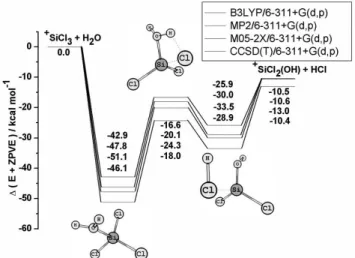
2O through successive hydrolysis reactions represented in Equation 1 and shown in Figure 1.
(1)
Although no attempts were made at measuring absolute rate cons-tants because of the dificulty in measuring the absolute pressure of water in the system, the kinetics shown in Figure 2 reveal that these reactions must proceed at rates close to the collision limit.
By analogy with the reactions previously studied for SiF3+,12,14 the likely mechanism for reaction 1 for SiCl3+ is represented in Scheme 1.
The proposed mechanism is conirmed by theoretical calculations that reveal that the energy proile of reaction 1 displays the usual double-well potential energy diagram of many gas-phase ion/mole-cule reactions.20 Figure 3 shows the calculated energy diagram for the gas-phase reaction of SiCl3+ and H
2O at different levels of theory.
The results of the theoretical calculations suggest that reaction 1 proceeds initially by addition of the silyl cation to the lone pair of the oxygen water. This addition is predicted to yield a strong ion-neutral binding in excess of 40 kcal mol-1, and the spectrum shown in Figure 1 reveals a distinct peak corresponding the [SiCl3+..OH
2] adduct corresponding to protonated trichlorosilanol. This strong binding energy is in good agreement with the experimental binding energies determined for gas-phase (CH3)3Si+ ions with oxygen bases by high pressure mass spectrometry.21 The large exothermicity of the association process and the low energy barrier for the system to proceed to products is responsible for the low abundance observed for the [SiCl3+..OH
2] adducts. The fact that vibrational radiative emis-sion is a relatively slow process and that colliemis-sional stabilization is ineficient at the pressures of our experiments allow us to predict that only a small fraction of the these adducts would have a suficiently long lifetime to be observed experimentally. The calculated energy diagram also reveals that the transition state is located some 20 kcal mol-1 below the energy of the reactants. While the different model chemistries yield quantitative differences for the energy diagram, the qualitative proiles are similar and suggest that reaction 1 should indeed proceed rapidly.
Calculations carried for the successive hydrolysis processes (1) reveal that both the exothermicities and energy barriers for the hydrolysis of Cl2SiOH+ and ClSi(OH)
2
+ are very similar to those shown in Figure 3.
The results obtained for SiCl3+ can be compared with the fact that the corresponding CCl3+ ions are unreactive toward H
2O within the time scale and pressure regime typical of FT-ICR mass spectrometry. Figure 1. Mass spectrum obtained in the FT-ICR spectrometer after 370 ms
trapping time revealing the sequential hydrolysis of SiCl3
+ ions. Spectrum
obtained from a mixture containing nominal pressures of 1.36 x 10⁻⁸ Torr of
SiCl4 and0.64 x 10
-8 Torr of H 2O
Figure 2. Relative intensities of the Cl3-xSi(OH)x
+ (x = 0 -3) ions as a function of
reaction time in an experiment carried out with a mixture containing nominal 1.36 x 10⁻⁸ Torr of SiCl
4 and0.64 x 10
-8 Torr of H 2O
Figure 3. Calculated energy proile for the gas-phase hydrolysis of SiCl3 + at
different levels of theory
SiCl3 + H2O
m/z 133
Si
Cl Cl H O
H Cl
+ HCl35
m/z 115 Si
35Cl
35 Cl35Cl
OH2
Si
35Cl OH 35Cl
Si 35Cl
35Cl OH
ClH
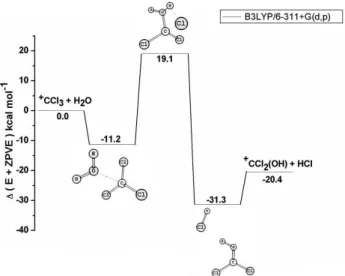
Figure 4 displays the results of theoretical calculations performed for this system and are consistent with the slowness of the hydro-lysis reaction of CCl3+. The main difference between the behavior of SiCl3+ and CCl
3
+ resides in the ability of the silyl cation to form a very stable adduct as shown in Figure 3. As in most gas-phase ion/ molecule reactions, formation of a strongly bound ion/neutral com-plex is responsible for the reaction transition state to be below the energy of the reactants. In the present case, the strong association between SiCl3+ and water, as opposed to the CCl
3
+/water complex, is responsible for the transition state of the 1,3-H migration to be below the energy of the reactants.
Alcoholysis of SiCl3+
Reaction of SiCl3+ with methanol is also observed to proceed rapidly by a solvolysis-type process, reaction 2.
Cl3-xSi(HOCH3)x (x = 0 - 2) + CH3OH Cl2-xSi(HOCH3)x+1
+ HCl (2)
The resulting spectrum also reveals a small fraction of CH3+ at m/z 15.
Figure 5 displays the calculated energy proile for the irst metha-nolysis reaction and shows that formation of CH3+ is an endothermic process, reaction 3, and thus can only be generated by non-thermalized SiCl3+ ions.
(3) The possibility of a small fraction of non-thermalized SiCl3+ ions cannot be ignored in these experiments because the methanolysis and hydrolysis occur so readily that long periods of ion cooling are not possible prior to isolation of SiCl3+ ions in the ICR cell.
Figure 5 reveals that the [SiCl3+…methanol] association, or protonated trichloromethoxysilane, is much stronger than for the water case, in agreement with the stability previously measured for the adducts of trimethylsilyl cations.21 As a consequence of this, the energy barrier for the 1,3-H migration is further decreased and the transition for reaction 2 is calculated to be some 25 kcal mol-1 below the energy of the reactants.
Reaction with the higher alcohols reveals that abstraction of hydroxide with subsequent formation of a carbenium ion becomes the dominant channel and solvolysis is no longer observed. This is
illustrated in Equation 4, where the formation of the carbenium ion is calculated to be the energetically preferred pathway.
(4a)
SiCl3 + CH3CH2OH
Cl2SiOCH3CH3 + HCl
SiCl3OH + CH3CH2
∆H = -20,7 kcal mol
-1
∆H = -29,5 kcal mol
-1 (4b)
The experiments reveal rapid formation of C2H5+ ions which then undergo rapid proton transfer to neutral ethanol to yield protonated ethanol, C2H5OH2+. Preference for carbenium ion formation becomes progressively more favorable for the higher alcohols.
Ammonolysis of SiCl3+
Gas-phase solvolysis-type reactions are also observed with am-monia, and Figure 6 shows that facile substitution occurs for the irst two chlorine atoms, Equation 5.
(5) The third substitution, leading to Si(NH2)3+, is much slower and can only be observed at longer trapping times ( trapping times > 1 s). The calculated energy proile for the ammonolysis of SiCl3+ is shown in Figure 7 and follows a similar pattern to the previous cases discussed above. The [Cl3Si+…NH
3] adduct, protonated trichlorosi-lanamine, is predicted to be very stable with an stabilization energy of over 60 kcal mol-1. The energy barrier for the reaction, although located well below the energy of the reactants, is calculated to be very similar to that for the hydrolysis reaction. Similar calculations for the sequential ammonolysis steps reveal that the energy barrier increases considerably. For example, the barrier for the second NH2 substitution is calculated to be at – 14.4 kcal mol-1 with respect to the reactants at the MP2/6-311+G(d,p) level while the barrier for the third NH2 substitution is calculated to be at -6.4 kcal mol-1 below the energy of the reactants at the MP2/6-311+G(d,p) level. This latter value is consistent with the fact that the third step in the ammonolysis reaction is much slower than the irst steps.
Reaction of SiCl3+ with amines follows a similar pattern to that observed with alcohols. Solvolysis occurs readily with CH3NH2 but starting with C2H5NH2 the reaction leading to initial formation of C2H5+ becomes the preferred route over solvolysis.
Figure 4. Calculated energy proile for the gas-phase hydrolysis of CCl3 + at
the B3LYP/6-311+G(d,p)//B3LYP/6-311+G(d,p) level of theory
Figure 5. Calculated energy proile for the gas-phase methanolysis of SiCl3 + at
the B3LYP/6-311+G(d,p)//B3LYP/6-311+G(d,p) level of theory. This energy proile also considers the energetics of reaction (3) to yield CH3
Reaction of SiCl3+with other substrates
While reaction with a large number of Lewis bases could be explored, we were particularly interested in reactions with neutral substrates that would involve initial attack at a double bond center.
Preliminary experiments with propylene reveal reaction 6 to occur slowly (about 40% conversion after 5 s under our typical experimental conditions).
(6) Calculations of the energy proile for reaction 6 suggest that this reaction proceeds through a bridged intermediate to yield a trans-silyl ion as shown in Scheme 2
Figure 6. Mass spectrum obtained in the FT-ICR spectrometer after 280 ms trapping time revealing the sequential ammonolysis of SiCl3
+ ions. Spectrum
obtained from a mixture containing nominal pressures of 2.0 x 10⁻⁸ Torr of
SiCl4 and1.5 x 10
-8 Torr of NH 3
Figure 7. Calculated energy proile for the gas-phase ammonolysis of SiCl3 +
at two different levels of theory
CONCLUSIONS
The present work shows that gaseous SiCl3+ cations can readily undergo chlorine substitution by reaction with Lewis bases through an addition-elimination mechanism where a 1,3-H migration in the transition state results in the elimination of HCl. These reactions yield a wide variety of substituted silyl cations and provide an inter-esting approach for multiple substituted silyl cations. This feature is particularly interesting because it provides a convenient approach for exploring a variety of secondary condensation type ion/molecule reactions that bear strong resemblance to the fundamental reactions of sol-gel processes.6,8
Theoretical calculations proved to be valuable to characterize the mechanism and energetics of these reactions. For the hydrolysis of gas-phase SiCl3+ ion, DFT and ab initio calculations yield comparable results although some differences are observed for the energies of the transition states and intermediates of the reaction.
A comparison of the hydrolysis reaction of SiCl3+ with that of CCl3+ reveals for the irst time two important differences: a) the initial adduct formation of the silyl cation with the Lewis base is much more stable than the corresponding adduct of the trichloromethyl cation; b) the energy barrier for the 1,3-H migration is considerably lower for the silyl reaction. This latter observation agrees with some previous claims that 1,3-H migration in silicon-containing ions is considerably more favorable than in carbon-containing ions.22
ACKNOWLEDGMENTS
The present work was supported by the CNPq through the Mil-lenium Institute for Complex Materials (IM2C), the Air Force Ofice of Scientiic Research (AFOSR) and FAPESP through the National Institute of Science, Technology and Innovation in Functional Mate-rials (INOMAT). The authors would like to thank CNPq for a post-graduate fellowship (T. D. R. Firmino) and the CNPq and CAPES for a Senior Research Fellowship (J. M. Riveros).
REFERENCES
1. Chambers, D. B.; Glockling, F.; Light, J. R.; Quart. Rev. 1968, 22, 317; Orlov, V. Yu.; Russ. Chem. Rev. (Engl. Transl.) 1973, 42, 529. 2. Lickiss, P. D.; J. Chem. Soc. Dalton Trans. 1992, 1333; Olsson, L.;
Ot-tosson, C.-H.; Cremer, D.; J. Am. Chem. Soc. 1995, 117, 7460; Lambert, J. B.; Kania, L.; Zhang, S.; Chem. Rev. 1995,95, 1191; Belzner, J.; Angew. Chem., Int. Ed. 1997, 36, 1277; Lambert, J. B.; Zhao, Y.; Angew. Chem., Int. Ed. 1997, 36, 400; Reed, C. A.; Acc. Chem. Res. 1998, 31, 325; Kim, K. C.; Reed, C. A.; Elliott, D. W.; Mueller, L. J.; Tham, F.; Lin, L.; Lambert, J. B.; Science 2002, 297, 825; Lee, V. Ya.; Sekiguchi, A.; Acc. Chem. Res. 2007, 40, 410.
3. Schwarz, H. In The Chemistry of Organic Silicon Compounds; Patai, S.; Rappoport, Z., eds.; John Wiley & Sons: Chichester, 1989, p. 445-510; Goldberg, N.; Schwarz, H. In The Chemistry of Organic Silicon Com-pounds; Rappoport, Z., ed.; John Wiley & Sons: Chichester, 1998, vol. 2, p. 1105-1142.
4. Fornarini, S. In The chemistry of organic silicon compounds; Rappoport, Z.; Apeloig, Y., eds.; John Wiley & Sons: Chichester, 2001, vol. 3, p. 1027-1057.
5. da Silva, M. L. P.; Riveros, J. M.; J. Mass Spectrom. 1995, 30, 733. 6. da Silva, M. L. P.; Riveros, J. M.; Int. J. Mass Spectrom. Ion Processes
1997, 165/166, 83.
7. Xavier, L. A.; Ambra, S.; Riveros, J. M.; Quim. Nova2002, 25, 766.
8. Xavier, L. A.; Pliego, J. R., Jr; Riveros. J. M.; Int. J. Mass Spectrom. 2003, 228, 551.
SiCl3
C C
H
H3C
H
H SiCl3 + CH2=CHCH3
C C
H
Cl2Si
CH3
H
C C
H
Cl2Si
CH3
H + HCl
C C Si
H
CH3
H Cl
Cl
Cl H
Cl H
9. Schumb, W. C.; Stevens, A. J.; J. Am. Chem. Soc. 1947, 69, 726; Schumb, W. C.; Stevens, A. J.; J. Am. Chem. Soc. 1950,72, 3178; Schumb, W. C.; Towle, L. H.; J. Am. Chem. Soc. 1953, 75, 6085. 10. Ignatov, S. K.; Sennikov, P. G.; Razuvaev, A. G.; Chuprov, L. A.;
Sch-rems, O. A.; Ault, B. S.; J. Phys. Chem. A 2003, 107, 8705; Cypryk, M.; J. Phys. Chem. A 2005, 109, 12020.
11. Murthy, S.; Beauchamp, J. L.; J. Phys. Chem. 1992, 96, 1247. 12. Grandinetti, F.; Occhiucci, G.; Ursini, O.; Depetris, G.; Speranza, M.;
Int. J. Mass Spectrom.1993, 124, 36.
13. Grandinetti, F.; Occhiucci, G.; Crestoni, M. E.; Fornarini, S.; Speranza, M.; Int. J. Mass Spectrom.1993, 127, 123;Grandinetti, F.; Occhiucci, G.; Crestoni, M. E.; Fornarini, S.; Speranza, M.; Int. J. Mass Spectrom. 1993, 127, 137.
14. Ketvirtis, A. E.; Baranov, V. I.; Ling, Y.; Hopkinson, A. C.; Bohme, D. K.; Int. J. Mass Spectrom.1999, 185/186/187, 381; Ketvirtis, A. E.; Baranov, V. I.; Hopkinson, A. C.; Bohme, D. K.; J. Phys. Chem. A1998, 102, 1162.
15. Giroldo, T.; Tese de Doutorado, Universidade de São Paulo, Brasil, 2007.
16. Isolani, P. C.; Kida-Tinome, M. C.; Linnert, H. V.; Menegon, J. J.; Riveros, J. M.; Tiedemann, P. W.; Quim. Nova1992, 15, 353. 17. Gaussian 03, Revision C.02; Frisch, M. J.; Trucks, G. W.; Schlegel, H.
B.; Scuseria, G. E.; Robb, M. A.; Cheeseman, J. R.; Montgomery, Jr., J.
A.; Vreven, T.; Kudin, K. N.; Burant, J. C.; Millam, J. M.; Iyengar, S. S.; Tomasi, J.; Barone, V.; Mennucci, B.; Cossi, M.; Scalmani, G.; Rega, N.; Petersson, G. A.; Nakatsuji, H.; Hada, M.; Ehara, M.; Toyota, K.; Fukuda, R.; Hasegawa, J.; Ishida, M.; Nakajima, T.; Honda, Y.; Kitao, O.; Nakai, H.; Klene, M.; Li, X.; Knox, J. E.; Hratchian, H. P.; Cross, J. B.; Bakken, V.; Adamo, C.; Jaramillo, J.; Gomperts, R.; Stratmann, R. E.; Yazyev, O.; Austin, A. J.; Cammi, R.; Pomelli, C.; Ochterski, J. W.; Ayala, P. Y.; Morokuma, K.; Voth, G. A.; Salvador, P.; Dannenberg, J. J.; Zakrzewski, V. G.; Dapprich, S.; Daniels, A. D.; Strain, M. C.; Farkas, O.; Malick, D. K.; Rabuck, A. D.; Raghavachari, K.; Foresman, J. B.; Ortiz, J. V.; Cui, Q.; Baboul, A. G.; Clifford, S.; Cioslowski, J.; Stefanov, B. B.; Liu, G.; Liashenko, A.; Piskorz, P.; Komaromi, I.; Martin, R. L.; Fox, D. J.; Keith, T.; Al-Laham, M. A.; Peng, C. Y.; Nanayakkara, A.; Challacombe, M.; Gill, P. M. W.; Johnson, B.; Chen, W.; Wong, M. W.; Gonzalez, C.; Pople, J. A.; Gaussian, Inc., Wallingford CT, 2004. 18. Andersson, M. P.; Uvdal, P.; J. Phys. Chem. A 2005, 109, 2937. 19. Merrick, J. P.; Moran, D.; Radom, L.; J. Phys. Chem. A 2007, 111,
11683.
20. Chabinyc, M. L.; Craig, S. L.; Regan, C. K.; Brauman, J. I.; Science 1998, 279, 1882.
21. Stone, J. A.; Mass Spectrom. Rev. 1997, 16, 25.