Article
J. Braz. Chem. Soc., Vol. 23, No. 9, 1741-1746, 2012. Printed in Brazil - ©2012 Sociedade Brasileira de Química 0103 - 5053 $6.00+0.00
A
*e-mail: [email protected]
Theoretical Study of Thermochemical Properties using Composite Methods
Adapted to ONIOM
Gabriel Heerdt* and Nelson H. Morgon
Instituto de Química, Universidade Estadual de Campinas, CP 6154, 13083-970 Campinas-SP, Brazil
Métodos compostos adaptados ao método ONIOM foram utilizados no cálculo teórico de afinidades por próton (PA) e eletrônica (EA) para um grupo de 50 moléculas (álcoois, cetonas, radicais e alcenos). A energia eletrônica foi descrita considerando-se o escalonamento de ZPE (λ) e a correção de alto nível (HLC). O valor ótimo para λ foi obtido através dos dados de PA. Os cálculos de EA foram utilizados na otimização dos termos presentes em HLC. Foram explorados diferentes tipos de funcionais de troca-correlação. A metodologia ONIOM2(QCISD(T)/6-311++G(2dF,p):HF/6-31G(d))//ONIOM2(B3LYP/6-31G(d):HF/6-31G(d)) forneceu os menores desvios absolutos médios para PA e EA, 5,38 kJ mol-1 e 0,11 eV, respectivamente, em comparação com dados experimentais.
Composite methods adapted to the ONIOM approach were used in the description of proton (PA) and electron (EA) affinities for a group of 50 molecules (alcohols, ketones, radicals and alkenes). The electronic energy was described considering the scaling ZPE (λ) and higher level (HLC) corrections. The optimal value for λ was obtained from the PA data. The EA calculations were used for optimization of the terms in HLC. Different performances of exchange-correlation functionals were considered. The methodology ONIOM2(QCISD(T)/6-311++G(2dF,p):HF/6-31G(d))//ONIOM2(B3LYP/6-31G(d):HF/6-31G(d)) provided the smallest median absolute deviation (MAD) for PA and EA, 5.38 kJ mol-1 and 0.11 eV, respectively, in comparison to the experimental data.
Keywords:proton and electron affinities, composite methods, ONIOM
Introduction
Molecular modeling calculations using high level (ab initio and DFT methods) and large basis sets have provided determinations of the precise electronic properties
of atomic and molecular systems.1-9 However, practical
calculations containing many particles become a task that
requires a very high computational cost.10 Some strategies
have been successful, making it possible to study large
systems, highlighting the composite methods11-19 and the
ONIOM (our own n-layered integrated molecular orbital
and molecular mechanics) method.20
Developed in the 1980s, the composite methods aim to extrapolate the electronic energies from a sequence of calculations, computationally inexpensive, to an electronic
energy with a high level of correlation and large basis set.2
In addition to the energy terms from the energy calculations,
some empirical parameters can be added to correct deficiencies of the method, like additional correlation effects, relativistic effect, etc.
The Gaussian-n theory, developed by Pople and
co-workers,13-17 exploits this idea to predict thermochemical
data of molecules containing elements of the first three periods of the periodic table. The purpose of this theory is to obtain a general procedure that can reproduce experimental data for properties such as proton and electron affinities, ionization energy, enthalpy of formation, etc., being applicable to any molecular system unambiguously. Recently, new approaches of these theories have included
pseudopotentials, rather than all-electron basis set.21
There are other theories to predict accurate thermochemical data of chemical compounds. The
correlation consistent composite approach (ccCA),22-24 the
complete basis set methods (CBS)25-28 and the Weizmann
theories (Wn),29-32 are examples of alternatives to the
Proton (PA) and electron (EA) affinities are two of the properties extensively studied with composite methods, and
generally excellent results are obtained.33-39 The interest in
studying the transfer of electrons or protons is mainly due to the fact that these processes are present in several areas
such as biochemistry,40-43 nanotechnology,44,45 and others.
The proton affinity (PA) from a neutral molecule is the measure of its basicity in the gaseous phase, and can be calculated from the energy released in the reaction:
X(g) + H+(g) → XH+(g) PA = −∆rH0 (1)
The electron affinity (EA), in turn, is the minimum amount of energy required to release an electron from an anion, thus forming a neutral atom or molecule:
X
-(g) → X(g) + e− EA = −∆rH0 (2)
Other methodologies aiming at reducing the computational costs are known as hybrid methods. They are described as a mixed quantum mechanics/ molecular mechanics method. These methods have been
developed since the 1970s,46-48 and are so called because
of the possibility for combining different approximations, highlighting the ONIOM method, that can be illustrated as a superposition of layers as in an “onion”. Thus, any molecular system can be divided into different levels, linked in an order convenient to the problem at hand. Each level can be treated by any method while, by integrating the results, we can get an extrapolation to more accurate energy values of the molecular system. The ONIOM method application in thermochemical studies have been
done considering various chemical species.49-51
The link between the ONIOM and the composite methods allows the calculation of systems with many
atoms at high level theory. Both methodologies use the extrapolation of their energies to more accurate results. The calculations are less costly and can extend to advanced theories. Some studies have been performed using combinations of hybrid methods with composite theories.52-55
Computational Details
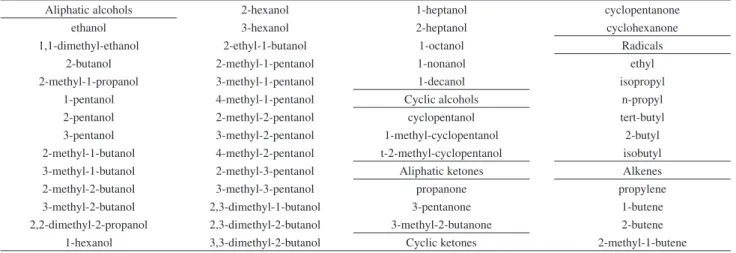
The ONIOM method was adapted to composite methods based on gaussian-n theories. The aim was to carry out calculations of proton and electron affinities for a group of molecules. The 50 molecules used in the validation process are shown in Table 1. The choice of this group of molecules is due to the presence of similar molecules in the cholesterol oxidation mechanism. Further studies on this mechanism are in progress.
Some proposed variables to this composite method
were tested in a previous study.10 In comparison with
different basis set, the best results were obtained with the double and triple zeta-valence basis set, 6-31G(d) and 6-311++G(2df,p), respectively. Among 25 exchange-correlation functionals and the HF and MP2 methods, we observed optimal results to eight functionals, B1LYP, B3LYP, HCTH, HCTH147, mPW1LYP, O3LYP, VSXZ, X3LYP. The ONIOM method was tested in two configurations, and the results were compared without the use of the layers. The Figure 1 shows the diagram of the best configuration of the high and low levels of theory applied to the ONIOM method considering an aliphatic alcohol.
The hydroxyl (OH), the carbon directly connected to it
(C1) and the carbons attached to it (C2), and the hydrogens
that complete the valences of these atoms (HO−C1−C2−R),
were treated at the highest level of theory and the rest of the molecule at the lower level (R). For the cyclic molecules
Table 1. Molecules employed in the present study
Aliphatic alcohols 2-hexanol 1-heptanol cyclopentanone
ethanol 3-hexanol 2-heptanol cyclohexanone
1,1-dimethyl-ethanol 2-ethyl-1-butanol 1-octanol Radicals
2-butanol 2-methyl-1-pentanol 1-nonanol ethyl
2-methyl-1-propanol 3-methyl-1-pentanol 1-decanol isopropyl
1-pentanol 4-methyl-1-pentanol Cyclic alcohols n-propyl
2-pentanol 2-methyl-2-pentanol cyclopentanol tert-butyl
3-pentanol 3-methyl-2-pentanol 1-methyl-cyclopentanol 2-butyl
2-methyl-1-butanol 4-methyl-2-pentanol t-2-methyl-cyclopentanol isobutyl
3-methyl-1-butanol 2-methyl-3-pentanol Aliphatic ketones Alkenes
2-methyl-2-butanol 3-methyl-3-pentanol propanone propylene
3-methyl-2-butanol 2,3-dimethyl-1-butanol 3-pentanone 1-butene
2,2-dimethyl-2-propanol 2,3-dimethyl-2-butanol 3-methyl-2-butanone 2-butene
were used the same idea, the carbon attached to the functional group and the carbons directly linked to it were defined as belonging to the high layer, while the rest of the molecule was treated as the low layer.
The following sequence of calculations will be used to obtain the results of proton and electron affinities: (1) optimization ONIOM2(DFT/6-31G(d):HF/6-31G(d)); (2) frequency ONIOM2(DFT/6-31G(d):HF/6-31G(d)); (3) energy ONIOM2(QCISD(T)/6-31G(d):HF/6-31G(d)); (4) energy ONIOM2(DFT/6-311++G(2df,p):HF/6-31G(d)). The final energy is represented by:
Ecomb = E3 + E4− E1 + (ZPE)λ (3)
In equation 3, λ is the ZPE scale factor. The scaling
parameters permit, using the method of least squares, to
get the best fit to the experimental data.56
Higher level correction (HLC), equation 4, is added to the final energy in the same way that is used in some variations of gaussian-n theory. This factor is necessary to correct limitations such as relativistic effects, complete basis set, non-dynamic correlation, etc.
HLC = − Anβ− B(nα− nβ) (4)
The parameters A and B are optimized for the minimization of mean absolute deviation between the calculated and experimental value of the EA.
The ground-state energy used in the calculations is given by equation 5:
E0 = Ecomb + HLC (5)
In summary the final energy obtained from calculations can be represented by equation 6:
E0≈ EONIOM2(QCISD(T)/6-311++G(2df, p):HF/6-31G(d ))//ONIOM2(DFT/6-31G(d):HF/6-31G(d)) (6)
The comparison among the methods was carried out with the lsd method (least squares difference). The lsd is given by equation 7:
(7)
The value of t-student (tα) was used at the 95%
level of confidence. The term MSerror corresponds to the
difference between the sum of individual variances and methodological variances and n is the number of methods being compared.
The viability of the methods was provided with the comparison among proposed methodologies and the
theories G3(MP2)15 and G3(MP2)/B3LYP16 (G3B3). The
purpose of this comparison is to examine whether the use of the ONIOM method, which provides a considerable reduction in computational time in relation to G3 theories, affects the results.
All calculations were carried out using the Gaussian 03
quantum chemistry package,57 and experimental data were
obtained from NIST Chemistry WebBook.58
Results and Discussion
Proton affinity
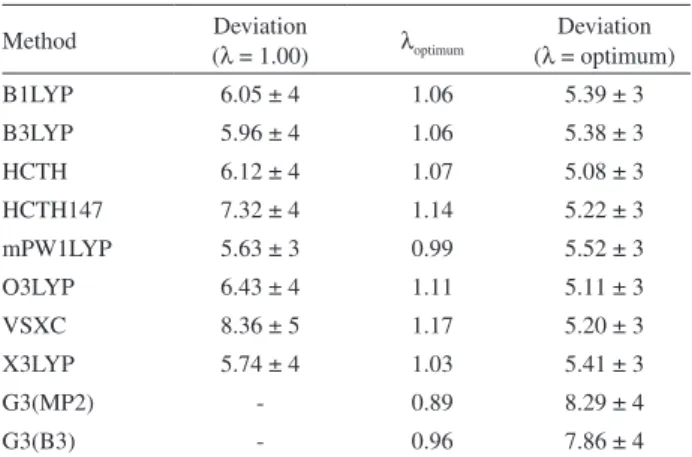
The average absolute deviations of proton affinity are given in Table 2. The results are presented with and without the ZPE scaling correction for the 50 molecules studied.
We observe that the results agree very well with the experimental data even without the optimization of scaling values of zero point energy. There is an average decrease
of 1.12 kJ mol-1 in deviations from the experimental data,
considering the optimization process of λ, point-by-point.
Table 2. Absolute deviations from proton affinities in kJ mol-1 with and without the ZPE scaling correction
Method Deviation
(λ = 1.00) λoptimum
Deviation (λ = optimum)
B1LYP 6.05 ± 4 1.06 5.39 ± 3
B3LYP 5.96 ± 4 1.06 5.38 ± 3
HCTH 6.12 ± 4 1.07 5.08 ± 3
HCTH147 7.32 ± 4 1.14 5.22 ± 3
mPW1LYP 5.63 ± 3 0.99 5.52 ± 3
O3LYP 6.43 ± 4 1.11 5.11 ± 3
VSXC 8.36 ± 5 1.17 5.20 ± 3
X3LYP 5.74 ± 4 1.03 5.41 ± 3
G3(MP2) - 0.89 8.29 ± 4
G3(B3) - 0.96 7.86 ± 4
This reduction shows that the ZPE scale factor must be included.
The comparison among the methods, performed by the statistical method lsd, suggests that values within the
range from 5.08 to 7.19 kJ mol-1 are accepted as equivalent.
Electron affinity
Table 3 presents the results of the deviations obtained between the calculated electron affinities and the experimental data.
In the results that do not have HLC correction, it is observed that the deviations from the experimental data are
relatively high. This is due to deficiencies in the method, which can be empirically adjusted by the HLC term.
The addition of higher level correction has significantly decreased the mean absolute deviation by 0.31 eV. This is an important term to be added to the final energy.
The comparison among the methods used to describe the electron affinities gives lsd values equal to 0.044 eV. Results within the range from 0.066 to 0.110 eV are equivalent at the 95% confidence level. It is observed that only those methods that use the exchange-correlation functionals B3LYP, HCTH and O3LYP occur in this interval.
Analysis of chemical functions
The group of molecules used in the validation can be separated according to their chemical functions, and the dependence on them can be carefully analysed.
The results for the absolute deviations of proton affinities according to the chemical functions are shown in Table 4.
Overall there is a higher deviation for the radicals and alkenes, which may be due to the number of samples. However, chemical functions do not indicate any dependency on the method.
Table 5 presents the absolute deviations results for the electron affinities in relationship of the chemical functions.
Just as for the results of proton affinities there is not a dependence of electron affinities with the chemical functions. These results indicate that the proposed method Table 3. Absolute deviations from electron affinities (eV) with and without
correction of HLC
Method
Deviation (without
HLC)
A/eVa B/eVa Deviation (with HLC)
B1LYP 0.419 ± 0.07 0.239 0.118 0.112 ± 0.07 B3LYP 0.416 ± 0.07 0.237 0.116 0.108 ± 0.07 HCTH 0.417 ± 0.07 0.237 0.116 0.110 ± 0.07 HCTH147 0.441 ± 0.07 0.253 0.125 0.119 ± 0.07 mPW1LYP 0.399 ± 0.07 0.230 0.113 0.112 ± 0.07 O3LYP 0.441 ± 0.07 0.258 0.127 0.106 ± 0.07 VSXC 0.444 ± 0.07 0.241 0.118 0.122 ± 0.07 X3LYP 0.405 ± 0.07 0.227 0.117 0.112 ± 0.07
G3(MP2) - 0.253 0.122 0.081 ± 0.08
G3(B3) - 0.273 0.136 0.066 ± 0.07
aA and B are constants in the HLC, according to equation 4.
Table 4. Absolute deviations from proton affinities in kJ mol-1 according to the chemical functions
Chemical functions (number of molecules) Proposed methodsa Equation 6 (B3LYP)b G3(MP2) G3(B3)
aliphatic alcohols (32) 4.86 ± 3 5.06 8.71 7.44
cyclic alcohols (3) 2.88 ± 3 2.97 2.90 2.70
aliphatic ketones (3) 3.61 ± 3 3.75 4.96 3.71
cyclic ketones (2) 6.20 ± 3 6.62 5.90 8.41
radicals (6) 7.93 ± 4 7.55 10.55 12.33
alkenes (4) 7.39 ± 4 7.17 9.32 11.17
average (50) 5.29 ± 3 5.38 ± 3 8.29 ± 4 7.86 ± 4
aAverage result for the eight exchange-correlation functionals. bDeviations obtained considering only the B3LYP exchange-correlation functional.
Table 5. Absolute deviations from electron affinities in eV to the chemical functions
Chemical functions (number of molecules) Proposed methodsa Equation 6 (B3LYP)b G3(MP2) G3(B3)
aliphatic alcohols (32) 0.106 ± 0.07 0.101 0.081 0.063
cyclic alcohols (3) 0.117 ± 0.07 0.119 0.082 0.083
aliphatic ketones (3) 0.112 ± 0.07 0.106 0.076 0.059
cyclic ketones (2) 0.121 ± 0.07 0.110 0.071 0.056
radicals (6) 0.141 ± 0.07 0.129 0.092 0.082
alkenes (4) 0.134 ± 0.07 0.126 0.079 0.074
average (50) 0.113 ± 0.07 0.107 ± 0.07 0.081 ± 0.08 0.066 ± 0.07
is suitable for describing molecules containing the same chemical functions.
Conclusions
The addition of empirical corrections to high level electronic energies gives a significant improvement in the results. Considering PA analysis, can be concluded that the results obtained from the choice of only the 8 exchange-correlation functionals, in the proposed method, are equivalent at the 95% confidence level. The EA calculations decrease the number of useful exchange-correlation potentials to B3LYP, HCTH and O3LYP. The results of G3(MP2) and G3(B3) are according to experimental data, as well as the proposed method.
We conclude that the ONIOM2(QCISD(T)/6- 311++G(2dF,p):HF/6-31G(d))//ONIOM2(B3LYP/6-31G(d):HF/6-31G(d)) provides lowest median absolute
deviation for PA and EA, 5.38 kJ mol-1 and 0.11 eV,
respectively, compared with the experimental data for these electronic properties.
Concerning the dependence of the results with the studied chemical functions, the method is appropriate to describe similar systems.
Supplementary Information
Supplementary data is available free of charge at http://jbcs.sbq.org.br as pdf file.
Acknowledgements
We would like to thank the computational facilities of Chemistry Institute at UNICAMP and the financial support from FAPESP (Fundação de Amparo à Pesquisa do Estado de São Paulo) and CNPq (Conselho Nacional de Desenvolvimento Científico e Tecnológico).
References
1. Dunning Jr., T. H.; Peterson, K. A.; Woon, D. E.; Encyclopedia of Computational Chemistry, Schleyer, P. v. R.,ed., Wiley: New
York, 1998.
2. Lima, J. C. B.; Morgon, N. H.; Quim. Nova2010, 33, 195. 3. Morgon, N. H.; Souza, A. R.; Sambrano, J. R.; J. Mol. Struct.
2006, 759, 189.
4. Morgon, N. H.; Int. J. Quantum Chem.2006, 106, 2658. 5. Morgon, N. H.; Riveros, J. M.; Int. J. Mass Spectrom.2001,
210, 173.
6. Feller, D.; Peterson, K. A.; J. Chem. Phys.1998, 108, 154. 7. Feller, D.; Dixon, D. A.; J. Chem. Phys.2001, 115, 3484.
8. Ruden, T. A.; Helgaker, T.; Jorgensen, P.; Olsen, J.; Chem. Phys. Lett.2003, 371, 62.
9. Braga , A. A. C.; Morgon. N. H.; Quim. Nova2006, 29, 187. 10. Heerdt, G.; Morgon, N. H.; Quim. Nova2011, 34, 868. 11. Montgomery, J. A. Jr.; Frisch, M. J.; Ochterski, J. W.; Peterson,
G. A.; J. Chem. Phys.1999, 110, 2822.
12. Montgomery, J. A. Jr.; Frisch, M. J.; Ochterski, J. W.; Peterson, G. A.; J. Chem. Phys.2000, 112, 6532.
13. Curtiss, L. A.; Raghavachari, K.; Fox, D. J.; Head-Gordon, M.; Pople, J. A.; J. Chem. Phys.1989, 90, 5622.
14. Curtiss, L. A.; Raghavachari, K.; Redfern, P. C.; Rassolov, V.; Pople, J. A.; J. Chem. Phys.1998, 109, 7764.
15. Curtiss, L. A.; Raghavachari, K.; Redfern, P. C.; Rassolov, V.; Pople, J. A.; J. Chem. Phys.1999, 110, 4703.
16. Curtiss, L. A.; Raghavachari, K.; Redfern, P. C.; Pople, J. A.; Chem. Phys. Lett.1999, 313, 600.
17. Curtiss, L. A.; Redfern, P. C.; Rassolov, V.; Kedziora, G.; Pople, J. A.; J. Chem. Phys. 2001, 114, 9287.
18. Curtiss, L. A.; Redfern, P. C.; Raghavachari, K.; J. Chem. Phys.
2007, 126, 084108.
19. Curtiss, L. A.; Redfern, P. C.; Raghavachari, K.; J. Chem. Phys.
2007, 127, 124105.
20. Svensson, M.; Humbel, S.; Froese, R. D. J.; Matsubara, T.; Sieber, S.; Morokuma, K.; J. Chem. Phys.1996, 100, 19357. 21. Pereira, D. H.; Ramos, A. F.; Morgon, N. H.; Custódio, R.;
J. Chem. Phys. 2011, 135, 034106.
22. DeYonker, N. J.; Cundari, T.; Wilson, A.; J. Chem. Phys.2006, 124, 114104.
23. Ho, D. S.; DeYonker, N. J.; Wilson, A. K.; Cundari, T. R.; J. Chem. Phys. A2006, 110, 9767.
24. DeYonker, N. J.; Grimes, T.; Yockel, S.; Dinescu, A.; Mintz, B.; Cundari, T. R.; Wilson, A. K.; J. Chem. Phys.2006, 125, 104111.
25. Nyden, M. R.; Petersson, G. A.; J. Chem. Phys.1981, 75, 1843. 26. Ochterski, J. W.; Petersson, G. A.; Montgomery Jr., J. A.;
J. Chem. Phys.1996, 104, 2598.
27. Petersson, G. A.; Tensfeldt, T. G.; Montgomery Jr., J. A.; J. Chem. Phys.1991, 94, 6091.
28. Montgomery Jr., J. A.; Frisch, M. J.; Ochterski, J. W.; Petersson, G. A.; J. Chem. Phys.2000, 112, 6532.
29. Martin, J. M. L.; de Oliveira, G.; J. Chem. Phys.1999, 111, 1843.
30. Parthiban, S.; Martin, J. M. L.; J. Chem. Phys.2001, 114, 6014. 31. Boese, A. D.; Oren, M.; Atasoylu, O.; Martin, J. M. L.; Kállay, M.;
Gauss, J.; J. Chem. Phys.2004, 120, 4129.
32. Karton, A.; Rabinovich, E.; Martin, J. M. L., Ruscic, B.; J. Chem. Phys.2006, 125, 144108.
33. Namazian, M.; Coote, M. L.; J. Chem. Thermodyn.2008, 40, 1116.
35. Range, K.; Riccardi, D.; Cui, Q.; Elstner, M.; Work, D. M.; J. Phys. Chem.2005, 7, 3070.
36. Richard, R. M.; Ball, D. W.; J. Mol. Model2008, 14, 21. 37. Namazian, M.; Siahrostami, S.; Coote, M. L.; J. Fluorine Chem.
2008, 129, 222.
38. Wang, L.; Int. J. Mass Spectrom.2007, 264, 84.
39. Miller, T. M.; Arnold, S. T.; Viggiano, A. A.; Int. J. Mass Spectrom.2003, 227, 413.
40. Bensasson, R. V.; Zoete, V.; Dinkova-Kostova, A. T.; Talalay, P.; Chem. Res. Toxicol.2008, 21, 805.
41. Librando, V.; Alparone, A.; Tomaselli, G.; J. Mol. Model.2008, 12, 489.
42. Higashi, N.; Tanimoto, K.; Nishioka, M.; Ishikawa, K.; Taya, M.; J. Biochem.2008, 144, 77.
43. Morgan, J. E.; Gennis, R. B.; Maeda, A.; Photochem. Photobiol.
2008, 84, 1038.
44. Battacharya, S. K.; Kshirsagar, A.; Eur. Phys. J. D 2008, 84, 1038.
45. Reinard, M. S.; Johnston, M. V.; J. Am. Soc. Mass Spectrom.
2008, 19, 389.
46. Warshel, A.; Karplus, M.; J. Am. Chem. Soc.1972, 94, 5612. 47. Warshel, A.; Levitt, M.; J. Mol. Biol.1976, 103, 227. 48. Field, M. J.; Bash. P. A.; Karplus, M.; J. Comput. Chem.1990,
11, 1970.
49. Espinosa-García, J.; Chem. Phys. Lett.2003, 377, 607. 50. Braga, A. C. B.; Morgon, N. H.; Quim. Nova2006, 29, 187. 51. Remkoa, M.; Liethb, C.; Bioorg. Med. Chem.2004, 12, 5395.
52. Oyedepo, G. A.; Wilson, A. K.; ChemPhysChem2011, 12, 3320. 53. Damin, A; Bordiga, S.; Zecchina, A.; Lamberti, C.; J. Chem.
Phys. 2002, 117, 226.
54. Vreven, T.; Morokuma, K.; J. Chem. Phys.1999, 111, 8799. 55. Froese, R. D. J.; Morokuma, K.; J. Phys. Chem. A1999, 103,
4580.
56. Eberly, D.; Least-Squares Fitting of Data, 2001. http://www. geometrictools.com/Document ation/LeastSquaresFitting.pdf accessed in March 2012.
57. Frisch, M. J.; Trucks, G. W.; Schlegel, H. B.; Scuseria, G. E.; Robb, M. A.; Cheeseman, J. R.; Montgomery Jr., J. A.; Vreven, T.; Kudin, K. N.; Burant, J. C.; Millam, J. M.; Iyengar, S. S.; Tomasi, J.; Barone, V.; Mennucci, B.; Cossi, M.; Scalmani, G.; Rega, N.; Petersson, G. A.; Nakatsuji, H.; Hada, M.; Ehara, M.; Toyota, K.; Fukuda, R.; Hasegawa, J.; Ishida, M.; Nakajima, T.; Honda, Y.; Kitao, O.; Nakai, H.; Klene, M.; Li, X.; Knox, J. E.; Hratchian, H. P.; Cross, J. B.; Bakken, V.; Adamo, C.; Jaramillo, J.; Gomperts, R.; Stratmann, R. E.; Yazyev, O.; Austin, A. J.; Cammi, R.; Pomelli, C.; Ochterski, J. W.; Ayala, P. Y.; Morokuma, K.; Voth, G. A.; Salvador, P.; Dannenberg, J. J.; Zakrzewski, V. G.; Dapprich, S.; Daniels, A. D.; Strain, M. C.; Farkas, O.; Malick, D. K.; Rabuck, A. D.; Raghavachari, K.; Foresman, J. B.; Ortiz, J. V.; Cui, Q.; Baboul, A. G.; Clifford, S.; Cioslowski, J.; Stefanov, B. B.; Liu, G.; Liashenko, A.; Piskorz, P.; Komaromi, I.; Martin, R. L.; Fox, D. J.; Keith, T.; Al-Laham, M. A.; Peng, C. Y.; Nanayakkara, A.; Challacombe, M.; Gill, P. M. W.; Johnson, B.; Chen, W.; Wong, M. W.; Gonzalez, C.; Pople, J. A.; Gaussian 03, Revision E.02, Gaussian, Inc.: Wallingford, CT, 2004.
58. http://webbook.nist.gov/chemistry/ accessed in March 2012.
Submitted: March 9, 2012
Published online: September 18, 2012