Coumarins and Alkaloids from the Stems of
Metrodorea Flavida
Ana Cristina S. Baetas, Mara S.P. Arruda*, Adolfo H. Müller,
and Alberto C. Arruda
Departamento de Química, CCEN, Campus Universitário,
Universidade Federal do Pará, 66075-900 Belém - PA, Brazil
Uma nova cumarina , a 5,6-metilenodioxi-7,8-dimetoxicumarina, foi isolada a partir dos galhos de Metrodorea flavida, juntamente com outras cumarinas e alcalóides conhecidos. As estruturas das substâncias isoladas foram definidas por análises de seus dados espectrais , bem como por comparação com dados da literatura.
A new coumarin, 5,6-methylenedioxy-7,8-dimethoxycoumarin has been isolated from the stems of Metrodorea flavida, as well as known coumarins and alkaloids. The structures of the new and the known compounds were established by spectral data and by comparison with the literature data.
Keywords: Metrodorea flavida, Rutaceae, coumarins, alkaloids
Introduction
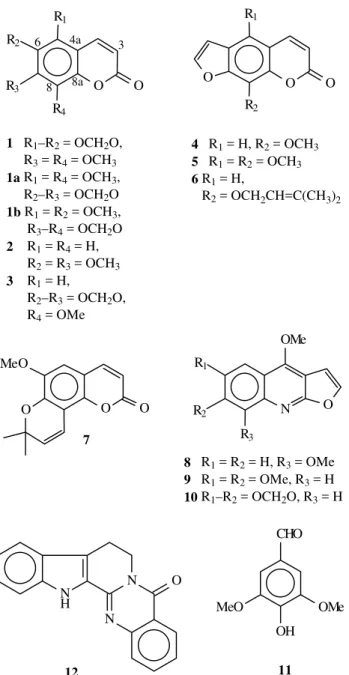
In a previous paper, we reported the characterization of a new coumarin, 8-(2,3-dihydroxy-3-methylbutyloxy)-6,7-methylenedioxycoumarin, together with known furocou-marins and a furofuran lignan, which were isolated from the leaves of Metrodorea flavida1. In continuation of our phytochemical studies on the constituents of this species, we report from the stem the isolation and structural eluci-dation of a new coumarin 5,6-methylenedioxy-7,8-di-methoxycoumarin (1) , i n a ddi ti on t o the known compounds: scoparone (2)2; 6,7-methylenedioxy-8-methoxycoumarin (3)3; xanthotoxin (4)4; isopimpinellin (5)4; imperatorin (6)4; braylin (7)5; γ-fagarine (8)6;
kokusaginine (9)7 ; maculin (10)8; syringic aldehyde (11)9;
rutaecarpine (12)10; sitosterol and lupeol.
All the compounds were isolated by chromatographic techniques. The structural elucidation of these compounds were based on spectrometric data, especially IR, 1H NMR and 13C NMR, involving comparison with the literature data.
Experimental
Equipment
Mps uncorr. IR were recorded in KBr discs. 1H and
13C-NMR spectra were recorded at 300 and 75 MHz,
respectively, in CDCl3 on a Varian GEMINI 300
instru-ment and at 400 and 100 MHz, in DMSO, on a Brucker
ARX 400 instrument. EIMS were obtained by direct probe insertion at 70 eV.
Plant material
Metrodorea flavida was collected in Paragominas, State of Pará, Brazil, in December 1991. A voucher speci-men is deposited at the Herbarium of the CPATU-EM-BRAPA, Belém, Brazil.
Extraction and isolation
After drying, stems (231 g) were ground and percolated with hexane and CH2Cl2, successively. The concd. hexane
extract (3.5 g) was submitted to CC using silica gel 60 Merck (particula size 0.063-0.200 mm) packed in hexane. Elution was performed with a gradient of hexane, Me2CO
and MeOH, affording 22 frs. The frs 3 and 7 after prep. TLC (silica gel and hexane- CH2Cl2- MeOH/10:10:0.1) yielded
lupeol and sitosterol, respectively.
Fr. 12 was rechromatographed on silica gel using gra-dients of hexane, CH2Cl2 and MeOH. Those frs. containing
homogeneous components, as judged by TLC, were com-bined and the solvent removed. Frs. 12/9-12 and 12/14-17 subjected to prep. TLC on silica gel (hexane-Me2CO/
75:25) afforded 6 (31.4 mg) and 12 (7.5 mg) , respectively. Fr.17 was subjected to CC on silica gel eluting with gradi-ents of hexane, CH2Cl2, Me2CO and MeOH affording 9
(3.1 mg).
The CH2Cl2 extract (4.2 g) was subjected to
chroma-tographic treatments similar to those used for the hexane
Article
J. Braz. Chem. Soc., Vol. 10, No. 3, 181-183, 1999. © 1999 Soc. Bras. Química
extract. Frs. 4-5 afforded a mixture (6.3 mg) of lupeol and sitosterol. The Fr. 7 afforded 6 (4.8 mg). Fr. 8 was rechro-matographed on silica gel using gradients of hexane, Me2CO and MeOH yielding 4 (3.7 mg), 6 (8.1 mg), 7
(5.2 mg) and 12 (1.3 mg). Fr. 9 was subjected to CC on silica gel using hexane, Me2CO and MeOH at different
ratios of increasing polarity to give 7.0 mg of the new coumarin 1, 2 (2.7 mg), 3 (0.5 mg), 4 (6.3 mg), 5 (4.3 mg), 8 (2.3 mg), 10 (3.2 mg), 11 (2.4 mg) and 12 (1.4 mg).
5,6-Methylenedioxy-7,8-dimetoxycoumarin (1). Amor-phous solid. 1H and 13C-NMR: see Table 1.
Results and Discussion
The new coumarin 1 was obtained from the dichlo-romethane extract of M. flavida and showed as a blue
color on TLC under UV light 336 nm. Its 1H NMR
spec-trum exhibited resonances typical of H-3 and H-4 (δ 6.20 and 7.91) of the coumarin nucleus in which C-5 was oxygenated11. The presence of a methylenedioxy group was indicated from the methylene hydrogens signal at δ 6.01 (s) and two methoxy groups from the signals at δ 4.04 and 3.99 (s, 3H each one). These groups were located at the positions 5, 6, 7 and 8 suggesting one of the possible structures 1, 1a or 1b. Further information concerning the actual positions of the methoxy groups was obtained by analysis of the 1D-NOE difference spectrum. Irradiation of the signal at δ 7.91 (d, H-4) didn’t enhance the signals at δ 4.04 and 3.99 (2x OMe), which confirmed the placement of the methylenedioxy group at C-5/C-6. This result is consistent with the struc-ture 1. The assignments of the signals of carbons 3,4 and –OCH2O- moiety in the 13C-NMR spectrum were
estab-lished by HETCOR (13C, 1H-COSY-1J
CH) spectrum and
the attribution of the quaternary carbons was made by COLOC (13C, 1H-COSY-nJ
CH, n = 2 and 3) experiment
(Table 1).
This is the first report of the occurrence of one in-dolopiridoquinazoline alkaloid (rutaecarpine) from the genus Metrodorea. This fact reinforces the taxonomic position of the Metrodorea flavida into the Cusparieae tribe, due to the occurrence of this type of alkaloid in the tribes Cusparieae and Xanthoxyleae.
Acknowledgements
The authors are grateful to Coordenação de Aper-feiçoamento de Pessoal de Ensino Superior (CAPES) and Financiadora de Estudos e Projetos (FINEP) for financial
182 Baetas et al. J. Braz. Chem. Soc.
8a 8
6 4a 3
O R1 R2 R3 R4 O O R1 R2 O O N O OMe R1 R2 R3 N H N N O 12 CHO MeO OH OMe 11 8 R1 = R2 = H, R3 = OMe
9 R1 = R2 = OMe, R3 = H
10 R1–R2 = OCH2O, R3 = H
4 R1 = H, R2 = OCH3
5 R1 = R2 = OCH3
6 R1 = H,
R2 = OCH2CH=C(CH3)2
1 R1–R2 = OCH2O,
R3 = R4 = OCH3
1a R1 = R4 = OCH3,
R2–R3 = OCH2O
1b R1 = R2 = OCH3,
R3–R4 = OCH2O
2 R1 = R4 = H,
R2 = R3 = OCH3
3 R1 = H,
R2–R3 = OCH2O,
R4 = OMe
7 O O
O O
Me
Table 1. NMR data for compound 1 (CDCl3, J values, in Hz, are given in parentheses).
Position 13C 1H COLOC
2 160.5 H-4
3 112.0 6.20, d (9.7)
4 138.8 7.91, d (9.7)
4a 107.0 H-3
5 142.9 OCH2O
6 132.8 OCH2O
7 133.4 MeO-7
8 126.9 MeO-8
8a 143.7 H-4
7-OMe 61.1 4.04, s
8-OMe 61.1 3.99, s
OCH2O 102.1 6.01, s
support and to Universidade Federal de São Carlos (São Carlos - São Paulo, Brazil) for 1H and 13C-NMR spectra at 400 and 100 MHz, respectively.
References
1. Baetas, A.C.; Arruda, M.S.P.; Müller, A.H.; Arruda, A.C. Phytochemistry 1996, 43, 491.
2. Adegosam, E.K. Phytochemistry1973, 12, 2310. 3. Sarker, S.D.; Gray, A.I.; Waterman, P.G. J. Nat.Prod.
1994, 57, 1549.
4. Razdam, T.K.; Qadri, B.; Harkar, S.; Waight, E. Phytochemistry 1987, 27, 2063.
5. Silva, M.; Cruz, M.A. Phytochemistry 1971, 10, 3255.
6. Tillequin, F.; Koch, M.; Sevenet, T.H. Planta Medica
1980, 38, 3830.
7. Khalid, S.A.; Waterman, P.G. Phytochemistry1981, 20, 2761.
8. Dreyer, D.L. Phytochemistry1980, 19, 941.
9. Pouchert, C.J. In The Aldrich Library of NMR Spectra, 2nd ed, Aldrich Chemical Company Inc., USA, 1983, vol. 2, p 179.
10. Breitmaier, E.; Voelter, W. In Carbon-13 NMR Spec-troscopy, 3rd ed., UCH, Weinheim, 1987, p 447. 11. Murray, R.D.H.; Mendez, J.; Brown, S.A. In The
Natural Coumarins: Ocurrence, Chemistry and Bio-chemistry, John Wiley & Sons Ltd, New York, 1982, p 21.
Received: September 9, 1998