Printed in Brazil - ©2004 Sociedade Brasileira de Química 0103 - 5053 $6.00+0.00
S
ho
rt
R
e
p
o
rt
* e-mail: [email protected]
Three New Natural Cyclopentenedione Derivatives from Piper carniconnectivum
Valdir A. Facundoa,Amanda L. Sáa, Silane A. F. Silvaa, Selene M. Moraisb, Carlos R. R. Matosc and Raimundo Braz-Filho*,c
a
Departamento de Química, Universidade Federal de Rondônia, 78.900-000 Porto Velho - RO, Brazil
b
Departamento de Física e Química, Universidade Estadual do Ceará, 60740-000 Fortaleza - CE, Brazil
c
Setor de Química de Produtos Naturais, Universidade Estadual do Norte Fluminense, 28013-600 Campos - RJ, Brazil
Três novos derivados ciclopentenodiônicos e a conhecida cumarina xantiletina foram isoladas das raízes de Piper carniconnectivum. As estruturas foram estabelecidas por RMN 1D e 2D e por espectrometria de massas.
Three new natural cyclopentenedione derivatives (1-3) and the known coumarin xanthyletin (4) were isolated from the roots of Piper carniconnectivum. The structures were established by spectroscopic data, mainly 1D and 2D NMR and EIMS.
Keywords: Piper carniconnectivum, Piperaceae, cyclopentenedione derivatives, xanthyletin
Introduction
Piperaceae is a tropical family that comprises many pharmaceutically important plants, useful in folk medicine and as bioproducer of essential oils. Piper carniconnectivum is a species found in the Amazon in the northern part of Brazil.1
Results of an investigation of a specimen of Piper carniconnectivum collected in Porto Velho, Rondônia, Brazil, are reported in this paper. Three new natural cyclopentenediones (1-3) and the known coumarin xanthyletin (4) were isolated from the ethanol extract from roots.
Results and Discussion
The known coumarin xanthyletin (4) was identified by spectral data, involving mainly 1H and 13C NMR spectra and comparison with literature values.2
The EIMS (Scheme 1) of 1 and 2 showed molecular peaks at m/z 238 daltons ([M]•+). The 1H and 13C (HBBD
Scheme 1. Proposed fragmentation mechanisms of 1 and 2 (only
and DEPT) NMR data (Table 1) coupled with the [M+•] allowed us to deduce the molecular formula, C15H10O3 for
1 and 2 (eleven degrees of unsaturation). This formula
suggests the presence of a modified coumarin skeleton (C9H6O, chromenylidene-) linked to a C6H4O2 moiety.
Comparative analysis of HBBD- and DEPT-13C NMR spectra was used to identify signals attributed to quaternary [(C)14, all sp2, (C)
7 attributed to each component, including two ketone C=O (1: δC 194.04 and 192.34; 2: δC 194.78 and 192.90], two involved in an ether function (1: δC 159.39 and 152.22; 2: δC 159.66 and 152.22] and one conjugated with a carbonyl group (1: δC 155.57; 2: δC 155.73], methine [(CH)14, all sp2, (CH)
7 representing each compound] and methyl [(CH3)2, one for each component] carbon atoms (Table 1). The 1H (1D and 2D 1H-1H-COSY) and 1H-13 C-COSY-nJ
CH (n=1, HMQC; n=2 and 3, HMBC) spectra are in agreement with these deductions (Table 1 and 2).
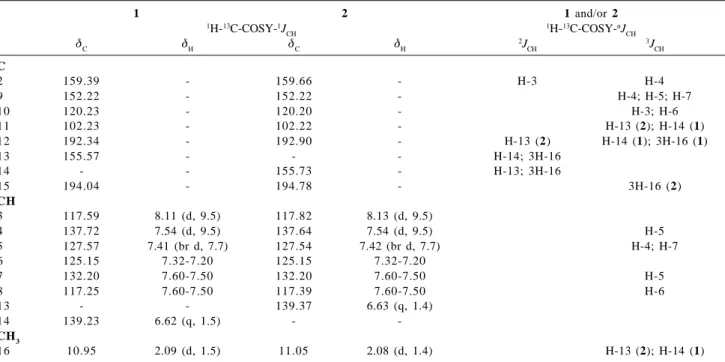
The 1H NMR spectra (1D and 2D 1H-1H-COSY) of 1 + 2 (Table 1) displayed signals of an AB system (J 9.5 Hz) attributed to cis-related H-3 [δH 8.11 (1) and 8.13 (2)] and H-4 [δH 7.54 (1 and 2)], correlated via one bond (1J
CH) with the corresponding carbon atoms by cross-peaks observed in the HMQC spectrum (Table 1), which in combination with the 1H and 13C signals due to four aromatic methines (CH-5 to CH-8) and three non-hydrogenated (C-2, C-9 and C-10), suggested the presence of a chromenylidene moiety
A (C9H6O, coumarin type). The peaks at m/z 170 (23.4 %) and 118 (21.8 %) observed in the EIMS are in agreement with the presence of this moiety (Scheme 1). The remaining signals observed in the 1H [singlet signals at δ
H 6.62(H-14)/6.63 (H-13) and 2.09/2.08 (3H-16 linked to sp2 carbon atom)] and 13C [four sp2 quaternary: δ
C 194.04/194.78 (conjugated ketone carbonyl group), 192.34/192.90 (conjugated ketone carbonyl group), 155.57/155.73 (non-hydrogenated olefinic carbon conjugated with carbonyl group); and one sp2 methine: δ
C 139.23/139.37] NMR spectra were used to establish the partial structure B, which was also confirmed by homonuclear 2D 1H-1H-COSY (long-range spin-spin interaction of the 14 and 316 and H-13 and 3H-16) and heteronuclear 2D shift-correlated 1 H-13C-COSY-nJ
CH (n=1, HMQC; n=2 and 3, HMBC) 3
summarized in Table 1.
The junction of two A and B moieties was confirmed by a heteronuclear long-range coupling (3J
CH) of C-11 [δC 102.23 (1) and 102.22 (2)] and H-14 (δH 6.62) and H-13
Table 1. 1H (400 MHz) and 13C (100 MHz) NMR spectral data for 1 and 2, including heteronuclear 2D shift-correlated obtained by 1H-13
C-COSY-nJ
CH (n=1, HNQC; n=2 and 3, HMBC) experiments, in CDCl3 as solvent, chemical shifts (δ, ppm) and coupling constants (J, Hz, in parenthesis) a
1 2 1 and/or 2
1H-13C-COSY-1J CH
1H-13C-COSY-nJ CH
δC δH δC δH 2J
CH
3J
CH
C
2 159.39 - 159.66 - H-3 H-4
9 152.22 - 152.22 - H-4; H-5; H-7
10 120.23 - 120.20 - H-3; H-6
11 102.23 - 102.22 - H-13 (2); H-14 (1)
12 192.34 - 192.90 - H-13 (2) H-14 (1); 3H-16 (1)
13 155.57 - - - H-14; 3H-16
14 - - 155.73 - H-13; 3H-16
15 194.04 - 194.78 - 3H-16 (2)
CH
3 117.59 8.11 (d, 9.5) 117.82 8.13 (d, 9.5)
4 137.72 7.54 (d, 9.5) 137.64 7.54 (d, 9.5) H-5
5 127.57 7.41 (br d, 7.7) 127.54 7.42 (br d, 7.7) H-4; H-7
6 125.15 7.32-7.20 125.15 7.32-7.20
7 132.20 7.60-7.50 132.20 7.60-7.50 H-5
8 117.25 7.60-7.50 117.39 7.60-7.50 H-6
13 - - 139.37 6.63 (q, 1.4)
14 139.23 6.62 (q, 1.5) -
-CH3
16 10.95 2.09 (d, 1.5) 11.05 2.08 (d, 1.4) H-13 (2); H-14 (1)
aNumber of hydrogens bound to carbon atoms deduced by comparative analysis of HBBD- and DEPT-13C NMR spectra. Chemical shifts and
coupling constants (J) obtained from 1D 1H NMR spectrum. Superimposed 1H signals are described without multiplicity and chemical shifts
(δH 6.63), respectively, allowing to postulate the isomeric structures 1 ([M]•+ 238) and 2 ([M]•+ 238).
The presence of 1 and 2 in the mixture was additionally confirmed by 1D and 2D 1H and 13C NMR spectra recorded in benzene-d6, which revealed best resolution induced by aromatic solvent effect (Table 2).
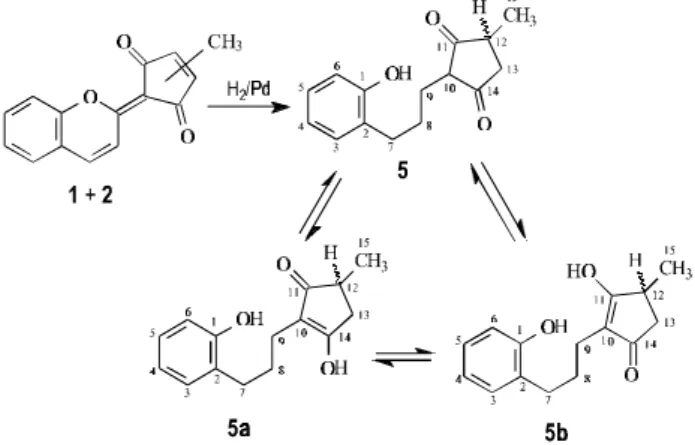
The results of the extensive application of 1D and 2D NMR spectral techniques in CDCl3 and benzene-d6 were also used to confirm the structures and to establish the 1H and 13C resonance assignments of 1 and 2 (Tables 1 and 2). Catalytic reduction (H2/10 % Pd-C, MeOH, 50 psi, 6 h) of the mixture of 1 and 2 yielded 1,3-diketooctahydro-derivative 5 {2-[3-(2-hydroxyphenyl)propyl]-4-methylcyclopentan-1,3-dione}, which appears in a keto-enol tautomerism represented by keto-enols 5a {3-hydroxy-2- [3-(2-hydroxyphenyl)propyl]-5-methyl-2-cyclopenten-1-one} and 5b {3-hydroxy-2-[3-(2-hydroxyphenyl)propyl]-4-methyl-2-cyclopenten-1-one}, as shown in Scheme 2. These enols were characterized on the basis of EIMS (Scheme 2) and 1D and 2D NMR (Table 3). At room temperature, a relatively rapid interconversion between the enol forms probably occurs and consequently average 1H and 13C NMR spectra are observed (Table 3).
Therefore, the structures of the new natural products isolated from Piper carniconnectivum were postulated as
2-(2H-2-chromenyliden)-4-methyl-4-cyclopenten-1,3-dione (1) and 2-(2H-2-chromenyliden)-5-methyl-4-cyclopenten-1,3-dione (2).
The isomeric structures 1 and 2 are very similar and are clearly in agreement with the 1H and 13C NMR spectral data, revealing 1H and 13C chemical shifts with slight differences. The attribution of 1H and 13C chemical shifts of 1, present in the mixture (about 50% of each component) was based in a major γ effect (shielding) of the heterocyclic oxygen atom on the carbonyl carbon C-12, justifying the its minor 13C chemical shift, as observed (e. g.) in the
Table 2. 1H (400 MHz) and 13C (100 MHz) NMR spectral data for 1 and 2, including heteronuclear 2D shift-correlated obtained by 1H-13
C-COSY-nJ
CH (n=1, HNQC; n=2 and 3, HMBC) experiments, in benzene-d6 as solvent, chemical shifts (δ, ppm) and coupling constants (J, Hz, in
parenthesis)a
1 2 1 and/or 2
1H-13C-COSY-1J CH
1H-13C-COSY-nJ CH
δC δH δC δH
2J
CH
3J
CH
C
2 158.96 - 159.24 - H-3 H-4
9 152.53 - 152.53 - H-8 H-4; H-5; H-7
10 120.82 - 120.78 - H-4 H-3; H-6; H-8
11 103.03 - 104.64 - H-13 (2); H-14 (1)
12 191.89 - 191.15 - H-13 (2) H-14 (1); 3H-16 (1)
13 155.96 - - - H-14; 3H-16
-14 - - 155.53 - H-13; 3H-16
15 193.54 - 194.48 - H-14 (1) H-13 (2); 3H-16 (2)
CH
3 118.15 8.17 (d, 9.5) 117.94 8.13 (d, 9.5)
4 136.80 6.49 (d, 9.5) 136.88 6.49 (d, 9.5) H-5
5 127.44 6.55 (br d, 7.7) 127.44 6.55 (br d, 8.4) H-4; H-7
6 124.61 6.62 (br dd, 7.7, 8.4) 124.61 6.62 (br dd, 7.7, 8.4) H-8
7 131.86 6.81 (br t, 8.4) 131.94 6.81 (br t, 8.4) H-5
8 117.36 7.16 (br d, 8.4) 117.44 7.19 (br d, 8.4) H-6
13 - - 139.86 6.26 (q, 1.8) 3H-16
14 139.59 6.25 (q, 1.8) - - 3H-16
CH3
16 10.76 1.68 (d, 1.8) 10.76 1.66 (d, 1.8) H-13 (2); H-14 (1)
aNumber of hydrogens bound to carbon atoms deduced by comparative analysis of HBBD- and DEPT-13C NMR spectra. Chemical shifts and
coupling constants (J) obtained from 1D 1H NMR spectrum. 1H-1H-COSY spectrum was also used in these assignments.
Scheme 2. Products obtained by catalytic reduction (H2/Pd/C) of the
Table 3. 1H (400 MHz) and 13C (100 MHz) NMR spectral data for octahydroderivative 5, including heteronuclear 2D shift-correlated obtained
by 1H-13C-COSY-nJ
CH (n=1, HNQC; n=2 and 3, HMBC) experiments, in CDCl3 as solvent. Chemical shifts (δ, ppm) and coupling constants (J, Hz,
in parenthesis)a
1H-13C-COSY-1J CH
1H-13C-COSY-nJ CH
δC δH 2J
CH
3J
CH
C
1 156.34 - H-3; H-5; 2H-7
2 129.84 - 2H-7 H-4; H-6; 2H-8
10 115.74 - 2H-9 2H-8
11 202.14 - H-12 2H-9; H-13a; 3H-15
14 193.12 - 2H-13 2H-9; H-12
CH
3 131.00 7.03 (dd, 7.3, 1.5) H-5; 2H-7
4 120.05 6.69 (dt, 7.3, 1.4) H-6
5 127.41 6.95 (ddd, 7.3, 8.1, 1.5) H-5
6 116.30 6.77 (dd, 8.1, 1.4) H-4
12 37.93 2.45 (qdd, 7.3, 7.3, 2.2) 3H-15 2H-13
CH2
7 30.66 2.59 (t, 7.7) 2H-8 2H-9
8 30.39 1.70 (tt, 7.7, 7.3) 2H-7; 2H-9
9 21.58 2.15 (t, 7.3) 2H-8 2H-7
13 39.62 2.65 (dd, 17.6, 7.3) 1.99 (dd, 17.6, 2.2) 3H-15
CH3
15 18.23 1.12 (d, 7.3) H-12 2H-13
aNumber of hydrogens bound to carbon atoms deduced by comparative analysis of HBBD- and DEPT-13C NMR spectra. Chemical shifts and
coupling constants (J) obtained from 1D 1H NMR spectrum. 1H-1H-COSY spectrum was also used in these assignments.
Scheme 3. Proposed fragmentation mechanisms of 5 (only peaks
classified as principals).
comparative analysis of the 13C chemical shifts of the methylene carbon atoms CH2-3 of cyclohexane (δC 27.6), methylcyclohexane (δC 26.6, ∆C = -1.0 ppm) and cyclohexanol (δC 24.4, ∆C = - 2.2 ppm).
Comparative analysis of HBBD- and DEPT-13C NMR of 3 was used to recognize signals corresponding to
quaternary [(C)6, all sp2, including two ketone C=O (δ C 192.64 and 201.08), one oxygenated (δC 168.11) and one conjugated with carbonyl group (δC 158.46)], methine [(CH)6 representing eight carbons, all sp2] and one methyl (CH3). The 1H (1D and 2D 1H-1H-COSY) and 1H-13 C-COSY-nJ
CH (n=1, HMQC; n=2 and 3, HMBC) spectra are in agreement with these deductions (Table 1). The E-configuration of the double bond between the carbon atoms CH-7 (δH/δC 7.79/143.56) and CH-8 (δH/δC 7.75/117.90) was defined by a coupling constant J 16.0 Hz observed in the 1D 1H NMR spectrum. The 2D 1H-1H-COSY spectrum was used to confirm the spin-spin interaction (3J
H,H) of these hydrogen atoms. The chemical shift of the olefinic quaternary carbon C-9 (δC 168.11) was assigned on the basis of its heteronuclear long-range coupling with both hydrogens H-7 (δH 7.79, 2J
CH) and H-8 (δH 7.75, 3J
CH) and, consequently, the two ketone carbonyl groups (δC 192.64, C-11, and 201.08, C-14) were located at a methyl-cyclopentene ring, which was confirmed by heteronuclear long-range of these carbons with H-13 and 3H-15 (Table 4). The NMR spectra only showed the presence enol tautomer 3 and/or 3a when the experiments were done in CDCl3, allowing to postulate the absence of the tautomers
occurs and consequently average 1H and 13C NMR spectra of 3 and/or 3a are observed (Table 4).
Therefore, the structure of this unknown natural product was established as 2-[1-hydroxy-3-phenyl-(Z,2E)-2-propenylidene]-4-methyl-4-cyclopentene-1,3-dione (3 and/or 3a).
The results of the extensive application of 1D and 2D NMR spectral techniques were also used to confirm the structure and to establish the 1H and 13C resonance assignments of the natural products1, 2 (Tables 1 and 2)
and 3 (Table 4), and of the derivative 5 (Table 3) obtained by catalytic reduction of the mixture of 1 and 2.
The biosynthesis of these new compounds has not yet been investigated. Structural examination of the compounds 1, 2 and 3 in view of biosynthetic arguments and application of a biosynthetic retroanalysis led us to suggest a biogenetic route. Cyclopentenoids are metabolites of varied biogenetic routes.4 Thus, the methylcyclopentene-1,3-dione ring present in the compounds 1, 2 and 3 can be postulated as a bioproduct of mevalonic acid, as summarized speculatively in Scheme 5. The C6-C3 moiety (cinnamoyl type) is in accordance with the shikimate (shikimic pathway) route,4 similar to the route of the bioformation of coumarins (e. g. xanthyletin, a prenylated coumarin, 4, which was also isolated of this plant) and other compounds isolated from
Piper genus.5
The compound 3 may be postulated as precursor of 1 and 2 after it appropriated ortho-hydroxylation to produce the intermediary 2-hydroxy derivative.
Experimental
General experimental procedures
Mps are uncorr. NMR spectra were run on Bruker -Advance 500 (1H: 500 MHz; 13C: 125 MHz) and Jeol – 400 (1H: 400 MHz; 13C: 100 MHz) spectrometers in CDCl
3 (1-4) or benzene-d6 (1 and 2) using TMS as internal standard
Table 4. 1H (500 MHz) and 13C (125 MHz) NMR spectral data for 3 including heteronuclear 2D shift-correlated obtained by 1H-13C-COSY-nJ CH
(n=1, HNQC; n=2 and 3, HMBC) experiments, in CDCl3 as solvent, chemical shifts (δ, ppm) and coupling constants (J, Hz, in parenthesis) a
1H-13C-COSY-1J CH
1H-13C-COSY-nJ CH
δC δH
2J
CH
3J
CH
4J
CH
C
1 135.24 - H-3/H-5; H-8
9 168.11 - H-8 H-7
10 103.55
-11 201.08 - H-13; 3H-15
12 158.46 - 3H-15
14 192.64 - H-13 3H-15
CH
2,6 129.05 7.67-7.65 (m) H-4; H-7
3,5 129.39 7.44-7.42
4 131.11 7.44-7.42 H-2/H-6
7 143.56 7.79 (d, 16.0) H-8 H-2/H-6
8 117.90 7.75 (d, 16.0) H-7
13 137.39 6.70 (q, 1.6) 3H-15
CH3
15 11.79 2.12 (d, 1.6)
HO - 12.12 (sl)
aNumber of hydrogens bound to carbon atoms deduced by comparative analysis of HBBD- and DEPT-13C NMR spectra. Chemical shifts and
coupling constants (J) obtained from 1D 1H NMR spectrum. Superimposed 1H signals are described without multiplicity and chemical shifts
deduced by HMQC, HMBC and 1H-1H-COSY spectra.
Scheme 5. Biosynthetic retroanalysis of 3/3a and possible biogenetic pathway of methylcyclopentene-1,3-dione from mevalonic acid.
or by reference to the solvent signal (CHCl3 at δH 7.24 or C6D5H at δH 7.26 and CDCl3 at δC 77.00 or C6D6 at δC
128.00). EIMS were obtained at 70 eV on a Shimadzu QP-2000 spectrometer. The IR spectra were recorded on a Perkin-Elmer FT-1500 spectrometer. Column chromato-graphy was carried out with silica gel 0.063-0.2 mm and TLC was done employing silica gel Kieselgel 60 from Merck and spots were visualized by UV (λmax 259 and 360 nm) and exposure to I2 vapour.
Plant material
Roots of Piper carniconnectivum were collected from the same specimen, in Porto Velho, Rondônia, Brazil. The botanical identification (exsiccate number 211718) was confirmed by Instituto Nacional de Pesquisas da Amazônia (INPA), Manaus, Brazil.
Isolation of the compounds
A mixture of chromenylidene- (1 and 2), a hydroxyphenylpropenylidenecyclopentenedione (3) and xanthyletin (4) were isolated by the use of column chromatography, after partition of the EtOH extract with hexane, CHCl3, EtOAc and MeOH. The residue obtained from the CHCl3 solution was submitted to a silica gel column chromatography and fractions 5 and 6 eluted with hexane-CHCl3 yielded a mixture of 1 + 2 (yellow crystals, m. p. 128-136o C) and 3 (yellow crystals, m. p. 122-124o C), whereas the fraction 7 afforded 4 and additional quantity of the mixture of 1 + 2.
Acknowledgements
The authors are grateful to Conselho Nacional de Desenvolvimento Científico e Tecnológico (CNPq) and FAPERJ for grants and CNPq to research fellowship. The Instituto Nacional de Pesquisas da Amazônia (INPA), Manaus, Brazil, is gratefully acknowledged for botanical identification (exsiccate number 211718).
References
1. Ribeiro, J.E.L. da S.; Hopkins, M.J.G.; Vicentin, A.; Sothers,
C.A.; Costa, M.A. da S.; de Brito, J.M.; de Souza, M.A.D.;
Martins, L.H. P.; Lohmann, L.G.; Assunção, P.A..C.L.; Pereira,
E. da C.; Mesquita, M.R.; Procópio, L.C.; Flora da Reserva
Ducke – Guia de Identificação das Plantas Vasculares de uma Floresta de Terra-Firme na Amazônia Central; INPA-DFID:
Manaus, Amazonas, Brasil, 1999. pp 181-167.
2. Márquez, W.B.; Pessoa, O.D.L.; Lemos, T.L.G.; Braz-Filho,
R.; Rev. Latinoamer. Quim. 2000, 28, 111.
3. Claridge; T. D. W. In High-Resolution NMR Techniques in
Organic Chemistry; Baldwin, J. E. ; Willians, R. M.; Willians,
F. R. S., eds.; Tetrahedron Organic Chemistry Series, Pergamon:
Oxford, UK, 1999.
4. Torssell, K. B. G.; Natural Product Chemistry – A Mechanistic,
Biosynthetic and Ecological Approach, 2nd ed.; Swedish
Phar-maceutical Press: Stockholm, Sweden, 1997.
5. Parmar, V. S.; Jain, S. C.; Bisht, K. S.; Jain, R.; Taneja, P.; Jha,
A.; Tyagi, O. D.; Prasad, A. K.; Wengel, J.; Olsen, C. E.; Boll,
P. M; Phytochemistry 1997, 46, 597.