Study of the factors associated with dental caries in children who
receive early dental care
Estudo de fatores associados à cárie dental em crianças que
recebem atendimento odontológico precoce
Fabian Calixto FRAIZ*
Luiz Reynaldo de Figueiredo WALTER**
FRAIZ, F. C.; WALTER, L. R. de F. Study of the factors associated with dental caries in children who receive early dental care.Pesqui Odontol Bras, v. 15, n. 3, p. 201-207, jul./set. 2001.
The present study investigated the factors associated with the development of dental caries in preschool children who receive regular dental care and follow-up. The research was carried out at the Baby Clinic, Londrina State University, and comprised two hundred preschool children, whose ages ranged from 24 to 48 months, as well as their mothers, who had already taken part in a dental program at the Baby Clinic during, at least, the previous twelve months. Regar-ding oral hygiene habits, there was no significant difference between the preschool children who presented with caries and those who did not present with caries. However, the presence of visible bacterial plaque on the upper incisors was strongly associated with the presence of dental caries. Other factors associated with the presence of caries were: period of formal education of the father or of both parents equal or inferior to 8 years, high sugar consumption and bottle-fee-ding during sleep. In the studied population, the dietary pattern is still the main cause of carious lesions. In addition, the presence of visible bacterial plaque on the labial surface of the upper incisors must be considered as an important clinical sign, often associated with inadequate patterns of diet and oral hygiene.
UNITERMS: Dental caries; Diet, cariogenic; Child, preschool.
INTRODUCTION
During the first years of life, dental caries may develop particular characteristics, and the mere adaptation of the knowledge and techniques em-ployed in other age groups might not be enough for the promotion of oral health.
Even in countries or regions where there are ev-idences of decline in dental caries, part of the in-fants still develop carious lesions that sometimes are so severe as to interfere with their development and growth3. Although many efforts have been
made in order to identify such risk group, there are few researches on infants subject to follow-up and early and steady dental care.
Researches conducted in Brazil in this age group indicate a high prevalence of caries4,17 and
reveal the need for adopting and popularizing strategies and actions capable of promoting health, such as those carried out at the Baby Clinic, Londrina State University (LSU), which was instituted by a convention signed in 1985 between the LSU and FINEP (sponsor of studies and
pro-jects)28. This program has education and
preven-tion as distinctive features, and the activities begin before the infant is one year old28,29.
This research has investigated some factors re-lated to dental caries in a group that is subject to early intensive dental care, through a program whose methods were already proven to be efficient and effective.
The identification of such factors will help to de-velop approaches better suited to subjects with higher risk to develop dental caries.
MATERIAL AND METHODS
The research was carried out at the Baby Clinic, Londrina State University, in 1997, and the sam-ple comprised infants from 24 to 48 months old and their mothers who had already taken part in a dental program during, at least, the previous twelve months.
The research involved 200 infants: 65 of them, with experience of caries, were placed in one
group, and the remaining 135, without experience of caries, were placed in another group.
The presence of bacterial plaque on the buccal surface of the upper incisors was visually detected, without any disclosing solution. When visible plaque was detected on two or more incisors, the infant was classified as positive for this factor.
Oral examination for the detection of caries was performed visually after the teeth were cleaned and dried. Infants presenting carious lesions, with or without cavities, either active or not, were con-sidered to have caries experience.
The mothers answered a specific questionnaire about their children’s dietary habits, oral hygiene and socioeconomic and behavioral issues. The children’s age at the time of the first visit was de-termined according to their records available at the Baby Clinic.
In order to establish the pattern of sugar con-sumption, a questionnaire – specifically designed for this research – was used. The frequency of sugar consumption was recorded.
In order to compare the group with caries with the one without caries the parametric Student’s
t-test, the nonparametric chi-squared test with Yates correction and the Mann-Whitney test for in-dependent samples were utilized. The minimum significance level adopted was 5%.
RESULTS AND DISCUSSION
The average age of the infants was 35.2 months (±6.7). Their average age by the time of their first visit was 11.3 months (±3.9) and the average num-ber of teeth by the time of the interview was 19.2 (±
1.7). The differences between the two groups were not statistically significant. The average age of the mothers by the time the infants were born was 26.3 years (±5.1) and the average age of the fathers by the time of the interview was 32.3 years (±5.8). The absence of significant differences between the groups reduces the possibility of errors in the as-sessment of the role played by other factors in the prevalence of caries.
Parents’ formal education and caries
Although the inquiries found in the literature usually concentrate on mothers, the present study also considered the education of fathers, since the program developed at the Baby Clinic has proved to have a positive impact on the entire family19.
The literature shows a clear relation between the formal education of mothers and the preva-lence of dental caries, dietary habits of the infant,
oral hygiene habits and other factors associated with the development of dental caries. Thus, chil-dren of mothers who received little formal educa-tion present with colonies of Streptococcus mutans10 earlier than those of mothers who
stud-ied for longer periods. They also present higher prevalence of caries9,11,13,18,22,23 and poor oral
hygiene21 and ingest foods rich in sucrose more
often20,22,23. However, the influence of mothers on
the dietary habits of their children seems to de-crease with time, probably due to other social and familial factors involved in the children’s diet24.
The results indicated that although the effect of the level of formal education of the mother was not statistically significant when comparing the group without caries and the group with caries (Table 1), the period of formal education of the mothers of 38.5% of the infants with caries was equal or infe-rior to 8 years, while, in the group without caries, only 25.9% of the mothers had the same time of formal education. That might reveal a relation be-tween low educational level of mothers and the presence of caries in infants. This tendency was statistically confirmed with regard to the formal education of fathers. The period of formal educa-tion of the fathers of 43.1% of the infants from the group with caries was equal or inferior to 8 years, while in the group without caries, only 27.4% of the fathers had the same time of formal education (Table 1).
Table 1 also shows that when the period of for-mal education of both parents was equal or inferior to 8 years, the differences in the distribution of in-fants between the groups with and without caries were statistically significant: 35.4% of the infants from the group with caries and 17% of the infants from the group without caries had parents with pe-riods of formal education equal or inferior to 8 years.
The lack of statistic significance regarding the relation between the educational level of mothers and the presence of carious lesions in infants may be due to specific features of the studied sample: the mother was the one who usually accompanied the infant on the visits, receiving, then, proper guidance and following the results of the program. Thus, the impact of the poor formal education of mothers may have been weakened by intensive ed-ucative actions. However, the same is not true for fathers, who accompanied the infants on the visits less often.
the environmental factors related to the develop-ment of carious lesions at home. In such cases, the father must be stimulated to attend the visits and the mother must be instructed in order to become capable of changing habits associated with oral health at home.
Sugar consumption pattern and caries
The dietary habits in the early infancy are very important not only because of the possibility of
leading to carious lesions but also because they are the basis for later dietary habits12,22,24,26 and
serve as an important indicator of the risk of caries9,20,22,26. The pattern of sugar consumption is
precociously established and maintained during the first years of life24. Foods rich in sugar are often
introduced in the first months after birth8,12.
The results observed in this research are in ac-cordance with those reported in the literature. It can be noticed (Table 1) that in the group with
car-TABLE 1 -Distribution of children with and without caries, considering the analyzed variables.
Variables
Caries experience Statistics*
With (n = 65) Without (n = 135) Total (n = 200)
Values p Sig
N % N % N %
Formal education (years of study)
Mother 2.71 0.100 NS
Equal or inferior to 8 25 38.5 35 25.9 60 30.0
More than 8 40 61.5 100 74.1 140 70.0
Father 4.30 0.038 S
Equal or inferior to 8 28 43.1 37 27.4 65 32.5
More than 8 32 49.2 87 64.5 119 59.5
Not reported** 5 7.7 11 8.1 16 8.0
Mother and father 7.34 0.007 S
Equal or inferior to 8 23 35.4 23 17.0 46 23.0
Bottle-feeding
Bottle-fed 55 84.6 107 79.3 162 81.0 0.51 0.476 NS
Never bottle-fed 4 6.2 13 9.6 17 8.5 0.31 0.579 NS
No longer bottle-fed 6 9.2 15 11.1 21 10.5 0.03 0.872 NS
Moment of bottle-feeding
Never to sleep/sleeping 22 33.8 78 57.8 100 50.0 9.12 0.003 S
To sleep 23 35.4 23 17.0 46 23.0 7.34 0.007 S
Sleeping 10 15.4 06 4.4 16 8.0 5.73 0.017 S
Not bottle-fed 10 15.4 28 20.7 38 19.0 0.51 0.476 NS
Sugar consumption
Category 17.56 <0.0001 S
High consumption 35 53.9 31 23.0 66 33.0
Moderate consumption 30 46.1 104 77.0 134 67.0
Presence of plaque
Upper incisors 25 38.5 24 17.8 49 24.5 9.06 0.003 S
ies, most infants (53.9%) were ranked on the high sugar consumption level, while only 23% of the in-fants from the group without caries were ranked on the same level; such a difference is statistically significant. The elevated consumption of sugar, determined through a method that monitors the frequency of contact with sugar-containing food, increased the probability of developing carious le-sions even in infants with both clinical and domes-tic regular follow-up.
Visible bacterial plaque on the buccal surface and caries
The evaluation of the presence of visible bacte-rial plaque on the buccal surface of the upper inci-sors is important, since this clinical indicator is positively related to the prevalence of caries15,16and
to the level ofStreptococcus mutansin the saliva15,
which enhances the possibility of development of carious lesions1. Furthermore, it is an easy
check-ing clinic evidence, which is epidemiologically im-portant in determining collective risk groups and in confirming reports regarding hygiene habits.
In the present study, the results indicated that the presence of visible bacterial plaque on the up-per incisors showed a high correlation with the presence of caries (Table 1).
Table 2 shows that infants with visible bacterial plaque also displayed a pattern of elevated sugar consumption more often than infants without visi-ble plaque – the percentages were 49% and 27.8%, respectively. Such a difference was statistically significant.
Thus, the presence of visible bacterial plaque may also be an indicative of high sugar consump-tion. Probably, high sugar consumption has an in-fluence on the composition of bacterial plaque and on the pace of its formation. Furthermore, it must be considered that the behavioral factors that de-termine poor oral hygiene might also contribute to establish a profile of inadequate consumption of cariogenic food. However, such aspects deserve specific attention and new researches must be conducted on the subject.
Bottle-feeding and caries
In 1996, FRAIZ7reported that both the way and
the moment of ingestion of food influence the time that is necessary to completely remove the food from the mouth. Thus, when infants are bottle-fed, the cariogenic potential of the food ingested is highly enhanced due to the possibility of high
fre-quency and long periods of ingestion, during sleep. The correlation between bottle-feeding and the presence of a particular type of caries, usually termed nursing-bottle caries, has been widely reported18,27,30.
Several authors associated bottle-feeding at night with nursing-bottle caries2,14,18,25,27and it has
been observed that the length of time of feeding influences the prevalence and severity of the disease5,13,14,30.
Furthermore, FRAIZ6 (1993) stated that the
nursing bottle is an important vehicle for sugar in-gestion in childhood, since most foods ingested through it contain sugar. These findings are a rea-son for worry, since bottle-feeding with sugar-con-taining food may lead the infant to an excessive sugar consumption in the future26.
Table 1 shows the results of the present study regarding bottle-feeding. It shows that there is no statistical difference between the frequency of bot-tle-feeding in the group with caries and in the group without caries. Such a result – which appar-ently contradicts those reported in the literature – may be justified when one observes that the stud-ied population had a low prevalence of caries, pre-sented with mild lesions and was under constant follow-up and guidance. The determination of the group with caries took into account any kind of carious lesion – the most prevalent lesions were in-cipient cavities and no nursing-bottle caries were observed. Furthermore, even though bottle-feed-ing was not related to the presence of caries, when the time of bottle-feeding was taken into account, there was statistically significant difference be-tween the groups. Children with caries were more often bottle-fed at sleep time or when they were asleep than children without caries (50.8% and 21.4% of the infants, respectively) (Table 1).
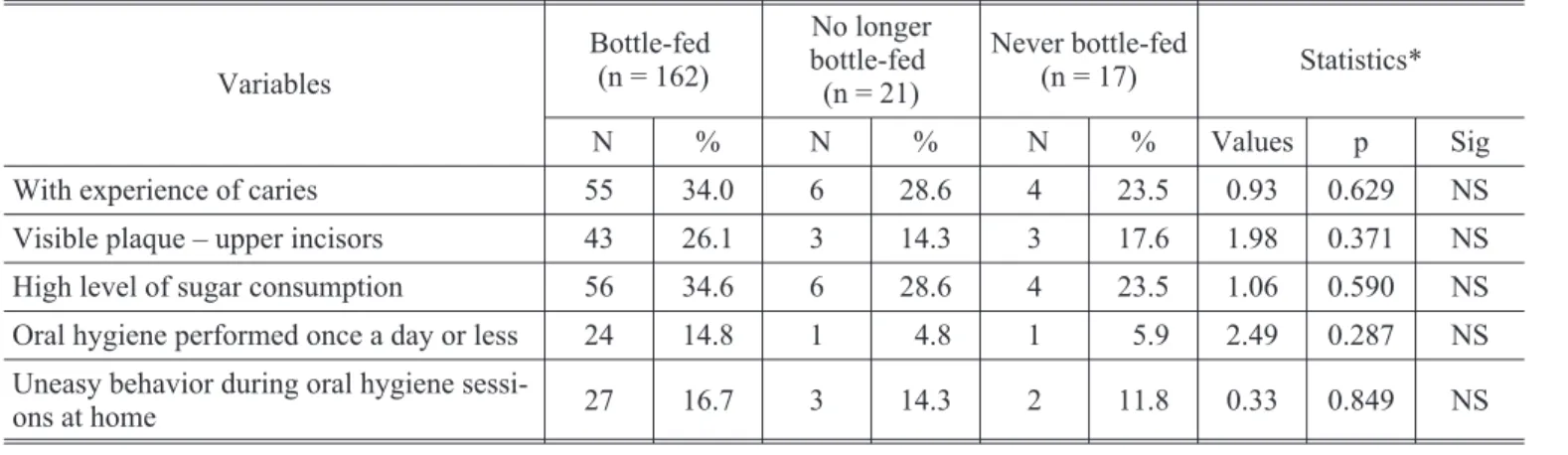
and bad behavior during oral hygiene – in com-parison with the infants who were never bot-tle-fed or who were no longer botbot-tle-fed. How-ever, the differences were not statistically significant (Table 3).
These variables show a stronger tendency to re-late to bottle-feeding when the time of that kind of feeding is taken into account. Thus, the habit of
bottle-feeding infants when they are put to sleep or during sleep is associated to higher prevalence of caries, higher difficulty in oral hygiene at home and inadequate standards of oral hygiene (Table 4).
As a matter of fact, bottle-feeding seems to be related to a pattern of behavior and a lifestyle that contribute to determine a profile of high caries risk.
TABLE 2 -Data and statistics concerning the presence of visible bacterial plaque on the upper incisors and its relation to the pattern of sugar consumption.
Plaque
Sugar consumption
With plaque (n = 49)
Without plaque
(n = 151) Total (n = 200) Statistics*
N % N % N % Values p Sig
Pattern of sugar consumption 6.57 0.010 S
High consumption 24 49.0 42 27.8 66 33.0
Moderate consumption 25 51.0 109 72.2 134 67.0
*Chi-squared test with Yates correction. Sig = significance; S = significant.
TABLE 3 -Comparison of data considering the habit of bottle-feeding.
Variables
Bottle-fed (n = 162)
No longer bottle-fed
(n = 21)
Never bottle-fed
(n = 17) Statistics*
N % N % N % Values p Sig
With experience of caries 55 34.0 6 28.6 4 23.5 0.93 0.629 NS
Visible plaque – upper incisors 43 26.1 3 14.3 3 17.6 1.98 0.371 NS
High level of sugar consumption 56 34.6 6 28.6 4 23.5 1.06 0.590 NS
Oral hygiene performed once a day or less 24 14.8 1 4.8 1 5.9 2.49 0.287 NS
Uneasy behavior during oral hygiene
sessi-ons at home 27 16.7 3 14.3 2 11.8 0.33 0.849 NS
*Chi-squared test. Sig = significance; NS = nonsignificant.
TABLE 4 -Comparison of data considering the moment of bottle-feeding.
Variables
During sleep (n = 16)
To sleep (n = 46)
Never to sleep
(n = 100) Statistics*
N % N % N % Values p Sig
With experience of caries 10 62.5 23 50.0 22 22.0 17.47 0.0002 S
Visible plaque – upper incisors 7 43.8 12 26.1 24 24.0 2.77 0.251 NS
High sugar consumption 9 56.2 16 34.8 31 31.0 3.89 0.143 NS
Oral hygiene performed once a day or less 7 43.8 8 17.4 9 9.0 13.54 0.001 S
Uneasy behavior during oral hygiene
sessi-ons at home 5 31.2 11 23.9 11 11.0 6.50 0.039 S
CONCLUSIONS
The results allow one to conclude that, among the subjects of the present research, dietary habits remain the main cause of carious lesions, and the presence of visible bacterial plaque on the buccal surface of the upper incisors must be considered as an important clinical indicator, often associated with inadequate dietary and oral hygiene habits.
According to the methodology employed and based upon the obtained results, we conclude that:
1. The factors associated with the presence of cari-es were: period of formal education of the father
or of both parents equal or inferior to 8 years; high sugar consumption; presence of visible bacterial plaque on the buccal surface of the upper incisors and bottle-feeding associated with sleeping.
2. The group of children who were bottle-fed du-ring sleep also showed, along with a higher ex-perience of caries, a higher frequency of the fac-tors associated with inadequate standards of oral hygiene and bad behavior during oral hygi-ene at home, when compared with those who were not-bottle fed while they were sleeping.
FRAIZ, F. C.; WALTER, L. R. de F. Estudo de fatores associados à cárie dental em crianças que recebem atendimento odontológico precoce.Pesqui Odontol Bras, v. 15, n. 3, p. 201-207, jul./set. 2001.
Esta pesquisa estudou os fatores associados com o desenvolvimento de cárie dentária em pré-escolares que recebem acompanhamento e intervenção odontológica. O estudo abrangeu 200 crianças, de 24 a 48 meses de idade, que parti-cipavam do programa da Bebê-Clínica (Universidade Estadual de Londrina) havia pelo menos 12 meses. A comparação entre as crianças com cárie e sem cárie não apresentou diferenças estatisticamente significantes com relação aos há-bitos de higiene bucal. No entanto, a presença de placa visível nos incisivos superiores esteve fortemente associada com a presença de cárie dentária. Outros fatores relacionados à presença de cárie foram a educação formal paterna ou de ambos os pais igual ou menor do que 8 anos, alto consumo de açúcar e uso de mamadeira durante o sono. Na popu-lação estudada, o padrão dietético continua sendo o principal responsável pelo desenvolvimento de lesões de cárie. Além disso, a presença de placa bacteriana visível na superfície vestibular dos incisivos superiores deve ser considera-da um importante sinal clínico, freqüentemente associado a padrões inadequados de higiene bucal e dieta.
UNITERMOS: Cárie dentária; Dieta cariogênica; Pré-escolar.
BIBLIOGRAPHIC REFERENCES
1. ALALUUSUA, S.; MALMIVIRTA, R. Early plaque accumula-tion: a sign for caries risk in young children.Community Dent Oral Epidemiol, v. 22, n. 5, p. 273-276, Oct. 1994. 2. AYHAN, H. Influencing factors of nursing caries.J Clin
Pe-diatr Dent, v. 20, n. 4, p. 313-316, 1996.
3. AYHAN, H.; SUSKAN, E.; YILDIRIM, S. The effect of nursing or rampant caries on height, body weight and head cir-cumference. J Clin Pediatr Dent, v. 20, n. 3, p. 209-212, 1996.
4. BÖNECKER, M. J. S.; GUEDES-PINTO, A. C.; WALTER, L. R. F. Prevalência, distribuição e grau de afecção de cárie dentária em crianças de 0 a 36 meses de idade.Rev Assoc Paul Cir Dent, v. 51, n. 6, p. 535-540, nov./dez. 1997.
5. ERONAT, N.; EDEN, E. A comparative study of some influ-encing factors of rampant or nursing caries in preschool children.J Clin Pediatr Dent, v. 16, n. 4, p. 275-279, Summer 1992.
6. FRAIZ, F. C.Estudo das características da utilização de açúcar através da mamadeira, do primeiro contato com açúcar e do padrão de aleitamento em crianças de 0 a 36 meses, Curitiba. São Paulo, 1993. 76 p. Tese (Mestrado em Odontopediatria) - Faculdade de Odontologia da Universidade de São Paulo.
7. FRAIZ, F. C. Dieta e cárie na primeira infância. In:
WALTER, L. R. F.; FERELLE, A.; ISSAO, M.
Odontologia para o bebê. São Paulo : Artes Médicas, 1996. p. 107-122.
8. FRAIZ, F.; ISSAO, M. The first time of and the sugar con-sumption by nursing bottle. J Dent Res, v. 7, n. 3, p. 785, 1995.
9. GRINDEFJORD, M.; DAHLLÖF, G.; NILSSON, B.; MODÉER, T. Prediction of dental caries development in 1-year-old children.Caries Res, v. 29, n. 5, p. 343-348, Sept./Oct. 1995.
10. GRINDEFJORD, M.; DAHLLÖF, G.; WIKNER, S.et al. Prev-alence ofmutansstreptococci in one-year-old children.
Oral Microbiol Immunol, v. 6, n. 5, p. 280-283, 1991. 11. GRYTTEN, J.; ROSSOW, I.; HOLST, D.; STEELE, L. Longi-tudinal study of dental health behaviors and other car-ies predictors in early childhood. Community Dent Oral Epidemiol, v. 16, n. 6, p. 356-359, Dec. 1988. 12. KING, J. M. Patterns of sugar consumption in early
in-fancy. Community Dent Oral Epidemiol, v. 6, n. 2, p. 47-52, Mar. 1978.
13. KING, J. M.; PITTER, A. F. V.; EDWARDS, H. Some social predictors of caries experience.Br Dent J, v. 155, n. 8, p. 266-268, Oct. 1983.
14. MARINO, R. V.; BOMZE, K.; SCHOLL, T. O.; ANHALT, H. Nursing bottle caries: characteristics of children risk.
15. MATTOS-GRANER, R. O.; ZELANTE, F.; MAYER, M. P. A. Relação entre acúmulo de placa dental e níveis salivares de estreptococos do grupo mutans e a prevalência de cárie dental em crianças de 1,0 a 2,5 anos de idade.In: REUNIÃO ANUAL DA SOCIEDADE BRASILEIRA DE PESQUISA ODONTOLÓGICA, Águas de São Pedro, 1997.Anais. p. 60.
16. MILANEZ, F. G.; WALTER, L. R. F. Estudo comparativo en-tre a presença de placa visível e cárie dentária em crianças de 18 a 40 meses de 2 populações distintas.
Semina, v. 18, p. 47-50, fev. 1997. Número especial. 17. MORITA, M. C.; WALTER, L. R. F.; GUILLAIN, M.
Prévalen-ce de la cárie dentaire chez des enfants Brésiliens de 0 à 36 mois.J Odont Stomato Pédiatr, v. 3, n. 1, p. 19-28, Mar. 1993.
18. MOYNIHAN, P. J.; HOLT, R. D. The national diet and nutri-tion survey of 1.5- to 4.5-year-old children: summary of the findings of the dental survey.Br Dent J, v. 181, n. 9, p. 328-332, Nov. 1996.
19. NAKAMA, L. Educar prevenindo e prevenir educando: Odontologia no primeiro ano de vida. Londrina, 1994. 58 p. Dissertação (Mestrado) - Universidade Estadual de Londrina.
20. PAUNIO, P. Dental health habits of young families from Southwestern Finland. Community Dental Oral Epi-demiol, v. 22, n. 1, p. 36-40, 1994.
21. PAUNIO, P.; RAUTAVA, P.; SILLANPÄÄ, M.; KALEVA, O. Dental health habits of 3-year-old Finnish children.
Community Dent Oral Epidemiol, v. 21, n. 1, p. 4-7, 1993.
22. PERSSON, L.-A.; HOLM, A.-K.; ARVIDSSON, S.; SAMUELSON, G. Infant feeding and dental caries – a longitudinal study of Swedish children.Swed Dent J, v. 9, n. 5, p. 201-206, 1985.
23. ROETERS, J.; BURGERSDIJK, R.; TRUIN, G.-J.; HOF, M. Dental caries and its determinants in 2 to 5-year-old children.J Dent Child, p. 401-408, Nov./Dec. 1995. 24. ROSSOW, L.; KJAERNES, U.; HOLST, D. Patterns of sugar
consumption in early childhood. Community Dent Oral Epidemiol, v. 18, n. 1, p. 12-16, Feb. 1990. 25. SCHWARTZ, S. S.; ROSIVACK, R. G.; MICHELOTTI, P. A
child’s sleeping habit as a cause of nursing caries.J Dent Child, v. 60, n. 1, p. 22-25, Jan./Feb. 1993. 26. SILVER, D. H. A longitudinal study of infant feeding
practi-ce, diet and caries, related to social class in children aged 3 and 8-10 years. Br Dent J, v. 163, n. 9, p. 296-300, Nov. 1987.
27. WALTER, L. R. F.; FERELLE, A.; HOKAMA, N.et al.Cárie em crianças de 0 a 30 meses de idade e sua relação com hábitos alimentares. Enc Bras Odontol, v. 5, n. 1, p. 129-136, 1987.
28. WALTER, L. R. F.; FERELLE, A.; ISSAO, M.Odontologia para o bebê. São Paulo : Artes Médicas, 1996. 246 p. 29. WALTER, L. R. F.; GARBELINE, M. L.; GUTIERREZ, M. C.
Bebê-Clínica: a experiência que deu certo.Divulgação em saúde para debate, n. 6, p. 65-68, out. 1991. 30. WINTER, G. B.; RULE, D. C.; MAILER, G. P.et al.The
pre-valence of dental caries in pre-school children aged 1 to 4 years. Part 1 - etiological factors.Br Dent J, v. 130, n. 7, p. 271-277, Apr. 1971.