A Multiparameter Chaos Control Method Applied to Maps
Aline Souza de Paula and Marcelo Amorim Savi Universidade Federal do Rio de Janeiro COPPE – Department of Mechanical Engineering 21.941.972 – Rio de Janeiro – RJ, Brazil, P.O. Box 68.503
E-Mail: [email protected], [email protected] (Received on 25 February, 2008)
Chaos is a kind of nonlinear system response that has a dense set of unstable periodic orbits (UPOs) em-bedded in a chaotic attractor. The idea of the chaos control is to explore the UPO stabilization obtaining dy-namical systems that may quickly react to some new situation, changing conditions and their response. The OGY (Ott-Grebogi-Yorke) method achieves system stabilization by using small perturbations promoted in the neighborhood of the desired orbit when the trajectory crosses a specific surface, such as a Poincar´e section. This contribution proposes a multiparameter (MP) method based on OGY approach in order to control chaotic behavior using different control parameters. As an application of the proposed multiparameter general formula-tion it is presented an uncoupled approach where the control parameters do not influence the system dynamics when they are not active. This method is applied to control chaos in maps using two control parameters. The two-dimensional H´enon and Ikeda maps are of concern. Results show that the proposed procedure can be a good alternative for chaos control since it provides a more effective UPO stabilization than the classical single-parameter OGY approach.
Keywords: Chaos; Control; Nonlinear dynamics; H´enon map; Ikeda map; OGY method
1. INTRODUCTION
Chaos control explores the intrinsic richness of the chaotic behavior by stabilizing unstable periodic orbits (UPOs) em-bedded in a chaotic attractor. This control method is based on some chaotic behavior properties as the existence of a dense set of UPOs embedded in a chaotic attractor; the er-godicity property; and the sensitive dependence to initial con-dition. Therefore, chaos is related to flexibility since, when controlled, may allows the system to quickly change from one kind of response to another.
Chaos control methods may be classified as discrete or con-tinuous techniques. The modern study of chaos control starts with the pioneer method proposed by Ott et al. [1], nowa-days known as the OGY method as a tribute of their authors (Ott-Grebogi-Yorke). This is a discrete technique that con-siders small perturbations of a single-parameter applied in the neighborhood of the desired orbit [2,3]. On the other hand, a different approach explores the delayed feedback control pro-posed by Pyragas [4] that states the stabilization of chaotic systems by a feedback perturbation proportional to the differ-ence between the present and a delayed state of the system. The original limitations of the OGY method are overcome in different references and, among others, one can cite: control of high periodic and high unstable UPO [5-9], control using time delay coordinates [10-13], control using different control parameters [14,15].
Chaos control techniques are being used in different appli-cations in order to stabilize UPOs. The first experimental ver-ification of the OGY approach is applied to magneto-elastic beams [16]. Andrievskii & Fradkov [17] present an overview of chaos control applications in various scientific fields. Me-chanical systems are included in this discussion presenting control of pendulums, beams, plates, vibroformers, microcan-tilevers, cranes and vessels.
This contribution considers a multiparameter chaos control
the uncoupled multiparameter approach can be a good alterna-tive for chaos control since it provides a more effecalterna-tive UPO stabilization when compared to those obtained from the clas-sical single-parameter OGY approach.
2. MULTIPARAMETER CHAOS CONTROL METHOD
Chaos control method is a two stage technique where the first step is the learning stage and the second one is the con-trol stage. The learning stage identifies the unstable periodic orbits and evaluates some system characteristics. The control stage, on the other hand, controls the desirable UPOs promot-ing their stabilization.
After the learning stage, one can proceed to the next stage where a control process needs to be used to stabilize a desired orbit. The OGY approach is an alternative to promote this UPO stabilization. Its description considers a discrete system equivalent to a parameter dependent map associated with a general surface, usually a Poincar´e section. LetFbe the map-ping of the system behavior from one Poincar´e sectionΣnto the next oneΣn+1andξnbe the intersection of the system
tra-jectory with the Poincar´e sectionΣn. Therefore, it is possible to write:
ξn+1=F(ξn
,p) (1)
wherep∈ℜis an accessible parameter for control. The con-trol idea is to monitor the system dynamics in these concon-trol stations until the neighborhood of a desirable fixed point is reached. After that, a proper small change in the parameterp causes the next stateξn+1to fall into the stable direction of the
fixed point. In order to find the proper variation in the control parameter, perturbationδp, it is considered a linearized ver-sion of the dynamical system near this control point. The lin-earization has a homeomorphism with the nonlinear problem that is assured by the Hartman-Grobman theorem [24].
The proposed multiparameter (MP) chaos control method formulation, introduced in reference [14] as a semi-continuous method, is now presented in order to provide a better reading. The multiparameter control considersNp dif-ferent control parameters, pi(i=1, ...,Np). By considering a specific control station, only one of those control parameters is perturbed. Under this assumption, the mapF, that estab-lishes the relation of the system behavior between the con-trol stationsΣnandΣn+1, depends on all control parameters.
In general, although only one parameter is perturbed in each section, it is assumed the influence of all control parameters based on their positions in station,Σn. On this basis,
ξn+1=F(ξn ,P
n) (2)
wherePn is a vector that contains all control parameter po-sitions. By using a first order Taylor expansion, one obtains the linear behavior of the mapF in the neighborhood of the control pointξn
C, that consist in the intersection of the desired
UPO with control stationΣn, and around the control parame-ters reference positions,P0, as defined by Eq. (3).
δξn+1∼=D
ξnF(ξn,P n)|
ξn=ξn
C,Pn=P0δξ n+
DPnF(ξn,P n)|
ξn=ξn
C,Pn=P0δP
n (3)
This equation may be rewritten as follows
δξn+1∼=Jnδξn+WnδPn (4) where δξn+1 = ξn+1 −ξn+1
C , δξn = ξn −ξnC, δP n =
Pn−P0 is related to the parameter perturbations, Wn = DPnF(ξn,P
n)|
ξn=ξn
C,Pn=P0 is the sensitivity matrix in which each column is related to a control parameter and Jn = DξnF(ξn,P
n)|
ξn=ξn C,P
n=P
0 is the Jacobian matrix. Moreover,
from Jacobian eigenvalues(eu,es) it is possible to define a contravariant basis vector(fu,fs)given by fs.es= fu.eu=1, fs.eu=fu.es=0.Therefore, the Jacobian can be written as:
Jn=λueufu+λsesfs (5) By assuming that only one parameter is perturbed in each control station, it is possible to define active parameters, repre-sented by subscripta,δPan(is perturbed in stationΣn), and pas-sive parameters, represent subscriptp,δP
n
p(is not perturbed in stationΣn). Hence,
δξn+1∼=Jnδξn+Wn
aδPan+WpnδPpn (6) whereWanis the sensitivity matrix column related to the active parameter in control stationΣnandWpnconsists on the sensi-tivity matrix columns related to the passive parameters in the same control station.
The foregoing formulation may be considered as a general multiparameter control method where all parameters perturb the system dynamics. A particular case of this general pro-cedure has uncoupled control parameters meaning that each parameter returns to its reference value when it becomes pas-sive. Under this assumption, passive influence vanishes:
WpnδPpn=0 (7)
Therefore, the mapFis just a function of the active parameter,
ξn+1=F(ξn ,P
n
a), and the linear behavior of the mapF in the neighborhood of the control pointξn
C and around the control parameter reference positions,P0, is now defined by:
δξn+1∼=Jnδξn+Wn
aδPan (8) In order to pickδPanin such a way thatδξn+1falls on the
fu·ξn+1=0 (9) Thus, for sufficiently smallδξnand using the Jacobian de-fined in (5), one obtains:
δPan=−λu fu·δξn fu·Wan
(10) whereδPancorresponds to the perturbation that must be ap-plied by the active parameter in control stationΣnin order to stabilize the system trajectory.
3. CONTROLLING MAPS
Numerical simulations considering maps are carried out in order to evaluate the capability of the proposed uncou-pled multiparameter chaos control method to stabilize desir-able UPOs. System characteristics are evaluated from time series generated by map iterations. Specifically, the two-dimensional H´enon and Ikeda maps are of concern. Since both cases are related to discrete-time nonlinear system, the system dynamics automatically furnishes the Poincar´e map construc-tion. Therefore, the control action is directly applied in map iterations.
In the first stage of the control strategy, UPOs embedded in the chaotic attractor are identified. The close return method [23] is employed with this aim. The UPO identification is done by considering a number of map iterations and a pre-scribed tolerance as follows:
kXn+P−Xnk ≤ tolerance (11) wherekXn+P−Xnkis a function that returns the largest sin-gular value of(Xn+P−Xn)and the subscriptPindicates the periodicity of the identified UPO.
After the UPO identification, the local dynamics expressed by the Jacobian matrix and the sensitivity matrix of the tran-sition maps in a neighborhood of the control points are de-termined using the least-square fit method [6,8,13,23,24]. The sensitivity matrices are evaluated allowing trajectories to come close to a control point and then one perturbs the pa-rameters by proportional value of the maximum permissible. After that, the singular value decomposition (SVD) technique is employed for determining the stable and unstable directions near the next control point. At this point, the first stage of the control strategy is completed. In control stage, the per-turbation is calculated and, when it is greater than the maxi-mum value, it is assumed a perturbation equal to the maximaxi-mum value.
The uncoupled multiparameter approach is treated by eval-uating a control rule considering a sequence of four different UPOs for each analyzed system. Moreover, in order to es-tablish a comparison between the uncoupled multiparameter and the single-parameter method, the same control rule is ap-plied to both approaches. Two different control parameters
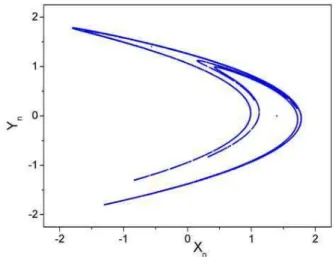
FIG. 1: Chaotic attractor for the H´enon map with parameters values
α=1.4 andβ=0.3.
are analyzed in the single-parameter approach considering the isolated perturbation performed by each parameter employed during multiparameter method.
As an application of the proposed formulation, it is an-alyzed the uncoupled multiparameter chaos control method applied to the H´enon and to the Ikeda maps using two con-trol parameters. Under this assumption, each system itera-tion represents the desired Poincar´e map. Moreover, since in each control station only one control parameter is perturbed, it is considered that they are perturbed alternating each other. Finally, the evaluation of the control parameter is given by Eq.(10), considering the column of the sensitivity matrix as-sociated with the active control parameter.
3.1. Controlling H´enon Map
The H´enon map is a simple two-dimensional map with quadratic non-linearity. Mathematically, it can be expressed as follows [19]:
Xn+1 = (α+δα) + (β+δβ)Yn−Xn2
Yn+1 = Xn (12)
whereδαis the first control parameter whileδβis the second control parameter.
By considering a chaotic strange attractor of the H´enon map (Fig. 1) for parameter valuesβ= 0.3 andα= 1.4, it is applied the multiparameter control approach, with two control param-eters, as well as the single-parameter approach.
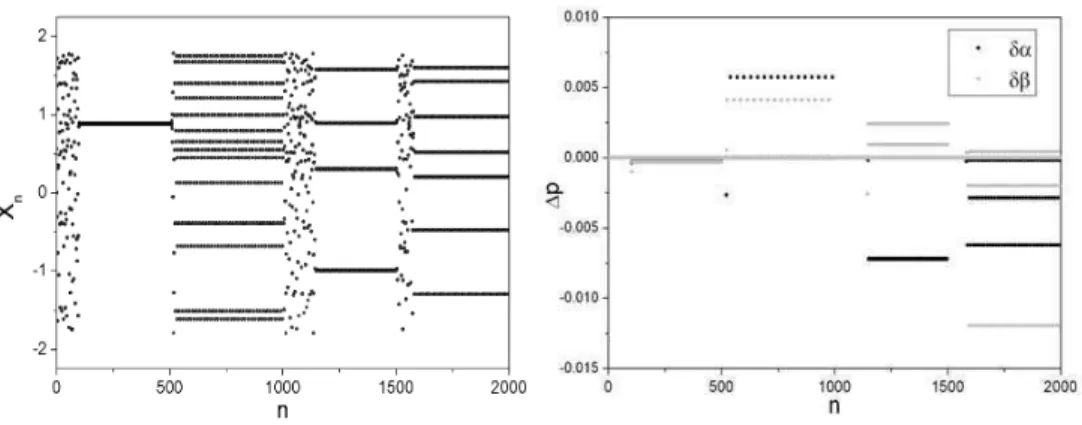
FIG. 2: H´enon map stabilization using uncoupled multiparameter approach: (a) Displacement; (b) Control parameters perturbations.
GD
FIG. 3: H´enon map stabilization using single-parameterδα: Displacement; (b) Control parameters perturbations.
GE
FIG. 4: H´enon map stabilization using single-parameterδβ: (a) Displacement; (b) Control parameters perturbations.
In chaos control evaluation it is considered δαmax = δβmax=0.09 as maximum parameter perturbations. When the calculated perturbation is greater than these values it is assumed a perturbation equal to the maximum value. The reference positions considered for both parameters areδα0= δβ0=0.
Figure 2 presents results for the cited control rule employ-ing the uncoupled multiparameter control approach. On the other hand, results for single-parameter approach, considering the isolated perturbation performed by each control
FIG. 5: Chaotic attractor for the Ikeda map with parameters valuesβ=0,γ=7,µ=0.9 andα=1.25.
FIG. 6: Ikeda map stabilization using uncoupled multiparameter approach: Displacement; (b) Control parameters perturbations.
3.2. Controlling Ikeda Map
The Ikeda map is a two-dimensional map that represents a string of light pulses entering at the partially transmitting mirror [20], being mathematically expressed as:
Xn+1 = (α+δα) + (µ+δµ)(Xncos[tn]−Ynsin[tn]) Yn+1 = (µ+δµ)(Xnsin[tn] +Yncos[tn]) (13) wheretn=β−1+Xγ2
n+Yn2,δαis the first control parameter while
δµis the second control parameter.
In chaos control evaluation it is considered δαmax = δµmax =0.05 as maximum parameter perturbations. Once
again, when the calculated perturbation is greater than these values it is assumed a perturbation equal to the maximum value. The reference positions considered for both parame-ters areδα0=δµ0=0.
The uncoupled multiparameter approach, considering two control parameters, as well as the single-parameter OGY method, is now applied to the chaotic strange attractor of the Ikeda map for the parameter valuesβ= 0,γ= 7,µ= 0.9 andα
= 1.25 (Fig. 5) [25].
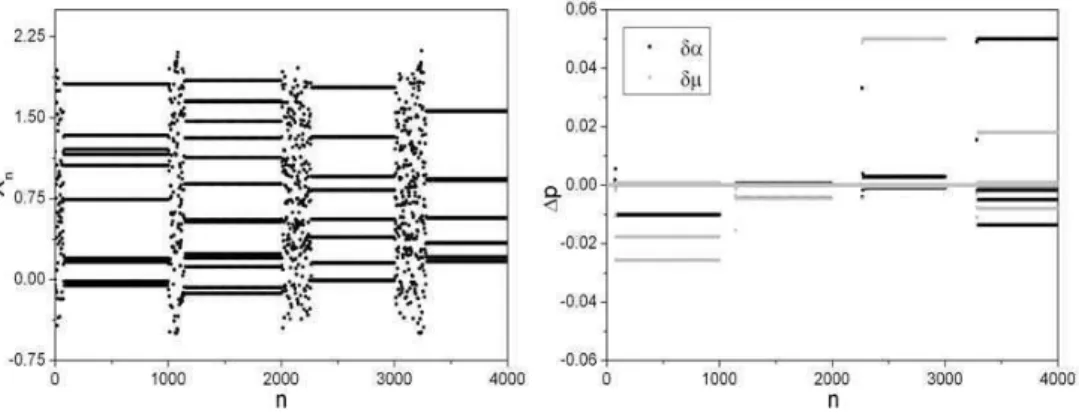
The UPO identification is now focused on by considering 30,000 map iterations and a tolerance of 0.005, assuming the same procedure of the preceding section. Under this assump-tion, 8 UPOs are identified during the learning stage up to periodicity 15. The control rule considers the following se-quence: a period-10 orbit during the first 500 iterations, a period-14 from iteration 500 to 1000, a period-8 from 1000 to 1500 and, finally a period-5, from period 1500 to 2000.
GD
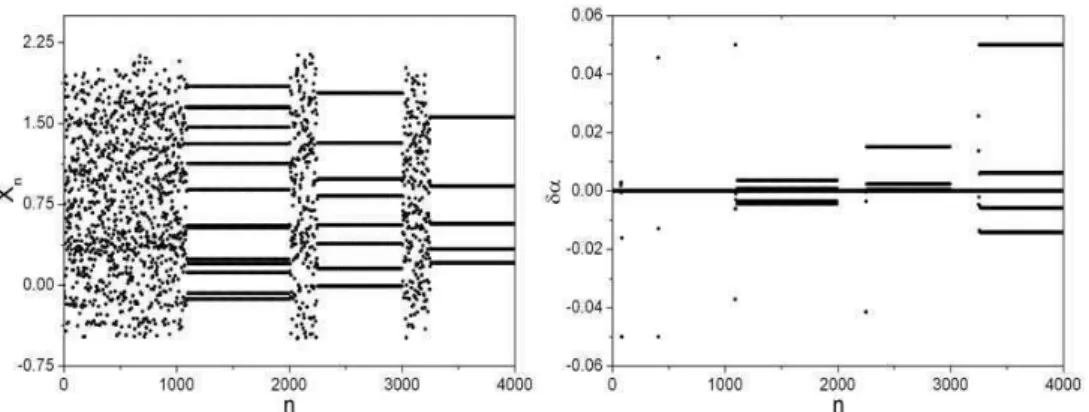
FIG. 7: Ikeda map stabilization using single-parameterδα: (a) Displacement; (b) Control parameters perturbations.
GP
FIG. 8: Ikeda map stabilization using single-parameterδµ: Displacement; (b) Control parameters perturbations.
single-parameter method is not able to stabilize the first UPO when the first parameter (δα) is employed as control parame-ter. On the other hand, the OGY single-parameter method is not able to stabilize the third UPO of the control rule when the second parameter (δµ) is employed (Fig. 8). These results are showing that the multiparameter approach may be more effective in order to perform UPO stabilization.
4. CONCLUSIONS
This contribution presents a multiparameter chaos control method built upon the OGY technique. The procedure as-sumes that only one control parameter is perturbed in each control station, defining active and passive control parameters. As an application of the proposed multiparameter general for-mulation, it is considered an uncoupled approach where con-trol parameters return to their reference positions when they are not active. The uncoupled multiparameter method is an-alyzed by evaluating chaos control in H´enon and Ikeda
two-dimensional maps with two control parameters. Control rules are defined from a sequence of four different UPOs for each map. Results show that the uncoupled multiparameter proce-dure successfully stabilizes all orbits controlled by the single-parameter approach. On the other hand, there are situations where the single-parameter approach fails. Therefore, one can conclude that the uncoupled multiparameter procedure tends to be more effective in order to stabilize unstable periodic or-bits embedded in the chaotic attractor when compared with the stabilization performed by the single-parameter approach. The application of the general coupled approach is associated with a non-trivial work on defining proper control parameters but may present successful results as shown in De Paula & Savi [14].
Acknowledgements
The authors acknowledge the support of Brazilian Research Councils CNPq and FAPERJ.
[1] E. Ott, C. Grebogi, and J. A. Yorke, Phys. Rev. Lett.64, 1196 (1990).
[2] C. Grebogi and Y. -C. Lai, Syst. Control Lett.31, 307 (1997).
[3] T. Shinbrot, C. Grebogi, E. Ott, and J. A. Yorke, Nature363, 411 (1993).
[5] B. H¨ubinger, R. Doerner, W. Martienssen, M. Herdering, R. Pitka, and U. Dressler, Phys. Rev. E50, 932 (1994).
[6] M. Otani and A. J. Jones, Guiding Chaotic Orbits, Research Report - Imperial College of Science Technology and Medicine (London, 1997).
[7] T. Ritz, A. S. Z. Schweinsberg, U. Dressler, R. Doerner, B. H¨ubinger, and W. Martienssen, Chaos Sol. & Fract.8, 1559 (1997).
[8] F. H. I. Pereira-Pinto, A. M. Ferreira, and M. A. Savi, Chaos Sol. & Fract.22, 653 (2004).
[9] M. A. Savi, F H. I. Pereira-Pinto, and A. M. Ferreira, Shock Vib.13, 301 (2006).
[10] U. Dressler and G. Nitsche, Phys. Rev. Lett.68, 1 (1992). [11] P. So and E. Ott, Phys. Rev. E51, 2955 (1995).
[12] R. J. de Korte, J. C. Schouten, and C. V. M. van den Bleek, Phys. Rev. E52, 3358 (1995).
[13] F. H. I. Pereira-Pinto, A. M. Ferreira, and M. A. Savi, Int. J. Bif. and Chaos15, 4051 (2005).
[14] A. S. De Paula and M. A. Savi, Chaos Sol. & Fract. doi:10.1016/ j.chaos.2007.09.056 (2007).
[15] E. Barreto and C. Grebogi, Phys. Rev. E54, 3553 (1995). [16] W. L. Ditto, S. N. Rauseo, and M. L. Spano, Phys. Rev. Lett.
65, 3211 (1990).
[17] B. R. Andrievskii and A. L. Fradkov, Automation and Remote Control65, 505 (2004).
[18] M. Sonis, Chaos Sol. & Fract7, 2215 (1996). [19] M. H´enon, Commun. Math. Phys.50, 69 (1976).
[20] S. Hammel, C. K. R. T. Jones, and J. Maloney, J. Opt. Soc. Am. B 552, (1985).
[21] A. S. De Paula, M. A. Savi, and F. H. I. Pereira-Pinto, J. Sound Vib.294, 585 (2006).
[22] H. Lenz and D. Obradovic, Int. J. Bifurcation and Chaos,9, 251 (1999).
[23] D. Auerbach, P. Cvitanovic, J. –P. Eckmann, G. Gunaratne, and I. Procaccia, Phys. Rev. Lett.58, 2387 (1987).
[24] M. A. Savi,Nonlinear Dynamics and Chaos, Editora E-papers (2006).