CASE REPORT
Tuberculous pericarditis in acquired immune deficiency syndrome patients
*RUGGERO BERNARDO GUIDUGLI1, PAUL ALBERT HAMRICK2, NANCY FIGUEIROA DE REZENDE2
Two quite dyspneic HIV positive patients were admitted to the Emergency Room; they presented clinical signs and images suggesting pericardial effusion. The analysis of an initial liquid puncture did not show any specificity and the patients did not exhibit any clinical improvement. Both patients were submitted to a subxiphoid pericardial window, all the effusion liquid was drained, and a biopsy of the pericardium tissue was completed, revealing a granulomatous
process. Immediately after the onset of specific treatment, the patients showed a good evolution. Such findings draw attention to a high possibility of pericardial suffusion in AIDS patients being tuberculosis, particular if one considers the high prevalence of this disease in Brazil. The results also showed that the opening of a subxiphoid pericardial window and the specific triple scheme was a procedure that led to good therapeutic evolution in these
patients. (J PneumolJ PneumolJ PneumolJ Pneumol 2003;29(2):98-100)
Key words – Pericarditis. AIDS. Tuberculosis. Pericardial window.
Abbreviations used in this article
AIDS – Acquired immunodeficiency syndrome HIV – Human immunodeficiency virus
KB – Koch’s bacillus
INTRODUCTION
Currently, the large amount of pericardial effusions are related to AIDS pathologies (1,2)
and, due to the high prevalence in our country, tuberculosis must always be recalled as one etiology of pericarditis in patients with HIV.
However, diagnostic difficulties may occur by the simple analysis of pericardial liquid obtained by puncture, which may not show specificity. This fact leads us to perform a biopsy.
This situation took place with two of our patients. Their reports will help us to conduct this association better.
CASE REPORTS
Case 1 Case 1 Case 1 Case 1
31 year-old HIV-positive man, being treated with anti-viral drugs as well as trimethoprim and
sulfamethoxazole for pneumocystosis. Admitted at the emergency room with intense dyspnea.
He had a fever (T 37.6°C), was tachycardiac (P 120 bpm) and the simple thoracic radiography showed an increase of the cardiac area with diffuse interstitial pulmonary infiltration, which was interpreted as pneumocystosis and treated with trimethoprim and sulfamethoxazole (Figure 1).
We hypothesized a pericardial effusion, which was confirmed by echocardiographic exam.
Having been submitted to a pericardial puncture, approximately 150 ml of a citric-yellow liquid was removed, showing 54% of lymphocytes, 40% of neutrophils, 4.2 g/l of protein, 18 g/l of glucose. Negative ADA. A sample was sent for KB culture. Due to the worsening of the dyspnea and the clinical features, a subxiphoid pericardial window and biopsy were performed under general anesthesia and approximately 280 ml of liquid was removed and a drain was kept in the mediastinum.
* Study carried out at Hospital Ipiranga, São Paulo, SP.
1. Surgeon of the Thoracic Surgery Service. Master in Surgical Technique and Experimental Surgery. 2. Infectologist.
Mailing address - Ruggero Bernardo Guidugli, Amiamspe, Rua Borges Lagoa, 1.855 – 04038-034 – São Paulo, SP.
Received for publication on 12/9/02. Ac Received for publication on 12/9/02. Ac Received for publication on 12/9/02. Ac
Received for publication on 12/9/02. Accepted after revision on 2/12/03.cepted after revision on 2/12/03.cepted after revision on 2/12/03.cepted after revision on 2/12/03.
Figure 1 Figure 1 Figure 1
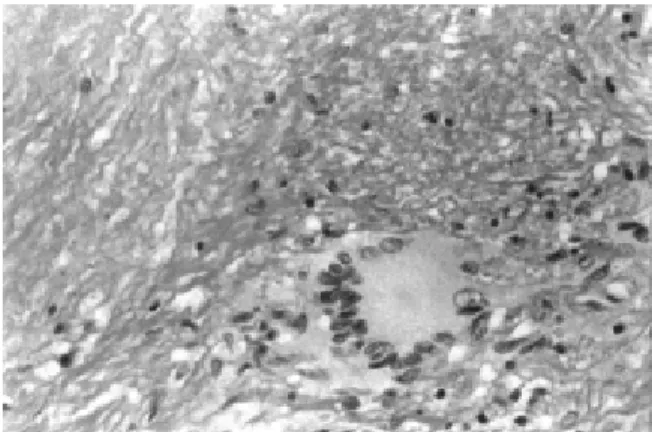
Figure 1 – Simple posterior-anterior thoracic X-Ray of the first Figure 2 Figure 2 Figure 2 Figure 2 – Histological slide dyed with hematoxilin-eosin, patient, showing an increase of the cardiac area, suggesting in larger view (250x) of the pericardial tissue of the first patient. pericardial effusion and diffuse interstitial pulmonary infiltration. Casein necrosis areas surrounded by Langhans cells and
lymphocytic infiltration.
There was a fast improvement of the dyspnea and the result of the biopsy revealed tuberculous pericarditis (Figure 2), allowing the introduction of a triple schedule, resulting in a significant and fast improvement of the patient’s status.
KB culture took 45 days and was also positive. The patient was followed-up for 9 months and there was no relapse of the symptoms.
Case 2 Case 2 Case 2 Case 2
45 year-old man, admitted into the emergency room with cough and intense shortness of breath. At the clinical examination he was quite dyspneic, tachycardiac and with fever (T 37.9°C). The simple thoracic radiography showed increased cardiac area and multiple sites of pulmonary condensation.
Computer assisted tomography evidenced zones of alveolar condensation and reticular-node interstitial infiltration (Figure 3), which were interpreted as probable tuberculosis, not confirmed by the bacterioscopic exam.
HIV serology was positive (Elisa and Western blot) and the pericardial effusion was confirmed by echocardiographic exam.
The patient was submitted to a pericardial puncture with removal of approximately 120 ml of a yellow-citric liquid, with 40% of neutrophils, 60% of lymphocytes, 26 g/l of glucose, 3.8 g/l of proteins, negative ADA and negative bacteriology.
Due to a progressive increase of the dyspnea, he was submitted to a subxiphoid pericardial window under general anesthesia, removing 240 ml of a yellow-citric liquid. After the surgery, there was a clear improvement of the dyspnea and the histopathological exam also revealed tuberculous pericarditis.
After the first days of triple schedule, there was a fast improvement of the patient’s status, as well as of the
Figure 3 Figure 3 Figure 3
Figure 3 – Computer assisted tomography of the second patient. Enlargement of the cardiac area and diffuse reticular-nodular interstitial pulmonary infiltration and areas of alveolar condensation.
pulmonary features. During a nine month follow-up, there was no sign of relapse of the disease.
DISCUSSION
Before AIDS appearance, pericardial effusions were mainly caused by uremia, malignancies and viral pericarditis (1)
.
Nowadays, in large urban centers, etiology of pericarditis is mainly related to the AIDS-associated pathologies (2)
. In African countries, tuberculosis is responsible for 100% of pericarditis cases in individuals with this syndrome (3,4)
.
analysis, there is still some difficulty to support the diagnosis.
Pericardial effusion may be the main sign of localized or spread tuberculosis and, usually, results in endangering the pericardial sac by mediastinal lymphonodus contaminated by mycobacterium (5,6)
. Usually, pericardial liquid is a yellow-citric exudate with high number of lymphocytes and low glucose. Its culture does not always result bacillus positive. If not conveniently emptied, it will evolve to formation of fibrin, septation and granuloma with adherence and thickening of leaflets, developing to constrictive chronic pericarditis. Corticoids are known to be beneficial, hindering liquid re-accumulation, but the literature still lacks data on the prevention of constrictive pericarditis
(7)
.
The complete and permanent drainage of the effusion liquid would be the best way to avoid future constriction of the heart chambers (8)
.
It is therefore essential to remove the effusion liquid and to perform the histopathologic exam of the pericardium for diagnosis confirmation.
The subxiphoid pericardial window is a low morbidity surgical procedure; it allows a total drainage of the
effusion liquid and the removal of a fragment the impaired tissue. In patients with precarious conditions, it can be done under local anesthesia (9-11)
.
In a review of 29 AIDS cases with pericardial effusion, submitted to a pericardial window or to a thoracotomy, Flum et al. (12)
concluded that pericarditis in AIDS patients is associated with a bad prognosis. Such surgical procedures would not be beneficial to the patients due to post-operative complications.
Our patients were quite dyspneic and the pericardial window allowed a fast clinical improvement. The biopsy allowed the adequate treatment, with a good evolvement of the patients.
We believe that, in our environment, in HIV patients who develop a pericardial effusion and present an inconclusive result in the liquid obtained by puncture, there is a great possibility to treat tuberculosis. In this case, the subxiphoid pericardial window constitutes an adequate conduct.
This procedure would allow a biopsy to be performed, shaping the diagnostic and the total and permanent drainage of the effusion liquid, preventing constrictive pericarditis.
REFERENCES
1. Chen Y, Brennessel D, Walters J, Johnson M, Rosner F, Raza M. Immunodeficiency virus associated pericardial effusions – Report of 40 cases and review of the literature. Am Heart J 1999;137:516-20.
2. Schiller M, Gordon AS, Eisemberg M. HIV associated pericardial effusions. Chest 1992;102:956-8.
3. Cegielski GJ, Ramiya K, Lallinger GJ, Mtulia IA, Mbaga IM. Pericardial disease and human immunodeficiency virus in Dar es Salaam, Tanzania. Lancet 1990;335:209-12.
4. Cegielski JP, Lwakatare J, Dukes CS, Lema LE, Lallinger GJ, Kitinya J, et al. Tuberculous pericarditis in Tanzania patients with HIV infection. Tuber Lung Dis 1994;775:429-34.
5. Lewis W. Aids: cardiac findings from 115 autopsies. Prog Cardiovasc Dis 1989;32:207-15.
6. Klatt EC, Meyer PR. Pathology of the heart in AIDS. Arch Lab Pathol Med 1988;112:114-6.
7. Strang H, Kalxaza HHS, Gibson DG. Controlled clinical trial of complete open surgical drainage and of prednisolone in treatment of tuberculous pericardial effusion in T. Lancet 1988;2:759-64.
8. Desai HN. Tuberculous pericarditis: a review of 100 cases. S Afr Med J 1979;5:877-80.
9. Millis SA, Jukian S, Hollyday RH, Visteu-Johansen J, Case LD, Hudspeth AS, et al. Subxiphoid pericardial window for pericardial effusion disease. J Cardiovasc Surg 1989;30:768-73.
10. Lennin BH, Aaron BL. The subxiphoid pericardial window. Surg Gynecol Obstet 1982;155:804-6.
11. Fontenelle LJ, Cuello L, Dooley BN. Subxiphoid pericardial window. A simple and safe method for diagnosing and treating acute and chronic pericardial effusions. J Thorac Cardiovasc Surg 1971;62:95-7. 12. Flum DR, Mc Ginin Jr GT, Tyras DH. The role of the