Vol. 6, No. 4, 2003 Effect of Impurities on Mechanical Relaxation in Niobium 541
Materials Research, Vol. 6, No. 4, 541-544, 2003. © 2003
*e-mail: [email protected]
Trabalho apresentado no XIV CBECIMAT, Águas de São Pedro - SP, Dezembro de 2000.
Effect of Impurities on Mechanical Relaxation in Niobium
Odila Florêncioa*, Paulo Sergio Silva Jra, Walter José Botta Filhob, Carlos Roberto Grandinic
aDepartamento de Física, UFSCar
C.P. 676, 13565-905 São Carlos - SP, Brazil
bDepartamento de Engenharia de Materiais, UFSCar
C.P. 676, 13565-905 São Carlos - SP, Brazil
cDepartamento de Física, UNESP
C.P. 473, 17033-360 Bauru - SP, Brazil
Received: November 13, 2000; Revised: August 23, 2003
Measurements of internal friction as a function of temperature were performed in samples of Nb containing different amounts of substitutional (Zr) and interstitial (O, N) solutes. These data were resolved using the method of successive subtraction, into a series of constituent Debye peaks corre-sponding to different interactions. For each relaxation process we obtained the height (Q-1
max) and temperature (Tp) of the peak, the activation energy (E) and the relaxation time (t0). The height, shape and temperature of the peaks depend on the concentration of interstitial and substitutional elements. With the addition of substitutional solute one can observed interactions between the two types of solutes (substitutional and interstitial), showing that the random distribution of the interstitial atoms was affected by presence of substitutional atoms. The peaks observed were associated with matrix-interstitial (Nb-O, Nb-N) and substitutional-matrix-interstitial (Zr-O) interaction processes.
Keywords:niobium, niobium alloys, interstitial elements, internal friction
1. Introduction
Metals with body-centered cubic (BCC) lattice contain-ing solute atoms dissolved interstitially often show anelastic behavior due to a process known as stress induced ordering. One manifestation of this anelastic behavior is the internal friction (Q-1), which was originally observed by Snoek1 in
Fe containing carbon and nitrogen as interstitial solutes in octahedral positions of the type (1/2, 0, 0) and (1/2, 1/2, 0) that produce a strain tensor that has local tetragonal sym-metry causing anelasticity.
In the lattices of Nb and Nb-Zr alloys (BCC), oxygen and nitrogen atoms are expected to occupy positions simi-lar to carbon and nitrogen atoms in the Fe lattice.
Several techniques can be used to measure the internal friction2-5, of these the torsion pendulum is one which is
suitable to the study of metal heavy interstitial solute actions (such as carbon, nitrogen or oxygen). At low inter-stitial-solute concentrations, the relaxation strength of in-ternal friction at a given temperature is a function of the nature, positions and concentration of the interstitial atoms.
In the present work the internal friction was measured as a function of temperature in samples of Nb with differents amounts of substitutional (Zr) and interstitials (O, N) sol-utes and were identified matrix-interstitial and substitutional-interstitial interaction processes.
2. Experimental Procedure
Nb and Nb-Zr polycrystalline alloys were obtained by electro-beam zone melting and supplied in the form of swaged rods of 3 mm diameter. Nb-Zr single crystal alloys were grown in an electron-beam melting zone apparatus, with an orientation near the center of the standard triangle6.
The Nb-0.08Zr and Nb-1.48Zr samples were internally oxi-dized during approximately 70 h at 1270 K in vacuum at a pressure of 5 × 10⁻⁷ mbar. Samples 50 mm long, which had
been chemically polished to 1.5 mm thickness in a mixture of nitric and fluoride acids, were used for the mechanical relaxation measurements.
542 Florêncio et al. Materials Research
pendulum of the Kê-type7, applying a heating rate of
1 K/min, at a pressure near 10-4 mbar. A laser beam was
deflected by a mirror on the pendulum bar, and data on the decay of the oscillations was collected automatically by two phototransistor connected to a computer. The internal fric-tion was obtained from the amplitude decay.
The internal friction curves as a function of temperature were decomposed into elemental Debye peaks8 using the
method of successive subtraction, and the anelastic relaxa-tion processes was identified comparing the experimental data with literature9-12.
3. Results and Discussions
Experimental spectra of internal friction as a function of temperature were obtained for the Nb and Nb-Zr alloys. Figure 1 shows the data for the polycrystalline samples Nb and Nb-1.2Zr . Chemical analysis of the interstitial impuri-ties in the metals indicated 50 wt.-ppm of O2 and 30 wt.-ppm of N2 in the Nb sample, and 60 wt.-ppm of O2 and 30 wt.-ppm of N2 in the Nb-Zr alloys. Comparison of the two curves (Fig.1) indicates that the presence of substitutional element (Zr) modifies the spectra of mechani-cal relaxation due to the interaction of Zr with the intersti-tial elements, as such oxygen and nitrogen in solid solution. For unalloyed Nb, the Snoek peaks we observed are Nb-O at 430 K with activation energy of 1.06 eV, and Nb-N at 560 K with activation energy of 1.17 eV13. The increase of
the values of internal friction at higher temperatures is due to the previous plastic deformation in the samples14.
Figure 2 shows the internal friction as a function of tem-perature for Nb-0.08Zr-O alloy with the experimental re-laxation spectrum resolved into four constituent peaks cor-responding to the interactions Nb-O (434 K), Nb-O-O (450 K), Nb-O-O-O (490 K) and Zr-O (517 K).
The resolution of internal friction spectra as function of temperature into their constituent Debye peaks was criti-cized by Weller et al.15-16. They contested the existence of pairs and triplets of atoms in interstitial solid solution in BCC metals to explain the observed asymmetric broaden-ing of anelastic relaxation peak, and that in the case of high interstitial contents, these atoms would also occupy inter-stitial tetrahedral positions, resulting in the double occu-pancy that cause the shifting and broadening of the peak.
Even using the correction proposed by Weller et al.16 in the results of Fig. 2, for Nb-0.08Zr-O alloy, the asymmetry continued to be evident. This corroborates the existence of more than one process of interaction, in conformity with the results of authors4,9,10,17.
According to Povolo and Lambri18 can be stated that no
clear physical model is available to explain all the features of the Snoek relaxation in BCC metals.
Figure 3 shows the experimental spectra for Nb-0.08Zr-O,
Nb-1.48Zr-O and Nb-0.5Zr single crystals, no mechanical relaxation peak due to the presence of interstitial atoms in solid solution was observed on the Nb-0.5Zr sample, and due to broaden of the relaxation peaks on the Nb-1.48Zr-O it is not possible the decomposition in constituent peaks.
The interstitial elements in solid solution of metals with BCC lattice are responsible for the Snoek peaks in the re-laxation spectrum of internal friction, due to the stress-induced ordering. The height, shape and temperature of these peaks depend on the concentration of interstitial and substitutional elements. The identification of the three con-Figure 1. Internal friction as a function of temperature for unalloyed
Nb(∆) and Nb-1.2Zr(Ο).
Figure 2. Internal friction as a function of temperature for
Vol. 6, No. 4, 2003 Effect of Impurities on Mechanical Relaxation in Niobium 543
stituent peaks Nb-O, Nb-O-O and Nb-O-O-O due to ma-trix-interstitial interactions was based on the results Ahmad and Szkopiak9, and the identification of the Zr-O peak due
to substitutional-interstitial interaction was based on re-sults of several authors10-12. Assuming that the peaks are
true Debye peaks, one can compute the activation ener-gies (E) for the processes, measuring the width at half peak height, and considering that the peaks obey Arrhenius type equation, t = t0exp(E/RTp), it is possible to calculate the
Figure 3. Internal friction as a function of temperature for
Nb-0.08Zr-O( ), Nb-1.48Zr-O(o) and Nb-0.5Zr (•) alloys.
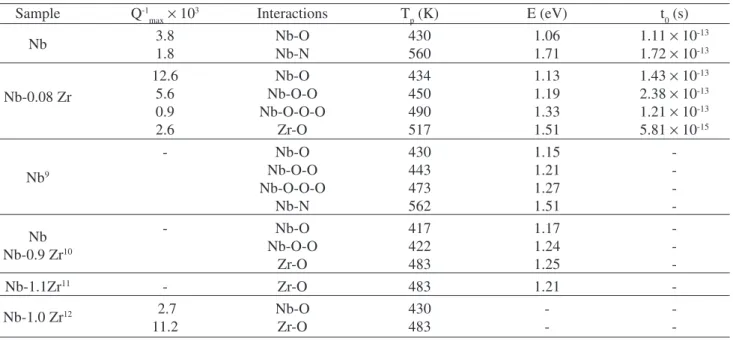
Table 1. Relation rate parameters of Nb-O, Nb-N and Zr-O interactions.
Sample Q-1
max× 103 Interactions Tp (K) E (eV) t0 (s)
Nb 3.81.8 Nb-ONb-N 430560 1.061.71 1.11 1.72 ×× 10 10-13-13
Nb-0.08 Zr
12.6 Nb-O 434 1.13 1.43 × 10⁻¹³
5.6 Nb-O-O 450 1.19 2.38 × 10⁻¹³
0.9 Nb-O-O-O 490 1.33 1.21 × 10⁻¹³
2.6 Zr-O 517 1.51 5.81 × 10⁻¹⁵
Nb9
- Nb-O 430 1.15
-Nb-O-O 443 1.21
-Nb-O-O-O 473 1.27
-Nb-N 562 1.51
-Nb - Nb-O 417 1.17
-Nb-0.9 Zr10 Nb-O-O 422 1.24
-Zr-O 483 1.25
-Nb-1.1Zr11 - Zr-O 483 1.21
-Nb-1.0 Zr12 2.7 Nb-O 430 -
-11.2 Zr-O 483 -
-relaxation time (t0) for each interaction process. Table 1 shows the parameters of mechanical relaxation for each kind of interaction, compared with values reported in the literature.
The differences observed between the mechanical re-laxation parameters obtained for the substitutional-intersti-tial (Zr-O) interactions and the values reported in literature are probably associated with the existence of ZrO2 precipi-tates in the samples6. Zirconium additions reduced and
broaden the relaxation peaks or even remove them com-pletely, these effects were observed by comparing the inter-nal friction spectra of the Nb-0.08Zr-O alloy with those of the Nb-1.48Zr-O alloy and of the unalloyed Nb and Nb-1.2Zr polycrystalline samples.
4. Conclusions
1.The mechanical relaxation spectra for Nb and Nb-Zr alloys containing different amounts of zirconium were obtained as a function of temperature, where were identified matrix-interstitial and substitutional-inter-stitial interaction processes.
2.The mechanical relaxation spectra for Nb-Zr single crystals containing different amounts of zirconium and oxygen were obtained as a function of temperature. The spectrum for Nb-0.08Zr sample was resolved into four interaction processes: Nb-O, Nb-O-O, Nb-O-O-O and Zr-O characterizing the mechanical multiple re-laxation in the Nb-Zr-O alloys.
al-544 Florêncio et al. Materials Research
loy we have observed that zirconium additions really reduce or even remove the relaxation peaks, similarly to the result observed for unalloyed Nb and Nb-1.2Zr polycrystalline samples.
Acknowledgments
We would like to thank the following brazilians institu-tions: CNPq, FAPESP and FINEP for financial support, and FAENQUIL for supplying the polycrystalline samples.
References
1. Snoek, J.L. Physica, v. 6, n. 7, p. 591-592, 1939. 2. Jordão, J.A.R. Doctor of Physics Thesis, Universidade
de São Paulo, 1982.
3. Florêncio, O.; Pinatti, D.G.; Roberts, J.M. J.Physique, v. 46, C-10, p. 115-118, 1985.
4. Botta Fo, W.J.; Florêncio, O.; Grandini, C.R.; Tejima, H.; Jordão, J.A.R. Acta metall.mater., v. 38, n. 3, p. 391-396, 1990. 5. Trequattrini, F.; Cannelli, G.; Cantelli, R.; Florêncio, O.
J.Alloys Compounds, v. 293, n. 1, p. 334-337, 1999. 6. Botta Fo, W.J. Ph.D. thesis, Oxford University, 1985. 7. Kê, T.S. Phys.Rev., v. 71, n. 8, p. 533-546, 1947. 8. Nowick, A.S.; Berry, B.S. Anelastic Relaxation in
Crys-talline Solids, Academic Press, New York , p. 677, 1972.
9. Ahmad, M.S.; Szkopiak, Z.C. J.Phys.Chem.Solids, v. 31, n. 8, p. 1799-1804, 1970.
10. Bunn, P.M.; Cummings, D.G.; Leavenworth Jr, H.W. J.Appl.Phys, v. 33, n. 10, p. 3009, 1962.
11. Vedenyapin, G.A.; Dushin, Yu-A.; Yemel”Yanova, L.I.; Novikov, L.F.; Parkhuta, G.N. Phys.Metall., v.47, n. 5, p. 62-67, 1980.
12. Szkopiak, Z.C.; Smith, J.T. J.Phys.D, v.8, n. 11, p. 1273-1284, 1975.
13. Florêncio, O.; Aparecido de Freitas, W.; Botta Fo, W.J.; Grandini, C.R.; Jordão, J.A.R. J.PhysiqueIV, v. 6, C-8, p. 123-125, 1996.
14. Fast, J.D. Gases in Metals, Macmillan Press Ltd, Lon-don, p. 260, 1976.
15. Weller, M.; Li, G.Y.; Zhang, J.X.; Kê, T.S.; Diehl, J. Acta metal., v. 29, n. 6, p. 1047-1054, 1981.
16. Weller, M.; Zhang, J.X.; Li, G.Y.; Kê, T.S.; Diehl, J. Acta metal., v. 29, n. 6, p. 1055-1060, 1981.
17. Florêncio, O.; Grandini, C.R.; Botta Fo, W.J.; Guedes, P.R.; Silva Jr., P.S. Materials Science Eng. A, in press. 18. Povolo, F.; Lambri, O.A. Materials Transactions, JIM,