Point Me in the Right Direction: Same and
Cross Category Visual Aftereffects to
Directional Cues
Sarah Maeve Cooney1☯*, Alanna O’Shea2, Nuala Brady1☯
1School of Psychology, University College Dublin, Belfield, Dublin, Ireland,2School of Biomolecular and Biomedical Science, University College Dublin, Belfield, Dublin, Ireland
☯These authors contributed equally to this work.
Abstract
Of the many hand gestures that we use in communication pointing is one of the most com-mon and powerful in its role as a visual referent that directs joint attention. While numerous studies have examined the developmental trajectory of pointing production and comprehen-sion, very little consideration has been given to adult visual perception of hand pointing ges-tures. Across two studies, we use a visual adaptation paradigm to explore the mechanisms underlying the perception of proto-declarative hand pointing. Twenty eight participants judged whether 3D modeled hands pointed, in depth, at or to the left or right of a target (test angles of 0°, 0.75° and 1.5° left and right) before and after adapting to either hands or arrows which pointed 10° to the right or left of the target. After adaptation, the perception of the pointing direction of the test hands shifted with respect to the adapted direction, reveal-ing separate mechanisms for codreveal-ing right and leftward pointreveal-ing directions. While there were subtle yet significant differences in the strength of adaptation to hands and arrows, both cues gave rise to a similar pattern of aftereffects. The considerable cross category adapta-tion found when arrows were used as adapting stimuli and the asymmetry in aftereffects to left and right hands suggests that the adaptation aftereffects are likely driven by simple ori-entation cues, inherent in the morphological structure of the hand, and not dependent on the biological status of the hand pointing cue. This finding provides evidence in support of a common neural mechanism that processes these directional social cues, a mechanism that may be blind to the biological status of the stimulus category.
Introduction
With relative ease and little reflection we readily follow numerous cues that direct our focus of attention. These directional cues can be biological such as hand gestures, head orientation and eye gaze or symbolic non-biological cues, like arrows. Of the various biological cues to social attention that people use, hand pointing is a meaningful social gesture that can convey a variety of communicative intentions [1]. Comprehension of pointing gestures provides an integral OPEN ACCESS
Citation:Cooney SM, O’Shea A, Brady N (2015) Point Me in the Right Direction: Same and Cross Category Visual Aftereffects to Directional Cues. PLoS ONE 10(10): e0141411. doi:10.1371/journal. pone.0141411
Editor:Cosimo Urgesi, University of Udine, ITALY
Received:May 20, 2015
Accepted:October 8, 2015
Published:October 28, 2015
Copyright:© 2015 Cooney et al. This is an open access article distributed under the terms of the
Creative Commons Attribution License, which permits unrestricted use, distribution, and reproduction in any medium, provided the original author and source are credited.
Data Availability Statement:Data can be found on Figshare:http://dx.doi.org/10.6084/m9.figshare. 1539608.
foundation for developing social reciprocity. The intention of the gesture is often aligned with the type of communicative point: imperative pointing is used to request an object whereas declarative pointing is used to direct another’s attention upon an object or event in the environ-ment [1,2].
Producing declarative pointing gestures with the index finger begins to emerge toward the end of the first year of infancy [1,3–5], is predominantly right handed [6] and is predictive of positive vocabulary acquisition [7,8]. Infants as young as 4.5 months have been shown to be sensitive to pointing direction towards a distal referent [9]. A developmental delay in produc-ing and comprehendproduc-ing pointproduc-ing gestures is often used as a diagnostic marker for Autism Spec-trum Disorder (ASD) [10]. Pointing, like eye gaze, is a deictic gesture that permits the signaler to indicate to a recipient an object or target of interest. The resulting convergence of eye gaze between the two interacting parties facilitates a mutual understanding of a common focus of interest, understood as joint attention [11,12].
Numerous studies have examined the developmental trajectory of pointing production and comprehension. By comparison, very little consideration has been given to adult perception of hand pointing gestures. While interacting with others, our visual system is constantly process-ing a number of biological directional cues that serve to establish and maintain joint attention [13]. Converging evidence suggests that some of these biological cues, such as eye gaze direc-tion [14], body orientation [15] and head orientation [16], are represented at a relatively high-level of visual processing. This paper asks if the visual system selectively codes for hand point-ing direction. If so, is this done at a high level of visual processpoint-ing? To determine if a selective population of neurons represents hand-pointing direction in the brain we employ visual adap-tation. Visual adaptation provides a well-established method [15,17–20] to study how the visual system codes for these directional cues.
When repeatedly presented with a stimulus, adaptation aftereffects manifest as perceptual biases that result from reduced neuronal sensitivity to specific features of that stimulus [20]. For example, adaptation to a leftward tilted line changes our perception of the orientation of a subsequently presented vertical line so that it appears to tilt in the opposite direction. The tilt aftereffect [21] and visual adaptation aftereffects in general reflect the continuous adjustment or recalibration of the response properties of neurons tuned to specific stimulus features in the environment [18,20]. Perceptual aftereffects have been found for basic stimulus features such as motion [22] and orientation [21] and to higher level qualities such as face identity [23], face viewpoint [16,19] and gender [24,25]. For instance, after participants adapted to a side view of a human face their judgments of forward facing test stimuli shifted in the opposite direction [16]. Fang and He [19] found that this face viewpoint aftereffect did not transfer between object groups, such that adapting to a face did not produce a perceptual shift in judg-ing the viewpoint of a selection of non-biological control stimuli such as cars and abstract wir-eframe objects. However, cross category aftereffects have been reported for the representation of gender, such that adapting to a male face results in a perceptual shift in the perception of body gender away from the gender of the adaptor and vice versa [25]. Interpretation of this cross category aftereffect as evidence of neuronal populations tuned to the higher order con-cept of gender are supported by further research [24] where prolonged viewing of gender-spe-cific non biological objects (e.g., lipstick, shoes, items of clothing etc.), induced a shift in the perception of face gender. There is considerable potential of cross category adaptation afteref-fects to examine neural sensitivity to high-level stimulus features. Here, we use the technique to examine visual coding of hand pointing direction, a biological directional cue, and ask whether this type of directional cue is visually coded by a separate neural mechanism than arrows, a non-biological directional cue.
O'Shea is an undergraduate Neuroscience student from UCD who worked on this project as part of her final year project. The funders had no role in study design, data collection and analysis, decision to publish, or preparation of the manuscript. No additional funding was received for this study.
The limited amount of research on pointing comprehension in adults has almost exclusively employed attention modulation paradigms [26–30] such as the Posner visual cueing task (1980), Stroop type interference paradigms and eye movement tracking, in order to examine how pointing along with other social cues can modulate attention. With particular consider-ation given to the biological versus non-biological features of the social cues, a number of stud-ies have reported that hand pointing direction, like eye gaze direction [27] exerts automatic control on the observers visual attention [30–32]. It is not only biological hand pointing and eye gaze cues that have been shown to modulate visual attention; social symbols such as arrows and directional words have been found to produce comparable attentional effects [33,34]. These studies provide evidence of a common neural mechanism that processes these social cues that may be blind to the biological status of the stimulus category.
In contrast, studies that have employed more complex attention-orienting paradigms that require a heavier cognitive load, to examine the influence of biological versus non-biological cues in capturing visual attention have provided evidence to support separate attentional pro-cessing of eye gaze direction, hand pointing direction, and arrows [29,35]. One study [35] com-bined visual adaptation with attention orienting to examine the influence gaze perception and hand-pointing perception has on attentional shifts in the direction of observed gaze. They found that repeated exposure to averted gaze but not to hand pointing direction resulted in subsequent weakened gaze cueing in the adapted direction while gaze cueing in the unadapted direction remained at normal attention cueing levels. This suggests that eye gaze and hand pointing direction are coded separately as cues to social attention.
Here we employ an adaptation paradigm rather than an attentional cueing paradigm to explore whether two cues to social attention, index finger pointing gesture and a symbolic arrow, are coded separately in the visual system or in common. Both same-category and cross-category adaptation are used to examine, for the first time, the visual representation of hand pointing direction. We ask two main questions, does adapting to hand pointing direction like other biological cues to joint attention such as eye gaze, head orientation and body orientation elicit a perceptual aftereffect? And, if so, are the aftereffects indicative of separate groups of neurons that code for this particular directional body cue or does the directional information alone elicit a perceptual shift? If hand-pointing direction is represented in high level vision then cross adapting to a non-biological directional cue such as arrows should not elicit a shift in the perception of hand pointing direction.
Materials and Methods
Participants
Twenty-eight (14 female) right-handed volunteers from the UCD student population (mean age of years, 25.54, SD = 6.30 years) received fifteen euros for their participation. All were naïve to the purpose of the experiments and had normal or corrected to normal vision. The study was approved by the University College Dublin, Human Research Ethics Committee, Humani-ties (HREC); in accordance with the Declaration of Helsinki all participants gave written, informed consent and were advised of their right to withdraw from the study at any time with-out prejudice.
Stimuli
The stimuli were computer-generated images of left and right hands with a portion of the fore-arm visible, positioned in a pointing gesture, with the index finger pointing in depth at an object, a kitchen skillet. All stimuli were created using 3D animation software Poser1
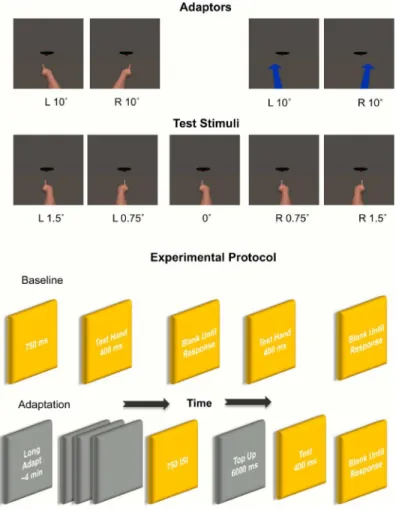
In both thesame-categoryandcross-categoryvariants of the adaptation experiment the test stimuli depicted 10 hands in total (5 right and 5 left hands) pointing directly at the handle of the skillet (0°) and 0.75° and 1.5° to the left or right of the skillet. These angles were chosen after a pilot study to gauge participants’ability to discriminate pointing direction in this task. In thesame-categoryadaptation variant, the adapting stimuli were 1 left and 1 right hand pointing in depth 10° to the left or right of the skillet. In thecross-categoryadaptation variant, the adaptor was changed to an arrow pointing in depth 10° to the left or 10° to the right of the skillet (SeeFig 1).
All images were rendered in colour at 978 x 978 pixels and subtended, vertically, ~27° of visual angle at a viewing distance of ~60cm. The distance from the tip of the finger (when in the 0° position) to the skillet handle was ~5.2° of visual angle. The stimuli were presented and participants’responses recorded using Presentation1(http://neurobs.com) running on a Dell XPS-8300 PC with a screen size of 19 inches and a display resolution of 2048 by 1152 at 60 Hz.
Procedure
In both thesame categoryandcross categoryadaptation variants of the experiment participants completed 2 experimental phases, a baseline phase and an adaptation phase, which were repeated for the 10° left and 10° right adaptors. To ensure no carry over adaptation effects par-ticipants had a 10-minute break between the right and left adaptation phases, and they com-pleted thesame categoryand thecross categoryadaptation variants of the experiment at least 1 day apart. Running order was also counterbalanced so that half the participants completed the same category variant of the experiment first and half completed the cross category first.
In each of the two baseline phases (one each before adaptation to right and to left pointing adaptors) all 10 hands (a right and left hand, each shown at 1.5° and 0.75° left, 0°, 0.75° and 1.5° right) were repeated 5 times for 50 trials, so that the combined number of baseline trials was 100. Baseline trials began with a central fixation cross for 750ms followed by a test hand for 400ms. The screen was then blanked until the participant responded using the number pad keys 1, 2 and 3 to indicate whether they perceived the hand as pointing to the left of, directly at or to the right of the skillet handle respectively. Presentation order was pseudo-randomized.
The adaptation phase started with an adaptation period of ~ 4mins during which the adap-tation stimuli (a left and a right hand pointing 10° to the right or left of the skillet handle) were presented 25 times each for 4000ms each followed by a blank 750ms ISI. Adaptation direction was counterbalanced so that half the participants adapted to leftward pointing stimuli first and half to rightward pointing stimuli first. The adaptation period was immediately followed by a post-adapt top up and test block of 50 trials. Each top up adaptor—left and right hands ( same-adaptation)or arrows (cross-adaptation) pointing 10° left or right of the skillet—was presented for 6000ms followed by a test stimulus for 400ms. The word‘RESPOND’was printed beneath each test stimulus and participants judged whether the test hands were pointing to the left of, directly at or to the right of the skillet using the keys on the number pad. The order of the 50 test trials was pseudo-randomized.
Results
interactions are explored by plotting and reporting point estimates and associated confidence intervals (Fig 2). In addition, significant interactions were further analysed using planned com-parisons with Bonferroni-correction.
In the omnibus test the main effect ofOrder of Adaptationwas not significant, F(1,26) = 3.55,p= 0.07,η2G= 0.03, and none of the higher order effects involvingOrder of Adaptation
were significant, e.g., for the 4-way interaction ofOrder of AdaptationDirectionCondition Type,p= 0.80. Therefore the data are collapsed across the two groups of participants (those
who adapted to hands first and those who adapted to arrows first) inFig 2below
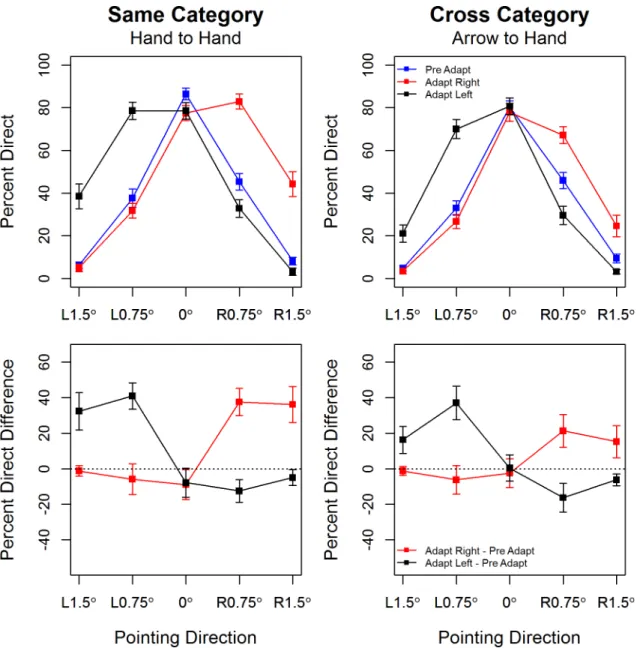
The percentage of trials on which participants perceived the test hands as pointing directly at the skillet handle is plotted by hand pointing direction in the top panel ofFig 2. There is evi-dence of strong adaptation in thesame-categorycondition. At baseline participants show high accuracy in judging the direction of hands which are pointing directly at the skillet and 1.5° to its left or right, but often judge hands pointing 0.75° to the left or to the right as pointing directly at the target. After adapting to hands pointing 10° to the right or to the left of the tar-get, the response curves shift in a way that is indicative of negative aftereffects as outlined by
Fig 1.Top Panel: Examples of test stimuli (pointed hands), and adaptors, (arrow and pointed hands) at different orientations.Bottom Panel: Sample of the experimental protocol. This included a baseline phase where participants judged the pointing direction of test hands at 5 orientations 0°, 0.75° right, 0.75° left, 1.5° right, 1.5° left. Followed by a long adaptation phase where participants viewed a series of adaptors (either hands or arrows). The long adaptation period, ~ 4mins, was immediately followed by a post-adapt top up and test block. Each top up adaptor—left and right hands (same-adaptation)or arrows (cross-adaptation) pointing 10° left or right of the skillet—was presented for 6000ms followed by a test stimulus for 400ms.
Webster and McLeod [39]. First, hands that are pointing in the same direction as the adapting stimulus are now more likely to be perceived as pointing directly at the target, and this is partic-ularly marked for the smallest pointing angle (0.75°). Secondly, and in contrast, hands that are pointing in the opposite direction to the adapting stimulus are now more likely to be correctly perceived as pointing in that direction. These characteristics of adaptation are also evident in the lower panel ofFig 2in which we plot point estimates of effect sizes (the mean difference in the percentage of straight ahead responses pre- and post-adaptation) with associated 95% CIs. The effects are positive for test hands that point in the same direction as the adaptors and nega-tive for test hands that point in the opposite direction to the adaptors.
Fig 2.Top Panel: Percentage direct responses plotted by hand pointing direction with separate traces for pre-adapt (blue), post-adapt right (red) and post-adapt left (black).Error bars show +/1 S.E.M.Bottom Panel: Mean difference in the percentage of direct responses pre- and post-adaptation by pointing direction, with separate traces for adaptation to rightward (red) and leftward (black) pointing adaptors. Error bars show 95% confidence intervals around the point estimates, the dotted black line marks an effect size of zero. Same and cross category variants of the experiment are shown in the left and right panel respectively.
There is similar evidence of strong adaptation in thecross-categorycondition where arrows pointing to the right or left of the skillet handle serve as the adapting stimuli. Test hands that are pointing in the same direction as the adapting arrows are now more likely to be perceived as pointing directly at the target. And accuracy is sharpened a little for test hands pointing in the opposite direction to the adapting arrows, i.e., after right (left) adaptation participants are more likely to correctly perceive 0.75° left (right)pointing hands as pointing to the left (right).
Statistical analyses confirm these observations. The omnibus test showed that the 3-way interaction ofPointing DirectionAdaptation ConditionAdaptation Type, F(8,208) = 5.39, p<0.001,η2G= 0.03, was significant. This suggests that the strength and pattern of adaptation
varied with the type of adaptation, hand-to-hand or arrow-to-hand. Further analyses were per-formed on thesame-categoryandcross-categorydata sets separately.
ANOVA for thesame-categorydata showed significant main effects ofPointing Direction, F (4,108) = 134.93,p~ 0,η2G= 0.61, and ofAdaptation Condition, F(2,54) = 27.50,p~ 0.0,η2G
= 0.06, whose interpretation is qualified by a significantPointing DirectionAdaptation Condi-tioninteraction, F(8,216) = 53.35,p~ 0,η2G= 0.42. Planned comparisons showed a significant
change in the percentage of‘pointing directly at’responses at 0.75° right, t(27) = 6.38,p~ 0.0, ES = 37.5% [29.88, 45.12] and at 1.5° right t(27) = 7.28,p~ 0.0, ES = 36.07% [25.90, 46.24], between baseline and adaptation to rightward pointing hands. Planned comparisons between baseline and adaptation to leftward pointing hands showed a significant change in the percent-age of‘pointing directly at’responses at 1.5° left, t(27) = 6.32,p~ 0.0, ES = 32.32% [21.83, 42.82], at 0.75° left, t(27) = 11.33,p~ 0.0, ES = 40.89% [33.49, 48.30] and at 0.75° right, t(27) = -4.07,p= 0.0004, ES = -12.5% [-18.79: -6.20].
ANOVA for thecross-categorydata likewise showed significant main effects ofPointing DirectionF(4,108) = 186.06,p~ 0,η2G= 0.67 and ofAdaptation Condition, F(2,54) = 11.69,p
~ 0.0,η2G= 0.02 whose interpretation is qualified by a significantPointing Direction Adapta-tion CondiAdapta-tioninteraction, F(8,216) = 30.94,p~ 0,η2G= 0.30. Planned comparisons showed a
significant change in the percentage of‘pointing directly at’responses at 0.75° right, t(27) = 4.78,p= 0.00005, ES = 21.25% [12.13, 30.37], and at 1.5° right, t(27) = 3.47,p= 0.0017, ES = 15.17% [6.22, 24.14], between baseline and adaptation to rightward pointing arrows. Planned comparisons between baseline and adaptation to leftward pointing arrows showed a significant change in the percentage of‘pointing directly at’responses at 1.5° left, t(27) = 4.39, p= 0.0002, ES = 16.25% [8.65, 23.85], at 0.75° left, t(27) = 8.09,p~ 0.0, ES = 36.96% [27.59, 46.33] and at both 0.75° right, t(27) = -4.13,p= 0.0003, ES = -16.25% [-24.32: -8.18], and 1.5° right, t(27) = -3.77,p= 0.0008, ES = -6.25% [-9.65: -2.85]. A comparison of these planned com-parisons results across the same-category and cross-category adaptation conditions, along with inspection of the lower panels ofFig 2, reveals the rather subtle effect of theAdaptation TypeAdaptation ConditionPointing Directioninteraction, i.e., same-category (hand-hand) adaptation generally leads to slightly higher changes in the percentage of‘pointing straight at’
responses than does cross-category (arrow-hand) adaptation
based on a simple vernier acuity cue but that participants take both hand shape and index fin-ger orientation into account in judging where the hand is pointing relative to the object.
Discussion
This study presents, for the first time, evidence of rapid visual adaptation to hand pointing direction. Adapting to hands pointing away from an object resulted in a shift in the perception of the direction of subsequently presented hand pointing stimuli away from the direction of the adaptor, a key characteristic of negative aftereffects [39].
The novel direction specific high level adaptation aftereffect reported here has, to date, been observed for three other types of visual social cues; eye gaze direction[14], head orientation [16,19] and body orientation [15]. In concluding that these aftereffects reflect the operation of
Fig 3. Percentage direct responses are re-plotted by hand pointing direction in the hand-to-hand (top panel) and arrow-to-hand (bottom panel) tasks, separately for left and right test hands.These plots illustrate an asymmetry in baseline (blue) performance such that participants are more accurate in judging the pointing direction of leftward pointing right hands and rightward pointing left hands when the task is most difficult. Error bars show +/1 S.E.M.
relatively high-level visual processing, researchers typically adjust either the size [15] or the ori-entation [40] of the adapting stimuli relative to the test stimuli so as to rule out low-level, reti-notopic effects. Here the adapting stimuli (hands or arrows pointing 10° to the right or left of the target) differ in orientation to and are non-overlapping with the test stimuli (hands point-ing 0° or 0.75° and 1.5° to the right or left of the target). As such, the aftereffects we report are unlikely to reflect retinotopic adaptation. Instead, this strong aftereffect provides initial evi-dence for the existence of neurons in the visual system tuned to hand pointing direction.
In response to a reviewer, we note that the pattern of responses before and after adaptation cannot be explained by a stimulus response compatibility effect, such as the Simon effect. According to the Simon effect, responses should be more accurate when participants press a response key that is located on the same side as the stimulus. In this study participants used the number pad which is located to the right of the keyboard, yet the same pattern of accuracy is seen for rightward and leftward pointing hands. In fact, examination ofFig 3shows that partic-ipants are more accurate at judging the direction of right hands pointing leftward and left hands pointing rightward and find the task more difficult for right hands pointing rightward and left hands pointing leftward. This suggests that the overall shape of the hand is important to the task.
Given that the directional information present in the adapting stimulus is paramount to this aftereffect, we asked, whether it is the specific configuration of the pointed hand that is respon-sible or whether adaptation to a non-biological cue to direction elicits a comparable perceptual shift in the perception of hand pointing. The results show that when adapting to an arrow ori-ented away from the object, participants subsequent perception of hands pointing in the same direction were also repelled away from the direction of the arrow adaptor. Both arrows and pointed hands serve as adaptors and change perception of the pointing direction of test hands. However, the strength of the adaptation attenuated a little when participants adapted to arrows, showing a small yet significant difference between same and cross category adaptation. The finding that adaptation varies according to the type of adaptor confirms that pointed hands are a more effective adaptor than arrows, as evidenced by generally greater effect sizes.
The cross category adaptation observed suggests that a relatively simple orientation cue is driving the aftereffects here. The inclusion of a referent object to the scene increases the num-ber of potential cues that participants could use in judging the pointing direction of the hand. These include the orientation of the index finger, the overall shape of the hand and forearm and additionally, vernier acuity—the misalignment of the tip of the skillet handle and the fin-gertip or tip of the arrow. In the case of vernier acuity this misalignment is identical for left-ward pointing left hands and leftleft-ward pointing right hands but participants are more accurate in the latter than former case, thus suggesting that vernier acuity is not the dominant cue for the adaptation aftereffect.
While the dominant hand preference is pertinent in the context of observation of hand pointing it does not fully explain the finding of the present study that participants were more accurate at judging the direction of hands pointed toward the contralateral side of space than to those pointed towards the ipsilateral side of space. Further experimentation is needed to determine the exact cues that observers are using, and if superior accuracy for contralateral directed hand pointing stimuli is found in left-handers. However, our results show that we are incredibly accurate and can resolve pointing direction at very small angles and this fine-tuned discrimination is likely gauged from both the structure of the pointed hand and the extent that the stimulus extends diagonally into contralateral space.
Our findings are in line with a study [30] that found fine tuned visual discrimination of the morphological structure of the pointed index finger. Ariga and Watanabe [30] showed that hands pointing with the index finger are superior at directing attention than hands pointing with the middle or little finger. This advantage in manipulating the viewer’s direction of atten-tion was shown not to be limited to the posiatten-tion of the index finger relative to the thumb or to the length of the index finger but from a holistic visual analysis of the morphological structure of the indexical gesture as a whole. Furthermore, when the accuracy and speed of directional judgments of index, middle and little finger at different lengths were measured, participants were fastest and most accurate at discriminating shortened index finger pointing stimuli. Inter-estingly, the type of indexical point did not always correlate with discrimination of direction, highlighting a partial dissociation between the cues we use to orient our attention to index fin-ger pointing and those that we use to discriminate the direction of indexical pointing. However, both the present study’s finding of cross category adaptation to arrow direction and those of the study described above provide evidence that it is likely low level cues that drive both the attentional shift and direction discrimination.
A parallel can be drawn with the cues used to discriminate eye gaze direction. Studies of eye gaze perception have emphasized the importance of processing simple geometric cues such as scleral contrast, the relative position of the iris to the white matter of the eye [43]. Other studies have demonstrated the high resolution of gaze acuity [44–46]. Cline [45] reported very fine-tuned sensitivity to detecting small changes in eye gaze direction, as small as 1.4° from as far as 1 metre away. Given the importance of discerning eye gaze and hand pointing direction to social interaction, and the fact that gaze and pointing play similar roles in the development of shared attention and language acquisition, it is perhaps unsurprising that our perception of these cues is subserved by simple cues. However, it is important to note that in the case of eye gaze perception, using simple geometric cues alone only works under restricted settings as head orientation also contributes to the detection of eye gaze direction [47]. Similarly, the posi-tion of the index finger relative to the hand and the posiposi-tion of the forearm relative to the hand and body are further configural cues that we use to judge the direction of the point. Like eye gaze direction, it is likely a combination of simple geometric cues and configural processing at work in judging pointing direction.
perceptual bias in judging the turning direction of subsequently presented bodies. In contrast, little to no change in the judgment of head orientation occurs after adapting to extremely ori-ented bodies [49]. Similar cross category aftereffects have been reported along the higher order dimension of gender and shown to be independent of stimulus orientation [25]. In the case of the cross adaptation aftereffects reported here, cross-category adaptation to these two direc-tional cues likely occurs at an early stage of visual processing.
Our finding that adapting to an arrow causes a shift in the perception of pointed hands sug-gests that it may not be the biological dimension of the stimuli per se that is producing the effects. Through experience we learn that both biological and non- biological cues contain salient directional information, so that our response to these cues is based on the directional information and not the semantic features of the stimulus. However, Bayliss et al [35] findings suggest otherwise, as adapting to a hand pointing stimulus did not result in weakened gaze cue-ing in the adapted direction while adaptcue-ing to averted gaze did, which implies that it is the per-ception of the specific biological stimulus dimensions that modulates attention cueing. A strict comparison between studies that employed attention orienting and the present study’s use of perceptual adaptation is difficult, however by combining adaptation with subsequent measure-ments of attentional cueing, Bayliss et al [35] demonstrate a direct link between perceptual cues and attentional shifts.
To date very different research paradigms have been employed to examine the interaction of cues to social attention. Studies that employed attention cueing paradigms have shown that pointing elicits a spatial cueing effect in the same way as arrows and other directional cues. For example, Langton and Bruce [27] examined the relationship between the information present in the social directional cues; pointing gestures, head-gaze orientation and spoken directional information. Using a cross-modal interference paradigm, where the pointing gesture was either congruent or incongruent with the verbal stimulus“up”or“down”and the head orientation was congruent or incongruent with the pointing gesture, they observed bi-directional interfer-ence effects. Interestingly, in a control experiment they examined whether interferinterfer-ence effects would be observed between head direction and non-social directional cues. The pointing sti-muli were replaced with non-biological directional cues; arrows and participants were required to respond to the arrow and, in separate blocks, to the orientation of the head. The to-be-ignored head orientation cues were found to interfere with judgments of the direction of the arrow stimuli. This provides evidence that it is the directional meaning rather than the biologi-cal dimension of the stimulus that is encoded at this early stage of processing. Using a very different paradigm, our finding of strong cross-category adaptation is consistent with this interpretation.
Some neuroimaging studies point to a common neural mechanism for processing both bio-logical and non-biobio-logical directional cues. An fMRI study that compared responses to pas-sively viewed directional biological and non-biological stimuli showed similar response in the occipital temporal cortex to arrow and hand pointing stimuli [34]. Consistent with [28] where participants were required to actively follow either hand pointing or eye gaze stimuli, there was no differentiation in the response of STS to these stimuli, supporting the suggestion that STS could be involved in automatic attentional orienting towards the cued direction, regardless of the biological dimension of the stimulus.
Author Contributions
Conceived and designed the experiments: SMC NB. Performed the experiments: AOS SMC. Analyzed the data: NB SMC AOS. Contributed reagents/materials/analysis tools: NB. Wrote the paper: SMC NB.
References
1. Tomasello M, Carpenter M, Liszkowski U. A new look at infant pointing. Child Dev. 2007; 78(3):705–22. PMID:17516997
2. Cochet H, Vauclair J. Deictic gestures and symbolic gestures produced by adults in an experimental context: Hand shapes and hand preferences. Laterality. 2014; 19(3);278–301. doi:10.1080/1357650X. 2013.804079PMID:23758417
3. Daum MM, Ulber J, Gredebäck G. The development of pointing perception in infancy: effects of com-municative signals on covert shifts of attention. Dev Psychol. 2013; 49(10):1898–1908. doi:10.1037/ a0031111PMID:23356522
4. Goldin-Meadow S. Pointing sets the stage for learning language—And creating language. Child Dev. 2007; 78(3):741–745. PMID:17517001
5. Gómez JC. Pointing behaviors in apes and human infants: A balanced interpretation. Child Dev. 2007; 78(3):729–34. PMID:17516999
6. Jacquet AY, Esseily R, Rider D, Fagard J. Handedness for grasping objects and declarative pointing: A longitudinal study. Dev Psychobiol. 2012; 54(1):36–46. doi:10.1002/dev.20572PMID:21656764
7. Brooks R, Meltzoff AN. Infant gaze following and pointing predict accelerated vocabulary growth through two years of age: a longitudinal, growth curve modeling study. J Child Lang. 2008; 35(1):207– 220. PMID:18300435
8. Begus K, Southgate V. Infant pointing serves an interrogative function. Dev Sci. 2012; 15 (5):611–617. doi:10.1111/j.1467-7687.2012.01160.xPMID:22925509
9. Rohlfing KJ, Longo MR, Bertenthal BI. Dynamic pointing triggers shifts of visual attention in young infants. Dev Sci. 2012; 15:(3);426–35. doi:10.1111/j.1467-7687.2012.01139.xPMID:22490182 10. Swettenham J, Remington A, Laing K, Fletcher R, Coleman M, Gomez J-C. Perception of pointing from
biological motion point-light displays in typically developing children and children with autism spectrum disorder. J Autism Dev Disord. 2013; 43(6):1437–1446. doi:10.1007/s10803-012-1699-1PMID: 23124358
11. Kita S. Pointing: A foundational building block of human communication. Pointing: Where language, culture, and cognition meet. 2003. p. 1–8.
12. Baron-cohen S. The eye direction detector (EDD) and the shared attention mechanism (SAM): Two cases for evolutionary psychology. Joint attention Its origins and role in development. 1995. p. 41–59. 13. Bangerter A. Using pointing and describing to achieve joint focus of attention in dialogue. Psychol Sci.
2004; 15(6):415–419. PMID:15147496
14. Jenkins R, Beaver JD, Calder AJ. I thought you were looking at me: direction-specific aftereffects in gaze perception. Psychol Sci. 2006 Jun; 17(6):506–513. PMID:16771801
15. Lawson RP, Clifford CWG, Calder AJ. About turn: the visual representation of human body orientation revealed by adaptation. Psychol Sci. 2009 Mar; 20(3):363–71. doi:10.1111/j.1467-9280.2009.02301.x PMID:19254238
16. Lawson RP, Clifford CWG, Calder AJ. A real head turner : Horizontal and vertical head directions are multichannel coded. 2011; 11:1–17.
17. Clifford CWG, Rhodes G. Fitting the Mind to the World. Oxford: Oxford University Press; 2005. 18. Clifford CWG, Webster MA, Stanley GB, Stocker AA, Kohn A, Sharpee TO, et al. Visual adaptation :
Neural, psychological and computational aspects. Vision Research. 2007; 47(25):3125–3131. PMID: 17936871
19. Fang F, He S. Viewer-centered object representation in the human visual system revealed by viewpoint aftereffects. Neuron. 2005; 45(5):793–800. PMID:15748853
20. Webster MA. Adaptation and visual coding. J Vis. 2011; 11:1–23.
21. Gibson JJ. Adaptation, after-effect, and contrast in the perception of tilted lines. II. Simultaneous con-trast and the areal restriction of the after-effect. Journal of Experimental Psychology. 1937. p. 553–569. 22. Levinson E, Sekuler R. Inhibition and disinhibition of direction-specific mechanisms in human vision.
23. Leopold DA, Rhodes G, Müller K-M, Jeffery L. The dynamics of visual adaptation to faces. Proc Biol Sci. 2005; 272(1566):897–904. PMID:16024343
24. Javadi AH, Wee N. Cross-Category Adaptation: Objects Produce Gender Adaptation in the Perception of Faces. PLoS One. 2012; 7(9):3–10.
25. Kessler E, Walls SA, Ghuman AS. Bodies adapt orientation-independent face representations. Front Psychol. 2013 July; 4:1–8.
26. Sato W, Kochiyama T, Uono S, Yoshikawa S. Automatic attentional shifts by gaze, gestures, and sym-bols. Psychologia. 2010; 53(1):27–35
27. Langton SR, Bruce V. You must see the point: automatic processing of cues to the direction of social attention. J Exp Psychol Hum Percept Perform. 2000; 26(2):747–757. PMID:10811173
28. Materna S, Dicke PW, Thier P. Dissociable roles of the superior temporal sulcus and the intraparietal sulcus in joint attention: a functional magnetic resonance imaging study. J Cogn Neurosci. 2008; 20:108–119. PMID:18095789
29. Gregory NJ, Hodgson TL. Giving subjects the eye and showing them the finger: Socio-biological cues and saccade generation in the anti-saccade task. Perception. 2012; 41:131–147. PMID:22670343
30. Ariga A, Watanabe K. What is special about the index finger?: The index finger advantage in manipulat-ing reflexive attentional shift. Jpn Psychol Res. 2009; 51(4):258–265.
31. Belopolsky A V., Olivers CNL, Theeuwes J. To point a finger: Attentional and motor consequences of observing pointing movements. Acta Psychol (Amst). 2008; 128:56–62.
32. Fischer MH, Szymkowiak A. Joint attention for pointing but not grasping postures. Cortex. 2004; 40:168–70. PMID:15174453
33. Langton SRH, O’Malley C, Bruce V. Actions speak no louder than words: Symmetrical cross-modal interference effects in the processing of verbal and gestural information. J Exp Psychol Hum Percept Perform. 1996; 22(6):1357–1375.
34. Sato W, Kochiyama T, Uono S, Yoshikawa S. Commonalities in the neural mechanisms underlying automatic attentional shifts by gaze, gestures, and symbols. Neuroimage. 2009; 45(3):984–992. doi:
10.1016/j.neuroimage.2008.12.052PMID:19167506
35. Bayliss AP, Bartlett J, Naughtin CK, Kritikos A. A direct link between gaze perception and social atten-tion. J Exp Psychol Hum Percept Perform. 2011; 37(3):634–644. doi:10.1037/a0020559PMID:
21038995
36. R Development Core Team. R: A language and environment for statistical computing. Vienna, Austria: R Foundation for Statistical Computing; 2010.
37. Bakeman R. Recommended effect size statistics for repeated measures designs. Behav Res Methods. 2005; 37(3):379–384. PMID:16405133
38. Cumming G. The new statistics: why and how. Psychol Sci. 2014; 25(1):7–29. doi:10.1177/ 0956797613504966PMID:24220629
39. Webster MA, MacLeod DI A. Visual adaptation and face perception. Philos Trans R Soc Lond B Biol Sci. 2011; 366(1571):1702–25. doi:10.1098/rstb.2010.0360PMID:21536555
40. Rhodes G, Jeffery L, Watson TL, Clifford CWG, Nakayama K. Fitting the mind to the world: face adapta-tion and attractiveness aftereffects. Psychol Sci. 2003; 14(6):558–566. PMID:14629686
41. Brady N, Maguinness C, Choisdealbha ÁN. My hand or yours? Markedly different sensitivity to egocen-tric and allocenegocen-tric views in the hand laterality task. PLoS One. 2011; 6(8). doi:10.1371/journal.pone. 0023316
42. Ní Choisdealbha Á, Brady N, Maguinness C. Differing roles for the dominant and non-dominant hands in the hand laterality task. Exp Brain Res. 2011; 211(1):73–85. doi:10.1007/s00221-011-2652-9PMID:
21533699
43. Anstis SM, Mayhew JW, Morley T. The perception of where a face or television“portrait”is looking. Am J Psychol. 1969; 82:474–489. PMID:5398220
44. Bock SW, Dicke P, Thier P. How precise is gaze following in humans? Vision Res. 2008; 48(7):946– 957. doi:10.1016/j.visres.2008.01.011PMID:18294671
45. Cline M. G. The Perception of Where a Person Is Looking. The American Journal of Psychology. 1967; 80:41–50. PMID:6036357
46. Symons LA, Lee K, Cedrone CC, Nishimura M. What are you looking at? Acuity for triadic eye gaze. J Gen Psychol. 2004; 131(4):451–69. PMID:15523825
48. Lawson RP, Calder AJ. The“where”of social attention: Head and body direction aftereffects arise from representations specific to cue type and not direction alone. Cogn Neurosci. 2015 June; 8928:1–11. doi:10.1080/17588928.2015.1049993
49. Cooney S, Dignam H, Brady N. Heads First : Visual Aftereffects Reveal Hierarchical Integration of Cues to Social Attention. PloS ONE. 2015.; 10(9); e0135742. doi:10.1371/journal.pone.0135742