1 Hospital de Reabilitação de Anomalias
Craniofaciais da Universidade de São Paulo - HRAC-USP, Bauru, São Paulo, Brasil.
2 Faculdade de Odontologia de Bauru,
Universidade de São Paulo - FOB-USP, Bauru, São Paulo, Brasil.
Research support source: Coordination for the Improvement of Higher Education Personnel CAPES.
Conflict of interests: Nonexistent
Orofacial myofunctional evaluation in cleft lip
and palate: an integrative literature review
Andréia Fernandes Graziani1
https://orcid.org/0000-0001-9802-7460
Giédre Berretin-Felix2
https://orcid.org/0000-0002-8614-2805
Katia Flores Genaro1,2
https://orcid.org/0000-0002-5218-760X
Received on: May 14, 2018
ABSTRACT
Purpose: to identify the focus of scientific publications in the field of orofacial motricity in individuals with cleft lip and palate, as well as validated protocols used in speech and language evaluation.
Methods: a study conducted using the following databases: Medline, SciELO, Lilacs and Google Scholar, through keywords including: cleft palate + cleft lip + evaluation + speech therapy + stomatognathic system + speech + phonation + chewing + swallowing + breathing + validation studies, in Portuguese and English.
Results: a total of 572 articles that addressed the evaluation of the stomatognathic system was selected. The articles were published between 2012 and 2017, and exa -mined for year of publication, subject area, focus, instrument used for evaluation, and type of study. Of these, 90 articles met the inclusion criteria, but only 5 used validated protocols. The greatest number of articles was published in 2014. The studies cove-red broad age groups, using subjective and objective methods, and instruments were often non-standardized.
INTRODUCTION
The stomatognathic system consists of oral struc-tures and performs several essential functions
thatint-errelatewith its anatomy. Thus, any influence on this
system will result in adaptation1. Cleft lip and palate
affect the stomatognathic system and, consequently, the performance of orofacial functions.
Even after surgical correction, individuals may present with orofacial myofunctional changes that require speech therapy2. Thus, a detailed evaluation
of the stomatognathic system3,4 is essential for the
speech-language pathologist to diagnose and treat dysfunction. There is a need for a well-structured data collection and recording system, and for standardized evaluation protocols5.
Among the functions performed by the stomato-gnathic system, speech is altered by the presence of a cleft lip and palate.This contributes to further stigma-tization of individuals with this malformation, which has beenwidely studiedin the literature. However, since the other components of this system are also important for achieving morpho-functional balance and completion of treatment, breathing, chewing, and swallowing functions should also be addressed. The question is whether all orofacial myofunctional components are being evaluated in individuals with cleft lip and palate.
Speech therapyhas emphasized the importance of evidence-based practice, and integrative review is a method that meets this objective, as it analyzes and synthesizes the results of selected studies, making
them useful in bothclinical practice and scientific
research. This type of review has several purposes:
definition of concepts, revision of theories and
evidence, andanalysis of methodological problems of a particular topic that allows the inclusion of experimental and non-experimental studies,in order to understand a
specific subject6.
Therefore, this study aimed to identify the focus of
scientific publications in the area of orofacial motricity in
individuals with cleft lip and palate, as well as validated protocols used in speech therapy evaluation.
METHODS
This study was conducted using the following databases: Medline, SciELO, Lilacs, and Google Scholar, through keywords including: cleft palate + cleft lip + evaluation + speech therapy + stomato-gnathic system + speech + chewing + swallowing + breathing + validation studies, in Portuguese and English.
Articles published between 2012 and 2017 that addressed speech therapy evaluation with regard to aspects of the stomatognathic system in individuals with cleft lip and palate not associated with syndromes were selected. Articles that used any validated protocol
and analysis regarding the level of scientific evidence
were categorized. The titles, abstracts, and articles that met the inclusion criteria were read in full.
As a selection criterion, all literature review articles, clinical cases, monographs, theses, and books were excluded. The articles included in the study were analyzed by a single researcher and tabulated according to the following categories: year of publi-cation, subject area, focus, instrument used for evalu-ation, type of study, study objective and results.
LITERATURE REVIEW
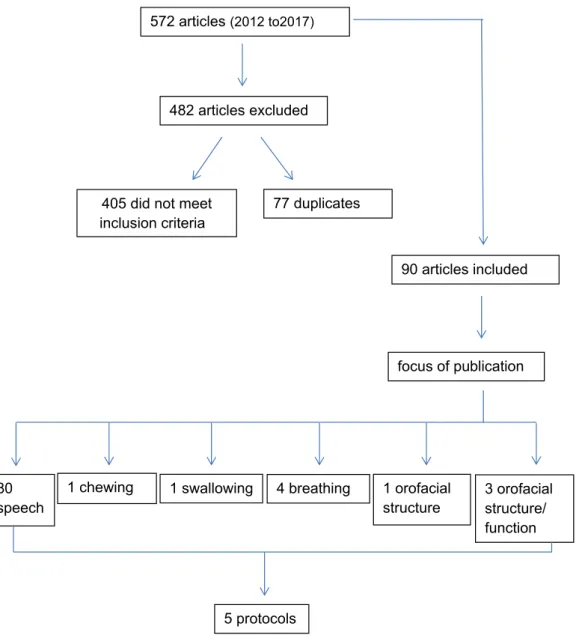
The database search identified 572 articles based
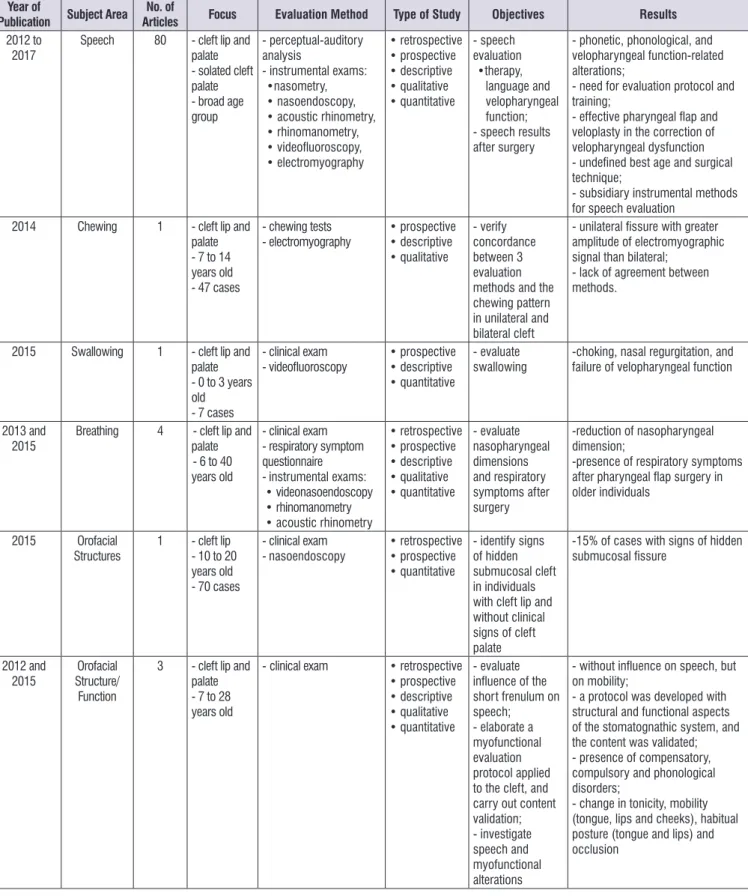
The selected articles were grouped by category: year of publication, subject area, focus, instrument used for evaluation, type of study, study objective, and results. The articles were subsequently grouped according to the focus of study: 90% (80 articles) focused on the evaluation of speech, 1% (1 article) on
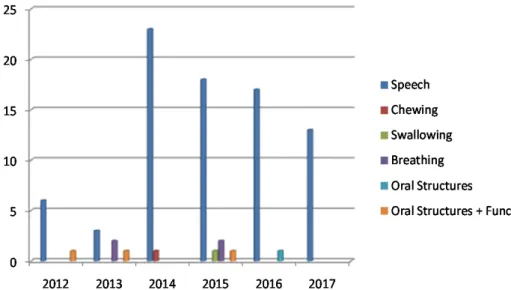
chewing, 1% (1 article) on swallowing, 1% (1 article) on orofacial structures, 4% (4 articles) on breathing, and 3% (3 articles) on evaluation of orofacial structures and function (Figure 2). Figure 3 shows the distribution of articles according to the subject area, and the focus of the publications by date.
Figure 1. Steps of the literature review analysis process
572 articles (2012 to2017)
482 articles excluded
405 did not meet
inclusion criteria 77 duplicates
90 articles included
focus of publication
80 speech
1 chewing 1 swallowing 4 breathing 1 orofacial
structure 3 orofacial structure/ function
Year of
Publication Subject Area No. of
Articles Focus Evaluation Method Type of Study Objectives Results
2012 to 2017
Speech 80 - cleft lip and palate - solated cleft palate - broad age group
- perceptual-auditory analysis
- instrumental exams:
•nasometry, • nasoendoscopy, • acoustic rhinometry, • rhinomanometry, • videofluoroscopy, • electromyography • retrospective • prospective • descriptive • qualitative • quantitative - speech evaluation •therapy, language and velopharyngeal function; - speech results after surgery
- phonetic, phonological, and velopharyngeal function-related alterations;
- need for evaluation protocol and training;
- effective pharyngeal flap and
veloplasty in the correction of velopharyngeal dysfunction
- undefined best age and surgical
technique;
- subsidiary instrumental methods for speech evaluation
2014 Chewing 1 - cleft lip and palate - 7 to 14 years old - 47 cases
- chewing tests - electromyography • prospective • descriptive • qualitative - verify concordance between 3 evaluation methods and the chewing pattern in unilateral and bilateral cleft
- unilateral fissure with greater
amplitude of electromyographic signal than bilateral;
- lack of agreement between methods.
2015 Swallowing 1 - cleft lip and palate - 0 to 3 years old - 7 cases
- clinical exam
- videofluoroscopy • prospective• descriptive • quantitative
- evaluate swallowing
-choking, nasal regurgitation, and failure of velopharyngeal function
2013 and 2015
Breathing 4 - cleft lip and palate
- 6 to 40 years old
- clinical exam
- respiratory symptom questionnaire
- instrumental exams:
• videonasoendoscopy • rhinomanometry • acoustic rhinometry
• retrospective • prospective • descriptive • qualitative • quantitative - evaluate nasopharyngeal dimensions and respiratory symptoms after surgery
-reduction of nasopharyngeal dimension;
-presence of respiratory symptoms
after pharyngeal flap surgery in
older individuals
2015 Orofacial Structures
1 - cleft lip - 10 to 20 years old - 70 cases
- clinical exam
- nasoendoscopy
• retrospective • prospective • quantitative
- identify signs of hidden submucosal cleft in individuals with cleft lip and without clinical signs of cleft palate
-15% of cases with signs of hidden
submucosal fissure 2012 and 2015 Orofacial Structure/ Function
3 - cleft lip and palate - 7 to 28 years old
- clinical exam • retrospective • prospective • descriptive • qualitative • quantitative
- evaluate
influence of the
short frenulum on speech;
- elaborate a myofunctional evaluation protocol applied to the cleft, and carry out content validation; - investigate speech and myofunctional alterations
- without influence on speech, but
on mobility;
- a protocol was developed with structural and functional aspects of the stomatognathic system, and the content was validated; - presence of compensatory, compulsory and phonological disorders;
- change in tonicity, mobility (tongue, lips and cheeks), habitual posture (tongue and lips) and occlusion
Figure 3. Distribution of research articles according to the subject area and time period
Out of 80 studies (100%) that considered speech, 26 (32%) referred to articulation, 21 (26%) to results after surgical procedures, 2 (3%) to results according to different surgical techniques,4(5%) to speech and language, 2 (3%) to results after speech therapy, and 25 (31%) to speech and evaluation of velopharyngeal function.
This review indicated that speech was the most discussed topic. This is understandable, since individuals with a speech impairment may be devalued by society due to their impaired ability to converse. In
addition, speech challenges can influence individuals in
other ways, and may be associated with emotional and/ or psychological problems, such as low self-esteem, anxiety, and depression7, thus affecting quality of life in
those with cleft lip and palate8.
Individuals with cleft lip and palate need repair surgery aimed at anatomical and functional correction, and studies have attempted to identify the optimal
timing of surgery, as well as to define the best surgical
technique9,10. However, surgical failures may occur due
to factors such as surgical technique and skill, cleft palate width, and/or inadequate postoperative care11.
Secondary surgical procedures on the palate may be necessary, mainly to provide adequate velopharyngeal function. When the velopharyngeal mechanism fails, a gap or communication between the nasal and oral
hypernasality, nasal air leakage, weak intraoral pressure, and nasal turbulence13.
These findings explain the prevalence of the focus
on speech in the articles analyzed. Among the selected studies, 74 used perceptual-auditory evaluation in speech analysis. The literature reports that this method is the most used by speech therapists for speech analysis, and is considered the gold standard14,15.
However, it is a subjective method, and depends on the experience and training of the listener16. Therefore,
complementary examinations are suggested to verify the reliability of the results. Complementary instru-mental exams, such as nasometry, nasoendoscopy,
rhinomanometry, acoustic rhinometry, videofluo
-roscopy, and electromyography, were identified in this
literature review.
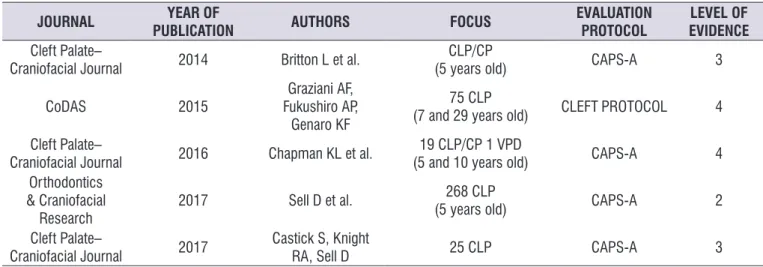
Only 5 articles used validated evaluation protocols; only 1 referred to a proposal for an orofacial myofunc-tional evaluation protocol, while the others used existing evaluation protocols. The other 4 studies used the Cleft Audit Protocol for Speech-Augmented
(CAPS-A)17, which is considered a reliable, valid, and
acceptable speech audit toolin individuals with cleft lip and palate. Used inthe UK and Ireland, and recently by the Americleft group18, it evaluates 8 parameters of
Table 1. List of selected articles that presented evaluation protocols in their methodology
JOURNAL YEAR OF
PUBLICATION AUTHORS FOCUS
EVALUATION PROTOCOL
LEVEL OF EVIDENCE Cleft Palate–
Craniofacial Journal 2014 Britton L et al.
CLP/CP
(5 years old) CAPS-A 3
CoDAS 2015
Graziani AF, Fukushiro AP,
Genaro KF
75 CLP
(7 and 29 years old) CLEFT PROTOCOL 4
Cleft Palate–
Craniofacial Journal 2016 Chapman KL et al.
19 CLP/CP 1 VPD
(5 and 10 years old) CAPS-A 4
Orthodontics & Craniofacial
Research
2017 Sell D et al. 268 CLP
(5 years old) CAPS-A 2
Cleft Palate–
Craniofacial Journal 2017
Castick S, Knight
RA, Sell D 25 CLP CAPS-A 3
Legend: CLP = Cleft Lip and Palate; CP = Cleft Palate; VPD = Velopharyngeal Dysfunction; CAPS-A = Cleft Audit Protocol for Speech-Augmented
Data on the articles presented in Table 1.
Britton, Albery, Bowden et al.
20:
Parameters for the analysis of speech and treatment results were established in 12 centers in Great Britain and Ireland, aiming at a national audit process to standardize the records of individuals with cleft lip and palate, and to improve treatment. This observational, cohort, prospective, qualitative study, with level of evidence 3, was split into 2 phases, and 1,110 speech samples were selected from children with cleft lip and palate born between 2001 and 2006. Samples were analyzed by speech therapists experienced in the application of the CAPS-A protocol17 to determine the
optimal timing of speech evaluation and recording and to compare inter-center speech results according to established parameters: speech evaluation (2 and 5 years old), speech and surgery, and surgery and
hearing. The results showed flaws in the standard -ization of evaluations and data recording. However, it was found that 48% of children had normal speech,
66% did not have difficulties in speech development,
and 60% did not have compensatory articulation.This study enabled a revision of national speech therapy
protocols, as well as modification of evaluation and
treatment parameters, thus improving the ability to compare results for use in clinical practice, and to enhance the quality of life in this population.
Chapman, Baylis, Trost-Cardamone
18:
The reliability of inter- and intra-rater speech results was compared in 2 studies using the CAPS-A17
protocol in British and American-Canadian English. This was a cross-sectional, prospective, qualitative, observational study, with level of evidence 4. Ten speech samples were selected from 5 and 10-year-old children with cleft lip and palate, and 9 examiners were invited to analyze them. British samples were analyzed in 3 phases: 1) before training, 2) immediately after training, and 3) one month after training; American samples were analyzed 4 to 5 months after the evalu-ations for subsequent comparison. Results suggested
that the classification of speech results was reliable,
but the study demonstrated a lack of uniformity for all
analyzed parameters, which justifies prior systematic
training, to ensure acceptable levels of reliability.
Graziani, Fukushiro, Genaro
21:
orofacial myofunctional changes or treatment results after interventions. Moreover, the protocol wasnot validated in its entirety.
Sell et al.
22:
Speech results and interventions performed in 5-year-old children with cleft lip and palate seen at specialized centers in the UK were evaluated. The CAPS-A17 protocol was used to evaluate the following
parameters: articulation, intelligibility, velopharyngeal
function, and presence of fistula.These were associated
with factors such as hearing loss, speech therapy, secondary surgery, and socio-demographic and parental factors. This was an observational, cross-sectional, prospective, quantitative study, with level of evidence 2. Results demonstrated variations in speech results among the different centers in the UK. The authors observed variation in the treatment of
velopha-ryngeal insufficiency, which indicates the importance of
treatment management and early speech therapy inter-vention. Because this was a multicenter study, there was a great deal of variability in the interventions and a lack of standardization in evaluation, despite use of the same protocol, which probably affected the results. Some factors werenot controlled, such as the choice of a single surgeon, age ofreparative surgery, and surgical technique.
Castick, Knight, Sell
19:
The reliability of the Visual Analogue Scale (VAS), when compared to an ordinal scale, was investigated in order to classify perceptual judgments of 6 speech parameters in individuals with cleft lip and palate: hypernasality, hyponasality, nasal leakage, nasal turbulence, intelligibility, and acceptability. This was an observational, transversal, prospective, quantitative study, with level of evidence 3. Speech therapists trained in the use of ordinal scales, CAPS-A17 protocol
guides,and universal parameters23 were invited to
analyze 25 speech samples from individuals with cleft
lip and palate. After hearing the samples, they classified
them separately, using an ordinal scale and the VAS. Results showed that both scales are reliable instru-ments for all parameters evaluated. However, the use
remaining articles, 78% (58 articles) used perceptual-auditory evaluation, 9% (7 articles) used existing evalu-ation protocols, and 13% (10 articles) did not clarify the evaluation method used. It was found that 50% (40 articles) used complementary examinations for speech evaluation.
Of the 90 articles included in the study,37% had diagnosis as their main goal, with a focus on prognosis in 63%. One study24 evaluated speech intelligibility after
primary palatoplasty in 12-month-old children with cleft
lip and palate and verified that surgical intervention
demonstrated satisfactory results for speech. Of the speech samples analyzed, 76% showed good intel-ligibility, 14% acceptable intelintel-ligibility, and 10% poor intelligibility.Another study25 evaluated the presence of
hypernasality after surgical correction of the secondary palate, and the results showed a reduction of hyperna-sality in 75% of cases and elimination in 32%. Of the selected studies, 90% used the judgment of experi-enced examiners, and 7% of lay examiners. According to the literature19,26, the use of reference and training
models improves the reliability of the analysis. Cross-sectional study modelswere prevalent (95%), and only 1 article27 presented a randomized clinical study to verify
the results of facial and speech development during the mixed dentition phase in individuals submitted to 2 different treatment protocols for correction of unilateral cleft lip and palate. Results showed small differences between the 2 protocols (Millard technique combined with nasal correction and Millard technique combined with nasal correction andanterior palate closure) and speech results. One of the groups showed poten-tially better development, while the other showed better speech results. However, neither protocol was considered superior. In 33% of the publications, the methodology and design of the study were not well
defined, which highlights the need to improve the scientific methodin order to enable reproducibility.
standards for this population require improvement. Standardized collection and recording ofevaluation results are needed,in addition to validated protocols and systematic training in their use. Therefore, new studies that consider all aspects of orofacial myofunc-tional evaluation with greater methodological rigor are necessary.
CONCLUSION
In the last 5 years, there has been an important
increase in scientific production in the field of orofacial
motricity in cleft lip and palate cases. However, speech is the prevalent theme, probably because it is the cause of greatest stigma in these individuals. On the other hand, the evaluation of other orofacial functions is still lacking despite its importance in diagnosis and
in defining the overall rehabilitation process. Moreover,
standardized protocols are rarely used.
REFERENCES
1. Gonçalves LPV, Toledo OA, Otero SAM. Relação entre bruxismo, fatores oclusais e hábitos bucais. Dental Press J Orthod. 2010;15(2):97-104.
2. Lohmander A, Persson C. A longitudinal study of speech production in swedish children with unilateral cleft lip and palate and two-stage palatal repair. Cleft Palate Craniofac J. 2008;45(1):32-41. 3. Silva RN, Santos EMNG. Ocorrência de alterações
de motricidade oral e fala em indivíduosportadores
de fissuralabiopalatinas. RBPS. 2004;17(1):27-30.
4. Figueiredo MC, Pinto NF, Faustino-Silva DD, Oliveira M. Fissura bilateral completa de lábio e palato: alteraçõesdentárias de máoclusão - relato de caso clínico. UEPG: Ciências Biológicas e da Saúde. 2008;14(1):7-14.
5. Sell D, John A, Harding-Bell A, Sweeney T, Hegarty F, Freeman J. Cleft Audit Protocol for Speech (CAPS-A): a comprehensive training package for speech analysis. Int J Lang Commun Disord. 2009;44(4):529-48.
6. Souza MT, Silva MD, Carvalho R. Revisão integrativa: o que é e como fazer? Einstein. 2010;8(1):102-6.
7. Dzioba A, Skarakis-Doyle E, Doyle PC, Campbell W, Dykstra AD. A comprehensive description of functioning and disability in children with
velopharyngeal insufficiency. J Commun Disord.
2013;46(4):388-400.
8. Tsangaris E, Riff KWYW, Goodacre T, Forrest CR, Dreise M, Sykes J et al. Establishing content validity of the CLEFT-Q: a new patient-reported outcome instrument for cleft lip/palate. Plast Reconstr Surg Glob Open. 2017;5(4):e1305.
9. Sommerlad BC. International confederation for cleft lip and palateand related craniofacial anomalies task force report: palatoplasty in the speaking individual with unrepairedcleftpalate. CleftPalate Craniofac J. 2014;51(6):e122-8.
10. Dissaux C,Grollemund B, Bodin F, Picard A, Vazquez MP, Morand B et al. Evaluation of 5-year-old children with complete cleft lip and palate: Multicenter study. Part 2: Functional results. J Craniomaxillofac Surg. 2016;44(2):94-103.
11. Smith DM, Losee JE. Cleft palate repair. Clin Plast Surg. 2014;41(2):189-210.
12. Kummer AW. Speech evaluation for patients with cleft palate. Clin Plast Surg. 2014;41(2):241-51. 13. Sie KCY, Tampakopoulou DA, Sorom JBA, Gruss
JS, Eblen LE. Results with Furlow palatoplasty in
management of velopharyngeal insufficiency. Plast
Reconstr Surg. 2001;108(1):17-25.
14. Kuehn D, Moller K. Speech and language issues in the cleft palate population: the state of the art. Cleft Palate Craniofac J. 2000;37(4):348-83.
15. Kummer AW, Clark SL, Redle EE, Thomsen LL, Billmire DA. Current practice in assessing and reporting speech outcomes of cleft palate and velopharyngeal surgery: a survey of cleft palate/ craniofacial professionals. Cleft Palate Craniofac J. 2012;49(2):146-52.
16. Lewis KE, Watterson TL, Houghton SM. The
influence of listener experience and academic
training on ratings of nasality. J Commun Disord. 2003;36(1):49-58.
17. John A, Sell D, Sweeney T, Harding-Bell A, Williams A. The cleft audit protocol for speech-augmented: a validated and reliable measure for auditing cleft speech. Cleft Palate Craniofac J. 2006;43(3):272-88. 18. Chapman KL, Baylis A, Trost-Cardamone J,
Cordero KN, Dixon A, Dobbelsteyn C et al. The Americleft Speech Project: a training and reliability study. Cleft Palate Craniofac J. 2016;53(1):93-108. 19. Castick S, Knight RA, SellD. Perceptual judgments
of resonance, nasal airflow, understandability,
20. Britton L, Albery L, Bowden M, Harding-Bell
A, Phippen G, Sell D. A cross-sectional cohort
study of speech in five-year-olds with cleft palate
+/- lip to support development of national audit
standards: benchmarking speech standards in
the United Kingdom. Cleft Palate Craniofacial J.
2014;51(4):431-51.
21. Graziani AF, Fukushiro AP, Genaro KF. Proposal
and content validation of an orofacial myofunctional
assessment protocol for individuals with cleft lip
and palate. CoDAS. 2015;27(2):193-200.
22. Sell D, Southby L, Wren Y, Wills AK, Hall A,
Mahmoud O et al. Centre-level variation in speech
outcome and interventions, and factors associated
with poor speech outcomes in 5-year-old children
with non-syndromic unilateral cleft lip and palate:
The Cleft Care UK study. Part 4. Orthod Craniofac
Res. 2017;20(2):27-39.
23. Henningsson G, Kuehn DP, Sell D, Sweeney T,
Trost-Cardamone JE, Whitehall TL. Universal
parameters for reporting speech outcomesin
individuals with cleft palate. Cleft Palate Craniofac
J. 2008;45(1):1-17.
24. Andreoli ML, Yamashita RP, Trindade-Suedam IK,
Fukushiro AP. Speech intelligibility after primary
palatoplasty: listener perception. Audiol Commun
Res. 2016;21:e1650.
25. Yamashita RP, Silva ASC, Fukushiro AP, Trindade
IEK. Perceptual and nasometric assessment of
hypernasality after intravelarveloplasty for surgical
management of velopharyngeal insufficiency:
long-term effects. Rev. CEFAC. 2014;16(3):899-906.
26. Oliveira ACASF, Scarmagnani RH, Fukushiro AP,
Yamashita RP. The influence of listener training
on the perceptual assessment of hypernasality.